Summary
Table of Content

Infrared (IR) LED Market
Get a free sample of this report
Form submitted successfully!
Error submitting form. Please try again.
Thank you!
Your inquiry has been received. Our team will reach out to you with the required details via email. To ensure that you don't miss their response, kindly remember to check your spam folder as well!
Request Sectional Data
Thank you!
Your inquiry has been received. Our team will reach out to you with the required details via email. To ensure that you don't miss their response, kindly remember to check your spam folder as well!
Form submitted successfully!
Error submitting form. Please try again.
Infrared LED Market Size
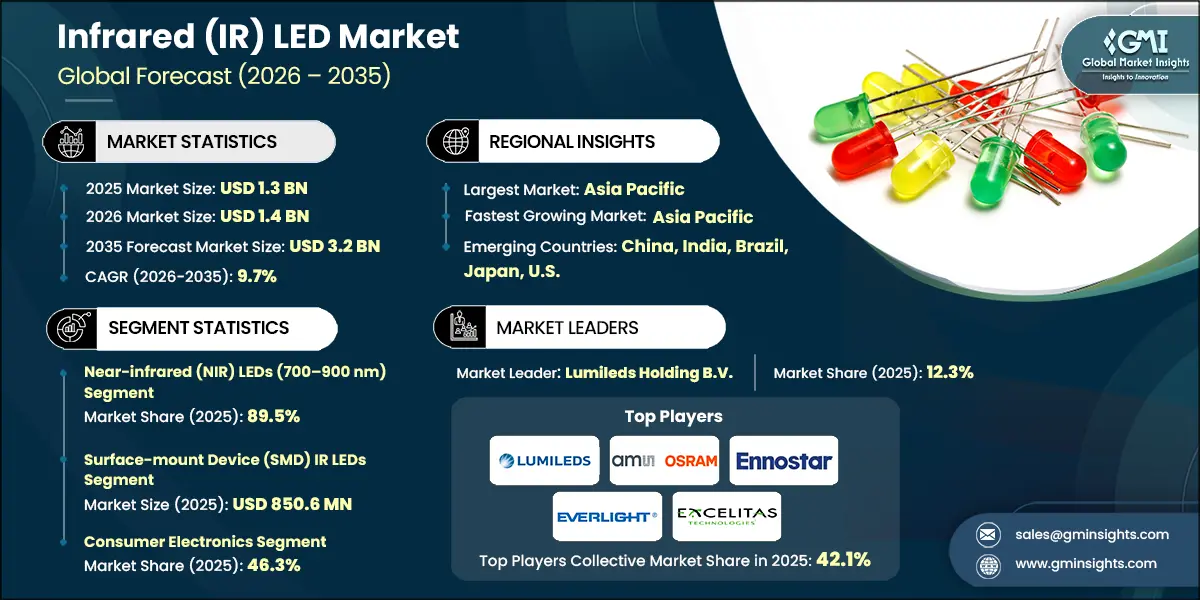
The global infrared LED market was valued at USD 1.3 billion with 8.1 billion units in 2025. The market is expected to grow from USD 1.4 billion in 2026 to USD 2.3 billion in 2031 & USD 3.2 billion in 2035 and 17.2 billion units, growing at a value CAGR of 9.7% during the forecast period according to the latest report published by Global Market Insights Inc.
To get key market trends
The growth of the infrared LED market is attributed to growing adoption in consumer electronics, increase in automotive sensing & safety systems, growth of industrial automation & machine vision, increased demand from biometric and healthcare applications, and growth in security & surveillance systems.
The consumer electronics industry is the major driver for the IR LED market because of widespread applications in smartphones, wearables, smart TVs, and remote-control devices. With IR LEDs, one gets various features such as facial recognition, gesture sensing, and proximity detection. According to Statista, in the third quarter of 2025, total global smartphone shipments reached 333.7 million units, highlighting the scale of opportunity. This high-volume demand ensures stable and growing adoption of IR LEDs across consumer devices worldwide.
Demand for IR LEDs is rising due to the increasing use of driver-assistance systems and in-cabin monitoring in cars. The IEA estimates that in 2024, over 17 million electric cars will be sold worldwide. This is about 3.5 million more than in 2023. This rapid increase in electric and smart vehicles accelerates the integration of IR-based sensors for driver monitoring, gesture control, and occupant detection, significantly boosting IR LED market growth.
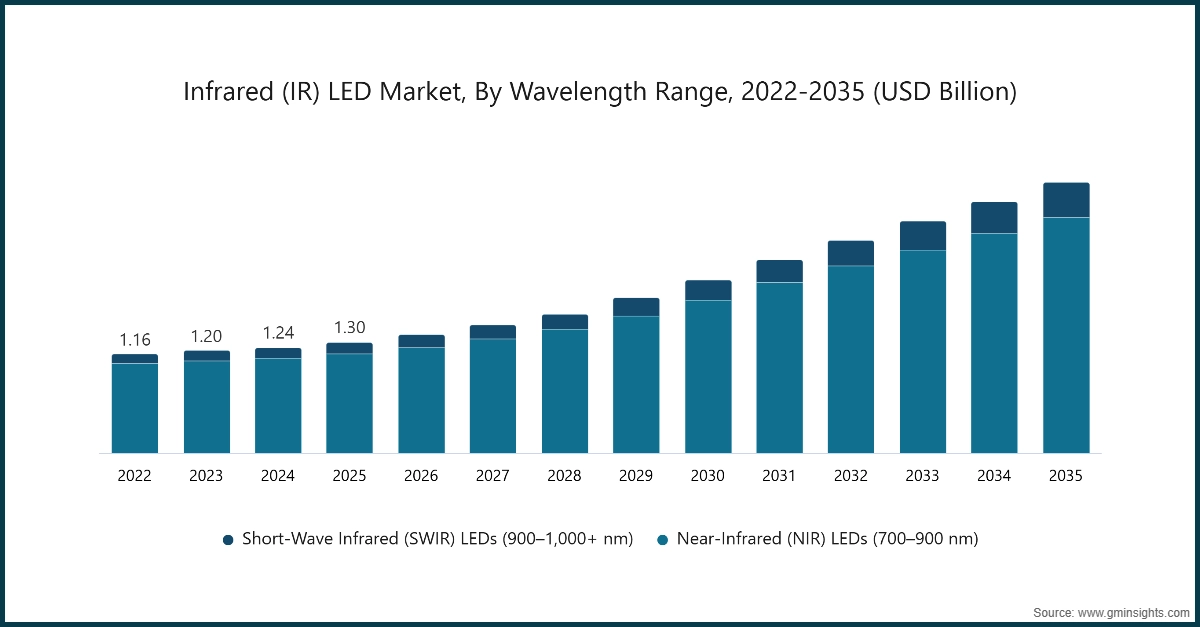
Between 2022 and 2025, the market witnessed considerable growth, increasing from USD 1.2 billion in 2022 to USD 1.3 billion in 2025 due to rising adoption in consumer electronics, expanding use in automotive sensing and safety systems, growth in industrial automation and machine vision, and increasing deployment in biometric and healthcare applications. Technological advancements in high-power and miniaturized IR LEDs further supported this growth.
Infrared (IR) LED Market Report Attributes
| Key Takeaway | Details |
|---|---|
| Market Size & Growth | |
| Base Year | 2025 |
| Market Size in 2025 | USD 1.3 Billion |
| Forecast Period 2026-2035 CAGR | 9.7% |
| Market Size in 2035 | USD 3.2 Billion |
| Key Market Trends | |
| Drivers | Impact |
| Rising Adoption in Consumer Electronics | Drives 22% growth as widespread integration of IR LEDs in smartphones, wearables, TVs, and remotes increases volume demand and revenue. |
| Increasing Use in Automotive Sensing & Safety Systems | Supports 20% growth with adoption in ADAS, in-cabin monitoring, and driver assistance systems, accelerated by rising electric vehicle sales. |
| Expansion of Industrial Automation & Machine Vision | Contributes 18% growth through deployment in automated inspection, process monitoring, and smart manufacturing applications. |
| Growing Demand for Biometric and Healthcare Applications | Adds 17% growth due to use in facial recognition, iris scanning, pulse oximetry, and wearable health monitoring devices. |
| Growth in Security & Surveillance Systems | Accounts for 23% growth as IR LEDs provide night vision, covert illumination, and machine vision solutions across commercial, industrial, and defense sectors. |
| Pitfalls & Challenges | Impact |
| High cost of precision and multi-parameter sensing solutions | Restrains market growth due to performance constraints, efficiency losses, and reliability issues in advanced sensing and imaging applications. |
| Limited interoperability and calibration complexities | Limits growth as availability of semiconductor wafers, packaging materials, and assembly capacity impacts production and delivery timelines. |
| Opportunities: | Impact |
| Growth in Wearable and Portable Healthcare Devices | Contributes 18% growth by enabling flexible, non-invasive monitoring devices such as pulse oximeters, smart watches, and health trackers. |
| Increasing Adoption in Smart Homes and IoT Devices | Adds 17% growth as IR LEDs are integrated into gesture control, motion sensing, and automation systems, driving consumer and industrial adoption. |
| Market Leaders (2025) | |
| Market Leader |
12.3% market share |
| Top Players |
Collective market share in 2024 is 42.1% |
| Competitive Edge |
|
| Regional Insights | |
| Largest Market | Asia Pacific |
| Fastest growing market | Asia Pacific |
| Emerging countries | China, India, Brazil, Japan, U.S. |
| Future outlook |
|
What are the growth opportunities in this market?
Infrared LED Market Trends
- Manufacturers are moving beyond classic GaAs/AlGaAs into refined heterostructures that curb efficiency droop at higher currents and drive better photon extraction. The real driver here is system-level performance, higher radiant flux at lower thermal load makes packaging simpler and extends duty cycles. Thin-film platforms and smaller die with higher brightness exemplified by new IR chip generations enable compact modules for mobile, PC, and in-cabin uses. Short term, expect incremental gains that stack, by the medium term, OEMs design for these characteristics rather than around them. Quantitatively, the shift shows up as double-digit efficiency improvements in new SKUs that translate directly into range or battery-life headroom.
- Regulatory mandates in Europe and active consideration elsewhere are pushing DMS/OMS from premium options to platform baselines. Because of this, IR illumination at 850/940 nm is becoming a fixture in new vehicle EE architectures, co-developed with driver ICs to ensure thermal, EMC, and functional safety compliance. The impact is durable multi-year model cycles lock in content, while software updates keep enhancing detection performance.
- Cameras sensitive from 400–1700 nm, paired with SWIR LEDs across 1050–1550 nm, are replacing dual-camera stacks and unlocking material-level insights. Timelines vary by vertical, but adoption is already visible in semiconductor, pharma, and food processing.
Infrared LED Market Analysis
Learn more about the key segments shaping this market
Based on the wavelength range, the global infrared (IR) LED market is divided into near-infrared (NIR) LEDs (700–900 nm) and short-wave infrared (SWIR) LEDs (900–1,000+ nm).
- The near-infrared (NIR) LEDs (700–900 nm) segment accounted for 89.5% of the market in 2025 due to widespread applications in consumer electronics, security, automotive sensing, and other industrial environments operating in the context of standardized IR lighting and sensing. Their ease of use and excellent compatibility with cameras and sensors continue to drive substantial demand for them.
- The short-wave infrared (SWIR) LEDs segment is anticipated to grow at a CAGR of 11.8% over the forecast period. The SWIR technology is driven primarily by its demands in advanced imaging, spectroscopy, and industries that require long wavelengths to provide deeper penetration capabilities and superior security scanning. Technological improvements and increasing adoption in high-value industrial, medical, and defense applications are driving higher revenue growth despite lower current market share.
Based on the packaging type, the infrared LED market is segmented into through-hole IR LEDs, surface-mount device (SMD) IR LEDs, and others.
- The SMD IR LED segment dominated the market in 2025 and valued at USD 850.6 million owing to compact size, efficiency, ease of implementation, and compatibility with automated assembly. These factors apply seamlessly in the areas of smartphones, wearable technology products, consumer electronics devices, and the automotive industry.
- The through-hole IR LEDs segment is expected to witness growth at a CAGR of 8.6% during the forecast period due to their ruggedness, higher power handling capabilities, and intended use for industrial, automotive, and outdoor applications. These LEDs are made to withstand harsh environments and are still considered a viable option when SMD packaging doesn't perform the required functions.
Learn more about the key segments shaping this market
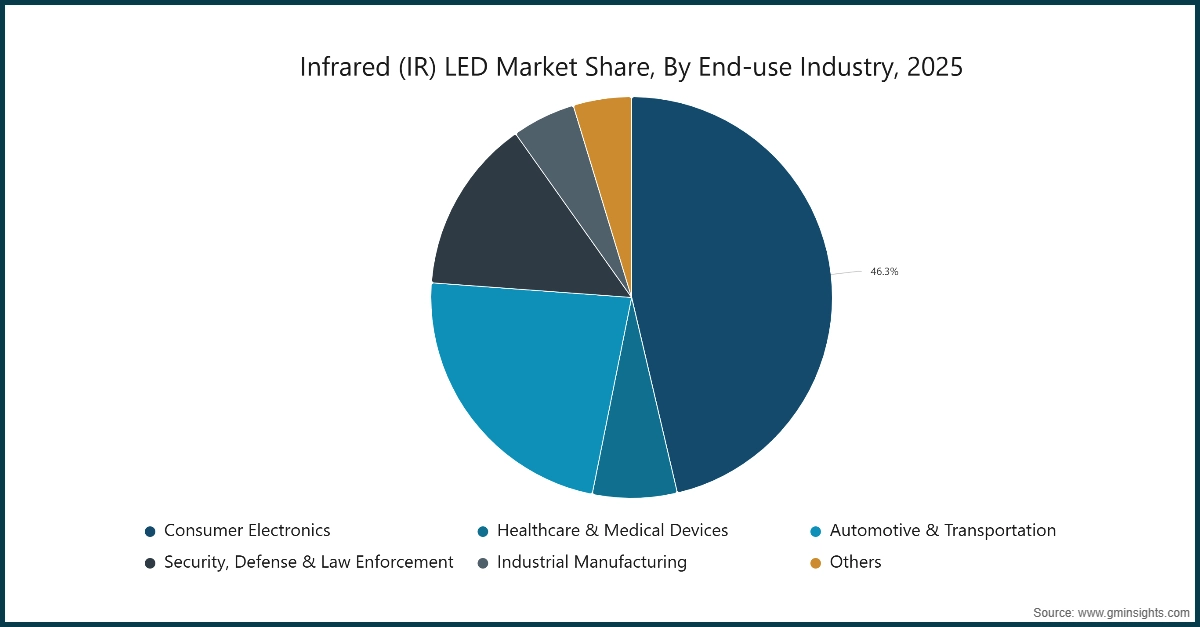
Based on the end-use industry, infrared LED market is classified into consumer electronics, healthcare & medical devices, automotive & transportation, security, defense & law enforcement, industrial manufacturing, and others.
- Consumer electronics led the market in 2025 with a market share of 46.3%. This sector dominates due to high demand for smartphones, TVs, wearables, and remote-control devices. IR LEDs are widely used for proximity sensing, gesture recognition, facial recognition, and remote communication. This makes consumer electronics the largest revenue contributor, boosted by high production volumes and quick device replacement cycles worldwide.
- The automotive and transportation segment is expected to grow at a CAGR of 13.5% during the forecast period. This growth comes from advanced driver-assistance systems, in-cabin monitoring, driver assistance technologies, and autonomous vehicles. The rising adoption of electric vehicles and safety regulations is increasing the use of IR LEDs for occupant detection, gesture sensing, and night-vision assistance. This trend leads to higher demand and better pricing opportunities.
Looking for region specific data?
North America Infrared LED Market
North America held a market share of 20.7% of IR LED market in 2025.
- North America remains a significant market hub, driven by high demand from the automotive, industrial automation, and defense sectors. The presence of strong manufacturing and the quick adoption of smart sensing technologies support solid market growth, especially in the U.S. and Canada. Investment in high-performance sensor integration and MEMS technology further boosts regional demand.
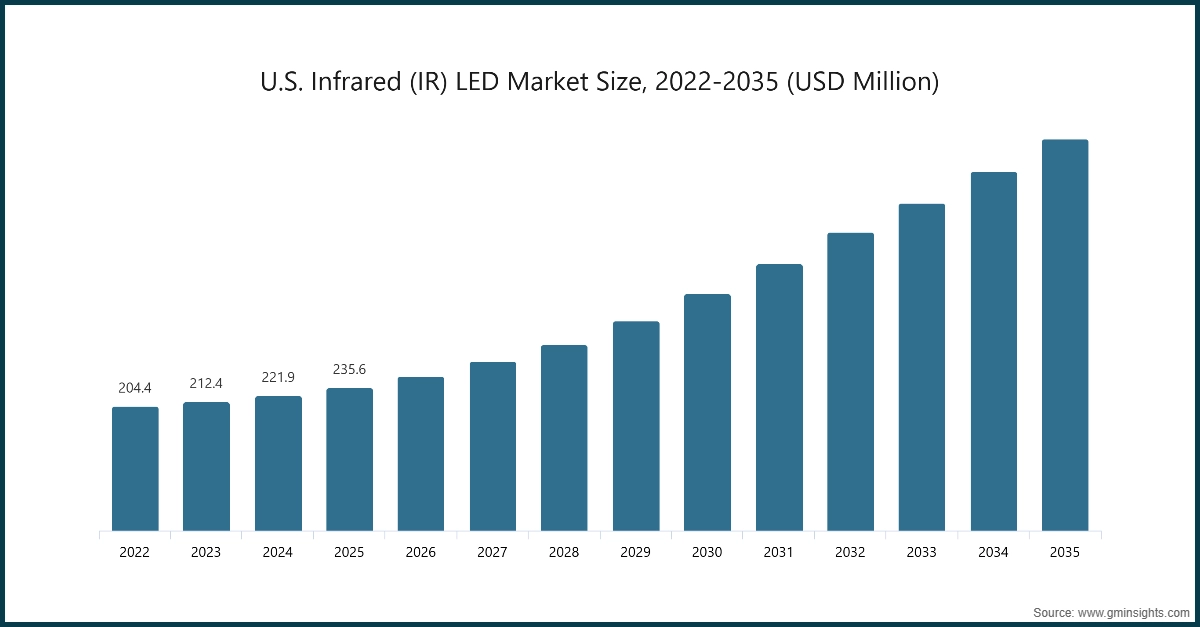
The U.S. infrared LED market was valued at USD 204.4 million and USD 212.4 million in 2022 and 2023, respectively. The market size reached USD 235.6 million in 2025, growing from USD 221.9 million in 2024.
- The U.S. market for infrared LEDs is growing because of the rapid adoption of ADAS technology, the increase in electric vehicles, and industrial automation. Manufacturers in the region are concentrating on IR technology for applications like proximity sensing, biometric verification, and machine vision.
- Industry associations such as the Semiconductor Industry Association (SIA) advocate policy support for U.S. semiconductor manufacturing and supply chain security, reflecting growing governmental focus on domestic production excellence. These efforts aim to boost the supply of chips, which helps improve the overall environment and indirectly supports the growth of the IR LED industry.
Europe Infrared LED Market
Europe market accounted for USD 189.2 million in 2025 and is anticipated to show lucrative growth over the forecast period.
- Europe’s market is supported by strong automotive manufacturing, industrial automation, and rigorous safety standards that encourage sensor adoption across smart infrastructure and manufacturing sectors. German, French, and UK industries contribute significantly to demand for advanced IR-based sensing and imaging systems.
- However, industry concerns over semiconductor supply disruptions have emerged. The VDA has emphasized the risks that could arise from the instability of the supply of chips to be used in the production process. Activities continue to focus on the localization of semiconductor production, research, and development in photonics.
Germany dominates the Europe infrared LED market, showcasing strong growth potential.
- Germany leads Europe in IR LED adoption because of its automotive manufacturing, industrial automation, and smart infrastructure projects. High-quality standards and strict safety rules in the automotive sector boost the need for driver monitoring, gesture sensing, and night-vision technologies. This creates strong demand for IR LEDs.
- The government supports the use of energy-efficient LEDs, including IR LEDs, in industrial and urban settings. This effort enhances smart manufacturing and automotive sensor systems. These regulations promote innovation and the use of IR LEDs in high-performance systems.
Asia Pacific Infrared LED Market
The Asia Pacific dominated the market with a market share of 59.6% in 2025.
- Asia Pacific leads the IR LED market because of its large production of consumer electronics, automotive manufacturing, and industrial automation, especially in China, South Korea, Japan, and Taiwan. The high volume of smartphone and wearable production, alongside smart city projects, keeps the demand for IR LEDs strong in proximity sensing, biometric applications, and industrial sensing.
- The region also benefits from the swift adoption of electric vehicles, growing security infrastructure, and IoT-enabled industrial applications. Government incentives and policies that promote domestic manufacturing of optoelectronics and semiconductor parts further boost the IR LED market, making Asia Pacific the largest and fastest-growing area in the world.
China infrared LED market is estimated to grow with a significant CAGR, in the Asia Pacific market.
- China leads the growth of IR LEDs in the Asia Pacific. It is a global hub for consumer electronics, automotive manufacturing, and industrial automation. The high demand for smartphones, wearables, and IoT-enabled devices boosts the need for IR LEDs in sensing, facial recognition, and gesture control.
- The government policies such as "Made in China 2025" are encouraging indigenous manufacturing of high-end semiconductors and optoelectronics components like IR LEDs. Such initiatives promote improved quality and development of indigenous supply chains and technology innovation. The applications of IR LEDs will increase due to these developments.
Latin American Infrared LED Market
Brazil leads the Latin American market, exhibiting significant growth during the 2026-2034.
- Brazil is emerging as a key market for IR LEDs, driven by the rise in consumer electronics, industrial automation, and security systems. Urbanization and smart city projects encourage the use of IR LEDs in surveillance, smart infrastructure, and IoT devices. The use of automotive sensors is gradually increasing with the introduction of advanced driver-assistance systems (ADAS) and vehicle safety features.
- Growing economies and expanding infrastructure development drive manufacturing, resulting in increased demands for IR LEDs in the field of machine vision. The challenge arises in the area of automotive segmentation due to the price sensitivity of IR LEDs. However, government support for energy-saving technologies presents new opportunities.
Middle East and Africa Infrared LED Market
UAE market to experience substantial growth in the Middle East and Africa market.
- The UAE market is growing because of smart city initiatives, industrial automation, and security applications, and embedded applications involve traffic management, smart lighting, security, and industrial IoT. Technological and infrastructure investments are increasing the number and sales value for the use of IR LEDs.
- Government initiatives for sustainable cities and digital infrastructure focusing on smart energy and IoT concepts are boosting IR LED demand. By focusing on highly efficient technologies for better city and manufacturing process performance, UAE is rapidly turning out to be a prominent market for IR LED in the region.
Infrared LED Market Share
The market is led by Lumileds Holding B.V., ams-OSRAM AG, Ennostar Inc., Everlight Electronics Co., Ltd., and Excelitas Technologies Corp. These five companies together held around 42.1% of the market share in 2025. They have strong foundations based on a variety of IR LED products, solid skills in semiconductors and optoelectronics, and a broad presence in consumer electronics, automotive, industrial, healthcare, and security sectors. Their range of wavelength options, packaging choices, and high-performance products help them stay at the forefront of the market.
These companies maintain an advantage through ongoing investments in research and development, miniaturization, and the development of high-power and automotive-grade IR LEDs. They also integrate with sensing and imaging systems. Furthermore, their strong customer ties, scalable production, and focus on new applications like biometrics, advanced driver assistance systems (ADAS), and smart infrastructure enable them to gain additional market share in fast-growing regions.
Infrared LED Market Companies
Prominent players operating in the infrared LED industry are as mentioned below:
- ams-OSRAM AG
- Boston Electronics
- Broadcom
- Dialight
- DOWA Electronics Materials Co., Ltd.
- Ennostar Inc.
- Everlight Electronics Co., Ltd.
- Excelitas Technologies Corp.
- Hamamatsu Photonics K.K.
- Kingbright
- Lumileds Holding B.V.
- Luminus, Inc.
- Marktech Optoelectronics Inc.
- Stanley Electric Co., Ltd.
- Vishay Intertechnology, Inc.
- Würth Elektronik eiSos GmbH & Co. KG
- Lumileds Holding B.V.: Lumileds is a major player in the IR LED market, focused on high-performance and automotive-grade IR LEDs. The company serves consumer electronics, automotive, and industrial applications. It uses effective packaging technologies, high efficiency, and large-scale manufacturing to maintain its market leadership.
- ams-OSRAM AG: ams-OSRAM is a leading innovator in infrared sensing and illumination. They have a diverse range of IR LEDs for autos, healthcare, industry, and consumer electronics. Their key strength derives from their extensive research and development, miniature packages, and bundling IR LEDs with sensing and optical technology.
- Ennostar Inc.: Ennostar specializes in IR LED chips and epitaxial technologies. It supplies high-brightness and long-lasting products for automotive, consumer electronics, and optical communication applications. The company enjoys strong semiconductor manufacturing expertise and cost-effective production.
- Everlight Electronics Co., Ltd.: Everlight is recognized as an IR LED vendor that is reasonable in price and yet produces high-quality IR LEDs with differing wavelengths and also supports various IR LED packages. The company has extensive reach in worldwide distribution as well.
- Excelitas Technologies Corp.: Excelitas delivers reliable IR LEDs and optoelectronic solutions mainly for industrial, defense, and scientific markets. The company focuses on precise performance, durable designs, and adherence to strict reliability standards, allowing it to stand out in high-value, mission-critical applications.
Infrared LED Industry News
- In February 2024, Dowa Electronics Materials unveiled a groundbreaking SWIR LED chip series, setting a global record for peak wavelength efficiency. With a 1mm square chip, the SWIR-LED achieves a 170mW output power at 1,350nm, doubling comparable products, and even at 1,900nm, it offers a 30% power increase.
- In February 2023, Excelitas Technologies Corp. acquired Phoseon Technology, Inc., a pioneer in the design and manufacture of world-class LED-based industrial curing and scientific illumination solutions based in Hillsboro. It delivers field-proven reliability and enables significant efficiency gains for customers globally.
- In October 2025, Excelitas signed an agreement to acquire Luxium Solutions, a leader in high-performance materials, substrates, components, and assemblies. The deal aims to improve Excelitas' abilities in optical technologies and growing markets like life sciences, industrial automation, and semiconductors.
The infrared LED market research report includes in-depth coverage of the industry with estimates and forecast in terms of revenue (USD Million) and volume (Units) from 2022 – 2035 for the following segments:
Market, By Wavelength Range
Near-infrared (NIR) LEDs (700–900 nm)
- Short-wave infrared (SWIR) LEDs (900–1,000+ nm)
Market, By Power Output
Low-power IR LEDs (<100 mW)
Medium-power IR LEDs (100 mW–1 W)
- High-power IR LEDs (>1 W)
Market, By Packaging Type
Through-hole IR LEDs
- Surface-mount device (SMD) IR LEDs
- Others
Market, By Application
Sensing & proximity detection
- Biometric identification
- IR illumination for imaging & night vision
- Remote control & human–machine interface (HMI)
- Optical communication & data transmission
- Others
Market, By End-use Industry
- Consumer electronics
- Healthcare & medical devices
- Automotive & transportation
- Security, defense & law enforcement
- Industrial manufacturing
- Others
The above information is provided for the following regions and countries:
- North America
- U.S.
- Canada
- Europe
- UK
- Germany
- France
- Italy
- Spain
- Netherlands
- Asia Pacific
- China
- India
- Japan
- South Korea
- Australia
- Latin America
- Brazil
- Mexico
- Argentina
- Middle East and Africa
- UAE
- Saudi Arabia
- South Africa
Frequently Asked Question(FAQ) :
Who are the key players in the infrared LED market?
Key players include ams-OSRAM AG, Boston Electronics, Broadcom, Dialight, DOWA Electronics Materials Co., Ltd., Ennostar Inc., Everlight Electronics Co., Ltd., and Excelitas Technologies Corp.
What are the key trends in the infrared LED industry?
Key trends include the shift from GaAs/AlGaAs to advanced heterostructures for improved efficiency, the adoption of thin-film platforms for compact modules, and regulatory mandates driving IR illumination integration in vehicle EE architectures.
Which region held the largest share of the infrared LED market in 2025?
North America accounted for 20.7% of the market share in 2025.
What is the projected value of the market by 2035?
The market is projected to reach USD 3.2 billion by 2035, with unit sales expected to hit 17.2 billion.
How much revenue did the SMD IR LED segment generate in 2025?
The SMD IR LED segment generated USD 850.6 million in 2025, dominating the market due to its compact size, efficiency, and compatibility with automated assembly processes.
Which sector led the infrared LED market in 2025?
Consumer electronics led the market in 2025 with a 46.3% share. High demand for smartphones, TVs, wearables, and remote-control devices drove this dominance.
What was the market size of the infrared LED market in 2025?
The market size was USD 1.3 billion in 2025, with 8.1 billion units sold. The market is expected to grow at a value CAGR of 9.7% during the forecast period.
Infrared (IR) LED Market Scope
Related Reports