Summary
Table of Content

Industrial Trucks Market
Get a free sample of this report
Form submitted successfully!
Error submitting form. Please try again.
Thank you!
Your inquiry has been received. Our team will reach out to you with the required details via email. To ensure that you don't miss their response, kindly remember to check your spam folder as well!
Request Sectional Data
Thank you!
Your inquiry has been received. Our team will reach out to you with the required details via email. To ensure that you don't miss their response, kindly remember to check your spam folder as well!
Form submitted successfully!
Error submitting form. Please try again.
Industrial Trucks Market Size
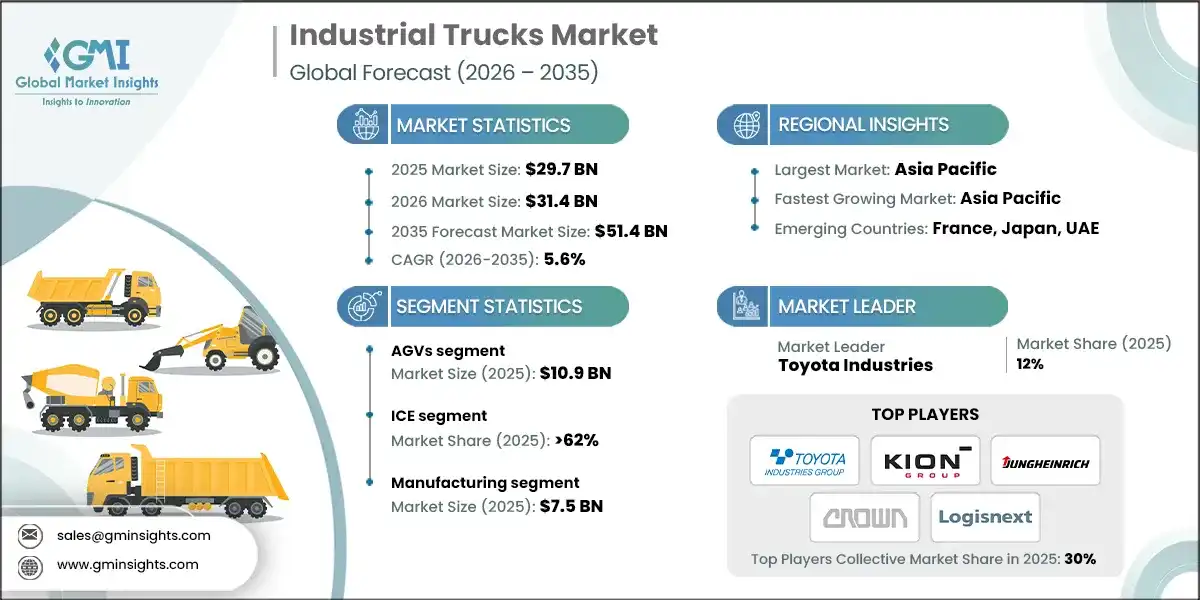
The industrial trucks market was estimated at USD 29.7 billion in 2025. The market is expected to grow from USD 31.4 billion in 2026 to USD 51.4 billion in 2035, at a CAGR of 5.6% according to latest report published by Global Market Insights Inc.
Industrial Trucks Market Key Takeaways
Market Size & Growth
- 2025 Market Size: USD 29.7 Billion
- 2026 Market Size: USD 31.4 Billion
- 2035 Forecast Market Size: USD 51.4 Billion
- CAGR (2026–2035): 5.6%
Regional Dominance
- Largest Market: Asia Pacific
- Fastest Growing Region: Asia Pacific
Key Market Drivers
- E-commerce expansion & warehouse automation.
- Adoption of industry 4.0 technologies.
- Growth in manufacturing, construction, and logistics sectors.
- Labor shortages in developed markets.
Challenges
- High upfront costs & maintenance expenses.
- Supply chain disruptions & component shortages.
Opportunity
- Electric & zero-emission trucks.
- Automated Guided Vehicles (AGVs) & autonomous trucks.
Key Players
- Market Leader: Toyota Industries led with over 12% market share in 2025.
- Leading Players: Top 5 players in this market include Toyota Industries, KION Group, KION Group, Crown Equipment, Mitsubishi Logisnext, which collectively held a market share of 30% in 2025.
Get Market Insights & Growth Opportunities
Ecommerce is modernizing global supply chains by creating a surge in demand for material handling efficiencies as more consumers shop online. Ecommerce companies and third-party providers of logistics are buying into more large-scale DC's (distribution centers) as well as micro-fulfillment centers (MFC) due to increased shipping demands from consumers for fast delivery times. There is consequently an increase in the volume of industrial trucks, such as forklifts, pallet jacks, and automated guided vehicles (AGVs) required to support the increased levels of quick shipments that these facilities will be dealing with. The quick transfer of goods from location to location within warehouse settings will become a competitive advantage for companies, and consequently, it will create increased demand for industrial trucks in the logistics industry.
In addition, as warehouse automation has been integrated into the industrial truck market, e.g. via robotics, conveyor systems, and smart storage applications, this demand for industrial trucks will be further escalated. Businesses are continually investing in automated processes whereby they become less dependent on human labor and have better accuracy and increased utilization of available space, which will affect the productivity levels of high-density warehousing in urban areas. As companies implement more advanced warehouse management systems (WMS), the need for industrial trucks, which are equipped with sensors, telematics, and connectivity requirements, is becoming an essential element of the supply chain environment in today's economy. The combination of ecommerce growth and warehouse automation will help sustain the market growth for industrial trucks over the next several years.
The emergence of Industry 4.0 currently represents a major turning point for the transformation of material handling within all aspects of the supply chain through the enhancement of industrial trucks with digital intelligence. Through the use of technologies such as Internet of Things (IoT), Artificial Intelligence (AI), and Telematics, the opportunity to monitor the health of existing assets in real-time, use predictive maintenance, and optimize the fleet of assets based on data will create a reduced level of downtime, increased lifespan of assets, and enhanced level of safety, which in turn will create significant cost savings for the end users. Additionally, smart trucks will share real-time information with Warehouse Management Systems (WMS) regarding load handling and monitor power and operational efficiency for the purpose of creating a completely connected ecosystem that supports the principles of lean manufacturing and agile logistics.
In addition to the above, the ability to use automation technology and the ability to connect assets to one another aligns with the broad range of new trends that are evolving within the realm of smart factories and digital supply chain technology. Autonomous navigation systems and machine learning algorithms will provide the foundation for autonomous material handling solutions, which will directly address current labor shortages while increasing throughput and reducing human error. As sustainability and operational resilience become top priorities of all manufacturing companies, Industry 4.0 technology-enabled trucks provide manufacturers and fleet owners with an excellent opportunity to meet the demands of an ever-changing global marketplace increasing competition driven by technological advances.
To get key market trends
Industrial Trucks Market Trends
The industrial truck industry is transforming as technology continues to change, government compliance towards sustainable development goals and new trends in supply chain management. Businesses continue to look for electric and automated solutions to comply with their local environmental laws and their push for increased operational efficiency. At the same time, increased digitization and industry 4.0 technologies are changing the fleet management and warehouse operations processes.
- In addition, the industrial truck market is shifting toward electric powered vehicles' as businesses' global goals toward sustainability and continued compliance with stringent nation-wide and local business-government regulations are being met through electric vehicles. Lithium-Ion Batteries as opposed to Lead-Acid batteries are gaining mass acceptance amongst businesses because of their ability to provide faster charging, longer life cycles and virtually maintenance free life cycle of lithium-ion batteries. Also, corporate responsibility through increasing government incentives and ESG commitments are facilitating the easy transition to electric vehicles and the ultimate dominance of electric vehicles in the industry.
- Automation is emerging as one of the foundational components of today's material handling system. Increasingly more warehouses and manufacturing facilities are adopting automated guided vehicle (AGV) technology and autonomous lift trucks. These technologies enable continuous operations with little reliance on human input or human error, while also promoting a safer working environment for employees. With AGVs and autonomous trucks completing many of the repetitive processes typically performed by humans, and through integration with warehouse management software (WMS), the movement of inventory will be coordinated as it occurs, resulting in increased efficiency in the movement of goods. Additionally, as e-commerce and other forms of high-volume distribution continue to increase, automation will likely become an integral part of most industrial truck fleets.
- Digitalization has changed how industrial trucks operate and provide businesses with a smart, connected asset. Internet-of-Things (IoT) sensors and telematics can deliver to business owners with the critical real-time information they require regarding the condition and operation of their trucks - including the usage history of the truck and how much energy it is using. These are the keys to creating Predictive Maintenance schedules that will significantly reduce downtime and extend the life of the trucks. Furthermore, through the availability of connectivity and IoT technology, the remote monitoring of trucks can easily integrate with a company’s Enterprise Resource Planning (ERP) systems, creating an interconnected supply chain.
- The growth of e-commerce has fueled a significant increase in the number of urban fulfillment centers where there is an emphasis on efficiency due to limited space. This phenomenon has created a greater demand for compact multi-directional forklift trucks (MDFL), as well as specialty trucks that can operate in very narrow aisles with high-density storage. As a response to this increase in demand, many manufacturers are making ergonomic designs for increased comfort and providing improved maneuverability through electric powertrains. Many of these solutions increase the ability of companies to utilize maximum storage capacity while also streamlining the logistical process in limited spaces. Therefore, they are critical components of a successful Urban Logistics strategy.
Industrial Trucks Market Analysis
Learn more about the key segments shaping this market
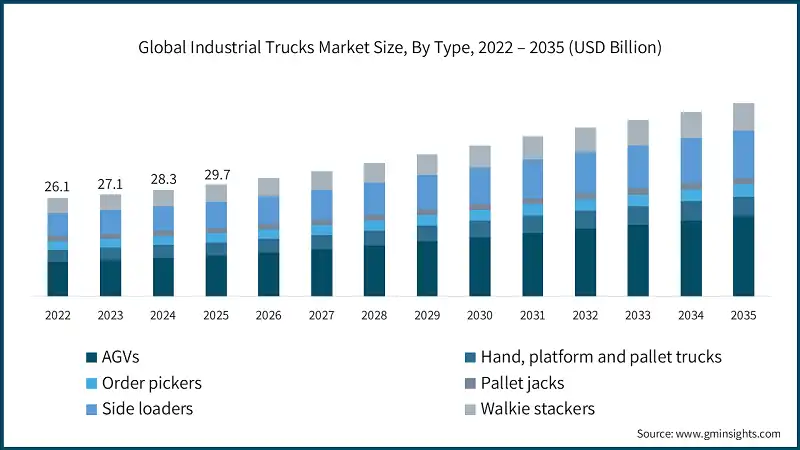
Based on type, the market is divided into AGVs, hand, platform and pallet trucks, order pickers, pallet jacks, side-loaders and walkie stackers. The AGVs segment generated a revenue of USD 10.9 billion in 2025.
- Automated guided vehicles (AGVs) are advanced material handling systems that allow companies to move products or materials from one location within the warehouse to another location without requiring the use of a human operator. AGVs use innovative technologies to operate autonomously, including laser navigation, inductive loops, and imagers. An AGV generally has pre-defined driving paths, allowing it to follow a specific route to complete its task. AGVs can dynamically adjust their driving route based on real-time data and are able to facilitate efficient and safe transportation of products and materials (including pallets and containers) throughout the facility without needing human intervention. The use of AGVs is becoming increasingly important in today's automated logistics systems.
- Many businesses are adopting AGVs because they can improve productivity, reduce reliance on human labor, and increase safety and security in an operation. By replacing humans with AGVs, companies are reducing the opportunity for human error, decreasing the risk of accidents, and allowing operations to operate continuously with no human intervention (24 hours a day, 7 days a week). This is particularly important for high-volume distribution and manufacturing operations. Furthermore, AGVs can be easily integrated into existing systems such as Warehouse Management Systems (WMS) and Enterprise Resource Planning (ERP). Lastly, because AGVs are able to perform many of the same functions as human workers, the return on investment (ROI) is typically higher than that of traditional human labor solutions and will help decrease the rate of employee attrition as wages rise and lower the costs of doing business in future years.
- Automated guided vehicles (AGVs) continue to evolve rapidly due to the advances made in sensor technology, artificial intelligence (AI), and connectivity. With the integrated ability to detect obstacles, dynamically reroute, and learn through machines, modern-day AGVs can operate within complex environments that do not require fixed infrastructure. The shift toward Industry 4.0 and smart factories have increased the number of companies looking for automated material-handling systems to be fully automated, thus supporting the continued growth of AGV usage.
Learn more about the key segments shaping this market
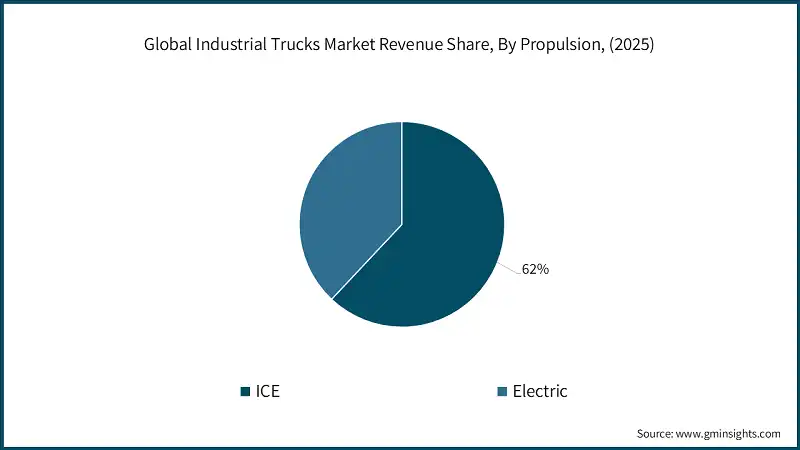
Based on propulsion, the industrial trucks market is segmented into ICE and electric. The ICE segment accounted for over 62% of the market share in 2025.
- Traditionally used to move materials around in a warehouse setting, internal combustion engines (ICE) trucks have been the main source of heavy-duty outdoor and indoor material handling. Most of the time, these trucks are powered by either diesel fuel, gasoline, or liquefied petroleum gas (LPG). They have excellent power capabilities because of their high torque and ability to maintain strong performance while lifting heavy objects for extended periods of time. For industries such as construction, mining, and large-scale manufacturing, being able to operate in tough outdoor and indoor environments while moving large amounts of weight makes ICE trucks invaluable for their business.
- In addition to providing many of the same advantages as electric trucks, ICE excel at operating outdoors, in environments with significant levels of dust, excess amounts of moisture, and uneven surfaces. As the use of electrically powered vehicles continues to increase, ICE trucks remain the primary choice for users who are faced with limited use of electrically powered equipment due to the lack of Electric Infrastructure and the need to move high-weight volume loads. Additionally, ICE-trucks continue to be an attractive choice for users who desire long-term reliability and less overall maintenance when moving products instead of using environmentally sustainable solutions.
- Thermal (ICE)-based Industrial trucks offer a great deal of flexibility in many types of industries all over the world. The flexibility that a thermal truck provides allows it to lift heavy loads, operate outdoors and be very reliable in different geographical conditions. Therefore, thermal industrial trucks are increasingly being used by logistics providers and large global manufacturers for their operational needs. Additionally, there is a vast amount of fuel availability and dealer networks around the world; consequently, thermal industrial trucks can provide consistent performance and service both in established economies as well as emerging economies. Therefore, the continued flexibility of thermal industrial trucks remains a key component of many material handling programs around the world.
Based on end use industry, the industrial trucks market is segmented into food & beverage, automotive, retail & e-commerce, construction & mining, manufacturing, pharmaceuticals, logistics & warehousing and others. The manufacturing segment held a major market share generating a revenue of USD 7.5 billion in 2025.
- A sizable amount of industrial truck consumption occurs within manufacturing, where those vehicles support many functions including material handling, support for production, and logistics between the facility. Forklifts, pallet trucks, and AGVs (Automated Guided Vehicles) are just a few examples of the types of trucks that are found in most manufacturing facilities. These industrial trucks assist with the movement of raw materials, semi-finished goods, and finished goods through each step along the production line. The use of industrial trucks helps to eliminate redundancy, decrease the time spent on keep the production line operating, and help to keep production lines running smoothly and on schedule. To maintain a continuous cycle of production and/or reduce downtime, industrial trucks in a high-volume manufacturing environment are vital for smooth operation.
- The demand for industrial trucks in manufacturing has been pushed to new levels due to many factors including increased levels of automation, use of lean production concepts, and a push to reduce costs associated with production. Green manufacturing initiatives, the use of electric trucks and connecting technologies, and Industry 4.0 technologies such as the Internet of Things (IoT) and telematics, have also created opportunities for manufacturers to enhance productivity through improved efficiencies in materials handling, and through the real-time tracking of materials. As global manufacturing continues to grow, there is an anticipated increased demand for advanced material handling solutions, leading to this end use segment being the largest contributor to the overall industrial truck market.
Looking for region specific data?
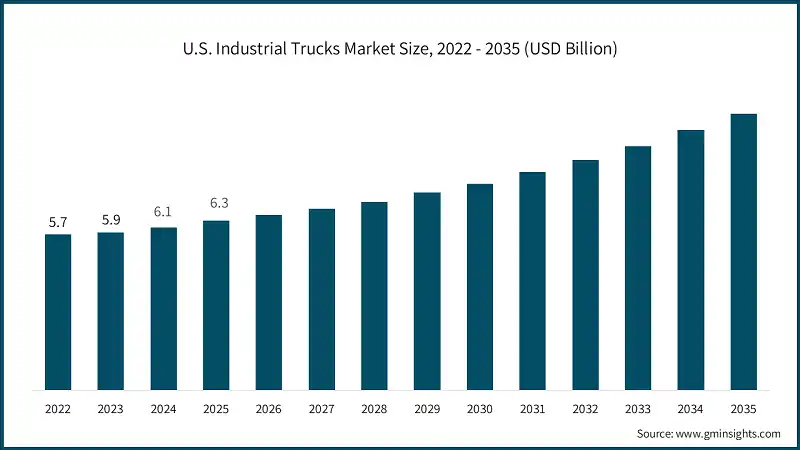
The U.S. dominated the North America industrial trucks market with around 75% share and generating USD 6.3 billion revenue in 2025.
- Due to the rapid growth in warehouses and automation initiatives within the U.S., the demand for e-commerce, manufacturing and logistics verticals has driven growth in the U.S. industrial truck market. Increasingly, there is greater acceptance for electric forklifts and advanced equipment that helps move materials, in part due to corporate sustainability initiatives and adherence to occupational safety and health administration regulations. The combination of the presence of many large international OEMs with companies investing in smart warehouse technology and automated guide vehicles, makes the U.S. an epicenter of innovation and adoption of industry 4.0 technologies within material handling.
- Throughout North America, the market for industrial trucks benefits from the construction of stronger infrastructure, increased volume and distribution of retail products, and greater adoption rates of electric and automated trucks in both Canada and the U.S., leading to significant cross-border logistical demand. The shift to the use of telematics for tracking, ongoing optimization of fleets, and improving the overall energy efficiency of material-handling processes is now being encouraged using federal tax incentives for purchasing clean energy equipment. Therefore, North America is considered a mature market but is also undergoing a transformation toward automation and electrification.
Europe industrial trucks held 21.1% share in 2025 and is expected to grow at 5.5% CAGR during the forecast period.
- With sustainability as its primary focus and multiple regulatory authorities overseeing all aspects of Europe’s industrial trucks market, Europe is an extremely mature and regulative region. The rapid move towards electric forklifts (E-Trucks) and automated guided vehicles (AGVs) is the result of Governments and companies having set up strict emission controls and corporate social responsibility (CSR) or environmental social governance commitments.
- Countries such as Germany, France, and UK are leading the way in the adoption of industry 4.0 Technology, specifically the integration of internet of things (IoT) Technology in industrial trucks and using telecommunications and sensors for fleet management, predictive maintenance and dimensional optimization. The continued growth of e-commerce in Europe, along with its strong manufacturing base, continues to drive the demand for increased efficiency using smaller lifting devices and building automation systems. High density urban logistics and compact truck designs are becoming more popular across Europe.
The Asia Pacific leads the industrial trucks market; China leads with 41.7% share in 2025 and is anticipated to grow with a CAGR of around 7.2% from 2026 to 2035.
- Asia-Pacific is the fastest-growing and leading region of the global industrial truck market due to rapid industrialization, infrastructure development and the rise of the e-commerce industry across the region. China, Japan and South Korea will also play a significant role in the growth of the region; China will continue to be the largest producer and consumer of forklifts globally. The strong manufacturing ecosystems and government initiatives to support automation and electrification are driving an enormous demand for both traditional forklift trucks, lithium-ion electric forklift trucks as well as automated guided vehicles (AGVs), especially in large-scale warehouse operations and Smart Factory environments.
- In addition to traditional industrial trucks, Asia-Pacific is seeing the emergence and rapid growth of adoption of Lithium-Ion electric trucks and Automated Guided Vehicles (AGVs) in large scale warehouse operations and smart factory environments. As more companies invest in logistics and supply chain modernization; as well as the loyalty of consumers toward e-commerce, Asia-Pacific will continue to be at the forefront of both volume and innovation in the Industrial Truck market as we move forward.
Latin America industrial trucks markets are growing at a CAGR of 4.3% during the forecast period.
- The Latin American market for industrial trucks is on a steady rise as a result of an expanding manufacturing, automotive, and retail sector across the continent. Brazil and Mexico have become leading industrial centers of growth and the subsequent increase in demand for forklifts and warehouse trucks has streamlined material handling within these sectors using industrial trucks. Although internal combustion engine (ICE) powered industrial trucks account for most of the market today due to their lower costs and limited infrastructure capabilities, Electric Industrial Trucks (EITs) are becoming increasingly popular for use in urban logistics and indoor transactions.
- In addition, Latin America is also exhibiting increasing interest in the use of automated and telematic systems for the purpose of increasing operational efficiencies and lowering terminating operational expenses. Additionally, many global manufacturers are expanding their presence in this area with the assist of established partnerships and dealer networks, thereby enabling users of those technologies to have access to cutting-edge technologies. As economic development continues and there is a greater penetration of ecommerce across Latin America, this provides unlimited opportunities for providing industrial truck solutions within the areas of compact and electric options.
Industrial Trucks Market Share
Toyota Industries is leading with 12% market share. Toyota Industries, KION Group, Jungheinrich AG, Crown Equipment, and Mitsubishi Logisnext collectively hold around 30%, indicating moderately fragmented market concentration. These prominent players are proactively involved in strategic endeavors, such as mergers & acquisitions, facility expansions & collaborations, to expand their product portfolios, extend their reach to a broad customer base, and strengthen their market position.
Industrial Trucks Market Companies
Major players operating in the industrial trucks industry are:
- Anhui Heli
- BYD Company
- Clark Material Handling Company
- Combilift
- Crown Equipment
- Doosan Corporation Industrial Vehicle
- Hangcha Group
- Hyster-Yale Materials Handling
- Hyundai Heavy Industries
- Jungheinrich AG
- KION Group AG
- Komatsu
- Manitou Group
- Mitsubishi Logisnext
- Toyota Industries
Jungheinrich has been at the forefront of the introduction of new technology. As one of the largest manufacturers of electric forklifts, warehouse trucks, and automatic systems for warehouse operations, Jungheinrich continues to be an industry leader with respect to the use of new technologies within Warehousing and Industry 4.0 integration. In addition to providing IoT-enabled devices, Jungheinrich also provides fleet management technology for all warehouses regardless of location. As a company committed to Sustainable Development through its use of Lithium-Ion Technology, Jungheinrich is well positioned to support smart warehousing for customers worldwide.
Komatsu is known for manufacturing durable and reliable forklifts that have been specifically designed for use in heavy-duty work environments such as construction, warehousing, distribution and manufacturing. All of the Komatsu forklift incorporated ergonomic features such as adjustable seats, variable travel speeds and tilt steering, which will enhance operator comfort and safety while providing maximum reliability in rigorous and harsh operating environments.
Toyota Industries is the leader in the world’s industrial truck or forklift market, providing a wide variety of forklifts, warehouse trucks, and automated solutions. It has established itself as an innovator in the areas of reliability and safety and is a recognized leader in developing and delivering electric and hybrid technologies, along with advanced systems used in ensuring safety, and automation, while promoting the principles of sustainability, and good practice when it comes to operating efficiently. Toyota's extensive worldwide presence and dealer network also make it the benchmark for material handling solutions.
Combilift is an Irish manufacturer that produces multi-directional and narrow aisle forklifts. It has become known for its ability to develop unique products that can safely and efficiently handle long, bulky materials such as timber, steel and manufactured goods within the confines of warehouses. Combilift has created innovative products that offer flexibility, safety and space-saving features that enable businesses to maximize their storage and efficiency.
Industrial Trucks Market Report Attributes
| Key Takeaway | Details |
|---|---|
| Market Size & Growth | |
| Base Year | 2025 |
| Market Size in 2025 | USD 29.7 Billion |
| Market Size in 2026 | USD 31.4 Billion |
| Forecast Period 2026 - 2035 CAGR | 5.6% |
| Market Size in 2035 | USD 51.4 Billion |
| Key Market Trends | |
| Drivers | Impact |
| E-commerce expansion & warehouse automation | Demand for advanced forklifts and AGVs (automated guided vehicles) is driven by an increasing need to process large volumes of orders and have quick turnaround times associated with fulfillment centers. |
| Adoption of industry 4.0 technologies | Facilitating smart connected trucks through IoT platforms and telematics solutions allows predictive maintenance and optimized fleet management. |
| Growth in manufacturing, construction, and logistics sectors | Increasing material handling requirements across multiple industries drives increased sales and utilization of heavier and specialized trucks. |
| Labor shortages in developed markets | Facilitating the automation and usage of autonomous trucks will increase productivity. |
| Pitfalls & Challenges | Impact |
| High upfront costs & maintenance expenses | Electric and automated trucks necessitate considerable upfront expenditure and specialized maintenance. |
| Supply chain disruptions & component shortages | Supply chain disruptions and component shortages will affect production timelines for trucks and will also affect several important components like batteries and semiconductors. |
| Opportunities: | Impact |
| Electric & zero-emission trucks | Increasing compliance and demand for sustainable solutions as supported through regulatory and incentives. |
| Automated Guided Vehicles (AGVs) & autonomous trucks | Increasing use of smart warehouses to increase efficiency and reduce labour costs |
| Market Leaders (2025) | |
| Market Leaders |
12% market share |
| Top Players |
Collective market share in 2024 is 30% |
| Competitive Edge |
|
| Regional Insights | |
| Largest market | Asia Pacific |
| Fastest growing market | Asia Pacific |
| Emerging countries | France, Japan, UAE |
| Future outlook |
|
What are the growth opportunities in this market?
Industrial Trucks Market News
- In September 2025, the introduction of Anton by Jungheinrich included a new line of entry-level products including pallet trucks equipped with 1.5 tons lift capacity and low electric powered lift trucks of 2.5 tons and 3.0 tons. The equipment is based on lithium-ion battery technology, providing businesses looking for eco-friendly and affordable solutions to the intralogistics requirements of companies via efficient material handling equipment options that provide reliable solutions for a variety of uses.
- In November 2025, Hyundai Heavy Industries (HHI) announced the launch of their newest High Voltage Electric Forklifts, known as the B-X Series. With lifting capacities ranging from 4 tons through to 9 tons, these cutting-edge machines use a state of the art 309–348-volt Lithium Ion Battery and charge in approximately 1 hour. In addition to fast charging features, this next-generation electric forklift also includes Water Cooled Battery Systems, allowing for superior thermal management of Lithium-Ion Batteries. The performance levels of the B-X Series is comparable to Internal Combustion models while utilizing less energy, thus providing an ideal solution for industrial users with rigorous material handling requirements.
- In May 2025, Combilift Ltd., exhibited two of its biggest innovations at Ligna 2025: the Combi-FSE 8000, a battery-powered electric sideloader capable of handling both heavy-duty as well as long loads, and the Combi Load Xtender, an extensible component that attaches to the sideloader and allows users to efficiently load single-sided loads. Both products were developed specifically for sectors of the manufacturing industry that require optimized design and maximum safety while dealing with large amounts of bulk items in tight quarters, such as timber and steel manufacturing sectors.
- In March 2025, Clark Equipment unveiled its latest Crossover Electric Forklifts, the Raider L25-35XE and the Renegade S25-35XE, at LogiMAT, Stuttgart, Germany. These models blend the benefits of using electric-powered machinery with the rugged durability of ICE (Internal combustion engine)-type trucks. These new products feature IP54-rated designs for outdoor useability, lithium-ion battery technology that enables rapid charging and extended service life and have been built with maximum productivity and efficiency in mind to operate under the most challenging conditions of the manufacturing industry.
- In March 2025, Hyster-Yale Materials Handling introduced the J230 - 400XD series of high-capacity electric forklifts for lifting loads of 23,000 lbs to 40,000 lbs. These state-of-the-art forklifts come with integrated lithium-ion power systems that provide up to 280kW of power. Additionally, they are compatible with CCS fast charging, injured brake systems, and IP rated protection from various environmental types.
The industrial trucks market research report includes in-depth coverage of the industry with estimates & forecasts in terms of revenue (USD Billion) and volume (Thousand Units) from 2022 to 2035, for the following segments:
Market, By Type
- AGVs
- Hand, platform and pallet trucks
- Order pickers
- Pallet jacks
- Side-loaders
- Walkie stackers
Market, By Propulsion
- ICE
- Electric
Market, By Operator Type
- Manual
- Semi-automated
- Fully automated
Market, By End Use Industry
- Food & beverage
- Automotive
- Retail & e-commerce
- Construction & mining
- Manufacturing
- Pharmaceuticals
- Logistics & warehousing
- Others
The above information is provided for the following regions and countries:
- North America
- U.S.
- Canada
- Europe
- Germany
- UK
- France
- Italy
- Spain
- Asia Pacific
- China
- India
- Japan
- Australia
- South Korea
- Latin America
- Brazil
- Mexico
- Argentina
- Middle East and Africa
- South Africa
- Saudi Arabia
- UAE
Frequently Asked Question(FAQ) :
What is the market size of the industrial trucks in 2025?
The market size was USD 29.7 billion in 2025, with a CAGR of 5.6% expected through 2035 driven by e-commerce expansion, warehouse automation, and the adoption of Industry 4.0 technologies.
What is the projected value of the industrial trucks market by 2035?
The industrial trucks market is expected to reach USD 51.4 billion by 2035, propelled by electric and autonomous vehicles, IoT-enabled fleet management, and growing demand across manufacturing and logistics sectors.
What is the current industrial trucks market size in 2026?
The market size is projected to reach USD 31.4 billion in 2026.
How much revenue did the AGVs segment generate in 2025?
Automated Guided Vehicles (AGVs) generated USD 10.9 billion in 2025, supported by demand for autonomous material handling and 24/7 operations in distribution centers.
What was the valuation of the ICE propulsion segment in 2025?
Internal Combustion Engine (ICE) trucks held over 62% market share in 2025, driven by their high torque capabilities, outdoor operational flexibility, and suitability for heavy-duty applications.
What is the growth outlook for the Asia Pacific industrial trucks market from 2026 to 2035?
Latin America industrial trucks markets are growing at a CAGR of 4.3% from 2026 to 2035.
Which region leads the industrial trucks market?
The U.S. dominated the North America industrial trucks market with about 75% share and USD 6.3 billion revenue in 2025, supported by rapid warehouse expansion and rising automation across e-commerce, manufacturing, and logistics sectors.
What are the upcoming trends in the industrial trucks market?
Key trends include transition to electric and hydrogen-powered trucks with lithium-ion batteries, adoption of AGVs and autonomous lift trucks, IoT-enabled telematics for predictive maintenance, AI-powered fleet management systems, and compact multi-directional forklifts for urban fulfillment centers.
Who are the key players in the industrial trucks market?
Key players include Toyota Industries, KION Group AG, Jungheinrich AG, Crown Equipment, Mitsubishi Logisnext, Anhui Heli, BYD Company, Clark Material Handling Company, Combilift, Doosan Corporation Industrial Vehicle, Hangcha Group, Hyster-Yale Materials Handling, Hyundai Heavy Industries, Komatsu, and Manitou Group.
Industrial Trucks Market Scope
Related Reports