Summary
Table of Content

Industrial Pasteurizers Market
Get a free sample of this report
Form submitted successfully!
Error submitting form. Please try again.
Thank you!
Your inquiry has been received. Our team will reach out to you with the required details via email. To ensure that you don't miss their response, kindly remember to check your spam folder as well!
Request Sectional Data
Thank you!
Your inquiry has been received. Our team will reach out to you with the required details via email. To ensure that you don't miss their response, kindly remember to check your spam folder as well!
Form submitted successfully!
Error submitting form. Please try again.
Industrial Pasteurizers Market Size
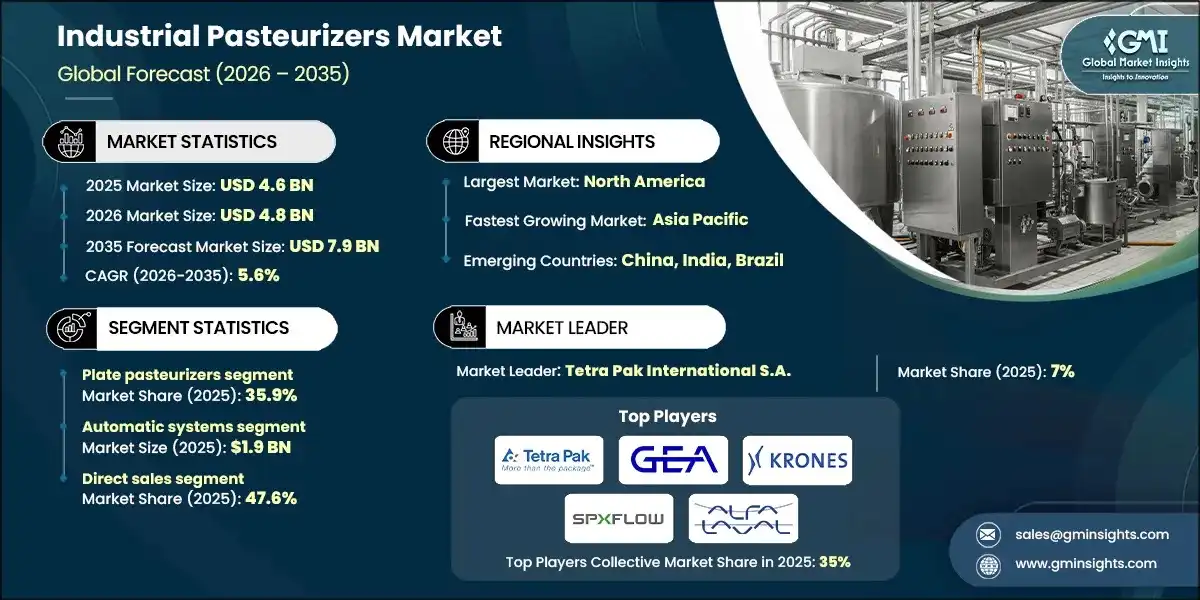
The industrial pasteurizers market was estimated at USD 4.6 billion in 2025. The market is expected to grow from USD 4.8 billion in 2026 to USD 7.9 billion in 2035, at a CAGR of 5.6% according to latest report published by Global Market Insights Inc.
To get key market trends
A significant rise in demand for advanced pasteurization systems is evident as an outcome of the growing efficiency and food sustainability awareness that exerted a strong influence, as well as mergers and acquisitions activities among leading companies in the industry. The consolidation of the power by the key players has led to increased innovation, expanded product portfolios, and enhanced market presence. On the other hand, conventional manual thermal processing methods are less eco friendly and economically feasible. Currently, high, temperature short, time and ultra, high temperature units embody a more environmentally friendly alternative, as these devices come with state, of, the, art heat recovery technology and regenerate thermal circuits, thus reducing their environmental footprint. This green technology aligns with the growing adoption of sustainability practices in dairy and beverage manufacturing and is, therefore, a driving factor for market growth. The need for liquid, processing automation and aseptic packaging hubs is quickly growing in North America. Additionally, there is an upward trend in industry and food, processing infrastructure investment in Europe and parts of the Asia Pacific regions, which is resulting in the local market's commercial feasibility of this equipment.
Consumers and professionals are seeking efficient, mechanized solutions for high, throughput sterilization. They are abandoning old, time-consuming methods such as manual batch pasteurization or basic gravity, and fed cooling systems. Continuous flow pasteurization, which transforms the thermal treatment process into a continuous, ultra, fast operation, is generally considered to be a cleaner, faster, and more environmentally friendly alternative. Beverage producers and dairy cooperatives, who are mostly demanding faster and less disruptive methods for microbial stabilization, are driving the major choice of plate and tunnel pasteurizers due to their already, known benefits, such as the optimization of facility floor space and the reduction of the risk of product contamination caused by inconsistent heating. This market is therefore essentially driven by a growing understanding of the long, term benefits of a fully integrated liquid flow, leading to a broader acceptance of these powerful devices. In addition to that, the ongoing changes in heat exchange design will certainly contribute to the safety and comfort in operation of the users. The synergy of infrastructure support, an industry, wide focus on smart thermal management, and a demand for high, efficiency convenience, which is acting as a synergy, is thus behind most of the market's strong financial performance.
Technological innovation in equipment is a key factor influencing the market's continuous expansion over time. Slowly, technological innovations are turning the traditional simple mechanical boilers that have been used for years into highly intelligent, application, specific machinery. The industry is seeing a shift very clearly to the use of smart sensors and sophisticated control systems that, on the one hand, improve pasteurization units accuracy and, on the other hand, increase the life of the gaskets and plates when different liquid viscosities and acidity levels are handled. Therefore, manufacturers are very much concerned with enhancing the operator experience by offering such features as IoT, enabled remote monitoring for safety purposes, modular pasteurizer designs for excellent maneuverability on irregular facility layouts, and integrated AI and telematics for energy load management. The industrial pasteurizer market is essentially a daily, moving machinery market that would be primarily driven by a post, pandemic jump in clean, label beverage consumption and global dairy trade, which has resulted in professional and industrial demand for error, free and high, speed thermal treatment spaces.
The primary operational distinction between traditional heat methods and automated pasteurizers is that the latter electrically and automatically control the thermal energy with absolute precision and efficiency, thereby eliminating processing bottlenecks while at the same time another felicitous consequence is also being generated and the time for cooling and stabilization is going down to the floor. Such effectiveness has been embraced by very large, scale distribution centers that are looking for even greater throughput and by manufacturing/packaging firms that have a need for a steady and timely supply of the production line. The market composition reveals the direct consequence of this demand as the Plate and Tunnel Pasteurizer segments have been consistently capturing the largest revenue share, thus accounting for most of the total industrial pasteurizer market revenue in recent years. The dominance of this segment is a direct outcome of the performance strength, reliability, and high throughput of these machines, which are an ideal solution for the modern professional's need for versatility and rapid deployment.
Technology is progressively becoming a very crucial factor, and features like programmable logic controllers provide a more customized and accurate thermal processing experience. These interconnected trends indicate the market's liveliness and its capacity to serve a wide range of industrial and commercial sectors. Flash and pulsed electric field systems are becoming very popular because of more individuals and professional services demanding quicker and less disruptive methods of maintaining food safety and product longevity. These devices are recognized for their benefits, such as reducing health hazards and lessening the risk of pathogen transmission from raw ingredients.
The market for these products is mainly driven by an increasing awareness of the long, term benefits of high, efficient microbial inactivation, which is resulting in a wider acceptance of these powerful devices. Besides, when several ongoing works on improvements in regenerative heat media and chamber design are finished, user safety and operating ease will be enhanced further. The interaction between better infrastructure, a concerted industry effort towards sustainable resource management, and a demand for high, efficiency convenience is strengthening the market's bullish financial trend.
One of the primary reasons that led to a market growth transition from simple heating tools to highly durable, application, specific machinery is the advancement of thermal transfer technology. The sector is witnessing a substantial change to nanofiber insulation and high, porosity heat exchangers, which, in turn, increase efficiency and component lifespan for a broader range of product densities and chemical compositions. Manufacturers are investing heavily in upgrading the operator's experience and some of the features that they have introduced include performance monitoring enabled by IoT for safety enhancement and automated self, cleaning (CIP) systems for excellent mobility in high, load environments.
All demonstrated in the market signs of growing further as technology develops and the respective demand continues.
Industrial Pasteurizers Market Report Attributes
| Key Takeaway | Details |
|---|---|
| Market Size & Growth | |
| Base Year | 2025 |
| Market Size in 2025 | USD 4.6 Billion |
| Market Size in 2026 | USD 4.8 Billion |
| Forecast Period 2026-2035 CAGR | 5.6% |
| Market Size in 2035 | USD 7.9 Billion |
| Key Market Trends | |
| Drivers | Impact |
| Surge in clean-label and functional beverages | Growing consumer demand for fresh, preservative-free juices and dairy products drives the need for precise flash pasteurization and PEF technology. |
| Strict food safety and FSMA regulations | Stringent global mandates for pathogen reduction force manufacturers to upgrade to high accuracy, validated thermal systems. |
| Sustainability and thermal efficiency | Energy-recovery heat exchangers and regenerative cooling circuits are becoming standard to reduce water and power consumption by up to 25%. |
| Pitfalls & Challenges | Impact |
| High initial CAPEX and installation costs | Advanced UHT and tunnel pasteurizers require significant upfront investment, which remains a hurdle for small-scale craft breweries and local dairies. |
| Complexity of product sensitivity | Maintaining nutritional profiles and flavor during heat treatment requires complex calibration that can lead to high scrap rates if mismanaged. |
| Opportunities: | Impact |
| Digital twins and real-time monitoring | Integrating AI to simulate thermal distribution allows for "right-first time" processing, reducing trial-and-error waste and energy use. |
| Hybrid and modular pasteurization units | The rise of boutique beverage brands creates a demand for skid-mounted, modular units that can be easily scaled or moved within a facility. |
| Market Leaders (2025) | |
| Market Leaders |
7% market share |
| Top Players |
|
| Competitive Edge |
|
| Regional Insights | |
| Largest Market | North America |
| Fastest Growing Market | Asia Pacific |
| Emerging Country | China, India, Brazil |
| Future Outlook |
|
What are the growth opportunities in this market?
Industrial Pasteurizers Market Trends
The industrial pasteurizer industry is seeing significant changes in trends because of many new products being launched and technological advancements made by the leaders of the industry. These leading companies are introducing to the market highly automated and modular units that are equipped with attractive features such as smart sensors, AI, driven thermal control, integrated clean in place systems, and high, efficiency regenerative heat exchangers. These enhancements satisfy the changing expectations of the users who require efficient and easy to use solutions for high, throughput microbial stabilization and accurate liquid processing. The industry's response to these trends shows that it is committed to continuous innovation, thus providing users with the advanced tools that increase the performance level, shorten the setup times, and make the thermal handling process more productive and streamlined.
- Technology advancement and product innovation: The machines are becoming more advanced and efficient as evidenced by the decision to integrate IoT, enabled remote monitoring and wireless control systems for improved safety and performance. Companies are investing in the development of more powerful and energy, efficient electric heating elements and the production of durable high, grade stainless steel plates that will increase system uptime and thermal transfer capacity.
- Expansion of clean, label and functional beverage services: The good health of the dairy, juice, and plant, based milk industries has been one of the main factors that have driven the market growth. The dairy and beverage segments, in total, represent the largest share that accounts for nearly 40% of the market. As a result of the high, speed demand for preservative, free products and shelf, life extension, the demand for effective flash pasteurization and UHT systems keeps increasing. By this increase, the global cold chain is contributing to its expansion as well as to specialized nutrient, retention processing, where manufacturers are investing heavily in advanced sterilization infrastructure.
- Sustainable resource and facility management: Proper thermal management of liquids is one of the main factors in the prevention of energy waste and operational bottlenecks due to inefficient batch processing, which creates healthier operational ecosystems and makes the implementation of green manufacturing and water, saving initiatives easier. These measures are in line with ESG objectives and carbon neutrality programs in various parts of the world.
- Greater incidence of global food safety disruptions: A heightened sensitivity to foodborne pathogens is putting a strain on global food supply chains, which has become the major reason for focusing local production on safety, resilience, and flexibility. As a result, the implementation of modular pasteurization architectures has increased massively. Processing plants are reconfiguring and scaling constantly, thus the demand for pasteurizer systems is high among dairy cooperatives, beverage hubs, and liquid packaging providers.
- Emphasis on Industry 4.0 and smart processing: Facility managers and industrial planners are more focused on the safety and throughput stability of the automated lines by performing proactive maintenance. To this end, they frequently monitor the health of the pasteurizer through predictive diagnostics to be able to avert costly downtime or batch contamination. The continuous need for validated thermal flow leads to an unceasing demand for commercial, grade, smart pasteurization systems throughout the year.
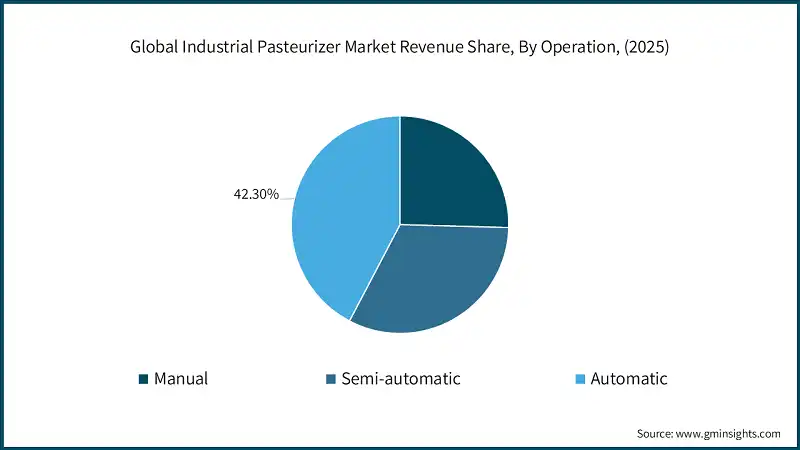
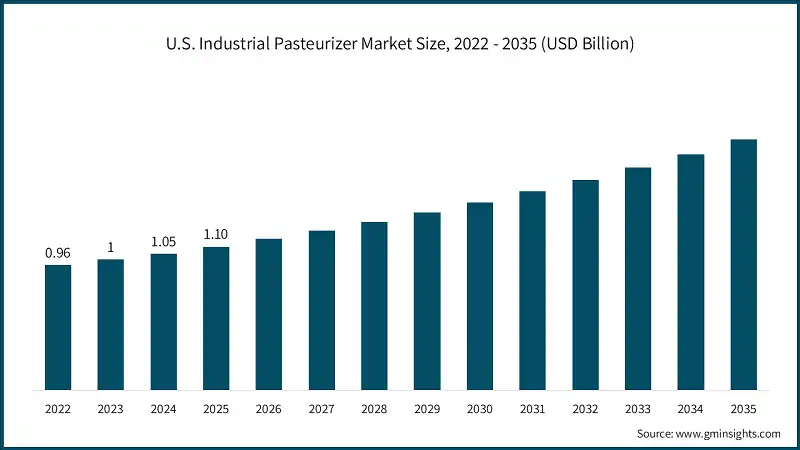
Industrial Pasteurizers Market Analysis Based on the product type, the market is divided into plate pasteurizers, tunnel pasteurizers, batch pasteurizers, HTST (high temperature short time) systems, and others. The plate pasteurizers segment accounted for 35.9% of the industrial pasteurizer market share in 2025. Based on the operation, the industrial pasteurizer market is segmented into manual, semi-automatic, and automatic. In 2025, automatic systems held a major market share of 42.3%, generating a revenue of USD 1.9 billion. Based on the mode of distribution channel, the industrial pasteurizers market is segmented into direct sales and indirect sales. In 2025, direct sales held the major market share of 47.6%, reflecting the industry’s reliance on customized engineering and long-term service contracts. In 2025, North America is a key regional market with an estimated value of USD 1.1 billion and a projected growth rate of 5.7% through 2035. Europe industrial pasteurizers market estimated at USD 1.2 billion in 2025 with a projected growth rate of 5.7%. Germany leads the region with a high growth rate of 6.2% due to its advanced engineering and strong beer and dairy sectors. Asia Pacific industrial pasteurizers market has an estimated market value of USD 1.2 billion in 2025 with a projected growth rate of 6% from 2026 to 2035. Latin America represents a developing segment with steady potential. It has an estimated market value of USD 400 million in 2025, growing at a rate of 4.8% from 2026 to 2035. Tetra Pak International S.A. is leading with a 7% market share. Tetra Pak International S.A., GEA Group AG, Krones AG, SPX FLOW, Inc., and Alfa Laval AB collectively hold around 35%, indicating a moderately fragmented market concentration with a strong tier of dominant global players. These prominent players are proactively involved in strategic endeavors, such as mergers & acquisitions, facility expansions, and collaborations, to expand their product portfolios, extend their reach to a broad customer base, and strengthen their market position. Major players operating in the industrial pasteurizers industry are: Krones AG expanded its range of modular pasteurization platforms with the introduction of the Lina Flex eSync, a system compatible with high-speed automated canning lines. Engineered for optimal thermal productivity and precise control, this single-lane system offered faster operation compared to older bulk-conveyor tunnel designs.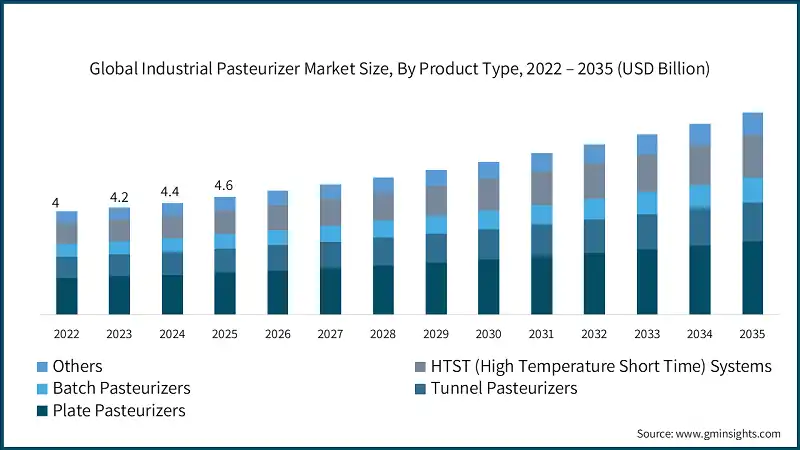 Learn more about the key segments shaping this market
 Learn more about the key segments shaping this market
 Looking for region specific data?
Industrial Pasteurizers Market Share
Industrial Pasteurizers Market Companies
Industrial Pasteurizers Market News
The industrial pasteurizers market research report includes in-depth coverage of the industry with estimates & forecasts in terms of revenue (USD Billion) and volume (Thousand Units) from 2021 to 2034, for the following segments:
Market, By Product Type
- Plate pasteurizers
- Tunnel pasteurizers
- Batch pasteurizers
- HTST (high temperature short time) systems
- Others
Market, By Operation
- Manual
- Semi-automatic
- Automatic
Market, By Technology
- Electric pasteurizers
- Gas pasteurizers
- Steam pasteurizers
Market, By Application
- Dairy industry
- Milk and cream
- Cheese production
- Yogurt manufacturing
- Ice cream processing
- Beverage industry
- Alcoholic beverage
- Non-Alcoholic beverage
- Food processing
- Others (pharmaceuticals, pet food, etc.)
Market, By Distribution Channel
- Direct
- Indirect
The above information is provided for the following regions and countries:
- North America
- U.S.
- Canada
- Europe
- Germany
- UK
- France
- Italy
- Spain
- Asia Pacific
- China
- India
- Japan
- Australia
- South Korea
- Latin America
- Brazil
- Mexico
- Argentina
- Middle East and Africa
- South Africa
- Saudi Arabia
- UAE
Frequently Asked Question(FAQ) :
What are the upcoming trends in the industrial pasteurizers market?
Key trends include IoT-enabled remote monitoring, AI-driven thermal control systems, integrated clean-in-place systems, regenerative heat exchangers, modular skid-mounted units, cold pasteurization technologies (HPP/PEF), and digital twins for real-time processing optimization.
Who are the key players in the industrial pasteurizers market?
Key players include Tetra Pak International S.A., GEA Group AG, Krones AG, SPX FLOW Inc., Alfa Laval AB, Dion Engineering, Feldmeier Equipment Inc., Hiperbaric, HRS Heat Exchangers, IDMC Limited, JBT Corporation, KHS Group, Milkron GmbH, Paul Mueller Company, and Sidel.
What is the growth outlook for the HTST systems segment from 2026 to 2035?
HTST (high temperature short time) systems are projected to grow at a rate of 6.1% till 2035, driven by consistent demand from liquid food sector prioritizing nutritional quality and flavor maintenance.
Which region leads the industrial pasteurizers market?
U.S. industrial pasteurizers market size exceeded USD 1.1 billion in 2025, with 5.7% CAGR expected through 2035 driven by massive investments in food safety automation, expansion of clean-label beverage sector, and transition to automated flash pasteurization.
What was the valuation of the automatic operation segment in 2025?
Automatic systems held 42.3% market share and generated USD 1.9 billion in 2025, driven by enhanced productivity, reduced labor costs, and integration of IoT technologies.
What is the market size of the industrial pasteurizers in 2025?
The market size was USD 4.6 billion in 2025, with a CAGR of 5.6% expected through 2035 driven by rising demand for advanced systems, food sustainability awareness, and industry consolidation.
What is the projected value of the industrial pasteurizers market by 2035?
The industrial pasteurizers market is expected to reach USD 7.9 billion by 2035, propelled by digital twins integration, AI-driven thermal control, and shift toward precision microbial control technologies.
What is the current industrial pasteurizers market size in 2026?
The market size is projected to reach USD 4.8 billion in 2026.
How much revenue did the plate pasteurizers segment generate in 2025?
Plate pasteurizers held 35.9% market share in 2025, leading the market due to high-capacity systems with efficient heat transfer and lower energy consumption in dairy and beverage production.
Industrial Pasteurizers Market Scope
Related Reports