Summary
Table of Content

Industrial Display Market
Get a free sample of this report
Form submitted successfully!
Error submitting form. Please try again.
Thank you!
Your inquiry has been received. Our team will reach out to you with the required details via email. To ensure that you don't miss their response, kindly remember to check your spam folder as well!
Request Sectional Data
Thank you!
Your inquiry has been received. Our team will reach out to you with the required details via email. To ensure that you don't miss their response, kindly remember to check your spam folder as well!
Form submitted successfully!
Error submitting form. Please try again.
Industrial Display Market Size
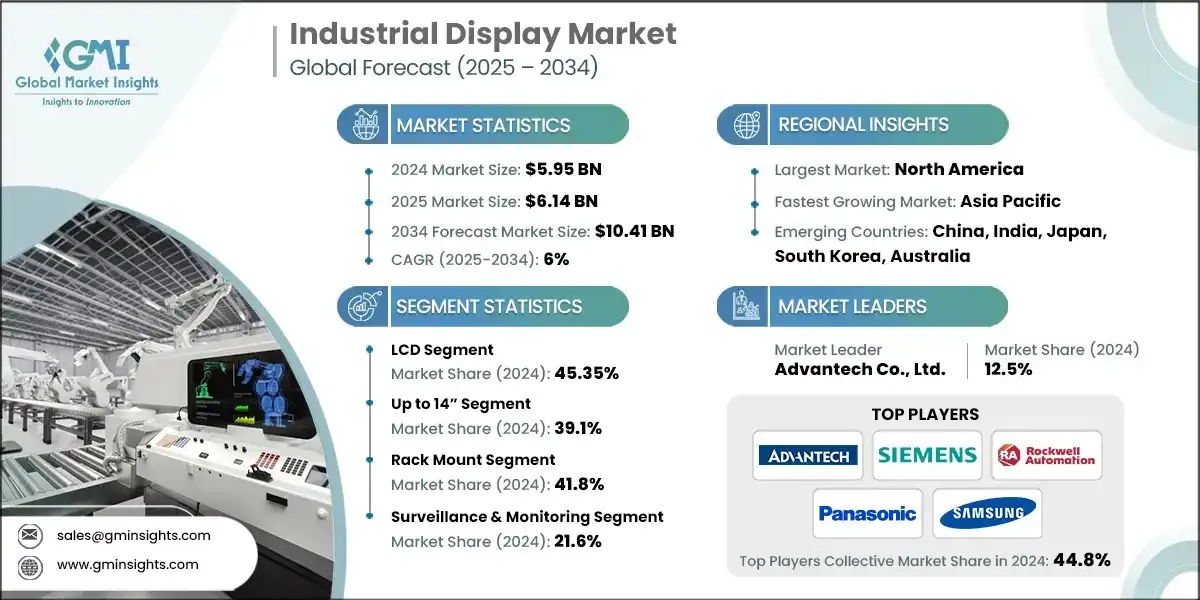
The global industrial display market was estimated at USD 5.95 billion in 2024. The market is expected to grow from USD 6.14 billion in 2025 to USD 7.85 billion in 2030 and USD 10.41 billion by 2034, at a CAGR of 6% during the forecast period of 2025–2034, according to Global Market Insights Inc.
Industrial Display Market Key Takeaways
Market Size & Growth
- 2024 Market Size: USD 5.95 billion
- 2025 Market Size: USD 6.14 billion
- 2034 Forecast Market Size: USD 10.41 billion
- CAGR (2025–2034): 6%
Key Market Drivers
- Rising Automation in Manufacturing and Industrial Processes.
- Cost-Effectiveness and Durability in Industrial Operations.
- Rapid Urbanization and Infrastructure Development.
- Expansion of Smart Factories and IIoT Deployments.
Challenges
- High Initial Cost of Advanced Display Technologies.
- Compatibility and Integration Issues with Legacy Systems.
Opportunity
- Growth of Smart Factories and Industry 4.0 Initiatives.
- Expansion in Emerging Markets with Infrastructure Modernization.
Key Players
- Market Leader: Advantech Co., Ltd. led with over 12.5% market share in 2024.
- Leading Players: Top 5 players in this market include Advantech Co., Ltd., Siemens AG, Rockwell Automation, Inc., Panasonic Holdings Corporation, Samsung Electronics Co., Ltd., which collectively held a market share of 44.8% in 2024.
Get Market Insights & Growth Opportunities
- It is anticipated that the rising automation in manufacturing and industrial processes, growing demand for HMI (human-machine interface) devices, increased adoption in harsh and hazardous environments, technological advancements in display panels (e.g., OLED, TFT-LCD), will all support the industrial display industry.
- Expansion of Industrial IoT (IIoT) and smart factories is a key growth driver for industrial displays as it elevates the need for real-time data visibility across shop floors. Machines are now integrating sensors and connecting to a central platform, typically, operators are using industrial displays - usually rugged HMIs or edge panels - for data presentation, process control, and real time interactions with semi-automated or fully automated systems. For example, Siemens Energy have deployed an AWS-based IIoT platform across 18 global factories, connecting several assets such as CNC machines and robots to collect and analyse operational and energy data. This initiative reduced manual data-collection time by up to 50%, cut maintenance costs by up to 25%, and increased asset availability by up to 15%. In this environment, industrial displays serve as the primary human–machine interface for these IIoT systems, driving demand by enabling immediate visualization, control, and decision-making at the edge.
- Industrial display market is witnessing a widespread growth due to the integration of IIoT across industries beyond manufacturing, which multiplies the need for real time visual interfaces. As Original Equipment Manufacturers (OEMs) push connectivity, IoT Analytics estimates that more than 50% of OEM devices will be IoT enabled by 2026, up from around 40% in 2023, while global active IoT devices exceeded 16 billion in 2023 and continue climbing. For instance, at Paragon Medical, IIoT driven production visibility raised equipment utilization from 20% to 60% and overall equipment effectiveness from 57% to 85%, while boosting quality output from approximately 4,200 to over 10,000 parts.
- Government initiatives promoting industrial digitization by evolving into low-cost automation solutions, together with rapid and evolving technological potential in the industrial display market. A general shift in the region is towards policies that encourage Industry 4.0, smart manufacturing, and localizing high-tech production, in order to establish, expand and invest in rugged and high-performance industrial displays, largely in the manufacturing, energy, and logistics sectors. Moreover, many regional governments are incentivizing industrial digitization, digital transformation, and restructuring the domestic electronic manufacturing economy which in turn motivates the development & policy making around industrial HMI and control systems focusing inward on R&D for manufacturing locally.
To get key market trends
Industrial Display Market Trends
- The industrial display industry is experiencing a significant shift towards modular and customizable hardware to suit individual sector needs. Manufacturers are developing rugged displays with high IP ratings, sunlight readable, shock resistant enclosures for mining, oil & gas, and transport among other rugged sectors. Custom factors, touch technologies (capacitive, resistive, infrared), and mounting options are being provided to improve operational flexibility. These displays provide seamless interoperability with PLCs, SCADA systems, and HMIs. This trend is being driven by organizations for 24/7 operations in harsh environments.
- Industrial displays are moving from static monitoring screens to integrated intelligent humans-machine interfaces (HMIs). AI and edge computing are being integrated enabling the displays to process information locally which delivers low-latency decision making, especially in mission critical applications. Further, edge-enabled displays are able to perform predictive maintenance analytics, detecting anomalies and triggering alerts - without depending strictly on centralized cloud infrastructure. This is particularly beneficial for manufacturing, energy, and utility applications where downtime is expensive. AI-enabled interfaces are being developed to learn user behaviour and display key performance indicators (KPIs).
- New technology such as transparent OLED and flexible TFT-LCD displays is becoming more established in advanced manufacturing. These displays take up less space and give better visualization quality, especially for AR operations, real time dashboards, and interactive training. Displays are being used in warehouses, assembly lines, and control rooms as visual overlays or with a multiplicity of windows layout. Nowadays, many displays utilize secure booting, role-based authorization, and end-to-end encrypted data transfer to provide layers of protection against unauthorized access. These extra layers are often imposed upon the device by the industries themselves and will continue to trend towards compliance and resiliency requirements, especially in defense, power and healthcare industries.
Industrial Display Market Analysis
Learn more about the key segments shaping this market
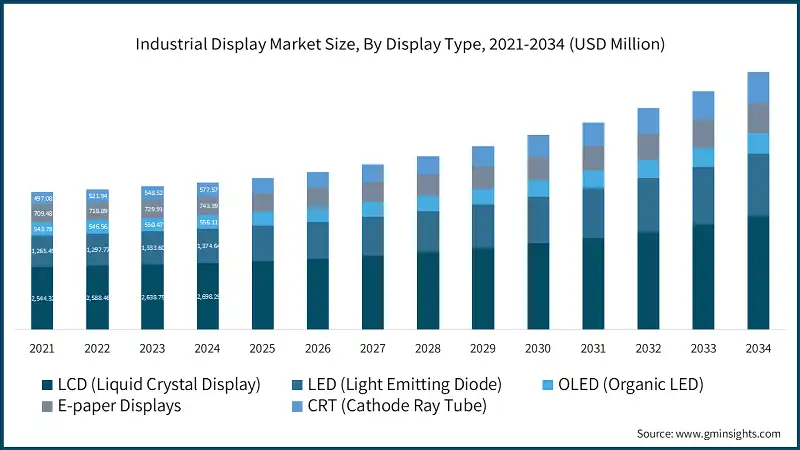
Based on display type, the market is segmented into LCD, LED, OLED, E-paper displays and CRT. The LCD segment accounts for the highest market share of 45.35% and the CRT segment holds a CAGR of 8.3% during the forecast period.
- The largest market is the LCD segment and held a value of USD 2.70 billion in 2024. The segment is witnessing high growth owing to its cost-effectiveness, design versatility, and globally scaled production infrastructure. LCDs dominate due to their wide temperature tolerance, long operational life (often >50,000 hours), and rugged construction. Major industrial display suppliers such as Advantech, Winmate, and Mitsubishi Electric offer LCDs designed to withstand harsh industrial environments, with features like sunlight-readable panels, wide viewing angles, and full IP65/IP67 enclosures.
- The shift toward Industry 4.0 and digital transformation has boosted demand for LCD displays in manufacturing, utilities, and energy sectors. For instance, Siemens’ SIMATIC HMI panels use LCD displays for real-time monitoring in smart factories, while Rockwell Automation’s PanelView series uses LCDs for graphical interface terminals in PLC environments.
- CRT (cathode ray tube) market is the fastest growing segment and is expected to be expanding at a CAGR of 8.3% over the forecasting period. Although CRTs are largely considered obsolete in consumer electronics, they maintain niche demand in industrial sectors that rely on legacy systems, particularly in defense, transportation, aerospace, and energy. Many older control systems in nuclear plants, naval vessels, air traffic control centers, and manufacturing lines still use CRT-based equipment, as transitioning to flat-panel technology may involve high retrofitting costs and system validation risks.
Learn more about the key segments shaping this market
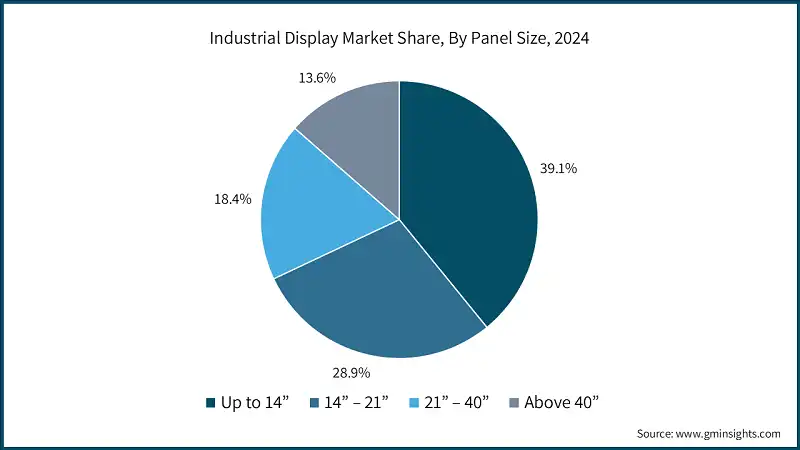
On the basis of panel size, the industrial display market is divided into Up to 14”, 14” – 21”, 21” – 40”, and Above 40”. The Up to 14” display market has the largest market share of 39.1% and 14” – 21” are expected to register a CAGR of 7.3% during the forecast period.
- The largest category was Up to 14” industrial display, with the value of USD 2.33 billion in 2024. Up to 14” display is a common category with a substantial market due to the small size and cost effectiveness for use in various industrial and commercial applications. The smaller displays are more prevalent in embedded systems, panel PCs, handheld HMIs, test & measurement equipment, factory automation panels where size and economy to ruggedness are majorly preferred. The lower amount of power consumption, compatibility to be added into other equipment, and the greater readability make them a good fit for control panel displays, medical devices, retail kiosks, etc.
- The 14” – 21” industrial display hold the highest growth rate and is poised to grow with an 7.3% CAGR over the forecast period, due to increased adoption across industries requiring a balance between screen and device portability. These displays are widely found in operator terminals, industrial PCs, process monitoring units, and interactive digital signage, partial to screen size that allows for multi-window data visualization, diagnostics, and real-time analytics.
- The expansion in this area is especially significant in automotive manufacturing, pharmaceuticals, public infrastructure, and energy, where touchscreen-based SCADA systems, quality control dashboards, and inspection systems are becoming regularly used. This area is widened with growing semi-rugged and rugged display demand under extreme environmental conditions (e.g., oil & gas, utilities).
On the basis of mounting type, the industrial display market is divided into rack mount, panel mount, open frame, wall mount, and VESA mount. The rack mount market has the largest market share of 41.8% and VESA mount are expected to register a CAGR of 8.3% during the forecast period.
- Rack mount industrial display was the largest category at USD 2.49 billion in 2024. Rack mount industrial displays dominate mainly due to the rapid adoption in data centers, industrial automation, and control rooms. The footprint of a rack mount display is no surprise as the ubiquitous standard mounting into 19-inch server racks is indispensable for the centralized environments where optimization of space use, and standardization of equipment is paramount, and these displays easily fall into this spectrum. These displays are heavily utilized within the oil & gas, utilities, transportation, and military sectors for mission critical monitoring.
- The high adoption rate is further reinforced with the increased deployment of edge computing systems and Industry 4.0 initiatives taking place in North America, Europe, and East Asia. Companies like Advantech, Kontron, and Rockwell Automation provide ruggedized, modularized rack mount displays with high brightness and touch capabilities, and wider temperature tolerances to suit rugged environments.
- VESA mount displays are the fastest growing at a CAGR of 8.3% during the forecast period. The flexibility of VESA mount display that enables mounted displays to be used and mounted in walls, arms, and mobile carts creates their fastest growth in the medical, retail, logistics, and field service sectors where space is often tight and the environment is dynamic and prone to change.
- The new technologies in touch screens (capacitive, resistive), sunlight readable displays, and antimicrobial coatings have made display technology even more supportive for healthcare and semi-outdoor applications. The trends toward digital transformation and the uptake of mobile cart-based diagnostics favor the deployment of these mounting options.
On the basis of application, the industrial display market is divided into HMI (Human-Machine Interface), digital signage, surveillance & monitoring, interactive kiosks, control rooms, industrial automation, medical equipment displays, and others. The surveillance & monitoring market has the largest market share of 21.6% and industrial automation are expected to register a CAGR of 7.7% during the forecast period.
- The industrial automation segment was the largest and represented USD 1.53 billion in 2024, due to increasing adoption of Industry 4.0 practices and the Industrial Internet of Things (IIoT), which focus on machine-to-machine communication, predictive maintenance, and data-driven operations. Manufacturers now require more robust displays that can enable real-time visualization in rugged factory settings with high brightness, wide viewing, IP65+ sealing, and shock and chemical resistance. Auto, electronics, and chemical manufacturing plants are major end-users, with large deployments throughout Germany, Japan, South Korea, and the U.S. Also, rising investments in robotics systems and automated warehouses in retail and logistics industries are further driving the demand for these displays.
- Control rooms have the highest growth rate and is expected to grow with a 6.7% CAGR during the forecast period. With operations becoming more digitalized, there's an increasing requirement for centralized monitoring & real-time decision-making. This drives the need for industrial displays of high performance with ultra-widescreen formats, 4K/8K resolution, resistance to high durability, & smooth integration with video wall systems. Usage ranges from power distribution monitoring & pipeline surveillance to surveillance and disaster response. In addition, the growth of smart cities, intelligent transportation systems (ITS), & energy grid modernization initiatives in particular in APAC, the Middle East, & Latin America is driving the installation of control room infrastructure.
Looking for region specific data?
North America commanded a 36% share of the industrial display market, which was growing at a 6.4% CAGR. The North American market witnessed highest growth due to the increase in investment towards automation and digitization of the core industries of manufacturing, healthcare, and retail, as well as an exceptionally robust supply chain and distribution network which furnish the delivery and deployment of industrial displays on large scale.
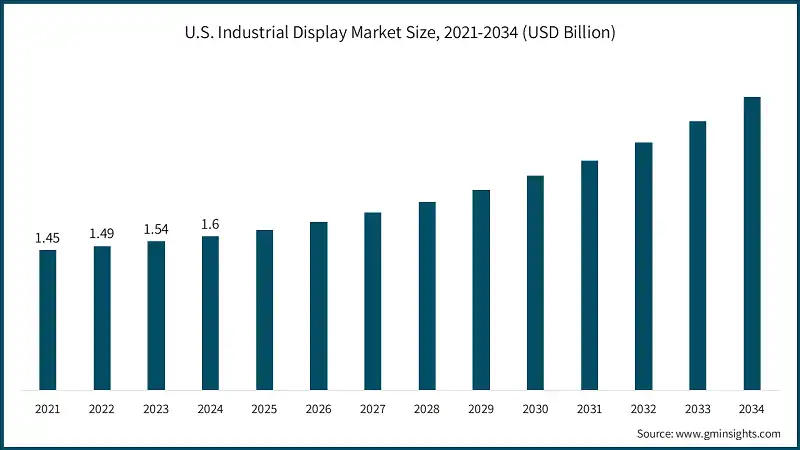
- The U.S. industrial display market posted a CAGR of around 7%, hitting USD 1.60 billion in 2024. This is propelled by the healthcare sector's need for high-end medical imaging and diagnostic displays, backed by FDA regulations that insist on high performance & reliability standards. Leading healthcare equipment vendors like Eizo Corporation and Barco have been consistently innovating in this area, fueling market growth.
- There is an increasing prevalence of industrial displays in retail and logistics for interactive kiosks, digital signage, and robotics in warehousing facilities. Walmart & Costco are examples of retailers who have put these technologies into practice to improve their inventory management & improve customer value which in turn has provided stable growth in this segment.
- The industrial display market in Canada is projected to grow at a CAGR of 4.7% in the forecast period, supported by domestic investments in clean energy & infrastructure update plans that rely on advanced monitoring & control solutions. Bodies like the Canadian Manufacturers & Exporters (CME) support digital change, promoting industrial display adoption in manufacturing & energy industries.
- Smart city initiatives in Toronto and Vancouver cities in Canada feature industrial displays as part of traffic management, public security, and environmental monitoring systems, stimulating further regional demand. The Innovation Superclusters Initiative by the Canadian government also funds technology integration, including innovative display solutions for industrial use.
Europe maintained a 23.9% market share while generating a 5.7% CAGR. The region's growth is heavily driven by the strength of its industrial automation, automotive manufacturing, and electronics industries.
- Germany industrial display market was USD 290.6 million in 2024 & will grow at a CAGR of 4.4% in the forecast period. Germany's automotive & manufacturing industries exhibit strong demand for industrial-grade displays, emphasizing high operating temperature ranges, brightness for outdoor venues, and protection against dust, dampness, and vibration. Enterprises including Siemens and Bosch are leveraging touchscreen HMIs, ruggedized panel PCs, and multi-touch industrial displays to enhance both operational efficiency and overall reliability of their systems. Further, the integration of SCADA & MES systems increases the drive for these origins.
- Public & private investments in Industry 4.0 and digital transformation projects, aided by EU initiatives such as Horizon Europe & Digital Europe, are speeding up the adoption of next-generation industrial displays in Germany. These displays come with AI-driven analytics interfaces, better cybersecurity capabilities, & a standardized communication protocol to guarantee interoperability across various industrial ecosystems.
- The UK industrial display market is likely to reach USD 412.04 million by 2034. Growth in sectors like healthcare, transportation, and logistics, which require highly reliable industrial displays to serve their operations with low latency, multi-screen synchronization, and enhanced connectivity options like Ethernet/IP and OPC UA, are fueling growth in the UK market. Smart infrastructure initiatives and digital signage in public transportation centers and warehouses are driving demand for industrial monitors with ultra-wide viewing angles and IP-rated enclosures for demanding environments.
Asia Pacific is valued a 19.6% share in the industrial display market. Rapid urbanization, automation in various industries, and a deepening manufacturing infrastructure are all supporting the trend.
- China market valued at USD 412.4 million in 2024 is expected to grow with a CAGR of 5.5% over the forecast period. The expansion is fueled by the nation's vast industrial infrastructure, wide acceptance of automation, and the government’s push on the “Made in China 2025” policy that enhances the shift towards digital manufacturing. Automation of industries, robotics, and smart logistics systems.
- Leading Chinese companies like Huawei and Hikvision are ramping up production of industrial displays, which offer greater durability, wider viewing angles, and touchscreen capabilities. The need for sophisticated industrial IoT and AI smart analytics has triggered an IoT platform and AI analytics integration in smart factories, which in turn drives the need for more sophisticated industrial displays.
- The industrial display market of Japan is continuously growing and is expected to reach a CAGR of 9.3% and USD 166.9 million in 2024. The industrial sector in Japan is known for its rigorous attention to accuracy and reliability in interface engineering for automotive assembly, robotics, and electronics assembly industries. Japan is providing, and is expected to provide, the industrial environment's strict needs such as high-resolution performance and operational temperature consistency. Japan's innovation and commitment to quality assurance will continue to facilitate growth in the industrial display market.
- South Korea industrial display reached USD 122.2 million in 2024 & is estimated to grow at a CAGR of 8.4% over the forecast period. Growth is being fueled by the electronics, automotive, and semiconductor manufacturing industries, which have a great need for displays within control panels, testing and monitoring systems. South Korean government policies to embrace Industry 4.0 and smart factory adoption are creating new opportunities for multitouch, flexible, and rugged displays useful in demanding industrial multifunctional settings. To meet the shifting needs in industrial automation and process control, display manufacturers such as Samsung and LG are focusing on enhancing the brightness, robustness, and smart connectivity of the screens.
Latin America had 12% market share and will grow at a CAGR of 5.2%. The demand for efficient & cost-effective industrial display solutions in major industries like manufacturing, retail, & logistics is driving growth in this region. The growing use of industrial automation & digitalization in manufacturing facilities is boosting demand for sophisticated industrial displays to increase operational effectiveness and real-time monitoring.
Middle East & Africa industrial display market size was USD 506.5 million in 2024 The region's growth is largely fueled by increasing industrial automation, smart factory programs, and infrastructure investment, especially in major industries like telecommunications, renewable energy, and aerospace.
- By 2024, the South Africa market was valued at USD 89.4 million, driven by continuous upgrading of telecom and renewable energy infrastructure. The increased support given by the government for solar and wind power projects necessitates accuracy in monitoring power electronics and inverter performance and thus generates need for rugged and reliable industrial display solutions. South African Renewable Energy Council points out that more than 58% of energy developers identify sophisticated monitoring devices as a key requirement for enhancing system efficiency and reducing downtime.
- In 2024, the UAE market was projected to be valued at USD 162.6 million. This market is supported by federal initiatives like "Operation 300bn" and "Make it in the Emirates" as well as strategies like the UAE Industrial Strategy 2031. These initiatives focus on smart manufacturing, technological innovation, and aerospace expansion while promoting the use of state-of-the-art industrial display systems to improve operational accuracy and connectivity. According to the UAE Ministry of Industry and Advanced Technology, over 65% of technology businesses in free zones concentrate their investments on high-performance instrumentation, of which industrial displays are a component used in robotics, automation, and aerospace production lines.
Industrial Display Market Share
The leading 5 companies, Advantech Co., Ltd., Siemens AG, Rockwell Automation, Inc., Panasonic Holdings Corporation, and Samsung Electronics Co., Ltd. hold a combined market share of approximately 44.8% of the worldwide industrial display, reflecting a moderately consolidated market structure. Strong customer relationships, patented industry display technology platforms, & high-end R&D infrastructure pose high entry barriers.
- Market leader is Advantech Co., Ltd. with a 12.5% market share led by its wide range of cutting-edge industrial display solutions for various industries including manufacturing, automation, and intelligent logistics. Advantech's emphasis on innovation, robust construction, and HMI interface customization for complex industrial applications underlines its leadership. Their dedication to incorporating IoT connectivity and edge computing in displays further enhances their competitive stature worldwide.
- Siemens AG has 9.8% market share, characterized by its customized and innovative industrial display solutions with a focus on high reliability and integration into Industry 4.0 platforms. Siemens relies on its in-depth know-how in automation & digitalization to offer scalable display solutions utilized across industries such as energy, transportation, & manufacturing. Its high R&D emphasis & partnerships with industrial players ensure ongoing development in display technology, which secures our market presence in mature and emerging markets.
- Rockwell Automation Inc. is well-known for its robust, high-quality, industrial display options that highlight the performance & cost-effectiveness required when used in unexpected industrial environments. It has a market share of about 8.7% in the automation technology sector. Through the development of new and updated touchscreen interfaces and the interoperability of its extensive automation product ecosystem, Rockwell is also innovating its products. Supported by robust customer service and application-specific solutions, their strategic focus on sectors such as process manufacturing, food & beverage, and automotive has helped them grow their market share.
Industrial Display Market Companies
Some of the prominent market participants operating in the industrial display include:
- Advantech Co., Ltd.
- AU Optronics Corporation
- Beijer Electronics Group AB
- BOE Technology Group Co., Ltd.
- EIZO Corporation
- Kontron AG
- LG Display Co., Ltd.
- Mitsubishi Electric Corporation
- Panasonic Holdings Corporation
- Pepperl+Fuchs SE
- Rockwell Automation, Inc.
- Samsung Electronics Co., Ltd.
- Siemens AG
- Schneider Electric SE
- Sparton Corporation
- Winmate Inc.
AU Optronics Corporation is one of the leading industrial display manufacturers with a broad portfolio of high-performance display panels and solutions for industrial automation, medical equipment, and transportation markets. AU Optronics uses cutting-edge LCD & OLED technologies to provide rugged, high-resolution displays capable of withstanding hostile environments. AU Optronics’ wide global manufacturing network and strong innovation help it grow in both emerging and established markets. Beijer Electronics Group AB focuses on industrial automation and HMI solutions, providing reliable and flexible industrial display products to improve efficiency in manufacturing, energy, and infrastructure sectors. Their products are known for sturdy design, user-friendly interfaces, and easy integration with automation systems, which has helped Beijer expand its presence in Europe and around the world. Beijer's strategic investment in Industry 4.0 uptake and digitalization underpins its continued demand for display technology.
Kontron AG is a top supplier of embedded computer technology, providing advanced industrial display modules and integrated HMI solutions for transportation, healthcare, and manufacturing. Their products are built to be tough, modular, & meet strict industry standards, making them perfect for demanding industrial settings. With ongoing investment in R&D and a worldwide service network, Kontron supports growth in many international markets.
Sparton Corporation provides specialized industrial display and electronic manufacturing services, focusing on reliable, high-quality displays for defense, aerospace, and industrial sectors. Their custom design and integration skills help create complex electronic systems that support mission-critical operations. The company's focus on quality & precision manufacturing has enabled it to secure long-term agreements with major clients in North America and internationally.
Industrial Display Market Report Attributes
| Key Takeaway | Details |
|---|---|
| Market Size & Growth | |
| Base Year | 2024 |
| Market Size in 2024 | USD 5.95 billion |
| Market Size in 2025 | USD 6.14 billion |
| Forecast Period 2025 - 2034 CAGR | 6% |
| Market Size in 2034 | USD 10.41 billion |
| Key Market Trends | |
| Drivers | Impact |
| Rising Automation in Manufacturing and Industrial Processes | A 1% increase in global factory automation demand adds 200,000 industrial displays annually across manufacturing lines. |
| Cost-Effectiveness and Durability in Industrial Operations | Switching to rugged industrial displays saves $30–$70 million annually in maintenance for large-scale production facilities. |
| Rapid Urbanization and Infrastructure Development | Urban population reaching 4.4B drives smart infrastructure rollouts, increasing industrial display installations in control systems by 12%. |
| Expansion of Smart Factories and IIoT Deployments | Each 5% increase in IIoT-connected factories adds demand for 500,000 industrial displays globally per year. |
| Pitfalls & Challenges | Impact |
| High Initial Cost of Advanced Display Technologies | Restricts adoption among SMEs, delaying upgrades and reducing market penetration in cost-sensitive industrial sectors. |
| Compatibility and Integration Issues with Legacy Systems | Increases deployment time and costs, slowing adoption in traditional facilities with outdated industrial control systems. |
| Opportunities: | Impact |
| Growth of Smart Factories and Industry 4.0 Initiatives | Drives demand for intelligent displays enabling real-time data visualization, predictive maintenance, and process automation. |
| Expansion in Emerging Markets with Infrastructure Modernization | Accelerates industrial display adoption in energy, transportation, and manufacturing sectors undergoing digital transformation. |
| Market Leaders (2024) | |
| Market Leaders |
12.5% market share in 2024 |
| Top Players |
Collective market share in 2024 is 44.8% |
| Competitive Edge |
|
| Regional Insights | |
| Largest Market | North America |
| Fastest Growing Market | Asia Pacific |
| Emerging Country | China, India, Japan, South Korea, Australia |
| Future Outlook |
|
What are the growth opportunities in this market?
Industrial Display Industry News
- In July 2025, Siemens AG completed the acquisition of ebm-papst’s Industrial Drive Technology (IDT) division, enhancing its position as a leader in factory automation & digitalization. Renamed “Mechatronic Systems” & integrated into the Siemens Xcelerator portfolio as Simotics E, the business includes intelligent, battery-powered mechatronic drive solutions primarily for autonomous transport systems and intralogistics.
- In April 2025, AUO presented its most recent innovations at Touch Taiwan 2025, with cutting-edge Micro LED displays, AI-based smart solutions, & green technologies. A standout highlight was the 127-inch single-module Micro LED TV, the 17.3-inch dual-sided transparent display, and the 65-inch 8K energy-saving FSC-LCD. Smart Cockpit 2025, incorporating immersive automotive HMI displays, showcased AUO's vision for innovation, eco-friendliness, and multi-industry user experience enhancement.
The industrial display market research report includes in-depth coverage of the industry with estimates and forecasts in terms of revenue in (USD million) from 2021 – 2034 for the following segments:
Market, By Display Type
- LCD (Liquid Crystal Display)
- LED (Light Emitting Diode)
- OLED (Organic LED)
- E-paper displays
- CRT (Cathode Ray Tube)
Market, By Panel Size
- Up to 14”
- 14” – 21”
- 21” – 40”
- Above 40”
Market, By Mounting Type
- Rack mount
- Panel mount
- Open frame
- Wall mount
- VESA mount
Market, By Application
- HMI (Human-Machine Interface)
- Digital signage
- Surveillance & monitoring
- Interactive kiosks
- Control rooms
- Industrial automation
- Medical equipment displays
- Others
Market, By Verticals
- Manufacturing
- Automotive
- Electronics & semiconductors
- Machinery & equipment
- Textiles
- Others
- Oil & gas
- Energy & power
- Mining & metals
- Transportation & logistics (industrial operations)
- Food & beverage processing
- Others
The above information is provided for the following regions and countries:
- North America
- U.S.
- Canada
- Europe
- Germany
- UK
- France
- Spain
- Italy
- Netherlands
- Asia Pacific
- China
- India
- Japan
- Australia
- South Korea
- Latin America
- Brazil
- Mexico
- Argentina
- Middle East and Africa
- Saudi Arabia
- South Africa
- UAE
Frequently Asked Question(FAQ) :
What is the market size of the industrial display industry in 2024?
The market size was USD 5.95 billion in 2024, with a CAGR of 6% expected through 2034 driven by automation, IIoT expansion, and infrastructure development.
What is the current industrial display market size in 2025?
The market size is projected to reach USD 6.14 billion in 2025.
What is the projected value of the industrial display market by 2034?
The industrial display industry is expected to reach USD 10.41 billion by 2034, supported by Industry 4.0 adoption, demand for rugged HMIs, and real-time visualization solutions.
How much revenue did the LCD display segment generate in 2024?
The LCD display segment generated USD 2.70 billion in 2024, holding 45.35% market share due to its cost-effectiveness, versatility, and durability.
What was the valuation of rack mount displays in 2024?
Rack mount industrial displays accounted for USD 2.49 billion in 2024, dominating due to widespread use in automation, control rooms, and data centers.
What is the growth outlook for the VESA mount segment from 2025 to 2034?
The VESA mount segment is projected to grow at an 8.3% CAGR till 2034, driven by rising adoption in healthcare, retail, and logistics sectors for flexible and space-saving display solutions.
Which region leads the industrial display market?
The U.S. market reached USD 1.60 billion in 2024, supported by strong demand for medical imaging, logistics automation, and advanced industrial interfaces. Growth is driven by FDA-backed reliability standards and rising adoption across healthcare and retail sectors.
What are the upcoming trends in the industrial display industry?
Key trends include integration of AI and edge computing for predictive maintenance, adoption of transparent OLED and flexible TFT-LCD panels, and growing use of rugged HMIs in harsh industrial environments.
Who are the key players in the industrial display market?
Key players include Advantech Co., Ltd., Siemens AG, Rockwell Automation, Inc., Panasonic Holdings Corporation, Samsung Electronics Co., Ltd., AU Optronics, BOE Technology, EIZO Corporation, Kontron AG, and Winmate Inc.
Industrial Display Market Scope
Related Reports