Summary
Table of Content

Indonesia & Malaysia Lead Acid Battery Market
Get a free sample of this report
Form submitted successfully!
Error submitting form. Please try again.
Thank you!
Your inquiry has been received. Our team will reach out to you with the required details via email. To ensure that you don't miss their response, kindly remember to check your spam folder as well!
Request Sectional Data
Thank you!
Your inquiry has been received. Our team will reach out to you with the required details via email. To ensure that you don't miss their response, kindly remember to check your spam folder as well!
Form submitted successfully!
Error submitting form. Please try again.
Indonesia & Malaysia Lead Acid Battery Market Size
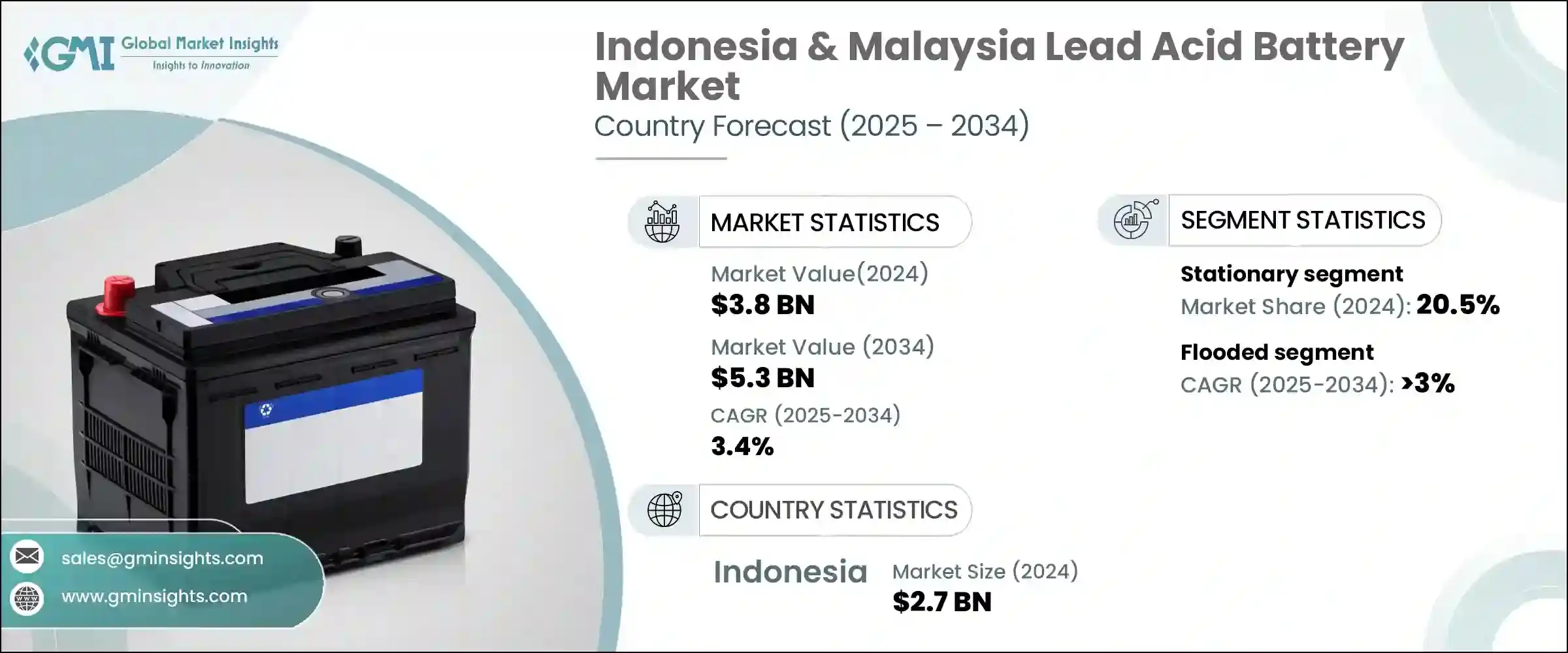
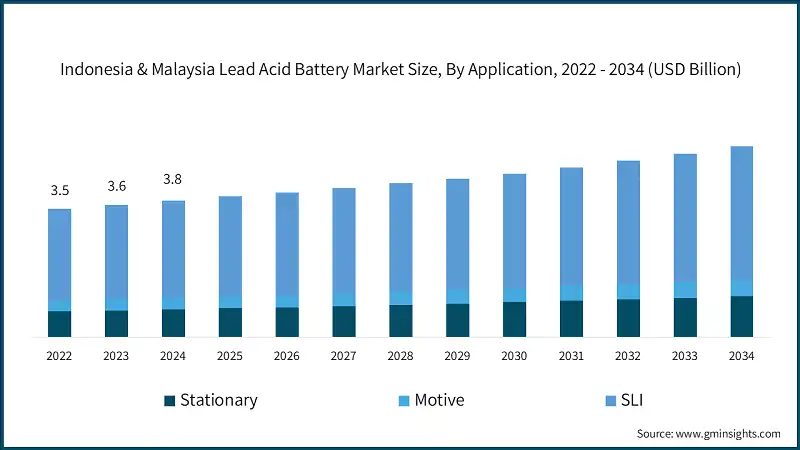
The Indonesia & Malaysia lead acid battery market was estimated at USD 3.8 billion in 2024. The market is expected to grow from USD 3.9 billion in 2025 to USD 5.3 billion in 2034, at a CAGR of 3.4%.
Indonesia & Malaysia Lead Acid Battery Market Key Takeaways
Market Size & Growth
- 2024 Market Size: USD 3.8 Billion
- 2034 Forecast Market Size: USD 5.3 Billion
- CAGR (2025–2034): 3.4%
Key Market Drivers
- Cost competitive solution for energy storage.
- Increasing demand for uninterrupted power supply.
Challenges
- Increasing proportion of lithium-ion batteries.
Opportunity
- Expansion of rural electrification and off-grid solar programs.
- Growth in two-wheeler and low-cost vehicle ownership.
- Development of local battery recycling and manufacturing hubs.
- Industrial automation and warehouse growth in logistics.
Key Players
- Market Leader: Clarios led with over 15% market share in 2024.
- Leading Players: Top 5 players in this market include Clarios, EnerSys, EXIDE INDUSTRIES, GS Yuasa International, Amara Raja Energy & Mobility, which collectively held a market share of 45% in 2024.
Get Market Insights & Growth Opportunities
- The rapid growth of telecom towers, mobile base stations, and internet backbone facilities to ensure continuity during grid failures will accelerate industry momentum. Increasing adoption of these batteries in automotive applications for SLI in internal combustion engines vehicles are driving business growth.
- Lead acid battery is a type of rechargeable battery that uses lead plates and sulfuric acid as its primary components to store and release electrical energy. It consists of positive plates made of lead dioxide, negative plates of sponge lead, and an electrolyte of diluted sulfuric acid.
- These batteries typically require replacement every 2-5 years, depending on climate, usage, and maintenance. In addition, the strong replacement cycle is driving a healthy aftermarket ecosystem, particularly in locations with extreme temperatures or poor road conditions.
- For instance, as of 2024, industry surveys indicate that VRLA batteries continue to account for 37% of centralized UPS energy storage, underscoring that performance gasps still remain for manufacturers to address.
- Growing adoption of these batteries in UPS systems across institutions, businesses, and homes which rely on backup power during outages are driving demand for flooded lead acid battery. Their ability to deliver immediate power in emergencies and function in a standby mode for years makes them indispensable in power-critical environments.
- Surging deployment of VRLA batteries which are favored in indoor applications including telecom towers, data centers, and hospitals owing to their low maintenance needs, spill-proof, and compact form factor. Furthermore, widespread adoption of these batteries in material handling equipment including industrial carts, floor scrubbers, and electric forklifts will sway business growth.
- The Indonesia & Malaysia lead acid battery market was valued at USD 3.2 billion in 2019 and grew at a CAGR of over 5.3% through 2024. Rapid expansion of automated manufacturing facilities, retail logistics, and warehousing across the countries will strengthen business potential.
- For reference, in May 2025, Tianneng introduced its TNEP high-temperature VRLA battery series, specifically designed for two-wheeler and distributed energy systems. The new models deliver up to 2,000 cycles at 80% depth of discharge and are manufactured using over 40% recycled lead, aligning with both performance and sustainability objectives.
- The Indonesia lead acid battery hold a largest share on account of increasing use in renewable energy storage in off-grid and rural solar systems. In semi urban areas, lead acid battery serves as reliable storage units for small-scale solar power generation integrated with inverters, which in turn will fuel product deployment.
To get key market trends
Indonesia & Malaysia Lead Acid Battery Market Trends
- The industry is gaining significant traction owing to preferred energy storage solutions in sectors where upfront affordability and local servicing matter particularly for stationary backup, rural solar, and utility scale hybrid installations. Increasing extensions into off-grid and microgrid projects across rural and underserved areas reflect continued reliance on deep-cycle lead-acid storage.
- Rapid adoption of energy storage in cost-sensitive applications including small clinics, household inverters, and rural electrification will bolster industry landscape. Supportive infrastructure and technician familiarities ensure reliable maintenance, reduce service downtime, and easy replacement is propelling business outlook.
- For citation, The Ministry of Energy and Mineral Resources of Indonesia has released the 2025-2034 Electricity Supply Business Plan for national utility PT PLN. The plan targets the addition of 69.5 GW in new installed capacity, with approximately 76% of this capacity to be sourced from renewable energy and storage systems, including battery energy storage.
- The cost competitive solution for energy storage began around 2010-2013, when both countries launched rural solar programs, village microgrids, and small-scale off-grid electrification. This trend is expected to peak between 2026-2029, as lithium-ion alternatives become cost-comparable and more policy-supported.
- Surging demand for these units in geographies where frequent blackouts, poor grid integration, and voltage fluctuations will foster industry trajectory. Moreover, their ability to handle shallow discharge and predictable load profiles makes them ideal for backup or standby storage.
- Increasing deployment of UPS systems in data centers, hospitals, retail outlets, and remote telecom areas, which offers cost-effective and reliable solutions will create favorable business scenarios. Substantial need for power reliability particularly in location with unstable grid is driving the demand for these battery solutions.
- For illustration, in May 2025, Microsoft is set to launch its first cloud region in Malaysia by Q2 2025, marking a significant milestone in the country’s digital transformation journey. The company’s USD 2.2 billion investment will support the development of three hyperscale data centers across Greater Kuala Lumpur and Johor, representing Microsoft’s largest investment in Malaysia.
- Growing energy loads from air conditioning, infrastructure overloads, natural disasters, digital devices, and machinery often result in unexpected disruptions, requiring UPS systems which act as power bridges will propel industry growth. Widespread utilization in emergency systems including alarms, smoke evacuation systems, and emergency lighting in both residential and commercial will sway product demand.
- In healthcare facilities, the UPS systems cater to continuous power supply to operate rooms, ICUs, medical refrigeration, and diagnostics equipment without fluctuations will energize favorable business scenario. Moreover, rapid construction and urbanization growth has led to an increase in residential towers, smart buildings, and commercial complexes will proliferate industry potential.
- Industrial manufacturing units, logistics hubs, and warehouses use UPS systems to maintain process integrity during power interruptions. In addition, forklifts, automated conveyors, and process controllers depend on battery-based backup to avoid material losses or safety hazards will influence business outlook.
- For instance, in July 2025, the battery manufacturing facility in Karawang, West Java, represents a USD 5.9 billion investment and is a key milestone in Indonesia’s growing battery value chain. The project is backed by strategic partners stakeholders including Aneka Tambang, CATL, Indonesia Battery Corporation, Lygend Resources, and Brunp Recycling.
Indonesia & Malaysia Lead Acid Battery Market Analysis
Learn more about the key segments shaping this market
- Based on application, the industry is segmented into stationary, motive, and SLI. The stationary lead acid battery market holds a share of 20.5% in 2024 and is expected to grow at a CAGR of over 3.5% through 2034.
- Growing demand for reliable backup systems in telecom towers, hospitals, and commercial buildings is driving the use of sealed lead-acid batteries. Increasing deployment in renewable energy systems for residential and community energy storage will strengthen business growth.
- Expansion of smart buildings and digital infrastructure requires short-duration power backup, fueling adoption of AGM and GEL-based VRLA batteries. Backup power for IT rooms, ATMs, control rooms, and public safety systems remains a stable application segment, which in turn will accelerate business momentum.
- For instance, in July 2025, Ningbo Contemporary Brunp Lygend officially secured a project on the Indonesia Battery Integration Project in Karawang. The project represents nearly USD 6 billion investment and spans over 2,000 hectares. It covers the entire battery value chain, including nickel mining, processing, battery material production, recycling, and battery manufacturing.
- The motive lead acid battery market will project at a CAGR of over 3.5% till 2034. Rapid expansion of warehousing, logistics, and retail automation is pushing demand for traction-type deep cycle lead acid batteries. These batteries are preferred in environments with heavy-duty discharge cycles owing to rugged construction and high surge tolerance.
- Industrial users favor these batteries due to lower capital costs and existing charger infrastructure. Furthermore, the growth in e-commerce and logistics centers across geographies will continue supporting motive lead-acid battery installations.
- For illustration, in May 2025, TotalEnergies and RGE have announced that their 50:50 joint venture, Singa Renewables, has received a conditional license from Singapore’s Energy Market Authority to import 1 GW of renewable electricity from Indonesia.
- The SLI lead acid battery market will grow at a rate of over 3% till 2034. These batteries are gaining traction owing to high replacement rates and low cost. These batteries remain dominant in conventional vehicles for starting engines, powering lights, and managing ignition systems.
- Growing integration with idle start-stop vehicle systems has increased demand for enhanced flooded batteries in the SLI category. Automotive battery suppliers continue to invest in design upgrades including vibration resistance and longer shelf life, which will amplify product deployment.
Learn more about the key segments shaping this market
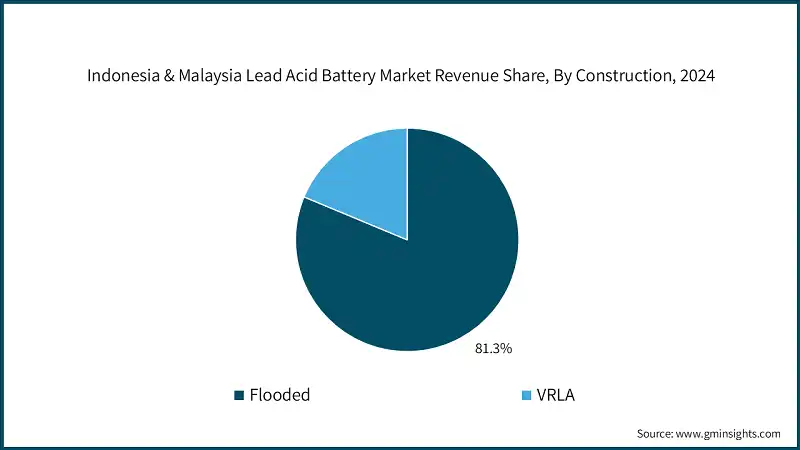
- Based on construction, the industry is segmented into flooded and VRLA. The flooded lead acid battery segment holds 81.3% market share in 2024 with over 3% CAGR through 2034. This segment is common in stationary power systems for rural telecom, irrigation, and solar installations where budget is constrained. High tolerance to electrical abuse and deep discharges make them suitable for field applications with unpredictable load patterns.
- Growing interest in low-antimony and hybrid alloy flooded design to reduce water loss and extend service intervals will sway industry growth. Moreover, flooded batteries are found in marine and RV applications where users prefer familiar, serviceable battery types.
- For reference, in April 2025, Tenaga Nasional Berhad, is significantly scaling up its commitment to clean energy by doubling its capital expenditure to USD 9.8 billion. The expanded investment will prioritize the development of solar power, energy storage systems, and renewable energy programs for corporate and community sectors.
- The VRLA segment dominates the market with 18.7% share in 2024, and the segment is anticipated to grow at a CAGR of over 3.5% from 2025 to 2034. These batteries are favored for their long-established performance, ability to operate in hot climates, and low acquisition cost.
- Increasingly adopted in compact indoor installations where maintenance access is limited and spill risk must be minimized. These solutions are preferred in telecom, banking, and medical environments where sealed, low-emission operation is critical for safety and compliance.
Looking for region specific data?
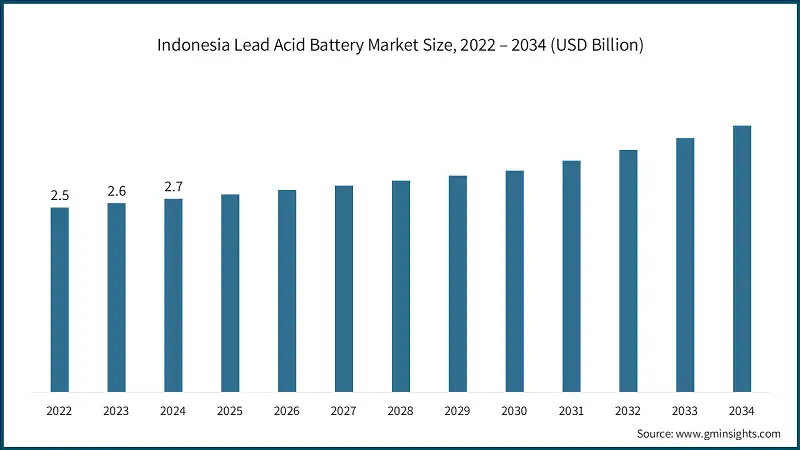
- The Indonesia dominated the lead acid battery market with around 71.3% share in 2024 and generated USD 2.7 billion in revenue. Strong demand from the two-wheeler sector continues to fuel aftermarket sales of SLI batteries across rural and urban locations.
- The widespread deployment of these batteries in rural solar systems and microgrids supports electrification efforts across remote islands. Increasing expansion of telecom infrastructure into outer provinces are increasing deployment of VRLA batteries for tower power backup.
- For reference, in July 2025, the National Consumer Protection Agency of the Republic of Indonesia is set to coordinate over USD 1 billion in investment to support the deployment of off-grid solar-plus-storage systems. This initiative aims to expand energy access in underserved regions, enhance energy independence, and accelerate the county’s transition toward sustainable, decentralized power solutions.
- The Malaysia lead acid battery market will project at a CAGR of over 3.5% through 2034. The country’s commercial sector is adopting lead acid based UPS systems to support critical operations in retail, banking, and hospitality will escalate industry dynamics.
- Surging expansion of logistics parks and warehousing boosts demand for motive batteries in forklifts and material handling equipment. VRLA batteries are increasingly used in healthcare facilities, schools, and government buildings for reliable backup power, which in turn will fuel business prospective.
Indonesia & Malaysia Lead Acid Battery Market Share
- The top 5 companies in the Indonesia & Malaysia lead acid battery industry are Clarios, EnerSys, EXIDE INDUSTRIES, GS Yuasa International, and Amara Raja Energy & Mobility contributing around 45% of the market in 2024. The industry is moderately fragmented with a mix of local manufacturers, regional assemblers, and global brand competing across automotive, industrial, and backup power segments.
- In both countries, price competitiveness, local servicing networks, and battery recycling capabilities are key differentiators. Local players dominate the low-cost, flooded battery segment, while international brand leads in VRLA and high-performance formats. Aftermarkets sales and distribution strength significantly influence brand visibility.
- Exide Industries operates in the industry primarily through exports and strategic partnerships, focusing on automotive, industrial, and UPS segments. The competitive landscape in both countries is moderately fragmented, with strong local players offering low-cost solutions and global brands competing in VRLA and premium categories.
- Clarios competes in the industry through its well-known brands including VARTA and Heliar, primarily in the automotive and industrial VRLA segments. Clarios holds a strong position in the premium automotive and UPS sectors. The company’s edge lies in technology integration and long battery life targeting higher-end and institutional customers.
- Over the past 3 years, local assembles and low-cost manufacturers expanded share in rural and aftermarket SLI segments, while global brands retained footholds in VRLA and industrial niche. The market has seen slight fragmentation, as more regional players enter the solar and backup segments.
Indonesia & Malaysia Lead Acid Battery Market Companies
- EnerSys reported FY 2024 net sales of USD 3.58 billion, with the majority of revenue generated from its reserve power and motive power divisions. These segments, anchored by thin-plate pure lead AGM and flooded lead-acid battery technologies accounted for over 80% of total sales.
- GS Yuasa reported FY 2024 revenue of USD 4 billion, supported by favorable replacement battery pricing and a stable order backlog for UPS systems. The company’s Automotive Battery and Industrial Battery & Power Supply segments both of which continue to rely significantly on enhanced flooded and VRLA lead acid technologies.
- Exide Industries reported FY 2024 revenue of USD 1.93 billion, primarily driven by sales of automotive, industrial, and inverter lead acid batteries manufactured across their eight domestic facilities. Despite a slowdown in OEM demand, robust growth in the inverter-UPS and two-wheeler replacement segments supported overall performance.
Major players operating in the Indonesia & Malaysia lead acid battery market are:
- ABM FUJIYA
- Amara Raja Energy & Mobility
- C&D Technologies
- CENTURY BATTERIES INDONESIA
- Century Yuasa Batteries
- Clarios
- EnerSys
- EXIDE INDUSTRIES
- GP Marketing
- GS Yuasa International
- HOPPECKE
- JYC BATTERY MANUFACTURER
- leoch International Technology
- Mitsubishi Electric Power Products
- Mutlu Battery
- NIMAC POWER SYSTEMS
- PT GS BATTERY
- PT. Motobatt Indonesia
- THE FURUKAWA BATTERY
- Yokohama Group
Indonesia & Malaysia Lead Acid Battery Market Report Attributes
| Key Takeaway | Details |
|---|---|
| Market Size & Growth | |
| Base Year | 2024 |
| Market Size in 2024 | USD 3.8 Billion |
| Forecast Period 2025 - 2034 CAGR | 3.4% |
| Market Size in 2034 | USD 5.3 Billion |
| Key Market Trends | |
| Drivers | Impact |
| Cost competitive solution for energy storage | Supports widespread adoption in price-sensitive sectors including rural solar, automotive aftermarket, and industrial UPS systems. |
| Increasing demand for uninterrupted power supply | Drives consistent uptake of VRLA batteries in telecom, hospitals, data centers, and commercial infrastructure needing reliable backup. |
| Pitfalls & Challenges | Impact |
| Increasing proportion of lithium-ion batteries | Gradually erodes lead-acid’s market share in premium applications due to lithium-ion’s superior energy density, faster charging, and longer cycle life. |
| Opportunities: | Impact |
| Expansion of rural electrification and off-grid solar programs | Boosts demand for deep-cycle lead-acid batteries as affordable, serviceable storage solutions in remote and under electrified areas. |
| Growth in two-wheeler and low-cost vehicle ownership | Sustains high aftermarket sales of SLI batteries due to frequent replacement in motorcycles and budget cars across both countries. |
| Development of local battery recycling and manufacturing hubs | Enhances circular economy potential, lowers production costs, and improves environmental compliances for domestic manufacturer. |
| Industrial automation and warehouse growth in logistics | Increase adoption of lead-acid traction batteries in forklift and material handling equipment driven by e-commerce and manufacturing sector expansion. |
| Market Leaders (2024) | |
| Market Leaders |
15% market share |
| Top Players |
Collective market share in 2024 is 45% |
| Competitive Edge |
|
| Regional Insights | |
| Largest Market | Indonesia |
| Fastest growing market | Malaysia |
| Emerging countries | Indonesia |
| Future outlook |
|
What are the growth opportunities in this market?
Indonesia & Malaysia Lead Acid Battery Industry News
- In May 2025, GS Yuasa Battery will launch an updated version of its ECO.R Revolution battery series. The refreshed lineup delivers enhanced starting power, longer service life, and improved performance for Idling Stop System-equipped vehicles. GS Yuasa will also consolidate branding under the ECO.R name, positioning it as the company’s flagship offering in the automotive battery segment and reinforcing its market leaders.
- In February 2025, EnerSys is set to unveil innovation around its Synova Sync charger and NexSys BESS energy storage system at the LogiMAT and ProMAT trade shows. These technologies are tailored to meet evolving needs in logistics and manufacturing, enabling businesses to optimize energy usage and reduce operating costs, thereby enhancing operational flexibility amid ongoing global energy transitions.
- In September 2024, VARTA Automotive, in collaboration with the parent company Clarios, will present its revamped product portfolio at Automechanika 2024. The updated battery lineup is designed to simplify selection for new and emerging vehicle segments, addressing shifting market demands. These offerings reflect Clarios’ continued focus on product innovation and global customer engagement.
- In June 2022, C&D Technologies announced the launch of its Pure Lead Plus VRLA battery, engineered to enhance backup power reliability for critical data center operations. The new solution is designed to optimize performance and reduce total operating costs for data center operators.
The Indonesia & Malaysia lead acid battery market research reports include in-depth coverage of the industry with estimates & forecast in terms of volume (Million Units) & revenue (USD Million) from 2021 to 2034, for the following segments:
Market, By Application
- Stationary
- Telecommunications
- UPS
- Control & switchgear
- Others
- Motive
- SLI
- Automobiles
- Motorcycles
Market, By Construction
- Flooded
- VRLA
- AGM
- GEL
Market, By Sales Channel
- OEM
- Aftermarket
The above information has been provided for the following countries:
- Indonesia
- Malaysia
Frequently Asked Question(FAQ) :
What was the size of the Indonesia & Malaysia lead acid battery market in 2024?
The market size was USD 3.8 billion in 2024, with a CAGR of 3.4% expected through 2034 driven by demand from automotive, telecom, and rural energy storage applications.
What is the projected value of the Indonesia & Malaysia lead acid battery market by 2034?
The Indonesia & Malaysia lead acid battery market is expected to reach USD 5.3 billion by 2034.
What is the growth outlook for the stationary lead acid battery segment from 2025 to 2034?
The stationary lead acid battery segment is projected to grow at a CAGR of over 3.5% through 2034, supported by demand for reliable backup systems in telecom, hospitals, and renewable energy storage.
What was the market share of the flooded lead acid battery segment in 2024?
The flooded lead acid battery segment held an 81.3% market share in 2024, with a projected CAGR of over 3% through 2034.
What is driving growth in the motive lead acid battery market in Indonesia & Malaysia?
The motive lead acid battery market is set to grow at a CAGR of over 3.5% through 2034, due to expanding warehousing, logistics, and retail automation.
Which country dominated the lead acid battery market in 2024?
Indonesia dominated the market with a 71.3% share, generating USD 2.7 billion in revenue in 2024.
What are the upcoming trends in the Indonesia & malaysia lead acid battery market?
Key trends include the cost-competitive nature of lead acid batteries, increasing demand for uninterrupted power supply, and their widespread use in automotive and rural energy storage applications.
Who are the major players in the Indonesia & Malaysia lead acid battery market?
Key players include Clarios, EnerSys, EXIDE INDUSTRIES, GS Yuasa International, Amara Raja Energy & Mobility, ABM FUJIYA, Century Yuasa Batteries, and PT GS BATTERY, among others.
Indonesia & Malaysia Lead Acid Battery Market Scope
Related Reports