Summary
Table of Content

In-Vehicle Networking Semiconductors Market
Get a free sample of this report
Form submitted successfully!
Error submitting form. Please try again.
Thank you!
Your inquiry has been received. Our team will reach out to you with the required details via email. To ensure that you don't miss their response, kindly remember to check your spam folder as well!
Request Sectional Data
Thank you!
Your inquiry has been received. Our team will reach out to you with the required details via email. To ensure that you don't miss their response, kindly remember to check your spam folder as well!
Form submitted successfully!
Error submitting form. Please try again.
In-Vehicle Networking Semiconductors Market Size
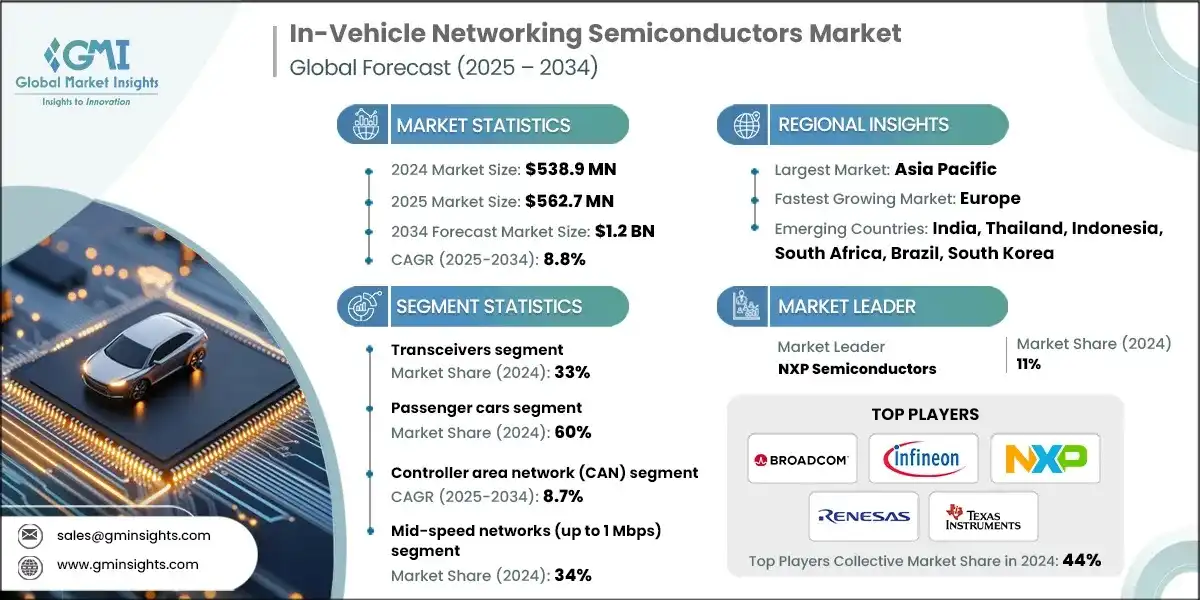
The global in-vehicle networking semiconductors market size was estimated at USD 538.9 million in 2024. The market is expected to grow from USD 562.7 million in 2025 to USD 1.2 billion in 2034, at a CAGR of 8.8% according to latest report published by Global Market Insights Inc.
To get key market trends
In-Vehicle Networking (IVN) semiconductors are transforming automotive electronics by enabling high-speed data transfer and communication among vehicle subsystems. The market is driven by trends such as electrification, ADAS integration, infotainment advancements, and increasing vehicle architecture complexity.
The in-vehicle networking semiconductors market is projected to exceed USD 752.7 million by 2029 and USD 801.7 million by 2030. Key growth drivers include the adoption of high-speed communication standards like Ethernet and CAN FD, rising demand for ADAS and infotainment systems, and the transition to electrification and connected vehicle architectures. Post-pandemic recovery and advancements in software-defined vehicles further accelerate market expansion.
The competitive environment is changing due to technological innovation, and the players on the market focus on energy-efficient, AI-oriented, and semiconductors concerned with cybersecurity. Such companies as STMicroelectronics, NXP, Renesas, and Infineon are designing scalable chipsets, which can support multi-domain communication and zonal control. Increased interest in the supply chain resilience and chip localization in the post-pandemic period has also stimulated the development of semiconductor manufacturing in the region, notably in Asia and Europe, which predetermined long-term market expansion of the in-vehicle networking semiconductors.
The Asia-Pacific region leads the market, driven by strong automotive, EV, and electronics manufacturing in China, Japan, South Korea, and India. Automakers and Tier-1 suppliers are investing in smart mobility and digital infrastructure, boosting demand for advanced in-vehicle networking systems. For instance, in 2025, Renesas Electronics partnered with Chinese OEMs to implement zonal network solutions with Ethernet in next-gen electric cars, improving communication efficiency and reducing wiring complexity.
Europe is the fastest-growing automotive market, driven by strict EU safety regulations, rapid electrification, and early adoption of software-defined vehicle systems. Automakers like BMW, Volkswagen, and Mercedes-Benz are integrating advanced networking chips for ADAS, V2X communication, and OTA updates. For instance, in early 2025, Germany's Infineon Technologies launched a multi-gigabit Ethernet transceiver to enhance data throughput and support autonomous systems.
In North America, semiconductor giants like NXP Semiconductors and Texas Instruments are driving consistent market growth. OEMs are increasingly integrating high-performance communication ICs into electric and hybrid vehicles, enhancing real-time diagnostics, infotainment, and safety features. Partnerships between chip manufacturers and automotive software firms are accelerating the industry's shift towards centralized automotive compute designs.
In-Vehicle Networking Semiconductors Market Report Attributes
| Key Takeaway | Details |
|---|---|
| Market Size & Growth | |
| Base Year | 2024 |
| Market Size in 2024 | USD 538.9 Million |
| Market Size in 2025 | USD 562.7 Million |
| Forecast Period 2025 - 2034 CAGR | 8.8% |
| Market Size in 2034 | USD 1.2 Billion |
| Key Market Trends | |
| Drivers | Impact |
| Shifts toward vehicle automation and ADAS | IVN semiconductors enable real-time communication for autonomous functions and driver assistance systems. |
| Growing adoption of electric and hybrid vehicles | Networking chips are essential for energy management in EVs and HEVs. |
| Shift toward high-speed, centralized, and zonal vehicle architectures | IVN semiconductors simplify wiring and enable scalable vehicle networks. |
| Increasing consumer preference for smart, feature-rich vehicles | Rising demand for advanced infotainment and diagnostics drives the need for high-performance networking ICs. |
| Regulatory focus on vehicle safety, cybersecurity, and communication reliability | OEMs are adopting advanced semiconductors to enhance secure automotive networking. |
| Pitfalls & Challenges | Impact |
| Electronic reliability under harsh automotive conditions | IVN semiconductors ensure reliable in-vehicle communication under extreme conditions. |
| Rapidly evolving communication protocols and standards | Frequent updates to Ethernet, CAN FD, LIN, and FlexRay escalate R&D costs. |
| Opportunities: | Impact |
| Integration with electric and hybrid vehicle platforms | IVN semiconductors enhance EV and HEV performance by enabling efficient system communication. |
| Advancements in automotive Ethernet and high-speed networking chips | Next-generation transceivers, gateways, and controllers enhance data transfer for ADAS, infotainment, and autonomous driving. |
| Expansion of ADAS, autonomous, and connected vehicle technologies | Rising adoption of safety systems boosts demand for in-vehicle networking semiconductors. |
| Rising adoption of software-defined and centralized vehicle architectures | Chips enabling multi-domain and centralized networking help OEMs simplify wiring and scale features. |
| Market Leaders (2024) | |
| Market Leaders |
11% Market Share |
| Top Players |
Collective market share in 2024 is Collective Market Share is 44% |
| Competitive Edge |
|
| Regional Insights | |
| Largest Market | Asia Pacific |
| Fastest Growing Market | Europe |
| Emerging Country | India, Thailand, Indonesia, South Africa, Brazil, South Korea |
| Future Outlook |
|
What are the growth opportunities in this market?
In-Vehicle Networking Semiconductors Market Trends
In early 2024, the in-vehicle networking semiconductors industry experienced significant growth as automakers and Tier-1 suppliers integrated high-speed networking chips. This shift toward software-defined vehicles enhanced ADAS, infotainment, and centralized computing, with protocols like automatic Ethernet and CAN FD improving communication, safety, and efficiency.
More OEMs are adopting advanced microcontrollers, gateways, and transceivers in multi-domain and zonal architectures. As these technologies gain traction in the mid-to-late 2020s, we can expect reduced wiring complexity, enhanced data transfer efficiency, and increased reliability in vehicle systems. Additionally, the rise of electric and hybrid cars is spurring the development of semiconductors optimized for battery management, powertrain control, and regenerative energy systems, all integral to global sustainable mobility solutions.
Personalized vehicle experiences, such as adaptive infotainment, live diagnostics, and over-the-air software updates, are boosting the demand for intelligent networking ICs. Chipmakers are focusing on developing strong, scalable, and robust semiconductors. These semiconductors not only support various protocols and offer cybersecurity but also ensure seamless integration with both autonomous and semi-autonomous vehicle platforms.
Automakers are increasingly adopting energy-efficient designs, AI-driven data routing, and modular semiconductor solutions, allowing them to customize in-vehicle networking for specific models and segments. Meanwhile, automotive suppliers are developing chips boasting enhanced thermal performance, resilience to harsh conditions, and versatility across both passenger and commercial vehicle platforms.
The further expansion is triggered by integration of connected technologies in vehicles, including V2X communication and cloud-enabled fleet management. High-bandwidth networking chips, real-time monitoring, and analytics can help OEMs to optimize operations in the vehicle, enhance safety, and improve passenger experience in both urban and semi-urban areas.
In-Vehicle Networking Semiconductors Market Analysis
Learn more about the key segments shaping this market
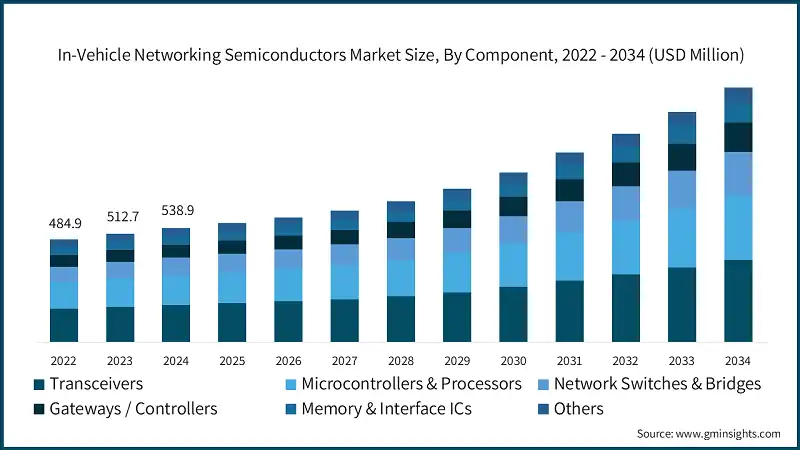
Based on component, in-vehicle networking semiconductors market is segmented into transceivers, microcontrollers & processors, network switches & bridges, gateways / controllers, memory & interface ICs and others. The transceivers segment dominates the market with 33% share in 2024, and the segment is expected to grow at a CAGR of over 8.7% from 2025 to 2034.
- In 2024, Transceivers will dominate the in-vehicle networking semiconductor market, enabling fast and reliable communication among ECUs, sensors, and actuators through protocols like CAN FD, LIN, FlexRay, and automotive Ethernet.
- The transceivers segment is driven by rising demand for multi-gigabit automotive Ethernet, ADAS adoption, and connected vehicle platforms. Innovations by Renesas Electronics and Texas Instruments will further boost growth in related segments like microcontrollers and gateways.
- For instance, in March 2024, Broadcom launched a scalable automotive Ethernet transceiver, highlighting OEMs' rising demand for advanced networking solutions in Asia-Pacific and Europe.
- Electric and hybrid vehicles are increasingly adopting transceivers, as their battery management systems, infotainment units, and powertrain controllers demand high-bandwidth communications. For instance, in July 2023, NXP Semiconductors unveiled a new lineup of CAN-FD transceivers, tailored for high-end SUVs, ensuring enhanced data integrity and simplified wiring.
- Regulatory requirements relating to the safety of vehicles, cybersecurity, and the reliability of communications, and growing consumer demands on the features of connected and autonomous vehicles are likely to further expand the transceivers segment.
- Microcontrollers and processors drive intelligent routing, ADAS, and telematics, while gateways and controllers enable multi-domain communication and reduce latency in vehicle architectures.
- Network switches and bridges and memory and interface ICs are still significant to serve advanced networking topologies with high-speed data storage and the others category that have emerging solutions like integrated system-on-chip networking modules are slowly gaining ground.
- In November 2024, Infineon Technologies unveiled a modular SoC-based networking solution at a European automotive event, aimed at next-generation autonomous and electric vehicles. This move suggests potential growth for the 'Others' category post-2030.
Learn more about the key segments shaping this market
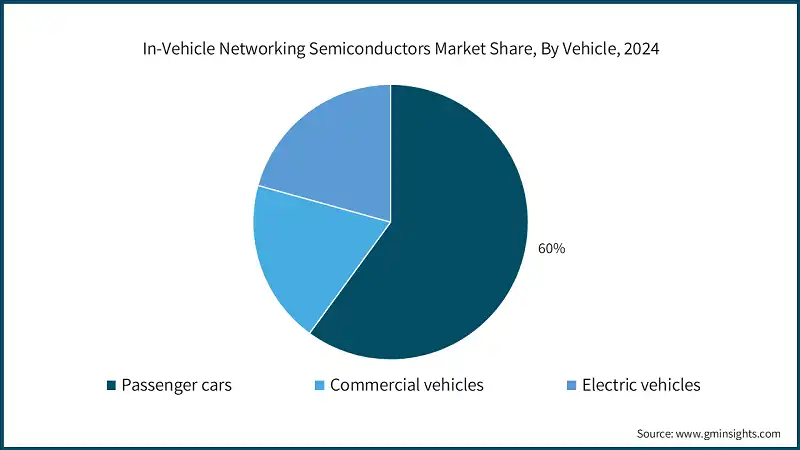
Based on vehicle, in-vehicle networking semiconductors market is divided into passenger cars, commercial vehicles and electric vehicles. Passenger cars segment dominated the market, accounting for around 60% in 2024 and is expected to grow at a CAGR of 7.9% from 2025 to 2034.
- In 2024, the passenger cars segment will dominate the in-vehicle networking semiconductors market, driven by rising adoption of ADAS, infotainment systems, and connectivity features in compact cars, sedans, and SUVs.
- Passenger cars are increasingly adopting semiconductors to meet regulatory demands for safety, security, and emissions compliance, with OEMs relying on these chips for advanced communication and software-defined architectures. For instance, in April 2025, NXP Semiconductors introduced a next-generation automotive Ethernet controller in Germany, offering higher bandwidth, low latency, and secure communication for ADAS and infotainment systems.
- The commercial vehicle segment is projected to grow at a CAGR of over 7% from 2025 to 2034, driven by electrification and stricter safety measures. In June 2024, Renesas Electronics introduced a modular gateway and microcontroller package for medium-duty trucks in North America, enhancing data communication and reliability.
- The commercial vehicle market is expanding, fueled by high-speed networking chips and IVN semiconductors offering advanced features like predictive diagnostics and real-time monitoring for logistics and transport applications.
- The electric vehicle (EV) segment is driving growth with a CAGR of 11.8% during forecast period in in-vehicle networking semiconductors due to rising EV adoption, battery management systems, and advanced driver assistance systems. Companies like Infineon Technologies and Texas Instruments are developing energy-efficient ICs with higher data transfer rates and improved safety for EV platforms.
Based on communication protocol, the in-vehicle networking semiconductors market is segmented into controller area network (CAN), local interconnect network (LIN), FlexRay, media-oriented systems transport (MOST), automotive ethernet and other emerging protocols. The controller area network (CAN) segment is projected to dominate the market with a CAGR of 8.7% from 2025 to 2034, owing to its high reliability, low-cost, low-space and satisfactory track record in real-time automotive communication network.
- The benefits of using CAN-based semiconductors include strength, facility to function with numerous and diverse vehicle design structures, and the capability to support safety-critical functions, such as ADAS and vehicle connectivity platforms. For instance, in March 2025, NXP Semiconductors introduced a more sophisticated CAN transceiver in Germany, with increased data rates, larger fault tolerance, and without any issues integrating with electric and hybrid vehicle platforms.
- Local Interconnect Network (LIN) protocol is a growingly popular body electronics and low-speed communication protocol offering low-cost communication between sensors and actuators and ECUs. For instance, in March 2024, STMicroelectronics launched compact EV-door and lighting system LIN transceivers.
- In May 2024, Bosch unveiled advanced FlexRay ICs, boasting enhanced bandwidth and redundancy features, tailored for high-end vehicles. These semiconductors play a pivotal role in safety-centric domains, such as chassis control and advanced driver assistance systems, ensuring swift and reliable communication.
- Automobile Ethernet is becoming popular in high-data systems, such as infotainment and camera-based ADAS. For instance, in June 2024, Broadcom launched automotive Ethernet PHYs that have gigabit speeds and better cybersecurity of connected cars.
- Other emerging protocols and hybrid networks are still being used to complement CAN, LIN, FlexRay, and Ethernet, allowing flexible, reliable, and scalable in-vehicle communication architectures to be used in next-generation vehicles.
Based on bandwidth, the in-vehicle networking semiconductors market is divided into low-speed networks (up to 125 kbps), mid-speed networks (up to 1 Mbps), high-speed networks (10 Mbps to 1 Gbps), and ultra-high-speed (>1 Gbps). Mid-speed networks (up to 1 Mbps) segment dominated the market accounting around 34% revenue share in 2024 and is expected to grow at a CAGR of 9.1% from 2025 to 2034.
- Mid-speed networks, favored by OEMs for their balance of adequate data transfer speeds, low power consumption, and reduced system complexity, find common applications in body electronics, infotainment control, and non-safety-critical communication between ECUs.
- For instance, in 2025, NXP Semiconductors launched an M-speed CAN transceiver for hybrid and electric vehicles, offering low electromagnetic interference and enhanced fault tolerance for stable communication in key systems.
- Low-speed networks support basic functions like door modules, window control, and seat adjustments. They hold a smaller market share but are vital for cost-sensitive and entry-level car models.
- High-speed networks (10 Mbps to 1 Gbps) are increasingly used in ADAS and infotainment, enabling real-time video and sensor data exchange. For instance, in June 2024, Broadcom's introduced automotive Ethernet ICs, to support connected vehicle platforms with seamless high-speed communication.
- Next-generation autonomous vehicles are adopting ultra-high-speed networks (over 1 Gbps) to enable AI processing and multi-camera data transfer. OEMs are investing in ultra-high-speed semiconductors to future-proof vehicle architectures.
- The industry increasingly uses semiconductors optimized for reliability, cost, and performance across conventional and electrified vehicle platforms, with mid-speed networks dominating automotive communication systems.
Looking for region specific data?
Asia Pacific region dominated the in-vehicle networking semiconductors market with a market share of 39% in 2024.
- In 2024, the Asia Pacific region leads the in-vehicle networking semiconductor market due to increasing vehicle electrification, ADAS adoption, and demand for smart mobility solutions.
- The region is witnessing significant semiconductor advancements in the automotive sector, driven by R&D, local OEM growth, and government support for electric and smart vehicles. Autonomous driving and connectivity are increasing networking semiconductor adoption in cars.
- China, the largest large motor market by size in the region, is the fastest growing market, with significant take-off of CAN, LIN and automotive Ethernet semiconductors in EVs and hybrid vehicles.
- For instance, in March 2024, NXP Semiconductors unveiled a new line of automotive CAN transceivers tailored for Chinese markets, emphasizing high reliability and fault tolerance, and targeting EVs and ADAS applications.
- Government policies in Japan, South Korea, and India are boosting vehicle safety, connectivity, and electrification, driving semiconductor demand in mid and high-speed networks through EV subsidies and local production incentives.
- For instance, in July 2024, STMicroelectronics increased automotive Ethernet IC production in Asia to address rising demand for connected car platforms and advanced infotainment systems.
- Asia Pacific's robust EV adoption, coupled with stringent regulations and strategic partnerships between OEMs and semiconductor suppliers, underscores the region's pivotal role in propelling the growth of in-vehicle networking semiconductors.
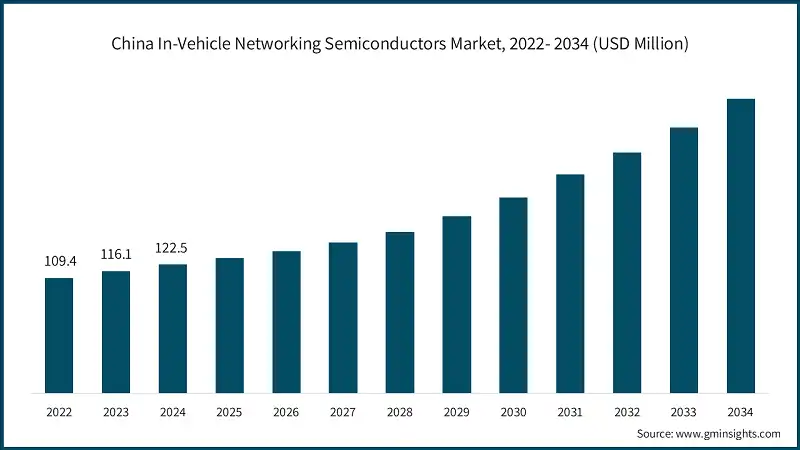
The China in-vehicle networking semiconductors market was valued at USD 103.2 million and USD 109.4 million in 2021 and 2022, respectively. The market size reached USD 122.5 million in 2024, growing from USD 116.1 million in 2023.
- China's in-vehicle networking semiconductors market is driven by its robust auto manufacturing industry, rising EV production, and government-led digital mobility initiatives. Key OEMs like BYD, SAIC Motor, Geely, and NIO are adopting advanced networking chips for smarter, connected vehicles.
- Government ICV policies and the "Made in China 2025" initiative are driving investments in automotive semiconductor innovations, focusing on Ethernet, CAN FD, and FlexRay solutions. China, with its expansive EV ecosystem, robust automotive manufacturing, and swift adoption of 5G-driven intelligent mobility systems, stands out as Asia-Pacific's leading market for in-vehicle networking semiconductors.
- Chinese automakers, chip manufacturers, and tech firms are joining forces to accelerate the development of domain and zonal architectures, ensuring seamless data flow to next-gen vehicles' ADAS, infotainment, and powertrain systems.
- The China in-vehicle networking semiconductors market is growing rapidly, driven by EV production, state-backed digital mobility initiatives, and efforts toward semiconductor self-sufficiency. Companies like Horizon Robotics and SemiDrive are advancing localized solutions, aligning with the 14th Five-Year Plan (2021-2025).
- China's centralization of vehicle-to-everything (V2X) systems is boosting demand for in-vehicle networking semiconductors, with pilot projects in cities like Shanghai and Shenzhen actively testing connected car ecosystems.
- For instance, in June 2024, NIO partnered with SemiDrive Technology to develop high-performance in-car semiconductor systems for ADAS and intelligent cockpits. This highlights China's focus on indigenous semiconductor designs for connected and autonomous vehicles.
Europe in-vehicle networking semiconductors market accounted for USD 133 million in 2024 and is anticipated to show growth of 9.5% CAGR over the forecast period.
- The Europe in-vehicle networking semiconductors market is driven by a strong automotive manufacturing sector, adoption of connected vehicle technologies, and a focus on advanced safety systems. Leading automakers like Volkswagen and BMW are leveraging high-performance semiconductors for centralized vehicle designs.
- Strict EU regulations on vehicle safety, emissions, and data connectivity are accelerating the adoption of network chips for ADAS, infotainment, and autonomous driving. The European Commission's push for digital transformation further drives the use of high-speed Ethernet, CAN FD, and LIN protocols in vehicle networks.
- Europe's advanced R&D, semiconductor ecosystem, and automotive innovation position it as a key hub for next-generation in-vehicle networking. Collaborations in Germany, France, and the UK enhance its global competitiveness.
- For instance, in March 2024, Bosch partnered with Infineon Technologies AG to develop advanced in-vehicle semiconductor platforms, emphasizing Europe's focus on connected and secure mobility solutions.
Germany dominates the Europe in-vehicle networking semiconductors market, showcasing strong growth potential, with a CAGR of around 10% from 2025 to 2034.
- Germany is a key market for in-vehicle networking semiconductors in Europe, driven by its strong automotive industry and focus on vehicle digitalization. Leading manufacturers like Mercedes-Benz, Audi, Volkswagen, and BMW are adopting advanced networking chips for seamless system communication.
- The adoption of software-defined vehicles (SDVs) and autonomous driving in Germany has increased the demand for high-speed Ethernet and CAN-based FD networking. Supported by government initiatives, the automotive sector is investing in semiconductor R&D to enhance safety, data processing, and communication reliability.
- Germany's strong semiconductor supply chain, led by companies like Infineon, Bosch, and Continental, is advancing real-time data transfer solutions to improve vehicle performance and connectivity.
- For instance, in April 2024, Infineon Technologies partnered with Volkswagen Group to develop high-speed in-vehicle networking semiconductors, enhancing real-time data processing and communication.
- Germany's focus on digital mobility and intelligent transport systems drives its leadership in connected, data-driven automotive technologies through high-performance networking semiconductors.
The North America in-vehicle networking semiconductors market is anticipated to grow at a CAGR of 8.1% during the analysis timeframe.
- The North American in-vehicle networking semiconductors market is growing steadily, driven by the rise of connected vehicles, EVs, and demand for high-speed data. Automakers in the US, Canada, and Mexico are adopting advanced chips for next-gen features and OTA capabilities.
- Technological advancements in semiconductor design are driving market growth, with manufacturers focusing on energy-efficient, high-performance chips that enable real-time data transfer for ADAS and autonomous driving.
- OEMs and semiconductor firms in North America are strengthening operations through partnerships and localized production. For instance, in July 2024, Qualcomm Technologies collaborated with a major US automaker to develop a scalable in-vehicle networking platform for software-defined vehicles.
- Government initiatives, such as the CHIPS and Science Act (2022), are driving growth in the region's in-vehicle networking semiconductor industry by promoting electric mobility, data security, and semiconductor manufacturing.
- The U.S. leads the North American market with strong semiconductor R&D, high EV adoption, and significant OEM presence. Canada focuses on connected vehicle research and sustainable automotive production.
The in-vehicle networking semiconductors market in US is expected to experience significant and promising growth from 2025 to 2034.
- Hybrid, electric, and premium vehicles are driving US market growth. Automakers are integrating advanced networking chips to enable high-speed communication in ADAS, infotainment, and powertrain systems.
- Semiconductor firms in the US and abroad are focusing on compact, energy-efficient in-vehicle networking solutions supporting zonal architecture, OTA updates, and centralized computing, catering to both ICE and EV markets moving towards intelligent mobility.
- In 2022, local semiconductor production grew due to federal policies like the CHIPS and Science Act and increased adoption of advanced networking systems, improving the safety and connectivity of US made vehicles.
- The US in-vehicle networking semiconductors market is set to grow rapidly, driven by EV adoption, autonomous driving advancements, and rising demand for real-time data networks. A strong innovative ecosystem positions the US as a leader in connected vehicle semiconductors.
- Collaboration among US automakers, Tier-1 suppliers, and semiconductor firms is driving advancements in high-speed Ethernet, CAN FD, and FlexRay technologies, enhancing ADAS, infotainment, and V2X systems. This positions the U.S. market as a leader in connected and autonomous vehicles.
Brazil leads the Latin American in-vehicle networking semiconductors market, exhibiting remarkable growth of 8.2% during the forecast period of 2025 to 2034.
- Brazil leads the Latin American market due to its expanding car manufacturing sector, rising adoption of connected and electric vehicles, and focus on advanced driver-assistance systems (ADAS).
- Government policies and incentives for EVs and connected vehicles drive the adoption of high-performance communication chips, enabling faster data transfer between sensors, ECUs, and infotainment systems.
- Brazilian automakers and Tier-1 suppliers are investing in semiconductor R&D and global alliances to advance Ethernet, CAN FD, and FlexRay solutions for vehicles.
- Brazil is expected to dominate the Latin American in-vehicle networking semiconductor market, driven by strong industrial support, rising EV adoption, and advancements in connected vehicle technologies.
- For instance, in July 2025, Embraer Automotive Technologies and NXP Semiconductors collaborated to enhance real-time communication in electric and hybrid commercial vehicles, showcasing Brazil's push for innovation in connected vehicles.
South Africa to experience substantial growth in the Middle East and Africa in-vehicle networking semiconductors market in 2024.
- South Africa is emerging as a key player in Africa's in-vehicle networking semiconductor market, driven by rising EV sales, ADAS demand, and advancements in its automotive industry. Automakers are adopting high-speed networking chips to enhance vehicle performance and efficiency.
- South Africa's EV market is growing despite challenges like high import taxes and infrastructure gaps. According to NADA, NEV sales doubled in 2024 to 15,589 units and rose by 14% in Q1 2025, reaching 3,487 units.
- South Africa plans to boost the EV industry with a 150% tax deduction for EV and hydrogen vehicle production starting next year. The government is also collaborating with the World Bank to develop critical minerals plan to support EV component production and supply chains.
- South Africa's growing EV adoption and government support are driving significant growth in the in-vehicle networking semiconductor market, establishing it as a key hub for automotive networking technologies in Africa.
In-Vehicle Networking Semiconductors Market Share
- The top 7 companies in the in-vehicle networking semiconductors industry are NXP Semiconductors, Texas Instruments (TI), STMicroelectronics, Broadcom, Analog Devices, Infineon Technologies, and Renesas Electronics contributed around 51% of the market in 2024.
- NXP Semiconductors offers integrated in-vehicle networking solutions, including automotive Ethernet, CAN FD, and LIN transceivers, connecting systems like ADAS, infotainment, and powertrains. It has a strong presence in Europe, North America, and Asia-Pacific.
- Texas Instruments (TI) provides automotive networking semiconductors, including CAN, LIN, and Ethernet transceivers, ensuring low-latency communication, high reliability, and energy efficiency for passenger cars, commercial vehicles, and electric mobility systems globally.
- STMicroelectronics enables real-time data exchange for ADAS, autonomous driving, and connected vehicles using high-performance automotive networking chips and microcontrollers, with strong market presence in Europe and Asia.
- Broadcom develops high-speed automotive Ethernet, focusing on reliability, cybersecurity, and scalability for connected and driverless car systems.
- Analog Devices provides advanced automotive networking solutions, including CAN, LIN, and Ethernet transceivers, supporting EVs, hybrids, and ICE vehicles with low-noise, high-speed data transfer.
- Infineon Technologies offers in-vehicle networking semiconductor platforms like Ethernet, CAN FD, and FlexRay, supporting centralized computing and zonal architecture. The company focuses on safety, energy efficiency, and ADAS modularity.
- Renesas Electronics produces automotive networking microcontrollers and transceivers for hybrid and electric cars, infotainment systems, and ADAS applications, with a strong presence in Japan, Europe, and North America.
In-Vehicle Networking Semiconductors Market Companies
Major players operating in the in-vehicle networking semiconductors industry are:
- Analog Devices
- Broadcom
- Continental
- Elmos Semiconductor
- Infineon Technologies
- Microchip Technology
- NXP Semiconductors
- Qualcomm Technologies
- Renesas Electronics
- Texas Instruments (TI)
- Key players in the in-vehicle networking semiconductor market include Analog Devices, Broadcom, and Continental, offering solutions like high-speed Ethernet, CAN FD, and LIN for connected and autonomous vehicles. Each specializes in areas such as safety-critical systems, secure networking chips, and advanced vehicle architecture.
- Infineon Technologies, Elmos Semiconductor, and Microchip Technology provide energy-efficient semiconductors for hybrid and electric vehicles. Elmos focuses on EV powertrains, Infineon on safe Ethernet and CAN FD networks, and Microchip on reliable communication controllers for passenger and commercial vehicles.
- NXP Semiconductors, Qualcomm Technologies, Renesas Electronics, and Texas Instruments (TI) focus on scalable, secure, and high-performance in-vehicle networking. Their offerings include platforms for connected vehicles, chips for ADAS and V2X, and energy-efficient transceivers for ICE, hybrid, and EV platforms.
In-Vehicle Networking Semiconductors Industry News
- In June 2025, Continental launched its Advanced Electronics & Semiconductor Solutions (AESS) division, focusing on the design and verification of automotive semiconductors to bolster its portfolio and cater to rising internal demands.
- In March 2025, Microchip, a leader in semiconductor solutions, bolstered its in-vehicle networking portfolio by acquiring VSI, a trailblazer in ADAS and digital cockpit connectivity, and seamlessly integrating VSI's ASA Motion Link technology.
- In February 2025, NXP, bolstering its in-vehicle networking prowess, revealed its intent to acquire Aviva Links, a firm at the forefront of automotive networking solutions tailored for ADAS and IVI systems.
- In September 2024, TI and Delta Electronics forged a long-term partnership to enhance onboard charging technology for electric vehicles, bolstering systems for both connected and electric vehicles.
The in-vehicle networking semiconductors market research report includes in-depth coverage of the industry with estimates & forecasts in terms of revenue (USD Mn) and volume from 2021 to 2034, for the following segments:
Market, By Component
- Transceivers
- Microcontrollers & processors
- Network switches & bridges
- Gateways / controllers
- Memory & interface ICs
- Others
Market, By Vehicle
- Passenger cars
- Hatchbacks
- Sedans
- SUV
- Commercial vehicles
- Light commercial vehicles (LCV)
- Medium commercial vehicles (MCV)
- Heavy commercial vehicles (HCV)
- Electric Vehicles (EVs)
Market, By Communication Protocol
- Controller area network (CAN)
- Local interconnect network (LIN)
- FlexRay
- Media oriented systems transport (MOST)
- Automotive ethernet
- Other emerging protocols
Market, By Application
- Powertrain & chassis systems
- Safety & ADAS (advanced driver assistance systems)
- Infotainment & telematics
- Body electronics & comfort systems
- Battery management systems (BMS)
- Autonomous vehicle data networking
Market, By Bandwidth
- Low-speed networks (up to 125 kbps)
- Mid-speed networks (up to 1 Mbps)
- High-speed networks (10 Mbps to 1 Gbps)
- Ultra-high speed (>1 Gbps)
The above information is provided for the following regions and countries:
- North America
- US
- Canada
- Europe
- Germany
- UK
- France
- Italy
- Spain
- Russia
- Nordics
- Portugal
- Croatia
- Asia Pacific
- China
- India
- Japan
- Australia
- South Korea
- Singapore
- Thailand
- Indonesia
- Latin America
- Brazil
- Mexico
- Argentina
- MEA
- South Africa
- Saudi Arabia
- UAE
- Turkey
Frequently Asked Question(FAQ) :
Who are the key players in the in-vehicle networking semiconductors industry?
Key players include Analog Devices, Broadcom, Continental, Elmos Semiconductor, Infineon Technologies, Microchip Technology, NXP Semiconductors, Qualcomm Technologies, Renesas Electronics, and Texas Instruments (TI).
What is the growth outlook for the controller area network (CAN) segment from 2025 to 2034?
The CAN segment is projected to grow at a CAGR of 8.7% from 2025 to 2034, led by its high reliability, cost-effectiveness, compact design, and proven performance in real-time automotive communication.
What are the upcoming trends in the in-vehicle networking semiconductors market?
Trends include V2X integration, cloud fleet management, AI-based routing, modular chips, and EV/hybrid-optimized semiconductors.
Which region leads the in-vehicle networking semiconductors sector?
The Asia Pacific region leads the market with a 39% share in 2024, propelled by increasing vehicle electrification, ADAS adoption, and demand for smart mobility solutions.
How much revenue did the transceivers segment generate in 2024?
The transceivers segment generated approximately 33% of the market share in 2024 and is expected to witness over 8.7% CAGR from 2025 to 2034.
What was the market share of the passenger cars segment in 2024?
The passenger cars segment dominated the market with a 60% share in 2024 and is set to expand at a CAGR of 7.9% till 2034.
What is the expected size of the in-vehicle networking semiconductors market in 2025?
The market size is projected to reach USD 562.7 million in 2025.
What is the projected value of the in-vehicle networking semiconductors market by 2034?
The market is poised to reach USD 1.2 billion by 2034, fueled by the adoption of software-defined vehicles, advanced microcontrollers, and the rise of electric and hybrid vehicles.
What is the market size of the in-vehicle networking semiconductors in 2024?
The market size was USD 538.9 million in 2024, with a CAGR of 8.8% expected through 2034. The market is driven by trends such as electrification, ADAS integration, infotainment advancements.
In-Vehicle Networking Semiconductors Market Scope
Related Reports