Summary
Table of Content

In-Vehicle Assistant Market
Get a free sample of this report
Form submitted successfully!
Error submitting form. Please try again.
Thank you!
Your inquiry has been received. Our team will reach out to you with the required details via email. To ensure that you don't miss their response, kindly remember to check your spam folder as well!
Request Sectional Data
Thank you!
Your inquiry has been received. Our team will reach out to you with the required details via email. To ensure that you don't miss their response, kindly remember to check your spam folder as well!
Form submitted successfully!
Error submitting form. Please try again.
In-Vehicle Assistant Market Size
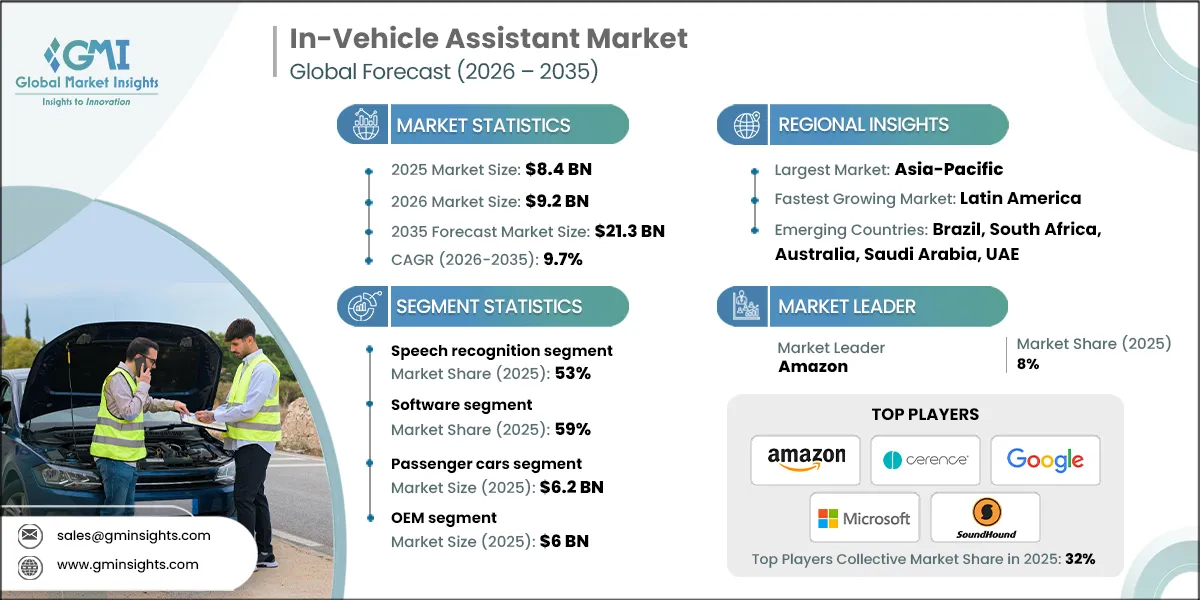
The global in-vehicle assistant market size was estimated at USD 8.4 billion in 2025. The market is expected to grow from USD 9.2 billion in 2026 to USD 21.3 billion in 2035, at a CAGR of 9.7% according to latest report published by Global Market Insights Inc.
In-Vehicle Assistant Market Key Takeaways
Market Size & Growth
- 2025 Market Size: USD 8.4 Billion
- 2026 Market Size: USD 9.2 Billion
- 2035 Forecast Market Size: USD 21.3 Billion
- CAGR (2026–2035): 9.7%
Regional Dominance
- Largest Market: Asia-Pacific
- Fastest Growing Region: Latin America
Key Market Drivers
- Increasing adoption of connected & smart vehicles.
- Rising consumer demand for safety & hands-free interaction.
- Expansion of electric and autonomous vehicles (EV/AV).
- Growth of aftermarket & software upgrades.
Challenges
- High OEM integration cost.
- Privacy & data security concerns.
Opportunity
- Integration of AI-driven assistants.
- Multimodal HMI adoption.
Key Players
- Market Leader: Amazon led with over 8% market share in 2025.
- Leading Players: Top 5 players in this market include Amazon, Cerence, Google, Microsoft, SoundHound, which collectively held a market share of 32% in 2025.
Get Market Insights & Growth Opportunities
The rapid progression of the connected smart vehicle sector continues apace, largely due to an increase in demand from consumers for safe and easy hands-free interaction with their vehicles and a growing commitment from OEMs worldwide to produce significant numbers of both electric and automated products. Major automotive OEMs including Tesla, Mercedes-Benz, BMW, and emerging Chinese manufacturers like NIO and XPeng are deploying large language model (LLM)-powered voice assistants.
The rise of the multimodal Human-Machine Interfaces (HMI) market emerged as an extension of voice HMI. The increasing use of LLMs (Large Language Models) for development of gadgets, platforms, and technologies provided automakers with opportunities to create new HMI products that integrate two or more modes of input including gesture, touch, and voice. This has resulted in greater acceptance of the use of multimodal HMIs in both premium segments and lower-end models.
The COVID-19 pandemic had a significant but mixed impact on the In-Vehicle Assistants market. As governments across the globe enacted lockdowns to combat the spread of viruses, the production and sale of automobiles around the world were interrupted by supply chain issues resulting from the closure of factories, shortages of components, and other issues associated with the pandemic. As such, the integration of voice assistants into new vehicles was temporarily hindered by these supply chain disruptions.
The Asia Pacific region has the highest market share of the global automotive product assistants. This growth is driven by total production volume by the thirty million annual vehicle manufacturing in China, with the implementation of the Government's Intelligent Connected Vehicle (ICV) mandate to ensure a voice-based emergency. The region has also developed robust domestic Artificial Intelligence (AI) platforms with low-cost solutions from Baidu DuerOS, Alibaba AliGenie, and Tencent Xiaowei with 94%+ accuracy scores for Mandarins.
Latin America is growing the fastest region, which is experiencing rapid growth in the number of voice assistants being used. Localization investment is expected to increase as local economic conditions become more stable and the overall economy stabilizes. Brazil is the largest economy in Latin America and has significant international companies currently working to develop and implement new Portuguese language localization capabilities on the voice assistant platforms of Google, Amazon, and Cerence.
To get key market trends
In-Vehicle Assistant Market Trends
The integration of generative artificial intelligence and large language models represents the most drastic change to date to the tech space that enables in-vehicle assistant’s technological capabilities and user experience. Tesla's use of the GPT-powered conversational AI across its Model S, Model 3, Model X and Model Y enables users to interact with their vehicle through natural language both for control of the vehicle and for navigation via voice commands.
The MBUX Hyperscreen in the EQS and EQE electric cars from Mercedes-Benz uses NVIDIA DRIVE AGX Orin chips to produce 254 TOPS (trillion operations/s). The combination of the chips with the MBUX allows for the ability to create real-time large language models for conversational exchanges, providing ongoing context and adapting responses based on user preferences.
Luxury or premium vehicles have been at the forefront of the AI integration trend. Currently this trend moved into lower-cost vehicles with the development of CARIAD (the Volkswagen Group's software platform) that will support hundreds of thousands of connected vehicles by 2030. The CARIAD platform has developed scalable voice-based artificial intelligence solutions for different manufacturers within the Volkswagen Group for their brand such as Volkswagen, Audi, Porsche and Skoda.
The implementation of a cloud-based connectivity infrastructure to support real-time data synchronization and over-the-air software updates is a major transformation that changes the way the in-vehicle assistant operates. The Ultifi platform, which was introduced by General Motors in 2023, offers OTA software updates to all 2024 model year Chevrolet, GMC, Buick & Cadillac vehicles along with the in-vehicle voice assistant.
By integrating voice, touch and gesture inputs into a new form of HMI, we are moving from the traditional single-mode vehicle interface to a more flexible multi-channel communication model between the vehicle and its occupants. The Mercedes-Benz MBUX represents the best example of this new form of multimodal leadership, as it combines a "Hey Mercedes" voice command with a touchscreen interface.
In-Vehicle Assistant Market Analysis
Learn more about the key segments shaping this market
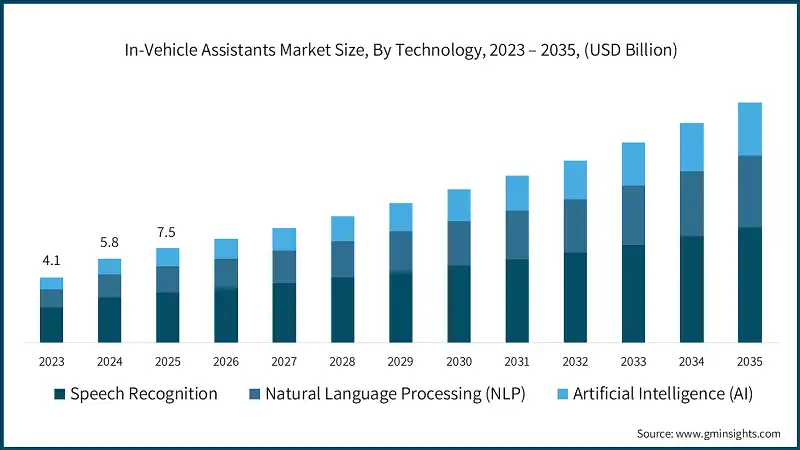
Based on technology, the in-vehicle assistant market is divided into Speech Recognition, Natural Language Processing (NLP), and Artificial Intelligence (AI). Speech recognition segment dominated the market accounting by 53% in 2025 and is expected to grow at a CAGR of 8.7% from 2026 to 2035.
- Speech recognition technology represents the foundational layer of voice assistant systems, converting acoustic audio signals from microphone arrays into textual transcriptions through automatic speech recognition (ASR) algorithms. Technology has essential role across all voice assistant implementations, with revenue derived from specialized automotive ASR software licensing, dedicated digital signal processor (DSP) chips for acoustic processing, and beamforming microphone.
- Natural Language Processing (NLP) technology enables voice assistants to perform conversational responses and allows them to respond with appropriate context, especially in applications where the interaction is more conversational than rigidly structured like "command-and-control". Revenue generated from NLP includes licensing fees for NLP platforms, developing intent classification models, and creating cloud services for complex language understanding.
- The artificial intelligence segment encompasses advanced capabilities beyond basic speech recognition and language understanding, including generative AI for conversational responses, predictive assistance anticipating user needs, personalization adapting to individual preferences, and multimodal AI integrating voice with vision and gesture inputs. In Jun 2023, Mercedes-Benz integrate the ChatGPT, the popular AI chatbot developed by OpenAI, implement in Mercedes-Benz User Experience (MBUX) feature in the United States.
Learn more about the key segments shaping this market
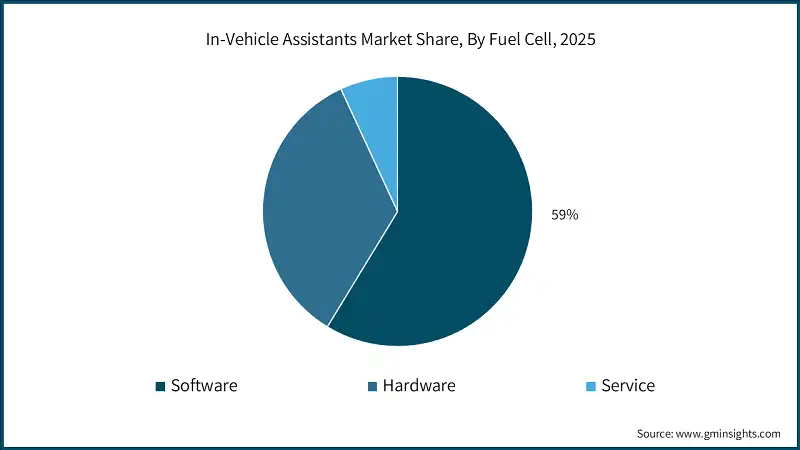
Based on component, in-vehicle assistant market is categorized into software, hardware, and service. Software segments dominated the market with 59% share in 2025, and the segment is expected to grow at a CAGR of 8.2% between 2026 to 2035.
- Software platforms include voice recognition and natural language processing engines, cloud processing and software update management systems, and APIs for integrating third-party applications with platforms. Different platform providers use different software licensing models to determine their pricing structure. Traditional automotive software vendors use a per-vehicle subscription model.
- Hardware components account for a huge portion of the market, because of the need for AI to run on the vehicle's edge with an increasing number of microphones integrated into the vehicle's hardware and increasingly sophisticated display screens for multimodal interaction. The fastest-growing hardware segment is AI accelerators; for example, the NVIDIA automotive-grade AI computing platforms are being implemented in Mercedes-Benz (EQS with NVIDIA DRIVE Orin 254 TOPS), Volvo (EX90 with NVIDIA DRIVE Orin 508 TOPS), and Lucid Air (dual NVIDIA Xavier 60 TOPS).
- The service segment of the automotive software market is growing at the fastest rate. This growth reflects the emergence of OEMs that are monetizing connected vehicle features using subscription services, ongoing cloud processing services, and value-added content. For example, General Motors has created a subscription service (OnStar) that bundles voice assistant capabilities with emergency services, vehicle diagnostics, and concierge services.
Based on vehicle, the in-vehicle assistant market is divided into passenger cars and commercial vehicles. Passenger cars dominate the market and were valued at USD 6.2 billion in 2025.
- The market for in-vehicle assistants is primarily driven by the popularity of entertainment, convenience features, and personalized capabilities of voice assistants in passenger vehicles. The use of generative AI in the integration of voice technology provides the ability to answer many natural language-based requests while providing contextual information and personalized answers.
- The commercial vehicles segment offers greater growth potential, due to the different value proposition of fleet management efficiency, driver safety compliance/monitoring and operational productivity versus entertainment of passenger vehicles. Companies such as UPS, FedEx, Amazon, and other regional delivery firms are equipping their existing commercial vehicle fleets with voice-enabled telematics.
Based on sales channel, the in-vehicle assistant market is divided into OEM and aftermarket. OEM is the largest segment in market and was valued at USD 6 billion in 2025.
- Original equipment manufacturer channel dominates, which reflects OEM strategic prioritization of integrated voice assistant experiences and consumer preference for factory-installed systems with comprehensive vehicle integration. Among the leading OEMs developing integrated voice platforms, the most prominent partnerships are displayed by GM's selection of Google Automotive Services across all 2024+ Chevrolet, GMC, Buick, Cadillac brand offerings, in favor of its proprietary OnStar platform. In using Google Assistant, Google Maps, and Google Play as integrated solutions for voice control.
- The aftermarket channel also has a growing number of retrofit opportunities for existing fleets of vehicles that do not currently feature factory-installed voice assistant capabilities. This channel is being driven by the customer demand for added capabilities, which are not available through OEMs, and by the emerging segment of consumers who are price conscious and therefore seek voice capabilities at an affordable price versus having to purchase a brand-new vehicle. The leading providers of voice assistants in the aftermarket channel include Pioneer's aftermarket head units with both Apple CarPlay and Android Auto, which also offer Siri and Google Assistant voice-control capabilities.
Looking for region specific data?
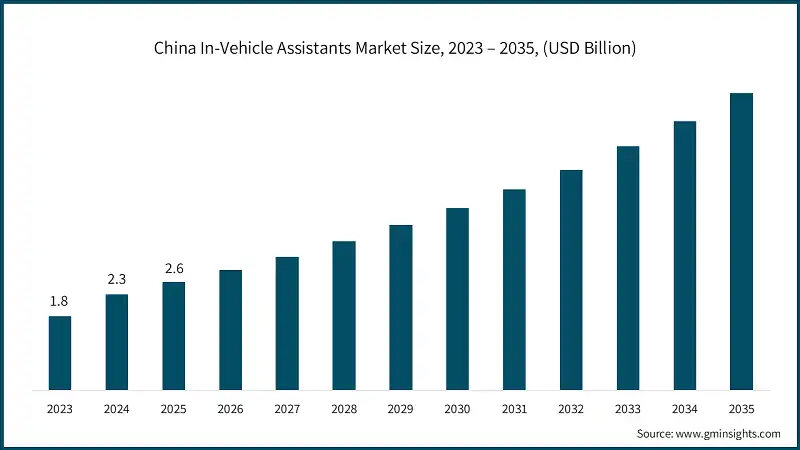
The China dominated Asia-Pacific in-vehicle assistant market with revenue of USD 2.6 billion in 2025.
- The market in China represents thirty million vehicles produced each year. The government's New Infrastructure Policy is focused on connecting vehicles to everything via vehicle-telematics and providing connectivity for voice assistants through the development of Smart Cities across China. In addition, the Ministry of Industry and Information Technology (MIIT) has mandated the implementation of voice-based emergency call functions in ICVs by 2026 and has allocated funds to manufacture ICVs.
- The market in Japan focuses on bona fide Kei Cars, driven by the need for voice integration in conjunction with the recent introduction of Toyota Safety Sense, Honda Sensing, and Nissan Safety Shield, which features driver-monitoring systems controlled by voice. The aging population of Japan represents 29% of the population aged sixty-five and older. The market in India is driven by the need to support multiple languages (22) and as a result, Google's voice recognition systems are also being used in India, and Cerence developed the first AI voice for the Indian market, supporting Hindi, Tamil, Telugu, Bengali, Marathi, and many more, with Hinglish (increasingly common).
US in-vehicle assistant market will grow tremendously with CAGR of 10% between 2026 and 2035.
- The United States currently accounts for the largest share of regional sales for voice-assistant-powered products. The U.S. region has major OEM headquarters in the area; majority of global technology suppliers; and the United States has one of the largest automotive markets, with more than 15 million new vehicles sold each year, providing sufficient scale for large-scale deployment of integrated voice assistants.
- Voice assistant usage trends in the U.S will be characterized primarily by advanced AI integration in the premium vehicle and electric vehicle marketplace, with Tesla, General Motors and Ford all deploying AI-assisted generative language models to their connected vehicle offerings.
- Canada's market is driven by two factors, as required by the Canadian Government; all devices must comply with Federal Language Bilingualism and provide English French dual language support via voice technology. Market characteristics include high smartphone penetration enabling Apple CarPlay and Android Auto voice control adoption, advanced telecommunications infrastructure supporting cloud-based voice processing, and insurance telematics programs from major carriers offering.
The Europe in-vehicle assistant market in Germany will experience robust growth during 2026-2035.
- The European market had a 14.3% share of the global market and has been growing at a rate of 11.0% per year due to the presence of many premium OEMs, GDPR-compliant technology, and rigorous government regulation. The presence of the many premium OEMs located in Germany is reflected in the German market and its growing automotive industry, including Mercedes-Benz, BMW, and Audi as the leaders in the integration of voice technology into their platforms through the usage of the MBUX (Mercedes-Benz User Experience), Intelligent Personal Assistant (BMW), and MMI Audi (Multimedia Interface).
- In the United Kingdom, the ongoing effects of the Brexit vote have led to the development of localized automotive software solutions, which differ significantly from those in the EU, with the most visible of these being the emphasis on training models to recognize British English dialects. France demonstrates Renault-Nissan-Mitsubishi Alliance adoption of Google Automotive Services with Renault Megane E-Tech and Nissan Ariya deploying Google Assistant, PSA Group (Stellantis) Amazon Alexa integration across Peugeot, Citroën, and DS brands.
The Brazil will experience robust growth of 13.1% between 2026 and 2035.
- Brazil's market focus on the development of Brazilian Portuguese language technology since the Brazilian dialect is different from the European Portuguese dialect and so the NLP of the Brazilian Portuguese dialect developed separately. The different regional dialects of Portuguese will also pose challenges for voice technology developers and Microsoft has also set up its AI research center in São Paulo, Brazil, specifically for the development of NLP for Brazilian Portuguese-speaking people.
- Economic instability continues to have an impact on Argentina, as it relates to the acceptance of voice technology. There also needs to be a localization of Spanish Rioplatense dialect with Italian influences as a separate voice recognition training model compared to Castilian or Mexican Spanish. Another consideration is how this technology will become available on CNG vehicles in this region.
UAE in-vehicle assistant market will grow tremendously with CAGR of 12.2% between 2026 and 2035.
- The UAE is another important region for luxury/higher-end automotive brands such as Mercedes-Benz, BMW, Lexus, and Range Rover. These brands have integrated comprehensive voice technology into their vehicle platforms. As such, the UAE has been developing voice technology solutions that support the Arabic language as well as other global languages to meet the needs of the local customer base.
- The growth of the automotive industry in Saudi Arabia is inextricably linked to the Vision 2030 initiative, which requires increased economic diversification and the expansion of the automotive sector. The establishment of manufacturing facilities, such as Lucid Motors’ plant in King Abdullah Economic City, supports large-scale EV production equipped with Arabic-English bilingual voice systems.
In-Vehicle Assistant Market Share
The top 7 companies in the market are Amazon, Cerence, Google, Microsoft, SoundHound, Apple, and Samsung. These companies hold around 32% of the market share in 2025.
- Cerence dominant as the provider of a purpose-built automotive voice recognition solution that has ultra-low latency, is capable of functioning in a noisy environment and does not require cellular connectivity for its safety-related commands to work offline. Its long-standing relationships with global automakers and ability to meet stringent automotive safety and reliability requirements make Cerence a foundational supplier in this market.
- Google to gain a significant amount of market share due to the adoption of the Android Automotive Operating System by several manufacturers has allowed. Google's bundle of services for automobiles (GAS) provides users with access to Google Assistant for their voice control as well as Google Maps for navigation, and the entire Google Play App Ecosystem.
- Amazon’s Alexa Auto platform being used in several major manufacturers' vehicles such as Ford, Lincoln, Stellantis, BMW, and Toyota. The integration of Alexa with Smart Home Control, Amazon Shopping, and the third-party Alexa Skills ecosystem creates a unique ecosystem of convenience for the consumer. The implementation of Alexa Auto utilizes dedicated automotive-optimized micro-phones that are installed in vehicles as well as dedicated automotive-optimized.
- Microsoft has gained access to the automotive sector due to its acquisition of Nuance Communications, a company that has a long history of providing voice recognition technology to the automobile industry. Microsoft's acquisition of Nuance will enable it to provide the full range of Nuance's automotive voice technology offerings as well as the infrastructure for deploying Azure cloud-based artificial intelligence data center workloads.
- SoundHound is a voice AI company that specializes in developing fast and conversationally productive natural language understanding (NLU) in an automotive context. The company has developed multiple deployment methods that give OEMs more flexibility in deploying their brand on the vehicles and controlling the data collected.
- Samsung is a Tier 1 automotive supplier. The company integrates voice assistant functionality into its infotainment systems and digital cockpit products. Harman's business model allows them to bring together all three components of the ecosystem to deliver customer-specific solutions using the OEM's voice platform. Harman has strengths in system integration, the global OEM marketplace, and the ability to bundle voice assistant technology within the greater context of the connected vehicle and audio experience.
- Apple's primary influence in the automotive voice assistant market is through its Siri integration with CarPlay and the extension of the iOS ecosystem to vehicles. While Apple does not have a history of providing OEMs with deeply embedded voice systems, the company's impact on the market is based on a high degree of consumer adoption and brand loyalty. The company's strategy focuses more on customer experience, user privacy and seamless transition between a customer's smartphone and their vehicle than on competing in the space of OEM deep integration of voice AI systems.
In-Vehicle Assistant Market Companies
Major players operating in the low-speed vehicle industry include:
- Amazon
- Apple
- Cerence
- Continental
- Microsoft
- Nuance
- Panasonic Automotive
- Samsung
- SoundHound
- The low-speed vehicle market has an extremely competitive marketplace with a combination of global players, specialist regional companies, and emerging niche companies. The major brands of Samsung, Bose and Sony are the leading premium and connected audio speaker manufacturers and provide multi-way, subwoofer, and smart infotainment systems that appeal to both OEM customers and the Luxury Vehicle market segments.
- Panasonic and Pioneer support OEM and aftermarket solutions to the automotive speaker category by focusing on cost-efficient, reliable mass-production solutions, while Kenwood focuses on the functional mid-level. All with extensive compatibility. Boutique high-end audio manufacturers like Bang & Olufsen focus solely on providing high-end audio systems for the audiophile category through acoustics, aesthetic appeal, and brand prestige.
- The competitive landscape is primarily defined through technology integration, brand partnerships, and diverging market segments such as premium positioning is based on OEM collaborations, while the aftermarket aspirational and cost-conscious demographics are best served through aftermarket brands. OEMs are integrating wireless connectivity, Bluetooth-enabled systems, and sound systems optimized for Electric Vehicles, as a minimum expectation for differentiation among brands.
In-Vehicle Assistant Market Report Attributes
| Key Takeaway | Details |
|---|---|
| Market Size & Growth | |
| Base Year | 2025 |
| Market Size in 2025 | USD 8.4 Billion |
| Market Size in 2026 | USD 9.2 Billion |
| Forecast Period 2026 - 2035 CAGR | 9.7% |
| Market Size in 2035 | USD 21.3 Billion |
| Key Market Trends | |
| Drivers | Impact |
| Increasing adoption of connected & smart vehicles | More vehicles now support infotainment, AI assistants, and app integration, driving in-vehicle assistant deployment. |
| Rising consumer demand for safety & hands-free interaction | Regulations and customer preference for distraction-free driving encourage OEMs to integrate voice assistants. |
| Expansion of electric and autonomous vehicles (EV/AV) | Quieter cabins in EVs and autonomous vehicles make voice interaction more prominent; AVs require more intelligent HMI. |
| Growth of aftermarket & software upgrades | Fleet operators and tech-savvy consumers upgrade vehicles with voice assistant systems or enhanced AI modules. |
| Pitfalls & Challenges | Impact |
| High OEM integration cost | AI software, sensors, cloud connectivity, and licensing increase vehicle costs, limiting adoption in economic segments. |
| Privacy & data security concerns | Consumers and regulators are cautious about voice data collection, slowing adoption. |
| Opportunities: | Impact |
| Integration of AI-driven assistants | Systems increasingly include generative AI or predictive assistance for navigation, infotainment, and personalization. |
| Multimodal HMI adoption | Combines voice, touch, and gesture input for enhanced interaction, improving adoption in premium and mainstream vehicles. |
| Market Leaders (2025) | |
| Market Leaders |
8% market share |
| Top Players |
|
| Competitive Edge |
|
| Regional Insights | |
| Largest Market | Asia-Pacific |
| Fastest growing market | Latin America |
| Emerging countries | Brazil, South Africa, Australia, Saudi Arabia, UAE |
| Future outlook |
|
What are the growth opportunities in this market?
In-Vehicle Assistant Industry News
- In January 2026, HERE Technologies and Amazon announced a collaboration to deliver an AI-powered navigation solution for vehicles, combining HERE’s digital mapping and location intelligence with Amazon’s conversational AI capabilities. The partnership enables automakers to deploy branded, voice-driven navigation experiences across multiple vehicle segments, reinforcing the shift toward software-defined, customizable in-vehicle assistants and reducing OEM dependence on generic navigation platforms.
- In October 2025, General Motors announced phase out Apple CarPlay and Android Auto from the entire GM vehicle lineup, including internal combustion engine vehicles as part of the overall transition to a unified, in-house software platform. This move represents a broader trend in the automotive industry to have OEMs control the infotainment and voice assistant ecosystems allowing manufacturers to have greater control over end-user data.
- In September 2024, Samsung Electronics established a strategic technology partnership with Hyundai Motor and Kia to integrate the SmartThings IoT platform into their software-defined vehicles. The partnership will strengthen in-vehicle assistants through seamless integration with smart devices outside the vehicle, enabling more contextual and AI-driven voice interactions.
- In August 2024, Volkswagen announced to integrating ChatGPT, an AI-powered chatbot, into its IDA voice assistant in select vehicle models. This move demonstrates the increasing use of generative AI technology in in-vehicle assistants that will enhance conversational capability, natural language processing abilities, and overall user engagement, placing voice interactions at the center of the next generation of infotainment systems.
The in-vehicle assistant market research report includes in-depth coverage of the industry with estimates & revenue ($Bn) and volume (Units) from 2022 to 2035, for the following segments:
Market, By Technology
- Speech Recognition
- Natural Language Processing (NLP)
- Artificial Intelligence (AI)
Market, By Component
- Software
- Embedded software
- Cloud-based software
- Ai-powered software
- Hardware
- Microphones
- Speakers
- Control units
- Display panels
- Service
- Integration and deployment
- Maintenance and support
- Consulting services
Market, By Vehicle
- Passenger Cars
- Sedans
- Hatchbacks
- SUVs
- Commercial Vehicles
- Light commercial vehicles (LCV)
- Medium commercial vehicles (MCV)
- Heavy commercial vehicles (HCV)
Market, By Application
- Navigation
- Entertainment
- Communication
- Others
Market, By Sales Channel
- OEM
- Aftermarket
The above information is provided for the following regions and countries:
- North America
- US
- Canada
- Europe
- UK
- Germany
- France
- Italy
- Spain
- Belgium
- Netherlands
- Sweden
- Russia
- Asia Pacific
- China
- India
- Japan
- Australia
- Singapore
- South Korea
- Vietnam
- Indonesia
- Latin America
- Brazil
- Mexico
- Argentina
- MEA
- South Africa
- Saudi Arabia
- UAE
Frequently Asked Question(FAQ) :
What is the market size of the in-vehicle assistant in 2025?
The market size was estimated at USD 8.4 billion in 2025, with a CAGR of 9.7% expected through 2035. The growth is driven by increasing demand for hands-free vehicle interaction and the adoption of electric and automated vehicles.
What is the projected value of the in-vehicle assistant market by 2035?
The market is poised to reach USD 21.3 billion by 2035, fueled by advancements in generative AI, large language models, and multimodal interfaces.
What is the expected size of the in-vehicle assistant industry in 2026?
The market size is projected to reach USD 9.2 billion in 2026.
What was the market share of the speech recognition segment in 2025?
The speech recognition segment accounted for 53% of the market in 2025 and is expected to grow at a CAGR of 8.7% till 2035.
What was the market share of the software segment in 2025?
The software segment dominated the market with a 59% share in 2025 and is set to expand at a CAGR of 8.2% between 2026 and 2035.
What was the valuation of the passenger car segment in 2025?
The passenger car segment was valued at USD 6.2 billion in 2025, led by the popularity of entertainment, convenience features, and personalized voice assistant capabilities.
Which region dominated the Asia-Pacific in-vehicle assistant sector in 2025?
China dominated the Asia-Pacific market with revenue of USD 2.6 billion in 2025.
What are the upcoming trends in the in-vehicle assistant market?
Integration of generative AI/LLMs, multimodal interfaces (voice, touch, gesture), cloud connectivity for real-time sync, and OTA software updates.
Who are the key players in the in-vehicle assistant industry?
Key players include Amazon, Apple, Cerence, Continental, Google, Microsoft, Nuance, Panasonic Automotive, Samsung, and SoundHound.
In-Vehicle Assistant Market Scope
Related Reports