Summary
Table of Content

In-circuit Test Market
Get a free sample of this report
Form submitted successfully!
Error submitting form. Please try again.
Thank you!
Your inquiry has been received. Our team will reach out to you with the required details via email. To ensure that you don't miss their response, kindly remember to check your spam folder as well!
Request Sectional Data
Thank you!
Your inquiry has been received. Our team will reach out to you with the required details via email. To ensure that you don't miss their response, kindly remember to check your spam folder as well!
Form submitted successfully!
Error submitting form. Please try again.
In-circuit Test Market Size
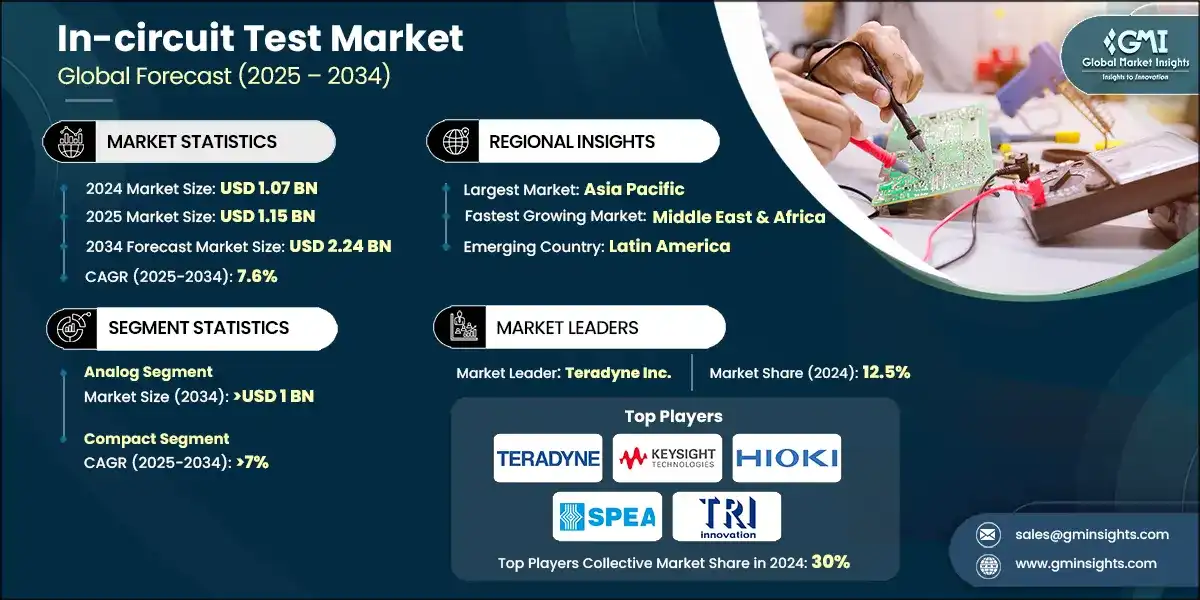
The global in-circuit test market size was valued at USD 1.07 billion in 2024. The market is expected to grow from USD 1.15 billion in 2025 to USD 2.24 billion in 2034, at a CAGR of 7.6%, according to Global Market Insights Inc.
In-circuit Test Market Key Takeaways
Market Size & Growth
- 2024 Market Size: USD 1.07 Billion
- 2025 Market Size: USD 1.15 Billion
- 2034 Forecast Market Size: USD 2.24 Billion
- CAGR (2025–2034): 7.6%
Regional Dominance
- Largest Market: Asia Pacific
- Fastest Growing Region: Middle East & Africa
Key Market Drivers
- Government Investment in Electronics Manufacturing.
- Rising Complexity of Electronic Devices.
Challenges
- High Initial Setup Cost.
Opportunity
- Growth in Electric Vehicles (EVs).
Key Players
- Market Leader: Teradyne Inc. led with over 12.5% market share in 2024.
- Leading Players: Top 5 players in this market include Teradyne Inc, Keysight Technologies, HIOKI E.E. Corporation, SPEA S.p.A, Test Research, Inc., which collectively held a market share of 30% in 2024.
Get Market Insights & Growth Opportunities
- In-Circuit Testing (ICT) is a critical process in electronics manufacturing, used to verify the integrity and functionality of printed circuit boards (PCBs). It checks for defects such as open circuits, shorts, incorrect component placement, and soldering issues. As electronic devices become more compact and complex, ICT ensures high reliability and performance standards. Its role is especially vital in industries like automotive, aerospace, telecommunications, and medical devices, where failure can have serious consequences.
- Globally, governments are investing heavily in electronics manufacturing and testing infrastructure to reduce dependency on foreign supply chains. For example, the U.S. Department of Commerce reported that only 2% of semiconductor assembly, testing, and packaging occurs domestically. In response, the CHIPS and Science Act allocated over USD 32 billion to boost local semiconductor capabilities, including testing. This initiative is expected to create over 115,000 jobs, many of which will support ICT operations. Such policy-driven growth directly fuels demand for advanced testing systems.
- The expansion of the in-circuit test market is also supported by a growing technical workforce. According to the U.S. Bureau of Labor Statistics, there were approximately 287,900 electrical and electronics engineers in 2024. The profession is projected to grow by 7% over the next decade, adding nearly 17,500 new jobs annually. These engineers are essential for designing, implementing, and maintaining ICT systems. A larger, more skilled workforce enables manufacturers to scale up testing operations and meet rising quality demands.
- Outside the U.S., countries like China, Taiwan, and South Korea are leading global semiconductor production. In 2022, China accounted for 32% of global semiconductor value-added output, followed by Taiwan (19%), the U.S. (18%), and South Korea (12%). Since ICT is a core part of the assembly and testing phase, these figures reflect the growing global demand for in-circuit testing. As these nations expand their electronics manufacturing capabilities, ICT systems are increasingly deployed to ensure product quality and compliance.
- The in-circuit test market is experiencing robust global growth, driven by government investments, workforce development, and rising electronics production. With strategic initiatives aimed at strengthening domestic testing infrastructure and a steady increase in skilled professionals, ICT is becoming more widespread and sophisticated. As industries demand higher reliability and faster production cycles, ICT will continue to evolve as a cornerstone of electronics manufacturing worldwide.
To get key market trends
In-Circuit Test Market Trends
- ICT systems are rapidly evolving within Industry 4.0 frameworks, integrating with IoT, AI, and predictive analytics. Governments in semiconductor-leading nations are supporting “smart factory” initiatives. For example, SEMI’s 2025 Semiconductor Assembly & Test Facility Database now lists more than 750 operating assembly and test sites, up by 70 year-over-year, highlighting global expansion of test infrastructure. This growth allows ICT equipment to feed real-time data into analytics platforms, empowering predictive maintenance and reducing unplanned downtime.
- Electronic spanning consumer devices, satellites, and medical wearables are becoming increasingly compact, with PCB densities rising. Governments have reported a 23% increase in automated optical inspection (AOI) adoption since 2022, driven by precision constraints on small boards where manual inspection fails. ICT solutions are evolving with fine-pitch probing and micro-pin fixtures designed to detect ultra-small defects accurately, enabling high-yield production despite shrinking form factors.
- The rollout of 5G infrastructure and consumer devices has accelerated demand for high-frequency testing. Government communications authorities in regions such as North America and Europe report over 450 certified 5G network launches since 2023, requiring compliance with tight signal integrity standards. ICT equipment providers are now incorporating high-speed signal testing capabilities and advanced timing analysis to ensure PCBs meet 5G bandwidth and performance requirements.
- Electric vehicles (EVs) and Advanced Driver-Assistance Systems (ADAS) are driving surging demand for ICT in automotive production. Governments, especially in Europe and China, have reported that semiconductor assembly & testing facilities in automotive supply chains expanded by over 30% in 2023, reflecting increased local capacity. ICT systems tailored for battery management PCBs, power electronics, and safety-critical systems ensure robust quality control and compliance with automotive standards.
- Environmental regulations are pushing manufacturers to minimize electronic waste and maximize yield. In response, ICT equipment now integrates features like adaptive test profiles, AI-based fault detection, and reduced energy modes, aligning with government sustainability targets. For instance, the EU’s circular electronics initiative encourages electronics-makers to adopt technologies such as ICT to reduce defective units and extend device longevity, thereby aligning test practices with broader environmental goals.
In-Circuit Test Market Analysis
Learn more about the key segments shaping this market
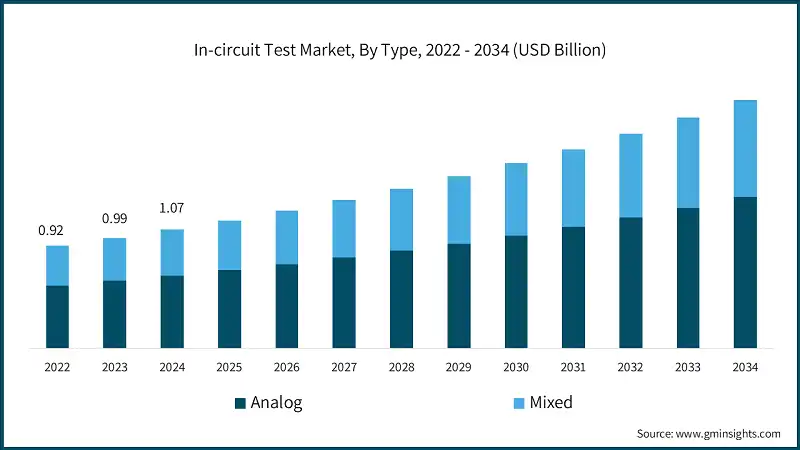
- The in-circuit test industry was valued at USD 0.92 billion, USD 0.99 billion and USD 1.07 billion in 2022, 2023 and 2024 respectively. Analog and mixed-signal segments are not niche, they are foundational to EV powertrains, 5G connectivity, and industrial automation. With governments investing billions in semiconductor ecosystems and official data showing rapid EV and 5G adoption, ICT solutions for these segments will remain central to ensuring quality, safety, and global competitiveness.
- Based on type, analog segment is anticipated to cross USD 1 billion by 2034 since it dominates in power management, sensor interfaces, and audio systems. For example, the U.S. Department of Energy reported that EV battery systems require precise analog monitoring for voltage and current, ensuring safety and efficiency in electric vehicles. With EV adoption accelerating over 1.4 million EVs sold in the U.S. in 2023 (DOE data), ICT for analog circuits is indispensable to validate these critical components before deployment.
- Mixed-signal PCBs integrate analog sensing with digital processing, crucial for IoT, 5G, and automotive electronics. According to the Federal Communications Commission (FCC), over 450 5G networks were operational globally by 2024, demanding robust mixed-signal testing for RF modules and baseband processors. ICT systems ensure these boards meet stringent performance standards, reducing failures in high-frequency applications.
- Government initiatives in semiconductor manufacturing amplify the need for analog and mixed-signal ICT. Europe’s IPCEI program supports analog sensor and mixed-signal chip development for automotive safety, reinforcing ICT’s role in compliance and reliability.
- The future of ICT in analog and mixed-signal testing lies in AI-driven diagnostics and energy-efficient test systems. The EU’s circular electronics initiative encourages manufacturers to adopt technologies that reduce waste and extend device life. ICT platforms are evolving with adaptive test profiles and predictive analytics, aligning with global sustainability and smart manufacturing goals.
Learn more about the key segments shaping this market
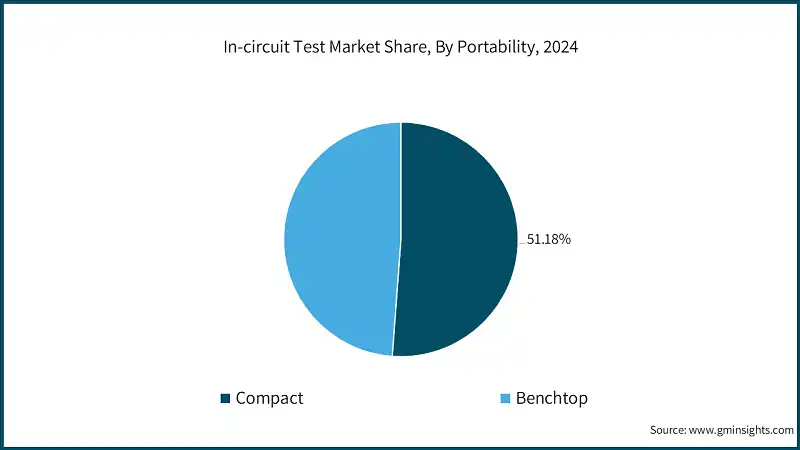
- Based on portability, the compact segment is expected to grow with CAGR of more than 7% by 2034. The compact segment in the in-circuit test (ICT) market is gaining traction because manufacturers increasingly need space-efficient, portable testing solutions for high-density PCBs and flexible production lines. Compact ICT systems reduce floor space, lower fixture costs, and enable quick deployment in modular or mobile assembly setups.
- The compact ICT segment is expected to grow rapidly because it addresses critical challenges in modern electronics manufacturing, space constraints, cost efficiency, and adaptability. As production lines become more modular and global demand for EVs, IoT, and 5G devices rises, compact ICT systems will remain essential. Their portability, combined with advanced features like cloud connectivity and smart analytics, positions them as a cornerstone of next-generation testing strategies.
- Benchtop ICT systems are widely used during product development stages. For example, the U.S. Department of Defense emphasizes rigorous testing for mission-critical electronics in aerospace and defense projects, where prototypes undergo multiple validation cycles before mass production. Benchtop ICT enables engineers to perform accurate component-level checks without investing in large-scale automated systems.
- Government-backed technical education programs also rely on benchtop ICT systems. According to India’s Ministry of Skill Development, over 500 electronics training centers were established under the Skill India initiative, many equipped with benchtop testers for hands-on PCB diagnostics. These systems help students and researchers learn fault detection techniques, supporting workforce development for the growing electronics sector.
- Benchtop ICT systems are cost-effective compared to inline testers, making them attractive for small and medium enterprises (SMEs). For instance, Japan’s METI reported that over 70% of electronics SMEs operate in facilities under 500 square meters, where space constraints favor benchtop solutions. Their portability allows easy relocation within labs or production floors, supporting flexible workflows without major infrastructure changes.
- As electronics become more complex, benchtop ICT systems are evolving with advanced features like AI-driven fault analysis, cloud connectivity, and mixed-signal testing capabilities. These enhancements make them suitable for emerging sectors such as IoT and medical devices, where small-batch production and rapid prototyping dominate. With governments investing in R&D and skill development, benchtop ICT will remain a cornerstone for innovation and quality assurance.
Looking for region specific data?
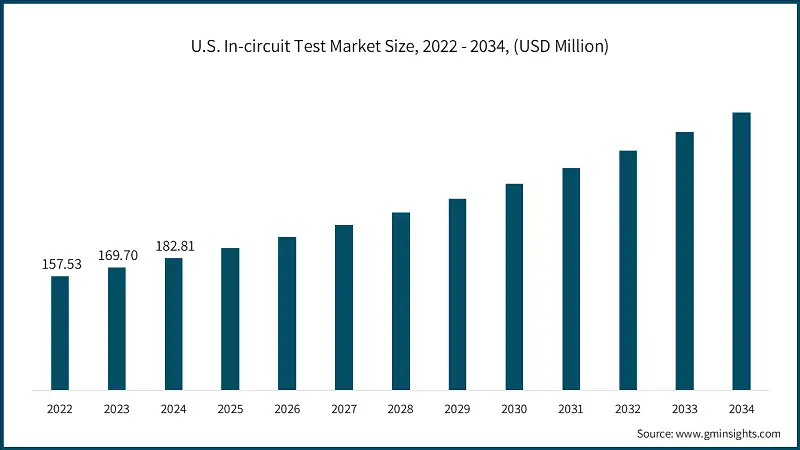
- The U.S. in-circuit test market in 2022, 2023 and 2024 was valued at USD 157.53 million, USD 169.70 million and USD 182.81 million respectively. This upward trend reflects strong demand for PCB testing driven by domestic semiconductor initiatives and advanced electronics manufacturing.
- Europe is also witnessing similar momentum, driven by the IPCEI (Important Projects of Common European Interest) program, which funds semiconductor and electronics testing projects. The European Commission reported that EV registrations in the EU crossed 3.2 million units in 2023, creating demand for ICT systems in automotive electronics. Additionally, Europe’s Green Deal emphasizes sustainable electronics manufacturing, pushing companies to adopt ICT solutions that minimize waste and improve yield during PCB production.
- Asia-Pacific remains the global hub for electronics manufacturing, with countries like China, Japan, and South Korea leading semiconductor production. According to Japan’s METI, subsidies exceeding USD 8 billion were allocated for semiconductor testing and packaging facilities in 2023, emphasizing precision testing for analog and mixed-signal PCBs.
- The Middle East in-circuit test market is also growing steadily, driven by diversification programs and smart manufacturing initiatives. According to the Saudi Ministry of Industry and Mineral Resources, electronics manufacturing investments under Vision 2030 exceeded to approximately USD 1.33 billion, with a significant portion allocated to PCB assembly and testing facilities. Similarly, the UAE Ministry of Economy reported that over 1,200 industrial licenses for electronics and semiconductor-related activities were issued in 2024, marking a 15% increase from 2023.
- By 2025, Saudi Arabia plans to establish three advanced electronics clusters, including dedicated test and validation centers for automotive and defense electronics. The GCC region’s EV adoption programs with targets of 50,000 EVs on roads by 2025 will require rigorous PCB testing for battery and control systems, creating demand for ICT solutions. These government-backed initiatives show that the Middle East is positioning itself as a strategic electronics hub, with in-circuit test systems playing a critical role in multiple sectors.
In-circuit Test Market Share
Top 5 companies including Teradyne Inc, Keysight Technologies, HIOKI E.E. Corporation, SPEA S.p.A, and Test Research, Inc. hold more than 30% of the market around the world. The major companies consistently work on new products and solutions which makes them a crucial part of the industry globally. These companies place a high focus on investment, especially on research and development. Besides, these companies apply different methods of market development in order to obtain considerable shares in the industry.
In-circuit Test Market Companies
- Teradyne Inc: Teradyne Inc. is a global leader in automated test equipment, offering advanced In-Circuit Test (ICT) solutions through its TestStation family. These systems support scalable configurations from small analog boards to complex mixed-signal PCBs, integrating boundary-scan and functional testing. Teradyne emphasizes speed, flexibility, and factory analytics with its Smart4Metrics software, making it ideal for high-volume electronics manufacturing in automotive, aerospace, and consumer sectors.
- Keysight Technologies: Keysight Technologies provides cutting-edge ICT systems, notably the i3070 Series and i1000 platforms, designed for high-density PCB testing. These solutions feature modular architecture, high node count capability, and Industry 4.0 integration for smart factories. Keysight’s ICT systems are widely adopted in automotive, telecom, and IoT industries, ensuring precision, compliance, and reduced test cycle times.
Major players operating in the in-circuit test industry are:
- A.T.E Solutions Ltd.
- Acculogic
- Checksum
- Digitaltest GmbH
- EMSG
- HIOKI E.E. Corporation
- INGUN
- Keysight Technologies
- KONRAD GmbH
- Kyoritsu Electric Corporation
- OKANO Electric
- Optima Technology Associates, Inc.
- Rigiflex Technology Inc.
- Seica S.p.A
- SPEA S.P.A
- Teradyne Inc
- TEST Research
- TESTRONICS
In-circuit Test Market Report Attributes
| Key Takeaway | Details |
|---|---|
| Market Size & Growth | |
| Base Year | 2024 |
| Market Size in 2024 | USD 1.07 Billion |
| Market Size in 2025 | USD 1.15 Billion |
| Forecast Period 2025 - 2034 CAGR | 7.6% |
| Market Size in 2034 | USD 2.24 Billion |
| Key Market Trends | |
| Drivers | Impact |
| Government Investment in Electronics Manufacturing | National programs like the U.S. CHIPS Act and India’s PLI Scheme are boosting domestic electronics production. These initiatives fund infrastructure for testing and packaging, directly increasing demand for ICT systems to ensure quality and reliability in high-volume manufacturing environments. |
| Rising Complexity of Electronic Devices | Modern electronics especially in automotive, aerospace, and medical sectors require densely packed PCBs with minimal tolerance for defects. ICT is essential for detecting faults early in production, making it a critical tool as manufacturers strive for higher precision and reliability in increasingly complex designs. |
| Pitfalls & Challenges | Impact |
| High Initial Setup Cost | Implementing In-Circuit Test systems requires significant upfront investment in fixtures, programming, and equipment. For low-volume or prototype production, this cost may outweigh the benefits, making ICT less viable for small manufacturers or startups aiming for flexibility and cost-efficiency in early-stage development. |
| Opportunities: | Impact |
| Growth in Electric Vehicles (EVs) | The rapid expansion of the EV industry presents a major opportunity for ICT systems. EVs rely on complex electronic control units and battery management systems, all requiring rigorous PCB testing. As governments push for EV adoption, ICT demand rises to ensure safety, reliability, and compliance in automotive electronics. |
| Market Leaders (2024) | |
| Market Leaders |
12.5% market share |
| Top Players |
Collective market share in 2024 is 30% |
| Competitive Edge |
|
| Regional Insights | |
| Largest Market | Asia Pacific |
| Fastest Growing Market | Middle East & Africa |
| Emerging Region | Latin America |
| Future outlook |
|
What are the growth opportunities in this market?
In-circuit Test Industry News
- In October 2025 Keysight Technologies announced that it has completed its acquisition of Spirent Communications plc. This acquisition will accelerate its strategy and positions them to deliver even greater value in a rapidly evolving technology landscape.
- In January 2025, Teradyne, Inc. announced that they have entered into a strategic partnership to advance power semiconductor test. As part of the strengthened relationship, Teradyne will acquire part of Infineon’s automated test equipment team (AET) in Regensburg, Germany. This acquisition provides mutual benefits for both companies. With additional resources and expertise, Teradyne will accelerate its roadmap in the power semiconductor segment while collaborating on new solutions with a key market leader.
- In November 2023, Keysight Technologies, Inc. introduced the new Keysight i3070 Series 7i in-line test system, an automated in-circuit test system (ICT), offering increased capacity and throughput, that enables manufacturers to economically meet the complex test demands of larger node count printed circuit board assembly (PCBAs).
This in-circuit test market research report includes in-depth coverage of the industry with estimates & forecast in terms of “USD Million” from 2021 to 2034, for the following segments:
Market, By Type
- Analog
- Mixed
Market, By Portability
- Compact
- Benchtop
Market, By Application
- Energy & power
- Aerospace & defence
- Wireless communication
- Consumer electronics
- Medical equipment manufacturing
- Automotive
- Others
The above information has been provided for the following regions and countries:
- North America
- U.S.
- Canada
- Mexico
- Europe
- UK
- France
- Germany
- Italy
- Russia
- Spain
- Asia Pacific
- China
- Australia
- India
- Japan
- South Korea
- Middle East & Africa
- Saudi Arabia
- UAE
- Turkey
- South Africa
- Egypt
- Latin America
- Brazil
- Argentina
Frequently Asked Question(FAQ) :
What is the market size of the in-circuit test in 2024?
The market size was USD 1.07 billion in 2024, with a CAGR of 7.6% expected through 2034 driven by rising need for fault detection and reliability in densely packed PCBs used across automotive, aerospace, and medical electronics.
What is the projected value of the in-circuit test market by 2034?
The in-circuit test market is expected to reach USD 2.24 billion by 2034, propelled by government investments in electronics manufacturing, rising complexity of electronic devices, and growth in electric vehicles.
What is the current in-circuit test market size in 2025?
The market size is projected to reach USD 1.15 billion in 2025.
How much revenue did the analog segment generate in 2024?
The analog segment is anticipated to cross USD 1 billion by 2034, led by demand in power management, sensor interfaces, and EV battery systems requiring precise monitoring.
What is the growth outlook for the compact segment from 2025 to 2034?
The compact segment is expected to grow at a CAGR of more than 7% through 2034, supported by space-efficient, portable testing solutions for high-density PCBs and flexible production lines.
Which region leads the in-circuit test market?
The U.S. in-circuit test market size exceeded USD 182.8 million in 2024, fueled by rising PCB testing demand from semiconductor initiatives and advanced electronics manufacturing.
What are the upcoming trends in the in-circuit test market?
Key trends include integration with Industry 4.0 frameworks (IoT, AI, predictive analytics), evolution for miniaturized electronics with fine-pitch probing, high-frequency testing for 5G infrastructure, and AI-driven diagnostics aligned with sustainability goals.
Who are the key players in the in-circuit test market?
Key players include Teradyne Inc, Keysight Technologies, HIOKI E.E. Corporation, SPEA S.p.A, Test Research Inc, A.T.E Solutions Ltd., Acculogic, Checksum, Digitaltest GmbH, EMSG, INGUN, KONRAD GmbH, Kyoritsu Electric Corporation, OKANO Electric, Optima Technology Associates Inc., Rigiflex Technology Inc., Seica S.p.A, and TESTRONICS.
In-circuit Test Market Scope
Related Reports