Summary
Table of Content

Hydropower Market
Get a free sample of this report
Form submitted successfully!
Error submitting form. Please try again.
Thank you!
Your inquiry has been received. Our team will reach out to you with the required details via email. To ensure that you don't miss their response, kindly remember to check your spam folder as well!
Request Sectional Data
Thank you!
Your inquiry has been received. Our team will reach out to you with the required details via email. To ensure that you don't miss their response, kindly remember to check your spam folder as well!
Form submitted successfully!
Error submitting form. Please try again.
Hydropower Market Size
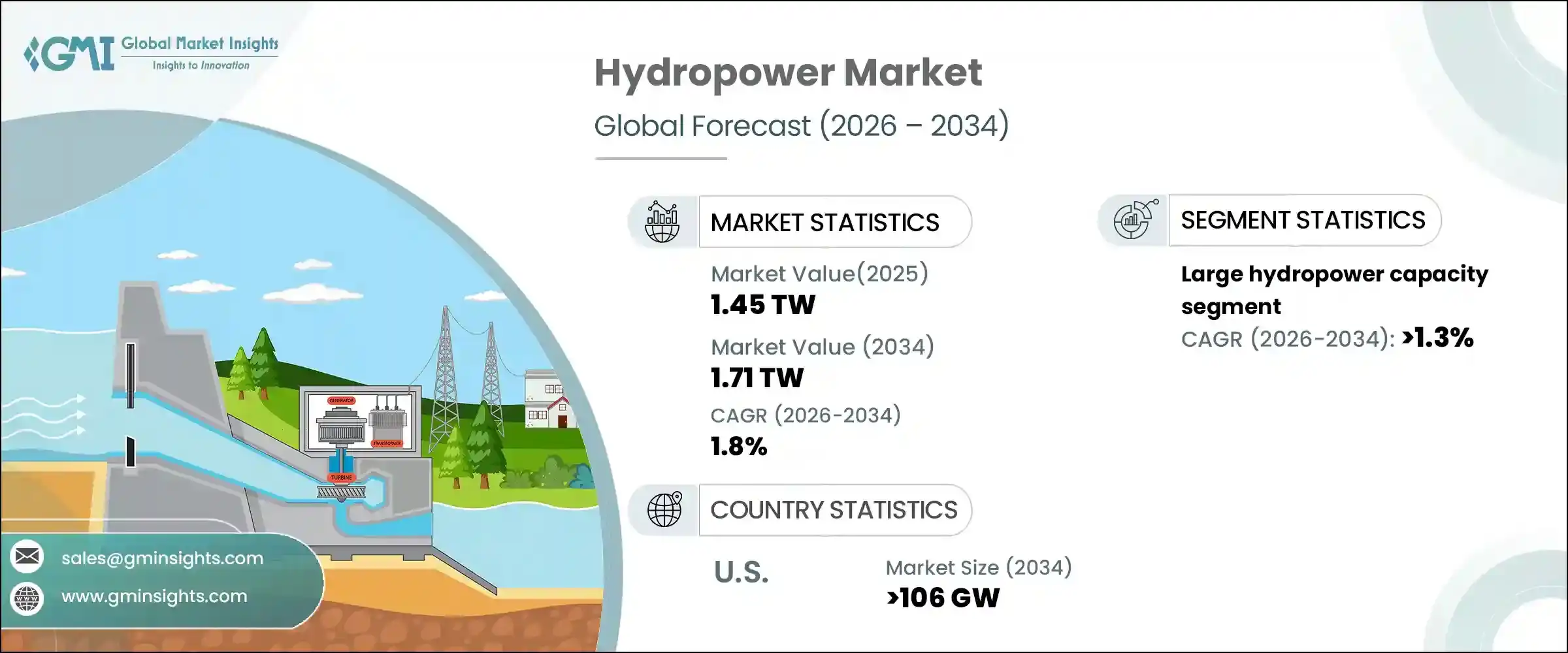
The global hydropower market reached an installed capacity of 1.45 TW in 2025 and is expected to expand at a CAGR of 1.8% from 2026 to 2034. This growth reflects the continued shift by governments and utilities toward renewable energy systems that support long-term sustainability goals and energy security. As one of the most established renewable power sources, hydropower remains a cornerstone of clean electricity generation due to its reliability, scalability, and low carbon footprint.
Hydropower Market Key Takeaways
Market Size & Growth
- 2025 Market Size: 1.45 TW
- 2035 Forecast Market Size: 1.71 TW
- CAGR (2026–2035): 1.8%
Key Market Drivers
- Positive outlook towards renewable energy.
- Growing demand for electricity.
- Favorable government initiatives.
Challenges
- High initial investment for large hydropower.
Get Market Insights & Growth Opportunities
The steady expansion of the hydropower generation market is primarily driven by the rising demand for carbon-free power solutions, supported by favorable government incentives, renewable energy mandates, and climate-focused policies. These factors are accelerating investment across the hydropower value chain, including generation assets, transmission integration, and auxiliary equipment such as turbines and hydro-generators.
While large-scale dams and reservoirs have historically dominated the market, there is growing momentum in small and decentralized hydropower projects, particularly in developing and energy-deficit regions. These projects enhance local energy access, reduce grid congestion, and offer a cost-effective alternative for rural and off-grid electrification, strengthening overall grid stability.
Technological innovation is reshaping the outlook of the hydropower plant market. Advancements in turbine engineering, digital automation, and condition monitoring are improving operational efficiency and extending the lifecycle of existing installations. As a result, segments such as the hydropower turbine market size and the hydro-generators market are witnessing consistent demand from both new installations and modernization projects.
A notable trend supporting long-term growth is the increasing deployment of pumped storage hydropower, which provides large-scale energy storage and grid-balancing capabilities. This is strengthening the role of hydropower in supporting variable renewable sources such as wind and solar.
At the same time, the hydropower plant construction market continues to evolve, with a stronger emphasis on environmentally responsible design, sediment management, and ecosystem protection. Insights from the hydropower plant construction market report and hydropower plant market report highlight a gradual shift toward refurbishment, capacity expansion, and efficiency upgrades alongside selective greenfield projects.
To get key market trends
Hydropower Market Trends

Learn more about the key segments shaping this market
The global transition toward decarbonization remains a primary growth driver for the hydroelectric power generation market, as countries accelerate efforts to reduce carbon emissions and achieve net-zero targets. Hydropower continues to be recognized as a reliable and scalable renewable energy source, supporting national energy transitions by lowering dependence on fossil fuels. Its ability to deliver consistent base-load power while rapidly responding to peak demand makes it a critical stabilizing force alongside variable renewables such as solar and wind.
Government-led renewable energy initiatives are further strengthening market momentum, with policy frameworks encouraging investments across the value chain, including the hydro turbines market and emerging technologies linked to the hydroelectric cells market. Incentives such as grants, tax benefits, and long-term financing structures are promoting the development of environmentally responsible hydropower projects, particularly those with reduced ecological impact and enhanced efficiency.
In regional markets such as hydropower energy in India, policy support and rising power demand are driving increased deployment of both large and small hydropower market projects. Small hydropower installations are gaining traction due to their lower capital requirements, faster execution timelines, and suitability for remote and rural electrification. According to insights highlighted in the hydroelectric power generation market report, these trends collectively reinforce hydropower’s role as a cornerstone of resilient, low-carbon energy systems.
Hydropower Market Analysis

Learn more about the key segments shaping this market
The market is divided by capacity into mini, micro & pico, small, and large. The large hydropower capacity is expected to expand at a CAGR of over 1.3% by 2034. The large-scale market continues to grow as nations seek to meet renewable energy targets and reduce carbon emissions. These projects, often involving the construction of massive dams and reservoirs, provide reliable, base-load power and play a critical role in stabilizing energy grids. Technological advancements in turbine efficiency and automation are enhancing the performance of these plants, while environmental concerns are driving the development of more eco-friendly solutions.

Looking for region specific data?
The U.S. hydropower market is projected to exceed 106 GW by 2034, supported by consistent growth in renewable energy demand and federal initiatives aimed at reducing carbon emissions. Hydropower remains a cornerstone of the country’s clean energy mix, offering dependable base-load generation and grid stability. While utility-scale projects continue to account for the majority of capacity, rising investment in small and micro-hydropower systems is strengthening distributed generation, particularly in rural and remote regions.
The Asia Pacific hydropower market is expanding at a strong pace, driven by rapid industrialization, rising electricity consumption, and policy support for renewable energy. The China market continues to lead global installed capacity, while the India is gaining momentum through increased development of large projects and renewed focus on small hydropower for regional electrification. Similarly, the Japan market is emphasizing plant modernization and efficiency improvements to optimize existing assets.
Beyond APAC, the Europe hydropower market is characterized by asset upgrades, pumped storage expansion, and integration with variable renewables to enhance grid flexibility. The Canada market for hydropower remains a key contributor to clean power generation, supported by abundant water resources and long-term investments in sustainable energy infrastructure. Collectively, these regional dynamics underscore hydropower’s continued importance in meeting global energy transition goals.
Hydropower Market Share

Andritz Hydro has established itself as a leading provider of hydropower solutions worldwide. The company fosters innovation by leveraging advanced technologies and analytical tools to enhance performance and operational efficiency. These initiatives play a key role in advancing the hydropower industry, driving its growth and technological progress.
Hydropower Market Companies
Some of the key market players operating across the hydropower industry are:
- ABB
- Agder Energy
- Alfa Laval
- Andritz Hydro
- China Three Gorges
- China Yangtze Power
- Duke Energy
- General Electric
- Georgia Power
- Hydro-Quebec
- Metso
- Ontario Power Generation
- RusHydro
- Statkraft
- Voith
Hydropower Market Report Attributes
| Key Takeaway | Details |
|---|---|
| Market Size & Growth | |
| Base Year | 2025 |
| Market Size in 2025 | 1.45 TW |
| Forecast Period 2026-2034 CAGR | 1.8% |
| Market Size in 2034 | 1.71 TW |
| Key Market Trends | |
| Growth Drivers |
|
| Pitfalls & Challenges |
|
What are the growth opportunities in this market?
Hydropower Industry News:
- Test synchronization of Subansiri Lower’s Unit-2 (250 MW) has been achieved; full commissioning expected by May 2026, which is forecasted to positively impact annual revenues from FY2026-27.
- Hydro approved a NOK 2.5 billion (≈US$250 million+) pumped storage investment adding 48 MW capacity and 107 GWh annual renewable power, plus long-term power contracts totaling 4.16 TWh.
- In September 2023, Furnas and Voith have joined forces to renovate the Porto Colombia hydropower plant, situated on the Grande River between the Brazilian states of São Paulo and Minas Gerais. Originally constructed in 1970 and operational by 1973 with a capacity of 320 MW, the plant is set for major upgrades. This project is particularly significant for Furnas, as it represents their first major contract since privatization. The modernization efforts will focus on enhancing the plant's infrastructure and optimizing its performance, ensuring its continued role as a vital energy source for the region.
Hydropower market research report includes an in-depth coverage of the industry with estimates & forecast in terms of volume in GW from 2021 to 2034, for the following segments:
Market, By Capacity (GW)
- Mini
- Micro & Pico
- Small
- Large
The above information has been provided for the following regions and countries:
- North America
- U.S.
- Canada
- Mexico
- Europe
- UK
- France
- Germany
- Italy
- Russia
- Spain
- Asia Pacific
- China
- Australia
- India
- Japan
- Rest of World
- Brazil
- Iran
Frequently Asked Question(FAQ) :
What is the market size of hydropower in 2025?
The market size was 1.45 TW in 2025, with a CAGR of 1.8% expected through 2034 driven by renewable energy adoption and decarbonization efforts.
What is the projected capacity of the hydropower market by 2034?
The hydropower market is expected to reach approximately 1.71 TW by 2034.
What is the current hydropower market size in 2026?
The market size is projected to reach 1.48 TW in 2026.
How much is the large hydropower segment expected to grow?
Large hydropower capacity is expected to expand at a CAGR of over 1.3% by 2034.
What is the valuation of the U.S. hydropower market by 2034?
The U.S. hydropower market is projected to exceed 106 GW by 2034.
Which region leads the hydropower market?
Asia Pacific leads the market, with China maintaining the largest global installed capacity, followed by India and Japan.
What are the upcoming trends in the hydropower market?
Key trends include pumped storage expansion, digital automation, small hydropower growth, and environmentally responsible plant design.
What is driving growth in the hydropower plant construction market?
Growth is driven by government incentives, renewable energy mandates, carbon reduction targets, and demand for grid stability.
Who are the key players in the hydropower market?
Key players include ABB, Andritz Hydro, China Three Gorges, General Electric, Hydro-Quebec, Statkraft, Voith, and RusHydro.
Hydropower Market Scope
Related Reports