Summary
Table of Content

Hydrogen Pipeline Market
Get a free sample of this report
Form submitted successfully!
Error submitting form. Please try again.
Thank you!
Your inquiry has been received. Our team will reach out to you with the required details via email. To ensure that you don't miss their response, kindly remember to check your spam folder as well!
Request Sectional Data
Thank you!
Your inquiry has been received. Our team will reach out to you with the required details via email. To ensure that you don't miss their response, kindly remember to check your spam folder as well!
Form submitted successfully!
Error submitting form. Please try again.
Hydrogen Pipeline Market Size
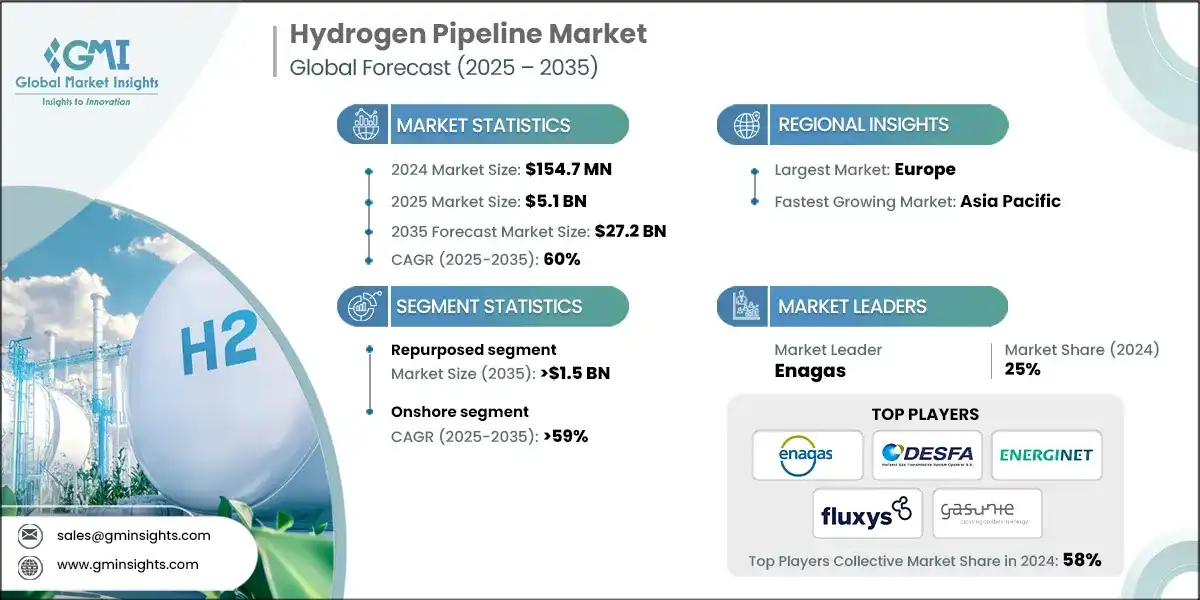
The hydrogen pipeline market size was valued at more than USD 154.7 million in 2024. The market is expected to grow from USD 5.1 billion in 2025 to USD 27.2 billion by 2035, at a CAGR of 60%, according to Global Market Insights, Inc.
Hydrogen Pipeline Market Key Takeaways
Market Size & Growth
- 2024 Market Size: USD 154.7 Million
- 2025 Market Size: USD 5.1 Billion
- 2034 Forecast Market Size: USD 27.2 Billion
- CAGR (2025–2034): 60%
Regional Dominance
- Largest Market: Europe
- Fastest Growing Region: Asia Pacific
Key Market Drivers
- Supportive government policies, incentives and funding programs.
- Research and development initiatives.
- Ongoing integration with the existing energy systems.
Challenges
- High capital cost.
Opportunity
- Development of cross border hydrogen corridors.
- Integration with industrial clusters & hydrogen hubs.
- Repurposing existing natural gas pipelines for hydrogen transport.
Key Players
- Market Leader: Enagas led with over 25% market share in 2024.
- Leading Players: Top 5 players in this market include Enagas, DESFA, Energinet, Fluxys, Gasunie, which collectively held a market share of 58% in 2024.
Get Market Insights & Growth Opportunities
- The government organizations are allocating significant funding for hydrogen infrastructure focusing on materials science, safety research, and the development of standards. It further supports pilot projects that test new technologies in real-world conditions. Moreover, ARPA-E funds high-risk, high-reward projects aim to develop breakthrough technologies for hydrogen transport, including pipeline innovations. The agency further seeks to advance technologies that can lower the costs and improve the safety of hydrogen pipelines.
- Various collaborative and international research efforts including projects such as HyNet, H2Future and Mission Innovation will drive the business scenario. The project includes extensive R&D efforts related to pipeline safety, conversion of existing natural gas pipelines, and new pipeline construction. Further, many governments are encouraging private-sector participation for hydrogen pipelines.
- Ongoing transition to clean energy has positioned hydrogen as a crucial element in achieving the sustainability goals. In addition, rising use of hydrogen as a clean energy carrier by the industries, governments, and investors coupled with the rising potential to reduce carbon emissions across various sectors will drive the hydrogen pipeline market scenario.
- Increasing financial support to promote the development and use of hydrogen along with introduction of government policies is set to drive the business scenario. Subsidies, incentives, and funding for hydrogen infrastructure projects, comprising pipelines, is set to augment the market growth. Ongoing national hydrogen strategies and targets will augment the development of hydrogen-related infrastructure, thereby influencing the product penetration.
- Integration and repurposing of the existing Natural Gas (NG) pipelines for hydrogen transportation will leverage the prevailing infrastructure, contributing to the business momentum. Additionally, industries including chemicals, refining, and manufacturing, will utilize hydrogen as a clean alternative, thereby driving the need for reliable and efficient hydrogen infrastructure.
- Introduction of the hub and spoke model in hydrogen wherein centralized hydrogen production hubs are connected to various end-users through dedicated pipelines in regions including North America, Europe and parts of Asia will drive the market scenario. Large scale development of cross border pipelines to create a continent-wide hydrogen network, facilitating trade and energy security will stimulate the product adoption.
- Ongoing integration of offshore pipelines with offshore wind farms, transporting green hydrogen produced via electrolysis, powered by offshore wind, directly to onshore facilities will drive the pipeline penetration. This is more prevalent in economies with large offshore wind farms in Europe, particularly in the North Sea, thereby augmenting the market growth. In addition, several pilot projects are underway to assess the feasibility of these hydrogen pipelines.
- Diversification of the energy portfolio and capitalization of abundant natural resources will augment the adoption of hydrogen pipelines across the rest of world. Developing hydrogen pipeline infrastructure primarily aimed at exporting hydrogen to international markets coupled with strategic partnerships with international companies and governments to ensure the alignment of hydrogen pipeline network with global demand centers will continue to drive the market landscape. In addition, countries like the UAE, Saudi Arabia, and Oman are investing in pipelines that connect hydrogen production sites to ports and shipping terminals, facilitating the export of hydrogen.
To get key market trends
Hydrogen Pipeline Market Trends
- Technological advancements to address deep-sea pressure, corrosion, and maintenance issues, including specialized coatings and materials designed to withstand harsh marine environments will drive the business scenario. Plans to convert decommissioned or underutilized offshore oil and gas platforms into hydrogen production and distribution hubs, with pipelines transporting hydrogen to shore will support the pipeline deployment.
- Several pilot projects are underway to assess the feasibility of these hydrogen pipelines. Moreover, offshore hydrogen pipelines are being considered for long distance, intercontinental transport of hydrogen. These pipelines potentially can connect hydrogen production regions in the North Africa with European markets, offering a direct route for hydrogen export.
- Large scale development of cross border pipelines to create a continent-wide hydrogen network, facilitating trade and energy security will stimulate the product adoption. Additionally, advances in pipeline materials and coatings, integration of enhanced safety protocols and monitoring system to prevent leaks and ensure safe operation will strengthen the hydrogen pipeline market landscape.
- For instance, In June 2024, Enagás, GRTgaz, and Teréga, in collaboration with OGE, finalized a Joint Development Agreement (JDA) for the BarMar hydrogen infrastructure project, linking Spain and France via a maritime pipeline. The agreement outlined the conditions for conducting feasibility studies and setting up a Special Project Vehicle (SPV). Enagás committed to a 50% stake, GRTgaz 33.3%, and Teréga 16.7%, with each holding equal shares in both the Spanish and French segments of the BarMar project.
- Large scale development of cross border pipelines to create a continent-wide hydrogen network, facilitating trade and energy security will stimulate the product adoption. Additionally, advances in pipeline materials and coatings, integration of enhanced safety protocols and monitoring system to prevent leaks and ensure safe operation will strengthen the industry landscape.
Hydrogen Pipeline Market Analysis
Learn more about the key segments shaping this market
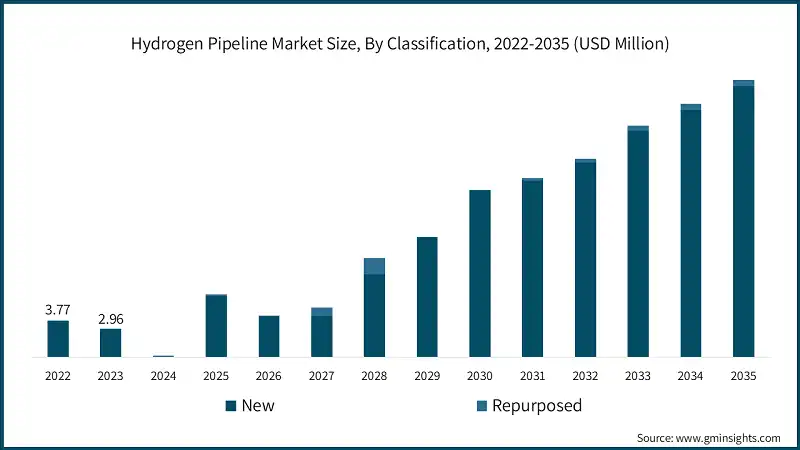
- Based on classification, the market is segmented as new and repurposed. The repurposed hydrogen pipeline will grow more than USD 1.5 billion by 2035.
- Rising adoption of cost efficient approach to improve repurposing of the existing natural gas into hydrogen pipelines will propel the industry growth. Repurposing is projected to cost only 10-35% of the new construction expenses. This cost advantage is anticipated to result in over 50% of hydrogen pipelines worldwide being converted from natural gas pipelines.
- Moreover, regions having established natural gas pipeline networks are the major players driving the repurposed pipeline adoption. The preexisting setup avoids the need for extensive land acquisition and environmental impact assessments associated with new projects. This approach leverages current investments and minimizes the disruption to communities and ecosystems.
- New hydrogen pipeline market will grow more than 77.5% CAGR till 2035. They are increasingly being integrated with green hydrogen production sites powered by renewable energy sources. In regions with abundant offshore wind resources, new hydrogen pipelines are developed to connect offshore hydrogen production directly to onshore facilities, thereby minimizing the need for electricity transmission and enhancing hydrogen transport efficiency.
- Incorporation of national and regional energy strategies including identifying optimal pipeline routes, ensuring connectivity between production and demand centers, and coordinating with the existing infrastructure will augment the new pipeline construction. Further, they are being designed to create interconnected hydrogen markets across borders. For instance, the Europe Hydrogen Backbone Initiative aims to link hydrogen production and consumption centers across Europe, facilitating cross-border trade and energy security.
- For instance, in April 2024, Federal Energy Minister appointed Fluxys Hydrogen, a subsidiary of Fluxys Belgium, as the Hydrogen Network Operator (HNO) for Belgium. This designation, in line with the Federal Hydrogen Act of July 11, 2023, marked a significant advancement in the energy transition. Fluxys Hydrogen was tasked with developing and managing Belgium’s hydrogen transmission infrastructure, contributing to the European Hydrogen Backbone and supporting the country’s climate objectives.
Learn more about the key segments shaping this market
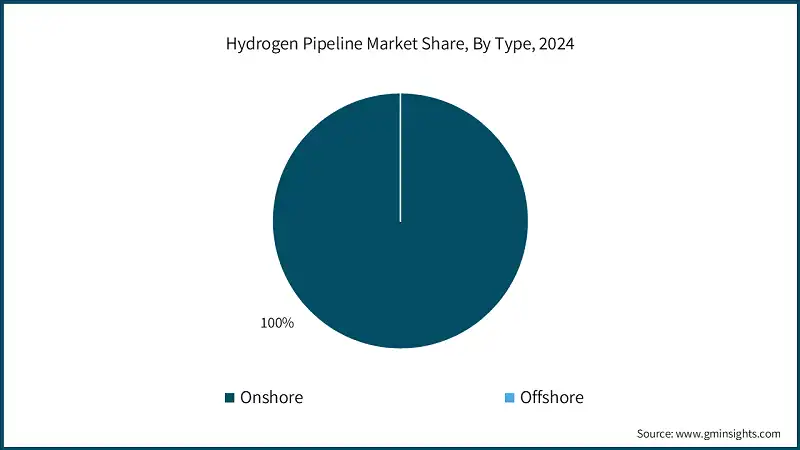
- Based on type, the hydrogen pipeline market is segmented as onshore and offshore. The onshore hydrogen pipeline will grow at over 59% CAGR till 2035. Rising integration with the existing natural gas pipelines to reduce capital expenditures and facilitate a smooth transition to hydrogen transport will boost the onshore pipeline adoption. This integration has shown significant growth in regions with extensive natural gas networks, enabling a rapid and cost-effective expansion of the hydrogen infrastructure.
- Ongoing integration with other elements, including storage systems, production facilities, and distribution networks, to create a seamless and efficient hydrogen delivery system will augment the market landscape. The connectivity and length of the pipelines depend on the geographical distribution of hydrogen production sites and demand centers.
- Offshore hydrogen pipeline market will cross more than USD 1.2 billion by 2035. Ongoing integration of offshore pipelines with offshore wind farms, transporting green hydrogen produced via electrolysis, powered by offshore wind, directly to onshore facilities will drive the pipeline penetration.
- Moreover, offshore hydrogen pipelines are being considered for long distance, intercontinental transport of hydrogen. These pipelines potentially can connect hydrogen production regions in the North Africa with European markets, offering a direct route for hydrogen export.
- For instance, in February 2023, DNV is rolling out the second phase of H2Pipe, a collaborative industry initiative aimed at crafting a detailed code. This code will govern the design, re-qualification, construction, and operation of offshore pipelines, specifically for transporting pure hydrogen or blends of hydrogen and natural gas. Additionally, supportive policies, funding initiatives, and strategic investments are driving the development of offshore hydrogen infrastructure.
Looking for region specific data?
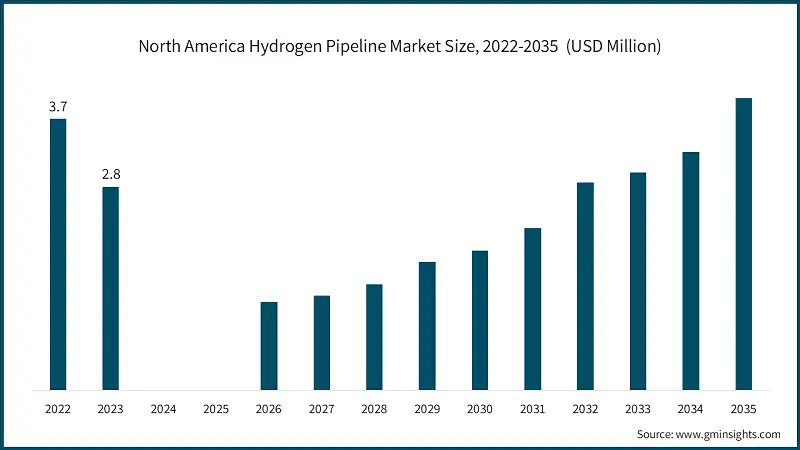
- North America hydrogen pipeline market recorded a valuation of USD 3.7 billion in 2022, rising to USD 2.8 billion in 2023 and is projected to rise more than USD 4 billion by 2035.
- The U.S. government has been actively supporting the development of hydrogen infrastructure, including pipelines, through initiatives including the Infrastructure Investment and Jobs Act. It further includes the funding for hydrogen hubs and pipeline projects aimed at creating a national hydrogen network. Major energy companies in the region, comprising of Sempra Energy, Enbridge, and TC Energy, are investing in hydrogen pipeline projects as a part of their broader strategies toward transition to low carbon energy sources.
- Europe Hydrogen Pipeline market will grow at a CAGR of more than 7.5% CAGR till 2035. Ongoing development of national hydrogen strategies across the economies that specifically outline policies, mandates and investments to promote the use of hydrogen, including the plans for expanding the hydrogen pipeline networks, will influence the market statistics. In addition, increasing efforts between the countries will accelerate the industry statistics.
- For instance, in October 2023, GAZ-SYSTEM completed the Gustorzyn-Wronów gas pipeline, connecting Gustorzyn and Wronów compressor stations across four provinces. This project, the longest undertaken by the company in the year 2023, enhanced gas supply to central Poland, increased system flexibility, and supported future gas transmission from the FSRU Terminal in the Gulf of Gdansk.
- Asia Pacific hydrogen pipeline market is anticipated to reach more than USD 2.2 billion by 2035. Countries including Japan, Australia, South Korea, and China, are incorporating hydrogen into their long-term energy transition plans. Furthermore, strong government support, significant investments, and strategic partnerships will support the region in developing a robust hydrogen infrastructure including pipelines to connect the production sites with key industrial and export markets.
Hydrogen Pipeline Market Share
- The top five players in the hydrogen pipeline industry include DESFA, Energinet, Fluxys, Gasunie, GAZ-SYSTEM and Enagas. Several companies with expertise in pipeline construction, materials, and infrastructure are involved in the development and deployment of hydrogen pipelines.
- It includes transmission service operators responsible for building and managing pipeline networks, as well as manufacturers specializing in the fabrication and technology associated with hydrogen pipelines. Further, the companies leverage their expertise in pipeline design, construction, and operation to support hydrogen infrastructure development.
- Within regions, consortium-based alliances of TSOs, manufacturers and EPCs support de-risk the CAPEX-heavy projects. Market power therefore accrues less to single vertically integrated firms and more to consortiums that can combine local execution capacity and pipeline/terminal assets. In addition, the smaller innovators can succeed by specializing and partnering with larger integrators, contributing to the business momentum.
- DESFA manages Greece’s high-pressure pipeline network and is actively advancing the hydrogen energy transition through several key initiatives. It is a key energy infrastructure provider, evolving strategically into hydrogen readiness through network upgrades and alignment with European energy corridors. Moreover, the company reported a revenue of USD 325.9 Million in 2022.
- GAZ-System controls Poland entire high-pressure gas network and was designated as the Hydrogen Transmission Network Operator (HTNO) in 2025. In 2023, the company invested USD 0.6 Million in gas infrastructure, with 71 km of new pipelines and compression enhancements. Furthermore, the company is transitioning from core natural gas infrastructure provider to a full-service hydrogen infrastructure operator, underpinned by strong financial footing, strategic project execution, and alignment with national and European decarbonization pathways.
Hydrogen Pipeline Market Companies
Eminent players operating in the hydrogen pipeline industry are:
- Bonatti
- Corinth Pipeworks
- DESFA
- Denys
- Enagás
- Energinet
- EUROPIPE
- Fluxys
- Gasunie
- GAZ-SYSTEM
- GRTgaz
- ONTRAS Gastransport
- REN
- Siemens Energy
- Spiecapag
- Snam
- Tekfen
- Tenaris
- Terega
- The ROSEN Group
- ONTRAS Gastransport operates as the Germany’s second largest high-pressure gas transmission network and is actively advancing the hydrogen pipeline market through the repurposing of its existing natural gas infrastructure. The company manages more than 7,500 km of pipelines and is a key player in the European Hydrogen Backbone initiative, aiming to establish cross-border hydrogen transport corridors. In 2024, the company reported revenue of approximately USD 1.4 billion, with significant investments directed toward pilot hydrogen pipeline projects and blending trials.
- ROSEN Group is a global service provider specializing in inspection, integrity management, and monitoring solutions for pipelines, including hydrogen transport infrastructure. In 2024, ROSEN supported multiple European Hydrogen Backbone initiatives by providing expertise in embrittlement testing, risk assessments, and digital pipeline integrity platforms. With operations in over 120 countries, ROSEN is positioned as a critical enabler of hydrogen pipeline deployment, ensuring long-term safety and efficiency for operators worldwide.
- Denys is a Belgian infrastructure and engineering contractor specializing in pipeline construction, with a strong hold in both natural gas and emerging hydrogen transmission projects. In 2024, Denys reported revenues of approximately USD 950 million, backed by large-scale EPC contracts in energy and water infrastructure. Moreover, the company is increasingly positioning itself as a strategic contractor for Europe’s hydrogen backbone by delivering technically advanced and cross-border hydrogen pipeline networks.
- GRTgaz is France’s leading gas transmission system operator, managing over 32,500 km of pipelines and investing heavily in the hydrogen pipeline market. The company generated revenues of about USD 2.6 billion in 2024, with significant allocation toward hydrogen pilot networks such as MOSAIC and Jupiter 1000. In addition, the company aims to develop 20,000 km of hydrogen-ready pipelines by 2040.
Hydrogen Pipeline Market Report Attributes
| Key Takeaway | Details |
|---|---|
| Market Size & Growth | |
| Base Year | 2024 |
| Market Size in 2024 | USD 154.7 Million |
| Market Size in 2025 | USD 5.1 Billion |
| Forecast Period 2025 - 2035 CAGR | 60% |
| Market Size in 2035 | USD 27.2 Billion |
| Key Market Trends | |
| Drivers | Impact |
| Supportive government policies, incentives and funding programs | Development of hydrogen pipelines is a critical aspect of the emerging hydrogen economy, and governments around the world are increasingly focusing on policies, regulations, and financial support to encourage the infrastructure expansion. |
| Research and development initiatives | Governments and organizations worldwide are increasingly investing in R&D to accelerate the deployment of hydrogen pipelines. Ongoing research to develop new alloys and composite materials that are both cost-effective and resilient against hydrogen-induced degradation, which includes studying the long-term effects of hydrogen on pipeline materials will drive the industry scenario. |
| Ongoing integration with the existing energy systems | Integrating hydrogen pipelines with existing energy systems is a complex but crucial aspect of building a sustainable hydrogen economy. This involves adapting current energy infrastructure, comprising natural gas pipelines, power grids, and storage facilities, to accommodate hydrogen. |
| Pitfalls & Challenges | Impact |
| High capital cost | Repurposing an existing natural gas pipeline for hydrogen transport can save costs in comparison to building new pipelines, but it requires significant modifications. Retrofitting involves inspecting and potentially replacing sections of pipelines, upgrading compression stations, and installing new safety systems, thereby contributing to the overall cost component. |
| Opportunities: | Impact |
| Development of cross border hydrogen corridors | Governments in Europe, the U.S. and the Middle East are advancing plans for international hydrogen pipelines. Large scale EPC contracts, pipe manufacturing, and strategic joint ventures for international export/import infrastructure will augment the business landscape. |
| Integration with industrial clusters & hydrogen hubs | Hydrogen pipelines serve as the main criteria for industrial decarbonization, connecting production with demand centers including refining, steel, chemicals, and mobility hubs. EPC firms and technology providers further capitalize on localized hydrogen transport networks and associated storage/terminal solutions. |
| Repurposing existing natural gas pipelines for hydrogen transport | Significant portion of global hydrogen infrastructure demand can be met faster and at lower cost by converting natural gas transmission networks to hydrogen service. This creates opportunities for EPCs, material suppliers, and service providers specializing in hydrogen-ready coatings, welding, compressors, and integrity management. |
| Market Leaders (2024) | |
| Market Leaders |
25% market share |
| Top Players |
Collective market share in 2024 is 58% |
| Competitive Edge |
|
| Regional Insights | |
| Largest Market | Europe |
| Fastest Growing Market | Asia Pacific |
| Emerging Countries | - |
| Future outlook |
|
What are the growth opportunities in this market?
Hydrogen Pipeline Industry News
- In February 2025, Enagas announced its plan to invest USD 4.7 billion by the end of 2030 with USD 3.67 billion earmarked specifically for hydrogen infrastructure, underscoring the company's strategic shift as Spain transitions away from natural gas. The investment further aligns with the company's involvement in the H2Med corridor and its development of Spain’s hydrogen backbone.
- In July 2024, Enagás, a Spanish gas grid operator, sold its 30.2% stake in Tallgrass Energy to Blackstone for USD 1.1 billion. Enagás allocated the proceeds from this transaction to advance its hydrogen infrastructure initiatives, aligning with its strategic objectives for 2030. Previously, the company divested from the Quintero LNG terminal, the Soto La Marina CS in Mexico, and the Morelos gas pipeline. Simultaneously, it bolstered investments in the HE Hub LNG/ammonia terminal in Germany and the Trans Adriatic gas pipeline.
- In October 2023, Open Grid Europe (OGE), based in Germany entered in an MoU with the existing consortium partners REN, Enagás, Teréga and GRTgaz. It would further contribute its existing domestic hydrogen network to the joint project, names as H2Med, set to connect Portugal and Spain with France along with Germany. Further, it is one of five corridors planned under the European Hydrogen Backbone initiative.
- In June 2023, REN initiated the adaption of its high pressure natural gas grid to carry up to 10% share of green hydrogen. Further, it plans to adapt its 1,375 km grid across Portugal, to allow it to cope with a mixture of natural gas and hydrogen. This will further enable the company to enhance its product offerings.
This hydrogen pipeline market research report includes in-depth coverage of the industry with estimates & forecast in terms of ‘Km & USD Million’ from 2024 to 2035 for the following segments:
Market, By Type
- Onshore
- Offshore
Market, By Classification
- New
- Repurposed
The above information will be provided for the following regions:
- North America
- Europe
- Asia Pacific
- Rest of World
Frequently Asked Question(FAQ) :
What is the market size of the hydrogen pipeline market in 2024?
The market size was USD 154.7 million in 2024, with a CAGR of 60% expected through 2034 driven by government funding, clean energy transition, and repurposing of existing natural gas infrastructure.
What is the projected value of the hydrogen pipeline market by 2035?
The hydrogen pipeline market is expected to reach USD 27.2 billion by 2035, propelled by cross-border pipeline development, industrial decarbonization, and integration with renewable energy sources.
What is the current hydrogen pipeline market size in 2025?
The market size is projected to reach USD 5.1 billion in 2025.
How much is the repurposed hydrogen pipeline market expected to grow by 2035?
The repurposed hydrogen pipeline market will grow to more than USD 1.5 billion by 2035, driven by cost-efficient conversion of existing natural gas pipelines at only 10-35% of new construction expenses.
What is the growth outlook for onshore hydrogen pipelines from 2025 to 2035?
Onshore hydrogen pipelines are projected to grow at over 59% CAGR by 2035, due to integration with existing natural gas networks and seamless connectivity with production facilities.
Which region leads the hydrogen pipeline market?
North America hydrogen pipeline market recorded a valuation of USD 2.8 billion in 2023 and is projected to rise more than USD 4 billion by 2035.
What are the upcoming trends in the hydrogen pipeline market?
Key trends include repurposing existing natural gas pipelines for hydrogen transport, development of offshore hydrogen corridors, integration with renewable energy production, and creation of international hydrogen export networks.
Who are the key players in the hydrogen pipeline market?
Key players include Bonatti, Corinth Pipeworks, DESFA, Denys, Enagás, Energinet, Europipe, Fluxys, Gasunie, GAZ-SYSTEM, GRTgaz, Ontras Gastransport, REN, Siemens Energy, Spiecapag, Snam, Tekfen, Tenaris, Terega, ROSEN Group.
Hydrogen Pipeline Market Scope
Related Reports