Summary
Table of Content

Hydrogen Fuel Cell Vehicle Cooling System Market
Get a free sample of this report
Form submitted successfully!
Error submitting form. Please try again.
Thank you!
Your inquiry has been received. Our team will reach out to you with the required details via email. To ensure that you don't miss their response, kindly remember to check your spam folder as well!
Request Sectional Data
Thank you!
Your inquiry has been received. Our team will reach out to you with the required details via email. To ensure that you don't miss their response, kindly remember to check your spam folder as well!
Form submitted successfully!
Error submitting form. Please try again.
Hydrogen Fuel Cell Vehicle Cooling System Market Size
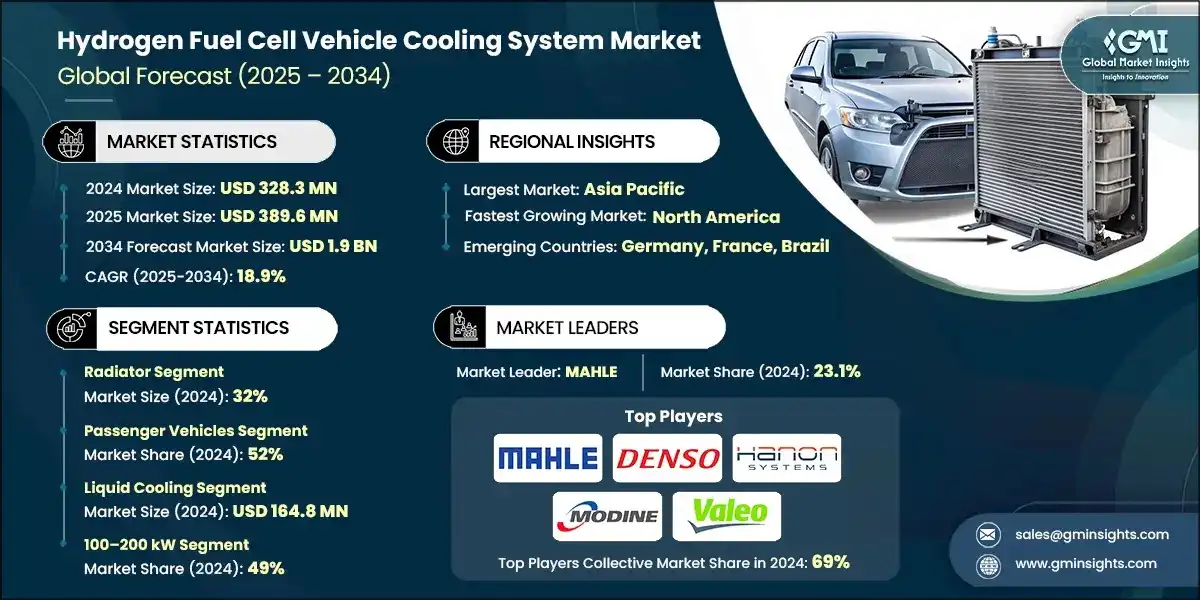
The global hydrogen fuel cell vehicle cooling system market was valued at USD 328.3 million in 2024. The market is expected to grow from USD 389.6 million in 2025 to USD 1.9 billion in 2034, at a CAGR of 18.9%, according to latest report published by Global Market Insights Inc.
To get key market trends
The hydrogen fuel cell vehicle cooling system (HFCV-CS) market is expected to witness substantial growth, driven by the rising adoption of hydrogen fuel cell vehicles, increasing focus on sustainable mobility solutions, and the growing demand for efficient thermal management systems that enhance vehicle performance and longevity. Continuous innovations in advanced cooling technologies, thermal management materials, and integrated system designs are enabling manufacturers to develop robust, efficient, and scalable cooling solutions, improving overall vehicle reliability and operational efficiency.
HFCV cooling systems, including radiators, coolant pumps, thermal interface materials, heat exchangers, and electronic control modules, play a critical role in modern hydrogen vehicles by maintaining optimal operating temperatures for fuel cells, batteries, and power electronics. Efficient cooling is essential to ensure consistent energy output, prevent overheating, extend component life, and meet stringent safety and emission regulations.
For instance, in 2025, several leading OEMs, including Toyota and Hyundai, began deploying advanced liquid-cooled and air-cooled hybrid systems in their fuel cell vehicles to enhance energy efficiency and maintain stable fuel cell operation under diverse driving conditions. These solutions form part of the broader focus on HFCV cooling systems, offering improved vehicle performance, durability, and driver confidence.
The market is witnessing rapid technological advancements driven by hydrogen-powered mobility adoption, regulatory mandates on emissions, electrification trends, and fleet electrification initiatives. Manufacturers and technology providers are focusing on innovative cooling architectures, lightweight thermal materials, and AI-enabled thermal management systems, allowing automakers and fleet operators to deliver next-generation hydrogen vehicles that are safe, efficient, and optimized for sustainable transportation ecosystems.
Hydrogen Fuel Cell Vehicle Cooling System Market Report Attributes
| Key Takeaway | Details |
|---|---|
| Market Size & Growth | |
| Base Year | 2024 |
| Market Size in 2024 | USD 328.3 Million |
| Market Size in 2025 | USD 389.6 Million |
| Forecast Period 2025 – 2034 CAGR | 18.9% |
| Market Size in 2034 | USD 1.9 Billion |
| Key Market Trends | |
| Drivers | Impact |
| Rising adoption of hydrogen fuel cell vehicles | Growing global interest in zero-emission transportation is driving demand for efficient thermal management solutions. |
| Technological advancements in cooling systems | Innovations such as hybrid liquid-air cooling, phase-change materials, and AI-enabled thermal management improve fuel cell efficiency and vehicle performance. |
| Stringent regulatory mandates | Safety and emission regulations globally are pushing OEMs to adopt reliable cooling systems to ensure compliance |
| Fleet electrification and commercial vehicle deployment | Hydrogen-powered buses, trucks, and other commercial vehicles require robust cooling solutions to maintain operational efficiency under heavy-duty conditions. |
| Pitfalls & Challenges | Impact |
| High system costs | Advanced cooling technologies increase manufacturing costs, potentially slowing adoption among cost-sensitive segments. |
| Limited infrastructure and supply chain | Dependence on specialized components and limited hydrogen vehicle penetration can hinder rapid scaling of cooling system production. |
| Opportunities: | Impact |
| Integration with connected vehicle technologies | Smart thermal management systems can optimize fuel cell performance, energy consumption, and predictive maintenance through vehicle telematics. |
| Expansion into commercial and heavy-duty applications | Hydrogen trucks, buses, and industrial vehicles present significant untapped markets for advanced cooling solutions. |
| Market Leaders (2024) | |
| Market Leaders |
23.1% market share |
| Top Players |
Collective market share in 2024 is 69% |
| Competitive Edge |
|
| Regional Insights | |
| Largest Market | Asia Pacific |
| Fastest growing market | North America |
| Emerging countries | Germany, France, Brazil |
| Future outlook |
|
What are the growth opportunities in this market?
Hydrogen Fuel Cell Vehicle Cooling System Market Trends
The demand for advanced hydrogen fuel cell vehicle cooling systems is being driven by increasing collaboration between thermal management solution providers, automotive component manufacturers, and automakers to accelerate the development of efficient, scalable, and modular cooling solutions. Companies are leveraging combined expertise to reduce integration costs, share technological know-how, and shorten the time-to-market for next-generation HFCV cooling systems, including liquid-air hybrid cooling, AI-enabled thermal management, modular heat exchangers, and advanced coolant circulation systems.
For instance, in 2025, MAHLE GmbH and Denso Corporation announced joint initiatives to develop end-to-end thermal management platforms optimized for passenger and commercial hydrogen fuel cell vehicles. These initiatives utilize their combined expertise in high-efficiency radiators, pumps, and thermal control systems to enhance fuel cell performance, maintain optimal operating temperatures, and improve vehicle reliability and energy efficiency.
Localization of cooling system development and deployment to meet regional safety, efficiency, and emission standards is another emerging trend. Companies such as Hanon Systems and Valeo SA are establishing regional R&D and production hubs in North America, Europe, and Asia-Pacific, ensuring HFCV cooling solutions comply with local regulations while optimizing deployment efficiency. These strategies enable suppliers to deliver high-performance thermal management systems more effectively, reduce dependency on global operations, and improve responsiveness to OEM and fleet operator requirements.
The entry of emerging players offering lightweight, modular, and scalable cooling platforms is gaining traction among automakers increasingly focused on hydrogen-powered, commercial, and heavy-duty vehicles. For example, startups specializing in advanced heat exchangers, AI-driven thermal controls, and integrated fuel cell cooling modules are introducing platforms capable of enhancing fuel cell efficiency, extending component life, and supporting innovative hydrogen mobility applications.
The development of modular HFCV cooling architectures is enabling manufacturers to produce systems compatible with passenger cars, buses, trucks, and industrial vehicles. For instance, Modine and Valeo SA are rolling out modular cooling platforms that support multiple vehicle types and fuel cell architectures, reducing integration costs, shortening deployment timelines, and enabling the creation of reliable, energy-efficient, and future-proof hydrogen mobility solutions.
Hydrogen Fuel Cell Vehicle Cooling System Market Analysis
Learn more about the key segments shaping this market
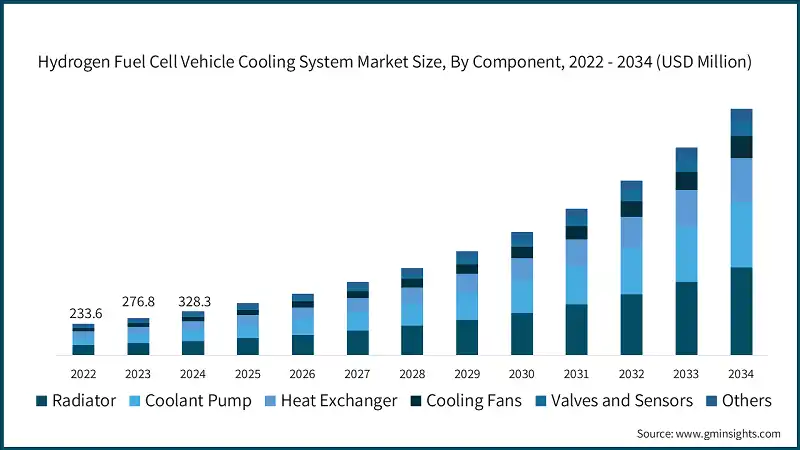
Based on component, the market is divided into radiator, coolant pump, heat exchanger, cooling fans, valves and sensors and others. The radiator segment dominated the market with 32% revenue share in 2024 and is expected to grow at a CAGR of over 20.1% from 2025 to 2034.
- The radiator segment holds a dominant position in the hydrogen fuel cell vehicle cooling system market, driven by its critical role in maintaining optimal operating temperatures for fuel cells, batteries, and power electronics. Radiators ensure consistent energy output, prevent overheating, and enhance overall vehicle efficiency and longevity. Advanced designs, such as high-efficiency liquid-cooled and hybrid cooling radiators, make this segment the preferred choice among OEMs, Tier-1 suppliers, and fleet operators for both passenger and commercial hydrogen fuel cell vehicles.
- The coolant pump segment, including electric and mechanical pumps, is experiencing notable growth as manufacturers focus on energy-efficient, reliable, and precise coolant circulation systems. These components are increasingly integrated with AI-enabled thermal management modules and modular heat exchanger systems, reflecting the industry’s shift toward optimized fuel cell performance and enhanced vehicle reliability. For instance, in 2025, MAHLE GmbH and Denso Corporation deployed advanced electric coolant pumps in production vehicles, improving thermal regulation, fuel cell efficiency, and operational safety.
- Meanwhile, the heat exchanger, cooling fans, valves, sensors, and other components segment is expanding steadily, fueled by increasing demand for modular, scalable, and high-performance thermal management systems. Market players are investing in advanced heat exchangers, smart thermal sensors, and integrated valve systems that enable precise temperature control, predictive maintenance, and improved energy efficiency. These innovations are particularly relevant for commercial and heavy-duty hydrogen vehicles, where continuous thermal regulation, durability, and operational reliability are critical performance considerations.
Learn more about the key segments shaping this market
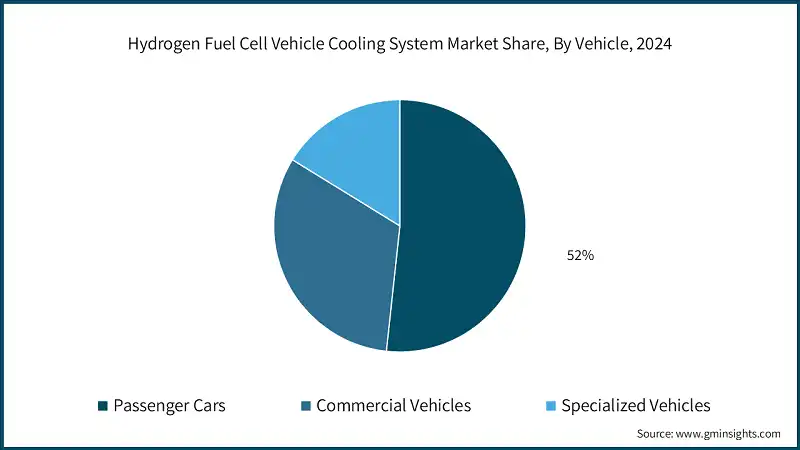
Based on vehicle, the hydrogen fuel cell vehicle cooling system market is divided into passenger vehicles, commercial vehicles and specialized vehicles. Passenger vehicles segment accounted for around 52% market share in 2024 and is expected to grow at a CAGR of over 18.4% from 2025 to 2034.
- The passenger vehicles segment accounts for the largest share of the hydrogen fuel cell vehicle cooling system (HFCV-CS) market, primarily driven by rising consumer and regulatory demand for energy-efficient, high-performance, and low-emission vehicles. Increasing integration of advanced cooling solutions into hydrogen-powered passenger vehicles ensures optimal fuel cell and battery temperatures, enhances vehicle reliability, and improves overall performance and safety.
- Suppliers are also diversifying their portfolios to cater to both conventional and electrified passenger vehicles, including hybrid and fully hydrogen fuel cell models. In 2025, leading players such as MAHLE GmbH and Denso Corporation introduced next-generation radiators, coolant pumps, and modular heat exchanger systems designed for passenger fuel cell vehicles, emphasizing energy efficiency, lightweight design, and precise thermal management. These advancements highlight the growing importance of efficient cooling, regulatory compliance, and performance optimization as key factors influencing adoption in the passenger vehicle segment.
- The commercial vehicles segment, although smaller in scale, is undergoing steady transformation with the growing incorporation of advanced cooling systems for trucks, buses, and specialty hydrogen fuel cell vehicles. The segment’s growth is supported by the increasing need for scalable, robust, and energy-efficient thermal management systems that maintain fuel cell performance under heavy-duty operation, extend component life, and reduce operational downtime.
- The specialized vehicles segment is emerging as a new growth area, particularly in industrial, mining, and public transport applications. Cooling solutions for specialized hydrogen vehicles focus on modular, durable, and high-capacity thermal management systems, reflecting the growing emphasis on reliability, operational safety, and energy efficiency in demanding environments.
Based on cooling technology, the market is divided into liquid cooling, hybrid cooling and air cooling. The liquid cooling segment dominates the market and was valued at USD 164.8 million in 2024.
- The liquid cooling segment holds a dominant position in the hydrogen fuel cell vehicle cooling system market, driven by its critical role in maintaining optimal operating temperatures for fuel cells, batteries, and power electronics in passenger, commercial, and specialized hydrogen vehicles. Liquid cooling solutions offer high thermal efficiency, precise temperature regulation, and reliability under diverse driving and environmental conditions, making them the preferred choice among OEMs, Tier-1 suppliers, and fleet operators for both light-duty and heavy-duty fuel cell vehicles.
- Suppliers are further diversifying their portfolios to include hybrid cooling systems, air cooling modules, and AI-enabled thermal management, addressing the automotive industry’s evolving demand for energy-efficient, scalable, and intelligent thermal solutions. These technologies play a key role in enabling applications such as predictive thermal control, extended fuel cell life, improved energy efficiency, and optimized performance under variable load conditions, contributing to enhanced vehicle reliability, safety, and operational efficiency.
- The other cooling technology segments, encompassing hybrid and air-cooling systems, are also exhibiting significant growth. Their adoption is being driven by increasing implementation in passenger and commercial hydrogen fuel cell vehicles that demand modular, lightweight, and adaptable thermal management solutions. These innovations are facilitating the development of energy-efficient, high-performance, and next-generation hydrogen vehicle ecosystems, aligning with OEM strategies centered around sustainability, regulatory compliance, and enhanced operational performance.
Based on power output, the market is divided into 100–200 kW, below 100 kW and above 200 kW. The 100–200 kW segment dominated the market with 49% share in 2024.
- The 100–200 kW segment holds the dominant market share, driven by the widespread adoption of hydrogen fuel cell vehicles with mid-range power output across passenger, commercial, and specialty vehicles. Cooling systems in this segment are critical for maintaining optimal fuel cell and battery temperatures, ensuring consistent energy output, preventing overheating, and enhancing overall vehicle performance and reliability. The growing deployment of hydrogen-powered cars, buses, and light commercial vehicles has further accelerated demand for efficient and scalable thermal management solutions in this power range.
- The below 100 kW segment is also witnessing steady growth, supported by increasing adoption of hydrogen fuel cell vehicles in small passenger cars, two-wheelers, and compact urban mobility solutions. These vehicles require lightweight, energy-efficient, and compact cooling systems to maintain fuel cell performance while optimizing vehicle weight and space.
- Additionally, the above 200 kW segment is emerging, driven by the expansion of hydrogen-powered heavy-duty trucks, buses, and industrial vehicles. Cooling systems for this high-power category focus on high-capacity, modular, and robust thermal management solutions capable of sustaining fuel cell efficiency under continuous heavy loads. These developments reflect the broader industry movement toward scalable, high-performance, and reliable cooling solutions that support the growing adoption of hydrogen fuel cell mobility across diverse power requirements.
Based on applications, the market is divided into private transportation, public transportation, industrial and military & defense. The private transportation segment dominated the market in 2024.
- The private transportation segment dominates the Hydrogen fuel cell vehicle cooling system market, driven by the growing adoption of hydrogen fuel cell passenger cars and light commercial vehicles. Cooling systems in this segment are essential for maintaining optimal fuel cell and battery temperatures, ensuring consistent energy output, preventing overheating, and enhancing overall vehicle performance and reliability. The rising deployment of hydrogen-powered cars, SUVs, and compact vehicles has further accelerated demand for efficient, lightweight, and scalable thermal management solutions in private transportation.
- The public transportation segment is witnessing steady growth, supported by increasing adoption of hydrogen-powered buses, shuttles, and urban transport vehicles. These applications require high-capacity, energy-efficient cooling systems to sustain fuel cell performance while managing long operational hours and frequent stop-start cycles typical in urban transit.
- The industrial segment is emerging, driven by the expansion of hydrogen-powered material handling equipment, logistics vehicles, and warehouse machinery. Cooling systems in this category focus on robust, modular, and high-performance thermal management solutions capable of sustaining fuel cell efficiency under continuous industrial workloads.
- The military & defense segment is also gaining traction, with hydrogen-powered tactical vehicles, unmanned ground vehicles, and specialized mobility platforms requiring reliable, rugged, and mission-ready cooling systems. These systems are designed to maintain fuel cell performance under extreme operational conditions and harsh environments.
Looking for region specific data?
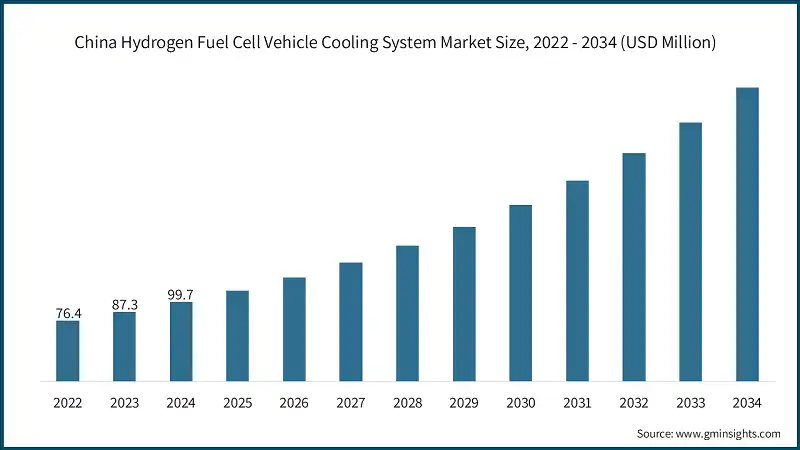
In 2024, China dominated the Asia Pacific hydrogen fuel cell vehicle cooling system market with around 41% share and generated approximately USD 99.7 million in revenue.
- Asia-Pacific accounted for a significant share of the hydrogen fuel cell vehicle cooling system in 2024, supported by a rapidly growing automotive manufacturing ecosystem, increasing adoption of hydrogen-powered vehicles, and expanding investments in hydrogen infrastructure. The region is witnessing strong growth at a CAGR of 15%, as OEMs and suppliers increasingly deploy advanced cooling solutions, including liquid and hybrid cooling systems, modular heat exchangers, and AI-enabled thermal management, to enhance fuel cell performance, vehicle reliability, and operational efficiency.
- China dominated the Asia-Pacific market, driven by the world’s largest fleet of hydrogen-powered buses, trucks, and passenger vehicles, along with strong government incentives promoting green mobility. Provinces such as Jiangsu, Guangdong, and Shandong are leading in OEM production and fleet adoption of advanced cooling systems, demonstrating a clear trend toward energy-efficient, high-performance, and reliable hydrogen mobility ecosystems.
- Moreover, leading manufacturers and technology providers such as MAHLE GmbH, Denso Corporation, Hanon Systems, Modine, and Valeo SA are pioneering innovations in liquid and hybrid cooling modules, modular heat exchangers, and AI-enabled thermal management systems. These companies are enhancing the market by integrating scalable, energy-efficient, and durable components, substantially improving fuel cell efficiency, vehicle reliability, and operational performance. Investments in advanced HFCV cooling solutions are helping automakers and fleet operators optimize thermal management, reduce energy losses, and deliver high-performance hydrogen mobility solutions.
U.S. holds share of 81% in North America hydrogen fuel cell vehicle cooling system market and it will grow tremendously between 2025 and 2034.
- North America holds a major share of the hydrogen fuel cell vehicle cooling system in 2024, supported by a strong automotive manufacturing ecosystem, growing adoption of hydrogen-powered passenger and commercial vehicles, and substantial investments in hydrogen infrastructure. Demand is driven by passenger cars, commercial fleets, and specialty vehicles, with OEMs and fleet operators focusing on high-efficiency, scalable, and reliable cooling systems to optimize fuel cell performance, maintain operational efficiency, and comply with evolving safety and environmental regulations.
- The U.S. represents North America’s largest market, buoyed by strong demand from passenger vehicles, commercial fleets, and specialty hydrogen vehicles requiring robust and high-performing thermal management solutions. Among current trends is the growing adoption of liquid and hybrid cooling systems, modular heat exchangers, AI-enabled thermal management, and smart coolant circulation systems integrated into fuel cell powertrains and battery modules. Manufacturers and technology providers are increasingly offering scalable, modular, and energy-efficient cooling platforms to comply with regulatory standards while maintaining reliability, performance, and operational efficiency expected by U.S. operators and consumers.
- Canada are emerging markets within North America, showing growing adoption of hydrogen fuel cell vehicles, particularly in commercial and industrial fleets. These markets are supported by government incentives for green mobility, fleet modernization programs, and increasing interest in sustainable urban transport.
Germany holds share of 16% in Europe hydrogen fuel cell vehicle cooling system market and it will grow tremendously between 2025 and 2034.
- Europe holds a major share of the hydrogen fuel cell vehicle cooling system in 2024, supported by its strong automotive manufacturing base, advanced technological capabilities, and stringent safety and emission regulations that are accelerating the adoption of efficient, high-performance thermal management systems. Demand is driven by passenger cars, commercial fleets, and specialty vehicles, with OEMs and fleet operators focusing on reliable, energy-efficient, and scalable cooling solutions to align with EU regulatory standards while ensuring optimal fuel cell performance and vehicle longevity.
- Germany dominated the Europe market, buoyed by substantial demand from passenger vehicles, commercial fleets, and specialty hydrogen vehicles that require high-performing and durable cooling systems. Among current trends is the growing adoption of liquid and hybrid cooling systems, modular heat exchangers, AI-enabled thermal management, and intelligent coolant circulation integrated into fuel cell and battery powertrains.
- The UK market is growing at a faster rate than other European countries, driven by rising adoption of hydrogen-powered vehicles, expansion of fleet and shared mobility services, and increasing regulatory requirements for efficient thermal management. Leading providers such as MAHLE GmbH, Denso Corporation, Hanon Systems, Modine, and Valeo SA are introducing advanced liquid and hybrid cooling solutions for OEMs and fleet operators, highlighting the UK market’s shift toward energy-efficient, high-performance, and technologically advanced hydrogen vehicle ecosystems.
- In contrast, the Italian market benefits from ongoing investments in transport infrastructure, fleet modernization, and urban mobility improvements. Italian vehicle operators face challenges such as diverse operating conditions, efficiency requirements, and fuel cell performance optimization. This has created demand for robust, modular, and scalable cooling solutions capable of performing reliably across passenger vehicles, commercial fleets, and specialty hydrogen vehicle applications.
The hydrogen fuel cell vehicle cooling system market in Brazil will experience significant growth between 2025 and 2034.
- Latin America holds an 1% share of the hydrogen fuel cell vehicle cooling system in 2024. Brazil represents the largest market in the region, fueled by strong demand from passenger vehicles, commercial fleets, and specialty hydrogen vehicles that require reliable, efficient, and scalable thermal management solutions.
- The hydrogen fuel cell vehicle cooling system market in Brazil will experience significant growth, driven by increasing adoption of hydrogen-powered passenger and commercial vehicles, fleet modernization, and expanding investments in hydrogen refueling infrastructure. OEMs, fleet operators, and mobility service providers are seeking cooling solutions capable of handling heavy usage, maintaining optimal fuel cell temperatures, and improving energy efficiency across diverse driving conditions.
- A notable trend in Brazil is the gradual adoption of advanced liquid and hybrid cooling systems, modular heat exchangers, and AI-enabled thermal management platforms to ensure consistent fuel cell performance, longer vehicle life, and operational reliability. These solutions support passenger vehicles, commercial fleets, and specialty applications while aligning with emerging environmental and efficiency regulations.
- Mexico represents the fastest-growing HFCV cooling system market in Latin America, driven by fleet expansion, increasing commercial vehicle operations, and the adoption of hydrogen mobility solutions. The market is experiencing growing preference for scalable, modular, and energy-efficient cooling systems, reflecting automakers’ and fleet operators’ efforts to enhance vehicle performance, reliability, and operational efficiency. Mexico is emerging as a key growth hotspot, complementing Brazil’s established market leadership in the region.
The hydrogen fuel cell vehicle cooling system market in UAE will experience significant growth between 2025 and 2034.
- The hydrogen fuel cell vehicle cooling system in the UAE holds a modest share in 2024, supported by steady vehicle demand, infrastructure growth, and the country’s position as a regional automotive hub in the Middle East. The market is driven by rising sales of passenger vehicles, luxury cars, and light commercial fleets that require reliable, high-performance, and energy-efficient thermal management solutions.
- Consumers and fleet operators in the UAE prioritize reliability, durability, and performance, given the increasing adoption of hydrogen-powered vehicles, commercial fleets, and specialty applications. There is growing demand for advanced cooling systems capable of maintaining optimal fuel cell and battery temperatures, ensuring consistent energy output, and supporting operational efficiency across diverse driving and environmental conditions.
- A notable trend in the UAE market is the deployment of liquid and hybrid cooling systems, modular heat exchangers, and AI-enabled thermal management platforms designed to enhance fuel cell performance, vehicle reliability, and energy efficiency. The premium and luxury vehicle segment, which is significant in the UAE, is particularly driving demand for technologically advanced HFCV cooling solutions that support high-performance powertrains, fleet telematics, and optimal thermal regulation across vehicle networks.
Hydrogen Fuel Cell Vehicle Cooling System Market Share
The top 7 companies in the market are MAHLE, Denso, Hanon systems, Modine, Valeo, Bosch and Continental. These companies hold around 75% of the market share in 2024.
- MAHLE is a leading player in the HFCV-CS market, renowned for its expertise in advanced radiators, coolant pumps, and modular heat exchangers. The company offers a broad portfolio of thermal management solutions for passenger, commercial, and specialty hydrogen vehicles. MAHLE emphasizes high-efficiency designs, lightweight materials, and integration with fuel cell stacks and battery systems to optimize energy efficiency, reliability, and operational performance.
- Denso specializes in electronic coolant pumps, HVAC modules, and hybrid cooling systems for hydrogen fuel cell vehicles. Denso focuses on energy-efficient, durable, and precise thermal management solutions that enhance fuel cell performance, extend component life, and ensure compliance with global vehicle safety and emission standards.
- Hanon Systems provides complete thermal management systems for hydrogen vehicles, integrating radiators, condensers, and AI-enabled thermal control technologies. Hanon emphasizes high-capacity, modular, and energy-efficient solutions designed for passenger cars, commercial fleets, and heavy-duty fuel cell vehicles operating under diverse conditions.
- Modine offers advanced heat exchangers and cooling modules for HFCVs, targeting both light-duty and commercial applications. The company highlights scalable, robust, and reliable thermal management solutions capable of maintaining optimal operating temperatures in demanding vehicle environments, supporting fuel cell efficiency and vehicle durability.
- Valeo delivers next-generation cooling systems for hydrogen fuel cell vehicles, including liquid and hybrid cooling modules, electronic controllers, and integrated thermal management platforms. Valeo emphasizes modularity, integration with fuel cell stacks, and energy optimization to improve overall vehicle performance, reduce energy consumption, and support sustainable mobility initiatives.
- Robert Bosch provides modular and scalable cooling solutions, including radiators, pumps, and AI-driven thermal management systems for HFCVs. Bosch focuses on highly reliable and adaptable thermal management platforms that support passenger, commercial, and specialty hydrogen vehicles, enhancing fuel cell efficiency, system durability, and operational safety.
- Continental offers integrated hydrogen vehicle cooling solutions, including high-performance heat exchangers, cooling fans, and control modules. Continental emphasizes interoperability across different vehicle architectures, modular design, and energy-efficient thermal management, supporting passenger vehicles, commercial fleets, and specialty fuel cell applications.
Hydrogen Fuel Cell Vehicle Cooling System Market Companies
Major players operating in the hydrogen fuel cell vehicle cooling system industry include:
- BMW
- Bosch
- Continental
- Denso
- Hanon Systems
- Hyundai Motor
- MAHLE
- Modine
- Toyota Motor
- Valeo
- The hydrogen fuel cell vehicle cooling system (HFCV) market is highly competitive, with established players such as MAHLE, Denso, Hanon Systems, Modine Manufacturing Company, Valeo, Bosch, and Continental occupying the primary market segments. MAHLE leads the sector with its extensive portfolio of advanced radiators, heat exchangers, and multi-loop liquid cooling solutions, focusing on high-efficiency thermal management, stack temperature optimization, and seamless integration for passenger and commercial fuel cell vehicles.
- Denso competes through its focus on compact, energy-efficient cooling modules, smart coolant pumps, and system integration. Denso emphasizes multi-loop liquid cooling systems that manage stack, battery, and power electronics temperatures, catering to passenger FCEVs and commercial fleets.
- Hanon Systems has established itself as a leader in high-performance thermal management systems, offering hybrid cooling solutions, modular heat exchangers, and advanced control strategies for fuel cell vehicles. Hanon targets both passenger and heavy-duty FCEVs, prioritizing energy efficiency and reliability.
- Meanwhile, Modine Manufacturing Company, Valeo, Bosch, and Continental position themselves across similar segments but differentiate through specialized technologies, modular cooling architectures, and strong OEM partnerships. Modine emphasizes high-capacity radiators and scalable thermal solutions for commercial fuel cell vehicles. Valeo focuses on compact, lightweight cooling systems with multi-loop integration for passenger FCEVs. Bosch leverages AI-driven thermal management and modular cooling platforms, integrating stack, battery, and electronics loops.
- Overall, the HFCV cooling system market is characterized by intense competition across radiators, pumps, heat exchangers, valves, and sensors, with companies continually innovating to meet increasing fuel cell stack power demands, multi-loop integration requirements, vehicle efficiency targets, and OEM quality standards. Market players are focused on enhancing system reliability, energy efficiency, and modularity while supporting the growing adoption of passenger, commercial, and heavy-duty fuel cell vehicles worldwide.
Hydrogen Fuel Cell Vehicle Cooling System Industry News
- In July 2025, MAHLE announced the launch of its next-generation multi-loop liquid cooling system for hydrogen fuel cell vehicles, targeting Asia-Pacific and North American passenger and commercial FCEVs. The new system features enhanced thermal efficiency, modular integration for stack, battery, and power electronics, and optimized coolant flow control, enabling automakers to improve fuel cell performance, energy efficiency, and vehicle reliability.
- In June 2025, Hanon Systems revealed a $150 million investment in its advanced hybrid cooling solutions facility in South Korea. The upgrade will expand production of stack-integrated heat exchangers, high-performance pumps, and AI-assisted thermal management modules to meet growing OEM demand in Asia-Pacific and Europe, preparing for next-generation heavy-duty fuel cell trucks and buses.
- In May 2025, Denso introduced its compact, high-efficiency liquid cooling module designed for passenger fuel cell vehicles in Japan and Europe. The module combines multi-loop thermal management, lightweight materials, and real-time coolant flow optimization, providing improved stack longevity, battery performance, and system energy efficiency, with deployment planned across multiple OEM platforms starting in 2026.
- In March 2025, Bosch and Continental announced a joint research initiative to co-develop AI-driven thermal management systems for fuel cell vehicles. The partnership focuses on modular, scalable, and high-performance cooling solutions, including hybrid liquid-air systems for commercial and passenger FCEVs, targeting Japan and European markets by 2027.
- In November 2024, Modine Manufacturing Company completed a strategic expansion of its high-capacity radiator and heat exchanger production lines to strengthen its presence in North America and Europe, while consolidating OEM relationships. The expansion emphasizes efficient, low-maintenance cooling solutions suitable for next-generation passenger and commercial hydrogen fuel cell vehicles.
The hydrogen fuel cell vehicle cooling system market research report includes in-depth coverage of the industry with estimates & forecasts in terms of revenue and volume (units) from 2021 to 2034, for the following segments:
Market, By Component
- Radiator
- Coolant pump
- Heat exchanger
- Cooling fans
- Valves and sensors
- Others
Market, By Cooling Technology
- Liquid cooling
- Hybrid cooling
- Air cooling
Market, By Vehicle
- Passenger Vehicles
- SUV
- Sedan
- Hatchback
- Commercial Vehicles
- Light commercial vehicles (LCV)
- Medium commercial vehicles (MCV)
- Heavy commercial vehicles (HCV)
- Specialized Vehicles
Market, By Power Output
- 100–200 kW
- Below 100 kW
- Above 200 kW
Market, By Application
- Private transportation
- Public transportation
- Industrial
- Military & defence
The above information is provided for the following regions and countries:
- North America
- US
- Canada
- Europe
- UK
- Germany
- France
- Italy
- Spain
- Belgium
- Netherlands
- Sweden
- Asia Pacific
- China
- India
- Japan
- Australia
- Singapore
- South Korea
- Vietnam
- Indonesia
- Latin America
- Brazil
- Mexico
- Argentina
- MEA
- South Africa
- Saudi Arabia
- UAE
Frequently Asked Question(FAQ) :
Who are the key players in the hydrogen fuel cell vehicle cooling system market?
Key players include MAHLE, Denso Corporation, Hanon Systems, Modine, Valeo SA, Robert Bosch, Continental, BMW, Hyundai Motor, and Toyota Motor.
What are the upcoming trends in the hydrogen fuel cell vehicle cooling system market? Key
trends include adoption of hybrid liquid-air cooling systems, AI-enabled thermal management, phase-change materials, modular heat exchangers, and integration with connected vehicle technologies for predictive maintenance and performance optimization.
Which region leads the hydrogen fuel cell vehicle cooling system market?
Asia Pacific accounted for a significant share in 2024, with China dominating at 41% regional share and generating approximately USD 99.7 million in revenue. Strong government incentives and the world's largest fleet of hydrogen-powered vehicles fuel the region's dominance.
What is the growth outlook for passenger vehicles from 2025 to 2034?
Passenger vehicles accounted for 52% market share in 2024 and are projected to grow at a CAGR of over 18.4% till 2034, due to rising consumer demand for energy-efficient, high-performance, and low-emission vehicles.
What was the valuation of liquid cooling segment in 2024?
Liquid cooling held a dominant position and was valued at USD 164.8 million in 2024.
What is the current hydrogen fuel cell vehicle cooling system market size in 2025?
The market size is projected to reach USD 389.6 million in 2025.
How much revenue did the radiator segment generate in 2024?
The radiator segment dominated the market with 32% share in 2024 and is expected to grow at a CAGR of over 20.1% from 2025 to 2034.
What is the projected value of the hydrogen fuel cell vehicle cooling system market by 2034?
The hydrogen fuel cell vehicle cooling system market is expected to reach USD 1.9 billion by 2034, propelled by technological advancements in cooling systems, fleet electrification, and stringent regulatory mandates.
What is the market size of the hydrogen fuel cell vehicle cooling system in 2024?
The market size was USD 328.3 million in 2024, with a CAGR of 18.9% expected through 2034, driven by rising hydrogen vehicle adoption and demand for efficient thermal management solutions.
Hydrogen Fuel Cell Vehicle Cooling System Market Scope
Related Reports