Summary
Table of Content

Home Improvement Market
Get a free sample of this report
Form submitted successfully!
Error submitting form. Please try again.
Thank you!
Your inquiry has been received. Our team will reach out to you with the required details via email. To ensure that you don't miss their response, kindly remember to check your spam folder as well!
Request Sectional Data
Thank you!
Your inquiry has been received. Our team will reach out to you with the required details via email. To ensure that you don't miss their response, kindly remember to check your spam folder as well!
Form submitted successfully!
Error submitting form. Please try again.
Home Improvement Market Size
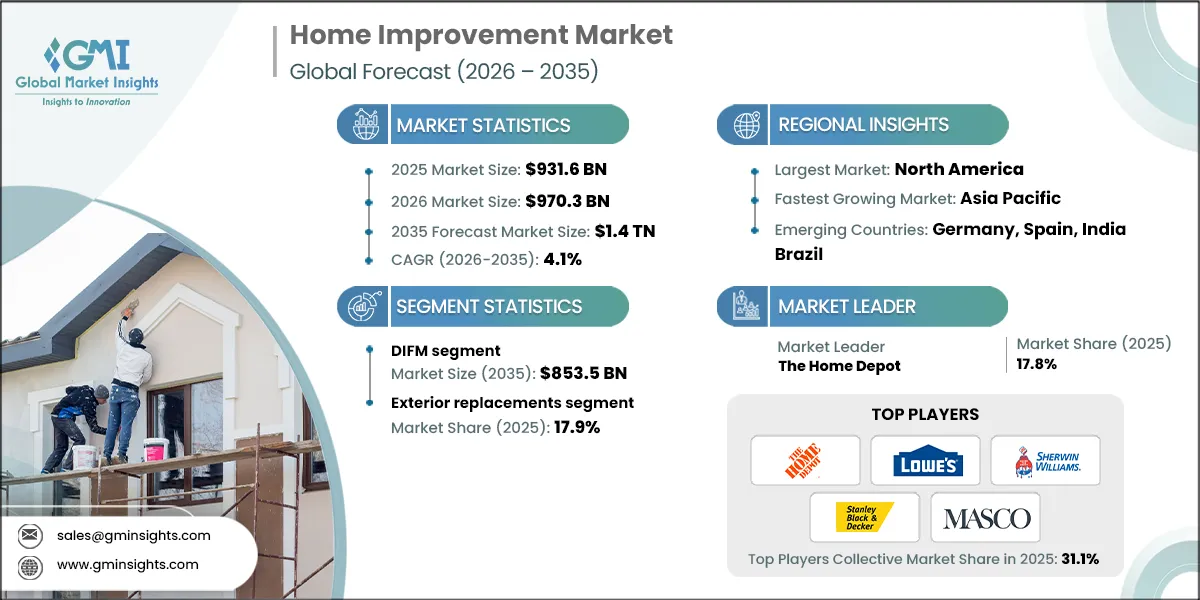
The home improvement market was valued at USD 931.6 billion in 2025. The market is expected to grow from USD 970.3 billion in 2026 to USD 1.4 trillion in 2035, at a CAGR of 4.1%, according to latest report published by Global Market Insights Inc.
Home Improvement Market Key Takeaways
Market Size & Growth
- 2025 Market Size: USD 931.6 Billion
- 2026 Market Size: USD 970.3 Billion
- 2035 Forecast Market Size: USD 1.4 Trillion
- CAGR (2026–2035): 4.1%
Regional Dominance
- Largest Market: North America
- Fastest Growing Region: Asia Pacific
Key Market Drivers
- Increasing Disposable Income.
- Technological Advancements.
- Aging Houses Requiring Renovation.
Challenges
- Changing consumer preferences and trends.
- Counterfeit and imitation products.
Opportunity
- Growth in Sustainable and Eco-Friendly Materials.
- Expansion of Smart and Functional Homes.
Key Players
- Market Leader: The Home Depot led with over 17.8% market share in 2025.
- Leading Players: Top 5 players in this market include The Home Depot, Lowe's Companies, Sherwin-Williams, Stanley Black & Decker, Masco Corporation, which collectively held a market share of 31.1% in 2025.
Get Market Insights & Growth Opportunities
The continuing rise of the home improvement is largely attributable to the various economic factors affecting the economy, the current realty market and the evolving consumer preferences towards home ownership. With consumers having more disposable income to spend on renovations and upgrades to their homes the home improvement market is growing dramatically. In 2020, as reported by the Economic Analysis Bureau, the disposable personal income for individuals increased by 3.5%, allowing homeowners to take advantage of the increased amount of disposable income by investing in home renovations and upgrades.
Realty market dynamics play a large part in the growth of this market, the National Association of Realtors reported that the Home Ownership Level as of Q2 2020 is at 65.9%, creating a large pool of potential buyers in the marketplace. The application of monthly home sales rates to this data creates an additional motivating factor for homeowners to renovate their homes before putting them on the market to maximize the resale value of the property.
Government programs and financial incentives also aid in promoting the continued growth of the home improvement industry. Through tax credits and incentives, as well as programs which help to finance the energy efficient upgrades, such as those provided through the Department of Energy's Weatherization Assistance Program. These programs increase homeowner's motivation to complete renovation efforts by making them less costly and create a greater need for services and products associated with the renovation commerce.
further the Interest rates play an essential role in the market, Federal Reserve has documented that mortgage rates peaked at 6.5% in 2023 versus only 3% back in 2021. Lower mortgage rates typically incentivize homeowners to borrow money to renovate their homes; conversely, higher mortgage rates often dissuade homeowners from borrowing for renovations. In response, lenders like Wells Fargo have introduced customized solutions for homeowners regarding financing for home improvement projects.
Technology is another force propelling growth forward within the home improvement arena. Technology products that add new levels of convenience such as Nest Thermostats and energy efficiency are being purchased more frequently, thanks to consumers' increased level of knowledge about these products. This new trend is helping to define the home improvement industry and will continue to drive the industry's growth during the forecast period.
To get key market trends
Home Improvement Market Trends
Changing innovation and technology transformation are important for the growth of the home improvement industry.
- The home improvement sector is shaped by both consumer desires that change gradually with technology. These renovations have been sustainable due to the financial benefits offered through various government programs such as U.S. government's current credit for clean energy program. Energy efficient products offer homeowners a 20%-30% reduction in their electric bills as reported by the U.S. Department of Energy through products such as solar, high efficiency insulation. Tesla's Competition and Sun Power are examples of companies that offer cutting-edge solar technologies to satisfy this ongoing market demand.
- According to the Consumer Technology Association 2025, with 75% of U.S. households owning at least one smart device. Some of these devices include things like programmable thermostats and home security systems which are interspersed throughout a renovation process for convenience, energy savings, and security. Smart home technology spending is expected to increase 12% each year until 2030 given the amount of tech savvy homeowners continuing to emerge.
- Economic conditions will certainly have an effect on renovations. The U.S. unemployment rate is 3.6% which, due to steadily rising wages, has led many homeowners to undertake renovation projects. With that being stated, given the Federal Reserve's decisions regarding controlling inflation, many homeowners will be focusing on smaller, more budget friendly projects rather than larger more elaborate ones, due to a higher cost of borrowing.
- The Census Bureau has shown that the home ownership rate is currently at 66.2% in 2025,demonstrated the continued demand for improvements or renovations on homes. Additionally, the NAR has provided evidence that homes that have already been renovated are going to sell quicker and at much higher prices than they would have sold in their original condition. This has encouraged many homeowners to increase their home's value prior to putting it on the market.
- With the changing market place, many large retail stores such as Lowe’s and Home Depot have responded to these trends by offering additional products to their customers. This includes the addition of green and smart products. There are also new and innovative companies such as Ecobee and Vivint that are gaining momentum by developing unique products for homes focused on energy efficiency and connectivity.
Home Improvement Market Analysis
Learn more about the key segments shaping this market
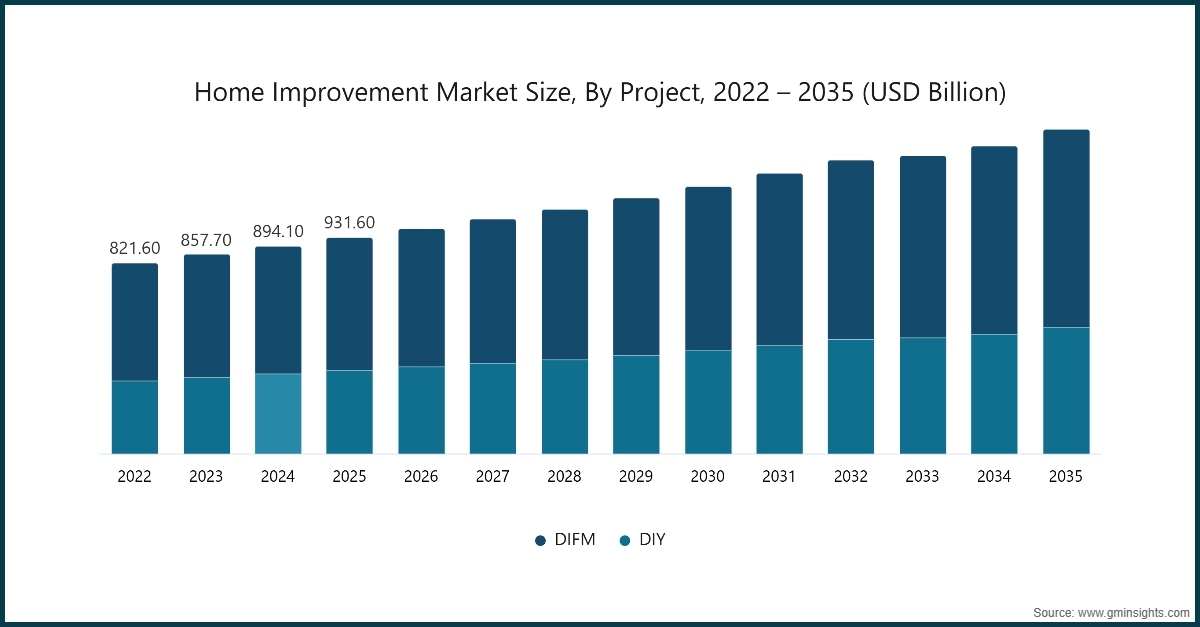
Based on project, the home improvement industry is segmented into DIY and DIFM. The DIFM segment accounts for revenue of around USD 574.9 billion in 2025 and is expected to reach USD 853.5 billion by 2035.
- Due to the increasing demand for professional expertise for more complicated home improvement projects, the DIFM segment has become the largest segment of the home improvement market. DIFM projects include kitchen, bathroom and electrical or structural renovation, all of which require specialized skills and time to perform. As reported by the U.S. Census Bureau, there has been an annual increase of 12% in total spending on home improvement projects by homeowners through 2025, with a sizeable amount of this growth attributed to DIFM.
- This growth is primarily driven by increased disposable incomes, increased urbanization, and a preference for higher quality professionally executed home improvement projects. For example, in 2024, the National Association of Home Builders (NAHB) reported that 70% of homeowners utilized a professional service for their major renovation project.
- In order to meet the increasing demand for DIFM services, retailers such as Lowe's and Home Depot have developed their own DIFM service offerings, which include installation and consultation services for consumers interested in completing their renovation projects with the assistance of a professional. According to Lowe's, it experienced a 15% increase in revenue generated from its DIFM business in 2024, demonstrating the growing demand for DIFM services.
- For example, under the Department of Energy's Weatherization Assistance Program, this program promotes energy-efficient improvements to homes; because many times the do-it-yourself approach requires professional assistance, programs such as this have helped to increase demand for DIFM Services in addition to the increasing demand for these services from consumers and through companies' initiatives.
- Thus, the DIFM segment continues to dominate the home improvement market because of its unique ability to address home improvement projects efficiently while offering a variety of options, and with all the governmental support, increased consumer demand, and initiatives from companies.
Learn more about the key segments shaping this market
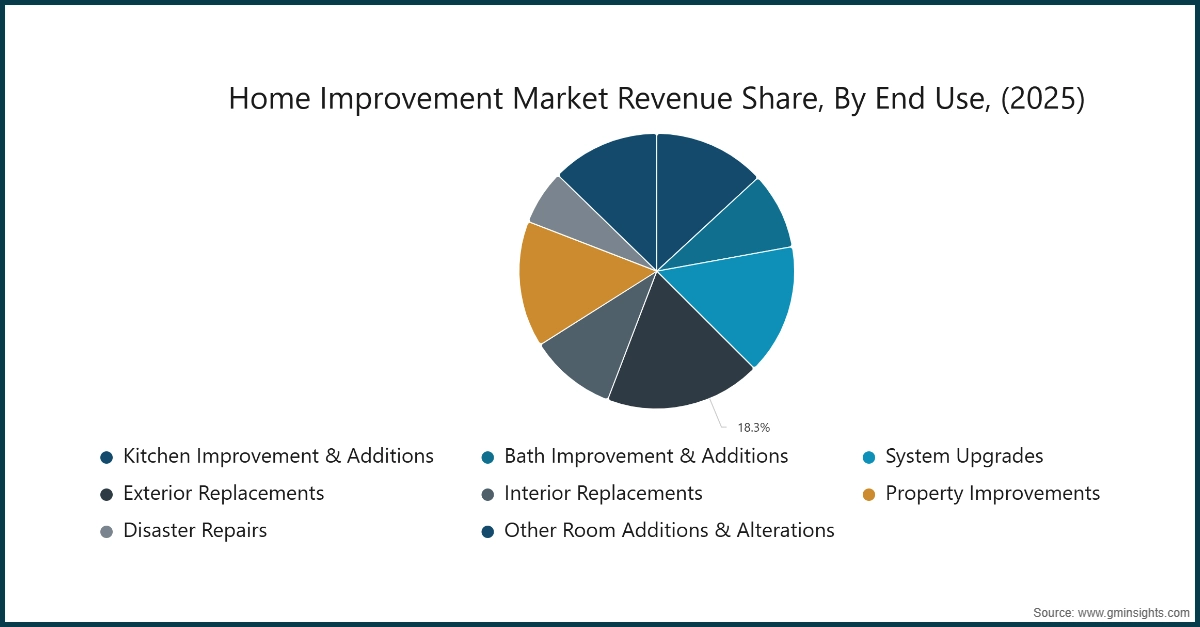
Based on the end use, the market is bifurcated kitchen improvement & additions, bath improvement & additions, system upgrades, exterior replacements, interior replacements, property improvements, disaster repairs and other room additions & alterations. The exterior replacements segments held around 17.9% of the market share in 2025.
- This dominance is attributed to increasing consumer focus on enhancing curb appeal and energy efficiency. According to the U.S. Census Bureau, spending on exterior home improvements, such as roofing, siding, and windows, accounted for a substantial portion of the USD 500 billion spent on home renovations in 2023. This trend is expected to continue through 2025, driven by rising disposable incomes and government incentives for energy-efficient upgrades..
- Government programs and agencies, such as the U.S. Department of Energy's Weatherization Assistance Program, have promoted exterior replacement projects. As part of these initiatives, programs promote the installation of energy-efficient windows, doors and insulation with the goal of reducing energy usage. Tax credits for making energy-efficient improvements have fuelled demand for this market segment even more.
- Many of the leading manufacturers in this segment, including Owens Corning and Pella Corporation, are capitalizing on these trends by developing and producing innovative and sustainable products for exterior applications. For example, Owens Corning has developed advanced roofing materials that are designed to maximise energy efficiency and durability. Pella Corporation has also expanded its product line of energy-efficient windows and doors to satisfy consumers’ increased focus on energy efficiency.
- The frequency of severe weather is increasing. Therefore, the need for exterior replacements that are durable and resistant to severe weather is increasing. Homeowners are choosing materials that have the ability to withstand severe weather, and this increase has helped the segment grow. As an example, vinyl siding and impact-resistant roofing materials have become more desirable due to their durability and low maintenance needs.
- As the home improvement market continues to grow, the exterior replacements segment will remain the largest portion of this market. Government support, product innovation, and consumer preference will all contribute to the continued growth of the exterior replacements segment throughout the period.
Looking for region specific data?
North America Home Improvement Market
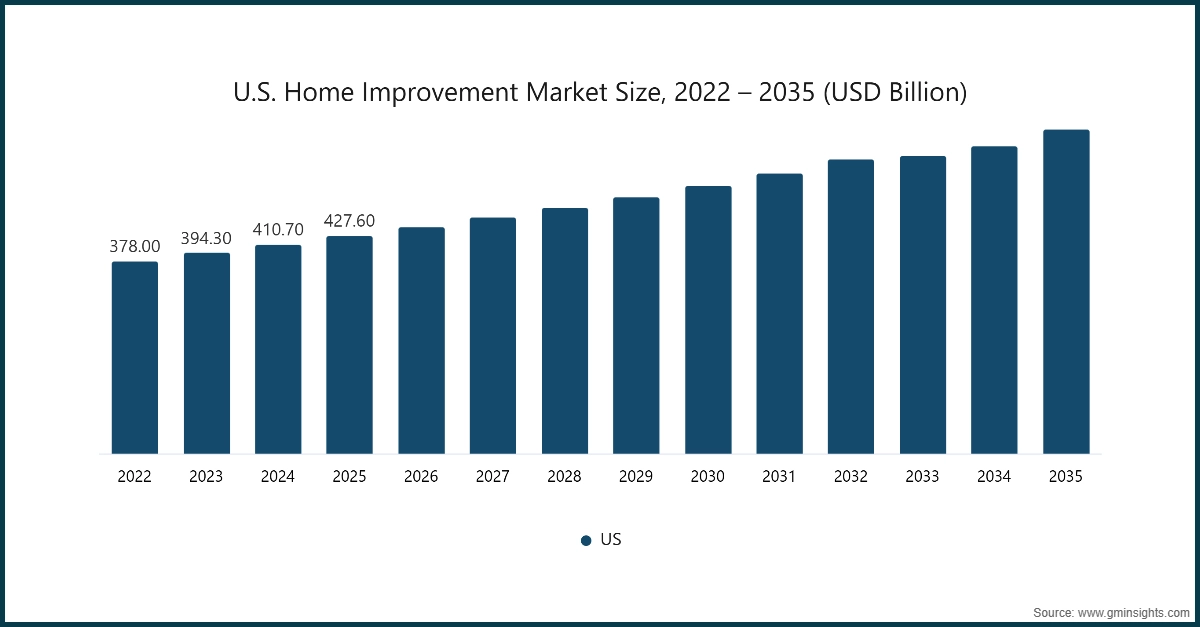
In 2025, the U.S. dominated the home improvement industry growth in North America, accounting for 84.9% of the share in the region.
- The market is driven by strong housing renovation trends and aging home stock. High disposable income and easy access to financing options encouraged homeowners to invest in remodeling projects. Government-backed programs like the Weatherization Assistance Program and tax credits for energy-efficient upgrades boosted demand for sustainable improvements.
- According to the U.S. Department of Energy, federal incentives under the Inflation Reduction Act allocated USD 8.8 billion for home energy efficiency rebates in 2025. Similarly, the EPA’s ENERGY STAR program reported over USD 7 billion in consumer savings through energy-efficient home upgrades. These initiatives significantly influenced homeowners to invest in system upgrades, insulation, and eco-friendly fixtures, reinforcing market expansion.
Asia Pacific Home Improvement Market
Asia Pacific market is expected to grow at 5.1% CAGR during the forecast period.
- The region’s growth is fueled by rapid urbanization and rising middle-class income. Countries like China and India are witnessing increased residential construction and remodeling activities. Growing awareness of modern interiors and smart home solutions is driving demand for kitchen and bath upgrades. E-commerce platforms and DIY tutorials are also making home improvement more accessible to younger demographics.
Europe Home Improvement Market
Europe market is expected to grow at 4.3% CAGR during the forecast period.
- Europe’s market is supported by stringent energy-efficiency regulations and sustainability goals. The EU’s Renovation Wave Initiative aims to double renovation rates by 2030, encouraging homeowners to upgrade insulation, heating systems, and windows. Rising preference for eco-friendly paints, water-saving fixtures, and smart thermostats is shaping consumer choices. Additionally, aging housing stock in Western Europe is fueling demand for modernization projects.
Middle East and Africa Home Improvement Market
Middle East and Africa market is expected to grow at 2 % during the forecast period.
- MEA is driven by increasing urban development and premium housing projects in GCC countries. Government investments in smart city initiatives, such as Saudi Arabia’s Vision 2030, are promoting modern home designs and energy-efficient systems. Rising tourism and hospitality projects also boost demand for property improvements and luxury interiors.
Home Improvement Market Share
The top companies in the home improvement industry include The Home Depot. Lowe's Companies, Sherwin-Williams, Stanley Black & Decker and Masco Corporation and collectively hold a share of 31.1% of the market in 2025. These prominent players are proactively involved in strategic endeavors, such as mergers & acquisitions, facility expansions & collaborations, to expand their product portfolios, extend their reach to a broad customer base, and strengthen their market position.
The Home Depot is a leading home improvement retailer offering a wide range of building materials, tools, and décor products. It serves DIY customers, professional contractors, a maintenance professional through physical stores and online platforms. The company focuses on convenience, project-based solutions, and installation services. Its portfolio includes appliances, flooring, plumbing, and outdoor living products. Lowe’s is a major home improvement retailer specializing in hardware, appliances, and renovation products. It caters to homeowners and professionals with solutions for remodeling, repair, and maintenance projects. Lowe’s emphasizes personalized services, installation support, and digital shopping experiences. Its offerings span kitchen, bath, flooring, and outdoor improvement categories. Sherwin-Williams is a global leader in paints, coatings, and related products for residential and commercial applications. It provides premium interior and exterior paints, stains, and finishes that enhance aesthetics and durability. The company focuses on eco-friendly formulations and color innovation to meet sustainability trends. Its distribution network includes company-owned stores and partnerships with retailers.
Home Improvement Market Companies
Major players operating in the home improvement industry are:
- American Exteriors
- Belfor
- Coit Services, Inc.
- Crane Renovation Group
- DKI Ventures, LLC
- FirstService Corporation
- Henkel Corporation
- Kohler
- Lowe's Companies
- Masco Corporation
- Mr. Handyman
- Neil Kelly Company
- Sherwin-Williams
- Stanley Black & Decker
- The Home Depot
Stanley Black & Decker is a prominent manufacturer of tools, hardware, and security solutions for home improvement and construction. Its portfolio includes power tools, hand tools, and storage systems designed for DIY and professional users. The company invests in smart tools and connected solutions to enhance efficiency and safety. It also supports sustainability through energy-efficient product designs.
MascoCorporation is a leading provider of branded home improvement and building products, including plumbing fixtures, cabinetry, and decorative hardware. Its brands such as Delta Faucet and KraftMaid cater to kitchen and bath remodeling needs. Masco emphasizes design innovation, water-saving technologies, and customization options. The company serves both residential and commercial markets through diverse distribution channels.
Home Improvement Market Report Attributes
| Key Takeaway | Details |
|---|---|
| Market Size & Growth | |
| Base Year | 2025 |
| Market Size in 2025 | USD 931.6 Billion |
| Market Size in 2026 | USD 970.3 Billion |
| Forecast Period 2026-2035 CAGR | 4.1% |
| Market Size in 2035 | USD 1.4 Trillion |
| Key Market Trends | |
| Drivers | Impact |
| Increasing Disposable Income | Higher household income enables consumers to allocate more funds toward renovations, upgrades, and premium materials. This drives demand for both DIY and DIFM projects across all home improvement categories. |
| Technological Advancements | Smart home devices, energy-efficient systems, and digital design tools are transforming renovation projects. These innovations enhance convenience, sustainability, and customization, attracting tech-savvy homeowners. |
| Aging Houses Requiring Renovation | A large portion of housing stock in developed markets is over 30 years old, creating a need for structural repairs and modernization. This trend fuels spending on kitchens, bathrooms, and system upgrades. |
| Pitfalls & Challenges | Impact |
| Changing consumer preferences and trends | Rapid shifts toward sustainability and smart solutions require constant product innovation. Companies face pressure to adapt quickly or risk losing relevance in a competitive market. |
| Counterfeit and imitation products | Major renovations and smart upgrades involve significant upfront costs, limiting adoption among price-sensitive consumers. Economic uncertainty and high interest rates further constrain spending. |
| Opportunities: | Impact |
| Growth in Sustainable and Eco-Friendly Materials | Rising environmental awareness and government incentives create strong demand for green products. Brands offering low-VOC paints, recycled materials, and water-saving fixtures gain a competitive edge. |
| Expansion of Smart and Functional Homes | IoT-enabled devices and modular designs are reshaping home improvement into a tech-driven segment. This opens new revenue streams for manufacturers and retailers through connected solutions. |
| Market Leaders (2025) | |
| Market Leader |
17.8% market share |
| Top Players |
Collective market share in 2025 is 31.1% |
| Competitive Edge |
|
| Regional Insights | |
| Largest Market | North America |
| Fastest growing market | Asia Pacific |
| Emerging countries | Germany, Spain, India, Brazil |
| Future outlook |
|
What are the growth opportunities in this market?
Home Improvement Industry News
- In January 2026, The Home Depot relaunched its nationwide Kids’ Workshops, offering free, monthly DIY sessions for children aged 5–12. Held on the first Saturday of each month, participants build themed projects like tow trucks and birdhouses with supplied materials and staff guidance. These workshops foster early DIY literacy and drive repeat weekend foot traffic.
- In December 2025, Masco announced a revamped executive leadership team emphasizing its Plumbing & Wellness division, including Delta and Hansgrohe. This move coincides with heightened market interest in water-efficient products, reinforcing its support for eco-friendly bathroom renovations.
- In November 22, 2025, Stanley Black & Decker secured FCC clearance for its “Blueway 2520” Bluetooth LE module, slated to roll out in DeWalt and Craftsman power tools. This smart module enables remote battery tracking, theft prevention, usage diagnostics, and tool management via proprietary apps.
- In August 2025, Sherwin Williams unveiled its 2026 Colormix Trend Forecast Anthology Volume Two, introducing palettes ideal for kitchen upgrades. The Sunbaked Hues palette, featuring warm earth tones like pink sandstone and dusty reds, is specifically designed to enrich cabinetry and backsplashes.
- In June 2025, Lowe’s finalized its acquisition of Artisan Design Group (ADG) for USD 1.3 billion, expanding its DIFM capabilities. ADG brings extensive design-to-installation services in flooring, cabinets, and countertops via a network of 3,200 installers across 18 U.S. states. This move accelerates Lowe’s professional services growth, targeting integrated kitchen and bath renovation demand.
The home improvement market research report includes in-depth coverage of the industry, with estimates & forecasts in terms of revenue (USD Billion) (from 2022 to 2035), for the following segments:
Market, By Project
- DIY
- DIFM
Market, By End Use
- Kitchen improvement & additions
- Bath improvement & additions
- System upgrades
- Exterior replacements
- Interior replacements
- Property improvements
- Disaster repairs
- Other room additions & alterations
The above information is provided for the following regions and countries:
- North America
- U.S.
- Canada
- Europe
- Germany
- France
- UK
- Italy
- Spain
- Asia Pacific
- China
- Japan
- India
- Australia
- South Korea
- Latin America
- Brazil
- Mexico
- Argentina
- MEA
- Saudi Arabia
- UAE
- South Africa
Frequently Asked Question(FAQ) :
What is the market size of the home improvement market in 2025?
The market size was USD 931.6 billion in 2025, with a CAGR of 4.1% expected through 2035 driven by rising disposable incomes, aging housing stock, and growing demand for sustainable and smart home solutions.
What is the projected value of the home improvement market by 2035?
The home improvement market is expected to reach USD 1.4 trillion by 2035, propelled by technological advancements, government incentives for energy efficiency, and increasing homeowner investments in renovations.
What is the current home improvement market size in 2026?
The market size is projected to reach USD 970.3 billion in 2026.
How much revenue did the DIFM segment generate in 2025?
DIFM (Do It For Me) projects generated USD 574.9 billion in 2025 and are expected to reach USD 853.5 billion by 2035.
What was the market share of the exterior replacements segment in 2025?
Exterior replacements held 17.9% market share in 2025, accounting for the largest portion of the global home improvement market.
What is the growth outlook for the Asia Pacific region from 2026 to 2035?
The Asia Pacific home improvement market is projected to grow at a 5.1% CAGR till 2035, driven by rapid urbanization, rising middle-class income, and increased residential construction activities.
Which region leads the home improvement market?
North America dominated with 84.9% regional share in 2025, led by the U.S. Strong housing renovation trends, government-backed programs, and high disposable income fuel the region's dominance.
What are the upcoming trends in the home improvement market?
Key trends include adoption of sustainable and eco-friendly materials, smart home technologies with IoT-enabled devices, energy-efficient systems, and modular designs for enhanced customization and functionality.
Who are the key players in the home improvement market?
Key players include The Home Depot, Lowe's Companies, Sherwin-Williams, Stanley Black & Decker, Masco Corporation, American Exteriors, Belfor, Coit Services Inc., Crane Renovation Group, DKI Ventures LLC, FirstService Corporation, Henkel Corporation, Kohler, Mr. Handyman, and Neil Kelly Company.
Home Improvement Market Scope
Related Reports