Summary
Table of Content

High-Speed Blowers Market
Get a free sample of this report
Form submitted successfully!
Error submitting form. Please try again.
Thank you!
Your inquiry has been received. Our team will reach out to you with the required details via email. To ensure that you don't miss their response, kindly remember to check your spam folder as well!
Request Sectional Data
Thank you!
Your inquiry has been received. Our team will reach out to you with the required details via email. To ensure that you don't miss their response, kindly remember to check your spam folder as well!
Form submitted successfully!
Error submitting form. Please try again.
High-Speed Blowers Market Size
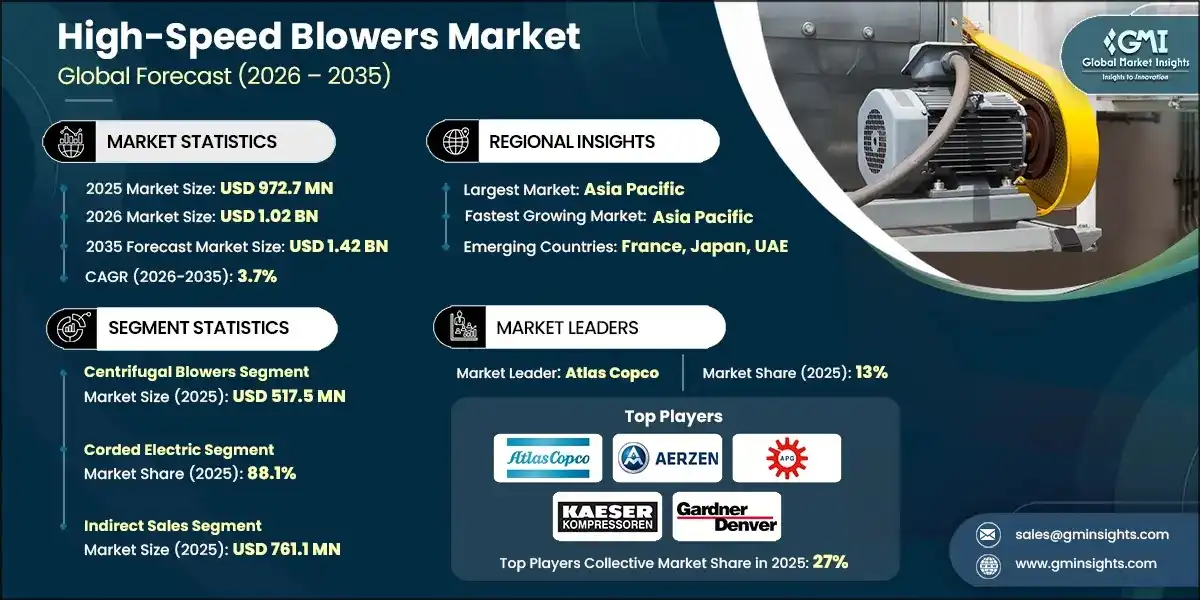
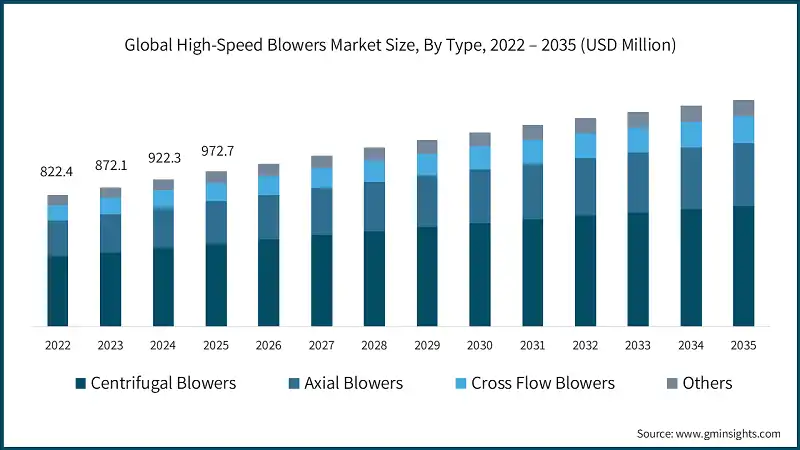
The high-speed blowers market was estimated at USD 972.7 million in 2025. The market is expected to grow from USD 1.02 billion in 2026 to USD 1.42 billion in 2035, at a CAGR of 3.7% according to latest report published by Global Market Insights Inc.
To get key market trends
High speed blowers have become a base of the oil & gas industry and use them to compress gas, refine crude oil and carry them to market with our Petrochemicals via pipelines throughout the world. Global energy consumption continues to increase and as such, companies want to maintain their continued success by using the latest technology in their operations so they can be able to operate efficiently and reliably in high-speed environments. High speed blowers offer the same benefits of being able to maintain stable air flow and less energy consumption than traditional technologies.
Additionally, stricter regulations and environmental sustainability have resulted in many oil and gas companies transitioning to more energy efficient technologies. The ability of high-speed blowers reduces your carbon footprint while providing the same level of performance and efficiency, thus providing the ability to modernize their operations. This trend is expected to grow due to the incorporation of smart monitoring systems (IoT) and Predictive Maintenance that allow greater control and reduce the time between breakdowns or delays & repair cycles, optimizing total cost of ownership.
A rapidly developing sector of the economy is creating a growing demand for high-speed blowers in emerging economies. This is driven both by increased demand for high-speed blowers in conjunction with large infrastructure projects as well as from the need of various industries to use these products for aeration, cooling, and material handling. Due to their compact design and energy-saving features, high-speed blowers represent an ideal solution for new facilities that are focused on both maximizing space and maintaining maximum efficiency.
The growing emphasis on smart cities by local governments, the increasing focus on clean water programs, and the focus on sustainable growth through advancing the industrial sectors is only serving to increase the demand for high-speed blowers. As industries continue to invest in their facilities to comply with environmental regulations, and to adopt the practices that support Industry 4.0, it is anticipated that high-speed blowers will become critical in achieving operational excellence. The combination of industrial and commercial growth in conjunction with the sustainability demands of industries indicates to analysts that the potential for substantial long-term growth in high-speed blower sales will be available.
High-Speed Blowers Market Report Attributes
| Key Takeaway | Details |
|---|---|
| Market Size & Growth | |
| Base Year | 2025 |
| Market Size in 2025 | USD 972.7 Million |
| Market Size in 2026 | USD 1.02 Billion |
| Forecast Period 2026-2035 CAGR | 3.7% |
| Market Size in 2035 | USD 1.42 Billion |
| Key Market Trends | |
| Drivers | Impact |
| Growth of the oil & gas industry | The growth of the oil and gas industry is increasing the need for high-speed blowers in a variety of applications, including the compression of gases, ventilation and the refining of petroleum products. |
| Industrialization & infrastructure expansion | The rapid development of industry and infrastructure has contributed to the increased use of high-speed blowers in major industrial sectors, such as wastewater treatment, manufacturing, and power generation. |
| Energy efficiency & operational savings | The search for energy efficiency and operational cost savings has been the primary factor in the market growth of advanced blower technologies that utilize magnetic bearings and variable speed drives. |
| Increasing demand for oil free and certified blowers | Industry compliance with regulations, as well as the need for contamination-free operations, have driven the growth of demand for oil-free blowers; in particular, the increased air quality standards in the food and pharmaceutical industries and the requirements for clean air in the water treatment industry. |
| Pitfalls & Challenges | Impact |
| High initial investment | For many smaller and mid-size businesses installing an advanced blower system still represents a significant investment, making it difficult to justify their purchase in todays cost-sensitive environment where many companies recognize the long-term benefits associated with reduced energy consumption. |
| Skilled workforce needs | The relatively new applications of modern blower systems require knowledgeable staff and OEM technical support for installation, operation and maintenance. |
| Opportunities: | Impact |
| Wastewater treatment applications | High-speed blowers continue to be the most significant usage for wastewater treatment facilities. Urbanization trends and stricter regulations on discharge quality continue to increase the need for efficient aeration technologies in water treatment applications. |
| Adoption of Smart & IoT-Integrated Blowers | Emerging technology and the integration of smart/IoT-enabled blowers into an Industry 4.0 system opens new capabilities for predictive maintenance and real-time performance monitoring and optimization solutions. |
| Market Leaders (2025) | |
| Market Leaders |
13% market share |
| Top Players |
Collective market share in 2024 is The collective market share in 2025 is 27% |
| Competitive Edge |
|
| Regional Insights | |
| Largest Market | Asia Pacific |
| Fastest Growing Market | Asia Pacific |
| Emerging Country | France, Japan, UAE |
| Future Outlook |
|
What are the growth opportunities in this market?
High-Speed Blowers Market Trends
There has been rapid growth in the high-speed blowers industry as the demand for new technology has increased along with the need for environmental-friendly efforts and growing industrialized nations. The industry is experiencing changes due to new trends, such as creating an energy-efficient product, digital evolution of the industry, and growth within emerging markets. Companies are actively developing smarter products, predictive maintenance strategies and designing their products in smaller footprints.
- Across the globe, manufacturers face an uphill battle to decrease their energy consumption and greenhouse gas emissions. The latest high-speed blowers feature sophisticated aerodynamic design of the impellers combined with either magnetic or aero foil bearing, thereby reducing drag and power losses while operating at these higher efficiency levels. Comparatively to traditional blowers, the energy-efficient models provide 15 to 30 percent greater efficiency. With sustainability being a high priority for businesses today, companies are replacing their older blower systems with the more energy-efficient models to meet regulatory compliance and to reduce their operating costs.
- Blower operations are being revolutionized because of the merging of IoT with Smart Technology. The newest generations of high-speed blowers include sensors that provide access to performance metrics, including vibration, temperature, and airflow, allowing for continuous monitoring and assessment of the blower’s operation. Using AI technology, predictive maintenance will allow maintenance professionals to identify potential failure before it happens, leading to reduced maintenance costs and less downtime.
- The rapid urbanization and significant increase in population has placed an unprecedented demand on wastewater treatment processes and the need for developing infrastructure. Due to high-speed blowers, aeration processes in treatment plants can be significantly improved due to the increase in the oxygen transfer process as well as resulting in significant energy savings. Due to the requirements of existing governments and jurisdictions around the world to develop a sustainable water management system, there has been a continual demand for the most sophisticated blower technologies.
- Numerous emerging markets across Asia Pacific, the Middle East, and Africa are currently developing infrastructure, industrialization, and therefore investing significantly in power generation, chemical processing, and water treatment facilities which all require High Performance Blowers. Therefore, manufacturers are now beginning to develop more affordable products and have created local service networks to meet the growing demand for these types of products as these areas are becoming engines of growth through the combination of industrial development and sustainability initiatives.
High-Speed Blowers Market Analysis
Learn more about the key segments shaping this market
Based on type, the market is divided into centrifugal blowers, axial blowers, crossflow blowers and others. The centrifugal blowers held the major market share generating a revenue of USD 517.5 million in 2025.
- Centrifugal blowers are machines that use centrifugal force to move air or gas from one location to another. The air enters through the center of a pulled impeller and then exits from a series of diffusers that convert the kinetic energy of the air into high-pressure energy. Centrifugal blowers are particularly well-suited for applications where there is a consistent volume of air at moderate to high pressures. Centrifugal blowers are extremely rugged and reliable and provide excellent energy efficiency; subsequently, they are utilized in industrial manufacturing processes and HVAC systems, as well as material handling applications.
- Centrifugal blowers offer users the capability to move large amounts of air at almost constant pressure even when the amount of air is changing because of the changes in resistance that occur within the system. Because they are such durable products with low maintenance, these centrifugal fans can serve in many applications including those that require a high level of reliability, flexibility and ability to work in challenging environments. Many of today’s centrifugal blowers also feature advanced aerodynamic designs, as well as energy-efficient electric motors, which make them more economical to operate while also helping to achieve sustainable development goals. The wide range of applications served by centrifugal blowers include chemical processing, power generation, wastewater treatment and other process industries.
- The continuous airflow supply provided by centrifugal blowers is often critical for many industrial operations where airflow must be continuous, including combustion air supply, cooling, ventilation and aeration. Demand for these products is driven largely by ongoing infrastructure development, the increasing number of environmental regulations that are becoming more common and the growing awareness of the importance to have energy efficiency in today’s marketplace. Recent technological advances in both variable frequency drives and smart monitoring systems have also led to further product advancements to better meet the current marketplace demand for automation and sustainability initiatives.
Learn more about the key segments shaping this market
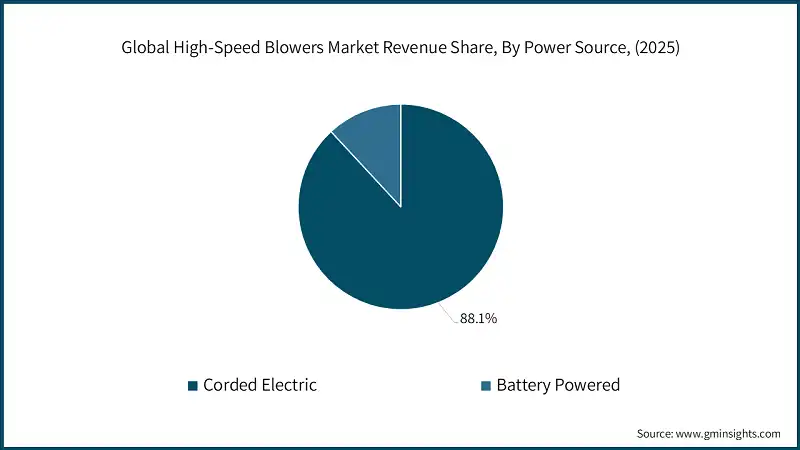
Based on power source, the high-speed blowers market is segmented into corded electric and battery powered. The corded electric segment accounted for around 88.1% of the market share in 2025.
- This segment includes a range of corded electric power sources which require an electrical outlet or socket for power. In general, the category has become well established in many industrial or commercial settings as they represent the most consistent and reliable power source. Unlike battery or gasoline-powered devices, corded electric power sources can be continuously operated without concern for recharge cycles or fuel supply to complete demanding work. These tools are typically less expensive to maintain, as they do not require complex fuel systems or combustion engines to operate. As a result, operators save money on both operational costs and longer equipment life. Since motor technology continues to be developed, the design of corded electric tools has become increasingly energy-efficient and user-friendly.
- Corded electric power sources are prevalent in the manufacturing, construction and material handling sectors; each is characterized by the need for high-volume production and constant operation. Therefore, the ability to produce powerful output without interruption is one of the most significant advantages provided by corded electric equipment in these applications. Corded electric power sources provide more torque and performance than cordless devices due to the added mass and energy source of a fixed power supply. Consequently, corded electric equipment is more appropriate for heavy-duty applications.
- While cordless mobility innovations continue gaining popularity, many users are still reliant on corded electric devices in situations where reliable or continuous access to power and energy use is of utmost importance. North America, Europe and certain areas of the Asia-Pacific region with strong power delivery systems continue to be the primary markets for these products. Cordless tools may provide convenience and adaptability; however, corded electric solutions have a competitive advantage in stationary equipment and higher-powered applications, thus retaining relevance in today’s developing industrial market environments.
Based on distribution channel, the high-speed blowers market is segmented into direct sales and indirect sales. The indirect sales segment generating a revenue of USD 761.1 million in 2025.
- In the indirect sales distribution method, merchants sell goods via agents instead of directly selling them to end users. An intermediary is a wholesaler, distributor, retailer, or agent that helps connect producers with customers. By using this method, producers can benefit from the established network and expertise of channel partners, thus avoiding the need for an extensive in-house sales infrastructure. Many businesses use the indirect distribution method in industries that require extensive geographic coverage and/or special handling of the product.
- The indirect distribution model is very cost-effective compared to direct selling and provides producers with the opportunity to enter new markets more quickly than if they were to sell directly to customers. The use of distributors and retailers allows producers to spend their time and resources on the activities of producing and innovating instead of on selling and distributing the product. However, it is critical for producers to cultivate solid relationships with channel partners and establish clear agreements to ensure consistency of branding and control over pricing. In many instances, due to complex supply chains and/or volume demands, indirect distribution is a great model for growth and scaling into the market.
Looking for region specific data?
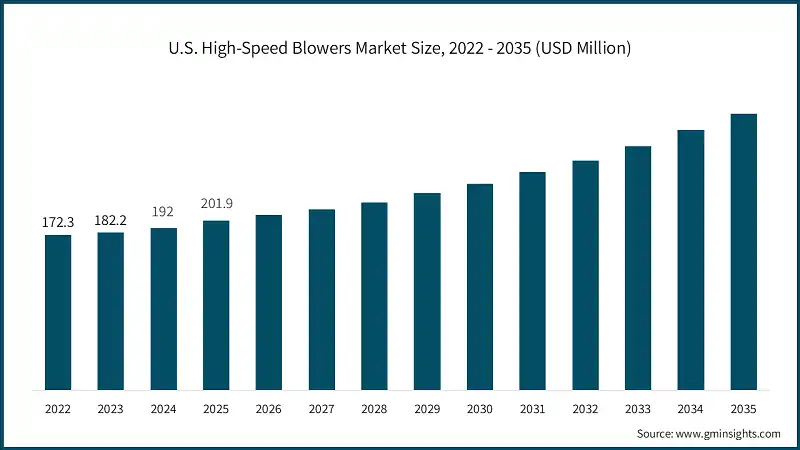
U.S dominated the North America high-speed blowers market with around 78.7% share and generating USD 201.9 million revenue in 2025.
- As industries move quickly toward more energy efficient and sustainable methods of operation, the U.S. high-speed blower market is similarly evolving in response. The wastewater treatment industry is currently the primary source of use for high-speed blowers, due to the increased demand associated with more stringent environmental regulations in addition to the requirement for more efficient methods of providing aeration. However, high speed blower systems have now begun to be utilized by many different industries including chemical processing, oil and gas and power generation. These industries are beginning to employ advanced blower technologies to reduce operating and maintenance costs while increasing system reliability.
- The growth of the North American high-speed blower market is being supported by the increase in infrastructure modernization and the increasing number of sustainable industrial practices in this region. There are also growing investments from both municipalities and private sector entities to upgrade their respective municipal water treatment plants. High-speed blowers facilitate aeration and biological processing in municipal wastewater treatment systems, therefore they help support and maintain municipal water treatment systems.
- Increasingly high-speed blowers are being adopted into the manufacturing and energy service industries, as there is an emphasis on efficiency and compliance to emission standards. Advanced technology such as variable speed drives (VSD) and digital control systems (DCS) provides precise management of airflow and can also provide significant energy savings. The combination of the above trends, as well as government investments in green technologies, creates the platform for high-speed blowers to become a key component in developing cleaner and more efficient industrial operations throughout North America.
Europe high-speed blowers market, Germany leads the with 19.2% share in 2025 and is expected to grow at 3.7% CAGR during the forecast period.
- The European Union's carbon neutrality and environmental regulations are pushing companies in the high-speed turbo fan blowing equipment to innovate. One key area driving this market is the use of these high-speed turbo fans for efficient aeration systems at wastewater treatment facilities to meet regulatory compliance with water quality and emissions. Another key area for the growth of this market will continue to be for companies in other major sectors chemical, pharmaceutical, and food processing who are implementing new blower technologies that provide more energy-efficient, cost-effective operations. This will drive growth due to the increased push for carbon-neutral and renewable energy in Europe.
- As a result, technological advancements are guiding the European market toward greater use of manufacturers' products with characteristics such as the use of magnetic bearings, airfoil configurations, and smart monitoring technologies that enable real-time performance optimization and predictive maintenance. As many industries are dependent on maintaining strict uptime requirements, this type of technology is vital for these sectors. Additionally, with the modernization of infrastructure taking place throughout both Western and Eastern Europe along with the promotion of green technology through government financial incentives, it is likely that there will be continued growth within the market for high-speed blowers in Europe.
The Asia Pacific leads the high-speed blowers market; China share of around 32% in 2025 and is anticipated to grow with a CAGR of around 4.3% from 2026 to 2035.
- The Asia Pacific region is leading the way in terms of high-speed blowing systems, because of rapid industrial growth and urbanization, along with massive infrastructure development throughout the area. Wastewater treatment plants have been established, and many other similar projects have already begun in countries like China, India, and South Korea, increasing the demand for energy-efficient blowing systems. The manufacturing industry also utilizes high-speed blowers to optimize plant operations and ventilate their facilities; therefore, both commercial and residential applications contribute to high-speed blower sales in Asia Pacific.
- Technological advancement, coupled with low-cost manufacturing, has made Asia Pacific the center of development for next generation blowing systems. The application of IoT enabled control systems, variable speed drives and advanced aerodynamic design are all examples of technologies currently being used to improve product performance and significantly decrease the total lifecycle cost of these motors. Growing demand for new technologies to reduce carbon emissions combined with more stringent environmental regulations will continue to drive innovation in this sector.
Latin America high-speed blowers markets are growing at a CAGR of 3.5% during the forecast period.
- The market for high-speed blowers in Latin America is expected to continue rising at a consistent rate due to increased infrastructure improvements and continued growth of numerous industries, including wastewater treatment, agriculture and food processing. In Brazil and Mexico particularly, there is increasing focus on upgrading water management systems, which will lead to greater demand for dependable aeration options to ensure optimal performance of this type of equipment.
- Technological adoption within this region is increasing rapidly; manufacturers of blowers are working hard to develop more advanced bearings that enable lower maintenance requirements, and to develop 'smart' controls for their units in response to demand for improved efficiency and lower maintenance levels. However, as this process takes some time, economic volatility and a lack of skilled technical resources for advanced technology continue to be major hurdles for furthering growth within the industry. However, there are opportunities for growth in the market over the next few years due to government funded infrastructure initiatives and increasing foreign investment into Latin America.
High-Speed Blowers Market Share
Atlas Copco is leading with 13% market share. Atlas Copco, Aerzen Turbo, APG Neuros, Kaeser Kompressoren, Gardner Denver collectively hold around 27%, indicating moderately fragmented market concentration. These prominent players are proactively involved in strategic endeavors, such as mergers & acquisitions, facility expansions & collaborations, to expand their product portfolios, extend their reach to a broad customer base, and strengthen their market position.
High-Speed Blowers Market Companies
Major players operating in the high-speed blowers industry are:
- Aerzen Turbo
- APG Neuros
- Atlas Copco AB
- Continental Industrie
- Esurging (Tianjin) Technology
- Gardner Denver
- Hoffman & Lamson
- Howden North America
- Kaeser Kompressoren SE
- KTurbo
- Nanjing Magnetic Valley Technology
- Spencer Turbine Company
- Sulzer
- Tuthill
- Xylem
Atlas Copco is an international manufacturer of high-quality, high-performance turbo blowers. One such range is the ZB VSD+ series. This range employs an oil-free, magnetic bearing design, which produces less friction than traditional designs, thus providing a much longer life for the blower. Atlas Copco's focus on sustainability and energy efficiency incorporates both intelligent monitoring and control systems that use variable speed drives to regulate speed according to demand for blowers.
Aerzen has established itself as a trusted manufacturer of oil-free, high-efficiency air-foil turbo blowers. Their focus is on creating a product that will be long-lasting and inexpensive to maintain. These blowers are commonly used in applications involving wastewater aeration, pneumatic conveying, and general industrial processes. Aerzen's commitment to design long-term reliability and cost savings reflects their strong engineering heritage and commitment to developing environmentally sound products.
Xylem is a worldwide leader in water technology, has included high-speed blower products among its many solutions for wastewater and aeration systems. As an energy-efficient technology that aligns with Xylem's mission to help solve the world's water problem, these types of blowers offer reduced energy consumption and help customers meet their environmental compliance. In addition to being energy-efficient, Xylem provides its customers with advanced control and monitoring systems for optimal performance and maximum efficiency through IoT-enabled solutions.
Gardner Denver offers complete range of high-speed turbo and related blower technologies that enable industrial and municipal applications. Every Gardner Denver blower has been aerodynamically designed, has magnetic bearings, provides maximum efficiency and requires very little maintenance. Many facilities, such as wastewater treatment plants and chemical processing, utilize blowers from Gardner Denver as precision airflow and energy-efficient technology are required. Gardner Denver's large international customer base and strong innovation focus ensure that customers will continue to rely on Gardner Denver as their primary source of blower technology.
High-Speed Blowers Industry News
- In July 2025, Bush Vacuum Solutions launched the TYR PLUS rotary lobe blower as their next-generation rotary blower, intended to provide energy efficiency and intelligent use of space. The TYR PLUS rotary lobe blower has a built-in variable speed drive (or VSD) which allows precise measurements of air flows, thus adding to the improvement of how much energy is used by them, while delivering performance specifications between 900-4,000 m³/h.
- In July 2025, Nanjing Magnetic Valley Technology launched its second generation of Magnetic Valley Premium blowers for magnetic levitation (maglev), and they have an advanced design that improves efficiencies and performance. They provide 30% energy savings while operating at up to 400kW capacity, and they produce less than 75dB noise levels while performing these duties.
- In March 2025, Gardner Denver has just launched its Hoffman & Lamson Sutorbilt® Legend Tri-Lobe Series of positive-displacement blowers in March 2025. Although it isn't a turbo blower, this new product line shows Gardner Denver's expansion of offerings and demonstrates Gardner Denver's focus on providing higher durability, improved efficiency and overall increased performance for today's increasingly demanding industrial applications via additional types of blowers.
- In December 2024, Atlas Copco launched The ZB VSD+ turbo blower series. It is a new generation of high-speed turbo blower that utilize magnetic bearings to run without friction, with the ability to control and manage performance exactly as intended. With its superior efficiency, it will revolutionize the oil-free aeration process and how the oil-free aeration products are maintained and monitored. It is designed to use less energy and have a greater airflow capacity than traditional solutions.
- In September 2024, Aerzen Turbo launched a compact, plug-and-play system with their new AT250 G5 Plus Turbo Blower, which was unveiled. This advanced blower uses an airfoil bearing system for oil-free operation and features a permanent magnet synchronous motor (IE5) that provides exceptional performance while consuming less energy than other products in the same market segment.
The high-speed blowers market research report includes in-depth coverage of the industry with estimates & forecasts in terms of revenue (USD Million) and volume (Thousand Units) from 2022 to 2035, for the following segments:
Market, By Type
- Centrifugal blowers
- Axial blowers
- Cross flow blowers
- Others (screw blower, roots blower, etc.)
Market, By Power Source
- Corded electric
- Battery powered
Market, By Technology
- Magnetic bearings
- Airfoil bearings
Market, By Application
- Wastewater treatment
- Oil & gas
- Chemical
- Marine
- Food & beverages
- Others (pulp and paper, food and beverage, etc.)
Market, By Distribution Channel
- Direct sales
- Indirect sales
The above information is provided for the following regions and countries:
- North America
- U.S.
- Canada
- Europe
- Germany
- UK
- France
- Italy
- Spain
- Asia Pacific
- China
- India
- Japan
- Australia
- South Korea
- Latin America
- Brazil
- Mexico
- Argentina
- Middle East and Africa
- South Africa
- Saudi Arabia
- UAE
Frequently Asked Question(FAQ) :
What are the upcoming trends in the high-speed blowers market?
Key trends include integration of IoT and smart technology for real-time monitoring, adoption of magnetic bearings and airfoil configurations, predictive maintenance capabilities, and development of energy-efficient designs with 15-30% greater efficiency than traditional models.
Who are the key players in the high-speed blowers market?
Key players include Atlas Copco AB, Aerzen Turbo, APG Neuros, Kaeser Kompressoren SE, Gardner Denver, Continental Industrie, Esurging (Tianjin) Technology, Hoffman & Lamson, Howden North America, KTurbo, Nanjing Magnetic Valley Technology, Spencer Turbine Company, Sulzer, Tuthill, and Xylem.
Which region leads the high-speed blowers market?
The U.S. dominated the North America high-speed blowers market with 78.7% share and USD 201.9 million revenue in 2025, driven by the shift toward energy-efficient and sustainable industrial operations.
What was the valuation of corded electric power source segment in 2025?
Corded electric power source held 88.1% market share in 2025, providing consistent and reliable power for continuous industrial operations.
What is the growth outlook for Asia Pacific high-speed blowers market from 2026 to 2035?
Asia Pacific leads the market with China holding 32% share in 2025 and anticipated to grow at a CAGR of 4.3% through 2035, led by rapid industrialization and urbanization.
What is the market size of the high-speed blowers in 2025?
The market size was USD 972.7 million in 2025, with a CAGR of 3.7% expected through 2035 driven by critical use in oil & gas sector for gas compression, crude oil refining, and petrochemical transport.
What is the current high-speed blowers market size in 2026?
The market size is projected to reach USD 1.02 billion in 2026.
How much revenue did the centrifugal blowers segment generate in 2025?
Centrifugal blowers generated USD 517.5 million in 2025, leading the market due to their excellent energy efficiency and reliability.
What is the projected value of the high-speed blowers market by 2035?
The high-speed blowers market is expected to reach USD 1.42 billion by 2035, propelled by industrialization, infrastructure expansion, and demand for energy-efficient operational solutions.
High-Speed Blowers Market Scope
Related Reports