Summary
Table of Content

Helicopter Market
Get a free sample of this report
Form submitted successfully!
Error submitting form. Please try again.
Thank you!
Your inquiry has been received. Our team will reach out to you with the required details via email. To ensure that you don't miss their response, kindly remember to check your spam folder as well!
Request Sectional Data
Thank you!
Your inquiry has been received. Our team will reach out to you with the required details via email. To ensure that you don't miss their response, kindly remember to check your spam folder as well!
Form submitted successfully!
Error submitting form. Please try again.
Helicopter Market Size
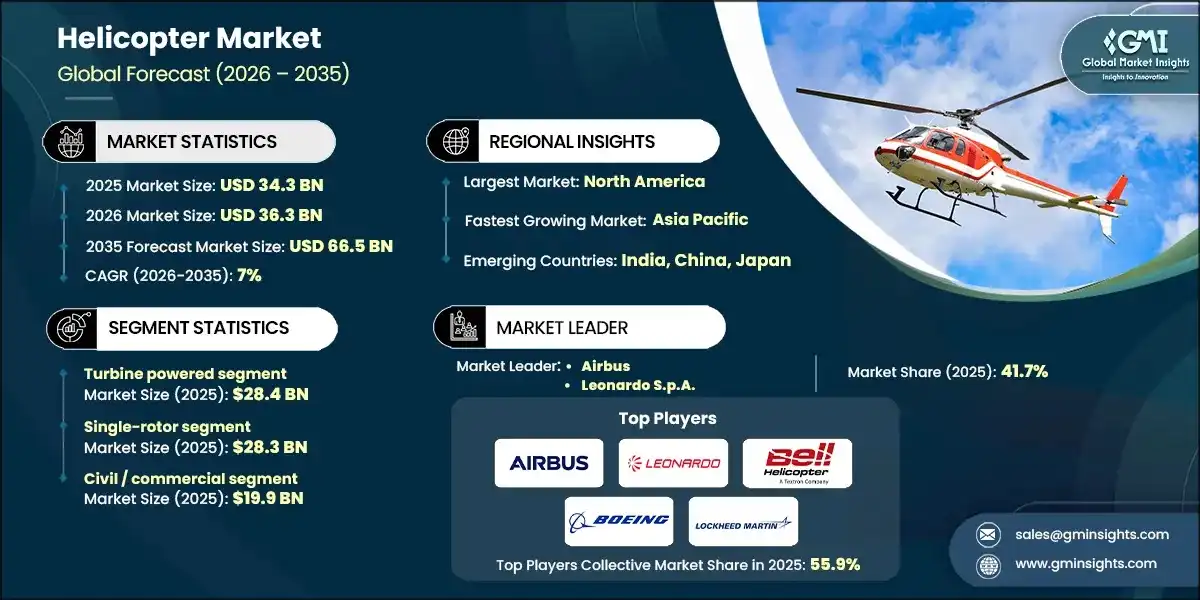
The global helicopter market was estimated at USD 34.3 billion in 2025. The market is expected to grow from USD 36.3 billion in 2026 to USD 47.1 billion in 2030 and USD 66.5 billion by 2035, at a value CAGR of 7% during the forecast period of 2026–2035.
To get key market trends
- The growth in demand for helicopters comes from increase in the global military and defense budgets, advancements in helicopter design and technology, and an increase in availability of helicopter air ambulance service. These factors have led to an increase in the number of helicopter tours and leisure flights as the market continues to grow.
- The increase in global military budgets is one of the main contributors to the growth of the helicopter industry. The Stockholm International Peace Research Institute provides estimates of the total amount spent on military activities by all countries globally, estimating a total outlay of 2.24 trillion U.S. dollars for the year 2023 (an increase of 3.7% over 2022). Increased military budgets will drive military modernization activities, with a focus on helicopter fleet expansions and upgrades. Because helicopters are a critical asset in performing a variety of different types of military operations, the amount that is being spent on military modernization directly correlates to increasing demand for advanced helicopter technologies, which improve both strategic and operational capabilities.
- The growing importance of emergency medical services is a key driver in the helicopter market. Helicopters are an important resource when it comes to transporting patients in emergencies, especially if the time is of the essence. The World Health Organization has stated that when people experience medical emergencies, if they receive medical treatment within the time frame that has been established by the World Health Organization, up to 25% of patients could survive. Helicopter service allows for the transportation of patients in need of medical attention to remote locations where the availability of necessary care is not possible.
- The North America region dominated with over 38.1% market share in 2025. Factors driving growth in the North American helicopter marketplace are increased demand from air mobility services, increased outlay in the defence sector and technological advancements. As reflected in the FY2025 Defence Appropriations Bill, USD 3 billion of the total annual defence budget (USD 851.7 billion) is allocated for modernising and procuring helicopters to support enhanced defence capabilities. With the increased responsibilities in electronic and emergency service (EMS) sectors, and oil and tourism related businesses, the future growth of the North American helicopter marketplace will remain strong .
Helicopter Market Report Attributes
| Key Takeaway | Details |
|---|---|
| Market Size & Growth | |
| Base Year | 2025 |
| Market Size in 2025 | USD 34.3 Billion |
| Market Size in 2026 | USD 36.3 Billion |
| Forecast Period 2026-2035 CAGR | 7% |
| Market Size in 2035 | USD 66.5 Billion |
| Key Market Trends | |
| Drivers | Impact |
| Increasing Military and Defense Expenditures | Drives 35% of market growth as rising global defense spending boosts demand for military helicopters in roles such as surveillance, combat, and logistics. |
| Drives 35% of market growth as rising global defense spending boosts demand for military helicopters in roles such as surveillance, combat, and logistics. | Drives 30% of market growth as innovations in rotor design, avionics, and propulsion systems improve performance, increasing demand in both commercial and military sectors. |
| Growing Importance of Emergency Medical Services | Contributes 20% of market growth as the increasing reliance on helicopters for medical evacuations, especially in urban areas, drives demand for specialized EMS helicopters. |
| Rising Urban Air Mobility (UAM) | Rising Urban Air Mobility (UAM) |
| Growing Interest in Helicopter Tours and Leisure Flights | Contributes 5% of market growth as rising tourism and recreational activities, including helicopter tours, boosts demand for leisure flight services. |
| Pitfalls & Challenges | Impact |
| High Operational Cost of Helicopters | Restrains 25% of market growth due to high operational and maintenance costs, limiting affordability and widespread use, especially in commercial sectors. |
| Limited Short-Range Transportation | Limits 15% of market growth as helicopters limited range for short-distance travel reduces their utility, particularly in urban air mobility and cost-effective transportation. |
| Opportunities: | Impact |
| Integration of Autonomous Technology | The rise of autonomous flying technology presents an opportunity to reduce the need for pilots, cutting operational costs and improving flight safety in various sectors like cargo transport and air taxis. |
| Advancements in Electric Helicopters | The development of electric-powered helicopters could significantly lower operational costs and environmental impact, offering sustainable and cost-effective solutions for both commercial and private sectors. |
| Market Leaders (2025) | |
| Market Leaders |
41.7% |
| Top Players |
|
| Competitive Edge |
|
| Regional Insights | |
| Largest Market | North America |
| Fastest Growing Market | Asia Pacific |
| Emerging Countries | India, China, Japan |
| Future outlook |
|
What are the growth opportunities in this market?
Helicopter Market Trends
- The trend of urban air mobility (UAM) is reshaping the helicopter industry, concentrating on the electric vertical takeoff and landing (eVTOL) aircraft. Starting in the early 2020s, UAM is structured from the desire for rapid and congestion-free transit in Metropolitan Areas. NASA predicts the UAM to reduce the problem of urban traffic congestion in the U.S. cities by 30%. The rapid development of technology and eco-sustainability is focusing the world on the air travel solutions in eVTOL aircraft to reduce the environmental footprints of air travel.
- The environmental focus of less carbon, and less noise in, the market for helicopters is emerging in the building and design of airframes. More flexible fuel burns with design-speed and hybrid-electric propulsion. Like in 2024, the airframe design and propulsion for city traffic eVTOL is designed by AIRBUS in the CityAirbus NextGen prototype with 80 km range and 120 km/h cruise speed. More emphasis on 3D modelling, engineering, and management in business, and aviation makes the AIRBUS new test center in Donauwörterth. The peak of this trend is predicted approx 2030's - aviation business model revolution.
- The technological advancements in rotorcraft design are changing the helicopter industry with new rotor blade materials and designs that will increase flight endurance, reduce noise, and enhance fuel economy. As demand grows for cost-effective operation and environmentally friendly solutions, this trend will continue to expand. NASA Glenn and Ames Research Center researchers believe that with advancements in hybrid electric rotorcraft technology, the range and loiter capabilities will see an immediate increase of 30%. Furthermore, if the advanced systems are developed and manufactured, the range of VTOL rotorcraft could increase two to three times that of conventional systems. The peak of this trend is predicted for the late 2020's as these technologies mature.
Helicopter Market Analysis
Learn more about the key segments shaping this market
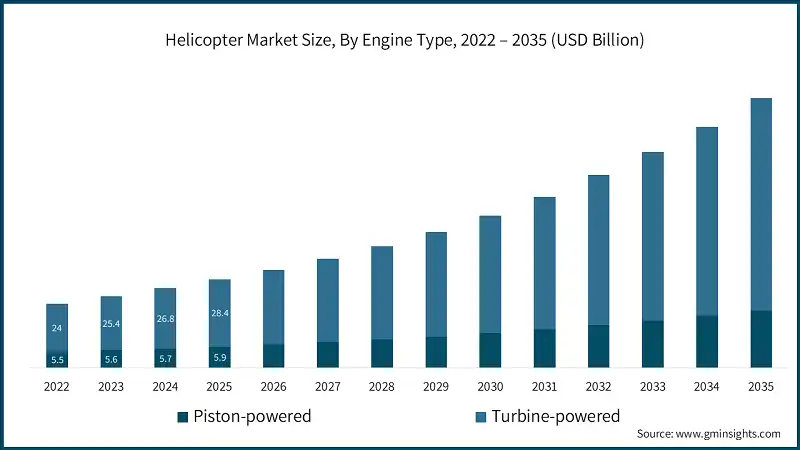
Based on the engine type, the market is bifurcated into piston-powered, turbine powered.
- The turbine powered segment was the largest market and was valued at USD 28.4 billion in 2025. Reliability and efficiency, as well as widespread use in military, commercial, and emergency helicopters demand high power and performance that drives this sector.
- Manufacturers focus should be on turbine engine efficiency, fuel burn, use of new, more appropriate materials for performance and cost, and on shifting more of the demand being generated in the military and commercial areas.
- The piston-powered segment is anticipated to grow with a CAGR of 3.5 % during the forecast period of 2026 – 2035. Fuel-efficient, inexpensive, and with lower operational costs make piston-powered helicopters more in demand, especially for training, light-duty, and recreational use.
- Manufacturers should focus on improvement in fuel efficiency, maintenance cost, and reliability of piston-powered helicopters, which would allow for more training, recreational, and small commercial operators and more market growth.
Learn more about the key segments shaping this market
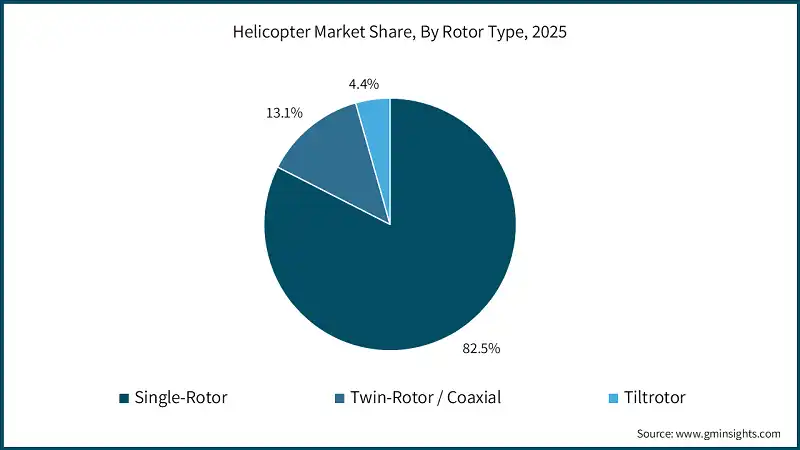
On the basis of rotor type, the helicopter market is segmented into single-rotor, twin-rotor / coaxial, tiltrotor.
- The single-rotor segment was the largest market and was valued at USD 28.3 billion in 2025. Having superior performance, fuel efficiency, and flexibility is what drives this sector.
- Manufacturers focus on single-rotor systems with more integrated advanced materials for cost, performance, and efficiency, with an optimized rotor for performance being the main consideration.
- The tiltrotor segment is the fastest segment and is anticipated to grow with a CAGR of 9.2% during the forecast period of 2026 – 2035. Tiltrotor has more demand because of its versatility. It is capable of both vertical takeoff and landing. It possesses the high speed of fixed wing and the maneuverability of rotorcraft, which makes it more desirable.
- Manufacturers should advance tiltrotor technology to achieve higher speeds, greater ranges and improved fuel efficiency, in addition to continued improvement of vertical takeoff and landing (VTOL) capabilities, to accommodate various commercial and military applications.
On the basis of end-use, the helicopter market is categorized into civil / commercial, military.
- The civil / commercial segment was the largest market and was valued at USD 19.9 billion in 2025. The demand in the commercial sector relates to the growth of mass tourism, air ambulance, offshore activities, and the operations of the new urban air mobility systems. The demand also relates to the need for new, more flexible, efficient, and cheaper rotorcraft to satisfy the use of the civil/ commercial helicopters.
- Manufacturers should be able to meet the growing needs of the tourism, ambulance and urban mobility markets, by developing more versatile and fuel-efficient helicopters and incorporating advanced safety features as well as providing lower operating costs.
- The military segment is anticipated to grow with a CAGR of 6.4% during the forecast period of 2026 – 2035. The demand from the military sector is determined by the growth of global defense budgets, the need for and supply of advanced surveillance and combat rotorcraft, and the technological sophistication of weapon systems.
- Manufacturers should be able to meet the changing needs of military customers by developing more advanced helicopters that are capable of higher performance, greater reliability and adaptability, in addition to increased stealth, reconnaissance, and weapons capabilities.
Looking for region specific data?
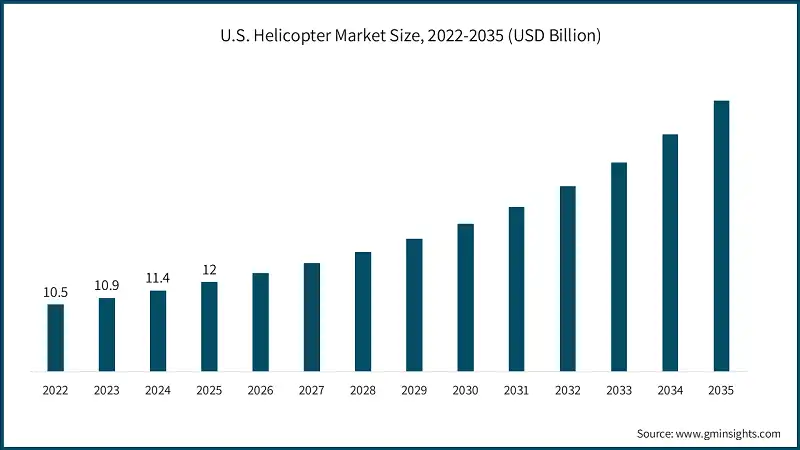
North America helicopter market was valued at USD 13.1 billion in 2025 and is anticipated to grow with a CAGR of 6.5% during the forecast period of 2026 – 2035. The increase in demand for the North American market is driven by rising military and defense spending, growth in emergency medical services, advancements in urban air mobility, and expanding commercial helicopter operations.
- U.S. dominated the helicopter market and was valued at USD 12 billion in the year 2025. The U.S. market is driven by technological leadership in aviation innovation, increasing offshore operations for oil and gas, and the growing adoption of private helicopters for personal transportation.
- Manufacturers should focus on advancing autonomous flight technologies, improving fuel efficiency for offshore operations, and developing customized private helicopters with enhanced performance, safety features, and luxury for the U.S. market.
- The helicopter market in Canada is anticipated to surpass USD 2.4 billion by 2035. The market in Canada is focused on arctic search/rescue, government investment in emergency medical systems (EMS), and improving connectivity to remote communities requiring very specialized types of helicopters that perform reliably and efficiently in the extreme harsh and remote environmental conditions found throughout Canada.
- Helicopter manufacturers should manufacture helicopters that are designed primarily for arctic operations, increase EMS capability, and enhance connectivity solutions for remote communities, providing reliable performance and efficient utilization of helicopters in the challenging conditions of Canada.
The helicopter market in Europe is anticipated to grow with a CAGR of 6.1% during the forecast period of 2026 – 2035. The European market is driven by cross-border helicopter services, and the growing tourism demand for helicopter services for use at ski resorts, as well as in other tourist areas of stunning visual beauty.
- Germany helicopter industry was valued at USD 2.1 billion in the year 2025. Germany’s commitment to the development of EU aviation regulations, as a very influential nation within the EU, has fostered numerous innovations within the German market and provides a platform that allows for increasing the effectiveness and compliance of European helicopter industry.
- Helicopter manufacturers should develop advanced military rotorcraft and increase EMS capability and disaster response readiness, comply with EU aviation regulations to preserve and meet the needs of the changing and growing helicopter industry in Germany.
- UK helicopter market is anticipated to surpass USD 3.2 billion by 2035. The UK market is expanding rapidly as the demand for EMS services increases, the UK government is investing in military defense, and the offshore oil and gas industry, and because of all these factors, the tourism and air transport industries are also growing in the UK and in surrounding regions.
- Manufacturers should develop and manufacture helicopters specifically designed for emergency medical service (EMS) usage, enhance the offshore operational capabilities of military rotorcraft, optimise military rotorcraft performance and develop helicopters that will meet the demands of the growing tourism market in the United Kingdom.
The helicopter market in Asia Pacific was valued 8.1 billion in 2025. The demand for helicopters in the Asia Pacific region is driven by the need for helicopter support for remote mining operations, the increased usage of helicopters in disaster relief, and the improved connectivity of island nations.
- China market is projected to reach USD 7.2 billion by the year 2035. The demand for helicopters in China is fuelled by the growing need for helicopter support for high-speed rail systems, the increased use of helicopters as part of the belt and road initiatives, and the development of urban air mobility, thereby increasing connectivity and infrastructure.
- Helicopter manufactures should be focused on helicopter types needed for support to high-speed rail, increased capabilities for belt and road projects and urban air mobility solutions to support the growing infrastructure needs of China.
- The helicopter industry in Japan was valued at USD 1.3 billion in 2025. Japan's helicopter market can be characterized by corporate and VIP transport usage, high coastal surveillance levels and several governments sponsored innovation initiatives that aim to develop air mobility solutions and transport & security capabilities.
- The manufacturer of helicopters for VIP and corporate transport applications and develop coastal surveillance technologies and air mobility & innovation to address Japan’s increasing demand for specialized and efficient rotary winged aircraft.
- India market is anticipated to grow with a CAGR of over 12% during the forecast period of 2026-2035. The growth of the Indian helicopter market is primarily attributed to the growing demand for urban air mobility applications, defense modernization and the development of infrastructure as well as emerging economic sectors including tourism, health care and logistics.
- To focus on the growing opportunities for helicopter manufacturing within the Indian market and target urban air mobility, defense, tourism, health care and logistics areas as significant areas of opportunity.
The helicopter market in Latin America was valued at USD 2.1 billion in 2025. Growth of Latin America's market due to high growth of luxury and adventure tourism has been influenced by growing demand for construction to support development and construction of remote locations and precision agriculture by aerial surveillance through agriculture.
MEA Helicopter Market is projected to surpass USD 3.5 billion by 2035. The MEA market is fueled by the increasing need for transportation to remote mining sites, disaster relief/humanitarian assistance and the continued increase in private/business aviation needs, resulting in greater efficiencies in air travel.
- South Africa helicopter industry was valued at USD 390.7 million in 2025. The South African market is growing because of the need for aerial patrols for wildlife protection, safari tourism, aerial tours and search and rescue missions.
- Helicopter manufacturers should focus on developing a helicopter with multi-purpose capabilities designed for the protection of wildlife, tourism, natural resource extraction, emergency service providers, and government infrastructure projects in South Africa's diverse markets.
- The helicopter market in Saudi Arabia is projected to grow with a CAGR of 6.3% during the forecast period of 2026-2035. The Saudi Arabian market is growing because of the demand for helicopter support within the oil and gas exploration market, Hajj and Umrah transportation, and healthcare/medical evacuation services.
- Helicopter manufacturers should design helicopters specifically for oil and gas operations, transportation of religious tourists, and health care/emergency medical services. these helicopters must offer flexibility and the latest technology to meet the needs of the diverse Saudi Arabian marketplace.
- The market in UAE is anticipated to surpass USD 883.8 million by 2035. The United Arab Emirates (UAE) helicopter market is experiencing growth because of the demand for helicopter support during expo events, surveillance, and environmental monitoring and military/defense operations to improve safety.
- Helicopter manufacturers should design and build helicopters for luxury tourism, event transport, military/defense, environmental monitoring and private corporate travel to meet the vast array of needs within the UAE market.
Helicopter Market Share
- The helicopter industry is a fragmented, intensely competitive market with many small and large businesses represented within this sector. Airbus, Leonardo S.p.A., Textron, Inc. (Bell Helicopter), Boeing & Lockheed Martin Corporation are some of the major competitors with a combined market share of 55.9% for the entire market in 2025.
- Airbus held a significant position in the global helicopter market share in 2025, controlling 25.1% of the total market share. Having offerings in the military and civilian sectors simultaneously and the wide range of products were the reasons the company surpassed expectations in previous working sectors.
- Leonardo S.p.A. held 16.6% of the market share in 2025, with a primary focus on producing advanced helicopters for both civilian and military sectors. Their strong portfolio includes models for search-and-rescue, offshore, and defense operations.
- Textron, Inc. (Bell Helicopter) ended with 7.4% of the market share in 2025. Having top tier status in the segment of the field, they have versatility and groundbreaking innovations such as the Bell 407, and Bell 429 which serve military, civilian, and commercial.
- Boeing held 3.6% of the helicopter market share in 2025. While mainly concentrating on military rotorcraft. like the industry resets like the AH-64 Apache and the CH-47 Chinook, they have significant uplift in investments which are also aimed towards autonomous aviation, hybrid technologies, and the new generation.
- Lockheed Martin Corporation ended with 3.3% of the market share in 2025. Having top tier status in the segment of the field, they have versatility and groundbreaking innovations such as the Bell 407, and Bell 429 which serve military, civilian, and commercial.
Helicopter Market Company
The top prominent companies operating in the helicopter industry include:
- Airbus
- Alpi Aviation SRL
- Columbia Helicopters, LLC
- DB Aerocopter Ltd.
- Enstrom Helicopter Corporation
- Helicopteres Guimbal S.A.S
- Hiller Aircraft Corporation
- Hindustan Aeronautics Limited (HAL)
- Kaman Corporation
- Karem Aircraft, Inc.
- Kawasaki Heavy Industries, Ltd.
- KOREA AEROSPACE INDUSTRIES, LTD.
- Leonardo S.p.A.
- Lockheed Martin Corporation (Sikorsky brand)
- MD Helicopters LLC
- Mitsubishi Heavy Industries, Ltd.
- Robinson Helicopter Company
- Schweizer
- Subaru Corporation
- Textron, Inc. (Bell Helicopter)
Airbus Helicopters, Leonardo S.p.A., & Textron, Inc. (Bell Helicopter) have large shares of the helicopter market and are leaders in innovation, creating trends in both the military and civilian markets with highly versatile, well-performing helicopter models. They are responsible for being the leading technology companies in improving helicopter technology and providing safer and more efficient designs.
Challengers such as Boeing, and Lockheed Martin are competitors to the market leaders, particularly in military and heavy-lift helicopters. They compete by producing state-of-the-art models that are highly durable and reasonably priced, thus pushing the envelope of what is possible when developing the next generation of machines used for both civil and defense purposes. Challengers compete vigorously with the leaders in global markets.
Followers like Robinson Helicopter Company, MD Helicopters, and Kawasaki Heavy Industries have focused their efforts on developing lightweight, cost-efficient helicopters that can be utilized in a variety of applications, including training and defense. Followers differentiate themselves in the marketplace by manufacturing low-priced, flexible models that cater to very specific niches, primarily targeting regional markets and applications.
Niche companies include the Kaman, Hiller Aircraft Corporation, DB Aerocopter Ltd., Karem Aircraft, Inc., Enstrom, and Hindustan Aeronautics. They design helicopters for various specialized applications and serve regional needs (e.g., cargo transport, law enforcement, military operations, and unmanned aerial systems utilized for reconnaissance).
Helicopter Industry News
- In June 2024, the launch of the H145 model into India's domestic energy market was done in partnership with Heligo to enhance the aerial support for energy operations. By introducing the H145 with its numerous advanced features, Airbus is using this as an opportunity to expand its market presence in India, and to cater to the growing need for specialised helicopter services in the region, which is a core part of Airbus' strategy.
- In May 2024, Babcock and Airbus Helicopters were awarded a 12-year contract with the French Ministry of Armed Forces for providing support and maintenance for a fleet of 48 Airbus EC145 helicopters used by Sécurité Civile and Gendarmerie Nationale. With this award, both companies will provide Aircraft support, Maintenance and manage Spare Parts for the helicopters, while creating approximately 20 jobs in the process.
- In June 2023, The Helicopter Company (THC), a Saudi Arabian firm, fully acquired Rotortrade, a global helicopter dealership. This acquisition enhances THC’s infrastructure development in Saudi Arabia and strengthens Rotortrade’s market position with its extensive global presence. THC and Rotortrade aim to leverage their combined strengths to drive growth and innovation in the helicopter industry, supporting Saudi Arabia’s Vision 2030.
The helicopter market research report includes in-depth coverage of the industry with estimates and forecasts in terms of revenue (USD Million) from 2022 – 2035 for the following segments:
Market, By Engine Type
- Piston-powered
- Turbine-powered
Market, By Rotor Type
- Single rotor
- Twin-rotor / coaxial
- Tiltrotor
Market, By Weight
- Light helicopters (≤3,000 kg)
- Medium helicopters (3,001–7,000 kg)
- Heavy helicopters (>7,000 kg)
Market, By Propulsion Type
- Conventional fuel-powered
- Hybrid-electric / electric
Market, By Range
- Short-range (≤300 km)
- Medium-range (301–800 km)
- Long-range (>800 km)
Market, By Sales Channel
- OEM (original equipment manufacturer)
- Maintenance, repair, and overhaul (MRO)
Market, By End Use Industry
- Civil / commercial
- Transport / passenger services
- Medical services / search & rescue (EMS/SAR)
- Offshore operations
- Tourism & leisure
- Others
- Military
- Reconnaissance
- Maritime surveillance
- Attack / combat
- Transport / troop movement
- Others
The above information is provided for the following regions and countries:
- North America
- U.S.
- Canada
- Europe
- Germany
- UK
- France
- Spain
- Italy
- Netherlands
- Asia Pacific
- China
- India
- Japan
- Australia
- South Korea
- Latin America
- Brazil
- Mexico
- Argentina
- Middle East and Africa
- Saudi Arabia
- South Africa
- UAE
Frequently Asked Question(FAQ) :
Which region leads the helicopter market?
North America led the market with USD 13.1 billion revenue in 2025, accounting for the largest share globally. Strong demand from defense, EMS, offshore operations, and rapid urban air mobility development supports regional dominance.
What are the upcoming trends in the helicopter industry?
Key industry trends include the rise of urban air mobility (UAM), adoption of electric and hybrid-electric helicopters, advancements in autonomous flight systems, development of low-noise eVTOL aircraft, and increasing focus on green aviation and sustainable rotorcraft designs.
Who are the key players in the helicopter market?
Major players include Airbus, Leonardo S.p.A., Textron (Bell Helicopter), Boeing, and Lockheed Martin (Sikorsky). These companies lead through innovations in rotor design, military aviation technologies, hybrid/electric propulsion, and advanced digital flight systems.
What was the valuation of the single-rotor segment in 2025?
The single-rotor segment generated USD 28.3 billion in 2025, making it the leading rotor-type category. Its dominance is attributed to strong performance capabilities, fuel efficiency, and broad suitability across mission profiles.
What is the growth outlook for the military segment from 2026 to 2035?
The military helicopter segment is projected to grow at a CAGR of 6.4% through 2035.
What is the helicopter market size in 2025?
The global market size for helicopter was valued at USD 34.3 billion in 2025. Rising military and defense expenditures, growing EMS demand, and increasing tourism and offshore operations are driving market expansion.
How much revenue did the turbine-powered engine segment generate in 2025?
The turbine-powered segment was the largest engine category, valued at USD 28.4 billion in 2025.
What is the projected value of the helicopter market by 2035?
The market size for helicopter is expected to reach USD 66.5 billion by 2035, growing at a CAGR of 7% from 2026 to 2035. This long-term growth is influenced by defense modernization programs, urban air mobility development, and increasing adoption of hybrid and electric propulsion systems.
What is the market size of the helicopter industry in 2026?
The helicopter market reached USD 36.3 billion in 2026, reflecting consistent growth supported by technological advancements in rotorcraft design and expanding commercial applications.
Helicopter Market Scope
Related Reports