Summary
Table of Content

Haptic Feedback Surgical System Market
Get a free sample of this report
Form submitted successfully!
Error submitting form. Please try again.
Thank you!
Your inquiry has been received. Our team will reach out to you with the required details via email. To ensure that you don't miss their response, kindly remember to check your spam folder as well!
Request Sectional Data
Thank you!
Your inquiry has been received. Our team will reach out to you with the required details via email. To ensure that you don't miss their response, kindly remember to check your spam folder as well!
Form submitted successfully!
Error submitting form. Please try again.
Haptic Feedback Surgical System Market Size
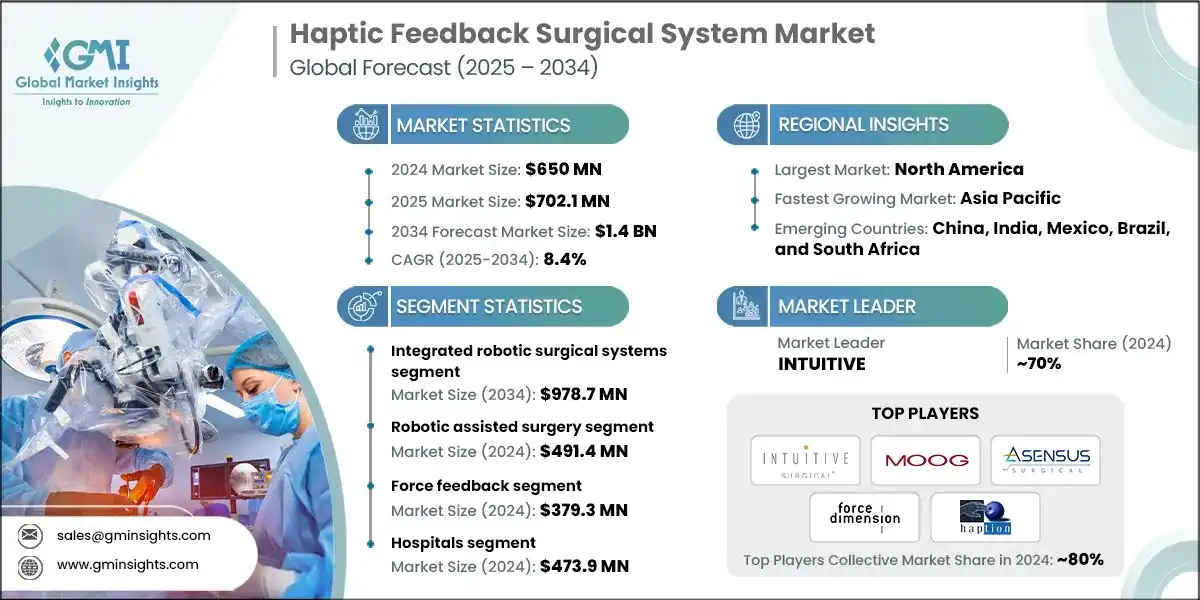
The global haptic feedback surgical system market was valued at USD 650 million in 2024. The market is expected to grow from USD 702.1 million in 2025 to USD 1.4 billion in 2034, at a CAGR of 8.4% during the forecast period, according to the latest report published by Global Market Insights Inc. The high market growth is attributed to rising demand for minimally invasive surgeries and precision tools, increasing adoption of robotic-assisted surgical systems, and growth in medical simulation for training, among other contributing factors.
To get key market trends
Haptic feedback systems are a revolutionary advancement in surgical robots, which allow surgeons to feel forces, resistance, and texture during a minimally invasive and remote procedure. These solutions reduce errors, improve surgical precision, and improve patient outcomes by reducing the sensory gap in robotic surgeries. Some leading providers, including INTUITIVE, ASENSUS SURGICAL, force dimension, haption, and MOOG, offer comprehensive haptic-enabled platforms and components driven by state-of-the-art sensors, actuators, and AI-driven control systems.
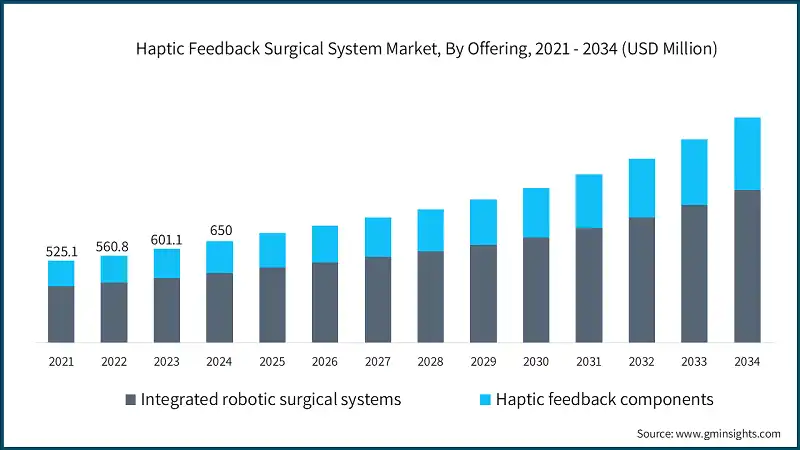
The market has increased from USD 525.1 million in 2021 and reached USD 601.1 million in 2023, with a historic growth rate of 7%. This expansion has been driven by rising adoption of minimally invasive surgeries, advancements in robotic-assisted platforms, integration of haptic feedback for enhanced precision, and growing demand for surgeon training and simulation technologies.
The growing preference for minimally invasive surgeries (MIS) is a key driver for haptic feedback systems, as these procedures require enhanced precision and tactile awareness. MIS techniques reduce incision size, minimise tissue damage, and accelerate recovery times, making them highly attractive for both patients and healthcare providers. The surge in demand is fueled by benefits such as lower postoperative pain, shorter hospital stays, and reduced infection risks.
As surgical complexity increases, haptic feedback becomes critical in robotic-assisted MIS, enabling surgeons to regain the sense of touch lost in traditional laparoscopy. This trend is further supported by advancements in robotic platforms, improved imaging systems, and rising patient awareness, positioning haptic-enabled solutions as an essential component of next-generation surgical care.
A haptic feedback surgical system refers to advanced surgical platforms that integrate tactile feedback technology, enabling surgeons to sense force, resistance, and texture during robotic or remote surgeries for improved precision and safety.
Haptic Feedback Surgical System Market Report Attributes
| Key Takeaway | Details |
|---|---|
| Market Size & Growth | |
| Base Year | 2024 |
| Market Size in 2024 | USD 650 Million |
| Market Size in 2025 | USD 702.1 Million |
| Forecast Period 2025 – 2034 CAGR | 8.4% |
| Market Size in 2034 | USD 1.4 Billion |
| Key Market Trends | |
| Drivers | Impact |
| Rising demand for minimally invasive surgeries and precision tools | Boosts adoption of haptic-enabled robotic systems for better control and patient outcomes. |
| Increasing adoption of robotic-assisted surgical systems | Expands the market for integrated haptic feedback technologies. |
| Technological advancements | Enables development of more accurate, responsive, and cost-efficient haptic solutions. |
| Growth in medical simulation for training | Drives demand for haptic-based simulators to improve surgeon skills. |
| Pitfalls & Challenges | Impact |
| High upfront costs of systems and maintenance | Limits adoption among smaller hospitals and emerging markets. |
| Integration challenges with the existing hospital infrastructure | Slows implementation and increases operational complexity. |
| Opportunities: | Impact |
| Expansion into remote surgery and teleoperated systems | Opens new revenue streams in telehealth and cross-border surgical care. |
| Development of AI-driven haptic platforms for predictive feedback | Creates differentiation and enhances surgical precision through real-time analytics. |
| Market Leaders (2024) | |
| Market Leaders |
~70% |
| Top Players |
Collective market share in 2024 is ~80% |
| Competitive Edge |
|
| Regional Insights | |
| Largest Market | North America |
| Fastest growing market | Asia Pacific |
| Emerging countries | China, India, Mexico, Brazil, and South Africa |
| Future outlook |
|
What are the growth opportunities in this market?
Haptic Feedback Surgical System Market Trends
The evolution of haptic feedback technology is fundamentally transforming robotic-assisted surgery by bridging the sensory gap between surgeons and patients.
- Traditional robotic systems often lack tactile sensation, making it challenging for surgeons to gauge tissue resistance and apply precise force. Recent advancements in force-feedback sensors, actuators, and real-time control algorithms have enabled haptic systems to deliver highly accurate tactile cues, improving surgical precision and reducing the risk of tissue damage. These innovations are particularly critical in minimally invasive procedures, where visual feedback alone is insufficient for complex maneuvers.
- Integration of artificial intelligence (AI) and machine learning (ML) into haptic platforms is another major breakthrough. AI-driven predictive analytics can anticipate force requirements and adjust feedback dynamically, creating a more intuitive and responsive surgical experience. This not only enhances surgeon confidence but also shortens learning curves for complex procedures.
- Furthermore, cloud-based connectivity allows continuous software updates and remote monitoring, ensuring systems remain optimized and compliant with evolving clinical standards. Collectively, these technological advancements position haptic feedback systems as a cornerstone of next-generation surgical care.
Haptic Feedback Surgical System Market Analysis
Learn more about the key segments shaping this market
Based on offering, the haptic feedback surgical system market is segmented into integrated robotic surgical systems and haptic feedback components. The integrated robotic surgical systems segment accounted for 68.8% of the market in 2024 due to its widespread adoption in minimally invasive procedures, ability to deliver comprehensive surgical solutions with haptic feedback integration, and strong demand from hospitals for advanced, multi-specialty platforms that improve precision and patient outcomes. The segment is expected to reach USD 978.7 million by 2034, growing at a CAGR of 8.2% during the forecast period.
On the other hand, the haptic feedback components segment held a significant market share of 31.2% in 2024, and its growth can be attributed to the rising demand for high-precision sensors, actuators, and force-feedback modules that enhance the tactile experience in robotic-assisted surgeries. These components are increasingly integrated into surgical platforms and simulation systems, enabling real-time force rendering and improving surgeon training.
- This dominance of the integrated robotic surgical systems segment is further reinforced by the ability to deliver a complete surgical ecosystem, combining robotic arms, vision systems, and haptic feedback into one integrated platform. Hospitals and surgical centres prefer these systems because they streamline workflows, reduce the need for multiple standalone devices, and offer advanced features such as AI-assisted motion control and real-time force sensing. Additionally, integrated systems support multi-specialty applications, making them a cost-effective long-term investment despite high initial costs. Their proven clinical outcomes and strong OEM support have positioned them as the preferred choice for large-scale surgical deployments.
Based on application, the haptic feedback surgical system market is segmented into robotic assisted surgery, remote surgery, and medical training and stimulation. The robotic assisted surgery segment continues to dominate, accounting for a majority market share valued at USD 491.4 million in 2024.
- This dominance is driven by increasing adoption of precision-based surgical procedures and favorable reimbursement policies in developed markets. Surgeons are increasingly relying on haptic-enabled robotic systems to enhance tactile feedback and reduce intraoperative errors. Moreover, advancements in AI integration and real-time sensory feedback are further elevating the capabilities of robotic platforms, making them indispensable in complex surgical interventions.
- The remote surgery segment held a revenue of USD 115.3 million in 2024, with projections indicating a steady expansion at 9.1% CAGR from 2025 to 2034. This growth is fueled by increasing demand for surgical access in remote and underserved regions, supported by advancements in 5G connectivity and telepresence technologies. Haptic feedback integration plays a pivotal role in enhancing surgeon control and patient safety, making remote procedures more viable and precise.
- The medical training and stimulation segment held a revenue of USD 43.3 million in 2024, with projections indicating a steady expansion at 7.7% CAGR from 2025 to 2034, fueled by the growing integration of simulation-based learning and virtual reality platforms in surgical education. Haptic feedback systems are increasingly being adopted to replicate real-life tactile sensations, allowing trainees to gain hands-on experience without patient risk.
Based on type, the haptic feedback surgical system market is segmented into force feedback, tactile feedback, and vibration response. The force feedback segment continues to dominate, accounting for a majority market share valued at USD 379.3 million in 2024.
- Its leadership is attributed to the critical role force feedback plays in enhancing tactile realism during minimally invasive procedures. By simulating resistance and pressure, these systems allow surgeons to better gauge tissue interaction, improving precision and reducing the risk of complications.
- The tactile feedback segment held a revenue of USD 184.7 million in 2024, with projections indicating a steady expansion at 8.7% CAGR from 2025 to 2034. This growth is primarily driven by the increasing demand for realistic surgical simulation and enhanced intraoperative sensitivity. Tactile feedback systems enable surgeons to perceive subtle variations in tissue texture and resistance, improving decision-making during procedures.
- The vibration response segment held a revenue of USD 86.1 million in 2024, with projections indicating a steady expansion at 7.9% CAGR from 2025 to 2034. This segment is gaining traction due to its ability to simulate subtle physiological cues, such as pulse or tremors, during surgical procedures. Vibration-based haptic systems enhance situational awareness for surgeons, especially in microsurgeries and delicate tissue handling.
Learn more about the key segments shaping this market
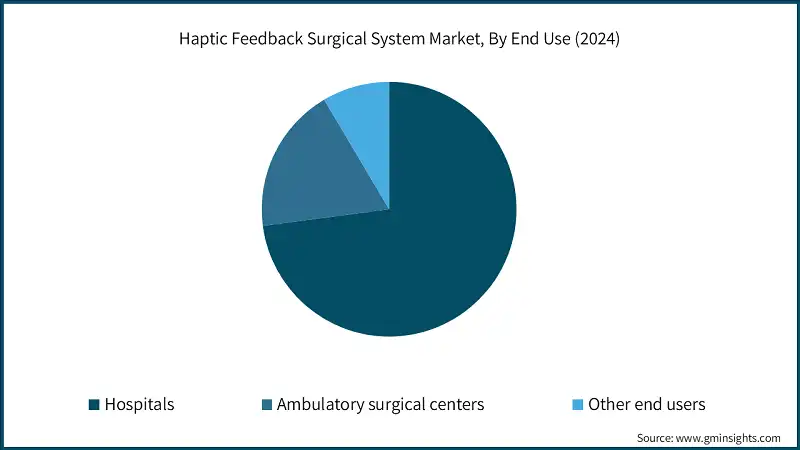
Based on end use, the haptic feedback surgical system market is segmented into hospitals, ambulatory surgical centers, and other end users. The hospitals segment accounted for USD 473.9 million in 2024 and is expected to grow at 8.3% CAGR from 2025 to 2034.
- This growth is driven by the increasing adoption of advanced surgical technologies and the rising number of complex procedures requiring precision and safety. Hospitals are investing heavily in haptic feedback systems to improve surgical outcomes, reduce recovery times, and enhance training for medical staff. Government initiatives and funding for healthcare infrastructure modernization are further supporting the integration of these systems across tertiary care centers.
- The ambulatory surgical centers segment accounted for USD 120.7 million in 2024 and is expected to grow at a 9% CAGR from 2025 to 2034. This growth is supported by the increasing preference for outpatient procedures that offer cost efficiency and reduced hospital stays. Haptic feedback systems are being integrated into compact surgical setups, enabling high-precision interventions in a streamlined environment.
- The other end users segment is expected to grow at a substantial pace during the period from 2025 to 2034 at a CAGR of 7.4%. This segment includes research institutions, academic labs, and specialized surgical training centers that are increasingly adopting haptic technologies for innovation and skill development. The rising focus on experimental procedures and simulation-based learning is driving demand for customizable haptic feedback systems in non-clinical environments.
Looking for region specific data?
North America Haptic Feedback Surgical System Market
North America dominated the market with the highest market share of 59.7% in 2024.
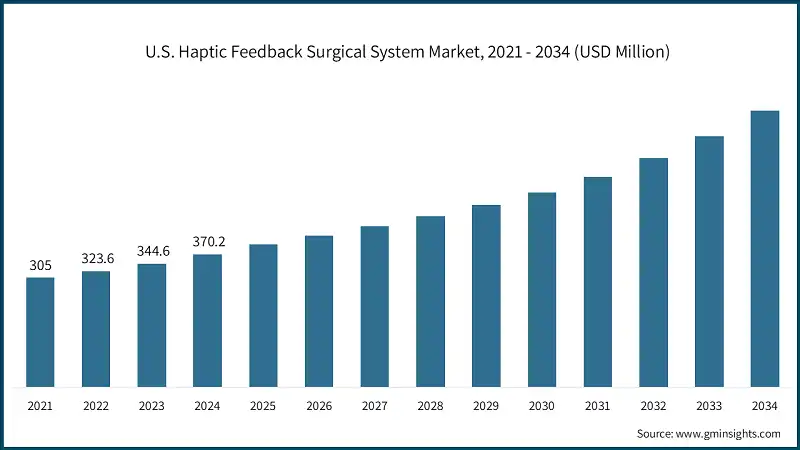
- The U.S. market was valued at USD 305 million and USD 323.6 million in 2021 and 2022, respectively. The market size reached USD 370.2 million in 2024, growing from USD 344.6 million in 2023, and is anticipated to grow at a CAGR of 7.6% between 2025 and 2034.
- North America leads the haptic feedback surgical system market, driven by strong healthcare infrastructure, high adoption of robotic-assisted surgeries, and continuous technological innovation. The presence of key players such as Intuitive and Moog, along with robust R&D investments, has positioned the region at the forefront of surgical advancements. Favourable reimbursement policies and growing demand for minimally invasive procedures further support market growth.
- Additionally, the region benefits from a mature ecosystem of medical training institutions and simulation centers that actively integrate haptic technologies into curricula. The U.S. and Canada are witnessing increased deployment of haptic-enabled systems in both hospitals and ambulatory surgical centers, with government initiatives promoting digital health and surgical precision.
Europe Haptic Feedback Surgical System Market
Europe market accounted for USD 122.2 million in 2024 and is anticipated to show lucrative growth over the forecast period.
- Europe holds a significant share in the market, supported by strong regulatory frameworks, widespread adoption of advanced surgical technologies, and a focus on patient safety. Countries like Germany, France, and the UK are leading in robotic surgery adoption, with hospitals investing in haptic-enabled platforms to improve outcomes and reduce recovery times.
- The region also emphasizes medical education and simulation-based training, with institutions incorporating tactile and force feedback systems to enhance surgical skill development. EU-funded research programs and collaborations between academia and industry are fostering innovation, particularly in microsurgery and pediatric applications.
Asia Pacific Haptic Feedback Surgical System Market
The Asia Pacific market is anticipated to grow at a CAGR of 9.8% during the analysis timeframe.
- Asia-Pacific is emerging as the fastest-growing region in the market, fueled by rising healthcare investments, expanding medical tourism, and increasing awareness of advanced surgical technologies. Countries like China, Japan, South Korea, and India are witnessing the rapid adoption of robotic and simulation-based systems, especially in urban hospitals and specialty centers.
- The region’s growth is also driven by local manufacturers offering cost-effective haptic solutions tailored to regional needs. Government initiatives to modernize healthcare infrastructure and train medical professionals are creating opportunities for both global and emerging players to expand their footprint in the Asia Pacific.
Latin America Haptic Feedback Surgical System Market
The Latin America market is experiencing robust growth over the analysis timeframe.
- Latin America is gradually gaining momentum in the market, with Brazil and Mexico leading the way in adopting robotic-assisted and simulation-based surgical technologies. The region’s growing focus on improving surgical outcomes and expanding access to minimally invasive procedures is driving demand for haptic-enabled systems.
Middle East & Africa Haptic Feedback Surgical System Market
The Middle East & Africa (MEA) market is experiencing notable growth over the analysis timeframe.
- The MEA region is witnessing steady growth in the market, supported by increasing healthcare investments in Gulf countries and a rising demand for high-precision surgical solutions. Countries like the UAE and Saudi Arabia are actively adopting robotic surgery platforms, with haptic feedback systems enhancing procedural accuracy and safety.
Haptic Feedback Surgical System Market Share
Leading industry players such as INTUITIVE, ASENSUS SURGICAL, force dimension, haption, and MOOG collectively hold a market share of 80% in the market. These companies maintain their dominance through continuous innovation in haptic-enabled robotic platforms, advanced force and tactile feedback technologies, and integration with AI-assisted surgical planning tools. Their systems are widely adopted across hospitals and surgical centers due to their reliability, precision, and ability to enhance surgeon performance in minimally invasive procedures. Strategic partnerships with healthcare institutions and consistent investment in R&D have enabled these players to stay ahead in terms of product sophistication and clinical outcomes.
Meanwhile, emerging players are carving out niches by focusing on cost-effective, modular, and region-specific haptic feedback solutions, particularly in Asia-Pacific and Latin America. These companies are leveraging local manufacturing capabilities and forming alliances with academic institutions and digital health startups to develop scalable training and surgical platforms. Their focus on affordability, ease of integration, and customization is helping address unmet needs in rural and mid-tier healthcare facilities, especially in developing economies.
Haptic Feedback Surgical System Market Companies
A few of the prominent players operating in the haptic feedback surgical system industry include:
- 3D SYSTEMS
- ASENSUS SURGICAL
- force dimension
- FUTEK
- haption
- haptx
- INTUITIVE
- MOOG
- INTUITIVE
INTUITIVE is a global leader in robotic-assisted surgery, best known for its da Vinci Surgical System. Its USP lies in combining advanced haptic feedback with real-time imaging and AI-powered analytics to enhance surgical precision and control. The company’s commitment to continuous innovation, surgeon training, and clinical validation makes it a benchmark in minimally invasive procedures across specialties.
Haption specializes in high-fidelity haptic devices for medical simulation and robotic surgery. Its USP is the delivery of precise force and tactile feedback through multi-degree-of-freedom systems, enabling realistic interaction with virtual anatomical models. Haption’s solutions are widely used in surgical training and planning, offering unmatched realism and responsiveness in simulated environments.
Force Dimension is renowned for its cutting-edge haptic interfaces used in teleoperation and surgical robotics. Its USP centers on ultra-sensitive force feedback technology that allows surgeons to feel and respond to micro-level tissue interactions. The company’s systems are engineered for high-performance applications, including microsurgery and remote procedures, ensuring superior control and safety.
Haptic Feedback Surgical System Industry News:
- In November 2023, Asensus Surgical announced the sale of its Senhance Robotic Surgical System to a distribution partner, with the system set to be deployed at a pediatric hospital in the Commonwealth of Independent States (CIS) region. This strategic placement highlights the growing adoption of Senhance in pediatric care, driven by its specialized features such as 3mm instrumentation, a 5mm camera scope, and advanced clinical intelligence.
The haptic feedback surgical system market research report includes an in-depth coverage of the industry with estimates and forecasts in terms of revenue in USD Million from 2021 - 2034 for the following segments:
Market, By Offering
- Integrated robotic surgical systems
- Haptic feedback components
Market, By Application
- Robotic assisted surgery
- Remote surgery
- Medical training and stimulation
Market, By Type
- Force feedback
- Tactile feedback
- Vibration response
Market, By End Use
- Hospitals
- Ambulatory surgical centers
- Other End Use
The above information is provided for the following regions and countries:
- North America
- U.S.
- Canada
- Europe
- Germany
- UK
- France
- Spain
- Italy
- Netherlands
- Asia Pacific
- China
- Japan
- India
- Australia
- South Korea
- Latin America
- Brazil
- Mexico
- Argentina
- Middle East and Africa
- South Africa
- Saudi Arabia
- UAE
Frequently Asked Question(FAQ) :
Who are the key players in the haptic feedback surgical system market?
Key players include 3D SYSTEMS, ASENSUS SURGICAL, force dimension, FUTEK, haption, haptx, INTUITIVE, and MOOG.
What was the valuation of the hospitals segment?
The hospitals segment held a market share of USD 473.9 million in 2024 and is projected to grow at a CAGR of 8.3% from 2025 to 2034.
Which region leads the haptic feedback surgical system market?
North America dominated the market with a 59.7% share in 2024.
What are the upcoming trends in the haptic feedback surgical system industry?
Key trends include advancements in force-feedback sensors and actuators, integration of AI and machine learning for predictive analytics, and increasing adoption of haptic systems in minimally invasive procedures.
What is the projected size of the haptic feedback surgical system market in 2025?
The market is expected to reach USD 702.1 million in 2025.
How much revenue did the integrated robotic surgical systems segment generate?
The integrated robotic surgical systems segment accounted for 68.8% of the market in 2024.
What is the projected value of the haptic feedback surgical system market by 2034?
The market is expected to reach USD 1.4 billion by 2034, fueled by technological advancements in haptic feedback systems and increasing integration of AI and machine learning in surgical platforms.
What is the market size of the haptic feedback surgical system market in 2024?
The market size was USD 650 million in 2024, with a CAGR of 8.4% expected through 2034, driven by rising demand for minimally invasive surgeries, adoption of robotic-assisted systems, and advancements in medical simulation for training.
Haptic Feedback Surgical System Market Scope
Related Reports