Summary
Table of Content

Halal Ingredients Market
Get a free sample of this report
Form submitted successfully!
Error submitting form. Please try again.
Thank you!
Your inquiry has been received. Our team will reach out to you with the required details via email. To ensure that you don't miss their response, kindly remember to check your spam folder as well!
Request Sectional Data
Thank you!
Your inquiry has been received. Our team will reach out to you with the required details via email. To ensure that you don't miss their response, kindly remember to check your spam folder as well!
Form submitted successfully!
Error submitting form. Please try again.
Halal Ingredients Market Size
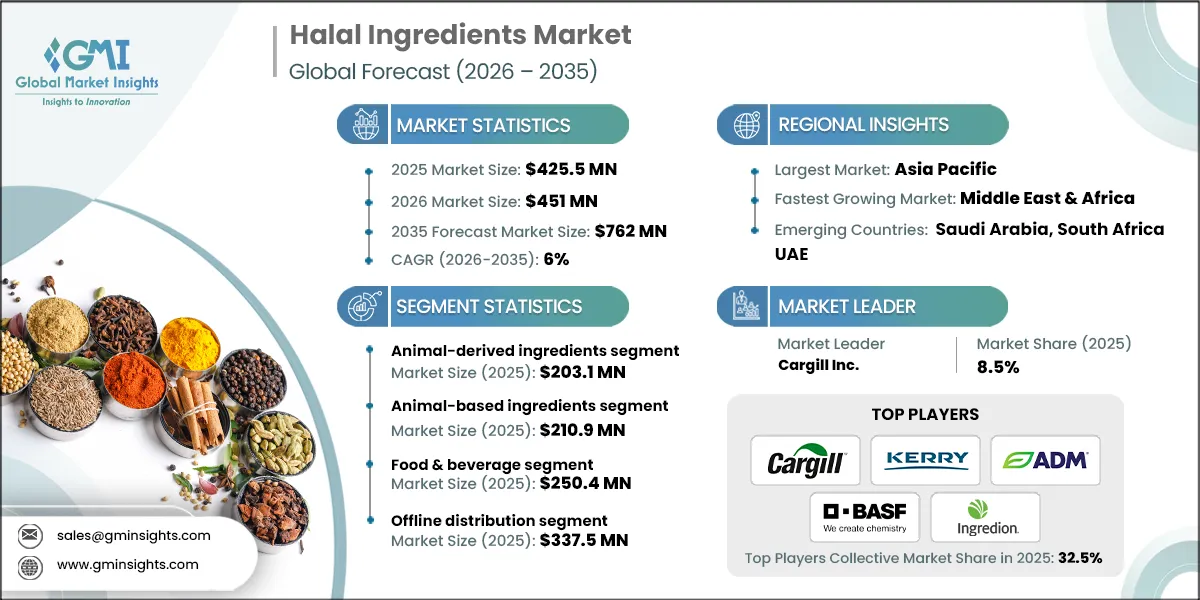
The global halal ingredients market were valued at USD 425.5 million in 2025. The market is expected to grow from USD 451 million in 2026 to USD 762 million in 2035, at a CAGR of 6% according to the latest report published by Global Market Insights Inc.
Halal Ingredients Market Key Takeaways
Market Size & Growth
- 2025 Market Size: USD 425.5 Million
- 2026 Market Size: USD 451 Million
- 2035 Forecast Market Size: USD 762 Million
- CAGR (2026–2035): 6%
Regional Dominance
- Largest Market: Asia Pacific
- Fastest Growing Region: Middle East and Africa
Key Market Drivers
- Rising global demand for Halal-compliant products.
- Increasing disposable incomes and urbanization in key markets.
- Growing health consciousness and preference for ethically sourced products.
Challenges
- High costs associated with Halal certification and compliance.
- Complex supply chains that increase operational challenges.
Opportunity
- Adoption of blockchain and IoT for supply chain traceability.
- Automation in food processing and quality control for efficiency.
- Development of plant-based and lab-grown Halal-compliant alternatives.
Key Players
- Market Leader: Cargill Inc. led with over 8.5% market share in 2025.
- Leading Players: Top 5 players in this market include Cargill Inc., Kerry Group, ADM (Archer Daniels Midland), BASF SE, Ingredion, which collectively held a market share of 32.5% in 2025.
Get Market Insights & Growth Opportunities
- The market refers to the global industry which produces and distributes food & beverages pharmaceuticals & cosmetics and other products that meet Halal standards. Halal-compliant ingredients exclude items such as pork derivatives, alcohol, and non-permissible animal products. The market ensures that all materials and processing methods and supply chain practices comply with strict religious and ethical requirements which create consumer trust in Halal products for their halal needs.
- The market has experienced strong expansion because worldwide consumers increasingly want Halal-compliant products. The major markets include Southeast Asia, Middle East and North Africa while European and North American markets experience growing demand for Halal products which customers consider as reliable and wide-ranging. The market includes a wide range of ingredients, such as meat, dairy, gelatin, flavorings, and food additives, all sourced and certified according to Halal standards.
- The market expands because of multiple factors which drive its development. Consumption of processed and packaged Halal products is increased due to rising disposable incomes, urbanization, and international trade. Health-consciousness and ethically sourced product preference have created new consumer interest in Halal products which extends beyond traditional Halal product consumers. Standardized labeling and global certification systems make the market more trustworthy through increased transparency.
- The market benefits from technological advancements which boost its traceability and safety features and operational efficiency. Digital solutions such as blockchain and IoT-enabled supply chains allow companies to verify Halal compliance at every stage of production. Automation in food processing, quality control, and slaughtering reduces human error and ensures adherence to Halal standards. The innovations provide capabilities which enable real-time tracking and reporting functions to enhance consumer confidence and regulatory compliance efforts.
- Market expansion continues because new ingredient development innovations create additional product opportunities. Plant-based alternatives, lab-grown proteins and enzyme-based flavorings undergo growing research to establish Halal standards while solving environmental and ethical challenges. Manufacturers use advanced analytics and AI tools to forecast market trends and develop optimal product formulas and decrease production waste. The Halal ingredients sector experiences global sustainable growth through technological improvements which establish reliable Halal product systems.
To get key market trends
Halal Ingredients Market Trends
- The market observes increasing global demand because consumers now understand product identification together with ethical ingredient sourcing. Halal certification requirements demand for full product transparency through complete labeling along with proper certification procedures.
- Halal ingredient production methods together with their tracking processes undergo transformation through technological integration. Companies are adopting blockchain and IoT technologies which ensure complete supply chain transparency. Technology adoption function as a major competitive factor which separates market players from each other.
- Market demand for new consumer preferences emerges from businesses which develop new product lines to serve their customers. Modern consumer demands push established businesses to develop plant-based, lab-grown, and alternative protein products. This helps in providing solutions to people who need to follow special diets while also respecting their ethical beliefs and environmental responsibilities. Companies are developing new products through the exploration of unique flavors together with functional ingredients and fortified products. Product innovation enables brands to reach new customers while they build their market share.
- The market expands because businesses open operations in untapped markets. The regions of Europe and North America together with some parts of Asia see increasing demand for products which meet Halal standards. Halal standard awareness together with the increase of multicultural societies drives greater acceptance of these standards. International expansion creates major growth prospects which enhance brand visibility.
- Market strategy development together with consumer behaviour patterns now depend on sustainability and ethical sourcing practices. Companies now dedicate their resources to creating sustainable production methods together with utilizing only certified sustainable materials. Sustainable development practices create a crucial link between impending innovations and competitive business advantages.
Halal Ingredients Market Analysis
Learn more about the key segments shaping this market
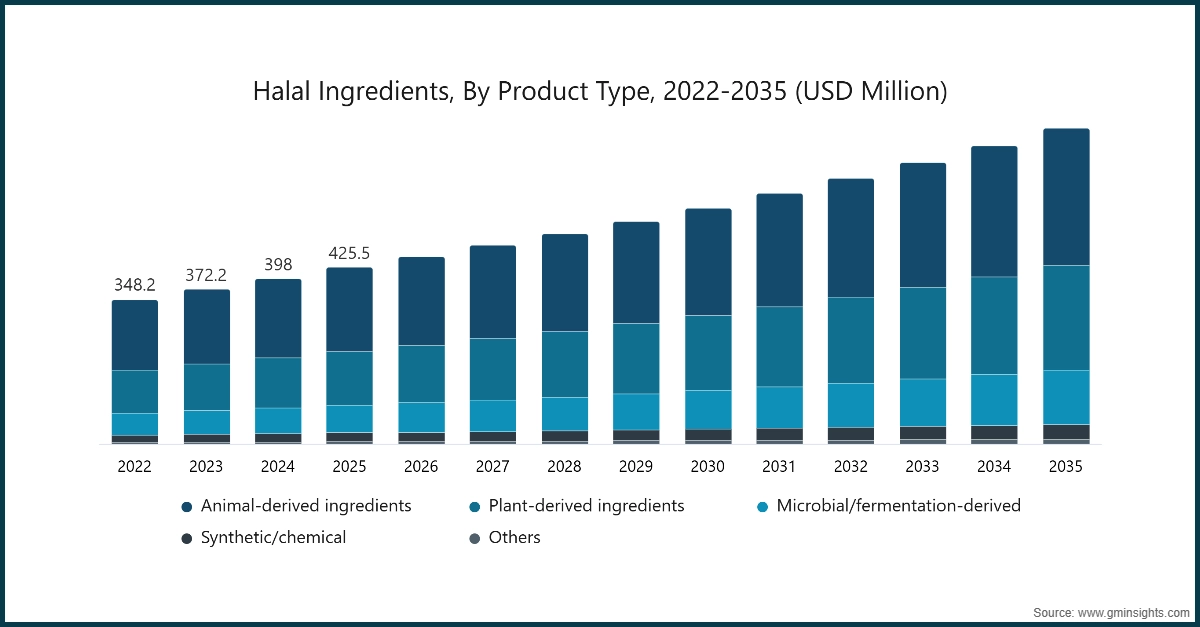
The halal ingredients market by product type is segmented into animal-derived ingredients, plant-derived ingredients, microbial/fermentation-derived, synthetic/chemical and others. Animal-derived ingredients hold the largest market value of USD 203.1 million in 2025.
- Animal-derived ingredients such as meat, dairy, gelatin, collagen, and enzymes require suppliers to maintain halal standards through transparency in sourcing and traceability systems and their implementation of stricter quality controls to meet international halal regulations. Halal-conscious consumers prefer plant-derived ingredients which include proteins and grains and oils and extracts because they meet their dietary needs and because plant-based diets are becoming more popular. Producers assess microbial and fermentation-derived ingredients which include enzymes and cultures and precision fermentation proteins for halal compliance through their use of certified production processes which guarantee halal requirements.
- The food industry currently examines synthetic and chemical ingredients which include synthetic additives and flavors and colors to verify these products do not include any forbidden substances or their derivatives. The overall trend indicates that halal-conscious consumers are driving demand for transparency, clean labeling, and innovative ingredients that align with both ethical and dietary requirements, which results in the industry increasing its certified product availability across all categories.
The halal ingredients market by source origin is segmented into animal-based ingredients, plant-based ingredients, microbial/fermentation-derived ingredients and synthetic/chemically synthesized ingredients. Animal-based ingredients hold the largest market value of USD 210.9 million in 2025.
- The market by source origin shows different trend in different segments which include animal-based ingredient, plant-based ingredients, microbial fermentation-derived ingredients and synthetic chemically synthesized ingredients. The halal status of animal-based ingredients which include meat-derived proteins, gelatin and collagen depends on the acceptable slaughter methods and certified processing of permissible species while plant-based ingredients receive broad acceptance by consumers and food & beverage manufacturers because they have straightforward halal certification requirements.
- Microbial and fermentation-derived ingredients serve as crucial sources for enzymes & flavors and functional ingredients because their production processes enable better control and their ingredients can be traced more easily. Halal status of synthetic and chemically synthesized ingredients which factories use in additives and pharmaceuticals depends on the source of their raw materials and the methods used to create them, so their factories need to prove that they avoid using any forbidden substances.
Learn more about the key segments shaping this market
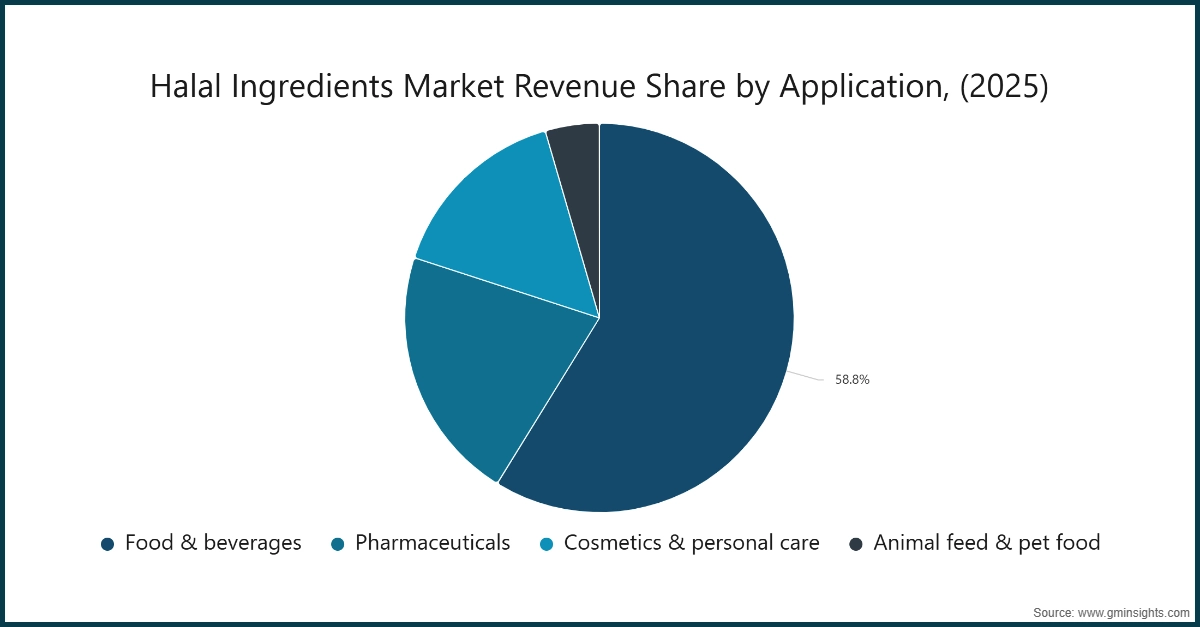
The halal ingredients market by application is segmented into food & beverages, pharmaceuticals, cosmetics & personal care and animal feed & pet food. Food & beverage hold the largest market value of USD 250.4 million in 2025.
- Food and beverages demand halal-certified ingredients because they use these ingredients throughout their processed food, beverage, bakery, dairy alternative and ready-to-eat product lines which need to meet halal standards for consumers to accept their products.
- Pharmaceuticals and cosmetics & personal care products have emerged as new markets which require halal compliance for their use of capsules, vitamins, skincare and personal care products. The segments receive support through organizations which need to trace their ingredients and obtain certification for their products while keeping away from non-halal animal-derived materials. The application area of animal feed and pet food functions as a small market segment which follows halal livestock production requirements and growing demand for halal-certified feed products in specific regions.
The halal ingredients market by distribution channel is segmented into offline distribution and online distribution. Offline distribution holds the largest market value of USD 337.5 million in 2025.
- The market by distribution channel is divided into two segments, which are offline distribution and online distribution. The established purchasing patterns of food manufacturers, foodservice operators and pharmaceutical companies drive offline distribution to generate higher sales revenue than any other distribution method. Suppliers need to establish their relationships with customers through physical channels that include hypermarkets and specialty halal stores and traditional markets and B2B foodservice, because customers want to verify their halal certification through physical inspections, while they purchase food products in bulk.
- The online distribution system experiences continuous growth, which B2B e-commerce platforms and online marketplaces and direct-to-consumer channels help to achieve. Buyers use online channels to discover more halal-certified ingredients, which allows them to compare different suppliers while they obtain digital documentation for certification and traceability purposes. The channel serves as a crucial access point for small and mid-sized manufacturers who require specialty ingredients and need to manage their international trade activities.
Looking for region specific data?
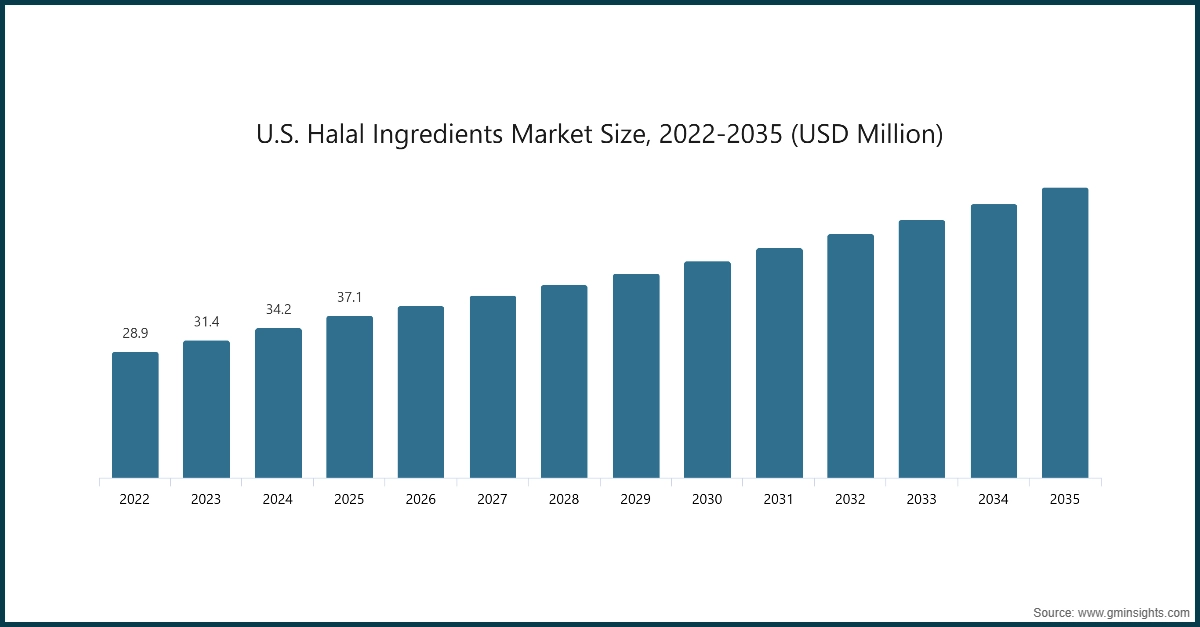
The market in the North America is expected to experience significant and promising growth from USD 44.7 million in 2025 to USD 80.1 million in 2035. The U.S. halal ingredients market accounted for USD 37.1 million in 2025.
- The Halal ingredients market in North America is growing because of two trends which include rising multicultural populations and increasing public awareness about Halal standards. Retailers and foodservice providers are increasing their Halal-certified product ranges to meet customer needs. Consumers are increasingly interested in products which contain plant-based ingredients and originate from ethical sources. The demand for Halal meat and dairy products exists in US urban areas as the primary location for such products. Certification bodies enhance labeling transparency through their efforts while supermarkets establish dedicated Halal sections.
The market in the Europe is expected to experience significant and promising growth from USD 48.9 million in 2025 to USD 91.4 million in 2035.
- The demand for Halal ingredients in Europe has increased because consumers want ethical products with traceable origins. The retail sector and specialty stores now offer more Halal-certified products which they distribute through their Standard retail channels. The market obtains trust through customers understanding certification standards and companies demonstrating transparency. French consumers who live in areas with large Muslim populations show strong demand for Halal meat and dairy products and convenience foods. Certification agencies work with producers to establish compliance standards which online retail platforms enable markets to access. The process drives both domestic Halal production and Halal-certified exporter imports.
The halal ingredients market in Asia Pacific is expected to experience increasing growth from USD 217 million in 2025 to USD 384.1 million in 2035.
- The market in Asia-Pacific (APAC) shows rapid expansion due to large consumer base and increasing consumer spending. The Halal food industry in Southeast Asian countries produces more Halal products than all other regions while building up their Halal certification systems. Health-conscious and ethically minded consumers are driving product demand for clean-label Halal items. Indonesia requires Halal certification for most food and beverage products because it has the world’s largest Muslim-majority population. Both local SMEs and multinational companies are increasing their Halal-compliant product ranges. Urban youth consumers will receive processed foods with innovative ingredients which companies will develop according to their preferences.
Middle East & Africa market is expected to experience significant and promising growth from USD 85.1 million in 2025 to USD 164.9 million in 2035.
- The MEA region remains the primary market for Halal ingredients because it has a considerable consumer base that needs Halal-compliant products. Demand exists in four product categories which include food items, beverage products, cosmetic goods and pharmaceutical products. Governments and regulatory bodies have established new Halal certification standards which organizations must follow to achieve product quality and safety. Dubai has developed into a central location for Halal business activities which include Halal product development and Halal trade operations. Retail chains and e-commerce platforms are implementing marketing campaigns which promote their certified products.
Latin America is expected to experience significant and increasing growth from USD 29.8 million in 2025 to USD 41.5 million in 2035.
- The Halal ingredients market in Latin America expands at a gradual pace because food exports to Muslim-majority nations drive its growth. Local consumers understand Halal products better now than they did before. Companies that want to conduct international trade now must obtain Halal certification according to new business requirements. Brazil which exports meat at high volumes faces strong market demand for Halal-certified beef and poultry among Middle Eastern and Southeast Asian buyers. The government helps exporters through compliance training while private processors enhance their facilities to achieve certification. The current market conditions create business opportunities which benefit local enterprises as well as export-based businesses.
Halal Ingredients Market Share
- The markets are moderately consolidated with players like Cargill Inc., Kerry Group, ADM (Archer Daniels Midland), BASF SE, Ingredion holding 32.5% market share and Cargill Inc. being the market leader holding the market share of 8.5% in 2025.
- The company retains its competitive advantage by continuously delivering products which meet high quality standards and Halal requirements. This strategy establishes consumer trust while the brand competes in the market as a dependable authentic business. The company establishes its reputation by conducting regular audits and obtaining certifications through its ethical practices.
- Businesses remain competitive through their ability to innovate new products. Companies create modern ingredients and alternative protein sources and functional products which match current consumer demands. Companies who establish market advantage through trend prediction and exclusive product launches will attract more customers.
- The combination of strategic partnerships with various organizations helps companies maintain their competitive advantage over extended periods. The company uses its trusted supplier network to access new markets while developing products which meet upcoming regulatory changes and consumer demands. Businesses can maintain their operational capabilities through collaboration while achieving sustainable business growth in markets that experience constant change.
- Brand reputation and marketing strategies also contribute to competitive strength. The combination of transparent labeling and ethical sourcing together with targeted campaigns helps businesses educate customers while developing brand loyalty. Companies that successfully communicate their values and product authenticity can establish a strong market presence.
Halal Ingredients Market Companies
Major players operating in the halal ingredients industry are:
- ADM
- Ajinomoto
- BASF SE
- Cargill Inc.
- Corbion
- DSM-Firmenich
- Givaudan
- Ingredion
- Kerry Group
- Roquette
Cargill Inc. deals in agricultural commodities and food ingredients, with a strong presence in halal-certified products. The company provides halal-certified products through its halal ingredient collection which includes proteins and oils and sweeteners and specialty additives for food and beverage and pharmaceutical industries. Cargill observes halal certification standards throughout its supply chain operations by ensuring that all its ingredients comply with religious dietary rules and halal market expansion requirements in various global regions.
Kerry Group deals in taste and nutrition solutions, including halal-certified ingredients. The company provides halal-compliant natural flavors and proteins and enzymes and dairy alternatives through its product range. Kerry uses all halal ingredients and certification bodies to protect halal integrity through their traceability system which helps food manufacturers create products for Muslim consumers.
ADM (Archer Daniels Midland) is a global food processing and ingredient provider with extensive halal ingredient offerings. The company sells halal-certified products which include plant-based proteins and sweeteners and emulsifiers and functional ingredients that comply with religious dietary restrictions. The dedicated production lines of ADM together with their relationships with halal certifiers enable customers to obtain trusted ingredients which meet halal requirements for various food and beverage uses.
BASF SE is a chemical company supplying functional ingredients, enzymes, and emulsifiers for food and nutrition markets. The halal-certified ingredient collection at BASF enables manufacturers to create food products and pharmaceutical items and cosmetic goods that meet halal standards. The company helps food producers create halal products for international markets through its halal certification process and strict manufacturing standards.
Ingredion specializes in the production of starches and sweeteners and plant-based components while ensuring all its products meet halal certification requirements. The halal ingredients are used in beverages, bakery, dairy alternatives, and snacks, which provide compliant texture, taste, and nutritional advantages. Ingredion halal certifiers ensure that their ingredients remain pure while meeting global needs for halal-certified food ingredients.
Halal Ingredients Market Report Attributes
| Key Takeaway | Details |
|---|---|
| Market Size & Growth | |
| Base Year | 2025 |
| Market Size in 2025 | USD 425.5 Million |
| Market Size in 2026 | USD 451 Million |
| Forecast Period 2026-2035 CAGR | 6% |
| Market Size in 2035 | USD 762 Million |
| Key Market Trends | |
| Drivers | Impact |
| Rising global demand for Halal-compliant products | The demand for Halal-compliant products is growing worldwide as consumers increasingly look for ethically and religiously permissible options. This trend is expanding market reach and creating opportunities for manufacturers to enter new regions. |
| Increasing disposable incomes and urbanization in key markets | Rising disposable incomes and rapid urbanization are driving higher consumption of Halal products. Processed and packaged offerings are becoming more accessible, supporting steady market growth. |
| Growing health consciousness and preference for ethically sourced products | Consumers are becoming more health-conscious and prefer products that are ethically sourced and responsibly produced. This shift encourages companies to focus on quality, safety, and sustainability in their Halal product offerings. |
| Pitfalls & Challenges | Impact |
| High costs associated with Halal certification and compliance | Obtaining Halal certification can be expensive, making it challenging for small and medium-sized businesses to enter the market. The rigorous compliance requirements add financial and operational pressure on manufacturers. |
| Complex supply chains that increase operational challenges | Managing complex supply chains while ensuring Halal compliance at every stage is difficult. Companies must carefully monitor suppliers and production processes to maintain product authenticity and quality. |
| Opportunities: | Impact |
| Adoption of blockchain and IoT for supply chain traceability | Blockchain and IoT technologies are enabling complete transparency in Halal supply chains. Companies can track products at every stage, ensuring compliance and building consumer trust. |
| Automation in food processing and quality control for efficiency | Automation reduces human error in production and quality control processes. This enhances efficiency and helps manufacturers consistently meet Halal standards. |
| Development of plant-based and lab-grown Halal-compliant alternatives | Innovations in plant-based and lab-grown ingredients offer Halal-compliant alternatives to traditional animal-based products. These solutions also address ethical and environmental concerns while meeting modern consumer demand. |
| Market Leaders (2025) | |
| Market Leaders |
8.5% Market Share |
| Top Players |
|
| Competitive Edge | |
| Regional Insights | |
| Largest Market | Asia Pacific |
| Fastest growing market | Middle East and Africa |
| Emerging countries | Saudi Arabia, South Africa, UAE |
| Future outlook |
|
What are the growth opportunities in this market?
Halal Ingredients Industry News
- On January 26, 2026, Tanmiah Food Company, one of the Middle East’s leading providers of poultry and processed proteins, announced a strategic partnership with global ingredient developer Griffith Foods to advance halal culinary excellence in the region. The collaboration will help Tanmiah develop new products while increasing its distribution network and serving Saudi Arabia's Vision 2030 goals for food security and environmental sustainability.
- On October 25, 2025, Brazilian food processor BRF announced a joint venture with Saudi Arabia’s Halal Products Development Company (HPDC) to develop the halal meat industry in the country. The venture will operate across the entire chicken production chain in Saudi Arabia which will implement a combined investment of $500 million to establish fresh, frozen and processed products.
The halal ingredients market research report includes an in-depth coverage of the industry with estimates and forecast in terms of revenue in USD Million and volume in terms of kilo tons from 2022–2035 for the following segments:
Market, By Product Type
- Animal-derived ingredients
- Meat
- Dairy
- Gelatin
- Collagen
- Enzymes
- Plant-derived ingredients
- Proteins
- Grains
- Oils
- Extracts
- Microbial/fermentation-derived
- Enzymes
- Cultures
- Precision fermentation proteins
- Synthetic/chemical
- Synthetic additives
- Flavors
- Colors
- Others
Market, By Source Origin
Animal-based ingredients
Plant-based ingredients
Microbial/fermentation-derived ingredients
Synthetic/chemically synthesized ingredients
Market, By Application
Food & beverages
- Meat and poultry products
- Dairy and dairy alternatives
- Bakery and confectionery
- Beverages
- Snacks and savory foods
- Processed and ready meals
- Condiments and sauces
- Others
Pharmaceuticals
- Gelatin capsules
- Excipients
- Active pharmaceutical ingredients (APIs)
- Vitamins and supplements
- Others
Cosmetics & personal care
- Skincare and body care
- Haircare
- Oral care
- Fragrances and perfumes
- Color cosmetics (makeup)
- Others
Animal feed & pet food
- Livestock feed (cattle, sheep, goat)
- Poultry feed (chicken, turkey)
- Aquaculture feed (fish, shrimp)
- Others
Market, By Distribution Channel
Offline distribution
- Hypermarkets and supermarkets
- Convenience stores
- Specialty halal stores
- Traditional markets and bazaars
- Foodservice
- Others
Online distribution
- E-commerce marketplaces
- Direct-to-consumer (DTC) brand websites
- Online grocery delivery
- Others
The above information is provided for the following regions and countries:
- North America
- U.S.
- Canada
- Europe
- Germany
- UK
- France
- Spain
- Italy
- Rest of Europe
- Asia Pacific
- China
- India
- Japan
- Australia
- South Korea
- Rest of Asia Pacific
- Latin America
- Brazil
- Mexico
- Argentina
- Rest of Latin America
- Middle East and Africa
- Saudi Arabia
- South Africa
- UAE
- Rest of Middle East & Africa
Frequently Asked Question(FAQ) :
Who are the key players in the halal ingredients market?
Major players include ADM, Ajinomoto, BASF SE, Cargill Inc., Corbion, DSM-Firmenich, Givaudan, Ingredion, and Kerry Group.
Which application segment dominated the halal ingredients market in 2025?
The food & beverages segment led the market, holding the largest value of USD 250.4 million in 2025.
Which region leads the halal ingredients market?
North America is expected to experience significant growth, with the market increasing from USD 44.7 million in 2025 to USD 80.1 million by 2035. The U.S. market accounted for USD 37.1 million in 2025.
What is the projected size of the halal ingredients market in 2026?
The market is expected to grow to USD 451 million in 2026.
What was the market share of animal-based ingredients by source origin in 2025?
Animal-based ingredients dominated the market by source origin, with a valuation of USD 210.9 million in 2025.
What was the market share of animal-derived ingredients in 2025?
Animal-derived ingredients held the largest market share, valued at USD 203.1 million in 2025.
What was the market size of the halal ingredients market in 2025?
The market size was USD 425.5 million in 2025, driven by increasing consumer awareness of ethical sourcing and product transparency.
What is the projected value of the halal ingredients market by 2035?
The market is expected to reach USD 762 million by 2035, growing at a CAGR of 6% during the forecast period.
Halal Ingredients Market Scope
Related Reports