Summary
Table of Content

Green Chemistry Market
Get a free sample of this report
Form submitted successfully!
Error submitting form. Please try again.
Thank you!
Your inquiry has been received. Our team will reach out to you with the required details via email. To ensure that you don't miss their response, kindly remember to check your spam folder as well!
Request Sectional Data
Thank you!
Your inquiry has been received. Our team will reach out to you with the required details via email. To ensure that you don't miss their response, kindly remember to check your spam folder as well!
Form submitted successfully!
Error submitting form. Please try again.
Green Chemistry Market Size
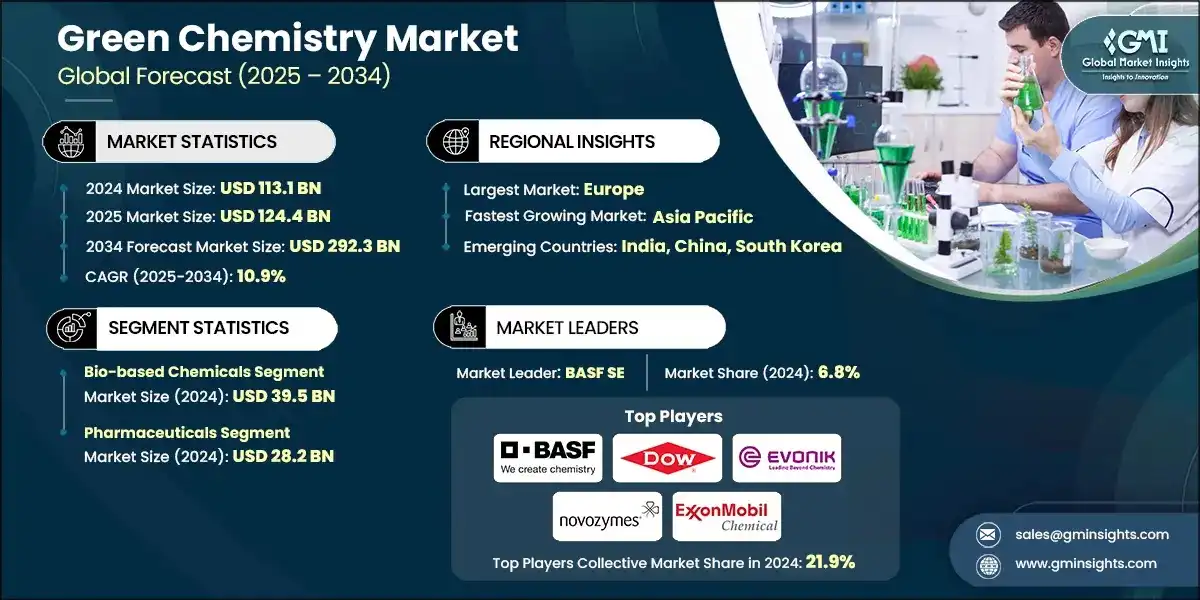
The global green chemistry market was valued at USD 113.1 billion in 2024. The market is expected to grow from USD 124.4 billion in 2025 to 292.3 billion in 2034, at a CAGR of 10.9% according to the latest report published by Global Market Insights Inc.
Green Chemistry Market Key Takeaways
Market Size & Growth
- 2024 Market Size: USD 113.1 Billion
- 2025 Market Size: USD 124.4 Billion
- 2034 Forecast Market Size: USD 292.3 Billion
- CAGR (2025–2034): 10.9%
Regional Dominance
- Largest Market: Europe
- Fastest Growing Region: Asia Pacific
Key Market Drivers
- Shift toward bio-based and renewable inputs.
- Integration of digital tools in green process design.
- Expansion into non-traditional sectors.
Challenges
- High transition and production costs.
- Inconsistent supply and quality of renewable feedstocks.
Opportunity
- Circular economy and waste valorisation.
- Development of smart, responsive materials.
- Integration of carbon capture and utilization (CCU) technologies.
Key Players
- Market Leader: BASF SE led with over 6.8% market share in 2024.
- Leading Players: Top 5 players in this market include BASF SE, Dow Inc., Evonik Industries, Novozymes A/S, ExxonMobil Chemical, which collectively held a market share of 21.9% in 2024.
Get Market Insights & Growth Opportunities
- Green Chemistry, also known as sustainable chemistry, refers to the design of chemical products and processes that reduce or eliminate the use or generation of hazardous substances. It promotes novelty in chemical synthesis, waste prevention, energy efficiency, and renewable feedstocks.
- Green Chemistry plays a crucial role in reducing the environmental impact of chemical manufacture following international sustainability objectives and relevant regulatory frameworks for a healthier and safer environment.
- Recently, there has been a shift in the growth for Green Chemistry, it is due to stricter environmental regulations, consumer requirements for sustainable products, and awareness among industries regarding ecological responsibilities. Further, international climate accords such as the Paris Agreement are making companies adopting greener alternatives. Technological advancements in bio-based chemicals and green solvents have also enabled the economies to move towards sustainability investment.
- The green chemistry industry extends beyond pharmaceuticals to agriculture, the automotive market, packaging, and personal care products. To further emit themselves to sustainability, businesses increasingly adopt green solvents, renewable raw materials, and eco-friendly catalysts. Governments and regulatory agencies throughout North America, Europe, and Asia-Pacific are providing incentives along with compliance standards that influence the adoption of green chemistry methodologies. Thus, many multinational companies have also held green chemistry principles in their R&D and production strategies.
To get key market trends
Green Chemistry Market Trends
- The market for green chemistry is undergoing a huge transformation, with industries worldwide embracing sustainability. It is driven by environmental awareness, regulatory pressure, and rising consumer demands for eco-friendly products.
- New approaches, including the introduction of renewables and bio-based feedstocks in petrochemical processes, are adopted by companies as alternatives to traditional processes to reduce their environmental impacts, and thus growing market for green chemistry.
- Technological advances are catering the fast growth of green chemistry adoption. Innovations of enzymatic catalysis, continuous flow chemistry, green solvent development, etc., guarantee processes to be efficient as well as compatible with the environment. More wastes become less hazardous with reduced energy consumption, thus enhancing sustainability. The integration of these technologies allows industries to comply with stringent environmental regulations while keeping the economy viable, creating a robust green chemistry market.
- Regulatory frameworks are evolving to support and enforce the adoption of green chemistry practices. Governments are increasingly implementing environmental regulations with penalties for lapse to encourage the use of sustainable materials under the circular economy. All these policies tend towards stimulating innovation in industries allowing the use of green chemistry solutions to meet the environmental standards.
- Bio-based and renewable raw materials are driving forces in chemical production. Traditional petrochemical inputs are increasingly being replaced by plant-based sources, agricultural byproducts, and waste-derived feedstocks. This change is driven not only by environmental priorities but also by supply chain concerns and the volatility of fossil-based inputs.
Green Chemistry Market Analysis

Learn more about the key segments shaping this market
The green chemistry industry by product type is segmented into bio-based chemicals, green solvents, renewable feedstocks, green polymers and green surfactants. Bio-based chemicals hold the largest market value of USD 39.5 billion in 2024.
- Bio-based chemicals have gained importance as industries search for sustainable alternatives to traditional fossil-fuel-derived chemicals. These chemicals are sourced from renewable biomass, meaning they have a relatively lower carbon footprint, and they find their use in multiple sectors, such as pharmaceuticals, agriculture, and consumer goods. Green solvents are also rapidly growing, with their low toxicity being attractive and lessening their environmental impact in comparison with conventional solvents.
- Renewable feedstocks are in demand as a result forcing manufactures to adopt sustainable alternatives rather than petroleum-based raw materials. Green polymers, consisting of biodegradable and bio-based plastics, have penetrated rapidly into the market with the intense regulatory pressure and customer demand. It is accepted by many industries including packaging, automotive, and construction. Currently, green surfactants have a steady growth trend, valued for their biodegradability and low environmental impact, with applications into the area of personal care and household-cleaning as well as the industrial sector.
Learn more about the key segments shaping this market
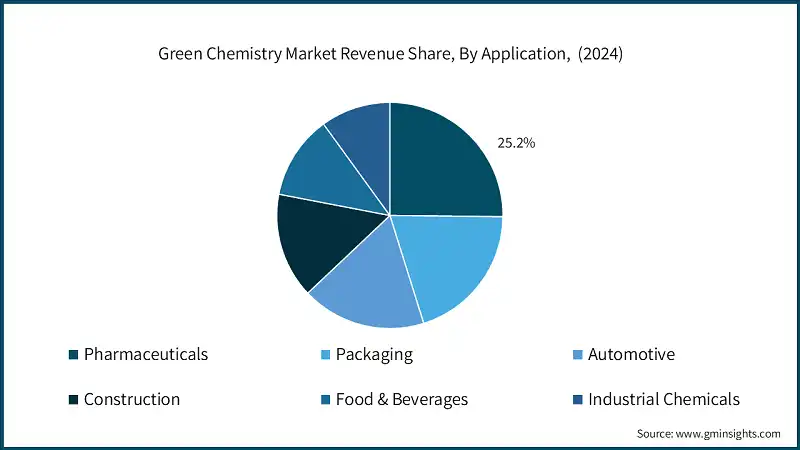
The green chemistry market by application is segmented into pharmaceuticals, packaging, automotive, construction, food & beverages and industrial chemicals. Pharmaceuticals hold the largest market value of USD 28.2 billion in 2024.
- In pharmaceuticals, the sustainable process of manufacturing and safer products is possible through green chemistry, while packaging makes use of biodegradable and bio-based materials for the replacement of plastic waste. The automotive and the construction sectors are adopting green materials and processes to reduce carbon footprints and improve energy efficiency.
- The food and beverage industry is applying green chemistry to improve the safety of food and develop sustainability through natural additives and sustainable packaging. Industrial chemicals are also transforming into greener alternatives to minimize their environmental impact and to comply with regulatory standards. Such diverse applications collectively increase the green chemistry industry and further confirm a commitment across these industries to sustainability and responsible production.
Looking for region specific data?
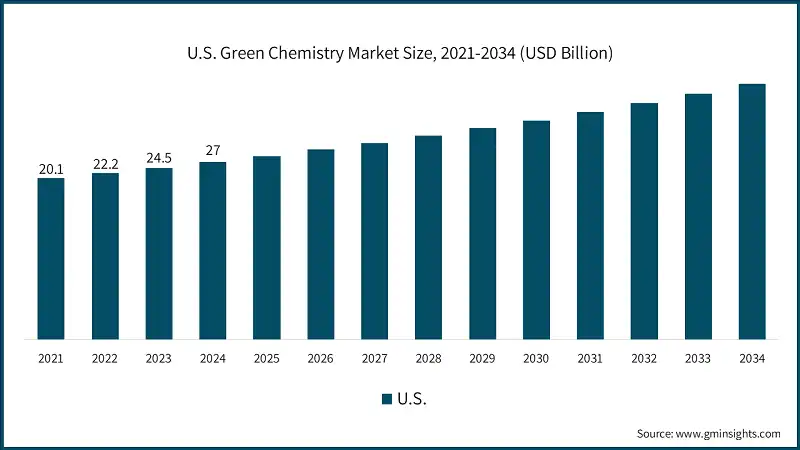
The U.S. green chemistry market accounted for USD 27 billion in 2024.
- The green chemical market is growing, especially in North America due to the convergence of strong regulatory support, abundance of renewable resources, and growing demand for sustainable products in all industrial sectors. Canada is leveraging both its forestry and agricultural sectors to produce bio-based chemicals whereas Mexico's manufacturing base is increasingly going green with his inputs available in the market to meet the global criteria to supply chains. At that level, environmental legislation was giving incentives to companies to opt for safer alternatives to hazardous substances which were in accordance with the global ESG goals. This regional push is also supported through public-private partnerships with funding capacity directed toward clean-tech pilot projects and infrastructure. These parameters are forming a bundled ecosystem for the quickened green chemistry innovation and commercialization across North America.
The market in the Germany is expected to experience significant and promising growth from 2025 to 2034.
- The growth of the green chemistry market in Germany is showing tremendous growth due to environmental policies, sufficient industrial base, and demand for sustainable solutions. The commitment of the government to lowering carbon emissions and promoting environmentally friendly production methods would encourage industries to adapt greener chemicals and processes. Germany's prominent position in the automotive and manufacturing industries generates an immediate strong requirement of innovative low-impact materials. In addition, public awareness regarding sustainability as well as EU environmental regulations trigger investments into cleaner alternatives, thus making green chemistry a vital component of the country’s industrial transformation.
The green chemistry market in China is expected to experience significant and promising growth from 2025 to 2034.
- The market is likely to escalate significantly from 2025 to 2034 in the Asia-Pacific region owing to rising environmental awareness and government regulations concerning the reduction of pollution and carbon emissions. Rapid industrialization and urbanization in countries such as China, India, and the Southeast Asian nations are pushing demand for cleaner chemical processes and sustainability. The sectors of renewable energy and biotechnology are adopting new technologies thus replacing traditional chemicals with greener alternatives. As sustainability is now being accepted as a paradigm in business and consumer culture, the transition to greener materials and manufacturing processes acts as a catalyst for the growth of green chemistry across the Asia-Pacific realm.
UAE market is expected to experience significant and promising growth from 2025 to 2034.
- The green chemistry market in the Middle East and Africa is being anticipated to grow massively during the period from 2025 to 2034, which would be stimulated by sustainability and economic diversification initiatives by the country. Government policies encouraging the clean industrial sector along with the companies to adopt greener chemical solutions. Increasing awareness among consumers and companies regarding eco-friendly products and their benefits further add to their demand. Besides that, strategic location along with well-developed infrastructure also supports UAE trade as well as efficient supply chains for the further growth of the green chemistry segment.
Brazil is expected to experience significant and promising growth from 2025 to 2034.
- Green chemistry market in Latin America is expected to experience rapid growth from 2025 to 2034, supported by increased environmental concerns and government efforts toward sustainable development. In the region, countries are increasingly forming regulations to reduce pollution and promote eco-friendly materials. Growing demand from the agriculture, manufacturing, and energy sectors for greener alternatives is aiding in this transition. Investments directed into renewable resources and technological innovations will give further momentum to the market, thus positioning Latin America as one of the most attractive scenarios in the next decade for green chemistry developments.
Green Chemistry Market Share
- Green chemistry industry are moderately consolidated with players like BASF SE, Dow Inc., Evonik Industries, Novozymes A/S, ExxonMobil Chemical holding 21.9% market share and BASF SE Incorporated being the market leader holding the market share of 6.8% in 2024.
- Sustainability is a predominant driving force that influences competitive strategies in addition to innovation. Companies use efficient production procedures that reduce waste and emissions, decrease energy consumption and provide facility scalable for increasing demand. This emphasis upon environmentally friendly production proves to be most appealing to customers and industry, especially those conscious of being environmentally responsible, and hence distinguishes the companies in the crowded marketplace.
- Another way in which market leaders distinguish themselves is compliance with ever-changing environmental regulations, thus maintaining a competitive edge. Such compliance with the rising trend of safety assessments, emissions, and chemical use standards engenders a sense of credibility towards consumers while easing market entry through acceptance in the global domain.
- Transparency and proactiveness in managing risks while aligning regulatory frameworks foster smooth transition in growth of the market.
- Industry leaders in the green chemistry field create collaborative relationships with academic institutions, start-up enterprises, and partners from their supply chain to enhance their innovation potential. These encompass mutually reinforcing partnerships where many of the resources can accelerate the research and development of sustainable technologies. Hence this cooperation leads to increased flexibility and adaptability to changing market requirements that is crucial for their survival in a fast-changing industry.
Green Chemistry Market Companies
Major players operating in the green chemistry industry are:
- BASF SE
- Dow Inc.
- DuPont de Nemours
- Air Liquide
- ExxonMobil Chemical
- Mitsubishi Chemical Group
- Cargill Inc.
- Corbion N.V.
- Novozymes A/S
- Evonik Industries
- Braskem S.A.
- Solugen Inc.
- Genomatica Inc.
- Gevo Inc.
- Amyris Inc.
- Modern Meadow
BASF SE is the chemical industry, with its headquarters in Germany. Its diversified portfolio includes chemicals, materials, industrial solutions, surface technologies, nutrition & care, and agricultural solutions. Operating under its integrated "Verbund" model, BASF takes advantage of synergies across production to maximize efficiency and sustainability. The company supports the incorporation of sustainability in its agenda through innovations to promote the circular economy, low-carbon technologies, and bio-based solutions alongside its "Loop Solutions" initiative. BASF intends to reach climate neutrality by 2050, with a strong focus on R&D and digitalization while retaining its global leadership in key sectors.
Dow Inc. is a dealing in materials science company headquartered in Midland, Michigan, with a portfolio of advanced products and solutions across packaging, infrastructure, mobility, and consumer care. The company operates through three major business segments: Packaging & Specialty Plastics; Industrial Intermediates & Infrastructure; and Performance Materials & Coatings. More than 30 countries have manufacturing sites of Dow and serve customers in more than 160 nations. In terms of strategy company focuses sustainability, such as Path2Zero carbon neutrality by 2050 and a greater push on circular economy solutions that include advanced recycling technologies and bio-based materials.
Evonik Industries is a German specialty chemicals companies and has its headquarters located in Essen, Germany. The company is known for its innovation-driven portfolio and high-value solutions across diversified sectors. Businesses in health care, nutrition, personal care, automotive, and construction are major segments with which Evonik operates in specialty chemicals to improve performance of end products, as well as their sustainability. The company has several important business units, including Smart Materials, Nutrition & Care, Specialty Additives, and Performance Materials.
Novozymes A/S it develops enzymes and microorganisms for sustainable solutions in agriculture, food and beverages, bioenergy, and household care industries. They seek to substitute classic chemical processes with biological alternatives that will reduce the environmental impact while improving efficiency and performance. Novozymes invests heavily in research and development to set standards for bio-based products and thus drives itself into becoming a key player in the shift towards greener, more eco-responsible industrial practices.
ExxonMobil Chemical is one of the largest chemical companiesin the world and is increasingly beginning to infuse green chemistry principles into all its operations, thereby acting as a catalyst for sustainable growth. It is a major investor in innovation programs that have an environmental focus, such as the development of chemicals with enhanced recyclability, reduced carbon footprint, and improved energy efficiency, drawing on vast resources and infrastructural technology.
Green Chemistry Market Report Attributes
| Key Takeaway | Details |
|---|---|
| Market Size & Growth | |
| Base Year | 2024 |
| Market Size in 2024 | USD 113.1 Billion |
| Market Size in 2025 | USD 124.4 Billion |
| Forecast Period 2025 - 2034 CAGR | 10.9% |
| Market Size in 2034 | USD 292.3 Billion |
| Key Market Trends | |
| Drivers | Impact |
| Shift toward bio-based and renewable inputs | Companies are rapidly replacing fossil-based raw materials with plant-based and waste-derived alternatives. This reflects pressure to reduce carbon footprints and align with sustainability goals. It’s driving innovation in polymers, solvents, and surfactants. |
| Integration of digital tools in green process design | AI, machine learning, and simulation tools are being used to optimise chemical processes and predict greener alternatives. This tech-driven trend reduces trial-and-error and accelerates the path to commercial-scale green chemistry. |
| Expansion into non-traditional sectors | Green chemistry is moving beyond industrial and pharmaceutical uses into cosmetics, construction, textiles, and electronics. This diversification reflects both environmental pressure and consumer demand for safer, sustainable products. |
| Pitfalls & Challenges | Impact |
| High transition and production costs | Adopting green chemistry often involves expensive equipment, sourcing of renewable inputs, and costly R&D. This can limit uptake, especially for smaller manufacturers or in price-sensitive markets. |
| Inconsistent supply and quality of renewable feedstocks | Green chemistry relies heavily on bio-based raw materials, but these feedstocks can vary widely in availability and quality due to seasonality, climate change, and agricultural practices. This unpredictability creates supply chain risks and production inconsistencies for manufacturers. |
| Opportunities: | Impact |
| Circular economy and waste valorisation | Green chemistry is enabling the transformation of waste (agricultural, food, industrial) into valuable inputs. This supports circular economy goals and reduces dependence on virgin raw materials. |
| Development of smart, responsive materials | Green chemistry will focus on designing materials that adapt to environmental changes such as self-healing plastics or biodegradable packaging that responds to humidity. These innovations will enhance product lifecycles while minimizing waste and environmental impact. |
| Integration of carbon capture and utilization (CCU) technologies | Green chemistry innovations will increasingly harness captured CO₂ as a raw material to create fuels, polymers, and chemicals. This not only reduces greenhouse gases but also opens new value chains that turn emissions into profitable products. |
| Market Leaders (2024) | |
| Market Leaders |
Market Share 6.8% |
| Top Players |
Collective market share of 21.9% in 2024 |
| Competitive Edge |
|
| Regional Insights | |
| Largest Market | Europe |
| Fastest growing market | Asia Pacific |
| Emerging country | India, China, South Korea |
| Future outlook |
|
What are the growth opportunities in this market?
Green Chemistry Industry News
- In February 2025, ChemistryNL has developed a Bio-based Raw Materials Committee that will create an action agenda for promoting the use of bio-based raw materials in the Dutch chemical sector. The committee is chaired by Dr. Sjoukje Heimovaara from Wageningen University & Research and comprises of top scientists and industry experts. The challenges to be tackled include feedstock availability, processing technologies, regulations, and economics through which the committee will be tasked with accelerating the transition to sustainable, circular chemistry. The Dutch government's biocarbon strategy will be catered from the findings of committee and circular economy goals, with results anticipated during summer 2025.
- In May 2024, Mondi launched a new product 'TrayWrap,' a sustainable paper packaging replacement for plastic shrink film for food and beverages. TrayWrap, made from 100% renewable kraft paper and totally recyclable, is in support of green packaging initiatives, increases product stability, and is consistent with European regulatory requirements, demonstrating Mondi's commitment to eco-friendly practices.
The green chemistry market research report includes an in-depth coverage of the industry with estimates and forecast in terms of revenue in USD Billion and volume in terms of kilo tons from 2021–2034 for the following segments:
Market, By Product Type
- Bio-based Chemicals
- Green Solvents
- Renewable Feedstocks
- Green Polymers
- Green Surfactants
Market, By Application
- Pharmaceuticals
- Packaging
- Automotive
- Construction
- Food & Beverages
- Industrial Chemicals
The above information is provided for the following regions and countries:
- North America
- U.S.
- Canada
- Europe
- Germany
- UK
- France
- Spain
- Italy
- Rest of Europe
- Asia Pacific
- China
- India
- Japan
- Australia
- South Korea
- Rest of Asia Pacific
- Latin America
- Brazil
- Mexico
- Argentina
- Rest of Latin America
- Middle East and Africa
- Saudi Arabia
- South Africa
- UAE
- Rest of Middle East & Africa
Frequently Asked Question(FAQ) :
What is the market size of the green chemistry industry in 2024?
The market size was USD 113.1 billion in 2024, with a CAGR of 10.9% expected through 2034 driven by increasing adoption of bio-based and renewable inputs.
What is the current green chemistry market size in 2025?
The market size is projected to reach USD 124.4 billion in 2025.
What is the projected value of the green chemistry market by 2034?
The green chemistry market is expected to reach USD 292.3 billion by 2034, supported by sustainability regulations, renewable feedstock usage, and circular economy initiatives.
How much revenue did the bio-based chemicals segment generate in 2024?
The bio-based chemicals segment generated USD 39.5 billion in 2024, making it the largest product category.
What was the valuation of the pharmaceuticals application segment in 2024?
The pharmaceuticals application segment was valued at USD 28.2 billion in 2024, leading due to growing demand for safer and environmentally responsible chemical processes.
Which region leads the green chemistry market?
The U.S. green chemistry market accounted for USD 27 billion in 2024. Growth is driven by supportive environmental regulations, abundant renewable resources, and strong industrial adoption of sustainable chemical alternatives.
What are the upcoming industry trends in the green chemistry industry?
Key trends include waste valorization, bio-based raw materials innovation, digital tools for process optimization, and carbon capture utilization for chemical manufacturing to improve sustainability and reduce emissions.
Who are the key players in the green chemistry market?
Key companies include BASF SE, Dow Inc., Evonik Industries, Novozymes A/S, ExxonMobil Chemical, DuPont de Nemours, Mitsubishi Chemical Group, Cargill Inc., Braskem S.A., Solugen Inc., and Genomatica Inc.
Green Chemistry Market Scope
Related Reports