Summary
Table of Content

Gourmet Salts Market
Get a free sample of this report
Form submitted successfully!
Error submitting form. Please try again.
Thank you!
Your inquiry has been received. Our team will reach out to you with the required details via email. To ensure that you don't miss their response, kindly remember to check your spam folder as well!
Request Sectional Data
Thank you!
Your inquiry has been received. Our team will reach out to you with the required details via email. To ensure that you don't miss their response, kindly remember to check your spam folder as well!
Form submitted successfully!
Error submitting form. Please try again.
Gourmet Salts Market Size
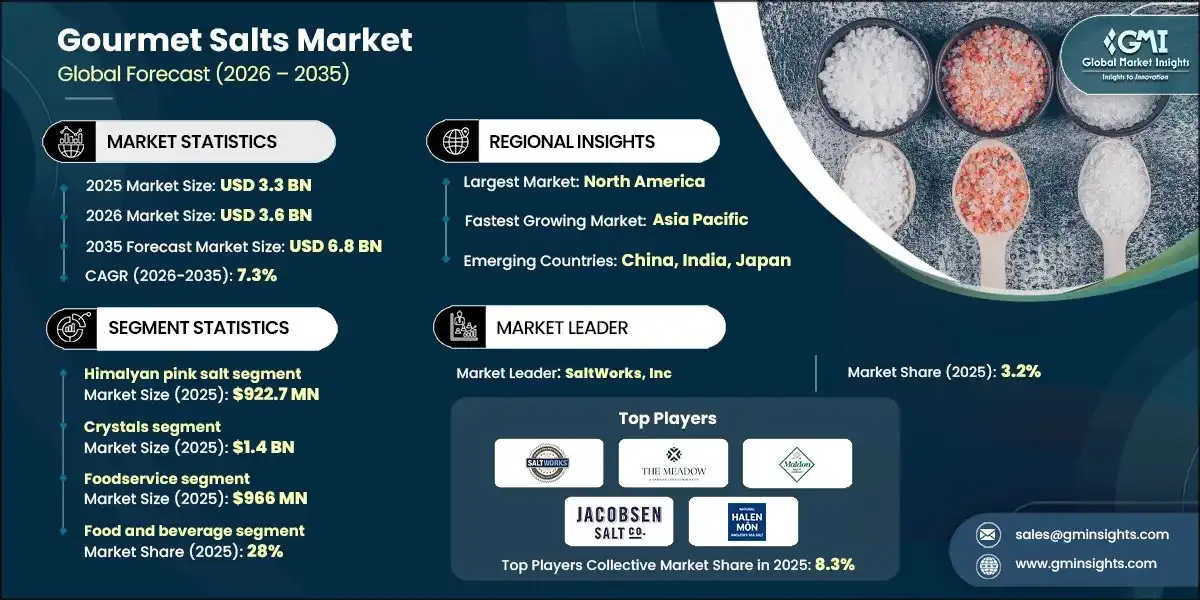
The global gourmet salts market size was valued at USD 3.3 billion in 2025. The market is expected to grow from USD 3.6 billion in 2026 to USD 6.8 billion in 2035, at a CAGR of 7.3% according to the latest report published by Global Market Insights Inc.
Gourmet Salts Market Key Takeaways
Market Size & Growth
- 2025 Market Size: USD 3.3 Billion
- 2026 Market Size: USD 3.6 Billion
- 2035 Forecast Market Size: USD 6.8 Billion
- CAGR (2026–2035): 7.3%
Regional Dominance
- Largest Market: Enter metric value
- Fastest Growing Region: Asia Pacific
Key Market Drivers
- Rising consumer preference for natural products.
- Demand from premium culinary segments.
- Expansion of e-commerce and retail channels.
Challenges
- Quality and authenticity concerns.
- Inconsistent quality and counterfeit products in the market can damage consumer trust. Authenticity verification and proper labeling are crucial to maintain credibility..
Opportunity
- Product innovation and flavored salts.
- Sustainable and eco-friendly practices.
- Expansion into emerging markets.
Key Players
- Market Leader: SaltWorks, Inc led with over 3.2% market share in 2025.
- Leading Players: Top 5 players in this market include SaltWorks, Inc., Maldon Crystal Salt Company Ltd., The Meadow, Jacobsen Salt Co., Halen Môn, which collectively held a market share of 8.3% in 2025.
Get Market Insights & Growth Opportunities
- Premium culinary salts are gourmet salts appreciated for their unique mineral compositions, textures, colours, and flavours. Unlike the table salt of standardization and refinement, gourmet salts possess some natural trace minerals or specific crystallization, which contribute to taste and presentation. Harvesting of these salts may be restricted to certain lands, such as marine or ancient salt beds, or volcanic areas, thus qualifying them to a terroir just like fine wines or specialty foods.
- Gourmet salt shifted technologically with the development of modern harvest, dehydration, and crystal formation techniques. These days, producers are using controlled evaporation, solar tunnel drying, and micro crystallization techniques to produce salts with precision on size and texture for culinary performance. Improved mineral analysis tools allow highlighting the chemical fingerprint unique to each salt, while digital and e-commerce have extended access to these salts across the globe.
- Salt, whether coarse or fine imparts different flavors and feelings, favoring them towards different culinary uses. Flaky salts like Maldon have a delicate crunch and are therefore prized for finishing dishes. Himalayan pink salt provides a subtle flavor of mineral richness and is often found in grinders or on salt blocks for cooking. Smoked and infused salts provide a fragrant or flavoured aspect to dishes without changing moisture content.
- With increasing consumer interest in high-end-natural-artisanal food products, the gourmet salt market has been witnessing steady growth over recent years. An increasing realization of the different flavours, textures, and health benefits associated with various salt types has led professional chefs and home cooks to reach out for more than conventional table salt. These salts appeal to consumers not just on flavour but for their aesthetic value, to enhance the presentation of dishes
To get key market trends
Gourmet Salts Market Trends
- The demand for natural and minimally processed foods by consumers caters the growth of the gourmet salt segment. Health-conscious consumers increasingly view gourmet salts as the healthy and authentic alternative to conventionally packaged table salt due to their mineral content, leading consumers to give these products preferences in households and restaurants.
- Gourmet salts demand is on the rise due to the popularity of fine dining and premium culinary experiences. With uniqueness in presentation and elevated flavors, specialty salts are used not only for seasoning but also for garnishing purposes and for their aesthetic appeal.
- The growing popularity of e-commerce and specialty food channel retailing propels the growth of the market. With increased accessibility, consumers can conveniently purchase various salts from different regions and across geographical boundaries.
- The ability of brands to create differentiating landscapes for themselves by introducing innovations in product offering type and flavour extension is also enticing further growth. Flavoured, smoked, infused salts, and regional varieties act as differentiating factors for brands.
Gourmet Salts Market Analysis
Learn more about the key segments shaping this market
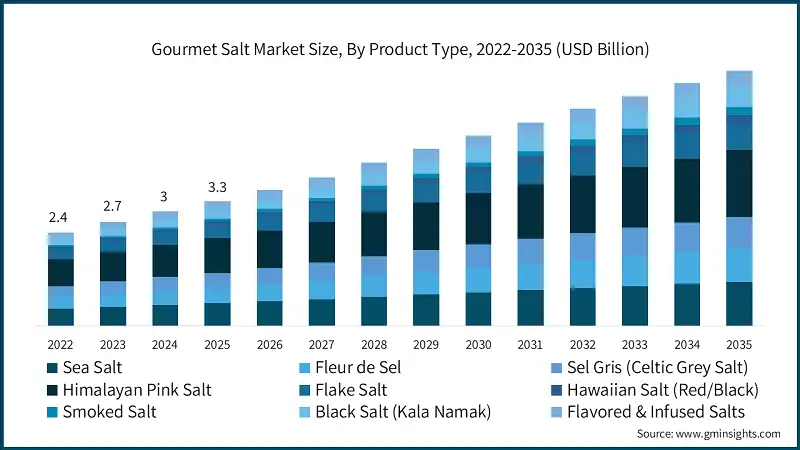
The gourmet salts market by product type is segmented into sea salt, fleur de sel, sel gris (celtic grey salt), himalayan pink salt, flake salt, hawaiian salt (red/black), smoked salt, black salt (kala namak), flavored and infused salts and herb-infused varieties. Himalyan pink salt hold the largest market value of USD 922.7 million in 2025.
- The market for gourmet salts including sea salts, fleur de sel, sel gris (Celtic grey salt), Himalayan pink salt, and flake salt is growing, as consumers increasingly looking for natural, minimally processed, and mineral-rich ingredients. Beyond their unique textures, tastes, and visual appeal, these salts enhance home kitchens and professional culinary.
- Salt types that remain in demand throughout the seasons include fleur de sel and sel gris, harvested artisanally from their own regions. Himalayan pink salt is endowed with perceptions of wellness and versatility, extending beyond cooking into lifestyle and health-related uses. Thin and flaky crystalline salts are known for finishing dishes, adding texture and very light saltiness without overtaking other flavours.
- Specialty salts, which include Hawaiian red and black salts, smoked salts, black salt (kala namak), and a variety of flavoured and herb-infused salts, are altering demand of gourmet salt. Such salts complement those consumers who are looking for singular taste, along with adding complexity to both traditional and contemporary dishes. Hawaiian salts are valued for their mineral profile and its colour.
- Black salt (kala namak) gives a distinctly sour taste that makes it popular in South Asian cooking. On the other hand, flavoured and herb-infused salts open up the horizon of seasoning, attracting curious chefs for making their meals extraordinary with new flavour profiles.
The gourmet salts market by product form is segmented into crystals, flakes and powder. Crystals holds the largest market value of USD 1.4 billion in 2025.
- Gourmet salts are coarse and fine in texture. These are in higher demand because of their natural texture and use versatility. Coarse crystals are generally preferred for seasoning meats, roasting vegetables, and for use as finishing salts, which impart a delightful crunch and explosion of flavor during consumption. Fine crystals are used in baking, cooking, everyday seasoning purposes, where even distribution of salt is essential.
- Flake salts and powdered salts perform different culinary functions and have established important niches in the gourmet salt. Flake salts have light but delicate texture and rapid dissolution that make it desirable for completing dishes with a gentle touch, while powdered salts, with their very fine texture, are usually used in blends, spice mixes, and applications that required rapid dispersion of salt.
The gourmet salts market by application is segmented into bakery and confectionery, meat and poultry products, seafood products, sauces and savories, food processing, foodservice, household / retail, cosmetics and personal care. Foodservice holds the largest market value of USD 966 million in 2025.
- The wide range of gourmet salts is used in many foods related applications, while bakery, confectionery, meat, poultry, and seafood products generate significant demand. In baking and confectionery, fine salts improve flavor balance and texture, while in meats and seafood, coarse and flavored salts provide seasoning, curing, and finishing, thereby enhancing taste and preservation. Sauces and savory foods benefit from various flavor profiles of special salts, adding to the complexity of culinary creations. The food processing sector uses gourmet salts for clean-label seasoning, addressing consumer preference for natural ingredients and healthy foods.
- The foodservice segment acts as a major driver for gourmet salts, with chefs putting extra effort into gourmet ingredients to enhance dining occasions. Household and retail consumers are also using gourmet salts increasingly in cooking and tabletop applications. The cosmetics and personal care industry is using salts more in products for their mineral content and exfoliating properties in bath salts, scrubs, and skincare. This diverse range of applications allows steady growth and innovation within the gourmet salt industry, supported by changing consumer tastes and wellness trends.
Learn more about the key segments shaping this market
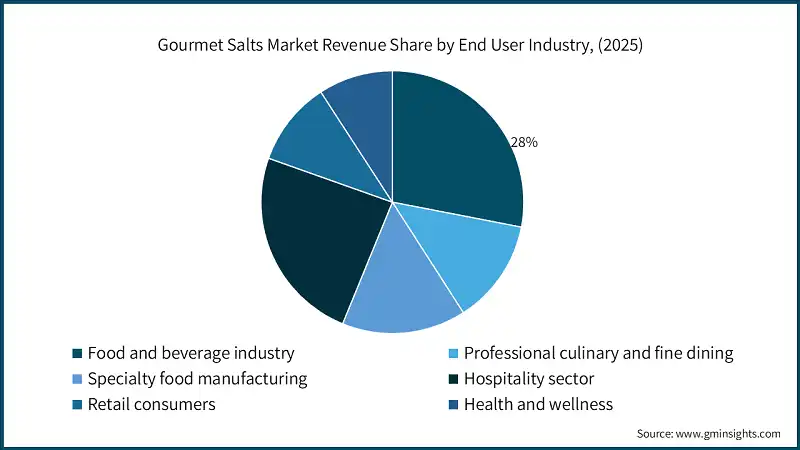
The gourmet salts market by end use industry is segmented into food and beverage industry, professional culinary and fine dining, specialty food manufacturing, hospitality sector, retail consumers and health and wellness. Food and beverage industry holds the largest market of 28% in 2025.
- The food and beverage industry, with fast-growing specialty food manufacturing and professional culinary facets, creates a very crucial demand for gourmet salts. Fine dining restaurants and chefs always searching out the rarest types of salts to enhance their dishes further in the complexity of flavour, texture, and visual presentations. Specialty food manufacturing product like snacks, seasonings, and fully cooked meals have gourmet salts to appeal to this market segment's growing preference for premium, natural inclusions.
- Markets have both retail consumers and hospitality segments. Such health conscious and adventurous retail consumers are more incorporating gourmet salts into their everyday cooking and finishing applications, for they offer almost endless, distinct flavours as well as considered health benefits. Hotels and other caterers are bringing that gastronomic experience right into guest dining by including gourmet salts to give guest menus uniqueness. This increased health and wellness awareness steers consumers toward mineral-rich, less processed salts.
Looking for region specific data?
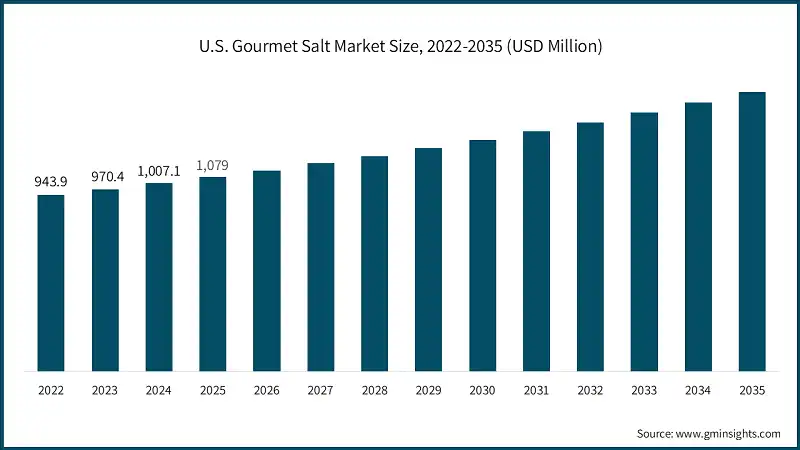
The U.S. gourmet salts market accounted for USD 1.07 billion in 2025.
- In North America, the growing interest in salt is increasingly made with flavor, aesthetics, and functional benefits. Consumers in the USA and Canada use smoked salts and flavored varieties more often to introduce more complexity into everyday dishes. Gourmet salts are also included in wellness-targeted products, such as bath salts and seasoning blends with minerals added to them. Foodies and home chefs enjoy putting finishing salt into high-end plating and presentation, while numerous specialty retailers and online channels make a wide range of premium salts easily accessible.
The gourmet salts market in the Germany is expected to experience significant and promising growth from 2025 to 2035.
- Fleur de sel, sel gris, and other traditional salts, specific to the region, have gained enormous cultural and culinary appreciation in Europe. In France, Germany, and the United Kingdom, gourmet salts are added in both professional preparation and domestic cooking to garnish traditional recipes with unique textures and flavours. There is an increasing interest in experimental and fusion cuisine for application of flavoured salts. consumers are becoming more concerned about sustainability, traceability, and heritage production methods for salt selection. The market is also supported by specialty food stores, culinary academies, and events that promote artisanal quality and provenance.
The gourmet salts market in China is expected to experience significant and promising growth from 2025 to 2035.
- The Asia-Pacific market is based on a combination of health awareness, increasing purchasing ability, and exposure to international culinary trends. In India, Japan, China, and Australia, mineralized salts widely used in cooking such as Himalayan pink salt and black salt (kala namak) are also used in well-being and lifestyling products. Younger people are exploring flavored and exotic salts. The availability of retail modernization and e-commerce avenues has all enhanced this scenario, while urban centres show a growing demand for premium salts. Food festivals and cooking shows are still differentiators to familiarizing one with new varieties of salt.
UAE gourmet salts market is expected to experience significant and promising growth from 2025 to 2035.
- The Middle East and Africa market is shaped with unique interest and culturally special salts. Himalayan pink salt, black salt, and exotic-flavoured salts that are very popular among consumers in countries such as UAE, South Africa, and Saudi Arabia. The culinary versatility and aesthetic appeal of salts, along with health benefits, make them valued by high-end restaurants, retailers, and online platforms.
Brazil is expected to experience significant and promising growth from 2025 to 2035.
- Brazil is contributing to the gourmet salts market in Latin America owing to its increasing emphasis on industrial safety, energy infrastructure, and protective equipment needs. With the growth in Brazil's oil & gas sector, gaining momentum for worker safety regulations, and thus demand for heat-resistant and high-strength materials is steady. Systems and industries are maintaining the trend with increasing regional adoption of aramid fibres for applications in protective clothing, cables, and reinforcement materials.
Gourmet Salts Market Share
Gourmet Salts industry is moderately consolidated with players like SaltWorks, Inc., Maldon Crystal Salt Company Ltd., The Meadow, Jacobsen Salt Co., Halen Môn holding 8.3% market share and Saltworks being the market leader holding the market share of 3.2% in 2025.
- Many gourmet salt producers remain diversified in their product offerings. In addition to singular varieties of salt, they have a broad range of salts such as sea salt, flake salt, smoked salt, and infused salts so that their salts can serve culinary needs or preferences. The idea behind this type of strategy is to cater for both requirements in everyday cooking and specific niche gourmet needs, thus, expanding the potential customer base and dependence of demand from a single product.
- Some companies differentiate themselves by brand identity, origin story, and premium positioning, turning the commodity salt into a product differentiated. Artisanal harvesting methods, provenance regarding region, traditional craftsmanship, or mineral profiles would explain further value in the consumer's mind. Such a strategy justifies higher pricing and retains loyalty from the consumers most concerned with authenticity, quality, and heritage, which is usually the investment in provenance and culinary tradition.
- Strong distribution networks and channel strategies are also central to sustainably competitive advantage. Combining such direct-to-consumer sales, online sales, and traditional retail channels like shops, specialty stores, and supermarkets enables established players to achieve wide availability and convenience and reach both their professional kitchen and everyday consumer markets, thereby increasing overall market penetration.
- Innovation, such as installing new recipes and package designs such as flavors of salts and smoked salts, infused salt and reduced sodium blends, green or eco-friendly packaging, and even ready-for-gift presentation styles, is keeping companies at strong market position. Continuous innovation is consistent with changing tastes and preferences of the consumer milieu such as health awareness, sustainability, and exciting flavors.
Gourmet Salts Market Companies
Major players operating in the gourmet salts industry are:
- Alaska Pure Sea Salt Company
- Amagansett Sea Salt Co.
- Bitterman Salt Co.
- Brittany Sea Salt
- Celtic Sea Salt
- Cargill Inc. / Morton Salt
- Cheetham Salt Limited
- Gilles Hervy
- Halen Môn
- Infosa
- Jacobsen Salt Co.
- Le Guérandais
- Louis Sel
- Maldon Crystal Salt Company Ltd.
- Murray River Salt (Sun Salt Pty Ltd)
- Pyramid Salt (Sun Salt / Pyramid Hill)
- Redmond Real Salt (Redmond Life)
- SaltWorks, Inc.
- San Francisco Salt Company
- Sassi Salts
- The Meadow
- The Salt Table
SaltWorks is an American gourmet salt company that has more than 100 gourmet salts sourced from the ends of the globe. It offers both retail and bulk sale applications-from culinary to foodservice and industrial applications. Quality is very important to SaltWorks, and with specialty salts, flavored or infused salts, and unique options, even chefs have something to look forward to. The company's extensive distribution system and its commitment to product integrity have made it a strong opponent in the premium salt marketplace.
Maldon Crystal was established in 1882 and is a historic British brand recognized for its flaky sea salt. Their reputation has been constructed on traditional harvesting methods, with a strong focus on an old-fashioned approach toward quality and consistency. Maldon sea salts are used in kitchens across the world and beloved for their texture and flavour-enhancing properties. It is mainly luxury positioning and concept of craftsmanship that has contributed to creating lifelong customers for the brand as well as good international recognition.
The Meadow is a retailer and producer of gourmet salts that are selected from artisanal sources around the globe, making it a specialty in the field. The company offers salts and other seasoning products. The Meadow has crafted an educational shopping experience known for tasting events, workshops, and premium product curation. This premium positioning and, indeed, the focus on high quality handcrafted ingredients place the company in a niche in the gourmet salt market.
Jacobsen Salt Co. uses artisanal methods for harvesting the sea salt from the Pacific waters of Northwest USA. The sustainable production of small batches coupled with excellence in quality provides an exclusive appeal to both the professional as well as the gourmet customer. It has built reputation on these flavourful and quality salts while also supporting local communities and environmental stewardship, which boosts that brand credibility and loyalty among culinary professionals.
Halen Môn the Anglesey Sea Salt Company, is a premier Welsh brand hand-harvesting its premium products from the blue coastal waters of Anglesey. Sustainability and environmental responsibility are the key factor for company's processes, which apply classical evaporation methods and modern quality control instruments to produce consistent mineral-rich salts. The range of products includes flavoured and simple sea salts for culinary and retail markets, professional chefs, and home cooks.
Gourmet Salts Market Report Attributes
| Key Takeaway | Details |
|---|---|
| Market Size & Growth | |
| Base Year | 2025 |
| Market Size in 2025 | USD 3.3 Billion |
| Market Size in 2026 | USD 3.6 Billion |
| Forecast Period 2026-2035 CAGR | 7.3% |
| Market Size in 2035 | USD 6.8 Billion |
| Key Market Trends | |
| Drivers | Impact |
| Rising consumer preference for natural products | Consumers are increasingly seeking natural, unrefined, and artisanal food products. Gourmet salts, with their minimal processing and retained mineral content, cater to this demand and enhance culinary experiences. |
| Demand from premium culinary segments | High-end restaurants, luxury hotels, and professional chefs are increasingly incorporating gourmet salts into their menus. This trend drives consistent demand for specialty salts that elevate presentation and flavor. |
| Expansion of e-commerce and retail channels | The rise of online marketplaces and specialty food stores has made niche salts more accessible to global consumers. E-commerce platforms allow direct-to-consumer sales, widening the market reach. |
| Pitfalls & Challenges | Impact |
| Quality and authenticity concerns | Inconsistent quality and counterfeit products in the market can damage consumer trust. Authenticity verification and proper labeling are crucial to maintain credibility. |
| Inconsistent quality and counterfeit products in the market can damage consumer trust. Authenticity verification and proper labeling are crucial to maintain credibility. | Certain salts, especially flake and coarse varieties, are sensitive to moisture and require proper storage. Improper handling can affect texture and quality, limiting shelf life. |
| Opportunities: | Impact |
| Product innovation and flavored salts | There is scope for developing new products like smoked, herb-infused, and truffle salts. Innovative flavors attract food enthusiasts and encourage repeat purchases. |
| Sustainable and eco-friendly practices | Adopting environmentally friendly harvesting methods and packaging can appeal to eco-conscious consumers. Sustainability initiatives enhance brand value and attract a loyal customer base. |
| Expansion into emerging markets | Rising disposable incomes and growing interest in premium foods in emerging markets create opportunities for gourmet salt brands. |
| Market Leaders (2025) | |
| Market Leaders |
3.2% |
| Top Players |
Collective market share of 8.3% in 2025 |
| Competitive Edge |
|
| Regional Insights | |
| Largest Market | Enter metric value |
| Fastest growing market | Asia Pacific |
| Emerging country | China, India, Japan |
| Future outlook |
|
What are the growth opportunities in this market?
Gourmet Salts Industry News
- In May of 2025, SaltWise, a plant-based and environmentally conscious salt producer, made an announcement regarding their acquisition of Green Salt, a company famed for its salt alternative from sea asparagus.
The gourmet salts market research report includes an in-depth coverage of the industry with estimates and forecast in terms of revenue in USD Billion and volume in terms of kilo tons from 2022-2035 for the following segments:
Market, By Product Type
- Sea Salt
- Fleur de Sel
- Sel Gris (Celtic Grey Salt)
- Himalayan Pink Salt
- Flake Salt
- Hawaiian Salt (Red/Black)
- Smoked Salt
- Black Salt (Kala Namak)
- Flavored & Infused Salts
Market, By Product Form
- Crystals
- Flakes
- Powder
Market, By Application
- Bakery and confectionery
- Meat and poultry products
- Seafood products
- Sauces and savories
- Food processing
- Foodservice
- Household / retail
- Cosmetics and personal care
Market, By End Use Industry
- Food and beverage industry
- Professional culinary and fine dining
- Specialty food manufacturing
- Hospitality sector
- Retail consumers
- Health and wellness
The above information is provided for the following regions and countries:
- North America
- U.S.
- Canada
- Europe
- Germany
- UK
- France
- Spain
- Italy
- Rest of Europe
- Asia Pacific
- China
- India
- Japan
- Australia
- South Korea
- Rest of Asia Pacific
- Latin Americ
- Brazil
- Mexico
- Argentina
- Rest of Latin America
- Middle East and Africa
- Saudi Arabia
- South Africa
- UAE
- Rest of Middle East & Africa
Frequently Asked Question(FAQ) :
What was the market size of the gourmet salts in 2025?
The market size was valued at USD 3.3 billion in 2025, with a CAGR of 7.3% expected through 2035. The growth is driven by increasing demand for natural, minimally processed salts and their applications in premium culinary experiences.
What is the projected value of the gourmet salts market by 2035?
The market is poised to reach USD 6.8 billion by 2035, fueled by the rising popularity of fine dining, e-commerce accessibility, and innovative product offerings such as flavored and infused salts.
What is the expected size of the gourmet salts industry in 2026?
The market size is projected to reach USD 3.6 billion in 2026.
What is the expected size of the Himalayan pink salt segment in 2025?
The Himalayan pink salt segment is expected to hold the largest market value of USD 922.7 million in 2025, led by its perceived wellness benefits and versatility in culinary and lifestyle applications.
How much revenue did the crystals segment generate in 2025?
The crystals segment generated approximately USD 1.4 billion in 2025, due to its natural texture and versatility in both coarse and fine forms.
What was the valuation of the foodservice segment in 2025?
The foodservice segment accounted for USD 966 million in 2025, propelled by its extensive use in bakery, confectionery, meat, poultry, seafood, and savory food applications.
Which region leads the gourmet salts sector?
North America leads the market, with the U.S. alone accounting for USD 1.07 billion in 2025. The region's growth is driven by consumer interest in flavored and smoked salts, as well as their use in wellness and culinary applications.
What are the upcoming trends in the gourmet salts market?
Trends include demand for minimally processed natural salts, growth of e-commerce and specialty retail, innovations in flavored salts, and rising use of gourmet salts in premium dining.
Who are the key players in the gourmet salts industry?
Key players include Alaska Pure Sea Salt Company, Amagansett Sea Salt Co., Bitterman Salt Co., Brittany Sea Salt, Celtic Sea Salt, Cargill Inc. / Morton Salt, Gilles Hervy, Halen Môn, Infosa, Jacobsen Salt Co., Le Guérandais, and Louis Sel.
Gourmet Salts Market Scope
Related Reports