Summary
Table of Content

Golf Cart Market
Get a free sample of this report
Form submitted successfully!
Error submitting form. Please try again.
Thank you!
Your inquiry has been received. Our team will reach out to you with the required details via email. To ensure that you don't miss their response, kindly remember to check your spam folder as well!
Request Sectional Data
Thank you!
Your inquiry has been received. Our team will reach out to you with the required details via email. To ensure that you don't miss their response, kindly remember to check your spam folder as well!
Form submitted successfully!
Error submitting form. Please try again.
Golf Cart Market Size
The increasing trends of the gated communities, retirement villages and smart townships development are also a major contributor to the growth of golf cart demand. These cars also make compact low-cost transportation over short distances in the controlled residential settings convenient. With urban planners now focusing on the pedestrian-friendly infrastructure and low-speed mobility solutions, golf carts are being built-in to master-planned communities and have increased a consistent replacement demand and fleet growth across the world.
Golf Cart Market Key Takeaways
Market Size & Growth
- 2025 Market Size: USD 2.3 Billion
- 2026 Market Size: USD 2.7 Billion
- 2035 Forecast Market Size: USD 5.1 Billion
- CAGR (2026–2035): 7.4%
Regional Dominance
- Largest Market: North America
- Fastest Growing Region: Asia Pacific
Key Market Drivers
- Expansion of gated communities and smart townships.
- Growth in golf tourism and leisure activities.
- Electrification and lithium-ion battery adoption.
- Increasing use in commercial & institutional facilities.
- Customization and connected vehicle features.
Challenges
- High upfront cost of lithium-ion models.
- Regulatory restrictions on low-speed vehicles.
- Battery disposal and environmental concerns.
- Competition from alternative micro-mobility solutions.
Opportunity
- Expansion in Asia Pacific tourism sector.
- Growth of electric utility vehicles.
- Fleet leasing and rental models.
- Technological advancements in battery management.
Key Players
- Market Leader: Club Car led with over 41% market share in 2025.
- Leading Players: Top 5 players in this market include Club Car, Dongguan Excar, Marshell Green, Suzhou Eagle Electric Vehicle, Yamaha, which collectively held a market share of 63% in 2025.
Get Market Insights & Growth Opportunities
Major players operating in golf cart market are engaged in various inorganic growth strategies such as new product launch, mergers & acquisitions, partnerships to stay competitive in the market. For instance, In March 2025, Yamaha declared it would introduce the new five-seater electric golf carts, G30Es and G31Eps. The new model will be an electromagnetically controlled G30Es and a manually controlled G31EPs which has a novel lithium-ion battery and a vehicle control unit. Besides the natural sound silence of an electric car, the introduction of a high-performance AC motor with higher speed and torque control makes it more powerful, smooth, and stable to ride.
The golf cart market is changing due to the increasing lithium-ion battery and electrification trend. Lithium-ion systems have longer life, quicker charge, reduced weight and less maintenance, compared to the traditional lead-acid batteries. This enhances overall cost of ownership and operations efficiency of golf courses, resorts and commercial facilities driving fleet upgrades and market growth sustainability.
The increasing use of it outside the golf courses to the airports, industrial facilities, warehouse, and large institutional campuses is increasing the size of the market to be addressed. Golf carts are used by the organization as a means of internal transportation and security patrol, as well as light freight transportation, because of their small size, maneuverability and low operation cost, turning golf carts out of the recreational vehicle into serious business product mobility.
Greater level of customization and premium integration of features is driving higher value sales. Customers are demanding improved seats, electronic dashboards, navigation systems, Bluetooth services, and changes in aesthetics. Makers of individualized setups and intelligent fleet administration platforms are earning bigger margins and securing both fashionable purchasers and business operators demanding differentiated and technology-driven mobility platforms.
The Asia Pacific has grown the fastest because of high rates of urbanization, the growth of disposable earnings, growing tourism infrastructure and since the government supports smart city development. The increase in the number of people playing golf in China, Thailand, Vietnam and India coupled with massive resort and township building is driving the high demand of electric mobility solutions, making the region a high growth potential to the manufacturers.
The market share in North America is the greatest because of the established golf culture, numerous golf courses, gated communities, and the replacement demand. A high consumer purchasing power, an early adoption of the lithium-ion models, and the existence of the leading manufacturers with decent dealer networks make the maintenance of consistent fleet upgrades and stability in regions.
The global golf cart market was estimated at USD 2.3 billion in 2025. The market is expected to grow from USD 2.7 billion in 2026 to USD 5.1 billion in 2035, at a CAGR of 7.4 % according to latest report published by Global Market Insights Inc.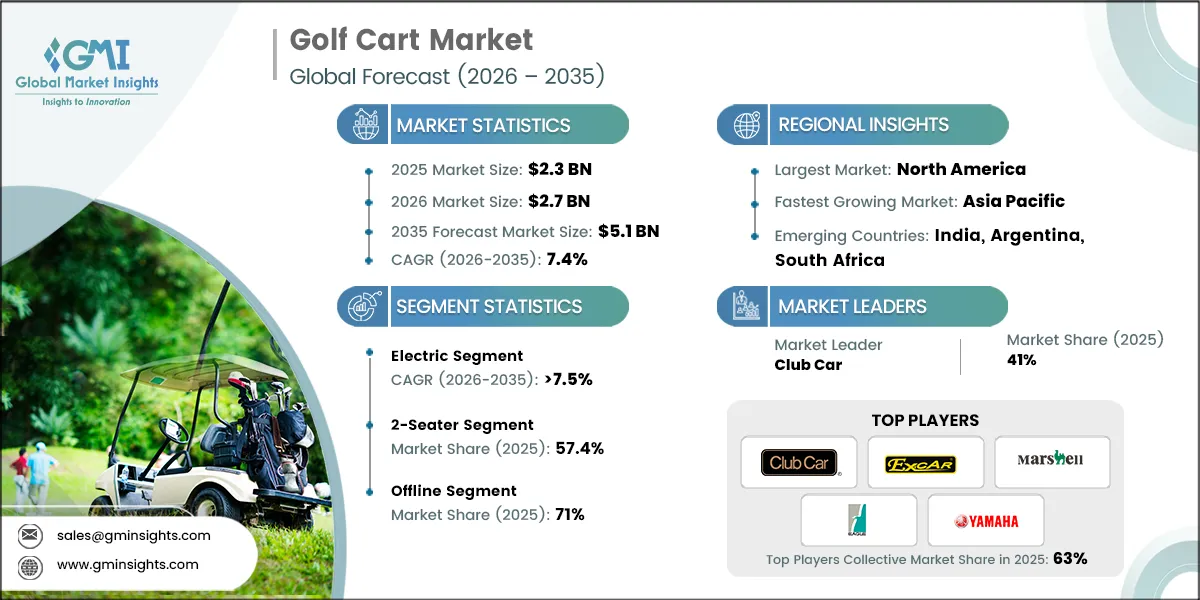
To get key market trends
Golf Cart Market Trends
The gradual increase in golf tourism and recreational sports taking has sustained a demand for golf carts all over the world. The investments in new golf courses, renovation of the old ones, and international tournaments increase the procurement of fleet. The resorts and country clubs upgrade carts on a regular basis to improve the experience of players with regular replacement cycles and facilitate long term market growth in the established and the developing regions.
Developments in the technology of lithium- ion batteries and rapid electrification are driving the use of electric golf carts. Better power density, quicker charge, less maintenance, and extended battery duration considerably reduce overall cost of ownership. Modernization of fleets in the world is generating more and more electric models rather than gasoline-powered carts as sustainability objectives become more aggressive and emission requirements are more stringent.
Non-golf usage is growing in master-planned communities, retirement communities and gated residential complexes. The use of golf carts in transporting people over short distances within the community premises has led to high demand for everyday mobility among the residents. The infrastructure is being developed to accommodate low-speed vehicles, turning golf carts into the active component of the community transport system and triggering the regular sales figures.
Golf carts are becoming utility vehicles due to the increase in commercial and institutional uses. They are used in airports, industrial parks, warehouses, hospitals, and university campuses to move people, as well as transport light cargo. Their small size and low operation expense provided with their maneuverability make them a viable alternative to larger vehicles, with the resultant expansion of the market that can be addressed.
GPS tracking, telematics, fleet management software and digital dashboards are all areas of technological integration that are increasing operational efficiency and user experience. Monitors allow the fleet operators to track performance, route optimization as well as controlling maintenance schedules. Such intelligent features enhance the value perception, promote high-end upgrade and attract business consumers who are interested in connected mobility solutions.
Accessibility is getting enhanced by flexible financing, leasing and rental models for businesses and individual consumers. Golf courses, resorts and event planners are looking more as leasing as a method to minimize startup capital spending. Shared mobility and subscription are also becoming a reality which increases the utilization rates and provides manufacturers and dealers with recurrent revenue streams, contributing to the long-term market expansion.
Golf Cart Market Analysis
Learn more about the key segments shaping this market
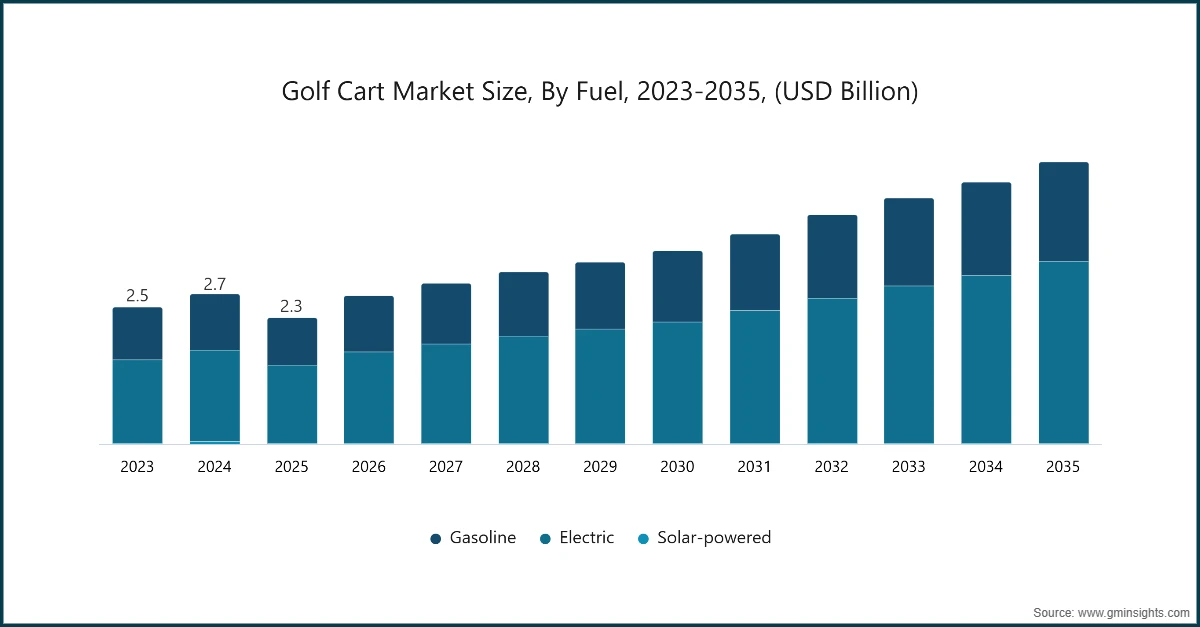
Based on fuel, the golf carts market is divided into gasoline, electric, and solar-powered. The electric segment dominated around 62% imarket share in 2025 and is expected to grow at a CAGR of over 7.5% from 2026 to 2035.
- The electric golf cart is being adopted in large numbers due to the increasing shift of zero-emission mobility. Governments and individual operators are focusing on the environmentally friendly means of transport as a way of mitigating the carbon footprints in golf courses, resorts as well as gated communities. Upon the release of the carts, tailpipe emissions and noise pollution are eradicated as well, which meets the sustainability efforts and green certification programs, thus enhancing the long-term demand.
- Lithium-ion battery technology is also advancing which enhances the performance and reliability of the electric golf carts. A more energetic density, quicker charging, weighing less, and prolonged battery life improve efficiency in operations, and lower the rate of maintenance. These enhancements promote the reduction of total cost of ownership against the conventional lead-acid systems making the fleet operators upgrade to current electric models.
- The increased volatility in the fuel prices is driving the development of the shift to electric powered carts as opposed to the use of gasoline. Electric models are cost-effective and have predictable operating costs and reduced energy costs, which have made them appealing to golf courses and commercial establishments operating huge fleets. Less reliance on fossil fuels enhances greater budget stability and promotes broader electrification in recreational and institutional uses.
- Increased requirements of smooth and noiseless movement are fortifying the electric cart infiltration. Electric motors offer virtually no noise and virtually no vibration that makes it better to use in golf courses, resorts, hospitals and residential sections. This is a better ride quality that enhances customer experience and will aid in premium positioning of the electric models as opposed to the traditional gasoline variations.
- The electric golf cart is also increasing with the integration of smart technology and connected systems. Digital dashboards, telematics, regenerative braking, and sophisticated battery management systems are easier to be installed on electric platforms. They allow improved fleet tracking, predictive maintenance, and optimization of charging cycles, making them more efficient and attractive to commercial purchasers of solutions based on data to ensure their mobility.
Learn more about the key segments shaping this market
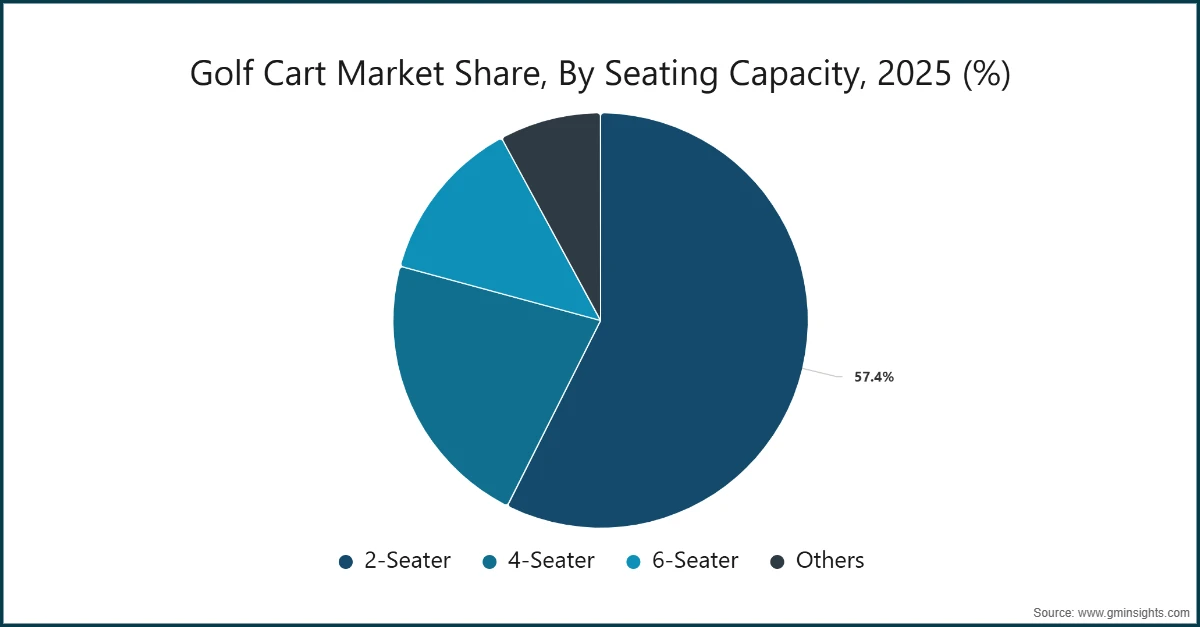
Based on seating capacity, the golf carts market is segmented into 2-seater, 4-seater, 6-seater, and others. The 2-seater dominate the market with 57.4% share in 2025 and is expected to grow at a CAGR of over 7.5% from 2026 to 2035.
- The small size and handling capabilities bring 2-seater golf carts to high levels of applicability in the traditional golf course playing. They are very light in construction, which lowers the damage to turf and enhances energy efficiency, thus being cost-efficient to operators who have to operate many units. Golf courses like 2-seater models of individual players or pairs, which are available worldwide, demand continuous replacement and procurement.
- The high demand of 2-seaters is due to the low cost incurred in acquiring and maintaining the 2-seaters as opposed to bigger capacity models. Smaller battery packs, generalized configurations and less use of materials help in low pricing. This gives them appeal to low end consumer markets, smaller golf clubs and emerging markets where prices are a major purchase consideration.
- The 2-seater sales are supported by the increasing demand in residential communities and retirement villages. People and couples are fond of compact vehicles in the short distance traveling inside gated communities. The ease of parking, easy handling and low costs of operation make 2-seater carts useful everyday solutions of mobility within controlled community settings.
- The 2-seater models are enjoying growth in the trend of personal ownership. In contrast to the fleet-based multi-seaters, 2-seaters attract the individual customer base aiming to have leisure mobility or move their property. They can be customized, made more aesthetically pleasing and lithium-ion can be added to increase their attractiveness to the lifestyle customers, boosting the units sales in developed markets.
- Opportunistic demands in 2-seater are due to increased commercial security and facility management systems. Compact carts are used by security staff, maintenance crew and park staff when performing patrol and inspection duties. Their maneuverability in small areas and low costs of operation enhance their deployment in campuses, industrial parks and event facilities.
- Transportability and storage facilitation enhances the growth of the 2-seater segment. Small sizes will enable easy trailering and less storage space. This is advantageous to event organizers, rental firms and seasonal operators that require mobile and easy to move transport option which has solidified consistent market growth.
Based on sales channel, the market is segmented online and offline. The offline segment dominated 71% revenue share in 2025.
- The domination of offline sales in the golf cart market is as a result of strong dealer networks and physical showrooms. Consumers would like to evaluate the product physically, to test drive and tailor consultations prior to making the purchase. Practical demonstrations enhance consumer confidence, especially to commercial fleet purchasers with large scale investments.
- Post sales support and services are very powerful contribution to offline channels. Registered dealerships will offer warranty and spare parts as well as repair services, which will be reliable in the long run. This network of localized services generates customer loyalty and repeat buying behavior particularly in case of golf courses and commercial operators.
- Fleet buyers prefer offline buying because of the benefits that come with negotiation on a personal basis and bulk buying. Direct interaction with distributors allows customized financing packages, leasing services and fleet management packages. This personalized form of selling promotes trust and facilitates big institutional buying.
- Different and multifaceted products structures and customization need facilitate offline channel development. The purchase clients tend to demand particular sitting arrangements, type of batteries, branding or accessories, and these aspects can be better discussed in dealership consultations. Physical touch provides specifications to be clear and eliminates dissatisfaction by the end user.
- Repeat offline sales are made by trade-in programs and upgraded programs that are offered in dealerships. Customers who are upgrading their old lead-acid models to lithium-ion ones tend to use exchange programs run by dealers. Planned upgrade routes encourage continuous demand of replacement in the offline ecosystem.
- The distribution through regional dealers increases penetration in the suburban and rural settings where the use of digital sales is still low. The availability is guaranteed by a developed network of dealerships in North America and Europe, which solidifies offline communication as the main source of income in the golf cart market.
Based on application, the market is divided into golf course, hotels and resorts, airports, housing projects, and others. Golf course dominates with 52% market share in 2025.
- Demand of golf carts is directly caused by the global growth and redevelopment of golf courses. The modernization projects in developed markets as well as the new course development in Asia Pacific demand the upgraded fleets. Courses are regularly changed so that the old carts are changed to keep the quality-of-service constant and the procurement cycles foreseeable.
- There is a growing trend of people getting involved in golf as a leisure and networking activity which helps in increasing the utilization of the fleet. Memberships, corporate tournaments and golf travel associated with tourism increases the demand of quality and comfortable carts which enhances the procurement quantities of the clubs and resorts.
- Electrification plans of the fleets in the golf courses hastens the demand of replacement. The operators want to minimize emissions, noise and fuel consumption by switching to electric carts. Implementation of new electric fleets is also supported by sustainability commitments and green certification programs.
- Premiumization of player experience is also pushing golf courses to invest in new carts with GPS capabilities, electronic scorecards and USB charging. Enhanced carts using technology make gameplay convenient and course competitive, provoking the purchase of more valuable items.
- Golf tourism and destination resort growth demands more fleet. Big resorts that organize international tournaments need huge cart inventories of players, caddies and employees. Peak demand is also seasonal in nature, and this prompts further procurement to meet the uninterrupted service.
- Wear and tear resultant of the daily use of the same items makes it certain that the replacement of the same can happen within golf courses. The intensive operation demands maintenance and periodical fleet replacement, which forms a consistent recurrent demand that locks the entire golf cart market in the entire world.
Looking for region specific data?
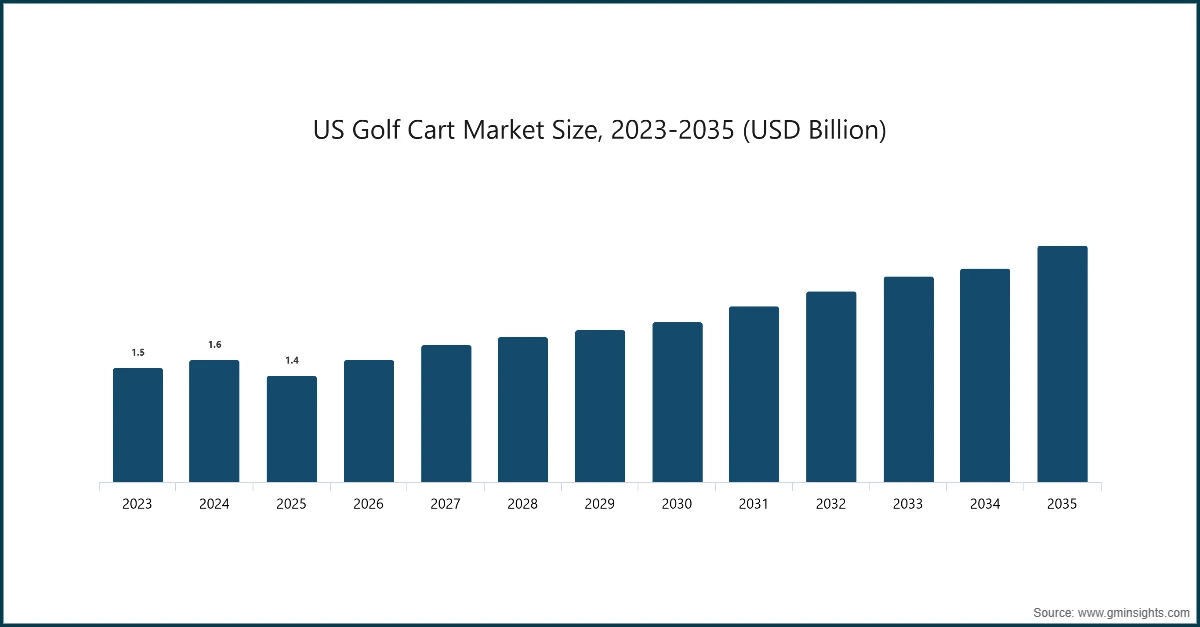
US dominated the golf cart market in North America with around 87% share and generated USD 1.4 billion in revenue in 2025.
- US enjoys the advantage of one of the largest links of golf courses in the world and this gives sustained fleet demand. High levels of participation in golf between the various age groups mean that there is a constant level in procurement and replacement. The existing country clubs and courses are being continually transformed into electric and lithium-ion versions, which is ensuring the long-term increase in revenues among the manufacturers.
- Large numbers of golf carts purchased in gated communities and retirement villages are a major demand. Golf carts are legal in most states of the United States to use on short routes on the road within the specified areas. This regulatory assistance expands usage not only to the golf industry, but also to personal ownership and mobility applications of people in the neighborhood.
- The premium and customized golf carts will sell with high consumer purchasing power. Customers often choose enhanced seating, infotainment and lithium-ion batteries. Such an attraction in value-added features raises the average selling prices and profitability in the US market.
- Powerful existence of major producers and wide dealer networks increases the accessibility and after sales. The distribution channels that have been established promote re-buys and fleet upgrades which are aimed at strengthening the country’s leading position in the global golf cart market.
- The increasing focus on sustainability and reduction of emissions is the force behind the electrification of golf cart fleets. Gasoline carts are being phased out by courses and communities, which is changing them to electric versions to comply with environmental regulations and lower their operating expenses.
- Market growth is also supported by the expansion of commercial applications in airports, large campuses and industrial parks. Businesses also use golf carts in the internal mobility and logistics, and its popularity is increased in internal use and logistics, not just in fun activities.
The Germany golf cart market reached over USD 52 million in 2025. Germany’s focus on sustainable mobility solutions drives demand for electric golf carts. Strict environmental regulations and strong EV adoption culture encourage golf courses and resorts to shift toward zero-emission models, supporting steady electric cart sales.
- Increased fleet growth is being driven by growth in golf tourism and development of high-end resorts in regions like Bavaria. The best golf facilities always invest in technologically advanced electric carts to enhance customer satisfaction, increase the efficiency of the operations and to retain the position within the competitive market. The regular upgrade and modernization projects enhance the regular procurement and expansion strategies and secure the sustainable growth of the market in Germany in the long run.
- High quality engineering and need of durable goods with high performance inclination has preference towards high standards of electric golf carts with advanced lithium-ion battery systems. German buyers are efficiency-driven, reliable, and long-service life promotion, which promotes the demand of technologically better models. The emphasis on quality rather than low-cost options reinforces more premium sales and consistent growth of revenues.
- The increase in the use of golf carts in industrial plants, logistics parks, and other large manufacturing complexes is increasing the market that can be addressed. Internal transportation is also becoming heavily reliant on compact electric vehicles because they are maneuverable and do not cause a lot of emissions. This coincides with the high level of industrial infrastructure and sustainability-oriented operation strategy in Germany.
- The government subsidies that will be provided to electric mobility and the use of renewable energy indirectly drive the demand of electric golf carts. Investments in the charging infrastructure and corporate sustainability initiatives promote the shift of facilities and resorts to zero-emission fleets. Clean transportation policies promote the trends of electrification of the golf cart market on the long-term basis.
- The population tends to grow older, and the retirement communities are also growing, which triggers the demand of a convenient short-range mobility solution. Golf carts which are electrically powered make the transportation in restricted residential areas to be safe and easy to operate. They are viable alternatives to the elderly residents owing to their accessibility, low noise, and low operating costs, which give them consistent growth with regard to domestic demand.
The golf cart market in Japan is projected to grow at a strong CAGR of 11% from 2026 to 2035. Japan’s aging population drives demand for compact and easy-to-operate mobility solutions. Golf carts are increasingly used in golf courses and retirement communities, providing convenient transportation for elderly users and supporting consistent sales growth.
- The golf participation rates and good condition golf facilities contribute to the consistent replacement measures in the country. In Japan, golf courses often change their fleets to technologically advanced electric ones that are more efficient in their operations and comfort players. Ongoing modernization guarantees sustainable procurement and guarantees the stable market growth.
- The electric golf carts are innovative as a result of the intensive electric vehicle ecosystem and battery technology industry in Japan. Lithium-ion systems are better with domestic expertise to enhance performance, reliability, and energy efficiency. This is a technological advantage that enhances competitiveness of products and speeds up the next-generation electric model adoption.
- Small electric cars are very practical due to limited land and space infrastructure. The maneuverability of golf carts, quiet mode of operation and space efficiency are very convenient to the densely populated urban and resort setting in Japan. Their applicability to controlled areas allows the expansion of the use beyond the conventional golf use.
- The rising tourism and resorts in resorts like Okinawa are a force that is driving fleet growth. The resorts are using dependable electric carts to carry guests through huge areas. Constant investment in tourism enhances procuring opportunities in the long term.
- The focus on automation and intelligent technologies promotes the development of GPS tracking, digital dashboards, and fleet management systems in golf carts. The Japanese institutions focus on precision and efficiency of the operation, which turns to the adoption of technologically advanced electric models.
- A graying population also creates an impetus towards the demand of easy mobility within the golf courses and retirement community. Electric carts are convenient and low effort means of transportation, which helps to increase accessibility and guarantees steady growth of a domestic demand.
The golf cart market in Mexico reached significant scale in 2025. Rapid expansion of golf tourism and luxury resort development in coastal regions such as Cancun and Los Cabos drives fleet demand. Resorts require large inventories of golf carts for guest transportation and golf course operations.
- Residential areas and gated communities are growing to fuel ever-increasing mobility requirements. Golf carts are common in the short-range movement that is very convenient in the context of the exclusive neighborhoods. They are often cost effective and convenient, thus being used in the controlled setting as a means of transport, and as such, they have contributed to consistent demand increase.
- The increase in foreign investment in the tourism infrastructure is stimulating new construction and upgrading of golf courses. The upgraded electric fleets in the resorts and leisure facilities are necessary to comply with the international standards of service, and the steady purchase can be generated in the major tourist sites.
- Raising awareness about sustainable tourism practices is making the resorts embrace electric golf carts. The elimination of emissions and the reduced sound levels are in accordance with the environmental objectives; the facilities will save money on their operations and increase their sustainability reputation.
- The presence of affordable models based on electricity by local manufacturers increases the accessibility of the mid-sized operator and municipalities. Competitive prices will help in broadening the application in tourism, residential, and institutional applications, and this will enhance the overall penetration of the market.
- The development of commercial use in industrial parks, warehouses and event spaces increases non-leisure use. Companies will use electric carts as their internal transportation, as well as for small-scale transportation, to facilitate the extensive and diversified growth in demand.
- Urban infrastructure enhancement and further development projects in tourism are other areas that enhance the procurement possibilities even more. Due to the increase in hospitality and leisure investments, electric golf carts have continued to be among the necessary internal transportation solutions.
The golf cart market in South Africa is projected to grow at a CAGR 8% from 2026 to 2035. South Africa’s strong golf culture and numerous scenic golf courses support consistent fleet demand. Golf tourism, including international tournaments, increases utilization and replacement cycles.
- Growth of safari lodges, resorts and eco-tourism destinations is increasing the demand of electric golf carts. Also, the silence, zero-emission of operation suits conservation and sustainability of wildlife, and the electric models are especially applicable to environmentally sensitive regions.
- Expansion of gated communities and retirement resorts leads to more people using golf carts to get around in residential areas. Safe communities prefer small electric cars to have a free and affordable movement around personal grounds.
- The increased attention to renewable energy and the integration of solar energy promotes the use of electric carts batteries to charge them, especially in isolated resorts and lodges. Charging with solar energy contributes to the efficiency of operation and helps minimize the dependence on the unpredictable grid infrastructure.
- High demand among large campuses, mining and industrial sites also help in diversification. Internal transportation and logistics utility-ascent electric carts are used to increase the market opportunities beyond recreational market segments.
- Development and modernization of the tourism infrastructure and hospitality in terms of procurement of modern electric fleets is enhanced. Newer facilities need a good mobile solution to improve customer satisfaction and keep international service quality.
- There is also increasing demand on sustainable transport solutions which also promotes adoption. Increasing environmental awareness makes the use of electric golf carts the choice of mobility in the tourism, residential, and commercial markets.
Golf Cart Market Share
- The top 7 companies in the golf cart industry are Yamaha, Club Car, Marshell Green, Suzhou Eagle, Dongguan Excar, LANGQING, and Aoxiang, contributing around 64% of the market in 2024.
- In a bid to stay competitive in the business, Yamaha has engaged in constant innovations in its electric and gasoline powered golf carts in terms of durability, fuel efficiency and superior engineering. The firm utilizes the high-quality dealer network across the world and its brand name to win repeat business contracts. Investments into lithium-ion battery integration and more comfortable ride assist Yamaha to maintain the premium position in the golf, residential, and commercial markets.
- Club Car shares its lithium-ion battery and fleet management connected with technologies as a way to firm up its market standing. The company focuses on customization, digital integration, and the high-quality construction of the buildings to provide services to golf courses and commercial operators. The high number of distribution channels and after sales service potential allows it to have a long-term relationship with customers and the potential to generate repeat demand when it comes to fleet replacement.
- Cost effective production and extensive export base are some of the competitive advantages that Marshell Green has. The company provides competitively priced electric golf carts to suit the emerging markets and buyers who are sensitive to price. It is flexible product customization and scalable production capacity that enable Marshell to comply with the regional needs and sustain high international growth in distribution.
- Suzhou Eagle is a company that is competitive due to the emphasis on high volume production and OEM relationships. It has a vertically integrated manufacturing system that helps it to control costs and maintain uniform quality of its products. The ability to provide electric golf carts and utility vehicles to international distributors helps the company to enhance its international presence and dominate the demand in leisure and commercial environments.
- Dongguan Excar also has its own manufacturing of components and high level of customization. The firm focuses on the flexibility of designs, strong electric motors, and affordable prices to lure the tourism hotels and residential projects. Diversifying to international distribution is also a strategy that promotes its potential to increase its market penetration across the globe.
- LANGQING is competitive as it offers a variety of electric vehicles and constantly develops the products. The firm invests in the efficiency of battery and flexible settings to accommodate the golf courses, resorts, and industrial customers. High export orientation and low-cost production make LANGQING be able to seize the opening in the developing regions.
- Aoxiang will compete based on low-price electric golf carts that have functional designs that can be used in tourism and community transportation. The focus on efficient production, local distribution associations, and agile personalization enables the organization to grow in the markets without negative effects on prices and constant export increases.
Golf Cart Market Companies
Major players operating in the golf cart industry include:
- Aoxiang
- Club Car
- Columbia
- Cushman
- Dongguan Excar
- E-Z-GO
- LANGQING
- Marshell Green
- Suzhou Eagle
- Yamaha
- Golf carts are moderately concentrated with well-established brands like Yamaha and Club car operating in the market at the expense of technological advancement, effective dealer chains and high product placement. These firms emphasize the integration of the lithium-ion battery, integrated fleet management that is connected, and customization features to make their products stand out. The association with golf courses, resorts, and residential developers will be strategic to guarantee the recurrent fleet contracts, whereas the ongoing product improvement will provide the brand loyalty and the increased average selling price.
- Meanwhile, the regional and new manufacturers like Marshell Green, Suzhou Eagle, and Dongguan Excar increase competition by means of cost-effective production and active export policy. Competitive pricing, flexible configurations and scalable production are the main points of these players to capture the demand in the emerging markets. The industry is also influenced by the trend of electrification, the opportunities of after sales services, and the penetration into the commercial exploitation where the companies are forced to strike a balance between cost, innovation and international distribution network.
Golf Cart Market Report Attributes
| Key Takeaway | Details |
|---|---|
| Market Size & Growth | |
| Base Year | 2025 |
| Market Size in 2025 | USD 2.3 Billion |
| Market Size in 2026 | USD 2.7 Billion |
| Forecast Period 2026-2035 CAGR | 7.4% |
| Market Size in 2035 | USD 5.1 Billion |
| Key Market Trends | |
| Drivers | Impact |
| Expansion of gated communities and smart townships | Increasing use of golf carts for short-distance transportation in residential areas boosts steady demand. |
| Growth in golf tourism and leisure activities | Rising participation in golf and resort tourism increases fleet procurement by golf courses and hospitality operators. |
| Electrification and lithium-ion battery adoption | Shift from lead-acid to lithium-ion batteries improves efficiency, lifespan, and reduces maintenance costs. |
| Increasing use in commercial & institutional facilities | Airports, campuses, industrial parks, and warehouses adopt golf carts for internal mobility and logistics. |
| Customization and connected vehicle features | Integration of GPS tracking, fleet management software, and premium customization enhances user experience and fleet efficiency. |
| Pitfalls & Challenges | Impact |
| High upfront cost of lithium-ion models | Advanced battery systems increase purchase prices, limiting adoption in price-sensitive regions. |
| Regulatory restrictions on low-speed vehicles | Compliance with regional LSV regulations increases certification and design costs. |
| Battery disposal and environmental concerns | Lead-acid battery disposal challenges affect sustainability perception. |
| Competition from alternative micro-mobility solutions | E-bikes, small EVs, and neighborhood electric vehicles pose substitution threats. |
| Opportunities: | Impact |
| Expansion in Asia Pacific tourism sector | Growing resorts, golf infrastructure, and urban development projects drive strong regional demand. |
| Growth of electric utility vehicles | Demand from logistics, last-mile delivery, and municipal services opens new revenue streams. |
| Fleet leasing and rental models | Subscription and leasing services increase recurring revenue and market penetration. |
| Technological advancements in battery management | Improved charging speed and battery durability enhance total cost of ownership attractiveness. |
| Market Leaders (2025) | |
| Market Leader |
41% market share |
| Top Players |
Collective Market Share in 2025 is 63% |
| Competitive Edge |
|
| Regional Insights | |
| Largest Market | North America |
| Fastest growing market | Asia Pacific |
| Emerging countries | India, Argentina, South Africa |
| Future outlook |
|
What are the growth opportunities in this market?
Golf Cart Industry News
- In January 2026, Samara Land Transportation declared the start of a project of the production of electric golf cart assembly in Saudi Arabia within a brand-new joint venture with Raya Holding. The project will put together a strong leadership capability and a deep market penetration by Samara in the Kingdom and manufacturing/ mobility capability of Raya Holding via its mobility division and portfolio company, Raya Auto.
- In November 2025, Kinetic Green Tonino Lamborghini (KGTL), has signed Surge Systems Pvt Ltd as the Indian representative of its electric luxury golf and lifestyle carts. The joint venture will combine luxury electric cars of KGDL and the proven market of Surge Systems which makes its contribution to the market development of professional turf maintenance. Surge Systems is the current partner of Toro, which is the international manufacturer of turf care equipment, and which has business relations with the golf courses, sports centers, resorts, and high-end landscapes in the North and Eastern regions of India.
- In July 2025, Kinetic Green Energy and Power Solutions and Tonino Lamborghini SpA in Italy has established a joint venture company to produce electric golf carts that can be sold locally and the rest in other countries. The cars will be produced in India and sold in the world under the brand-name Tonino Lamborghini, but their design is Italian.
- In November 2024, Massimo Group stated that its new MVR Series electric carts were now available, consisting of the MVR 2X Golf Cart and the MVR Cargo Max Utility Cart. These electric vehicles are high-speed vehicles customized to satisfy the whole growing demand on the low-speed electric vehicle (LSV) that provide flexibility in both leisure and work mode.
The golf cart market research report includes in-depth coverage of the industry with estimates & forecasts in terms of revenue ($ Mn/Bn) and shipment (Units) from 2022 to 2035, for the following segments:
Market, By Fuel
- Gasoline
- Electric
- Solar-powered
Market, By Application
- Golf Course
- Hotels and Resorts
- Airports
- Housing Projects
- Others
Market, By Sales Channel
- Online
- Offline
Market, By Seating Capacity
- 2-Seater
- 4-Seater
- 6-Seater
- Others
The above information is provided for the following regions and countries:
- North America
- US
- Canada
- Europe
- UK
- Germany
- France
- Italy
- Spain
- Poland
- Netherlands
- Belgium
- Asia Pacific
- China
- India
- Japan
- South Korea
- Southeast Asia
- ANZ
- Latin America
- Brazil
- Mexico
- Argentina
- MEA
- UAE
- South Africa
- Saudi Arabia
Frequently Asked Question(FAQ) :
What is the market size of the golf cart in 2025?
The global golf cart market was estimated at USD 2.3 billion in 2025, with a CAGR of 7.4% expected through 2035, driven by expanding gated communities, electrification trends, and increasing commercial and institutional applications.
What is the projected value of the golf cart market by 2035?
The golf cart market is expected to reach USD 5.1 billion by 2035, propelled by widespread adoption of lithium-ion battery technology, integration of smart fleet management systems, and expanding use beyond golf courses into airports, campuses, and residential communities.
What is the current golf cart market size in 2026?
The market size is projected to reach USD 2.7 billion in 2026.
What was the market share of the electric segment in 2025?
The electric segment dominated the golf cart market, accounting for approximately 62% in 2025, driven by lithium-ion battery advancements, rising fuel costs, and increasing sustainability commitments among golf courses and commercial operators.
Which application segment leads the golf cart market?
The golf course segment leads with a 52% market share in 2025, driven by continuous fleet modernization, growing golf tourism, electrification initiatives, and demand for premium technology-enhanced carts with GPS and digital scorecard features.
What was the market share of the offline sales channel in 2025?
The offline segment dominated the golf cart market with a 71% share in 2025, as buyers prefer physical product evaluations, test drives, personalized consultations, and access to localized after-sales service and warranty support through established dealer networks.
Which region leads golf cart market?
The US dominated the North America golf cart market with approximately 87% share, generating USD 1.4 billion in revenue in 2025, supported by strong consumer purchasing power, and widespread use in gated communities and retirement villages.
What are the upcoming trends in the golf cart market?
Key trends include accelerating electrification with lithium-ion battery adoption, integration of GPS tracking and telematics for fleet management.
Who are the key players in the golf cart market?
Key players include Aoxiang, Club Car, Columbia, Cushman, Dongguan Excar, E-Z-GO, LANGQING, Marshell Green, Suzhou Eagle, and Yamaha.
Golf Cart Market Scope
Related Reports