Summary
Table of Content

Biphenyl Market
Get a free sample of this report
Form submitted successfully!
Error submitting form. Please try again.
Thank you!
Your inquiry has been received. Our team will reach out to you with the required details via email. To ensure that you don't miss their response, kindly remember to check your spam folder as well!
Request Sectional Data
Thank you!
Your inquiry has been received. Our team will reach out to you with the required details via email. To ensure that you don't miss their response, kindly remember to check your spam folder as well!
Form submitted successfully!
Error submitting form. Please try again.
Biphenyl Market Size
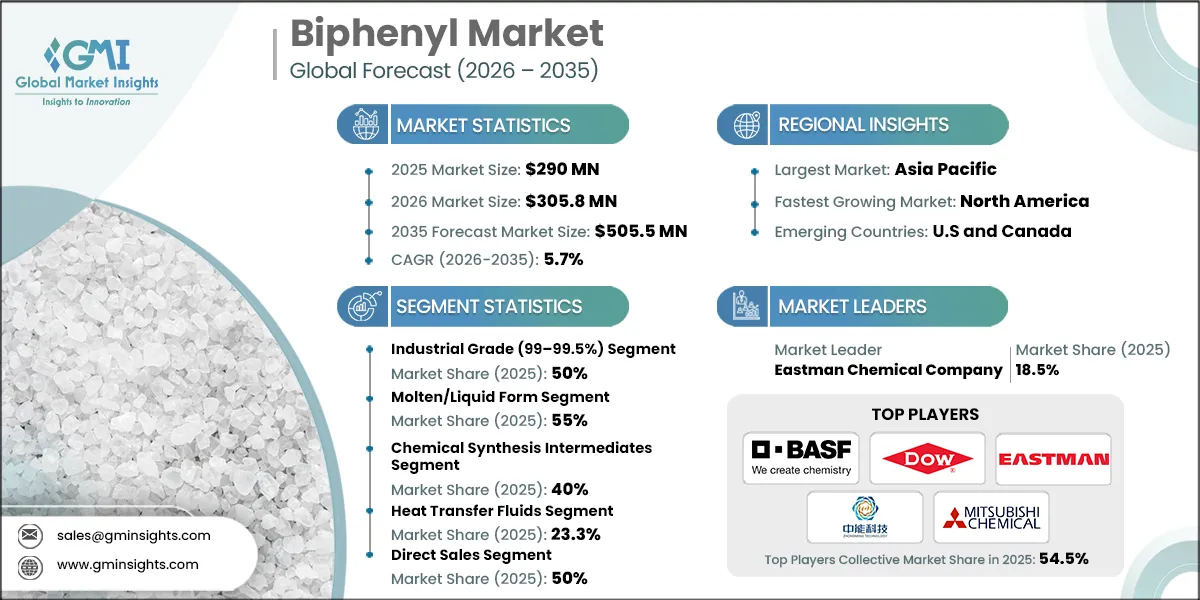
The global biphenyl market was valued at USD 290 million in 2025. The market is expected to grow from USD 305.8 million in 2026 to USD 505.5 million in 2035, at a CAGR of 5.7% according to latest report published by Global Market Insights Inc.
Biphenyl Market Key Takeaways
Market Size & Growth
- 2025 Market Size: USD 290 Million
- 2026 Market Size: USD 305.8 Million
- 2035 Forecast Market Size: USD 505.5 Million
- CAGR (2026–2035): 5.7%
Regional Dominance
- Largest Market: Asia Pacific
- Fastest Growing Region: North America
Key Market Drivers
- Rising pharmaceutical API production driving demand for ultra-high-purity biphenyl intermediates.
- Growing adoption of biphenyl-based heat transfer fluids across industrial thermal management systems.
- Expanding high-performance polymer usage in aerospace, electronics, and advanced engineering plastics.
Challenges
- Stringent environmental regulations and PCB contamination concerns limiting production flexibility and approvals.
- Volatile benzene feedstock pricing impacting production economics and long-term pricing stability.
- Increasing competition from alternative heat transfer fluids and substitute chemical synthesis pathways.
Opportunity
- Commercialization of bio-based and green-chemistry biphenyl production technologies.
- Rapid expansion of electronics manufacturing requiring ultra-pure biphenyl for OLED and semiconductor applications.
- Untapped demand in emerging Asia Pacific and Latin American industrializing economies.
Key Players
- Market Leader: Eastman Chemical Company led with over 18.5% market share in 2025.
- Leading Players: Top 5 players in this market include BASF SE, Dow Inc., Eastman Chemical Company, Jiangsu Zhongneng Chemical Technology Co., Ltd., Mitsubishi Chemical Corporation, which collectively held a market share of 54.5% in 2025.
Get Market Insights & Growth Opportunities
- The global market is seeing an increase in purity and regulatory requirements across many industries worldwide.
- Industrial grade biphenyl is the dominant purity grade in the market with nearly 50% of the total biphenyl market share in 2025. Industrial grade biphenyl is widely used in various applications, specifically in the manufacture of chemicals such as polymers, heat transfer fluids, and chemical intermediates. The Pharmaceutical Grade biphenyl segment is projected to be the fastest growing segment, with a CAGR of 7.3%.
- In terms of Physical Form, Molten/Liquid Biphenyl is currently the largest segment with approximately 55% of total market share by 2025. The molten/liquid biphenyl segment is expected to see steady growth, of approximately 6% CAGR.
- By Application, Chemical synthesis intermediates dominate with a 40% share in 2025, growing from USD 116 million to USD 227 million by 2035, driven by pharmaceutical, agrochemical, and polymer intermediates demand. Heat transfer agents hold around 35% market share, growing modestly, while specialty applications account for 25% but decline over time due to substitution by advanced chemicals. This shift reflects increasing focus on value-added chemical synthesis, purity, and regulatory compliance, driving supplier innovation and customized products to capture higher profit margins globally.
- Asia Pacific leads with a 47.5% market share in 2025, expanding at a 7.6% CAGR, fueled by rapid industrialization, electronics manufacturing, and export capacity. North America and Europe remain mature, compliance-driven markets emphasizing quality and sustainability. Latin America is emerging but constrained by infrastructure and investment uncertainties. The Middle East and Africa face structural hurdles from limited downstream manufacturing, import dependency, and fragmented regulations, limiting near-term growth despite potential in select industrial hubs.
To get key market trends
Biphenyl Market Trends
- Ultra-pure biphenyl grades are gaining traction in both the pharmaceutical and electronics industries due to an increase in the regulatory oversight of these products from both the U.S FDA (food drug administration) and the European union. due to the increase in competition, manufacturers are investing heavily into the use of molecular distillation, advanced crystallization methods and real-time monitoring for quality assurance to ensure compliance to the growing number of regulations.
- The trend toward ultra-pureness has resulted in higher entry barriers, improved profitability for producers of ultra-pure biphenyls and most importantly, has provided an opportunity for producers of ultra-pure biphenyl grades to build a reputation through their ability to comply with government agencies regulations and produce ultra-pure products with quality control processes.
- Bio-based and electrochemical production methods are expected to dramatically reduce carbon footprints, waste generation and regulatory risk. as a result, companies who have developed these products will experience an increase in the ability to differentiate themselves through branding and premium pricing opportunities. over time, these production methods will supplement and change the way producers view their investment priorities and procurement decisions when dealing with the environmentally conscious end-user segment.
Biphenyl Market Analysis
Learn more about the key segments shaping this market
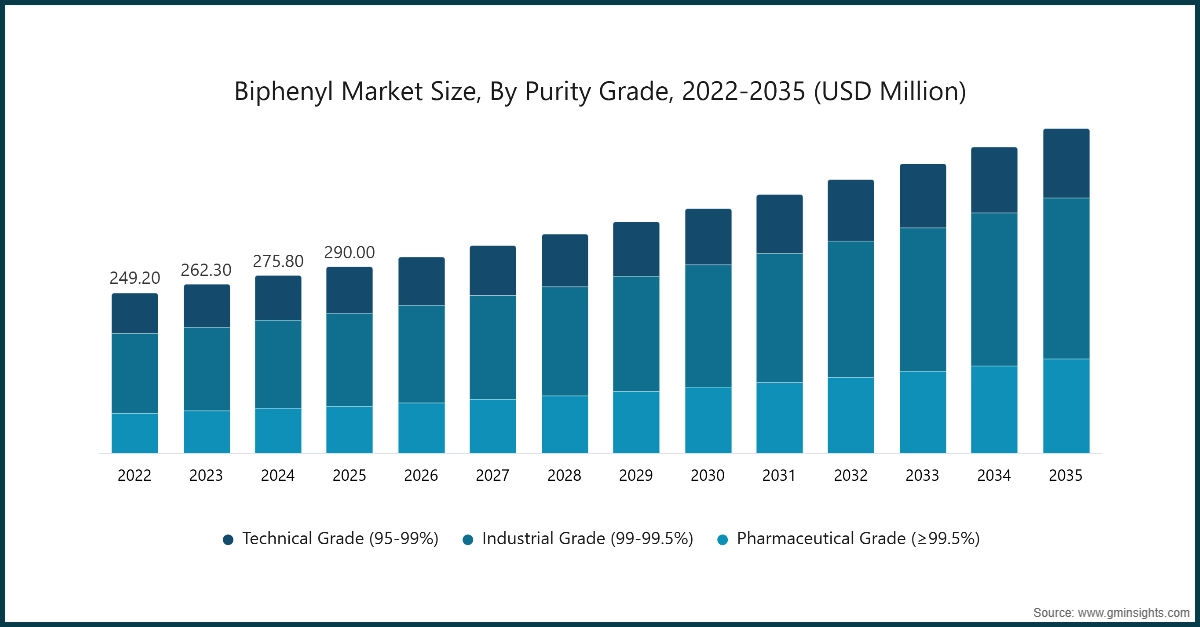
Based on purity grade, the biphenyl market is segmented into pharmaceutical grade (≥99.5%), industrial grade (99–99.5%), and technical grade (95–99%). Industrial grade dominated the market with an approximate share of 50% in 2025 and is projected to maintain its leadership through 2035, supported by broad usage across polymers, heat transfer fluids, and chemical synthesis applications.
- Industrial grade biphenyl remains the primary product driving global demand, as it provides the optimal balance of purity, price, and scalability. The value of industrial grade biphenyl is forecasted to increase from USD 145 million in 2025 to USD251.2 million in 2035, reflective of a CAGR of 5.7%.
- Pharmaceutical grade biphenyl is the most rapidly expanding segment of the market, showing an annual growth rate of 7.3%, with the share of the market growing from 25% in 2025 to 28.9% in 2035. The growth of pharmaceutical grade biphenyl is a result of increasing use in API synthesis, increasing regulatory compliance and growing high purity requirements.
- Technical grade biphenyl is experiencing moderate growth at a CAGR of 4.1%, and has a declining share of the market, primarily due to the substitution of lower grade, lower purity products with higher purity product in more sophisticated applications.
Learn more about the key segments shaping this market
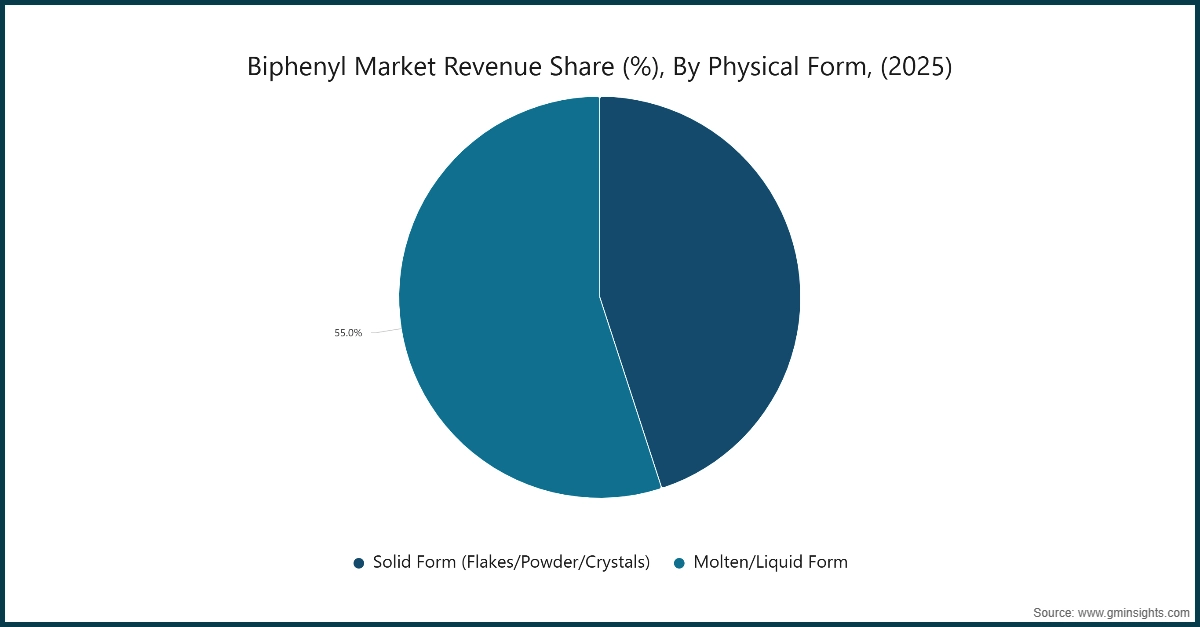
Based on physical form, the biphenyl market is segmented into solid form and molten/liquid form. Molten/liquid form dominated the market with an estimated 55% share in 2025, driven by its operational efficiency in continuous industrial processes and thermal systems.
- The liquid or molten version of biphenyl is expected to experience rapid growth over the next decade, with an estimated CAGR of 6% between 2025 and 2035, resulting in revenues of USD 286.1 million. This product type remains dominant within the market because of its extensive use in heat-transfer fluids, large-scale chemical reactors and in closed-loop thermal management systems.
- Solid biphenyl is anticipated to hold a 45% market share in 2025, supporting applications in pharmaceuticals, agrochemicals, and the synthesis of specialty chemicals through a reliable growing shipment on a CAGR of 5.4%, as a result of being easy to handle, provide for accurate dosing, and maintain stable storage conditions.
- As time progresses, it is anticipated that the market will gradually transition to liquid formats as industrial users become more focused on automating their processes, which require fewer handling losses and maximized efficiencies, while solid forms will remain relevant for specialty applications that are regulated or require small-batch production.
Based on application, the biphenyl market is segmented into chemical synthesis intermediate, heat transfer agent, and specialty applications. Chemical synthesis intermediates dominated the market with an approximate share of 40% in 2025 and are projected to expand steadily through 2035, supported by rising demand for pharmaceutical, agrochemical, and polymer intermediates.
- Chemical synthesis intermediates has been the largest growing section of the total market, with projected growth from USD 116 million in 2025 to USD 227 million in 2035 due to increased volumes of downstream chemical manufacturing, increased (API) production and increased demand for biphenyls and derivative products used to manufacture high-performance materials.
- Heat Transfer Agent applications will continue to account for 35% of the total market in 2025, and will continue to play an important part in the industrial thermal management systems as they grow. While growth will be modest at 5.3% CAGR, continued replacement demand and industrial capacity expansion will drive the overall consumption of heat transfer agents over the long term.
- Specialty application areas for example electronics, coatings and niche synthesis applications currently account for 25% of the overall market in 2025, but this will decrease over time to 21.4% by 2035 due to growth at a much lower rate at 4.1% CAGR and partial substitution with newer advanced specialty chemicals.
- The demand for respective applications is changing towards value-added chemical synthesis, which will lead to a greater focus on supplier purity, customized chemical products and regulatory compliance in order to gain greater profit margin opportunities in worldwide markets.
Based on end-use industry, the biphenyl market is segmented into pharmaceutical, agrochemical, polymer & plastics, electronics & electrical, heat transfer fluid, and other industries. The heat transfer fluid industry dominated the market in 2025 with a share of 23.3%, though its relative contribution declines steadily due to slower growth rates.
- The polymer and plastics industry is the fastest-growing end-use segment, expanding at a CAGR of 7.1% from USD 53.8 million in 2025 to USD 106.7 million by 2035. Growth is driven by increasing use of biphenyl-based compounds in high-performance polymers and engineering plastics.
- The pharmaceutical industry shows strong growth at a 6.7% CAGR, with market share rising from 20.3% in 2025 to 22.1% by 2035. Demand is supported by expanding API manufacturing and stringent purity requirements.
- Electronics and electrical applications register the highest CAGR at 7.4%, fueled by rising semiconductor, OLED, and advanced electronic material production, particularly in Asia pacific.
- Agrochemical demand grows steadily at a 6% CAGR, supported by sustained crop protection chemical production and formulation needs.
- Heat transfer fluid and other industries grow slowly at 3.4% and 3.2% CAGRs, respectively, resulting in declining market shares over time as higher-growth end-use sectors increasingly dominate total demand.
Based on distribution channel, the biphenyl market is segmented into direct sales, chemical distributors & wholesalers, and specialty chemical suppliers. Direct sales dominated the market with an approximate share of 50% in 2025 and continue to represent the primary procurement route for large-volume industrial and pharmaceutical customers.
- Direct sales continue to lead the channel segment with growth of USD 145 million in 2025 to USD 248.7 million by the end of 2035 at a CAGR of 5.6%. Strong end-user relationships, long-term contracts, guaranteed product quality, and regulatory traceability provide for a consistent preference by end-users.
- The distribution channel's importance in the chemical industry is reflected in the market share of chemical distributors and wholesalers; this channel's market share is estimated to grow from 35% in 2025 to 40% in 2035 at a CAGR of 5.9%. Chemical distributors provide essential services for smaller buyers, such as providing product availability, regional distribution, and additional logistical support, including repackaging and distribution optimization.
- Specialty chemical suppliers have approximately 15% of the market share in 2025; however, they will experience the fastest growth CAGR of 6%. The growth of this channel continues to be fueled by increased demand for high-purity, application-specific, and customized biphenyl grades.
Looking for region specific data?
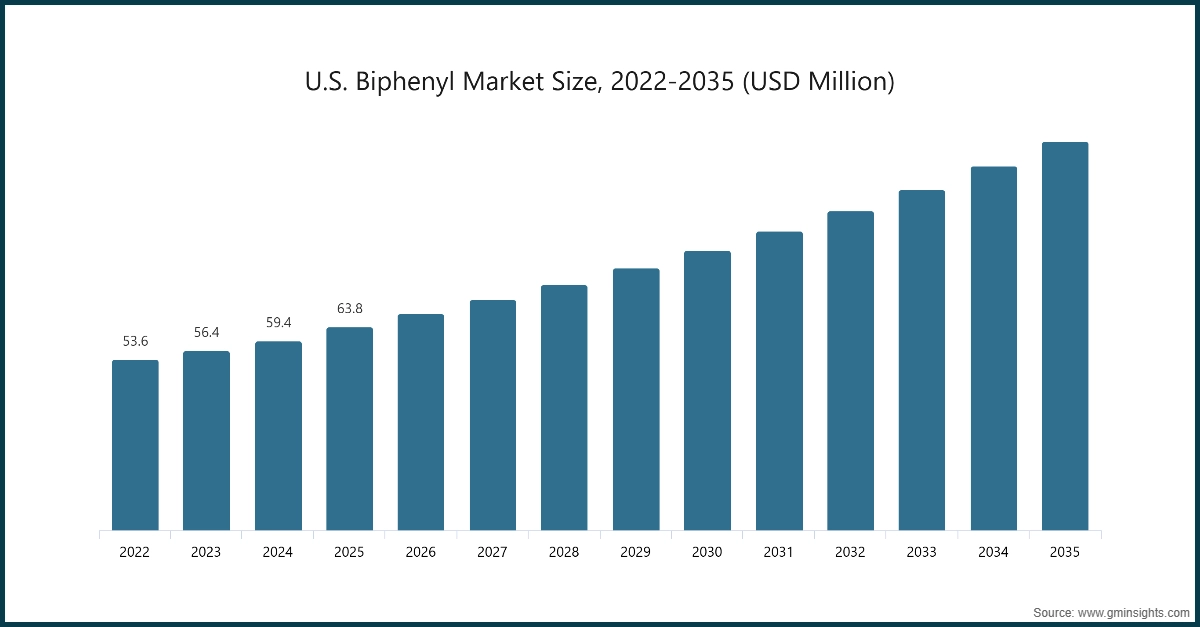
The North America biphenyl market is anticipated to grow at a CAGR of 6.7% during the analysis timeframe.
- The market in North America is mature and heavily regulated. The demand in North America is primarily based on pharmaceutical manufacturing, specialty chemicals and established applications for heat transfer fluids.
- The demand is relatively stable and is typically driven by compliance as well as incremental technological upgrades. Competitive positioning in North America is driven by innovation, sustainability initiatives and advanced purification capabilities.
The Europe biphenyl industry is growing rapidly on the global level with a market share of 20% in 2025.
- Europe is characterized by strong regulatory oversight (REACH compliance) and sustainability and traceability of products. The market continues to be driven by pharmaceutical, specialty chemical and advanced materials. However, due to limited industrial expansion and pressures from substitutes affecting the market, volume growth in Europe has been limited.
- Suppliers within the region prioritize enhancing their operational efficiencies and environmental compliance over volume growth through economies of scale.
Asia Pacific biphenyl market leads the industry with revenue of USD 137.8 million in 2025 and is anticipated to show lucrative growth over the forecast period.
- The Asia-Pacific region is the leading growth region within the global market. Rapid industrialization, expanded chemical manufacturing and a high demand for electronics, polymers and pharmaceuticals continue to drive strong levels of consumption.
- With expansion of production capacity in the Asia-Pacific region, cheap labor and a growing domestic market, there is a high level of investment in the region. Furthermore, due to favourable manufacturing ecosystems and increasing volume of exports and higher value products, Asia-Pacific has a competitive advantage over other global regions within the market.
Latin America biphenyl market accounted for 3% market share in 2025 and is anticipated to show highest growth over the forecast period.
- Latin America's market for biphenyl is emerging and developing. Demand for biphenyl is based on domestic production and is driven by application. The market has limited local production capacity; therefore, there are a high number of imports.
- The market development for biphenyl in Latin America is dependent upon the level of industrial investment, improvements to the infrastructure in Latin America, and the ability to expand the development of the chemical market in Latin America. The market for biphenyl in Latin America is moderately growing due to economic and regulatory uncertainty.
Middle East & Africa biphenyl accounted for 2% market share in 2025 and is anticipated to show lucrative growth over the forecast period.
- Due to structural changes in the biphenyl market that are being experiences in the Middle East and Africa, there are a number of challenges relating to this market. The Middle East and Africa have limited manufacturing capability for downstream chemicals and have a heavy reliance on imports of bp. Limited availability of palladium and petroleum further restricts the demand for biphenyl in both of these regions.
- Industrial diversity is also uneven, and the fragmentation of the regulatory structure makes it difficult to develop the market for biphenyl. Most of the major industrial hubs have the ability to further develop and advance the market for biphenyl while experiencing many limitations with regards to the low amount of applications that currently exist and the limited investment into developing value chains for specialty chemicals.
Biphenyl Market Share
The top 5 companies in biphenyl industry include BASF SE, Dow Inc., Eastman Chemical Company, Jiangsu Zhongneng Chemical Technology Co., Ltd., and Mitsubishi Chemical Corporation. These are prominent companies operating in their respective regions covering approximately 9% of the market share in 2025. These companies hold strong positions due to their extensive experience in market. Their diverse product portfolios, backed by robust production capabilities and distribution networks, enable them to meet the rising demand across various regions.
- BASF SE is a global chemical leader producing biphenyl intermediates and derivatives for pharmaceutical, agrochemical, and industrial applications. Its extensive portfolio, regulatory compliance expertise, and innovation in specialty chemicals position it as a key supplier. Strong global footprint, integrated value chain, and patent-backed technologies support sustained market relevance and quality leadership.
- Dow Inc. is a major U.S. chemical manufacturer known for its biphenyl-containing heat transfer fluid products, particularly within the DOWTHERM portfolio. The company serves industrial and energy sectors with engineered formulations. Dow’s technical capabilities, strong brand presence, and long-standing industry relationships underpin its strategic position in the global biphenyl market.
- Eastman Chemical Company is a leading biphenyl producer with a significant share in industrial-grade and heat transfer fluid markets through its Therminol line. The company emphasizes performance reliability, process efficiency, and broad application support.
- Jiangsu Zhongneng Chemical Technology specializes in high-purity biphenyl production under the DYNOVA brand, serving pharmaceutical, electronic, and specialty chemical markets. With large capacity and quality-focused offerings, the company competes strongly in Asia Pacific. Its diversified applications and growing global partnerships drive expanding presence in premium biphenyl segments.
- Mitsubishi Chemical Corporation produces biphenyl derivatives such as BPDA for advanced polyimide resins and high-performance materials. Its strong research orientation and integration within broader petrochemical operations support product innovation. The company’s regional leadership in Asia and diversified end markets reinforce its strategic role in the evolving biphenyl supply landscape.
Biphenyl Market Companies
- BASF SE
- Dow Inc.
- Eastman Chemical Company
- Huntsman Corporation
- Jiangsu Zhongneng Chemical Technology Co., Ltd.
- LANXESS AG
- Merck KGaA
- Mitsubishi Chemical Corporation
- Solvay S.A.
- Tokyo Chemical Industry Co., Ltd
Biphenyl Market Report Attributes
| Key Takeaway | Details |
|---|---|
| Market Size & Growth | |
| Base Year | 2025 |
| Market Size in 2025 | USD 290 Million |
| Market Size in 2026 | USD 305.8 Million |
| Forecast Period 2026-2035 CAGR | 5.7% |
| Market Size in 2035 | USD 505.5 Million |
| Key Market Trends | |
| Drivers | Impact |
| Rising pharmaceutical API production driving demand for ultra-high-purity biphenyl intermediates | Accelerates pharmaceutical-grade consumption, improves margins, and strengthens long-term contracts with regulated drug manufacturers globally |
| Growing adoption of biphenyl-based heat transfer fluids across industrial thermal management systems | Increases steady bulk demand, supports capacity utilization, and stabilizes revenues through replacement and maintenance-driven consumption |
| Expanding high-performance polymer usage in aerospace, electronics, and advanced engineering plastics | Drives technical-grade demand growth and encourages suppliers to develop application-specific, high-value biphenyl variants |
| Pitfalls & Challenges | Impact |
| Stringent environmental regulations and PCB contamination concerns limiting production flexibility and approvals | Raises compliance costs, restricts supplier base, delays expansions, and increases operational complexity across regulated regions |
| Volatile benzene feedstock pricing impacting production economics and long-term pricing stability | Compresses profit margins, complicates forecasting, and forces manufacturers to adopt hedging and supply-security strategies |
| Increasing competition from alternative heat transfer fluids and substitute chemical synthesis pathways | Gradually limits addressable market, intensifies price competition, and pressures innovation-driven differentiation efforts |
| Opportunities: | Impact |
| Commercialization of bio-based and green-chemistry biphenyl production technologies | Enables premium pricing, attracts sustainability-focused customers, and improves regulatory acceptance across environmentally strict markets |
| Rapid expansion of electronics manufacturing requiring ultra-pure biphenyl for OLED and semiconductor applications | Creates high-growth, high-margin demand pockets, particularly in Asia Pacific’s advanced electronics supply chains |
| Untapped demand in emerging Asia Pacific and Latin American industrializing economies | Expands volume growth potential, supports localization strategies, and diversifies geographic revenue concentration |
| Market Leaders (2025) | |
| Market Leader |
18.5% Market Share |
| Top Players |
Collective market share in 2025 is 54.5% |
| Competitive Edge |
|
| Regional Insights | |
| Largest Market | Asia Pacific |
| Fastest growing market | North America |
| Emerging countries | U.S and Canada |
| Future outlook |
|
What are the growth opportunities in this market?
Biphenyl Industry News
- In December 2025, Kanto Chemical Co., Inc., a subsidiary of Kanto Group initiated construction of a new campus of ultrapure chemicals production in Casa Grande, Arizona to make high-purity chemicals used in semiconductors. This growth increases the supply of high-specification chemicals, which affect the demand of special intermediates of high-end uses like biphenyl in electronics processes.
- In September 2025, Thermo Fisher declared that it has bought the Purification and Filtration business of Solventum, their purification technology, at USD 4.1 billion. The agreement expands analytical and purification services, which are suitable for high-purity chemical demands, which apply to biphenyl derivatives in pharmaceutical and electronic applications where performance and purity are of paramount importance.
This biphenyl market research report includes in-depth coverage of the industry, with estimates & forecasts in terms of revenue (USD Million) and volume (Kilo Tons) from 2025 to 2035, for the following segments:
Market, By Purity Grade
- Pharmaceutical Grade
- Industrial Grade
- Technical Grade
Market, By Physical Form
- Solid Form
- Flakes
- Powder
- Crystals
- Molten/Liquid Form
Market, By Application
- Chemical Synthesis Intermediate
- Heat Transfer Agent
- Specialty Applications
Market, By End use Industry
- Pharmaceutical Industry
- Agrochemical Industry
- Polymer & Plastics Industry
- Electronics & Electrical Industry
- Heat Transfer Fluid Industry
- Other Industries
Market, By Distribution Channel
- Direct Sales (Manufacturer to End-User)
- Chemical Distributors & Wholesalers
- Specialty Chemical Suppliers
The above information is provided for the following regions and countries:
- North America
- U.S.
- Canada
- Europe
- Germany
- UK
- France
- Spain
- Italy
- Rest of Europe
- Asia Pacific
- China
- India
- Japan
- Australia
- South Korea
- Rest of Asia Pacific
- Latin America
- Brazil
- Mexico
- Argentina
- Rest of Latin America
- Middle East and Africa
- Saudi Arabia
- South Africa
- UAE
- Rest of Middle East and Africa
Frequently Asked Question(FAQ) :
What was the market size of the biphenyl market in 2025?
The global market was valued at USD 290 million in 2025, with a CAGR of 5.7% expected through 2035, driven by demand for industrial-grade biphenyl and ultra-pure grades in pharmaceuticals and electronics.
What is the projected value of the biphenyl market by 2035?
The market is expected to reach USD 505.5 million by 2035, fueled by advancements in manufacturing processes and increasing regulatory compliance requirements.
What is the projected size of the biphenyl market in 2026?
The market is expected to reach USD 305.8 million in 2026.
How much revenue did the industrial-grade biphenyl segment generate?
Industrial-grade biphenyl generated USD 145 million in 2025, maintaining its position as the primary product due to its balance of purity, price, and scalability.
What was the market share of the molten/liquid form segment?
The molten/liquid form segment dominated the market with an estimated 55% share in 2025, driven by its operational efficiency in industrial processes and thermal systems.
Which distribution channel dominated the biphenyl market?
Direct sales accounted for approximately 50% of the market share in 2025, serving as the primary procurement route for large-volume industrial and pharmaceutical customers.
Which region is expected to witness the highest growth in the biphenyl industry?
The North American market is anticipated to grow at a CAGR of 6.7% during the analysis period, driven by strong industrial demand and regulatory compliance.
What are the key trends in the global biphenyl market?
Key trends include the growing adoption of ultra-pure biphenyl grades in pharmaceuticals and electronics, increased investment in advanced manufacturing techniques, and the dominance of industrial-grade biphenyl due to its cost-effectiveness and scalability.
Biphenyl Market Scope
Related Reports