Summary
Table of Content

Germany Specialty Medical Chairs Market
Get a free sample of this report
Form submitted successfully!
Error submitting form. Please try again.
Thank you!
Your inquiry has been received. Our team will reach out to you with the required details via email. To ensure that you don't miss their response, kindly remember to check your spam folder as well!
Request Sectional Data
Thank you!
Your inquiry has been received. Our team will reach out to you with the required details via email. To ensure that you don't miss their response, kindly remember to check your spam folder as well!
Form submitted successfully!
Error submitting form. Please try again.
Germany Specialty Medical Chairs Market Size
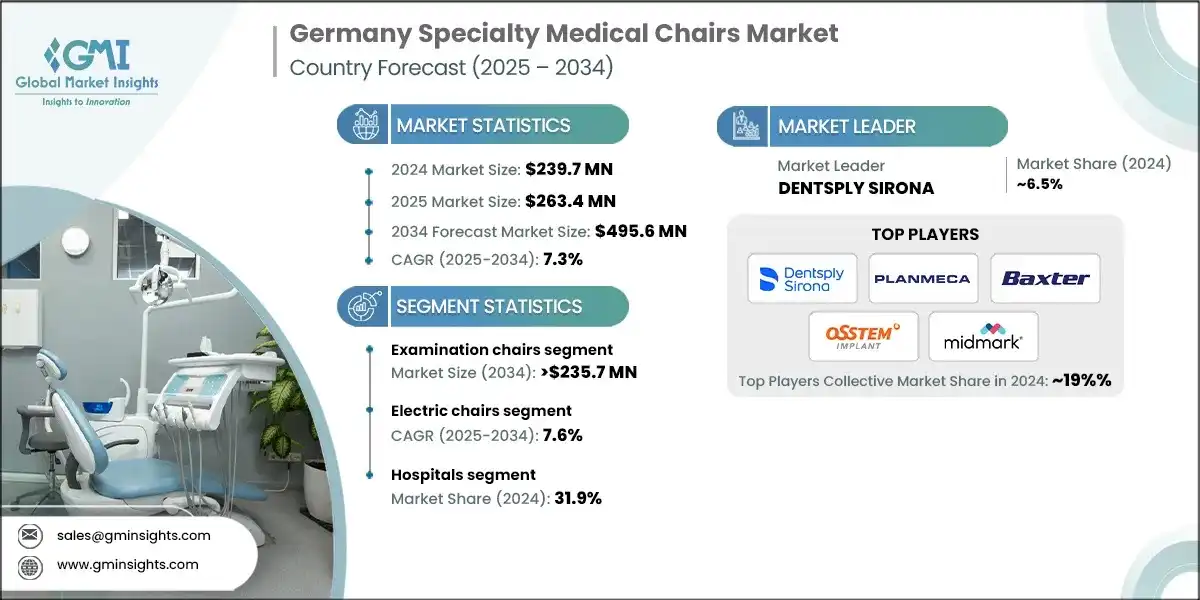
The Germany specialty medical chairs market was valued at USD 239.7 million in 2024. The market is expected to grow from USD 263.4 million in 2025 to USD 495.6 million in 2034, at a CAGR of 7.3% during the forecast period, according to the latest report published by Global Market Insights Inc. The high market growth can be attributed to the expanding network of specialty clinics, blood banks, and urgent care centers, coupled with a growing geriatric population, rising demand for rehabilitation procedures, and the increasing volume of ambulatory surgical intervention.
Germany Specialty Medical Chairs Market Key Takeaways
Market Size & Growth
- 2024 Market Size: USD 239.7 Million
- 2025 Market Size: USD 263.4 Million
- 2034 Forecast Market Size: USD 495.6 Million
- CAGR (2025–2034): 7.3%
Key Market Drivers
- An increasing number of specialty clinics, blood banks, and urgent care centers.
- Technological advancements and demand for powered chairs.
- Growing geriatric population and need for rehab procedures.
- Rising ambulatory surgical procedures.
Challenges
- High cost of specialized equipment.
- Limited reimbursement policies.
Opportunity
- Expansion of outpatient and home healthcare.
Key Players
- Market Leader: DENTSPLY SIRONA led with over 6.5% market share in 2024.
- Leading Players: Top 5 players in this market include DENTSPLY SIRONA, Planmeca, Baxter, OSSTEM IMPLANT, Midmark, which collectively held a market share of 19% in 2024.
Get Market Insights & Growth Opportunities
Specialty medical chairs are sophisticated seating solutions designed for procedures like dialysis, dental, rehab, and oncology, among others. Key players in the market include DENTSPLY SIRONA, Planmeca, Baxter, OSSTEM, and Midmark, who maintain their competitive edge through continuous product innovation, global expansion, and strong customer-centric strategies. These companies focus on R&D investments, ergonomic advancements, and strategic partnerships to meet evolving clinical requirements and regulatory standards, ultimately improving patient experiences and supporting efficient healthcare operations across hospitals, clinics, and specialized care facilities.
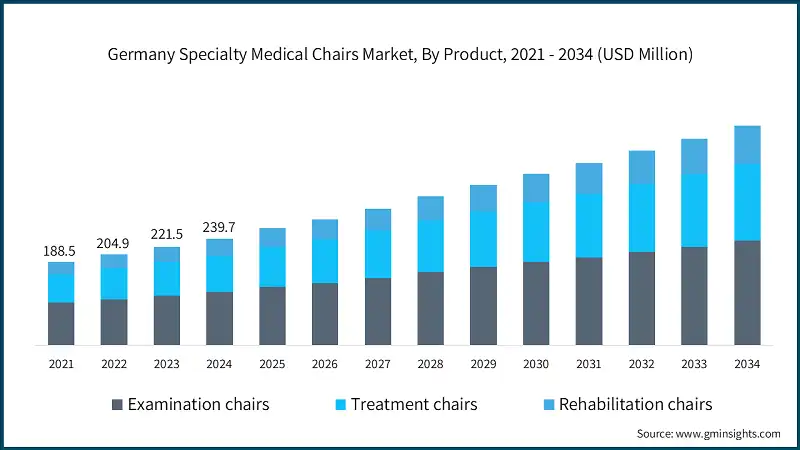
The market has increased from USD 188.5 million in 2021 and reached USD 221.5 million in 2023, with a historic growth rate of 8.4%. This growth has been primarily driven by rising demand for patient-centric care environments, increasing adoption of ergonomic and technologically advanced medical chairs, and expanding healthcare infrastructure across emerging economies.
Additionally, greater emphasis on outpatient services, aging populations, and the need for specialized treatment settings have further accelerated market expansion. Strategic investments in R&D, product customization, and partnerships with healthcare providers have enabled key players to meet evolving clinical needs and regulatory standards, reinforcing the market’s upward trajectory. For instance, according to Germany Trade & Invest, in 2022, Germany’s total R&D expenditure reached USD 141 billion, with the healthcare and medical technology sectors receiving a significant share, reflecting the country’s strong commitment to innovation and clinical excellence.
Specialty medical chairs refer to a category of seating solutions designed and engineered to meet specific healthcare needs and address various medical conditions. These chairs are characterized by their specialized features, ergonomic designs, and functionalities that cater to the unique requirements of individuals dealing with specific health challenges or undergoing medical treatments.
To get key market trends
Germany Specialty Medical Chairs Market Trends
Technological advancements are significantly propelling the growth of the specialty medical chairs market in Germany.
- Modern powered chairs increasingly feature AI-enabled obstacle detection, IoT connectivity, pressure-sensing posture correction, and multi-modal control systems such as joysticks, eye-tracking, and even brain-computer interfaces (BCIs). For instance, recent research has demonstrated a brain-controlled wheelchair prototype that interprets EEG signals and eye blinks to guide movement while integrating proximity sensors to prevent collisions.
- Similarly, eye-tracking systems have shown high accuracy in directing motorized wheelchair motion across varied environments. These innovations not only enhance mobility and independence for users but also encourage adoption in rehabilitation, home care, and institutional settings.
- Moreover, the incorporation of machine learning algorithms into chairs systems helps predict patient needs and optimize comfort settings, reducing strain and improving therapeutic outcomes. As healthcare systems increasingly prioritize digital transformation and data-driven care, specialty medical chairs are evolving into smart medical devices that support both clinical decision-making and patient empowerment, driving sustained market growth and adoption across advanced care environments.
- Furthermore, the rising preference for minimally invasive procedures is catalyzing demand for technologically advanced chairs that support precision, comfort, and clinical efficiency, solidifying their role in modern healthcare delivery.
Germany Specialty Medical Chairs Market Analysis
Learn more about the key segments shaping this market
Based on product, the Germany specialty medical chairs market is segmented into examination chairs, treatment chairs, and rehabilitation chairs. The examination chairs segment accounted for 50.1% of the market in 2024 due to its widespread use across outpatient clinics, dental practices, and diagnostic centers, driven by rising demand for ergonomic designs, procedural efficiency, and patient comfort. The segment is expected to exceed USD 235.7 million by 2034, growing at a CAGR of 6.7% during the forecast period.
On the other hand, the treatment chairs segment is expected to grow with a CAGR of 7.5%. The growth of this segment is driven by increasing demand for specialized care in oncology, dialysis, and infusion therapies, alongside rising investments in ergonomic designs and smart features that enhance patient comfort, procedural efficiency, and clinical outcomes.
- The examination chairs segment, which includes dialysis chairs, is experiencing robust growth driven by multiple clinical and market factors, primarily the rising prevalence of chronic kidney disease (CKD) and end-stage renal disease (ESRD) among aging populations, leading to increased global demand for such examination chairs.
- The rehabilitation chairs segment is expected to grow with an 8.5% CAGR during the analysis period. This growth is primarily driven by the increasing prevalence of mobility impairments, rising demand for post-operative and geriatric care, and advancements in chair design that support physical therapy, posture correction, and patient comfort across home and institutional settings.
Based on type, the Germany specialty medical chairs market is segmented into electric chairs and manual chairs. The electric chairs segment dominated the market in 2024 and is growing with a CAGR of 7.6% during the forecast period.
- This dominance is driven by increasing adoption of motorized and smart chairs equipped with advanced features such as remote control, programmable settings, and integrated sensors that enhance patient comfort, clinical efficiency, and accessibility across various healthcare environments. Additionally, the integration of AI and IoT technologies is enabling predictive maintenance and remote diagnostics, further boosting operational reliability and long-term value for healthcare providers.
- The manual chairs segment is expected to grow with a 6.5% CAGR during the analysis period. This growth is fueled by the rising demand for cost-effective, low-maintenance solutions in primary care and rural healthcare settings, where simplicity, durability, and ease of use are prioritized over advanced automation. Additionally, their lightweight design and portability make them ideal for temporary setups, emergency response units, and mobile clinics.
Learn more about the key segments shaping this market
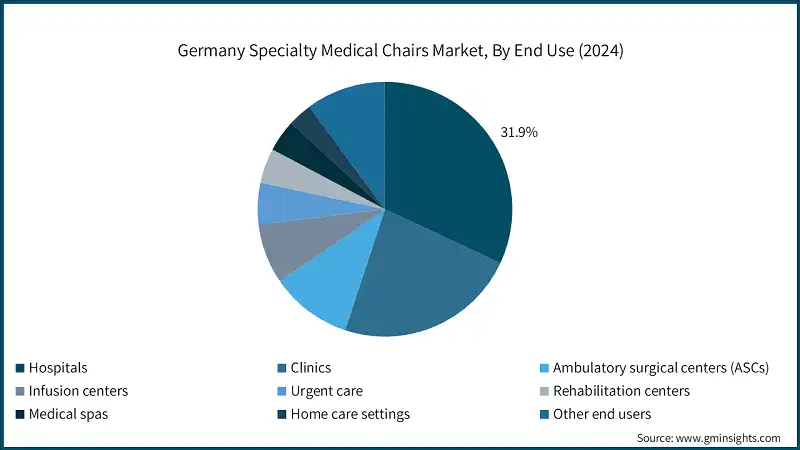
Based on end use, the Germany specialty medical chairs market is segmented into hospitals, clinics, ambulatory surgical centers (ASCs), infusion centers, urgent care, rehabilitation centers, medical spas, home care settings, and other end users. The hospitals segment dominated the market with a revenue share of 31.9% in 2024 and is expected to reach USD 152.1 million within the forecast period.
- This dominance is driven by the high volume of patient intake, increasing demand for specialized treatment chairs across departments, and ongoing investments in advanced medical infrastructure to support efficient and comfortable care delivery.
- The clinics segment held a revenue of USD 55.4 million in 2024. Growth in this segment is fueled by the increasing number of outpatient visits, rising demand for specialized chairs in dental, dermatology, and diagnostic procedures, and the growing preference for compact, multifunctional equipment that enhances space efficiency and patient throughput.
- The ambulatory surgical centers (ASCs) segment was valued at USD 24.9 million in 2024 and is expected to reach USD 54.9 million by 2034, driven by the growing shift toward outpatient procedures, demand for cost-effective surgical environments, and increased adoption of compact, multifunctional specialty chairs that support minimally invasive treatments and rapid patient turnover.
- The infusion centers segment held a revenue of USD 18.3 million in 2024, driven by the rising prevalence of chronic conditions requiring long-term intravenous therapies, such as cancer, autoimmune disorders, and infectious diseases. The demand for specialized infusion chairs offering enhanced comfort, adjustability, and integrated monitoring features continues to grow as infusion centers expand their services and patient volumes.
- The urgent care segment is expected to grow with a 7.7% CAGR during the analysis period. This growth is driven by the increasing demand for rapid, walk-in medical services, the expansion of urgent care networks, and the need for versatile specialty chairs that support a wide range of diagnostic and minor treatment procedures in fast-paced clinical environments. Additionally, the shift toward decentralized healthcare delivery is encouraging investment in compact, multifunctional equipment tailored for urgent care settings.
- The rehabilitation centers segment was valued at USD 10.6 million in 2024 and is expected to reach USD 22.2 million by 2034, driven by the growing shift toward outpatient procedures, demand for cost-effective surgical environments, and increased adoption of compact, multifunctional specialty chairs that support minimally invasive treatments and rapid patient turnover.
- The medical spas segment held a revenue of USD 9.7 million in 2024, driven by the rising popularity of non-invasive aesthetic procedures, growing consumer preference for wellness-focused treatments, and increasing adoption of specialized chairs designed for comfort, adjustability, and multi-treatment compatibility in spa and cosmetic settings.
- The home care settings segment is expected to grow with an 8.4% CAGR during the analysis period. This growth is driven by the increasing preference for in-home medical support among aging populations and patients with chronic conditions, coupled with advancements in portable, user-friendly specialty chairs that offer clinical-grade comfort and functionality.
- The other end users segment held a revenue of USD 24.3 million in 2024, driven by the increasing need for specialized chairs in diagnostic imaging centers, nursing homes, palliative care centers, and other facilities that support long-duration procedures, enhance patient comfort, and meet the ergonomic and safety standards required in long-term and supportive care environments.
Germany Specialty Medical Chairs Market Share
Leading companies operating in the industry, such as DENTSPLY SIRONA, Planmeca, Baxter, OSSTEM IMPLANT, and Midmark, hold around 19% of the market. These companies are leveraging innovation, ergonomic design, and integrated technologies to enhance patient care and clinical efficiency. These companies are responding to rising demand driven by aging populations, chronic disease prevalence, and the shift toward outpatient and home-based care.
Other notable players in the Germany specialty medical chairs market, including ATMOS MedizinTechnik, FRESENIUS MEDICAL CARE, Topcon, and MARCO, are actively pursuing strategies to expand their global reach and enhance product innovation. These companies are focusing on ergonomic design, smart technology integration, and patient-centric features to meet the evolving demands of modern healthcare environments.
Germany Specialty Medical Chairs Market Companies
A few of the prominent players operating in the Germany specialty medical chairs industry include:
- ActiveAid
- A-dec
- ATMOS MedizinTechnik
- Baxter
- DENTALEZ
- Dentsply Sirona
- FRESENIUS MEDICAL CARE
- MARCO
- Midmark
- OSSTEM
- PLANMECA
- TOPCON
- Dentsply Sirona
DENTSPLY SIRONA’s USP lies in its innovative dental chair designs, seamless integration with digital dentistry solutions, ergonomic and patient-centric features, distribution network, and commitment to continuous R&D, delivering advanced, reliable, and efficient solutions for diverse dental and specialty care settings.
Planmeca’s USP is driven by modular and customizable chair systems, advanced technology integration, AI-enabled imaging compatibility, superior ergonomics, and patient-focused design, enabling highly efficient, flexible, and comfortable clinical workflows across dental, surgical, and specialty healthcare environments.
Baxter International has significantly strengthened its position in the specialty medical chairs market following its acquisition of Hillrom. The company offers a wide range of chairs for rehabilitation designed to enhance patient comfort and clinical workflow.
Germany Specialty Medical Chairs Market Report Attributes
| Key Takeaway | Details |
|---|---|
| Market Size & Growth | |
| Base Year | 2024 |
| Market Size in 2024 | USD 239.7 Million |
| Market Size in 2025 | USD 263.4 Million |
| Forecast Period 2025 – 2034 CAGR | 7.3% |
| Market Size in 2034 | USD 495.6 Million |
| Key Market Trends | |
| Drivers | Impact |
| An increasing number of specialty clinics, blood banks, and urgent care centers | Rising establishment of specialized healthcare facilities boosts demand for advanced medical chairs that enhance patient comfort, safety, and procedural efficiency. |
| Technological advancements and demand for powered chairs | Integration of automation, smart controls, and ergonomic designs enhances usability, positioning precision, and workflow efficiency, driving adoption across clinical and diagnostic settings. |
| Growing geriatric population and need for rehab procedures | Aging populations with chronic and mobility-related conditions increase demand for rehabilitation and treatment chairs supporting comfort, safety, and long-term therapeutic care. |
| Rising ambulatory surgical procedures | Shift toward outpatient and day-care surgeries fuels the need for adjustable, easy-to-clean specialty chairs suitable for efficient patient positioning and quick procedural turnaround. |
| Pitfalls & Challenges | Impact |
| High cost of specialized equipment | Expensive advanced chairs limit adoption among small clinics. |
| Limited reimbursement policies | Lack of comprehensive insurance coverage for specialty chairs reduces affordability and slows procurement by healthcare facilities. |
| Opportunities: | Impact |
| Expansion of outpatient and home healthcare | Growing preference for cost-effective, home-based, and outpatient care settings accelerates demand for portable, multi-functional, and user-friendly medical chairs. |
| Market Leaders (2024) | |
| Market Leaders |
Market Share 6.5% |
| Top Players |
Collective market share in 2024 is Market Share 19% |
| Competitive Edge |
|
What are the growth opportunities in this market?
Germany Specialty Medical Chairs Industry News:
- In June 2023, A-dec launched its digitally connected delivery systems, the A-dec 500 Pro and A-dec 300 Pro platforms, marking a significant advancement in smart operatory technology. These platforms integrate seamlessly with A-dec’s dental chairs, enhancing clinical workflows through real-time data connectivity, customizable settings, and improved ergonomic control, thereby strengthening the company’s product portfolio and expanding its customer base in the premium dental operatory segment.
- In December 2021, Baxter International Inc. announced that it had completed its acquisition of Hillrom. This strategic move united two leading medtech companies, expanding Baxter’s capabilities in the specialty medical chairs market. The acquisition positions Baxter for accelerated top and bottom-line growth while broadening access to care.
The Germany specialty medical chairs market research report includes an in-depth coverage of the industry with estimates and forecasts in terms of revenue in USD Million from 2021 - 2034 for the following segments:
Market, By Product
- Examination chairs
- Dental
- OB/GYN
- Dialysis
- Ophthalmic
- Dermatology
- Blood drawing
- Mammography
- Other examination chairs
- Treatment chairs
- Dental
- Ophthalmic
- ENT
- Dermatology
- Other treatment chairs
- Rehabilitation chairs
- Geriatric chairs
- Pediatric chairs
- Bariatric chairs
- Other rehabilitation chairs
Market, By Type
- Electric chairs
- Manual chairs
Market, By End Use
- Hospitals
- Clinics
- Ambulatory surgical centers (ASCs)
- Infusion centers
- Urgent care
- Rehabilitation centers
- Medical spas
- Home care settings
- Other end users
Frequently Asked Question(FAQ) :
What was the market size of the Germany specialty medical chairs in 2024?
The market size was valued at USD 239.7 million in 2024, with a CAGR of 7.3% expected through 2034, driven by the expansion of specialty clinics, blood banks, and urgent care centers.
What is the projected value of the Germany specialty medical chairs market by 2034?
The market is expected to reach USD 495.6 million by 2034, fueled by technological advancements and increasing adoption of specialty chairs in various healthcare settings.
What is the projected size of the Germany specialty medical chairs market in 2025?
The market is projected to grow to USD 263.4 million in 2025.
What was the revenue share of the examination chairs segment in 2024?
The examination chairs segment accounted for 50.1% of the market in 2024, generating significant revenue due to its widespread use in outpatient clinics, dental practices, and diagnostic centers.
What is the expected valuation of the examination chairs segment by 2034?
The examination chairs segment is expected to exceed USD 235.7 million by 2034, growing at a CAGR of 6.7% during the forecast period.
Which segment dominated the market based on type in 2024?
The electric chairs segment dominated the market in 2024 and is projected to grow at a CAGR of 7.6% during the forecast period.
Which end-use segment led the Germany specialty medical chairs market in 2024?
The hospitals segment led the market with a revenue share of 31.9% in 2024 and is expected to reach USD 152.1 million during the forecast period.
What are the key trends in the Germany specialty medical chairs market?
Key trends include advancements in powered chairs with AI-enabled obstacle detection, IoT connectivity, pressure-sensing posture correction, and multi-modal control systems such as joysticks, eye-tracking, and brain-computer interfaces (BCIs).
Who are the key players in the Germany specialty medical chairs market?
Key players include ActiveAid, A-dec, ATMOS MedizinTechnik, Baxter, DENTALEZ, Dentsply Sirona, FRESENIUS MEDICAL CARE, MARCO, Midmark, and OSSTEM.
Germany Specialty Medical Chairs Market Scope
Related Reports