Summary
Table of Content

Germany Self-healing Flooring Materials Market
Get a free sample of this report
Form submitted successfully!
Error submitting form. Please try again.
Thank you!
Your inquiry has been received. Our team will reach out to you with the required details via email. To ensure that you don't miss their response, kindly remember to check your spam folder as well!
Request Sectional Data
Thank you!
Your inquiry has been received. Our team will reach out to you with the required details via email. To ensure that you don't miss their response, kindly remember to check your spam folder as well!
Form submitted successfully!
Error submitting form. Please try again.
Germany Self-healing Flooring Materials Market Size
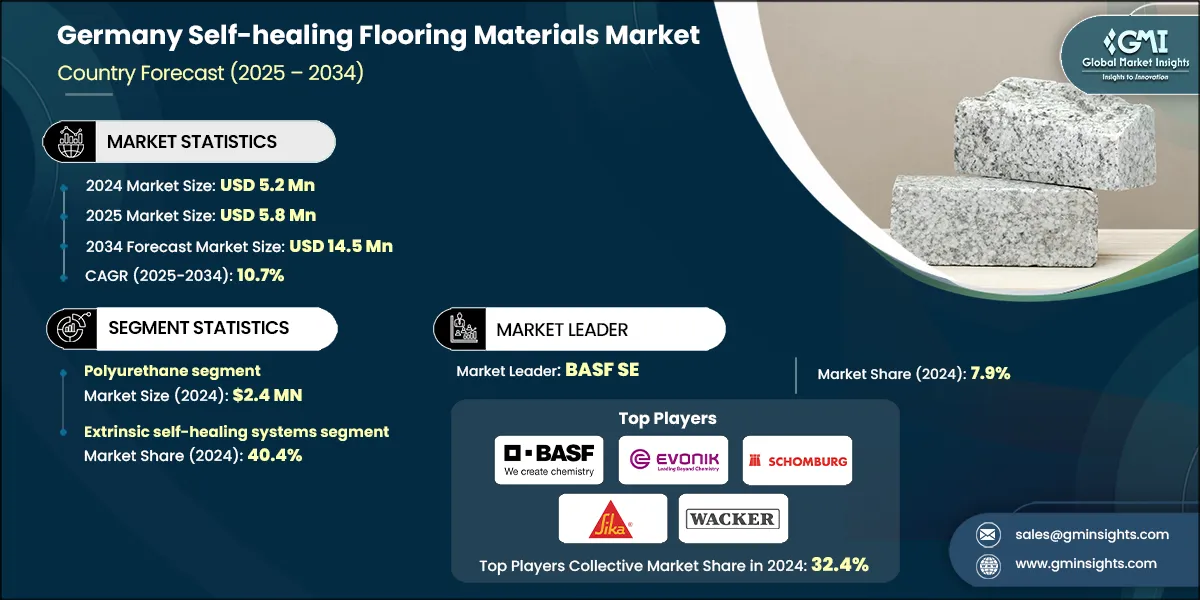
Germany self-healing flooring materials market was valued at USD 5.2 million in 2024. The market is expected to grow from USD 5.8 million in 2025 to USD 14.5 million in 2034, at a CAGR of 10.7%, according to Global Market Insights Inc.
To get key market trends
Self-healing flooring materials are innovative flooring technologies that are incorporated with materials capable of self-repairing minor damages like cracks and wear and tear that ultimately increases the life span and cost of maintenance.
Germany Self-healing Flooring Materials Market Report Attributes
| Key Takeaway | Details |
|---|---|
| Market Size & Growth | |
| Base Year | 2024 |
| Market Size in 2024 | USD 5.2 Million |
| Market Size in 2025 | USD 5.8 Million |
| Forecast Period 2025 - 2034 CAGR | 10.7% |
| Market Size in 2034 | USD 14.5 Million |
| Key Market Trends | |
| Drivers | Impact |
| Rising maintenance cost pressures in German construction | Accelerates demand for durable, self-healing adhesives to enhance safety and longevity in electric vehicle components |
| Stringent German building quality standards | Drives need for advanced self-healing adhesives that improve thermal stability and miniaturized device reliability |
| Government support for advanced materials research | Promotes adoption of bio-based and environmentally friendly self-healing adhesives to meet sustainability standards |
| Sustainability & circular economy mandates | Facilitates integration of self-healing adhesives in automated production lines to improve product lifespan and reduce downtime |
| Pitfalls & Challenges | Impact |
| Complex German regulatory approval processes | Hinders rapid commercialization of innovative self-healing adhesive formulations in the German market |
| High initial investment requirements | Creates barriers for market acceptance and widespread adoption of self-healing adhesives due to regulatory uncertainties |
| Opportunities: | Impact |
| Digital materials development integration | Opens new growth avenues for self-healing adhesives in enhancing safety and reliability of EV battery packs |
| Biomimetic technology commercialization | Expands market potential for biocompatible, self-healing adhesives in medical and wearable tech sectors |
| Market Leaders (2024) | |
| Market Leaders |
7.9% Market Share |
| Top Players |
Collective market share in 2024 is 32.4% |
| Competitive Edge |
|
| Regional Insights | |
| Future outlook |
|
What are the growth opportunities in this market?
Rising maintenance cost pressures in the German construction industry result in a quest by stakeholders to seek long-lasting, cost-effective solutions that are to lower ongoing repair expenditure. Amongst these regions, North Rhine-Westphalia has the largest market due to its extensive infrastructure and commercial developments, while Bavaria is recognized as the rapidly growing market due to increased investments in advanced construction technology.
In addition to pressure from stringent quality standards in German buildings, these factors are pushing for the application of advanced materials that meet rigorous safety and durability requirements, thus creating additional demand for self-healing floor systems capable of complying with and ensuring long-term performance.
All these regulations and economic pressures fuel innovations and the adoption of new techniques throughout regions, and North Rhine-Westphalia is one of the leaders when it comes to infrastructure development while Bavaria is expanding quickly as an influence because of increasing awareness and demand.
Germany Self-healing Flooring Materials Market Trends
- Biomimetic self-healing technology, now in increasing use, signals more scientific innovations for the design of flooring materials. In Germany, some of the prime research institutions, including sans pareil in the field-the Max Planck Institute and the Fraunhofer Society, are engaged in the establishment of bio-inspired healing mechanisms mimicking natural processes found in biological systems. Such technologies utilize innovations like microencapsulation, vascular networks, and shape-memory polymers for repairing damage autonomously. The trend is very impactful in industrial application areas where the low downtime is of utmost importance.
- German manufacturers are increasingly in search of bio-based healing agents sourced from renewable resources like natural polymers and plant oils. The German high performers like Wacker Chemie AG are driving the development of silicon-based self-healing systems, high-performing and environmentally friendly. The market is willing to pay premium prices for products with less lifecycle impacts and superior lifecycle value.
- Sensors, IoT connectivity, and data analytics capabilities are embedded into these materials to enable predictive maintenance and real-time performance monitoring by German firms. Smart self-healing flooring solutions can detect structural issues at an early stage, monitor pattern of damages, and trigger autonomous healing responses, thereby providing increased durability and risk reduction to failures. This trend aligns quite well with the digitalization trends and Industry 4.0 framework at the level of Germany, paving avenues for value-added services and data-driven insights.
Germany Self-healing Flooring Materials Market Analysis
Learn more about the key segments shaping this market
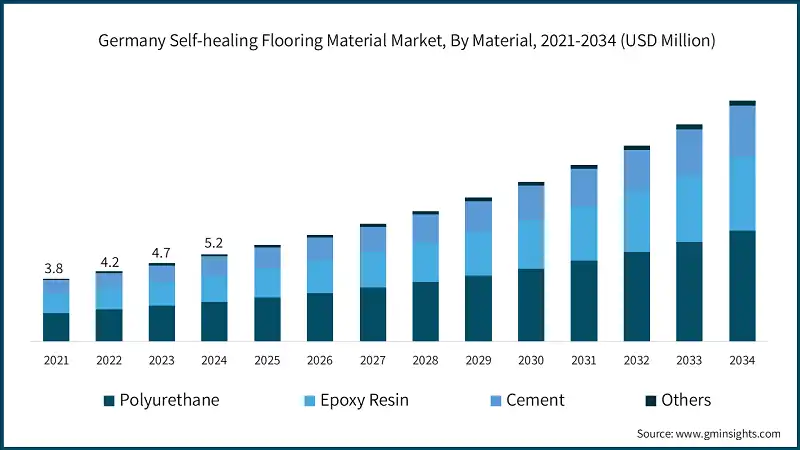
In 2021, the market was valued at USD 3.8 million. The following year, it saw a slight increase to USD 4.2 million, and by 2023, the market further climbed to USD 4.7 million.
Based on material, the market is segmented into polyurethane, epoxy resin, cement and others. Polyurethane generated USD 2.4 million in 2024.
- Polyurethane is the main segment dominating the market owing to performance characteristics and more applications. There is high demand for polyurethane self-healing systems because of chemical resistance and durability properties, and these systems are mainly applied in industrial and commercial flooring applications. The segment continues to grow toward data centers, hospitals, and automotive manufacturing, buoyed by demand for chemical-resistant flooring solutions.
- The epoxy resin segment holds a salient share of the self-healing flooring market in Germany, known for its high-performance capabilities. This epoxy-based self-healing system can also provide full functionality in service conditions requiring extraordinary mechanical strength and chemical resistance. The automotive and aerospace segments thrive in this country, requiring durable and high-performance flooring solutions and channeling further advantages to it. Adoption of the epoxy self-healing material is growing in manufacturing plants, laboratories, and clean room environments, where epoxy's superior properties justify investment in advanced healing technology.
Learn more about the key segments shaping this market
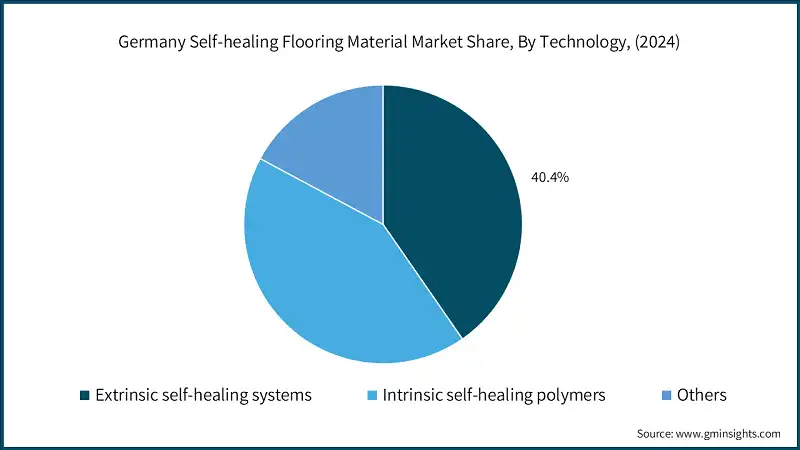
Based on technology, the Germany self-healing flooring materials market is segmented into extrinsic self-healing systems, intrinsic self-healing polymers, others. Extrinsic self-healing systems made up 40.4% of the market in 2024.
- Intrinsic self-healing polymers dominates market. These systems are integrated with self-healing functionality directly into the polymer, allowing for an autonomous intervention in the event of damage. Applications of intrinsic self-healing polymers extend to residential, commercial, and industrial settings, particularly in situations that demand frequent minor repairs. Intrinsic self-healing polymers are thus preferred for applications that cannot afford risks, such as in healthcare and data centers because of their reliability and performance.
- Extrinsic self-healing systems generates embedded healing agents that are refortified through release caused by damage providing highly productive healing with maximum design flexibility. These systems are most helpful with large damage areas and allow for multiple healing agent types to be integrated into a unique application for chemical processing, pharmaceutical manufacturing, and other heavy industrial environments.
Based on application, the Germany self-healing flooring materials market is segmented into industrial flooring, residential flooring, commercial flooring, waterproofing systems and car park flooring. Industrial flooring stands out in the market.
- Industrial flooring is leading due to its durable, chemical resistant, and capable of lasting for long properties. Cold and heat manufacturers, chemical processors, and pharmaceutical concerns require flooring solutions that can withstand tough environments with frequent mechanical stress and profound chemical exposure. Self-healing technologies captures market, as they reduce downtime and maintenance costs by curing microcracks and minor damages and the high performance requirements in industrial settings drive the advances in both intrinsic and extrinsic self-healing systems with respect to large-area damages and chemical resilience.
- Residential flooring continues to be secondary in terms of market contribution. The trend is supporting the innovation of flooring solutions that are smart, durable, and eco-friendly, looking specifically at bio-based systems and faster-healing self-healing systems.
- Commercial flooring holds a considerable share, backed mainly by the retail, office, and hospitality sectors that look for resilient and low-maintenance surfaces. Innovations here aim to provide beautiful surfaces that are durable enough to withstand minor damage quickly while preserving aesthetic and safety standards.
- Waterproofing systems application is important on sites such as basements, tunnels, and roofs, where resistance to water damage has such imperative durability. Modern technology at the forefront of microencapsulation, and vascular systems, has also revolutionized the waterproofing solutions by making them more reliable and efficient.
- Carpark flooring stands the chance to improve due to demand for tough, damage-resistant surfaces that can withstand load from vehicles, chemical spillages, and exposure to the environment. Self-healing technologies will ensure maintenance of surface integrity, thus lower the frequency of repairs, and extending the life span of the surface, attributes which are highly prized by property owners and operators.
Based on end use industry, the Germany self-healing flooring materials market is segmented into construction & building, data centers & IT infrastructure, manufacturing & industrial, healthcare facilities and transportation infrastructure.
- The construction and building sectors are the predominant end-use industries due to continuous demand in these sectors for durable and long-lasting flooring solutions for commercial, residential, and infrastructural projects. These developments make the sector keen on minimizing maintenance costs and life extension for flooring systems, thus enabling a wide adoption of advanced self-healing technologies, more so in high traffic areas.
- Data centers and IT infrastructure are emerging niches on which demands are building since this flooring must be resistant to damage in withstanding very high loads and chemically exposed environments typical of server rooms and data centers. The push towards self-healing these floors goes to ensure no down time and interruption during maintenance, both of which are expensive in such places.
- Manufacturing and industrial applications majorly drive the growth of this market. For instance, users from the chemical processing, automotive, and heavy machinery manufacturing industries require flooring that can resist chemical spills, mechanical stress, and thermal fluctuations. Self-healing flooring systems include an additional layer which reduces downtime and maintenance costs that are essential in achieving operational efficiency.
- Healthcare facilities are starting to become a new market for self-healing flooring in order to comply with hygiene standards and realize the continuous, safe environments. Generally, hospital and clinic floors are on the receiving end of many small damages caused by constant walking, by the moving of equipment, and by cleaning. These self-healing materials assure a sterile, damage-free surface and reduce the occurrence of frequent repairs and replacements.
- Self-healing flooring addresses high traffic as well as mechanical wear typical of such infrastructure, such as airports, train stations, and bus terminals. In addition to safety and beauty in appearance, these flooring systems require less maintenance.
Looking for region specific data?
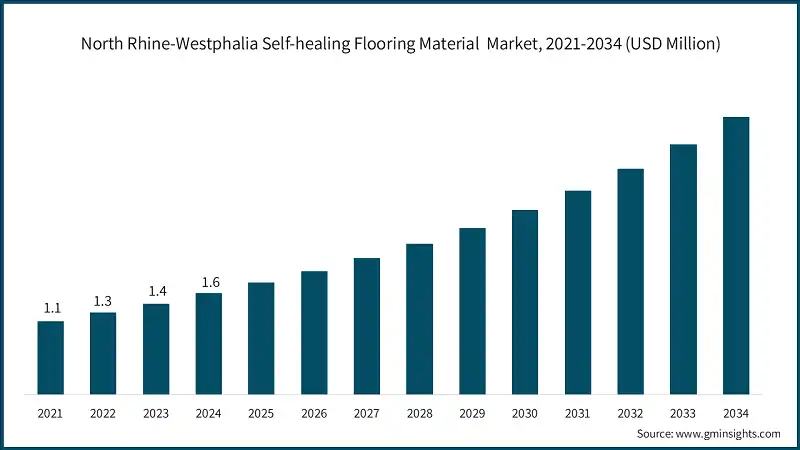
North Rhine-Westphalia self-healing flooring material market was accounted for USD 1.6 million in 2024.
- North Rhine-Westphalia achieves its market-making status vis-à-vis physical-industries and construction activities. It hosts a diversity of industries such as chemicals, automotive, or steel, which fuel a relatively uninterrupted demand for high-performance flooring solutions. The region's industrial legacy, in combination with a string of ongoing modernization projects, supports steady growth fed by initiatives such as Industry 4.0, facility upgrades, and expanding data center infrastructure within the Rhine-Ruhr metropolitan area.
- Bavaria continues to grow quickly between new technology applications and major investments in infrastructure. The state's well-established automotive industry, headed by BMW and Audi, creates great demand for advanced flooring solutions in production and R&D locations. The swift techno-commercial advancement of Munich as a technology hotspot is endorsements of fast track developments of market due to infrastructure augmentations for data centers.
- The major market share of Baden-Württemberg from the concentration on automotive manufacturing and precision-engineering industries. Heavy demand for high-performance flooring solutions in production facilities is generated by a number of companies such as Mercedes-Benz, Porsche, and Bosch. The state's scientifically trained personnel-strong R&D infrastructure of universities and applied research institutes sends stimulation toward the innovation processes of self-healing materials and their applications.
- Ongoing modernizations of various facilities, growth of electric vehicle manufacturing, and expansion within precision-manufacturing situations are key contributors to market growth. Moreover, implementable sustainable manufacturing practices by Baden-Württemberg with underlying circular economy principles are in alignment with the benefits underlined by self-healing materials, thus further solidifying its standing in the industrial marketplace.
Germany Self-healing Flooring Materials Market Share
- BASF SE, Evonik Industries AG, SCHOMBURG GmbH, Sika and Wacker Chemie AG accounts 32.4% of the market share.
- The Germany self-healing flooring materials market consists of such leading companies, operating mostly in their regional areas. Their long years of experience with flooring material allow these companies to maintain a strong market position worldwide. Their product offerings are diverse and majorly supported by production capacities and distribution networks, which can serve the increasing demand for self-healing flooring materials in various regions.
Germany Self-healing Flooring Materials Market Companies
Major players operating in the Germany self-healing flooring materials industry are:
- BASF SE
- Evonik Industries AG
- HEGGEL GmbH
- SCHOMBURG GmbH
- Sika
- Tarkett Group
- Wacker Chemie AG
BASF SE gains its marketing edge due to its rich experience in chemicals, R&D activities, and customer relations across varied application domains. The company derives its position from the decision to invest in self-healing technologies early and successfully commercialized polyurethane-based systems for industrial applications.
Evonik Industries AG with a good second position as a competitor, mainly in specialty chemicals and advanced materials. The core differentiators from the company's viewpoint include an active market approach towards intrinsic self-healing polymers and smart material integration.
SCHOMBURG GmbH-the well known specialist in construction chemicals and waterproofing systems-provides high expertise in commercial and industrial flooring applications. The company's technical-oriented approach confer competitive advantages in market .
Sika's competitive advantages in large-scale projects and commercial applications rest upon a strong portfolio of construction solutions and a well-established distribution network.
Wacker Chemie AG uses its expertise in silica-based chemistry to design innovative self-healing systems with intrinsic and unique performance characteristics in the market. The firm's sustainable solutions with digital integration could echo and ride on the market trends.
Germany Self-healing Flooring Materials Industry News
- In July of 2025, Egger Flooring re-entered the U.S. laminate market due to renewed demand for durable high-quality flooring materials, with challenges on SPC and WPC products, aimed towards the bigger retailers and distributors.
- In June 2024, EUROBOND and RHEINZINK have introduced a self-healing zinc material to India, establishing a new benchmark in architectural flooring and façade materials with its eco-friendly, durable, and age-defying features.
- In April 2023, Evonik enlarged its global capacity for VESTAMID E PEBA, a high-performance polymer used in lightweight and durable flooring materials for athletic and industrial applications, with increasements in production in Asia and Germany in order to satisfy higher demand.
Germany self-healing flooring materials market research report includes an in-depth coverage of the industry with estimates and forecast in terms of revenue in USD Million and volume in terms of Kilo Tons from 2021–2034 for the following segments:
Market, By Material
- Polyurethane
- Epoxy Resin
- Cement
- Others
Market, By Technology
- Extrinsic self-healing systems
- Intrinsic self-healing polymers
- Others
Market, By Application
- Industrial flooring
- Chemical processing facilities
- Heavy-duty performance standards
- Food processing applications
- Pharmaceutical manufacturing
- Residential flooring
- Single-family home applications
- Multi-family housing projects
- Commercial flooring
- Office buildings & retail spaces
- Public building applications
- Healthcare facility requirements
- Waterproofing systems
- Car park flooring
- Underground parking facilities
- Multi-story car park applications
Market, By End Use Industry
- Construction & building
- Data centers & IT infrastructure
- Manufacturing & industrial
- Automotive production facilities
- Chemical processing plants
- Pharmaceutical manufacturing
- Food & beverage processing
- Healthcare facilities
- Hospitals & medical centers
- Laboratory environments
- Pharmaceutical research facilities
- Hygiene & safety standards
- Transportation infrastructure
- Airport terminal facilities
- Railway station applications
- Public transportation hubs
The above information is provided for the following states:
- North Rhine-Westphalia
- Bavaria
- Baden-Württemberg
- Lower Saxony
- Bremen
- Other Federal States
Frequently Asked Question(FAQ) :
What are the upcoming trends in the Germany self-healing flooring materials industry?
Key trends include the integration of biomimetic technologies, adoption of bio-based materials, and advancements in automated production lines to enhance product efficiency and sustainability.
Who are the key players in the Germany self-healing flooring materials market?
Key players include BASF SE, Evonik Industries AG, HEGGEL GmbH, SCHOMBURG GmbH, Sika, Tarkett Group, and Wacker Chemie AG.
Which region leads the Germany self-healing flooring materials market?
North Rhine-Westphalia accounted for USD 1.6 million in 2024, leading the market. The region's dominance is attributed to its strong industrial base and increasing adoption of advanced flooring technologies.
What was the valuation of the extrinsic self-healing systems segment in 2024?
Extrinsic self-healing systems held 40.4% market share in 2024, driven by their effectiveness in enhancing product lifespan and reducing maintenance costs.
What is the market size of the Germany self-healing flooring materials industry in 2024?
The market size was USD 5.2 million in 2024, with a CAGR of 10.7% expected through 2034, driven by increasing demand for sustainable and low-maintenance flooring solutions in construction and architecture.
How much revenue did the polyurethane segment generate in 2024?
The polyurethane segment generated USD 2.4 million in 2024, leading the market due to its superior durability and self-healing properties.
What is the projected value of the Germany self-healing flooring materials market by 2034?
The market is expected to reach USD 14.5 million by 2034, driven by advancements in self-healing technologies and growing adoption of eco-friendly materials.
What is the current Germany self-healing flooring materials market size in 2025?
The market size is projected to reach USD 5.8 million in 2025.
Germany Self-healing Flooring Materials Market Scope
Related Reports