Summary
Table of Content

Germany Apoptosis Assay Market
Get a free sample of this report
Form submitted successfully!
Error submitting form. Please try again.
Thank you!
Your inquiry has been received. Our team will reach out to you with the required details via email. To ensure that you don't miss their response, kindly remember to check your spam folder as well!
Request Sectional Data
Thank you!
Your inquiry has been received. Our team will reach out to you with the required details via email. To ensure that you don't miss their response, kindly remember to check your spam folder as well!
Form submitted successfully!
Error submitting form. Please try again.
Germany Apoptosis Assay Market Size
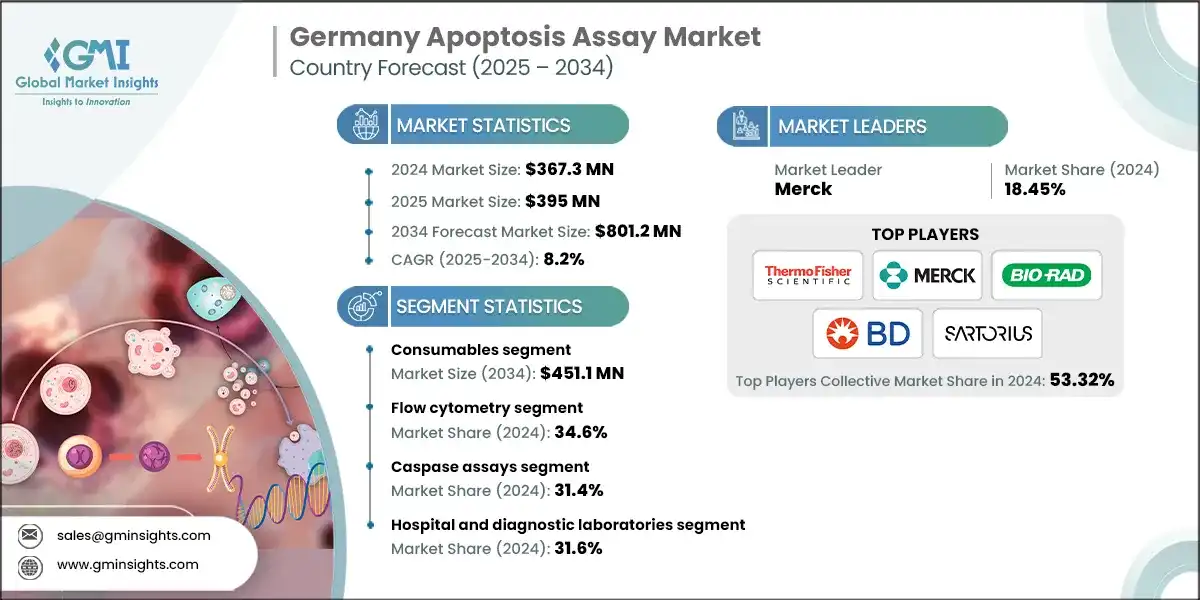
The Germany apoptosis assay market was valued at USD 367.3 million in 2024 and is projected to grow from USD 395 million in 2025 to USD 801.2 million by 2034, expanding at a CAGR of 8.2% during the forecast period, according to the latest report published by Global Market Insights Inc. The repetitive growth of the German market for apoptosis assays is fueled by the rising incidence of chronic conditions such as cancer and neurodegenerative diseases, as well as the growing focus on personalized medicine. Advances in cell analysis equipment specifically high-throughput flow cytometry and image-based assays are improving research accuracy and productivity. Furthermore, robust funding from both public and private sectors of Germany's life science research is propelling the adoption of apoptosis assays. The apoptosis assays are fundamental research tools utilized for detecting and measuring programmed cell death, which are critical to disease research, drug development, and toxicology test. Some of the larger industry participants include Thermo Fisher Scientific, Merck, Bio-Rad Laboratories and Becton, Dickinson and Company and Sartorius.
Germany Apoptosis Assay Market Key Takeaways
Market Size & Growth
- 2024 Market Size: USD 367.3 Million
- 2034 Forecast Market Size: USD 801.2 Million
- CAGR (2025–2034): 8.2%
Key Market Drivers
- Increasing prevalence of chronic diseases.
- Growing need for personalized medicine.
- Technological advancements in flow cytometry.
- Rising application in toxicology and drug safety assessment.
Challenges
- High cost of advanced technologies.
- Regulatory and ethical challenges.
Opportunity
- Rising focus on cancer and neurodegenerative research.
Key Players
- Market Leader: Merck led with over 18.45% market share in 2024.
- Leading Players: Top 5 players in this market include Thermo Fisher Scientific, Merck, Bio‑Rad Laboratories, Becton, Dickinson and Company, which collectively held a market share of 3.32% in 2024.
Get Market Insights & Growth Opportunities
The expansion of apoptosis assay uptake in Germany is fueled chiefly by the increasing prevalence of chronic diseases, notably cancer, neurodegenerative diseases, and autoimmune diseases. As researchers and pharmaceutical firms increase their interest in cell processes involved in disease progression and treatment response, apoptosis assays have emerged as essential tools in basic and translational research. One of the key stimulants for this need is the rising burden of cancer in the country. In 2022, there were 605,805 new cancer diagnoses reported in Germany, highlighting the pressing necessity for innovative cell-based approaches to explore programmed cell death (apoptosis) a central mechanism in cancer development, growth, and treatment response.The increasing focus on apoptosis-based diagnostics and therapy monitoring is part of a wider trend toward precision medicine and targeted cancer treatments in Germany's research and healthcare environment. Encouraged by high levels of public and private funding in life sciences, Germany remains at the forefront in terms of developing and implementing high-throughput technologies such as flow cytometry and image-based assays, which continues to drive the apoptosis assay market along.
Increasing need for personalized medicine is giving the apoptosis assay market a considerable impetus. Personalized treatment methods seek to personalize therapies on the basis of an individual's genetic profile, disease categorization, and behavior of cells, rendering proper and early-stage cell analysis more crucial than ever before. Apoptosis assays are also central to this in the sense that they enable researchers and doctors to learn about how the targeted drugs are handled by certain cells, and particularly in cancer, autoimmune, and neurodegenerative diseases. A few examples are the approach of personalizing cancer therapies, where a lot depends on whether or not tumor cells are responding to a potential drug by apoptosis. This is utilized in treatment response predictions and dosing schedule planning. The capacity for measurement of apoptosis induced by treatments at the cellular level allows clinicians to modulate therapies for optimal effectiveness and minimum side effects.
Additionally, there has been a notable increase in the geriatric population base across Germany. The country is experiencing a significant demographic shift, with the number of people aged 67 and older projected to rise by approximately 4 million, reaching at least 20 million by the mid-2030s. While the population aged 80 and above is expected to remain relatively stable between 5.8 and 6.7 million until the mid-2030s, a sharp increase is anticipated thereafter. This surge in the very old population will likely drive a substantial rise in long-term care needs, as reported in 2022. This aging trend is contributing significantly to the growth of the apoptosis assay market in Germany. As individuals age, they become more vulnerable to chronic and degenerative diseases such as cancer, Alzheimer’s, Parkinson’s, and cardiovascular conditions all of which are closely linked to disruptions in programmed cell death (apoptosis). Understanding these cellular mechanisms is essential for developing effective treatments and interventions. The expanding elderly population highlights the urgent need for advanced research tools to study cell behavior, disease progression, and therapeutic response, reinforcing the importance of apoptosis assays in both clinical and research settings.
Apoptosis assays are specialized laboratory tests used to measure programmed cell death a vital biological process that plays a key role in both health and disease. These assays enable researchers to evaluate how cells respond to different treatments and environmental conditions. As a result, they are widely used in medical research and drug development to support the understanding of disease mechanisms and the effectiveness of therapeutic interventions.
To get key market trends
Germany Apoptosis Assay Market Trends
- The German apoptosis assay market is rapidly evolving, influenced by national research agendas and technological advances. More funding for oncology and neurodegenerative disease research, as well as intense focus on personalized medicine, is boosting demand for sophisticated tools to investigate programmed cell death. Government agencies and scientific communities in Germany are also facilitating the incorporation of these assays into drug development pipelines, broadening their application in academic and commercial research environments.
- Advanced laboratory technologies such as flow cytometry, fluorescence imaging, and luminescence assays are now commonplace in German laboratories. These technologies allow researchers to identify early apoptosis with precision and reproducibility. For example, tools such as BD Biosciences' FITC Annexin V Apoptosis Detection Kit are commonly utilized by German laboratories for flow-based analysis, providing reliable performance under high-throughput conditions.
- Artificial intelligence is progressively being felt in the area, with AI-based platforms aiding in automated cell analysis, image interpretation, and predictive modeling. The systems commonly interface with cloud-based infrastructures, enabling scientists throughout Germany to engage remotely and manage complicated datasets more efficiently. One such example is Bio-Rad's Image Lab software, where AI-aided features analyze apoptotic markers in Western blot experiments.
- In order to address growing orders from universities, biotech firms, and pharmaceutical companies, top suppliers are investing in next-generation reagents, optimized tools for 3D cell culture models, and smart quality control systems. Germany's healthcare and research industries are also expanding their commitment to the early detection of disease and personalized therapies, driving apoptosis assay platforms to become smart, scalable ecosystems that are capable of supporting interdisciplinary research and data-driven decision-making.
Germany Apoptosis Assay Market Analysis
Learn more about the key segments shaping this market
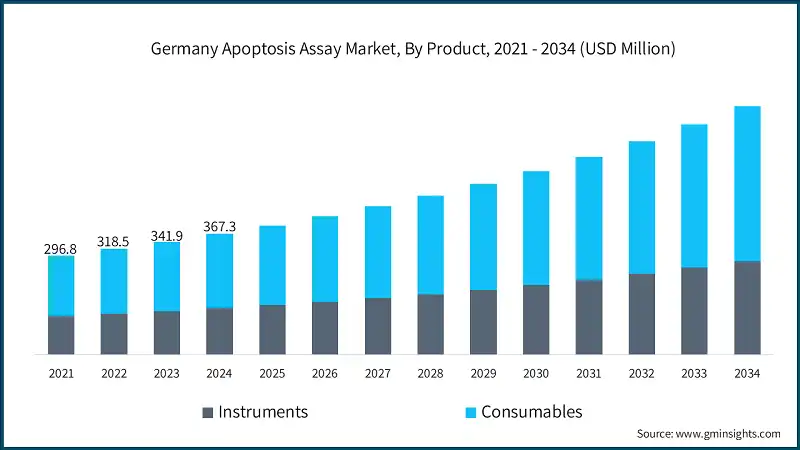
The Germany apoptosis assay market was valued at USD 296.8 million in 2021. The market size reached USD 341.9 million in 2023, from USD 318.5 million in 2022.
Based on product type, the apoptosis assay market in Germany is segmented into instruments and consumables. In 2024, the consumables segment emerged as the dominant category, largely due to the growing volume of cell-based research conducted in academic institutions and pharmaceutical laboratories across the country. The increasing need for reproducible and high-quality results has driven strong demand for premium reagents, assay kits, and microplates core components that are routinely used across various experimental platforms. This segment was valued at USD 204.8 million in 2024 and is projected to reach USD 451.1 million by 2034, growing at a CAGR of 8.3%. The increasing demand for high-performance reagents, assay kits, and detection consumables that support reproducible, scalable, and high-throughput apoptosis analysis is fueling significant growth across Germany’s pharmaceutical R&D, academic research, and clinical diagnostics sectors. German laboratories are prioritizing consistency and efficiency in cell death studies, leading to widespread adoption of specialized consumables that enable reliable data generation across diverse experimental platforms. In comparison, the instrument segment, valued at USD 162.4 million in 2024, is expected to grow to USD 350.1 million by 2034, with a slightly lower CAGR of 8%, supported by rising adoption of automated imaging platforms, integration of AI for real-time data analysis, and expanding applications in drug discovery, toxicology, and personalized medicine across advanced research and clinical laboratories.
- In Germany, the consumables segment such as kits and reagents, microplates, and other consumables remains the core of apoptosis assay protocols. They are necessary for routine cell death analysis and are used in pharmaceutical R&D, academic research, and clinical diagnostics. Their continuing demand is rooted in the desire for reproducible high-quality results for both high-throughput and small-scale experiments.
- The strength of the segment is its versatility and compatibility with a wide array of analytical platforms such as flow cytometry, fluorescence microscopy, and spectrophotometry. German labs are aided by consumables that seamlessly integrate with automated systems as well as multiplexing technologies that help increase efficiency and decrease manual errors.
- A commonly used example is Merck's Annexin V-FITC Apoptosis Detection Kit (APOAF), prized for speed and sensitivity in recognizing apoptotic cells. The kit detects phosphatidylserine exposure on cell membranes by using FITC-conjugated Annexin V, thereby making it easier to distinguish between living, apoptotic, and necrotic cells. Dual staining is facilitated by the inclusion of propidium iodide (PI) to enhance specificity and reduce background noise.
- In the future, Germany's changing demography will continue to impact demand. The nation will have 4 million more individuals aged 67 and above by the year 2035, while by the 2040s, those aged 80 and older will sharply rise owing to the increasing demand for long-term care and age-related disease research.
- Overall, consumables continue to be a foundation of apoptosis assay protocols in Germany, allowing for innovation in assay design and augmenting the country's shifting priorities in healthcare and research.
Based on technology, the Germany apoptosis assay market is segmented into flow cytometry, cell imaging and analysis system, spectrophotometry and other detection technologies. The flow cytometry, valued at USD 4.9 billion in 2022 and is estimated to register over 8.4% CAGR between 2023 and 2032, segment accounted for the highest market share of 34.6% in 2024.
- Flow cytometry is the top technology for apoptosis assay protocols in Germany because it can provide quick, multi-parameter single-cell analysis. It is the first choice of researchers in Germany for its accuracy to identify different stages of apoptosis and to measure multiple biomarkers in a single experiment. Its sensitivity and robustness render it indispensable for both early and late apoptosis cell death studies for pharmaceutical, academic, and clinical research.
- Modern flow cytometry instruments applied in Germany are designed for high-throughput applications and have sophisticated capabilities such as laser detection, automated cell sorting, and real-time data presentation. These capabilities are especially important in the development of new drugs and clinical diagnosis, where speed and precision matter. High-volume sample processing with little human interaction assists laboratories with their productivity and turnaround time.
- One system that has found broad use in German laboratories is BD Biosciences' FACSCanto II, which is efficient in the multi-color analysis. It is compatible with apoptosis detection kits and has automated sample loading and data management capabilities, which make it suitable for intricate cell analysis workflows.
- Concurrently, spectrophotometry is also picking up popularity in German research and clinical laboratories because it is cost-effective and easy to use. It gives simple, quantitative responses with little to no sample preparation and accommodates different assay types. This renders it a convenient option for laboratories that want cost-effective and scalable apoptosis detection methods.
Based on the assay type, the Germany apoptosis assay market is segmented into caspase assays, DNA fragmentation assays, mitochondrial assays, annexin v and cell permeability assays. The caspase assays segment accounted for the highest market share of 31.4% in 2024.
- In Germany, caspase assays remain one of the most widely adopted methods for detecting programmed cell death. Their central role in monitoring cellular responses to stress, therapeutic compounds, and disease progression makes them indispensable in fields such as oncology, immunology, and drug development. German researchers rely on these assays to evaluate treatment efficacy and toxicity, especially in translational and personalized medicine studies.
- Caspase assays used in German labs are designed for high-throughput applications, offering features such as luminescent and fluorescent detection, automated platform compatibility, and multiplexing support. Their ability to deliver fast, accurate results with minimal sample preparation makes them a preferred choice for both pharmaceutical companies and academic institutions.
- A widely used example in Germany is Promega’s Caspase-Glo 3/7 Assay, known for its simple mix-and-read format and stable luminescent signal. It enables precise measurement of caspase activity, helping researchers distinguish between healthy and apoptotic cells efficiently ideal for labs focused on cancer biology and drug screening.
- Alongside caspase assays, mitochondrial assays are gaining momentum in Germany, driven by increasing interest in the role of mitochondrial dysfunction in diseases such as cancer, neurodegenerative disorders, and metabolic conditions. These assays are being adopted in research aimed at uncovering disease mechanisms and developing targeted therapies, especially in institutions focused on aging and chronic illness.
Learn more about the key segments shaping this market
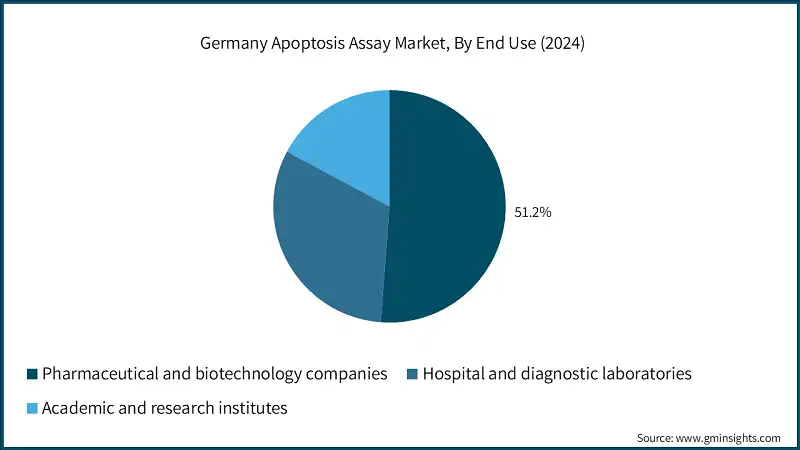
Based on end use, the Germany apoptosis assay market is segmented into pharmaceutical and biotechnology companies, hospital and diagnostic laboratories and academic and research institutes. The hospital and diagnostic laboratories segment, accounting for 31.6% market share in 2024
- The growth is driven by the widespread use of these assays in clinical diagnostics, particularly for cancer and autoimmune disorders. These institutions benefit from advanced laboratory infrastructure and access to highly trained clinical personnel, which streamlines data interpretation and reporting processes.
- With 1,874 hospitals operating across Germany as of 2023, the country has a robust healthcare system that supports both routine and specialized diagnostic testing. Many of these facilities are involved in state-sponsored screening programs, contributing to high patient volumes and consistent demand for apoptosis assays in clinical workflows.
- The segment’s growth is further supported by Germany’s aging population, which increases the need for diagnostic tools that can detect and monitor age-related diseases. Apoptosis assays are particularly valuable in identifying cellular changes linked to cancer progression, immune dysfunction, and neurodegeneration making hospitals and diagnostic labs a key setting for both early detection and personalized treatment planning.
- Moreover, the pharmaceutical and biotechnology companies segment accounted for the highest market share of 51.2% in 2024, driven by the extensive use of apoptosis assays in drug development, target validation, and toxicity screening. These companies rely on apoptosis detection tools to evaluate cellular responses to therapeutic compounds, particularly in areas such as oncology, autoimmune disorders, and neurodegenerative diseases.
Germany Apoptosis Assay Market Share
- In Germany, the apoptosis assay market is led by top companies including Thermo Fisher Scientific, Merck, Bio Rad Laboratories, Becton, Dickinson and Company (BD), and Sartorius. Together, these five players accounted for 53.32% of the market share in 2024, reflecting their strong presence across pharmaceutical, academic, and clinical research settings.
- Their leadership is built on a combination of continuous product innovation, diverse assay portfolios, strategic acquisitions, and well-established distribution networks throughout Germany and the broader EU. These companies offer solutions that range from reagents and kits to advanced instrumentation and cloud-based analytics, supporting both routine and specialized apoptosis research.
- Smaller companies such as Promega are gaining traction by delivering cost-effective, flexible, and AI-compatible assay solutions. These firms are meeting growing demand in areas such as personalized medicine, live-cell monitoring, and budget-conscious research environments. Their focus on user-friendly formats and scalable platforms is helping them expand across German laboratories.
- To remain competitive, leading companies are introducing next-generation apoptosis assays with enhanced sensitivity, built-in quality controls, and compatibility with 3D cell culture models. The integration of AI-powered analytics and cloud-based platforms is transforming by what means German labs manage, interpret, and share data fostering collaboration and accelerating scientific discovery.
Germany Apoptosis Assay Market Companies
Few of the prominent players operating in the Germany apoptosis assay industry include:
- Agilent Technologies
- BD Becton, Dickinson and Company
- Bio-Rad Laboratories
- Bio-Techne
- Carl Roth GmbH + Co. KG
- Enzo Life Sciences
- Merck
- Miltenyi Biotec
- PerkinElmer
- Promega
- Sartorius
- Tecan Group
- Thermo Fisher Scientific
- BD (Becton, Dickinson and Company)
BD is a key player in Germany’s apoptosis assay market, offering a comprehensive portfolio that includes Annexin V-FITC kits, caspase assays, and advanced flow cytometry systems. These tools are widely adopted in both clinical and academic laboratories across Germany due to their clinical-grade reliability and seamless integration with automated lab systems. BD’s focus on multi-parameter analysis and real-time data visualization supports high-throughput screening and detailed cell profiling, making it a preferred choice for cancer and immunology research.
Rad provides a broad range of apoptosis assay solutions tailored for German research institutions and pharmaceutical labs. Known for their user-friendly formats, high sensitivity, and multiplexing compatibility, Bio-Rad’s products are well-suited for both routine and advanced cell death studies. The company’s Image Lab software, which includes AI-powered image analysis tools, is widely used in Germany to quantify apoptotic markers with precision. Bio-Rad’s strong presence in academic research, clinical diagnostics, and biotech R&D reinforces its role in supporting translational science.
Agilent is also a prominent player in Germany, offering a diverse portfolio of apoptosis detection tools including flow cytometry reagents, TUNEL assay kits, and multiplexed detection systems. These solutions are valued for their precision, scalability, and compatibility with automated platforms, making them ideal for high-throughput research environments. Agilent’s tools are widely used in oncology, neurobiology, and immunology, and the company’s emphasis on data quality and reproducibility aligns well with the rigorous standards of German research institutions. Its integration across cytometry, imaging, and molecular analysis workflows makes it a trusted partner for labs focused on personalized and translational medicine.
Germany Apoptosis Assay Market Report Attributes
| Key Takeaway | Details |
|---|---|
| Market Size & Growth | |
| Base Year | 2024 |
| Market Size in 2024 | USD 367.3 Million |
| Forecast Period 2025 – 2034 CAGR | 8.2% |
| Market Size in 2034 | USD 801.2 Million |
| Key Market Trends | |
| Drivers | Impact |
| Increasing prevalence of chronic diseases | Fuels demand for apoptosis assays as cancer, neurodegenerative, and autoimmune conditions continue to rise across Germany, prompting deeper investigation into cellular mechanisms and therapeutic responses |
| Growing need for personalized medicine | Accelerates adoption of apoptosis assays in precision medicine initiatives, particularly within Germany’s clinical trials, biotech startups, and university-led research programs |
| Technological advancements in flow cytometry | Enhances the speed, sensitivity, and scalability of apoptosis detection, supporting high-throughput screening in German pharmaceutical companies and publicly funded research institutions |
| Rising application in toxicology and drug safety assessment | Strengthens the role of apoptosis assays in preclinical drug development, especially under European Medicines Agency (EMA) regulatory frameworks focused on safety profiling and efficacy validation |
| Pitfalls & Challenges | Impact |
| High cost of advanced technologies | Restricts access to cutting-edge assay platforms for smaller German academic labs and independent research centers, potentially slowing innovation |
| Regulatory and ethical challenges | Delays clinical integration due to stringent EU and German regulations around cell-based assays, patient-derived samples, and data protection |
| Opportunities: | Impact |
| Rising focus on cancer and neurodegenerative research | Drives increased use of apoptosis assays in German research institutions focused on biomarker discovery, therapeutic development, and translational medicine, especially in aging-related disease studies |
| Market Leaders (2024) | |
| Market Leaders |
18.45% market share |
| Top Players |
Collective Market Share is 3.32% |
| Competitive Edge |
|
| Future outlook |
|
What are the growth opportunities in this market?
Germany Apoptosis Assay Industry News
- In August 2025, Agilent Technologies expanded its Dako Omnis portfolio with three new instruments Omnis 110, Omnis 165, and Omnis 165 Duo designed to enhance automated immunohistochemistry (IHC) and in situ hybridization (ISH) workflows. These systems offer scalable throughput, real-time monitoring, and remote access capabilities, supporting high-efficiency pathology labs across Europe. The launch strengthened Agilent’s presence in the European clinical diagnostics market and supports advanced cell analysis workflows, including those relevant to apoptosis research in oncology and personalized medicine.
The Germany apoptosis assay market research report includes an in-depth coverage of the industry with estimates and forecast in terms of revenue in USD Million and from 2021 - 2034 for the following segments:
Market, By Product
- Instruments
- Consumables
- Kits and reagents
- Microplate
- Other consumables
Market, By Technology
- Flow cytometry
- Cell imaging and analysis system
- Spectrophotometry
- Other detection technologies
Market, By Assay Type
- Caspase assays
- DNA fragmentation assays
- Mitochondrial assays
- Annexin V
- Cell permeability assays
Market, By End Use
- Pharmaceutical and biotechnology companies
- Hospital and diagnostic laboratories
- Academic and research institutes
Frequently Asked Question(FAQ) :
What is the market size of the Germany apoptosis assay industry in 2024?
The market size was USD 367.3 million in 2024, with a CAGR of 8.2% expected through 2034 driven by rising chronic disease burden and personalized medicine adoption.
What is the current Germany apoptosis assay market size in 2025?
The market size is projected to reach USD 395 million in 2025.
What is the projected value of the Germany apoptosis assay market by 2034?
The Germany apoptosis assay industry is expected to reach USD 801.2 million by 2034, supported by advancements in flow cytometry and strong funding for life sciences.
How much revenue did the consumables segment generate in 2024?
Consumables generated USD 204.8 million in 2024, accounting for the largest market share.
What was the valuation of the instruments segment in 2024?
Instruments were valued at USD 162.4 million in 2024, driven by demand for automated imaging and AI-integrated platforms.
What are the upcoming trends in the Germany apoptosis assay market?
Key trends include AI-enabled image analysis, adoption of 3D cell culture models, and rising use of apoptosis assays in toxicology and translational medicine.
Who are the key players in the Germany apoptosis assay market?
Key players include Thermo Fisher Scientific, Merck, Bio-Rad Laboratories, Becton, Dickinson and Company (BD), Sartorius, Agilent Technologies, Promega, Miltenyi Biotec, and PerkinElmer
Germany Apoptosis Assay Market Scope
Related Reports