Summary
Table of Content

Geriatric Nutrition Protein Hydrolysates Market
Get a free sample of this report
Form submitted successfully!
Error submitting form. Please try again.
Thank you!
Your inquiry has been received. Our team will reach out to you with the required details via email. To ensure that you don't miss their response, kindly remember to check your spam folder as well!
Request Sectional Data
Thank you!
Your inquiry has been received. Our team will reach out to you with the required details via email. To ensure that you don't miss their response, kindly remember to check your spam folder as well!
Form submitted successfully!
Error submitting form. Please try again.
Geriatric Nutrition Protein Hydrolysates Market Size
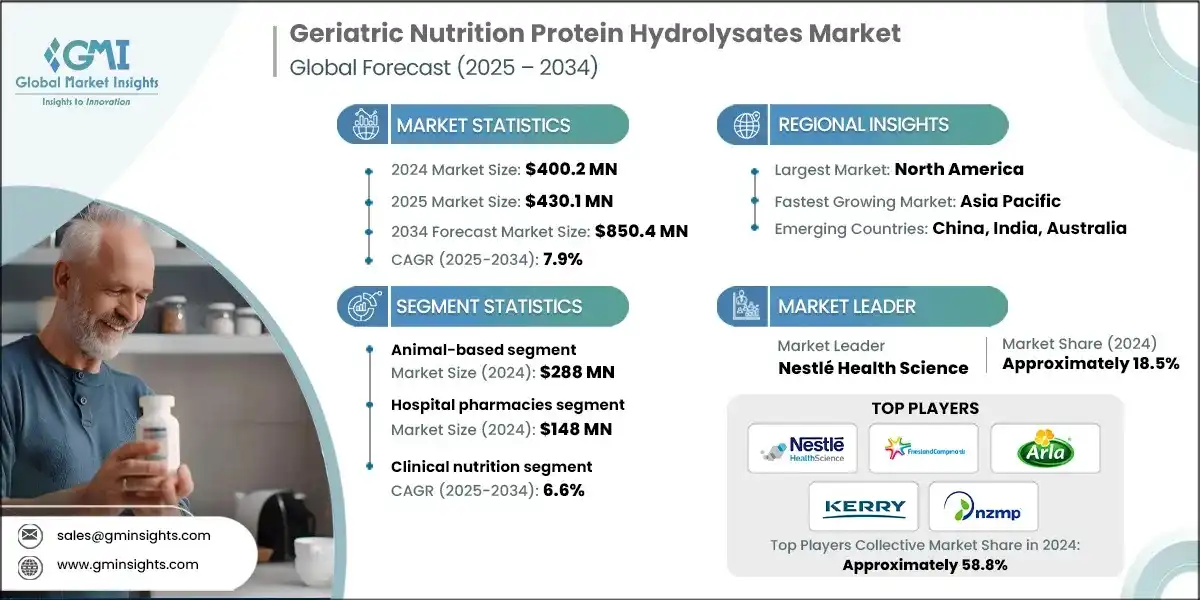
The global geriatric nutrition protein hydrolysates market size was valued at USD 400.2 million in 2024. The market is projected to grow from USD 430.1 million in 2025 to USD 850.4 million by 2034, representing 7.9% CAGR from 2025 to 2034, according to latest report published by Global Market Insights Inc.
Geriatric Nutrition Protein Hydrolysates Market Key Takeaways
Market Size & Growth
- 2024 Market Size: USD 400.2 Million
- 2025 Market Size: USD 430.1 Million
- 2034 Forecast Market Size: USD 850.4 Million
- CAGR (2025–2034): 7.9%
Regional Dominance
- Largest Market: North America
- Fastest Growing Region: Asia Pacific
Key Market Drivers
- Rapid growth of the global ageing population.
- Rising prevalence of sarcopenia and age-related malnutrition.
- Better digestibility and absorption versus intact proteins.
- Increasing use in clinical and hospital nutrition.
Challenges
- Bitter taste and palatability issues.
- High production and raw material costs.
- Complex and varying regulatory requirements.
Opportunity
- Customized hydrolysates targeting sarcopenia management.
- Growth of plant-based and hybrid hydrolysates.
- Collaborations with hospitals and long-term care facilities.
- Fortification with leucine, vitamin D, and anabolic cofactors.
Key Players
- Market Leader: Nestlé Health Science led with over 18.5% market share in 2024.
- Leading Players: Top 5 players in this market include Nestlé Health Science, Royal FrieslandCampina N.V., Arla Foods Ingredients, Kerry Group, Fonterra (NZMP), which collectively held a market share of 58.8% in 2024.
Get Market Insights & Growth Opportunities
To get key market trends
- The geriatric nutrition protein hydrolysates is a market that continues to grow gradually due to the increasing world population that is ageing, and this has resulted in a high and steady demand base of special nutrition solutions. As the percentage of people over 65 years of age grows in both developed and developing countries, there is a greater demand to find diets that promote muscle strength, mobility, and general vitality. This population trend in itself will necessitate the use of high quality, easy digestible protein sources which are specific to the older generation.
- The increasing rate of sarcopenia and malnutrition due to age also makes the market grow faster. The decreased muscle mass in older adults is common as the elderly have low appetite, chronic diseases, and physiological deterioration that exacerbate the necessity to review specific nutritional support. Protein hydrolysates are gaining traction in dietary regimes to prevent muscle wasting, positively influence recovery and enable functional autonomy which generates a long-term need in specialized formulations.
- One of the main reasons that support the growth of the market is that hydrolyzed proteins are easily digested and absorb quickly opposed to intact proteins. Older people often experience poor digestion, lower enzyme activity, and slower absorption of nutrients and this calls into question the use of traditional protein sources. Hydrolysates have smaller peptides and are more bioavailable, which can overcome these shortcomings, which increases their popularity among geriatric nutrition product creators.
- Market scale is also being fueled by increased incorporation of protein hydrolysates into clinical and hospital nutrition systems. There has been a growing trend of medical nutrition companies developing oral nutritional supplements, tube-feeding, and recovery diets with the use of hydrolysates because of its clinical benefits and tolerance. With the focus on evidence-based nutrition among the elderly patients in hospitals, nursing homes, and long-term care facilities, these ingredients are steadily increasing in popularity as a part of the larger geriatric care ecosystem.
Geriatric Nutrition Protein Hydrolysates Market Trends
- There is a move towards customized and tailored nutrition products in the elderly with a growing segmentation in medical and functional nutrition currently occurring in the market. Firms also create special blends of hydrolysates that fulfill particular requirements like muscle maintenance, mental wellness and immunity. This shift to more accuracy in nutrition is compelling manufacturers to develop more and more peptide profiles and product line changes.
- The trend of geriatric nutrition is clearly inclined towards clean-label, natural, and transparent formulations. The elderly and the carers are moving towards products that have the least possible number of additives, whose sources are clear and whose ingredients are provided in simplified lists. This trend is also forcing producers to maximize enzyme action, enhance purification and use sustainable raw material approaches, making clean-label hydrolysates sparser in geriatric products.
- There is a shift towards clinical nutrition as a home-based system which has increased the need to adopt convenient forms of products that are easy to consume. Ready-to-drink drinks, liquid shots, and sachets are increasingly popular because the elderly choose convenient forms of consumption that do not disrupt everyday life. This change facilitates increased use of hydrolysates in home nutrition long-term home nutrition and outpatient recovery programs.
- Nutrition tracking, remote monitoring, and AI-based diet suggestions are becoming a powerful trend in digital health integration that affects product design. Medical practitioners and caregivers are increasingly depending on electronic aids in order to track protein intake and nutrition adherence. This trend suggests that companies should put hydrolysate products with digital support systems to improve compliance and geriatric nutrition outcomes.
Geriatric Nutrition Protein Hydrolysates Market Analysis
Learn more about the key segments shaping this market
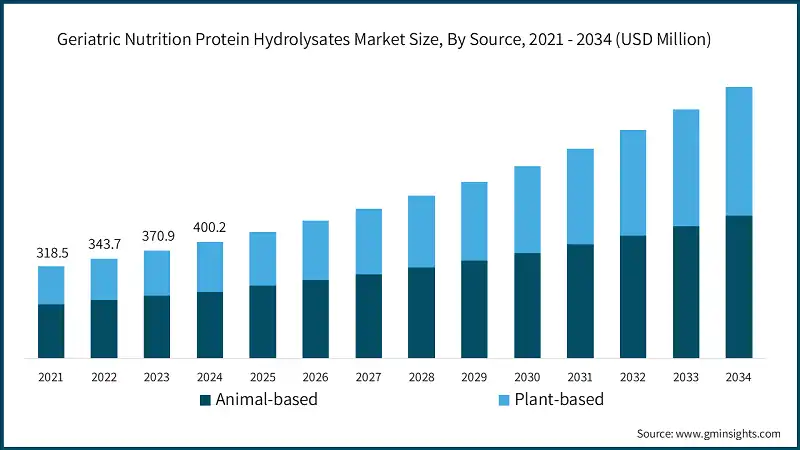
Geriatric nutrition protein hydrolysates market based on source, segmented into animal-based and plant-based. The animal-based segment was valued at USD 288 million in 2024, and it is anticipated to expand to 7.3% of CAGR during 2025 to 2034.
- Protein hydrolysates derived in animals are still promoting massive growth in the market because of high amino acid profiles and excellent digestibility that is applicable in elderly diets. Their applicability in clinical preparations to preserve, restore and generally metabolic support of muscles remains in popular use in hospitals, nursing homes and in specialized geriatric preparations. Continued advancement of hydrolysis processes and flavour enhancement is also contributing to acceptance of products among the older buyers.
- Plant-based protein hydrolysates are gaining momentum due to the changing preference trend towards the selection of alternatives that are sustainable, allergen-free, and easy to digest. The improvement in processing is assisting manufacturers in gaining cleaner taste profiles and enhanced functionality to meet geriatric needs. The increasing need in environmentally conscious nutrition also helps the segment by making more companies add variety to plant-based diets offered to the aged population and implement them into diverse product lines.
Geriatric nutrition protein hydrolysates market based on distribution channel, segmented into hospital pharmacies, retail pharmacies, online stores, and specialty stores. The hospital pharmacies segment was valued at USD 148 million in 2024, and it is anticipated to expand to 5.7% of CAGR during 2025 to 2034.
- The uptake of the hydrolysate-based clinical nutrition products offered by the company remains stable at the hospital pharmacies because the hydrolysate-based product is given to elderly patients to improve their nutritional status, recover, or have digestive restrictions. They are involved in post-operative care, chronic disease management, and in inpatient nutrition programs, which guarantee a continuous medical supervision of formulations. This channel is an important point of access to special products as ageing populations are focused on structuring nutrition plans in healthcare facilities.
- The market is expanding with the availability of hydrolysate-based nutrition by retail pharmacies, online stores, and specialty stores as more convenient to consume on a daily basis. The specialty and retail shops serve caregivers and elderly who need regular functional nutrition, whereas online shops are convenient, offer subscriptions, and increase the visibility of the products. The increase in a preference towards home based elderly care is driving more consumers to buy outside the clinical setting, and this is strengthening the demand in these routes.
Learn more about the key segments shaping this market
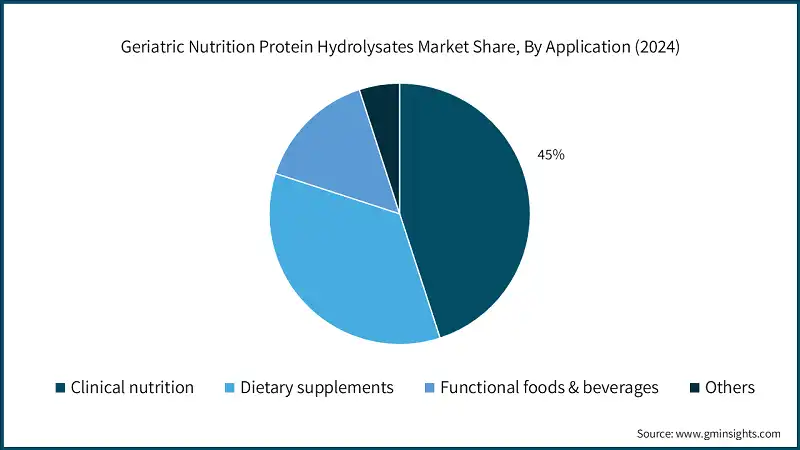
Geriatric nutrition protein hydrolysates market based on application, segmented into clinical nutrition, functional foods & beverages, dietary supplements, and others. The clinical nutrition segment was valued at USD 180 million with a market share of 45% in 2024, and it is anticipated to expand to 6.6% of CAGR during 2025 to 2034.
- Clinical nutrition has continued to be a viable field of application with more and more hospitals, rehabilitation centers and long-term care centers adopting the use of protein hydrolysates in oral nutritional supplements and tube-feeding formulae to serve elderly patients. The products are also appropriate in persons with impaired digestion or malnutrition associated with diseases since they assist in muscle maintenance, recovery, and increased nutrient absorption. With the focus on evidence-based nutrition as a standard of clinical practice, the need for specific hydrolysate-based formulations is steadily growing.
- Functional foods, beverages, dietary supplements, and other forms are setting new growth avenues because the elderly consumers are demanding convenient options of nutrition to be used daily. Hydrolysates are being added into ready to drink drinks, powders, fortified snacks and capsules to help maintain regular wellness, mobility and healthy ageing. This wider incorporation in the lifestyle and preventive nutrition markets means that manufacturers are able to focus on both the medically monitored consumer and those buying these products in the independent context, improving the overall market growth.
Looking for region specific data?
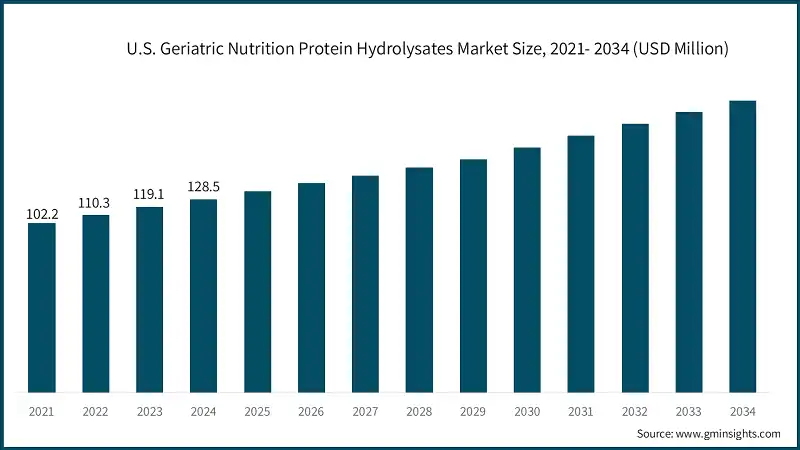
The North America geriatric nutrition protein hydrolysates market accounted for USD 144 million in 2024.
The North American region displays a consistent growth due to the growing age, solid clinical nutrition models, and significant expenditures on healthcare, which elevate the application of protein hydrolysates. Hydrolyzed proteins are used in the management of sarcopenia, post-operative care and malnutrition in hospitals and eldercare. The beverages, powdered, and senior-based products are also on the rise due to consumer interest in healthy ageing and functional nutrition. Enhanced technologies in processing and the use of home-based care encourage a wider uptake of the market.
U.S. dominates the North America geriatric nutrition protein hydrolysates market, showcasing strong growth potential.
U.S. has a high growth rate because of the high population of the aged population, excellent clinical nutrition system and product awareness. Hydrolysate-based formulas are becoming much more popular in hospitals, and consumer brands are also introducing elderly-oriented supplements and beverages. The accessibility is increased by digital health, personalized nutrition programs, and direct-to-consumer models. These elements provide an opportunity in favor of innovation and growth of hydrolysate-based geriatric nutrition.
The Europe geriatric nutrition protein hydrolysates market accounted for USD 116 million in 2024 and is anticipated to show lucrative growth over the forecast period.
The healthy development of the healthcare system, systematic care of the elderly, and effective clinical nutrition instructions contribute to the steady growth of Europe. Medical institutions and nursing homes are consuming hydrolysate-based formulas to support and recover the body, as well as digestive tolerance. The demand is not limited to clinical facilities, which is influenced by the trends in functional ageing and the interest in digestive wellness. Manufacturing standards are high, and product development is driven by research to enhance its adoption.
Germany dominates the Europe geriatric nutrition protein hydrolysates market, showcasing strong growth potential.
Germany is improving fast because of excellent use of clinical grade hydrolysates in hospitals and rehabilitation facilities. The health care system focuses on the use of nutrition based intervention in chronic disease and after surgery and increased consumption of special formula. There is also an increasing interest among consumers in medically oriented functional foods and supplements. The growth in the markets is further enhanced by research investments and positive quality processing.
Asia Pacific geriatric nutrition protein hydrolysates market is anticipated to grow at a CAGR of 9.9% during the analysis timeframe.
Asia-Pacific expands at an accelerated rate due to the increasing ageing population and the increased awareness of senior malnutrition. The growth of healthcare systems and clinical nutrition programs provokes the consumption of hydrolyzed proteins in the elderly diet. Firms introduce elderly friendly beverages, powders and liquid food based on digestive requirements. Market growth is also supported by the trends of preventive health and the growing home-based care of the elderly.
China geriatric nutrition protein hydrolysates is estimated to grow with a significant CAGR, in the Asia Pacific geriatric nutrition protein hydrolysates market.
China demonstrates a high rate of growth owing to high number of the elderly population and increased attention on sarcopenia and chronic conditions. Hospitals are using hydrolysate based formulas in enteral and oral nutritional programs. Retail market is expanding at a rapid pace with the need for high demand of senior-oriented beverages and supplements. Commercialization can be achieved fast with local manufacturing investments as well as better flavor technologies.
The Latin America geriatric nutrition protein hydrolysates market accounted for 7% market share in 2024 and is anticipated to show lucrative growth over the forecast period.
Geriatric hydrolysates are slowly gaining acceptance in Latin America as the elderly population increases, and nutritional awareness increases. To control malnutrition, muscle weakness, and recovery requirements, healthcare institutions incorporate hydrolyzed proteins. The visibility of the products is enhanced by the use of modern pharmacy and retail channels. The projects of the public health and investments into the healthcare on the part of the individuals as well reinforce the uptake in the region.
Brazil leads the Latin America geriatric nutrition protein hydrolysates market, exhibiting remarkable growth during the analysis period.
Brazil is the fastest growing because hospitals are increasing their clinical nutrition programs with hydrolysate-based chronic disease and recovery formula. Protein-enriched elder supplements and beverages are getting more acceptance by consumers. Local manufacturers and international collaborators come up with affordable and customized solutions. Such developments make Brazil a major growth region in the region.
Middle East & Africa geriatric nutrition protein hydrolysates market is expected to grow at a CAGR of 8% during the analysis timeframe.
The region demonstrates a consistent improvement due to the increased awareness of the nutritional issues of elderly people and the growth of the health care systems that specialize in the relevant field. Hospitals incorporate hydrolysates to enhance better recovery, chronic illness and malnutrition. The increased cases of lifestyle diseases among the elderly stimulate guided nutritional programs. Market expansion is enhanced by retail growth and availability of international products.
Saudi Arabia geriatric nutrition protein hydrolysates market to experience substantial growth in the Middle East and Africa market in 2024.
The development of Saudi Arabia is fast because of robust government funding in healthcare and increasing concern over the wellbeing of senior citizens. Hospitals embrace hydrolysate-based chronic illnesses management and recovery formulas. The purchasing power is very high making premium nutritional beverages and supplements to rapidly be adopted. Market penetration is facilitated through the growth of clinical nutrition programs and international brand name.
Geriatric Nutrition Protein Hydrolysates Market Share
- Nestlé Health Science, Royal FrieslandCampina N.V., Arla Foods Ingredients, Kerry Group, and Fonterra (NZMP) are a significant part of the geriatric nutrition protein hydrolysates industry and with the further standing being slightly consolidated with the top five players steadily held 58.8% market share in the year 2024.
- The market competition in the geriatric nutrition protein hydrolysate is defined by the existence of companies which continuously invest in the development and implementation of new processing technologies, clinical validation and formulation innovations.
- Companies enhance their advantage by creating hydrolysates that are more digestible, tastier, and better bioavailable, which are some of the characteristics of elderly nutrition.
- Their ability to produce to a large scale with high quality and consistency of production, and maintenance of the same across all global supply chains, makes them serve the clinical and consumer nutrition segments quite well.
- One primary competitive advantage in these firms is their high level of R&D where unremitting peptide profiling, enzyme development and clinical performance testing enable the companies to develop specific solutions to sarcopenia, malnutrition and recovery support.
- Their scientific strategy enables them to gain trust with hospitals, dietitians and medical nutrition brands, making them relevant in clinical environment. This has led to the fact that their formulations are in tandem with the changing geriatric nutrition guidelines because they work with healthcare professionals.
- The strong product diversification present in these companies also helps them to maintain the leadership of the market, providing hydrolysate ingredients in clinical formula, functional beverages, supplements, and elderly-oriented nutritional foods. This is because they can be used in a variety of applications which will facilitate market penetration and sustained growth.
- Also, they have strategic alliances with international nutrition producers and health-related facilities to expand their horizons in different territories and adjust to the regulations in different areas.
- The other determinant that is influencing the competitive environment is their adherence to quality, safety standards and regulatory compliance. These firms invest a lot in certifications, traceability systems, and high quality control and this makes them acceptable in high demand body such as hospital nutrition and specialized geriatric care.
- They maintain their presence and keep on influencing the production of hydrolysate-based geriatric nutrition solutions globally by adhering to the standards of science, changing consumer demands, and utilizing regional requirements.
Geriatric Nutrition Protein Hydrolysates Market Companies
The major players operating in geriatric nutrition protein hydrolysates industry include:
- Arla Foods Ingredients
- Nestlé Health Science
- Kerry Group
- Fonterra Co-operative Group
- Royal FrieslandCampina N.V.
- Others
- Arla Foods Ingredients remain competitive by improving clinical-grade whey hydrolysates to enhance the digestion of the elderly, muscle strength and fast absorption. The emphasis it has on peptide optimization, clean processing, and solid clinical relationships do not go out of favor in geriatric formulations.
- Nestle Health Science sustains its position by having a broad scope of clinical nutrition portfolios and product innovation in aging beverages and medical supplements. Its great network of hospitals, evidence-based formulations, and distribution systems make it well rooted in the geriatric nutritional care.
- Kerry Group enhances its position by coming up with highly functional hydrolysates that have increased taste, solubility, and digestibility to meet the needs of senior feeding. It has extensive application research and custom ingredient solutions, which has allowed it to be widely integrated into clinical and consumer geriatric products.
- Fonterra Co-operative Group maintains competitiveness through high-level technologies on dairy proteins and generation of uniform and superior quality hydrolysates in the nutrition of ageing. Its robust supply chain, innovation-driven by science and collaboration with other global brands in the nutrition industry underpin long-term demand.
- Royal FrieslandCampina N.V. still stands on its medical and geriatric-focused dairy-based hydrolysates. Its interest in ingredient development is based on research and its correspondence to clinical nutrition principles maintains its products popularity in the realm of geriatric care uses.
Geriatric Nutrition Protein Hydrolysates Market Report Attributes
| Key Takeaway | Details |
|---|---|
| Market Size & Growth | |
| Base Year | 2024 |
| Market Size in 2024 | USD 400.2 Million |
| Market Size in 2025 | USD 430.1 Million |
| Forecast Period 2025 – 2034 CAGR | 7.9% |
| Market Size in 2034 | USD 850.4 Million |
| Key Market Trends | |
| Drivers | Impact |
| Rapid growth of the global ageing population | Expands demand for specialized protein hydrolysates in geriatric nutrition |
| Rising prevalence of sarcopenia and age-related malnutrition | Drives adoption of hydrolysates for muscle maintenance and recovery |
| Better digestibility and absorption versus intact proteins | Positions hydrolysates as a preferred choice for elderly consumers |
| Increasing use in clinical and hospital nutrition | Strengthens institutional demand and accelerates market penetration |
| Pitfalls & Challenges | Impact |
| Bitter taste and palatability issues | Limits consumer acceptance and requires flavor-masking innovations |
| High production and raw material costs | Constrains pricing flexibility and impacts profitability |
| Complex and varying regulatory requirements | Slows product approvals and market entry across regions |
| Opportunities: | Impact |
| Customized hydrolysates targeting sarcopenia management | Enables premium positioning and personalized solutions |
| Growth of plant-based and hybrid hydrolysates | Opens new segments aligned with sustainability and vegan trends |
| Collaborations with hospitals and long-term care facilities | Enhances trust and institutional adoption |
| Fortification with leucine, vitamin D, and anabolic cofactors | Improves efficacy and differentiates product offerings |
| Market Leaders (2024) | |
| Market Leaders |
Market Share Approximately 18.5% |
| Top Players |
Collective market share in 2024 is 58.8% |
| Competitive Edge |
|
| Regional Insights | |
| Largest Market | North America |
| Fastest growing market | Asia Pacific |
| Emerging countries | China, India, Australia |
| Future outlook |
|
What are the growth opportunities in this market?
Geriatric Nutrition Protein Hydrolysates industry News
- In December 2024, Nestle introduced a whey-protein shot (~10 g protein) in the U.S. that targets consumers on GLP-1 weight-loss medications with Nestle as the new product that is a deep-peptide protein. This innovation demonstrates that Nestle has the potential to formulate products based on peptides (hydrolysate-like) a potential that can be transferred most to geriatric nutrition formulations of the firm.
- In November 2024, Kerry Group purchased LactoSens technology of DirectSens. This provides Kerry with real time lactose-measurement capability, which adds to its enzyme and protein-ingredient portfolio, including hydrolyzed proteins which is crucial in geriatric nutrition where both digestion level and lactose amount are critical.
- In April 2024, Arla Foods Ingredients entered a contract to purchase the Whey Nutrition business of Volac. The Felinfach plant in Wales will boost the capacity of Arla in the production of whey isolate. This is pertinent to geriatric hydrolysate market as this supports the supply of high quality whey by Arla to the surging requirements of clinically relevant protein hydrolysates to the elderly.
- In November 2023, FrieslandCampina introduced Nutri Whey ProHeat, a heat-stable whey protein meant for use in medical nutrition. It is heat-resistant and thus suitable in ready-to-drink clinical nutrition products - an important format in geriatric hydrolysate applications.
The geriatric nutrition protein hydrolysates market research report includes in-depth coverage of the industry with estimates & forecast in terms of revenue (USD Million) & (Kilo Tons) from 2021 to 2034, for the following segments:
Market, By Source
- Animal-based
- Milk protein hydrolysates (casein, whey)
- Egg protein hydrolysates
- Meat protein hydrolysates
- Fish protein hydrolysates
- Plant-based
- Soy protein hydrolysates
- Pea protein hydrolysates
- Rice protein hydrolysates
- Other plant sources (e.g., wheat, corn)
Market, By Distribution Channel
- Hospital pharmacies
- Retail pharmacies
- Online stores
- Specialty stores
Market, By Application
- Clinical nutrition
- Hospital-based nutrition
- Tube feeding formulations
- Functional foods & beverages
- Nutritional drinks
- Fortified foods
- Dietary supplements
- Capsules
- Tablets
- Sachets
- Others
The above information is provided for the following regions and countries:
- North America
- U.S.
- Canada
- Europe
- UK
- Germany
- France
- Italy
- Spain
- Rest of Europe
- Asia Pacific
- China
- India
- Japan
- South Korea
- Australia
- Rest of Asia Pacific
- Latin America
- Brazil
- Mexico
- Argentina
- Rest of Latin America
- MEA
- UAE
- Saudi Arabia
- South Africa
- Rest of Middle East and Africa
Frequently Asked Question(FAQ) :
What was the market size of the geriatric nutrition protein hydrolysates in 2024?
The market size was USD 400.2 million in 2024, driven by the growing ageing population and the demand for specialized nutrition solutions.
What is the projected value of the geriatric nutrition protein hydrolysates market by 2034?
The market is poised to reach USD 850.4 million by 2034, with a CAGR of 7.9% from 2025 to 2034, fueled by the increasing need for high-quality, easily digestible protein sources for the elderly.
What is the expected size of the geriatric nutrition protein hydrolysates industry in 2025?
The market size is projected to reach USD 430.1 million in 2025.
How much revenue did the animal-based segment generate in 2024?
The animal-based segment generated USD 288 million in 2024 and is anticipated to grow at a CAGR of 7.3% from 2025 to 2034.
What was the valuation of the hospital pharmacies segment in 2024?
The hospital pharmacies segment was valued at USD 148 million in 2024 and is expected to witness over 5.7% till 2034.
What is the growth outlook for the clinical nutrition segment from 2025 to 2034?
The clinical nutrition segment, valued at USD 180 million with a 45% market share in 2024, is set to expand at a CAGR of 6.6% up to 2034.
Which region leads the geriatric nutrition protein hydrolysates sector?
North America leads the market, accounting for USD 144 million in 2024. Growth in the region is driven by an ageing population, robust clinical nutrition frameworks, and significant healthcare expenditures.
What are the upcoming trends in the geriatric nutrition protein hydrolysates market?
Trends include personalized nutrition, clean-label natural formulations, convenient ready-to-drink formats, and digital health integration through AI diet tools and remote monitoring.
Who are the key players in the geriatric nutrition protein hydrolysates industry?
Key players include Arla Foods Ingredients, Nestlé Health Science, Kerry Group, Fonterra Co-operative Group, and Royal FrieslandCampina N.V.
Geriatric Nutrition Protein Hydrolysates Market Scope
Related Reports