Summary
Table of Content

Generative AI in Automotive Market
Get a free sample of this report
Thank you!
Your inquiry has been received. Our team will reach out to you with the required details via email. To ensure that you don't miss their response, kindly remember to check your spam folder as well!
Form submitted successfully!
Error submitting form. Please try again.
Request Sectional Data
Thank you!
Your inquiry has been received. Our team will reach out to you with the required details via email. To ensure that you don't miss their response, kindly remember to check your spam folder as well!
Form submitted successfully!
Error submitting form. Please try again.
Generative AI in Automotive Market Size
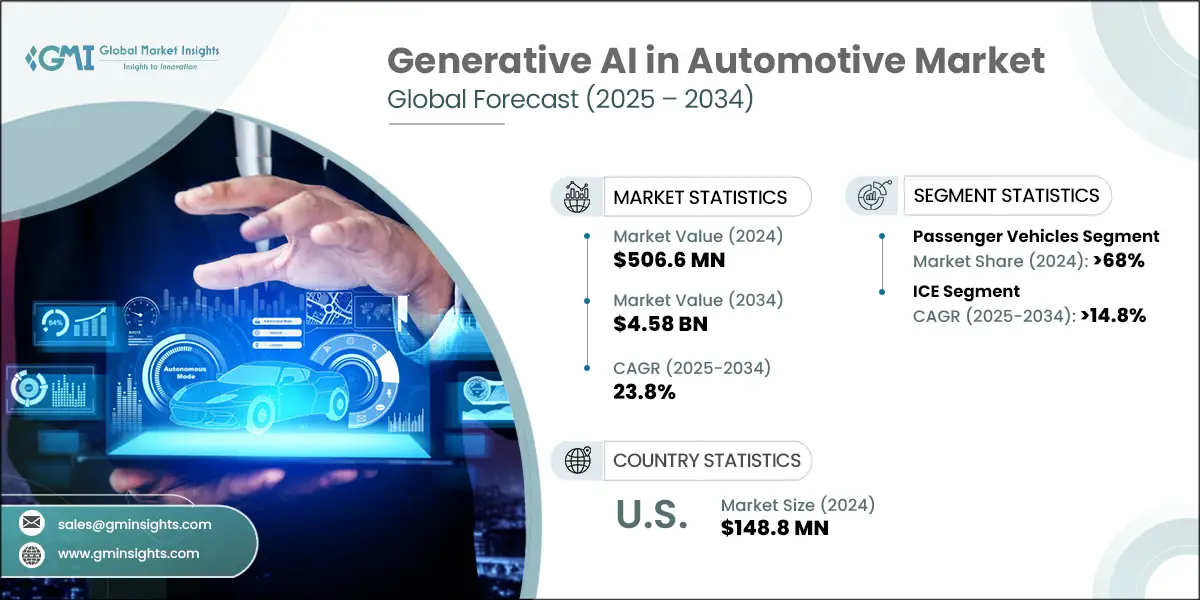
The global generative AI in automotive market size was estimated at USD 506.6 million in 2024. The market is expected to grow from USD 671 million in 2025 to USD 4.58 billion in 2034, at a CAGR of 23.8%, according to Global Market Insights Inc.
To get key market trends
- The integration of generative artificial intelligence within the automotive sector is poised for substantial expansion, propelled by progress in autonomous vehicle assessment, interconnected infrastructure, and simulation proficiencies. Favorable regulatory frameworks and financial support are fostering an environment conducive to technological assimilation across Original Equipment Manufacturers (OEMs), primary suppliers, and firms specializing in mobility technology.
- As of June 1, 2025, the California Department of Motor Vehicles has granted permission to 29 distinct entities for autonomous vehicle testing, including prominent organizations such as Waymo LLC, and Zoox Inc. This sophisticated testing platform offers a practical, authentic setting for evaluating generative AI models across diverse fields. Specifically, it facilitates the confirmation of these paradigms in areas including the creation of synthetic environments, flexible automotive assistance technologies, and refined autonomous decision-making proficiencies.
- Furthermore, the USDOT’s $52 million in grants for automated vehicle demonstrations is expediting AI-driven confirmation at established validation sites. Generative AI fulfills a pivotal function in simulating infrequent and intricate traffic situations that are challenging to record under natural conditions, thereby considerably diminishing the duration and expenditures associated with safety confirmation.
- Supportive regulatory structures, consistent public financial support, and accelerated commercial trials are projected to augment adoption rates and elevate market growth significantly beyond conventional forecasts for AI in the automotive industry. Organizations involved in these preliminary implementations are anticipated to possess a strategic advantage in the delivery of AI-enabled autonomous driving features, intelligent cockpit systems, and resource-efficient research and development channels.
Generative AI in Automotive Market Report Attributes
| Key Takeaway | Details |
|---|---|
| Market Size & Growth | |
| Base Year | 2024 |
| Market Size in 2024 | USD 506.6 Million |
| Forecast Period 2025 - 2034 CAGR | 23.8% |
| Market Size in 2034 | USD 4.58 Billion |
| Key Market Trends | |
| Drivers | Impact |
| AI integration in vehicle design and ADAS | Enhances autonomous driving, predictive maintenance, and in-vehicle personalization |
| Increasing adoption of electric and connected vehicles | Expands scope for generative AI in charging networks, fleet management, and digital cockpits |
| Cloud and edge AI deployment | Cloud and edge AI deployment Enables real-time AI processing, scalable simulation, and over-the-air software updates |
| OEM–tech company collaborations | OEM–tech company collaborations Accelerates software-defined vehicle development and ecosystem integration |
| Advancements in multimodal AI | Supports integration of vision, speech, sensor, and behavioral data for enhanced vehicle intelligence |
| Pitfalls & Challenges | Impact |
| Data privacy and cybersecurity | Sensitive vehicle and driver data requires strong safeguards and regulatory compliance |
| Integration with legacy systems | Modernizing existing vehicle software for AI deployment can be complex and costly |
| Opportunities: | Impact |
| Expansion of software-defined and autonomous vehicles | Growing adoption of SDVs and AVs increases demand for generative AI solutions |
| Collaborations with academic and research institutes | Joint initiatives foster innovation in AI algorithms and autonomous mobility |
| Emerging markets in Asia-Pacific and Latin America | Government incentives and EV adoption fuel regional growth |
| Integration with mobility services | Fleet operators and shared mobility platforms can leverage generative AI for optimization |
| Market Leaders (2024) | |
| Market Leaders |
26% market share |
| Top Players |
Collective market share in 2024 is 59% |
| Competitive Edge |
|
| Regional Insights | |
| Largest Market | North America |
| Fastest growing market | Asia Pacific |
| Emerging countries | China, India, South Korea, Brazil, UAE |
| Future outlook |
|
What are the growth opportunities in this market?
Generative AI in Automotive Market Trends
- The application of generative AI in the automotive is entering an era of heightened regulatory oversight. The EU AI Act, to take effect in August 2024, classifies the majority of autonomous systems as exhibiting "high-risk." This, in conjunction with over 20 European Union regulations concerning the exchange of data from connected vehicles, necessitates AI solutions that are transparent, secure, and demonstrably free from bias. While adherence to these mandates may increase operational expenditures, it concurrently fosters greater public trust and streamlines access to cross-border markets.
- Generative AI is substituting expensive physical trials with artificially constructed environments. Extensive testing programs, such as China's initiative involving 16,000 permits and California's system with 29 permit holders, in conjunction with public research and development investments like the USDOT's $700 million Vehicle-to-Everything (V2X) investment, are enabling large-scale simulation of infrequent scenarios. This accelerates the validation of safety protocols and the implementation of new features, thereby compressing the time required for market introduction.
- The mobility industry is heading towards complete, connected systems. Government pushes in China and Europe, along with hardware/software partnerships like those involving NVIDIA, are building these platforms. AI is becoming a key tool here, helping with design, upkeep, smart dashboards, and simulations, creating a competitive edge.
- Government regulations are playing a major role in how artificial intelligence is being adopted in the car industry. Specifically, China's "AI Plus" and "Made in China 2025" programs are heavily focused on improving smart driving technologies. For instance, they've issued 16,000 licenses for testing self-driving cars by 2024, covering a large network of 32,000 kilometers of roads. These large-scale, government-supported tests generate lots of data, which helps generative AI improve how self-driving cars navigate and predict traffic patterns. This, in turn, speeds up the process of getting these technologies ready for widespread use.
Generative AI in Automotive Market Analysis
Learn more about the key segments shaping this market
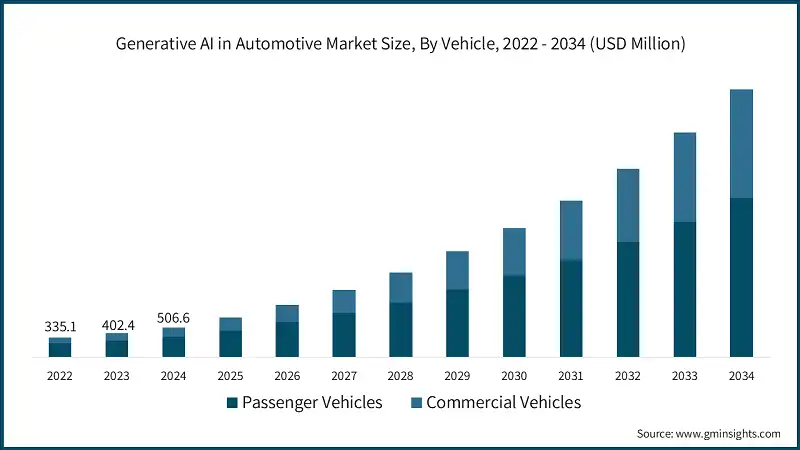
Based on vehicle, generative AI in automotive market is divided into passenger vehicles, and commercial vehicles. The passenger vehicles segment dominated the market in 2024, accounting for over 68% of total revenue.
- The increasing prevalence of generative artificial intelligence is being driven primarily by its adoption of automobiles. Specifically, its integration is noticeable across a range of vehicular applications, including infotainment platforms, driver assistance features, and vehicle safety mechanisms. Generative AI is a game-changer for cars! It's making in-car assistants super easy to use and chat with, predicting when your car needs service, and boosting driver safety with smarter ADAS. Plus, better sensors and regular over-the-air updates keep everything running smoothly.
- The growth of the luxury and electric vehicle (EV) markets is a key catalyst in this progression. These segments commonly incorporate the necessary hardware infrastructure and connectivity to accommodate the substantial computational requirements of sophisticated AI. This capacity allows for instantaneous reconstruction of environmental surroundings, sophisticated design simulations, and the delivery of highly personalized in-cabin experiences.
- Furthermore, AI-powered simulations are instrumental in the training of drivers and the validation of autonomous systems. These simulations effectively replicate infrequent or perilous scenarios, thereby contributing to enhanced safety protocols across a spectrum of industries, including logistics, resource extraction, and long-distance transportation.
Learn more about the key segments shaping this market
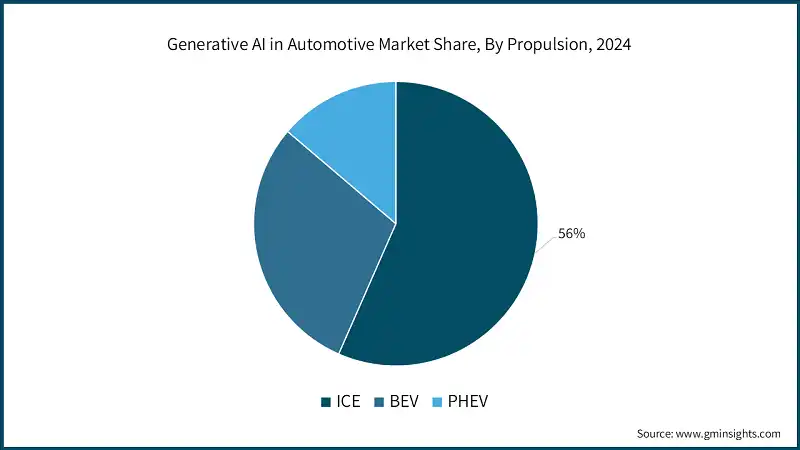
Based on propulsion, the generative AI in automotive market is segmented into ICE, BEV and PHEV. The ICE segment dominated market in 2024 and is expected to grow at a CAGR of over 14.8% from 2025 to 2034.
- Internal combustion engines (ICE) automobiles are increasingly integrating generative artificial intelligence, primarily to enhance driver support systems, in-vehicle entertainment, and proactive upkeep. Although adoption is less rapid compared to electric vehicles, the retrofitting of interconnected systems and over-the-air software enhancements are facilitating the selective incorporation of AI-driven functionalities in upper-mid-range and high-end models.
- Battery Electric Vehicles (BEVs) are at the forefront of this trend, harnessing generative AI to facilitate autonomous navigation, optimize battery performance, and create captivating in-cabin experiences. Their substantial processing power, sophisticated sensor arrays, and seamless cloud integration render them exceptionally well-suited for executing intricate AI tasks.
- Plug-in Hybrid Electric Vehicles (PHEVs) employ generative AI to achieve equilibrium between electric and combustion efficiency, streamline energy management, and refine route optimization. The uptake of AI in PHEVs is gaining momentum, as these vehicles function as an intermediary between conventional ICE platforms and fully electrified architectures.
- Fundamentally, BEVs and PHEVs possess an inherent advantage in AI integration, owing to the compatibility of electrification with interconnected and self-governing features. Conversely, ICE vehicles focus on economical, targeted AI applications.
Based on technology, the generative AI in automotive market is segmented into large language models (LLMS) and NLP, computer vision and image generation, multimodal AI and cross-domain integration, generative AI platforms and tools, and others. The large language models (LLMS) and NLP segment are expected to dominate the generative artificial intelligence in automotive market, as the growing demand for intuitive, conversational in-car systems and personalized driver experiences drives adoption of advanced natural language understanding and response capabilities.
- Large Language Models (LLMs) and Natural Language Processing (NLP) are facilitating progress in automotive voice control, speech-based navigation, and consumer engagement interfaces. These technologies promote seamless communication between vehicle occupants and the system, which minimizes driver inattention and optimizes user-specific customization.
- Computer vision and image generation are fundamental to self-driving vehicles and advanced driver-assistance systems (ADAS). These technologies facilitate instantaneous environmental interpretation, object identification, and the generation of artificial datasets for model training. Consequently, they enhance perceptual precision and verification of safety protocols.
- The convergence of multimodal AI and cross-functional integration combines textual, visual, sensory, and auditory data to provide comprehensive analytical capabilities for intricate driving conditions. This synergistic approach underpins functionalities such as dynamic route optimization, risk forecasting, and augmented reality-based navigational aids.
- Generative AI platforms and tools provide a robust framework for creating, refining, and implementing artificial intelligence models across a spectrum of automotive applications. This empowers vehicle manufacturers and component providers to accelerate the advancement of their AI capabilities, while simultaneously adhering to stringent safety regulations and performance benchmarks.
Looking for region specific data?
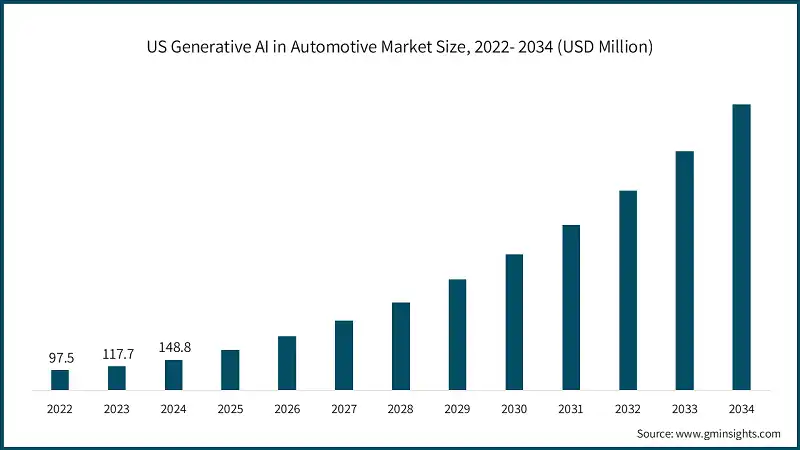
The US dominates the North American generative AI in automotive market, generating approximately USD 148.8 million revenue in 2024.
- The United States currently maintains a leading position in the North American, due to its robust technological environment, extensive research capacities, and vigorous collaboration between governmental bodies, academic institutions, and private industries. Universities, research facilities, and private sector entities are progressing generative AI implementations across both vehicular platforms and associated infrastructure.
- For instance, in January 2025, University of Texas at Dallas being awarded a grant of $3.5 million for the project entitled "Generative AI Enabled Cybersecurity of Electric Vehicle Charging for Grid Services." This undertaking employs generative AI and deep learning methodologies to formulate sophisticated intrusion detection systems for electric vehicle charging networks and grid-vehicle integration, elements vital to ensuring the secure functionality of future transportation environments.
- Such projects highlight the United States' capacity to integrate advancements in artificial intelligence within existing automotive and energy infrastructures, fostering collaborations across sectors. By focusing strategically on both vehicle-based intelligent systems and supporting digital infrastructures, the nation is solidifying its leadership position not only in automotive artificial intelligence capabilities but also in the dependable and scalable deployment of integrated mobility solutions.
The generative AI in automotive market in the Germany is expected to experience significant and promising growth from 2025 to 2034.
- Europe is increasingly recognized as a pivotal area for the advancement of Generative Artificial Intelligence within the automotive sector. This prominence is fueled by its robust legal and supervisory system, its well-developed automotive production industry, and its prioritization of secure and moral AI implementation.
- The European Union's AI legislation, scheduled to take effect in August 2024, designates the majority of self-driving vehicle technologies as "high-risk." This classification necessitates rigorous transparency, assessment, and data protection protocols, thereby compelling organizations to incorporate adherence to these standards from the initial phases of their AI development processes.
- The region's sophisticated automotive centers, notably in Germany, France, and Italy, are actively implementing generative AI to optimize design processes, conduct safety simulations, and develop advanced in-vehicle control systems. Furthermore, the existing framework of over twenty European directives governing connected vehicle data exchange establishes a standardized, albeit closely monitored, environment. This arrangement serves to bolster consumer confidence while simultaneously encouraging technological advancement.
- Collaborative initiatives involving automotive manufacturers, AI technology suppliers, and academic research bodies are expediting the integration of generative AI. A heightened emphasis is being placed on multimodal AI solutions, the creation of synthetic data, and high-precision simulation techniques for the verification and validation of autonomous driving capabilities. These efforts are further supported by European Union investments in transnational testing facilities and connected vehicle infrastructure.
The generative AI in automotive market in China is expected to experience strong growth from 2025 to 2034.
- Asia is experiencing one of the fastest-growing regions in the global Generative AI in Automotive sector. This burgeoning development is primarily fueled by strong state support, the swift progression of vehicle electrification efforts, and widespread autonomous driving research endeavors.
- China has embedded artificial intelligence in the automotive domain into its "AI Plus" initiative and the "Made in China 2025" strategy. The ambition is to cultivate a comprehensive and interconnected intelligent vehicle ecosystem by 2025. To date, China has issued 16,000 permits for autonomous vehicle trials, encompassing 32,000 kilometers of open roads. This has yielded one of the largest extant collections of authentic data, invaluable for the education and authentication of generative AI models.
- Furthermore, Japan and South Korea are actively pursuing the adoption of generative AI, with a particular emphasis on mobility-as-a-service (MaaS) applications, robotic integration, and the crafting of highly realistic simulations designed for autonomous navigation. These countries leverage their robust electronics and semiconductor sectors to produce automotive-grade AI hardware, endowing them with the processing power necessary to execute complex generative models in real time.
- The India is materializing as a cost-effective development center, witnessing increasing research and development investment in AI-powered automotive software, particularly for connected vehicle platforms and fleet optimization. Regional cooperation throughout Asia is cultivating shared experimentation environments, data interchange conventions, and standardization endeavors that expedite inter-market implementation.
Generative AI in automotive market in UAE is expected to experience significant and promising growth from 2025 to 2034.
- The Middle East and African automotive sector currently exhibit nascent integration of generative artificial intelligence. However, increasing impetus is derived from burgeoning smart city developments, expansion of electric vehicle infrastructure, and preliminary autonomous mobility schemes. Notably, the Gulf nations, specifically the United Arab Emirates and Saudi Arabia, are incorporating artificial intelligence-enabled transportation strategies into their national development agendas. These strategies are primarily focused on interconnected vehicle networks, sophisticated traffic regulation systems, and self-driving transit solutions.
- Generative artificial intelligence is increasingly employed in simulation-based verification processes to model harsh climatic and topographical conditions. This facilitates original equipment manufacturers (OEMs) in tailoring autonomous and electric vehicle platforms to the distinctive operational landscapes present in specific regions. Collaborative arrangements with international automotive manufacturers and providers of artificial intelligence solutions are instrumental in facilitating the dissemination of expertise and the establishment of localized testing infrastructures.
- Within the African continent, the integration of these technologies is occurring at a more deliberate pace, though it is being spurred by nascent mobility-as-a-service programs, particularly within urban conurbations. Nations such as South Africa are investigating the potential of AI-driven fleet optimization and safety surveillance for applications in commercial transportation and logistical operations.
The generative AI in automotive market in Brazil is expected to experience significant and promising growth from 2025 to 2034.
- The automotive sector in Latin America is currently witnessing the nascent stages of generative AI adoption, with expansion primarily fueled by the increasing prevalence of connected vehicles, the optimization of fleet management practices, and the introduction of initial autonomous mobility pilot programs. Within the region, Brazil and Mexico are at the forefront of this technological integration, capitalizing on their established automotive manufacturing centers to evaluate AI-augmented design processes, simulation capabilities, and proactive maintenance solutions.
- Generative artificial intelligence is being explored for optimizing urban traffic patterns, elevating the effectiveness of logistical operations, and bolster vehicular safety through the development of AI-produced training simulations. Its convergence with electric and hybrid vehicle initiatives is progressively expanding, particularly in response to governmental advocacy for environmentally sustainable transportation alternatives.
- Collaborative engagements with international original equipment manufacturers (OEMs) and AI technology purveyors are facilitating access for domestic stakeholders to cutting-edge platforms designed for modeling, intuitive linguistic interactions, and the fabrication of synthetic datasets. Nevertheless, deficiencies in existing infrastructure and protracted regulatory processes continue to represent significant impediments to comprehensive implementation.
Generative AI in Automotive Market Share
- The top 7 companies in the generative AI in automotive industry are NVIDIA, Qualcomm, Microsoft, Google, Amazon Web Services (AWS), IBM, and Intel contributing around 69% of the market in 2024.
- NVIDIA is a dominant player in automotive AI, using its DRIVE platform and powerful GPUs for simulation, self-driving, and design. Strong revenue growth and partnerships highlight its dominance in AI perception and integration. However, its high costs can be a barrier for some.
- Qualcomm's Snapdragon Digital Chassis uses generative AI to help drivers, personalize entertainment, and predict when maintenance is needed. Their edge is combining AI smarts with excellent connectivity for instant decisions in connected cars. They work with lots of big suppliers but face tough competition from NVIDIA and Intel.
- Microsoft's Azure AI offers generative AI for design, maintenance, and driver interaction. Its strengths are enterprise-level compliance, integration, and scalability, especially in cloud-based vehicle simulation, though edge-device capabilities trail behind NVIDIA and Qualcomm.
- Google is using its cloud AI for virtual prototyping, voice assistants, and driver monitoring. Its strengths are in natural language processing, cloud scalability, and access to vast datasets. While popular for digital cockpit innovation, it lags in enterprise-level customization compared to Microsoft and IBM.
- AWS supports generative AI in vehicles via SageMaker, IoT FleetWise, and simulation for self-driving car testing. Key assets are scalability, accessible APIs, and supply chain data integration. Favored for autonomous driving R&D and fleet analytics, data privacy worries may limit adoption in regulated industries.
- IBM brings AI to vehicle diagnostics, design, and personalization with Watson. Its ethical AI, hybrid cloud, and on-premise options appeal to regulated industries. However, slower innovation and higher costs limit its reach in the consumer vehicle market.
- Intel, via Mobileye, also uses generative AI for self-driving features. Their strength is making hardware and software work really well together, offering affordable chips for many car models. Mobileye's getting better at creating fake driving data to train self-driving systems, but NVIDIA is still a major rival in top-end autonomous tech.
Generative AI in Automotive Market Companies
Major players operating in generative AI in automotive industry are:
- Amazon Web Services (AWS)
- Aptiv
- Bosch
- Continental
- IBM
- Intel
- Microsoft
- NVIDIA
- Qualcomm
- NVIDIA, Intel, Qualcomm, Microsoft, Amazon, and Google are building complete AI systems and car-specific tools. NVIDIA DRIVE and Intel's Mobileye are powering self-driving cars with smart perception and realistic simulations. Qualcomm adds AI to vehicle connectivity for quick decisions. Microsoft Azure and Google Cloud give automakers flexible AI tools for design, maintenance, and in-car help, plus cloud-based training.
- IBM, Bosch, Continental, and Aptiv concentrate on AI solutions for businesses. IBM Watson brings AI to vehicle repair, fleet control, and online services, with a focus on doing things the right way. Bosch, Continental, and Aptiv offer AI-powered driver assistance, sensor tech, and vehicle control, selling to automakers and suppliers for better safety and performance.
- Together, these companies mix hardware, software, and cloud tech to promote generative AI in both consumer and commercial vehicles. They're working on self-driving, simulation, smart maintenance, and connected features, building an environment where AI makes cars smarter, more efficient, and better to use.
Generative AI in Automotive Industry News
- In May 2025, Qualcomm introduces generative AI for automotive connected services through its Car-to-Cloud platform and new AI orchestrator. The solutions enhance personalized in-vehicle experiences, support software-defined vehicles, and accelerate OEM deployment of ADAS, digital cockpit, and connectivity solutions.
- In March 2025, IBM collaborates with AWS to accelerate automotive application modernization using generative AI. The solution automates legacy code conversion, streamlines migration to cloud and hybrid environments, and improves efficiency in vehicle software development and diagnostics.
- In January 2025, AWS collaborates with Honda to develop software-defined vehicles (SDVs) and enhance EV charging experiences using generative AI. The initiative leverages AWS’s Digital Proving Ground, AI, IoT, and cloud capabilities to accelerate EV services, OTA updates, and personalized vehicle features.
- In January 2025, HERE and AWS announce a 10-year, $1 billion cloud partnership to provide AI-powered mapping solutions, accelerating the development of software-defined vehicles (SDVs), ADAS, automated driving, and digital car experiences globally.
The generative AI in automotive market research report includes in-depth coverage of the industry with estimates & forecasts in terms of revenue ($ Mn/Bn) from 2021 to 2034, for the following segments:
Market, By Vehicle
- Passenger vehicles
- Hatchback
- Sedan
- SUV
- MPV
- Electric passenger cars
- Commercial vehicles
- Light commercial vehicles
- Heavy commercial vehicles
Market, By Propulsion
- ICE
- BEV
- PHEV
Market, Technology
- Large Language Models (LLMs) and NLP
- Computer vision and image generation
- Multimodal AI and cross-domain integration
- Generative AI platforms and tools
- Others
Market, By Application
- Autonomous driving and ADAS applications
- Vehicle design and engineering
- Manufacturing and production optimization
- Customer experience and personalization
- Supply chain and logistics optimization
- Others
Market, By End Use
- OEM
- Tier 1 automotive suppliers
- Automotive software and technology companies
- Mobility service providers and fleet operators
The above information is provided for the following regions and countries:
- North America
- US
- Canada
- Europe
- Germany
- UK
- France
- Italy
- Spain
- Russia
- Nordics
- Asia Pacific
- China
- India
- Japan
- Australia
- South Korea
- Southeast Asia
- Latin America
- Brazil
- Mexico
- Argentina
- MEA
- South Africa
- Saudi Arabia
- UAE
Frequently Asked Question(FAQ) :
What are the upcoming trends in the generative AI in automotive market?
Trends include regulatory oversight like the EU AI Act, large-scale simulation replacing physical trials, connected systems driven by government initiatives.
Who are the key players in the generative AI in automotive industry?
Key players include Amazon Web Services (AWS), Aptiv, Bosch, Continental, Google, IBM, Intel, Microsoft, NVIDIA, and Qualcomm.
Which region leads the generative AI in automotive sector?
The U.S. leads the North American market with USD 148.8 million revenue in 2024, driven by technology, research, and public-private partnerships.
What was the growth outlook for the ICE segment from 2025 to 2034?
The ICE segment is expected to grow at a CAGR of over 14.8% from 2025 to 2034, with generative AI enhancing driver support systems, in-vehicle entertainment, and predictive maintenance.
What percentage of revenue did the passenger vehicles segment account for in 2024?
The passenger vehicles segment dominated the market, accounting for over 68% of total revenue in 2024.
What is the projected value of the generative AI in automotive market by 2034?
The market is poised to reach USD 4.58 billion by 2034, fueled by technological integration across OEMs, primary suppliers, and mobility technology firms.
What is the market size of the generative AI in automotive in 2024?
The market size was estimated at USD 506.6 million in 2024, with a CAGR of 23.8% expected through 2034. Advancements in autonomous vehicle assessments, interconnected infrastructure, and simulation capabilities are driving market growth.
Generative AI in Automotive Market Scope
Related Reports