Summary
Table of Content

GaN Power Transistors Market
Get a free sample of this report
Form submitted successfully!
Error submitting form. Please try again.
Thank you!
Your inquiry has been received. Our team will reach out to you with the required details via email. To ensure that you don't miss their response, kindly remember to check your spam folder as well!
Request Sectional Data
Thank you!
Your inquiry has been received. Our team will reach out to you with the required details via email. To ensure that you don't miss their response, kindly remember to check your spam folder as well!
Form submitted successfully!
Error submitting form. Please try again.
GaN Power Transistors Market Size
The GaN power transistors market is primarily driven by automotive OEM qualification of GaN for 800V electric vehicle platforms and government-backed wide-bandgap semiconductor manufacturing policies are accelerating commercialization, scaling production capacity, and strengthening GaN adoption across automotive, industrial, and consumer power electronics applications.
GaN Power Transistors Market Key Takeaways
Market Size & Growth
- 2025 Market Size: USD 511.3 Million
- 2026 Market Size: USD 667.8 Million
- 2035 Forecast Market Size: USD 8 Billion
- CAGR (2026–2035): 31.8%
Regional Dominance
- Largest Market: Asia Pacific
- Fastest Growing Region: Asia Pacific
Key Market Drivers
- EV onboard chargers shifting to high-efficiency GaN architectures.
- Data center power supplies targeting 80 Plus Titanium.
- Consumer electronics OEMs adopting USB-C PD GaN adapters.
- Automotive OEMs qualifying GaN for 800V platforms.
- Wide-bandgap policies supporting domestic semiconductor manufacturing investments.
Challenges
- Thermal management complexity in high-power GaN designs.
- Limited long-term reliability data for automotive-grade GaN.
Opportunity
- Solid-state transformers using high-voltage GaN devices.
- Aerospace power systems demanding lightweight, high-efficiency converters.
Key Players
- Market Leader: Infineon Technologies led with over 25% market share in 2025.
- Leading Players: Top 5 players in this market include Infineon Technologies, Navitas Semiconductor, Onsemi, Texas Instruments, STMicroelectronics, which collectively held a market share of 77% in 2025.
Get Market Insights & Growth Opportunities
The GaN power transistors market is strongly driven by the transition of EV onboard chargers toward high-efficiency GaN architectures as governments accelerate clean mobility infrastructure. For instance, the Technology Development Board of the Government of India and the Department of Science & Technology support the commercialization of indigenous EV chargers in line with the vision of the ‘Atmanirbhar Bharat.’ It will help in growing the indigenous EV charger technology and decreases import dependencies. This support promotes the use of advanced power semiconductors like GaN in onboard chargers. It allows for greater efficiency, fewer losses, and faster electrification of transport platforms.
The GaN power transistors market is further boosted by data center power supplies that aim for 80 Titanium Plus efficiency standards as governments focus on energy efficiency in essential infrastructure. For instance, the U.S. Environmental Protection Agency is broadening ENERGY STAR efforts to increase energy efficiency of data centers This includes energy efficiency verification and rating of power supplies with the aim of minimizing energy waste. Such regulatory pressure is influencing data center operators to move toward high-efficiency power supply units, thereby increasing demand for GaN devices that provide better efficiency, reduced losses, and lower operational costs across hyperscale and enterprise facilities.
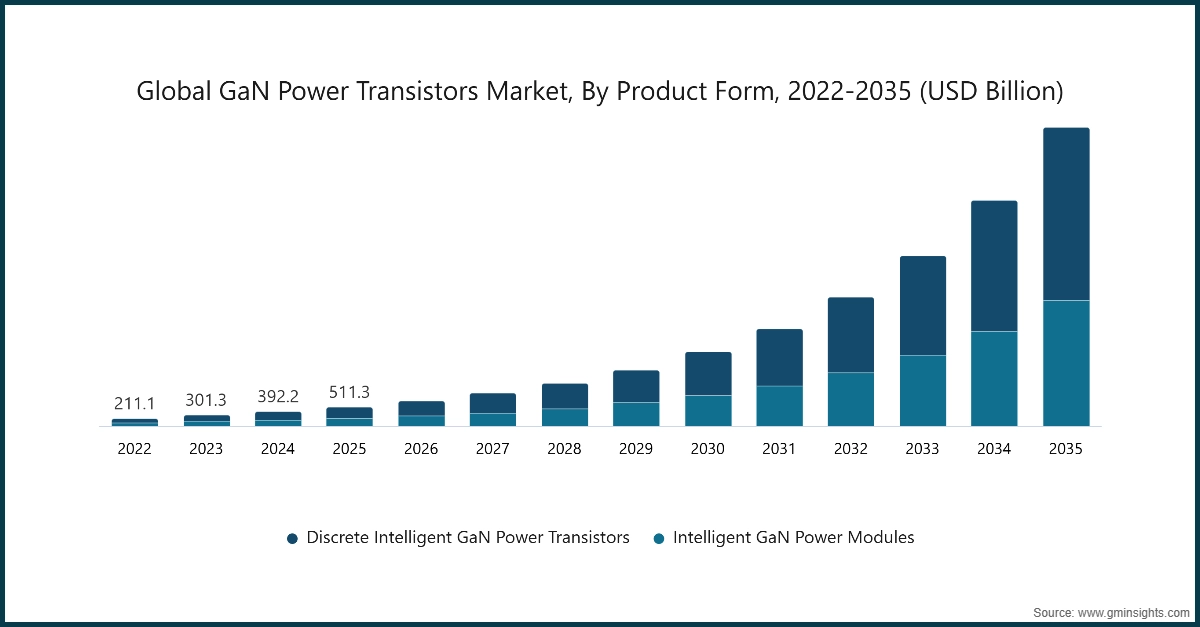
Between 2022 and 2024, the market witnessed considerable growth, increasing from USD 211.1 million in 2022 to USD 392.2 million in 2024. This growth was fueled by the electrification of vehicle platforms, increasing energy efficiency demands in digital infrastructure, and the rise of fast-charging consumer devices. Additional momentum arose from pilot projects using GaN in high-voltage automotive systems and public investments that support domestic wide-bandgap semiconductor ecosystems. This improves supply availability and accelerates market penetration.
The global GaN power transistors market was valued at USD 511.3 million in 2025. The market is expected to grow from USD 667.8 million in 2026 to USD 2.6 billion in 2031 & USD 8 billion in 2035, at a CAGR of 31.8% during the forecast period according to the latest report published by Global Market Insights Inc.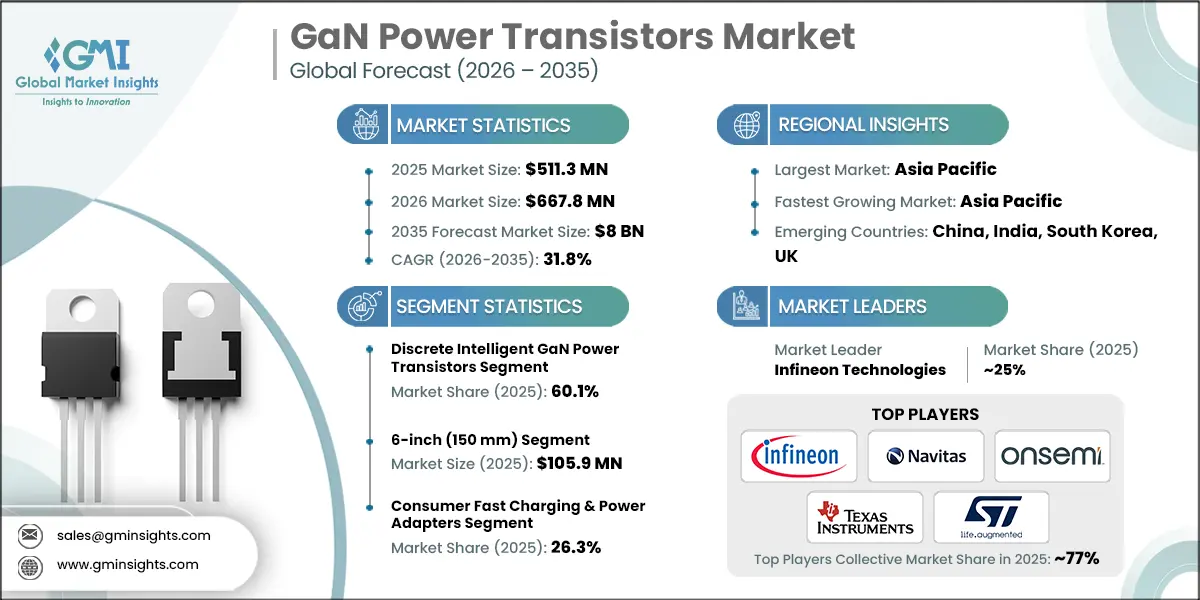
To get key market trends
GaN Power Transistors Market Trends
- GaN power transistor technology in medium- and high-voltage power conversion systems is likely to be another important market trend in the coming time. This trend is expected to start from around 2021. The main driving force for the adoption of GaN power transistors is the increased need for space-saving, high-frequency power converters in renewable energy, rail traction, and power supplies. The usage of GaN power transistor technology is expected to continue through 2030.
- The use of enhanced GaN packaging and co-packaged power modules helps to advance the efficiency and reliability of devices. This development has been going on since 2020, where the idea was to address challenges like parasitic effects, thermal constraints, and EMI challenges related to GaN devices. This development will probably continue till late 2020s for automotive and industrial clients looking for greater integration in their devices.
- The move toward fabless GaN device models with outsourced manufacturing is becoming more common. This trend accelerated after 2022, driven by high capital costs of GaN fabs and the availability of specialized foundries offering GaN-on-Si processes. It is expected to persist through 2030 as supply chains regionalize. This approach lowers entry barriers, speeds innovation, and diversifies supplier ecosystems globally.
- The use of GaN power transistors in harsh-environment and high-temperature applications is gaining traction. Early adoption began around 2021, especially in aerospace, defense, and industrial automation where silicon performance is limited. This trend is likely to continue beyond 2030 as reliability data builds up and qualification standards evolve. This expansion enhances GaN’s role in mission-critical power electronics that have strict performance needs.
GaN Power Transistors Market Analysis
Learn more about the key segments shaping this market
Based on the product form, the market is divided into discrete intelligent GaN power transistors and intelligent GaN power modules.
- The discrete intelligent GaN power transistors segment dominated the market with 60.1% share in 2025, driven by their widespread adoption in consumer fast chargers, data center power supplies, and telecom power systems. These devices offer design flexibility, lower system cost, and easier integration into existing power architectures, making them the preferred choice for high-volume, cost-sensitive applications where OEMs optimize performance at the board level.
- The intelligent GaN power modules segment is anticipated to grow at a CAGR of 32.4% over the forecast period due to rising demand from automotive, industrial, and aerospace applications. Integrated gate drivers, protection features, and optimized thermal paths reduce design complexity and qualification time, accelerating adoption in high-reliability and high-power systems where performance consistency and safety are critical.
Based on the wafer size, the global GaN power transistors market is divided into 4-inch (100 mm), 6-inch (150 mm), 8-inch (200 mm), and 12-inch (300 mm) wafers.
- The 6-inch (150 mm) wafer segment dominated the market in 2025 and valued at USD 105.9 million, as it represents the most commercially mature and widely adopted manufacturing platform for GaN-on-silicon devices. Established fabrication processes, stable yields, and optimized cost structures have enabled large-scale production of GaN power transistors on 6-inch wafers. This wafer size is extensively used for consumer electronics, telecom, and industrial applications, where a balance between performance, manufacturing efficiency, and cost competitiveness is essential.
- The 12-inch (300 mm) wafer segment is expected to witness growth at a CAGR of 32.4% during the forecast period, supported by the semiconductor industry’s push toward higher manufacturing efficiency and lower per-device costs. Leading foundries and integrated device manufacturers are investing in 300 mm GaN process development to leverage existing silicon manufacturing infrastructure. As these processes mature, 12-inch wafers will support high-volume automotive and data center applications, significantly improving scalability and long-term cost economics.
Learn more about the key segments shaping this market
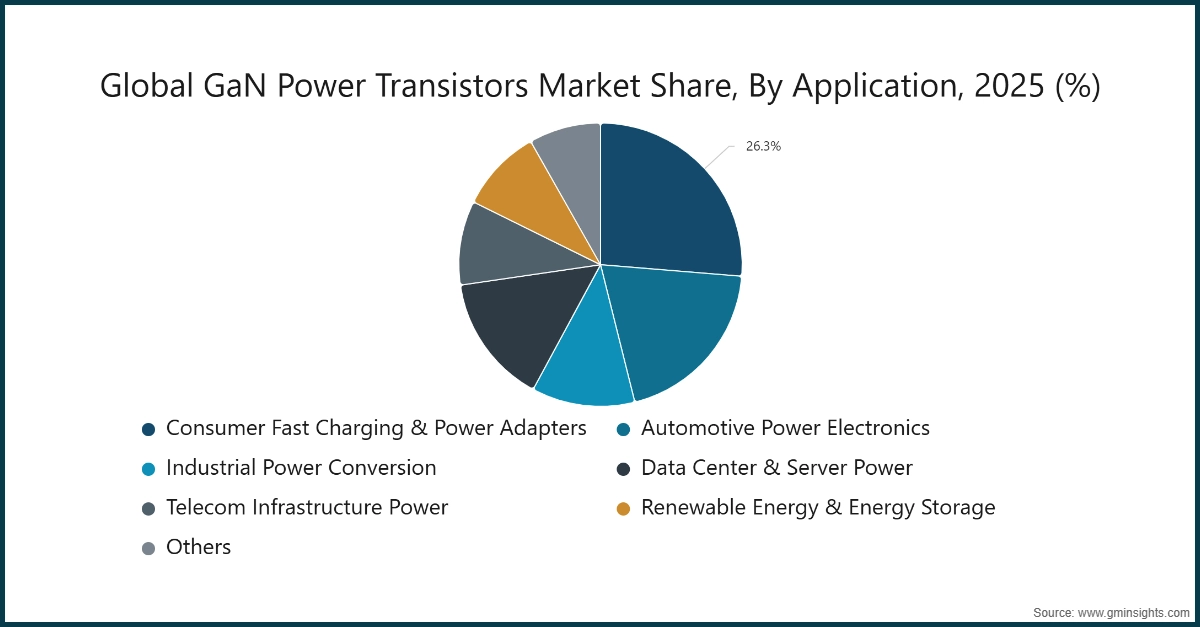
Based on the application, the global GaN power transistors market is divided into consumer fast charging & power adapters, automotive power electronics, industrial power conversion, data center & server power, telecom infrastructure power, renewable energy & energy storage, and others.
- The consumer fast charging & power adapters segment led the market with 26.3% share in 2025. This can be attributed to increased use of GaN-based USB-C power delivery chargers in various devices, including smartphones, laptops, tablets, and other electronic equipment. GaN technology is useful in these devices as it provides higher power density, faster charging time, as well as higher compactness. High device demand, frequent replacement of these devices, as well as consumer demand, are factors that ensure the high demand for GaN technology.
- The automotive power electronics segment is expected to witness a high growth rate of 33.1% during the forecast period. This growth can be attributed to the increased use of GaN in onboard chargers, DC-DC converters, and new 800V EV architectures. The focus of automotive OEMs remains on increasing efficiency and reducing the overall size of the components to deliver long-range and reliable automotive solutions. Moreover, increased automotive OEM adoption will accelerate the use of GaN in the next generation of electric vehicle solutions.
Looking for region specific data?
North America GaN Power Transistors Market
The North America accounted for over 28.6% of GaN power transistors industry share in 2025.
- In North America, the market for GaN power transistors is expanding because of that region’s high emphasis on EVs, data center efficiency, and emerging technologies in power devices. Automakers and charging-infrastructure providers are increasingly adopting GaN to improve efficiency and reduce system size in EV onboard chargers and fast-charging systems.
- Governments and technology giants are investing in developing and increasing power semiconductor technologies, digital infrastructures, and GaN-related R&D in handling wide bandgap materials, and federal incentives and clean energy investments. North America is anticipated to maintain its position as one of the largest GaN technology adopters, and automotive, cloud data center, and aerospace industries will continue growing through 2035.
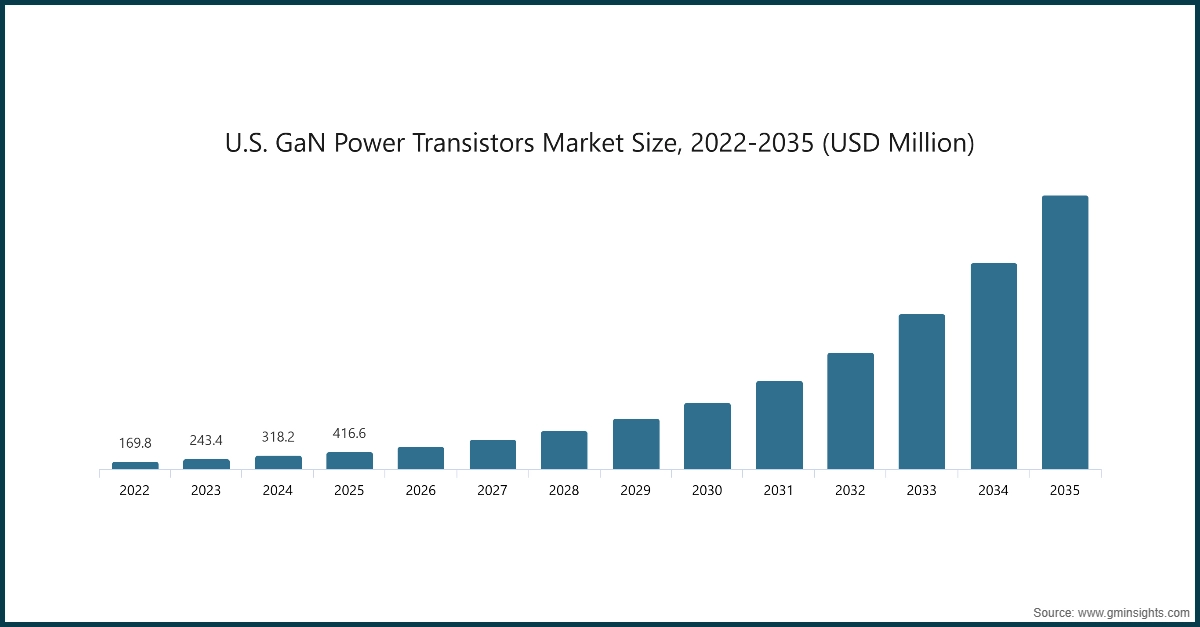
The U.S. GaN power transistors market was valued at USD 169.8 million and USD 243.4 million in 2022 and 2023, respectively. The market size reached USD 416.6 million in 2025, growing from USD 318.2 million in 2024.
- The GaN transistors power market has a high growth rate in the United States, driven by investments made by the federal government for the manufacture of semiconductors domestically, the expansion of EV infrastructure, and energy-efficient data centers. For instance, the U.S. government is supporting wide-bandgap semiconductor R&D and manufacturing through the CHIPS and Science Act to enhance supply-chain resilience, directly benefiting GaN device development and production.
- Along with the Department of Energy initiatives to advance high-efficiency power electronics for electric vehicles, grid modernization, data centers, etc., these initiatives are driving worldwide adoption of GaN technology for 800V Electric Vehicles, server power supplies, and advanced defense systems, making the U.S. the leading supplier in North America.
Europe GaN Power Transistors Market
Europe GaN power transistors industry accounted for USD 90.3 million in 2025 and is anticipated to show lucrative growth over the forecast period.
- The Europe market is growing due to the stringent energy efficiency regulations in place in the region, the rise of electric vehicles in the automotive industry in Europe, and the push for renewable energy solutions in Europe. Driving the use of GaN power transistors in power electronics in electric vehicles, railways, and renewable energy solutions in the region is the emphasis placed by OEMs in Europe on reducing energy losses in their systems and designs. The early adoption of 800V electric vehicles in Europe has been beneficial to GaN power transistors.
- The automobile industries in Germany, France, and the UK are actively contributing to the deployment of GaN technology by making investments in automobile electrification, the EU Chips Act, and initiatives related to increasing energy efficiency. The premium presence of companies related to automobiles, power modules, and industrial automation creates a long-term market for GaN technology to be used in industries such as automobiles and aerospace.
Germany dominates the Europe GaN power transistors market, showcasing strong growth potential.
- Germany leads GaN power transistor adoption in Europe due to its strong automotive electrification base, advanced power electronics ecosystem, and early transition toward high-efficiency industrial systems. German automotive OEMs and Tier-1 suppliers are actively evaluating and deploying GaN in onboard chargers, DC-DC converters, and traction-adjacent power systems to improve efficiency and reduce system weight.
- Federal programs supporting e-mobility, energy-efficient manufacturing, and semiconductor R&D, combined with Germany’s concentration of automotive engineering and industrial automation firms, accelerate GaN qualification and volume adoption. This positions Germany as a key European market for automotive-grade and industrial GaN power devices.
Asia Pacific GaN Power Transistors Market
The Asia Pacific market is anticipated to grow at the highest CAGR of 32.8% during the forecast period.
- The dominant role of the region in electronics manufacturing, accelerating EV production, and the expansion of high-efficiency power infrastructure drive the rapid growth in demand for GaN power transistors in the Asia Pacific. Countries such as China, Japan, South Korea, and Taiwan are integrating GaN into consumer fast chargers, telecom power supplies, and EV power electronics to improve efficiency and reduce system size. Asia Pacific's position as the global hub for consumer electronics and automotive supply chains structurally favors the early and large-scale GaN adoption.
- The market growth is further being supported with growing investments across wide-bandgap semiconductor fabs, advanced packaging facilities, and domestic EV ecosystems through China, India, and Southeast Asia. Backed by government semiconductor initiatives and participation from regional foundries and OEMs, these factors are driving GaN commercialization across automotive, industrial, and consumer power applications, making Asia Pacific the fastest growing and highest volume region through the forecast period.
India GaN power transistors market is estimated to grow with a significant CAGR, in the Asia Pacific market.
- India is emerging as a high-potential GaN power transistors industry driven by rapid EV ecosystem development, expansion of domestic power electronics manufacturing, and grid modernization efforts. Increasing deployment of electric two-wheelers, passenger EVs, and charging infrastructure is creating demand for compact, high-efficiency onboard chargers and power converters where GaN offers clear advantages.
- National initiatives focused on electronics manufacturing localization, EV adoption, and power efficiency improvement are encouraging local design and assembly of GaN-based power systems. Growing participation of Indian OEMs, startups, and global suppliers makes India a strategically important growth market in Asia Pacific.
Middle East and Africa GaN Power Transistors Market
UAE GaN power transistors industry to experience substantial growth in the Middle East and Africa.
- The UAE GaN power transistors market is gaining momentum due to the country’s focus on energy-efficient infrastructure, advanced data centers, and electric mobility adoption. Investments in hyperscale data centers, renewable-integrated power systems, and smart mobility projects are increasing demand for high-efficiency power conversion technologies.
- Government-led initiatives supporting clean energy, digital infrastructure, and advanced manufacturing are accelerating interest in wide-bandgap semiconductors. GaN adoption in high-efficiency power supplies, fast chargers, and aerospace-adjacent systems positions the UAE as a technology-driven GaN market within the MEA region.
GaN Power Transistors Market Share
The GaN power transistors industry is led by players such as Infineon Technologies, Navitas Semiconductor, Onsemi, Texas Instruments, and STMicroelectronics. These five companies collectively account for 77% share of the global market due to their strong power electronics portfolios, wide-bandgap expertise, and global manufacturing and distribution footprints across automotive, consumer electronics, industrial, and data center applications. Their leadership is reinforced by differentiated offerings spanning discrete GaN devices, intelligent power ICs, and system-level solutions.
These companies maintain a competitive edge through advanced GaN-on-silicon processes, automotive-grade qualification programs, and integration of gate drivers and protection features. Continued investments in high-voltage GaN development, advanced packaging, and large-wafer manufacturing position them strongly to capture rising demand from EV power electronics, fast charging, and high-efficiency digital infrastructure across multiple geographies.
GaN Power Transistors Market Companies
Prominent players operating in the GaN power transistors industry are as mentioned below:
- Efficient Power Conversion (EPC)
- Infineon Technologies
- Innoscience Technology
- Mitsubishi Electric
- Navitas Semiconductor
- Nexperia
- Onsemi
- Panasonic
- Power Integrations, Inc
- Renesas Electronics (Transphorm)
- STMicroelectronics
- Texas Instruments
- Toshiba
- VisIC Technologies
- Wolfspeed
- Infineon Technologies
Infineon offers a broad portfolio of CoolGaN discrete devices and power solutions targeting consumer fast charging, data center power supplies, and automotive power electronics. The company leverages its deep expertise in power semiconductors, automotive qualification standards, and advanced packaging to deliver high-efficiency, reliable GaN solutions. Its strong R&D focus and integration with system-level power management solutions support adoption in high-reliability and high-volume applications.
Navitas Semiconductor is a pure-play GaN company specializing in monolithically integrated GaN power ICs that combine GaN transistors, gate drivers, and protection circuitry. The company focuses on high-frequency, high-efficiency designs for consumer fast chargers, data centers, and emerging automotive applications. Its system-level approach reduces component count and improves power density, enabling compact and energy-efficient power solutions across consumer and industrial markets.
Texas Instruments offers GaN power transistors as part of its broader power management and analog semiconductor portfolio, targeting applications such as data center power supplies, telecom infrastructure, and industrial power conversion. TI’s strength lies in combining GaN devices with advanced control ICs, reference designs, and system-level optimization. Its extensive customer base, long product lifecycles, and robust manufacturing capabilities support steady GaN adoption in performance-critical applications.
Onsemi with its proprietary vertical GaN (vGaN) technology, delivers higher power density, superior efficiency, and rugged performance for AI data centers, EV inverters, charging infrastructure, and renewable energy systems. Onsemi’s GaN-on-GaN architecture enables higher voltage operation with reduced losses and compact designs, strengthening its foothold in electrification and high-efficiency power conversion.
STMicroelectronics provides GaN power transistors designed for automotive, industrial, and consumer power applications, supported by its strong presence in automotive electronics and power semiconductors. The company focuses on high-voltage GaN development, reliability qualification, and integration with power modules and control electronics. ST’s alignment with automotive OEMs and industrial customers positions it well for growth as GaN adoption expands into 800V EV platforms and advanced industrial systems.
GaN Power Transistors Market Report Attributes
| Key Takeaway | Details |
|---|---|
| Market Size & Growth | |
| Base Year | 2025 |
| Market Size in 2025 | USD 511.3 Million |
| Market Size in 2026 | USD 667.8 Million |
| Forecast Period 2026-2035 CAGR | 31.8% |
| Market Size in 2035 | USD 8 Billion |
| Key Market Trends | |
| Drivers | Impact |
| EV onboard chargers shifting to high-efficiency GaN architectures | Drives 26% growth as the shift toward 400V and 800V EV platforms is pushing automakers and Tier-1 suppliers to replace silicon-based power devices with GaN for improved thermal performance and extended driving range. |
| Data center power supplies targeting 80 Plus Titanium | Supports 21% growth as hyperscale and enterprise data centers pursue 80 Plus Titanium efficiency targets to reduce power losses and cooling costs. |
| Consumer electronics OEMs adopting USB-C PD GaN adapters | Contributes 19% growth as demand for compact, fast-charging solutions across smartphones, laptops, and wearables accelerates GaN penetration by enabling smaller form factors without compromising power output. |
| Automotive OEMs qualifying GaN for 800V platforms | Adds 18% growth as GaN’s ability to operate at higher voltages and temperatures improves inverter efficiency and reduces passive component size, supporting next-generation EV powertrain architectures. |
| Wide-bandgap policies supporting domestic semiconductor manufacturing investments | Accounts for 16% growth as incentives, subsidies, and national semiconductor programs in the US, Europe, and Asia-Pacific accelerate investments in GaN fabrication, packaging, and power module development. |
| Pitfalls & Challenges | Impact |
| Thermal management complexity in high-power GaN designs | Restrains market growth as high-power GaN designs face complex thermal management requirements due to high switching frequencies and power density. The need for advanced packaging, substrate materials, and heat dissipation solutions increases design complexity, development time, and system-level costs, limiting adoption in high-current industrial and automotive applications. |
| Limited long-term reliability data for automotive-grade GaN | Limits growth as automotive-grade GaN lacks extensive long-term field reliability data compared to silicon devices. Stringent qualification standards, extended validation cycles, and concerns around device degradation under harsh operating conditions delay large-scale deployment in safety-critical automotive systems. |
| Opportunities: | Impact |
| Solid-state transformers using high-voltage GaN devices | Presents significant growth potential by enabling solid-state transformers using high-voltage GaN devices for smart grids and renewable integration. GaN’s high-frequency switching capability allows compact, efficient power conversion, supporting grid modernization, bidirectional power flow, and improved energy management. |
| Aerospace power systems demanding lightweight, high-efficiency converters | Offers opportunity in aerospace power systems where lightweight, high-efficiency converters are critical. GaN transistors reduce system weight, improve power density, and enhance thermal performance in aircraft, satellites, and defense platforms, supporting electrification and next-generation avionics architectures. |
| Market Leaders (2025) | |
| Market Leader |
~25% market share |
| Top Players |
Collective Market share of ~77% |
| Competitive Edge |
|
| Regional Insights | |
| Largest Market | Asia Pacific |
| Fastest growing market | Asia Pacific |
| Emerging countries | China, India, South Korea, UK |
| Future outlook |
|
What are the growth opportunities in this market?
GaN Power Transistors Industry News
- In December 2025, Navitas Semiconductor and GlobalFoundries announced a strategic partnership to accelerate U.S.-based GaN technology and manufacturing, expanding capacity for advanced GaN solutions across AI data centers, EV power systems, and critical electrification infrastructures.
- In July 2025, Infineon Technologies advanced 300-millimeter GaN manufacturing for scalable power transistor production, enabling higher volume, reduced unit costs, and broader system deployment across automotive, industrial, and consumer power applications. This scalable IDM roadmap positions Infineon as a key GaN supplier for high-performance power electronics.
- In March 2025, STMicroelectronics signed a GaN technology development and manufacturing agreement with Innoscience Technology, enabling shared manufacturing capacity and joint advancement of GaN power solutions for automotive, data center, consumer, and industrial applications.
The GaN power transistors market research report includes in-depth coverage of the industry with estimates and forecast in terms of revenue (USD Million) from 2022 – 2035 for the following segments:
Market, By Product Form
- Discrete intelligent GaN power transistors
- Intelligent GaN power modules
Market, By Wafer Size
- 4-inch (100 mm)
- 6-inch (150 mm)
- 8-inch (200 mm)
- 12-inch (300 mm)
Market, By Voltage Rating
- ≤ 200 V
- 201–650 V
- 651–1200 V
- > 1200 V
Market, By Functional Integration Level
- Gate driver–integrated GaN transistors
- Protection & sensing–integrated GaN transistors
- Fully intelligent GaN Devices
Market, By Application
- Consumer fast charging & power adapters
- Automotive power electronics
- Industrial power conversion
- Data center & server power
- Telecom infrastructure power
- Renewable energy & energy storage
- Others
The above information is provided for the following regions and countries:
- North America
- U.S.
- Canada
- Europe
- Germany
- UK
- France
- Spain
- Italy
- Asia Pacific
- China
- India
- Japan
- Australia
- South Korea
- Latin America
- Brazil
- Mexico
- Argentina
- Middle East and Africa
- South Africa
- Saudi Arabia
- UAE
Frequently Asked Question(FAQ) :
What is the market size of the GaN power transistors in 2025?
The market size was USD 511.3 million in 2025, with a CAGR of 31.8% expected through 2035, driven by automotive OEM qualification of GaN for 800V electric vehicle platforms, government-backed wide-bandgap semiconductor manufacturing policies, and rising demand for high-efficiency data center power supplies.
What is the projected value of the GaN power transistors industry by 2035?
The GaN power transistors market is expected to reach USD 8 billion by 2035, propelled by accelerating electrification of vehicles and rapid deployment of fast-charging infrastructure.
What is the current GaN power transistors industry size in 2026?
The market size is projected to reach USD 667.8 million in 2026.
How much revenue did the consumer fast charging & power adapters application segment generate in 2025?
The consumer fast charging & power adapters segment led the market with a 26.3% share in 2025, driven by increased adoption of GaN-based USB-C power delivery chargers across smartphones, laptops, tablets, and wearables.
What was the market share of the discrete intelligent GaN power transistors product form segment in 2025?
The discrete intelligent GaN power transistors segment dominated the market with a 60.1% share in 2025, driven by widespread adoption in consumer fast chargers, data center power supplies, and telecom power systems.
What is the growth outlook for the automotive power electronics application segment?
The automotive power electronics segment is the fastest-growing application category with a CAGR of 33.1% expected through 2035, driven by increased use of GaN in onboard chargers, DC-DC converters, and 800V EV architectures.
Which region leads the GaN power transistors market?
Asia Pacific market is anticipated to grow at a CAGR of 32.8% through 2035, supported by its dominant role in electronics manufacturing, accelerating EV production, growing investments in wide-bandgap semiconductor fabs.
What are the key trends shaping the GaN power transistors market?
Key trends include growing GaN adoption in renewable energy and rail power systems, advancements in GaN packaging, expansion of fabless GaN manufacturing models, and increasing use in aerospace, defense, and industrial automation.
Who are the key players in the GaN power transistors market?
Key players include Efficient Power Conversion (EPC), Infineon Technologies, Innoscience Technology, Mitsubishi Electric, Navitas Semiconductor, Nexperia, Onsemi, Panasonic, Power Integrations Inc., Renesas Electronics (Transphorm), STMicroelectronics, Texas Instruments, Toshiba, VisIC Technologies, and Wolfspeed.
GaN Power Transistors Market Scope
Related Reports