Summary
Table of Content

Gaming Handheld Market
Get a free sample of this report
Form submitted successfully!
Error submitting form. Please try again.
Thank you!
Your inquiry has been received. Our team will reach out to you with the required details via email. To ensure that you don't miss their response, kindly remember to check your spam folder as well!
Request Sectional Data
Thank you!
Your inquiry has been received. Our team will reach out to you with the required details via email. To ensure that you don't miss their response, kindly remember to check your spam folder as well!
Form submitted successfully!
Error submitting form. Please try again.
Gaming Handheld Market Size
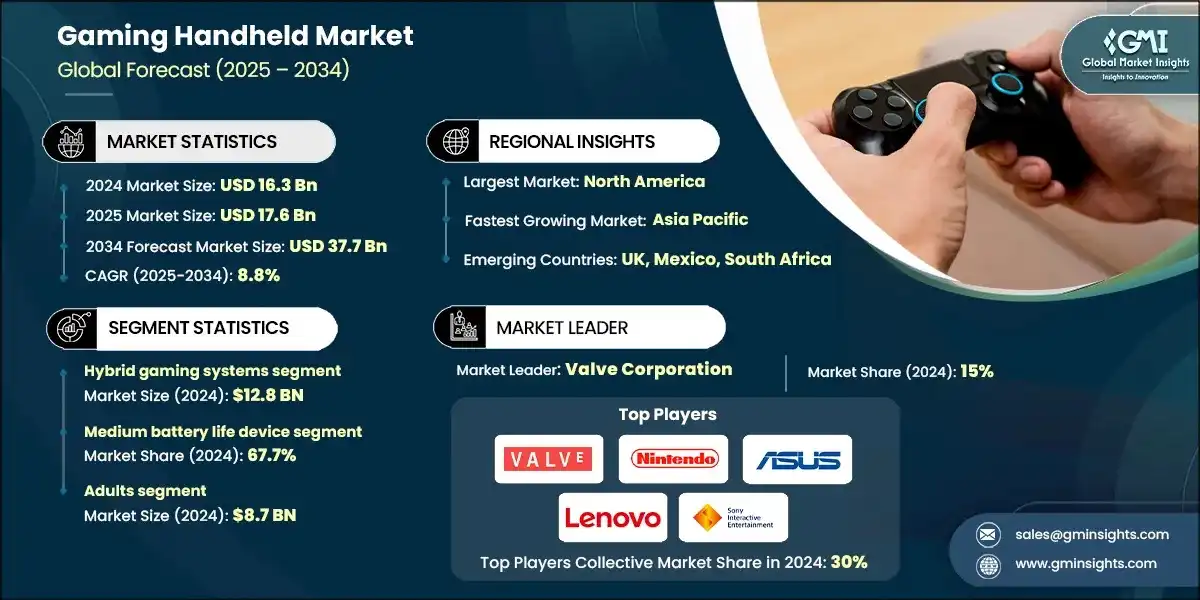
The global gaming handheld market size was estimated at USD 16.3 billion in 2024. The market is expected to grow from USD 17.6 billion in 2025 to USD 37.7 billion in 2034, at a CAGR of 8.8% according to latest report published by Global Market Insights Inc.
Gaming Handheld Market Key Takeaways
Market Size & Growth
- 2024 Market Size: USD 16.3 Billion
- 2025 Market Size: USD 17.6 Billion
- 2034 Forecast Market Size: USD 37.7 Billion
- CAGR (2025–2034): 8.8%
Key Market Drivers
- Expanding gaming demographics.
- Connectivity & ecosystem integration.
- Rise of cloud gaming.
Challenges
- Financial & investment barriers.
- Regulatory & legal risks.
Opportunity
- Sustainability & AI integration.
- Eco-friendly innovation.
Key Players
- Market Leader: Valve Corporation led with over 15% market share in 2024.
- Leading Players: Top 5 players in this market include Valve Corporation, Nintendo, ASUS, Lenovo, Sony Interactive Entertainment, which collectively held a market share of 30% in 2024.
Get Market Insights & Growth Opportunities
Demand within the handheld gaming sector is growing as gaming demographics expand to include a more extensive age range and more diverse user profiles. This growth is attributed to the growth of mobile-first gamers, the availability of freemium business models, and a barrage of games to suit a variety of interests. As gaming becomes more socially acceptable and more integrated into people’s daily routines, manufacturers are developing devices that cater to different types of users and in turn broaden the market base.
Simultaneously, both connectivity as well as ecosystem integration are changing handheld consoles from a standalone device to serve as a component of a larger, holistic digital ecosystem. Handhelds provide connectivity to cloud gaming services, social media, multiplayer gaming networks, and gaming on multiple devices. Capabilities such as cellular connectivity, Wi-Fi and Bluetooth connectivity allow for play in real time, sharing content, and access to a large library of games, which in addition to integration to cloud systems for Xbox or PlayStation remote play, also serves to enhance user engagement.
This experience of connected content translates to higher utility of the device but also customer loyalty and ultimately allows for subscription models and spend on additional content or purchase of products. Handheld gaming devices are transitioning to core product offerings in a connected entertainment ecosystem as ecosystems become increasingly seamless and immersive.
Connectivity and ecosystem integration are a major growth drive in the handheld gaming market as they enable seamless device, platform, and service interactions. Today's handhelds are no longer stand-alone consoles but are instead part of a larger digital ecosystem, characterized by cross-device syncing and access to cloud gaming platforms, multiplayer networks, and content sharing. Integration of these ecosystems allows users to start playing a game on one device and pick it up on another, using cloud-saving games while also being able to play in multiplayers across platforms.
In addition, the increasing integration of ecosystems builds brand loyalty, profitability, and increases the lifetime value of customers. When handhelds become effortless and seamless with its ecosystem including accessories, software, and services, then the users will not want to step out of that ecosystem, which encourages businesses to develop recurring revenue strategies such as subscriptions, downloadable content (DLC), and accessories.
To get key market trends
Gaming Handheld Market Trends
The market for gaming handheld devices is undergoing innovation and cross-platform driven transformation that may fundamentally change consumer expectations. With consumer demand for handheld gaming and high-fidelity gaming experience growing, manufacturers are making investments in products that enhance the conveniences of handheld technologies with performance found in consumer, home-based products. The competition has potentially expanded the market for consumers beyond traditional handheld products to hybrid and cloud-based systems.
- Products such as Steam Deck, ROG Ally, and Lenovo Legion Go enable users to access platforms for example, Xbox Cloud Gaming and GeForce Now - and stream the games directly to the device. As a result, cloud-based gaming reduces reliance on onboard memory for extensive game libraries and PC gaming, making handheld products more financially accessible and ultimately more affordable. This innovation also enhances versatility and accessibility to premium gaming experiences across a variety of devices.
- Handheld gaming systems now boast hybrid features first inspired while developing the Nintendo Switch, whereby users can play games on-the-go, and then once docked, on a TV or computer screen if the user chooses. This dual-mode allows the user to play mild-deep games as they can on-the-go for better mobility, without sacrificing the immersive experience of gaming on a larger screen. The Steam Deck and Lenovo Legion Go are examples of modern consoles that are appropriately engineered to utilize the available format.
- Modern day handheld devices now utilize cutting-edge silicon processors, including types based on AMD Ryzen Z1 and Snapdragon G3x, which enable performance comparable to that of consoles in an incredibly small form factor. These handhelds can play more demanding games and emulations and are suitable for casual as well as hardcore gamers. Additionally, more effective thermal performance, displays with a higher refresh rate, and improved battery life have enhanced user experiences for handheld gaming altogether, and appeal to a wider audience.
- Handhelds are now increasingly integrated into larger gaming ecosystems that allow for cross-platform play, cloud saves and connected content ownership. For instance, Xbox handhelds plug directly into Game Pass, while PlayStation Portal is built for the PS5 ecosystem. Overall, these handhelds make specific brand ecosystems even more convenient than players might have otherwise experienced without one. The added opportunities to interact with an existing ecosystem effectively builds customer retention and ultimately leads to the kind of recurring revenue that creates customer lifetime value through subscriptions and digital content.
Gaming Handheld Market Analysis
Learn more about the key segments shaping this market
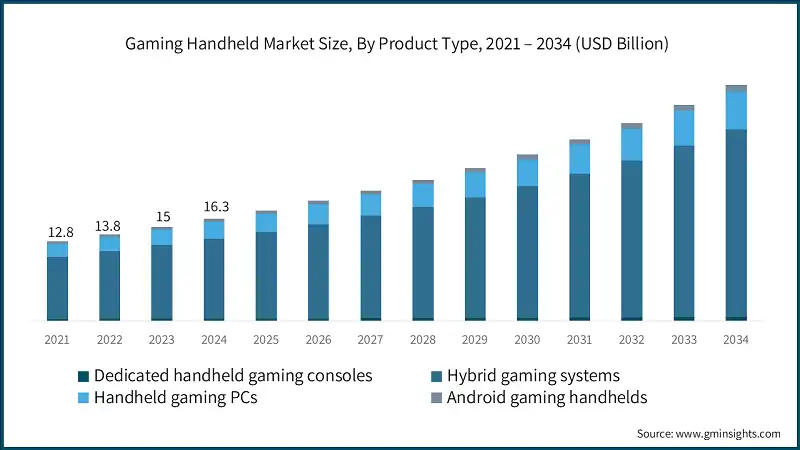
Based on product type, the market is divided dedicated handheld gaming consoles, hybrid gaming systems, handheld gaming PCs and android gaming handhelds. In 2024, hybrid gaming systems held the major market share, generating a revenue of USD 12.8 billion.
- Hybrid gaming platforms grant consumers the opportunity to transition between handheld and docked modes, giving them options both for gaming on the go as well as gaming at home in an immersive experience. With devices such as the Nintendo Switch and the Lenovo Legion Go, consumers can play their games on a smaller screen when traveling or dock the device into a larger display to engage with the benefits of console-like gaming experiences. Whether you're a casual or more dedicated gamer who enjoys flexibility, hybrid systems provide choice for a larger variety of use case scenarios.
- More hybrid systems are being designed to integrate into a wider gaming ecosystem, one with mechanics like cross-platform play, cloud saves, and synced content. The Steam Deck has direct access to the Steam platform, where gamers can access their entire library of games between the different devices in a hybrid system. ROG Ally from ASUS integrates directly with Windows and Xbox Game Pass, allowing a seamless experience between PC and handheld gaming. The integration will improve user interaction and encourage users to continue to use the brand’s software and services in the long run.
- Modern hybrid handhelds feature potent processors, high resolution displays, and cooling systems to compete directly with commercial consoles. Thus, hybrid systems are of equivalent viability as gaming systems of significant larger sizes (for example, commercial games consoles). As gaming hardware continues another course of improvement, hybrid gaming systems will find themselves as the centerpiece of portable gaming future.
Learn more about the key segments shaping this market
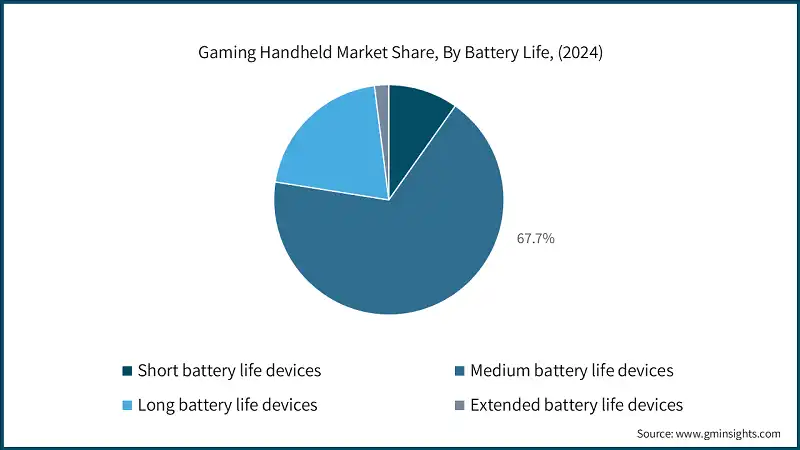
Based on battery life, the gaming handheld market is segmented into short battery life device, medium battery life device, long battery life device, extended battery life. The medium battery life device segment held the largest share, accounting for 67.7% of the global market in 2024.
- Devices with medium battery life usually offer a good compromise between performance and portability. These portable devices have processors that are moderately powerful, along with display capabilities that have lower energy consumption than premium flagship devices, which allows users to play casual or mid-core gaming sessions. They may not be able to play for very long periods due to battery life like ultra-efficient battery life devices might, but they are good options for users who want a very lightweight device and want to use their device in a portable manner instead of playing for a long time. Users that often like to play in short bursts rather than long marathon-like sessions may appreciate this balance especially commuters, students, and casual gamers.
- Medium battery life devices also usually reflect some cost-conscious considerations in design choices to keep costs down and competitive for the manufacturer. For example, brands can provide a helpful gaming experience to consumers, while also being budget-friendly, by using components like mid-range chipsets, lower resolution displays, smaller battery technologies, etc. This makes these helpful devices appeal to cost-saving consumers and appealing in burgeoning markets where affordability is a purchasing driver. These helpful devices often have fast charge capabilities that help partially offset some of the shorter battery life versus portable devices, with shortened turnaround times.
Based on age group, the gaming handheld market is segmented into children, teenagers and adults. In 2024, adults held a major market share, generating a revenue of USD 8.7 billion.
- Adults between the ages of 25 and 45 are typically drawn to handheld systems that offer console-level capabilities, allow multitasking, and are compatible with a larger ecosystem of software and hardware options. Those interested in these types of devices are typically looking for something that is entertaining, yet it is also a utility device and is aesthetically useful.
- Adult gamers are also more invested in digital ecosystems, such as Steam, Xbox Game Pass, PlayStation Network, and cloud-based services like GeForce Now. Handhelds that are integrated in these ecosystems, or some way compatible, offer convenience that is difficult to beat via consoles or PCs, as users can access their game library, cloud saves, and multiplayer networks across devices. Ecosystem compatibility, continuity, and convenience improve user engagement with products or brands, increases user satisfaction, and assist in brand loyalty among paying and time-limited professionals.
Looking for region specific data?
North America Gaming Handheld Market
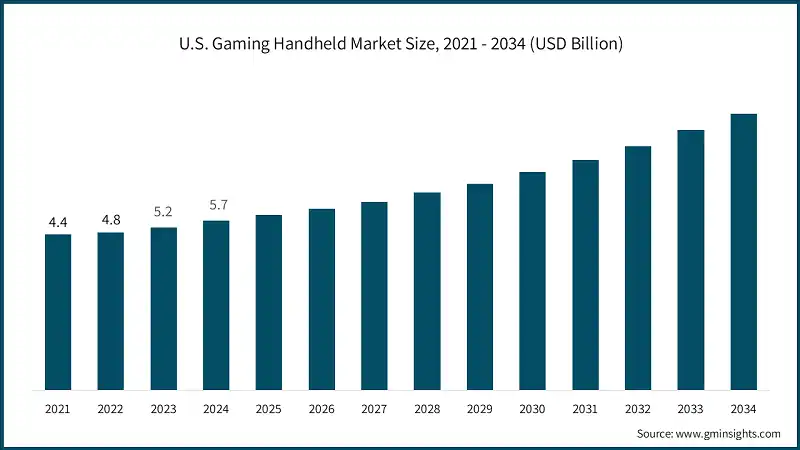
In 2024, the U.S. dominated the North America market, accounting for around 78.2% and generating around USD 5.7 billion revenue in the same year.
- The U.S. is a key player in the market as both a major consumer market and a source of innovation. U.S. consumers have a strong gaming culture across age demographics, as well as significant disposable income, leading to adoption of advanced gaming handhelds like the Steam Deck, ROG Ally, and PlayStation Portal. It is also home to major manufacturers like Valve, Microsoft, and Analogue who are developing new products and promoting ecosystem integration. Lastly, the U.S. has infrastructure in place to support usage of cloud gaming services, digital distribution, and e-commerce that supports the growth of the handheld gaming market.
- North American region, including the U.S, Canada, and Mexico, leads the global gaming handheld market because of a well-established gaming ecosystem, high internet user penetration and strong retail networks. North American consumers are willing to support a range of handheld devices from premium hybrid devices to retro-focused gaming consoles for both mainstream consumers and as a niche alternative. This non-consumer market is appealing to brands.
- North American consumers value performance, and connections to their existing ecosystem, and range of content that new brands who want to enter the North American market need to keep in mind when developing product, brands view the North American market as a validation of their product development efforts; as well as to consider localization to suit their existing consumer base. North American demand for portable entertainment products has been stable along with increased demand for portable cloud gaming options, which North America continues to set the standard for worldwide.
Europe Gaming Handheld Market
Europe market, UK leads the market with 21.1% share in 2024 and is expected to grow at 6.7% during the forecast period.
- Europe plays a significant role in the handheld gaming market due to a diverse consumer base and a strong willingness to buy both mainstream and niche gaming handhelds. Germany, France, and the UK have established gaming cultures that are inclusive of portable consoles and are seeing high adoption rates. European consumers have also shown strong interest in hybrid systems and cloud gaming. Multiple areas are seeing high demand for hybrid systems like Steam Deck and Nintendo Switch; however, the hybrid market continues to be competitive.
- Expectations during the pandemic about regulations combined with healthy interest in sustainability continue to drive product design and marketing considerations into the region. European gamers expect high build quality, ecosystem purchasing/playing, and long-term usability, therefore they present a strong market for premium handhelds. Similarly, indie and retro gaming communities continue to grow in Europe, resulting in devices like AYANEO and Analogue Pocket supporting demand for the expanding market.
Asia Pacific Gaming Handheld Market
The Asia Pacific leads the market; China leads with market share of around 22.5% in 2024 and is anticipated to grow with a CAGR of around 11.9% from 2025 to 2034.
- The APAC region has emerged as a high growth market for gaming handhelds, indicated by its large and tech-savvy population, increased disposable incomes, and an established mobile gaming culture. Countries like China, Japan, South Korea, and India are adopting handheld gaming devices for both casual and competitive gaming. Local brands including AYANEO, Anbernic, and GPD are gaining global prominence, while established companies like Nintendo and Sony continue to hold extensive market share.
- Moreover, APAC's strong manufacturing infrastructure and supply chain capacity provide all companies in the region with an advantage for production and innovation. In addition, the growing interest in cloud gaming and esports in APAC is providing an additional boost to the demand for portable, high-performance handheld devices. All these developments position APAC as the leading player for the future of handheld gaming moving forward due to the increasing penetration of the internet and increasing coverage of 5G.
Middle East and Africa Gaming Handheld Market
Middle East and Africa markets are growing at a CAGR of 6.6% during the forecast period.
- The MEA region presents an emerging market for gaming handhelds, with increasing interest among younger demographics and urban segments. While the market is in the nascent stages of growth, rising smartphone penetration and improved access to the internet are establishing the landscape for handheld gaming uptake. The UAE, Saudi Arabia, and South Africa show early signs of growth in mobile and cloud-based segments.
- Emerging issues of price sensitivity and a limited retail presence are gradually mitigating through e-commerce and regional partnerships. Global brands are beginning to explore MEA market opportunities through localized marketing efforts, distribution, and retail efforts. While digital entertainment is continuing to scale into mainstream activity, MEA will be an attractive expansion opportunity for handheld gaming, particularly mid-tier and cloud-enabled handheld gaming devices.
Gaming Handheld Market Share
Valve Corporation is leading with 12% market share. Valve Corporation, Nintendo, ASUS, Lenovo, and Sony Interactive Entertainment collectively hold around 30%, indicating moderately fragmented market concentration. These prominent players are proactively involved in strategic endeavors, such as mergers & acquisitions, facility expansions & collaborations, to expand their product portfolios, extend their reach to a broad customer base, and strengthen their market position.
Valve's launch of Steam Deck, a powerful Linux-based device to portably enjoy PC gaming, has transformed the handheld gaming market. Within the Steam ecosystem, Valve has provided access to thousands of games, cloud saves, and community features that make Steam Deck an appealing hybrid choice for gamers who are looking for capable desktop performance on the move.
Nintendo continues to hold a strong footing in the handheld gaming market, primarily thanks to the continuing success of the Nintendo Switch and Switch Lite consoles. Apart from its family-friendly culture and exclusive titles, Nintendo has loyal fans around the globe all of which are due to the console’s hybrid design and its expansive library of first-party games, both of which have become standards for portable gaming experiences.
Gaming Handheld Market Companies
Major players operating in the gaming handheld industry are:
- Anbernic
- ASUS
- AYANEO
- AYN Odin 2
- GPD Technology
- Lenovo
- Logitech Europe
- Microsoft Gaming (Xbox Division)
- Nintendo of Europe
- NVIDIA Corporation (GeForce Now)
- OneXPlayer
- Razer
- Sony Interactive Entertainment
- SteelSeries
- Valve Corporation (Steam Deck)
NVIDIA has more of a supporting position in the handheld space through its cloud gaming platform, GeForce Now, which allows high-performance gaming on lower-powered devices, despite not being a hardware brand in this space. Nevertheless, NVIDIA technology powers many handhelds and this technology support the gaming shift toward streaming-based gaming, making it a core reason why next-gen portable experiences exist.
Through its Xbox division, Microsoft Gaming is getting involved in the handheld market through Xbox Cloud Gaming and Game Pass. They have not yet produced a standalone handheld device, but their ecosystem is available on other portable devices and users can stream a console experience anywhere, effectively making Microsoft a leader in the handheld, cloud-powered gaming market.
Gaming Handheld Market Report Attributes
| Key Takeaway | Details |
|---|---|
| Market Size & Growth | |
| Base Year | 2024 |
| Market Size in 2024 | USD 16.3 Billion |
| Market Size in 2025 | USD 17.6 Billion |
| Forecast Period 2025 - 2034 CAGR | 8.8% |
| Market Size in 2034 | USD 37.7 Billion |
| Key Market Trends | |
| Drivers | Impact |
| Expanding gaming demographics | The handheld market is also reaching an audience that is broader than previously seen, namely adults, casual gamers, and retro gamers, which is driving demand for various types of devices ranging from high-end hybrids to retro consoles for the lowest price. |
| Connectivity & ecosystem integration | Integration with platforms like Steam, Xbox, and PlayStation will make the player experience and player retention better. Syncing across devices, cloud saves, and shared multiplayer access across platforms will become something that users will - justifiably expect from all device types, putting pressure on programmers to innovate and consumers wanting to use one brand, or preferred platform. |
| Rise of cloud gaming | Cloud-powered gaming will also change the landscape of handheld devices, allowing consumers to play AAA titles without necessarily needing the latest and greatest piece of hardware. Devices capable of performing well as streaming devices are starting to see more uptake and success, especially in areas with strong interest infrastructure. |
| Pitfalls & Challenges | Impact |
| Financial & investment barriers | High costs of research & development (R&D) and production can be a deterrent for new entrants to the hybrid and high-performance device market. Customers may also incur a cost when purchasing a new device which may limit their acceptance, especially in markets with a price sensitivity. |
| Regulatory & legal risks | Different regions have public policies regarding data privacy laws, controls on digital content, as well as import & export laws that complicate global development and sales. The need to comply with laws can add costs and slow the drag on development and product sales. |
| Opportunities: | Impact |
| Sustainability & AI integration | Artificial Intelligence (AI) is being used to improve things like battery lifetime and device performance. AI is also used for personalizing a device for the user. Additionally, the green movement continues to impact decisions about design, including recyclable materials and energy efficient components. |
| Eco-friendly innovation | Brands are embracing green manufacturing practices and selling devices with low energy consumption over devices that arent “green." Consistent with todays consumers and public expectations, the switch reflects the regulatory movement toward sustainability. |
| Market Leaders (2024) | |
| Market Leaders |
15% market share |
| Top Players |
The collective market share in 2024 is 30% |
| Competitive Edge |
|
| Regional Insights | |
| Largest Market | North America |
| Fastest Growing Market | Asia Pacific |
| Emerging Country | UK, Mexico, South Africa |
| Future Outlook |
|
What are the growth opportunities in this market?
Gaming Handheld Industry News
- In October 2025, ASUS and Microsoft Gaming announced the ROG Xbox Ally X, a high-end portable gaming device designed specifically for AAA gaming and heavy integration within the Xbox ecosystem. Supplying the latest Ryzen AI Z2 Extreme by AMD, along with 24GB of RAM and a 1TB SSD, users get the comfort of Xbox's full screen UI and impulse triggers for a more responsive gaming experience. The launch of the ROG Xbox Ally X represents a strategic move to merge premium gaming hardware with Xbox services by delivering an enhanced portable gaming experience.
- In October 2025, Lenovo announced the Legion Go 2, a premium handheld gaming PC with Windows, to compete against premium devices such as the Steam Deck and ROG Ally X. Legion Go 2 offers an 8.8-inch OLED touchscreen with a 144Hz refresh rate, runs on an AMD Ryzen Z2 Extreme processor, has up to 32GB of LPDDR5X RAM, and can have 2TB of SSD Storage. Legion Go 2 has detachable TrueStrike controllers, 2 USB4 ports, Wi-Fi 6E, Bluetooth 5.3, and a 74Wh battery for longer play time.
- In August 2025, GPD Technology released the GPD Win 5 and it is described as the strongest and most powerful handheld gaming console available, with specs including the new Ryzen AI Max+ 395 processor with 16 Zen 5 cores, the Radeon 8060S GPU, and the ability to support up to 128GB of RAM. This gaming device is intended for gaming at a high-end level of play and to be a productivity device, while having the option to use a detachable 80Wh battery which allows for longer play time and modularity for use as the best portable gaming experience available.
- In June 2025, Anbernic introduced the RG35XX Pro, a retro-inspired handheld gaming device built for immersive gameplay experiences. While the RG35XX Pro uniquely has dual joysticks, it also comes with built-in Wi-Fi and Bluetooth capabilities, as well as HDMI output for connecting to external displays. The RG35XX Pro is meant to enhance the retro gaming experience while embracing modernity with its versatile connectivity options for those seeking portability and connectivity.
The gaming handheld market research report includes in-depth coverage of the industry with estimates & forecasts in terms of revenue (USD Billion) and volume (Thousand Units) from 2021 to 2034, for the following segments:
Market, by Product Type
- Dedicated handheld gaming consoles
- Hybrid gaming systems
- Handheld gaming PCs
- Android gaming handhelds
Market, by Battery Life
- Short battery life devices
- Medium battery life devices
- Long battery life devices
- Extended battery life devices
Market, by Form
- Traditional handheld
- Clamshell
- Slider
- Modular
- Foldable
Market, by Technology
- Touch only
- Physical controls
- Hybrid touch & physical
- Motion control
- Voice control
- Eye tracking & biometric foods
Market, by Age Group
- Children
- Teenagers
- Adult
Market, by Display Size
- Small screen devices (3-5 inches)
- Medium screen devices (5-7 inches)
- Large screen devices (7-9 inches)
- Extra-large screen devices (9+ inches)
Market, by Price Range
- Low
- Medium
- High
Market, by Application
- Entertainment gaming
- Professional & competitive gaming
- Educational gaming applications
- Cloud & streaming gaming
Market, by Distribution Channel
- Offline
- Online
The above information is provided for the following regions and countries:
- North America
- U.S.
- Canada
- Europe
- Germany
- UK
- France
- Italy
- Spain
- Asia Pacific
- China
- India
- Japan
- Australia
- South Korea
- Latin America
- Brazil
- Mexico
- Argentina
- Middle East and Africa
- South Africa
- Saudi Arabia
- UAE
Frequently Asked Question(FAQ) :
What is the market size of the global gaming handheld market in 2024?
The market size was USD 16.3 billion in 2024, driven by the expanding gaming demographics, growing popularity of hybrid handheld consoles, and increasing ecosystem integration with cloud gaming platforms.
What is the projected market value of the global gaming handheld market by 2034?
The market is expected to reach USD 37.7 billion by 2034, growing at a CAGR of 8.8%, fueled by cross-device gaming compatibility, AI-enhanced hardware performance, and rising demand for portable entertainment devices.
What is the estimated market size of the global market in 2025?
The market is projected to reach USD 17.6 billion in 2025, supported by the expansion of cloud gaming services, launch of new hybrid systems, and improved battery and display technologies enhancing user experience.
Which product segment dominated the market in 2024?
The hybrid gaming systems segment led the market, generating USD 12.8 billion in 2024, owing to their ability to function both as handheld and docked devices.
Which battery life segment held the largest share in 2024?
The medium battery life device segment accounted for 67.7% of the market in 2024, favored for their balance between portability, performance.
Which age group segment generated the highest revenue in 2024?
The adults segment held the largest share, generating USD 8.7 billion in 2024, driven by demand for high-performance hybrid systems and strong engagement with ecosystem-based gaming platforms like Steam, Xbox, and PlayStation.
Which region leads the global market?
North America dominated the market, led by the U.S., which accounted for 78.2% of regional revenue (USD 5.7 billion) in 2024.
Which region is expected to be the fastest growing in the global gaming handheld market?
The Asia Pacific region is projected to grow at a CAGR of 11.9% through 2034, driven by its large gaming population, rapid adoption of cloud and mobile gaming, and strong manufacturing ecosystem in China, Japan, and South Korea.
Who are the key players in the global gaming handheld market?
Key players include Valve Corporation, Nintendo, ASUS, Lenovo, Sony Interactive Entertainment, Microsoft Gaming (Xbox Division), NVIDIA (GeForce Now), Razer, Logitech, Anbernic, AYANEO, GPD Technology, OneXPlayer, SteelSeries, and AYN Odin 2.
Gaming Handheld Market Scope
Related Reports