Summary
Table of Content

Frozen Dough Market
Get a free sample of this report
Form submitted successfully!
Error submitting form. Please try again.
Thank you!
Your inquiry has been received. Our team will reach out to you with the required details via email. To ensure that you don't miss their response, kindly remember to check your spam folder as well!
Request Sectional Data
Thank you!
Your inquiry has been received. Our team will reach out to you with the required details via email. To ensure that you don't miss their response, kindly remember to check your spam folder as well!
Form submitted successfully!
Error submitting form. Please try again.
Frozen Dough Market Size
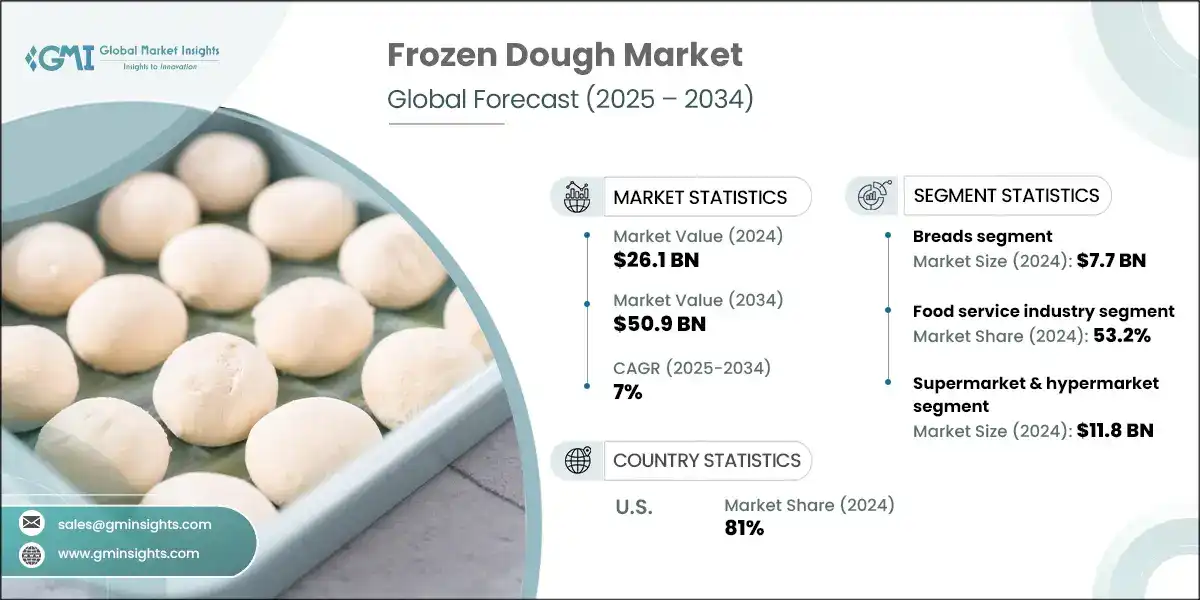
The global frozen dough market size was estimated at USD 26.1 billion in 2024. The market is expected to grow from USD 27.7 billion in 2025 to USD 50.9 billion in 2034, at a CAGR of 7%, according to Global Market Insights Inc.
Frozen Dough Market Key Takeaways
Market Size & Growth
- 2024 Market Size: USD 26.1 Billion
- 2034 Forecast Market Size: USD 50.9 Billion
- CAGR (2025–2034): 7%
Regional Dominance
- Largest Market: North America
- Fastest Growing Region: Asia Pacific
Key Market Drivers
- Rising urbanization and busy lifestyles.
- Increasing demand for convenience foods.
- Expanding retail and online distribution channels.
Challenges
- Quality and freshness concerns.
- High competition and market saturation.
Opportunity
- Growing demand for international and specialty frozen dough products.
- Innovation in healthier and organic options.
Key Players
- Market Leader: General Mills led with over 8.6% market share in 2024.
- Leading Players: Top 5 players in this market include General Mills, Ajinomoto, Aryzta AG, Bridgford Foods Corporation, Campbell Soup Company, which collectively held a market share of 33.40% in 2024.
Get Market Insights & Growth Opportunities
- Commercial production and marketing of frozen doughs for extended shelf life and convenience are the main focus of the frozen dough market. The market encompasses a multitude of segments such as bread, pizza, pastry, and cookie dough, and caters to both the commercial and household sectors. Convenience food consumption has dramatically increased by 15% in the last five years, according to the U.S. Department of Agriculture.
- Whereas the key drivers would be the increasing demand for convenience foods, the fast-expanding foodservice industry accepting these products, and the rising fame among specialty doughs like gluten-free and organic varieties. The emphasis on health-centered consumer preferences in favor of ready-to-bake products and online retail expansion will give ample opportunities to grow the market, especially in the emerging regions like Asia-Pacific.
- Even busier consumers looking for time-saving solutions for meals create the market for frozen dough. The expanding foodservice sector which involves restaurants and cafes demands consistently high-quality frozen dough thus further supporting this demand. The appeal of frozen dough products, particularly among commercial bakeries and retailers is created largely due to longer shelf life and lower preparation time.
- According to National Restaurant Association data, 60% of consumers are more willing to choose restaurants that offer healthier options. Finally, advancements in freezing technology, combined with vast opening up of online retail platforms for frozen dough, are causing the sales in some parts of the globe, particularly the emerging ones, to flourish.
- North America is the leading region in this market because of the blooming nations like U.S. and Canada.
- Asia Pacific is the fastest growing region owing to increasing urbanization and a growing middle class demanding convenience and quality.
To get key market trends
Frozen Dough Market Trends
The frozen dough industry is evolving in many ways. Changes such as gluten-free and vegan types of dough being in demand are because of an increased number of health-conscious customers looking for healthier options.
In the year 2021, organic food sales in the United States were at USD 57.5 billion according to the U.S. Department of Agriculture (USDA). Great demand for organic products like frozen dough has been on the upswing. Major drivers for growth are convenience, coupled with increasing retail & foodservice sales of frozen pizza & bread dough.
Online retail platforms are also expanding and improving the reach of such products especially in urban areas. There is also growing preference for premium style frozen dough products with consumers wanting the taste of gourmet bakery products but the convenience of being frozen. According to the Bureau of Labor Statistics, bakery employment is expected to grow 8% by 2030, faster than the average across all jobs, partly because of the growing market for specialty baked goods, which would include first quality artisanal-style frozen dough items.
Also there has been developments in technologies which changed the face of frozen dough market. These technologies include modern frozen dough storage and transportation systems such as rapid freezing techniques, involving blast freezing, which help maintain quality, texture, and freshness of the dough inside storage or Transportation. Advanced packaging solutions like modified atmosphere packaging (MAP) extend the shelf life while also maintaining the freshness of the product.
Innovations in dough formulation using enzyme technology and natural preservatives improve dough stability and fermentation and lead to a better end-product quality. Furthermore, IoT sensors and AI-based quality control systems have enabled real-time monitoring of production processes, hence reducing wastage and ensuring high quality.
Frozen Dough Market Analysis
Learn more about the key segments shaping this market
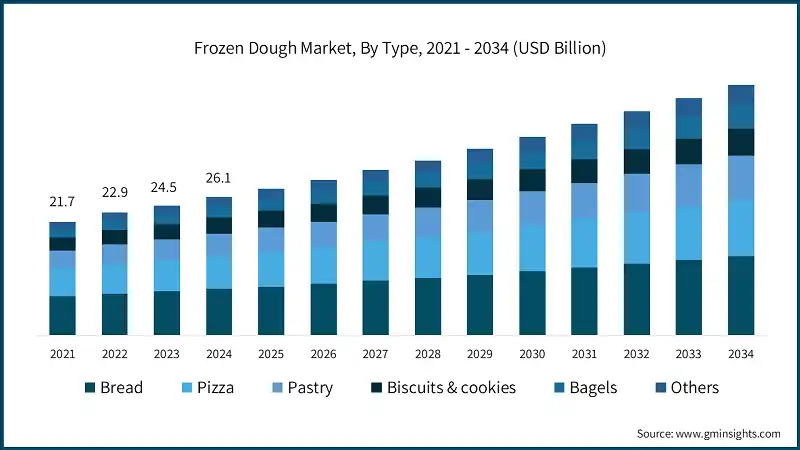
Based on type, the frozen dough market is segmented into bread, pizza, pastry, biscuits & cookies, bagels, others. Breads are estimated to increase from approximately USD 7.7 billion in 2024 corresponding to an increase of 6.4% CAGR.
- Bread is one of the most significant segments in the frozen dough market. It is widely used in homes, restaurants, and all kinds of bakeries. Frozen bread dough gives the opportunity for people to almost effortlessly create fresh varieties of bread. More customers are looking for special types like whole grain gluten-free and organic bread dough. The selling of frozen dough through supermarkets and online shops has helped in increasing the size of the market.
- The frozen pizza dough market has expanded considerably, giving the consumer ready-to-bake pizza bases that are of high quality and taste consistency for anyone who is always pressed for time. Similarly, frozen pastry dough gives bakers and home cooks options that are versatile and easy to use for making all kinds of sweet and savory goodies without the hassle of making dough from scratch.
- Frozen biscuit and cookie dough further helps in quick baking, keeping them fresh and intact in texture, giving advantages to commercial bakeries and to the homes that seek convenience. The frozen bagel dough ensures uniform quality and consistency in shape and texture, thus allowing for the swift production of freshly baked bagels with the least effort.
Learn more about the key segments shaping this market
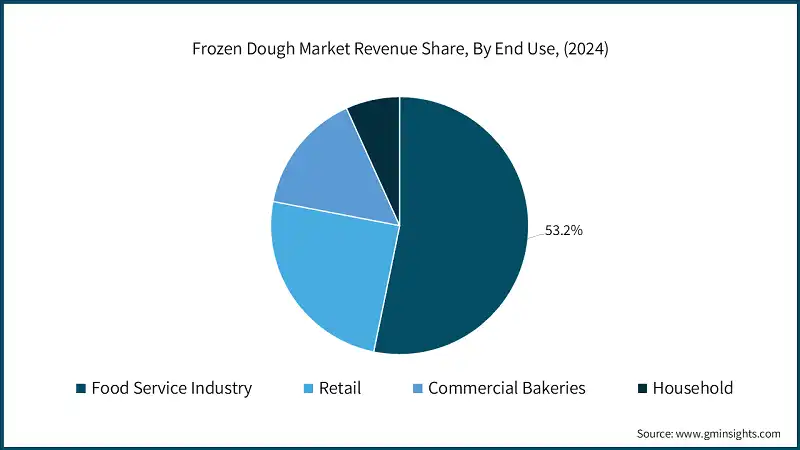
Based on end use, the market is segmented into food service industry, retail, commercial bakeries, household. Food service industry commands the major market share, precisely around 53.2% of the total market in 2024 and expected to grow at a CAGR of over 7.1% from 2025 to 2034.
- The food service industry accounts for a large part of frozen dough sales. Restaurants, cafes, hotels, and catering companies require this to bake their bread, pizza, and pastries quickly and uniformly. Time thus saved means product quality is assured. The demand for frozen dough may therefore rise with the increase in the number of food businesses throughout the world, with the newly booming Asian markets taking the lead.
- The consumption within the retail sector is booming for frozen dough products because consumers have differences in busy lives and home trends of baking at homemade solutions to which they can seek products such as organic, gluten-free, and even artisanal through e-commerce portals. Addition in commercial bakeries, frozen dough means reduced labor costs, increased productivity, and consistency of products.
- For ultimate household convenience, it has somehow made them consider using retail frozen doughs, as it requires so little preparation and just an oven to bake at home.
Based on distribution channel the frozen dough market is segmented into supermarkets & hypermarkets, convenience stores, online retail, specialty stores, others. Supermarket & hypermarket industry holds the market size of USD 11.8 billion in 2024 and expected to grow at a faster rate of 7.2% CAGR in 2034.
- Supermarkets and hypermarkets, along with online portals, serve as the main channels for mass distribution in the market. With their comprehensive mix, promotions, and large consumer bases, they offer ready access to many frozen dough brands. As such, they form a leading segment in this frozen dough market. These mega stores attract consumers looking for grocery shopping under one roof, including frozen bakery items, leading to increases in sales and brand public visibility.
- Convenience stores majorly help provide customers on the go with quick access as well as easy options. Their small product range, however, targets the urban consumer, who always needs immediate solutions within baking or last-minute purchases.
- Online retail is growing very fast in allowing consumers to sit at home browsing the wide array of frozen dough products. Because comparison and reviews are made much easier for home delivery, the reach becomes broader than through traditional stores. Specialty stores sell organic, artisanal, or premium frozen dough and thus target niche markets or provide goods for health-conscious and premium-seeking consumers.
Looking for region specific data?
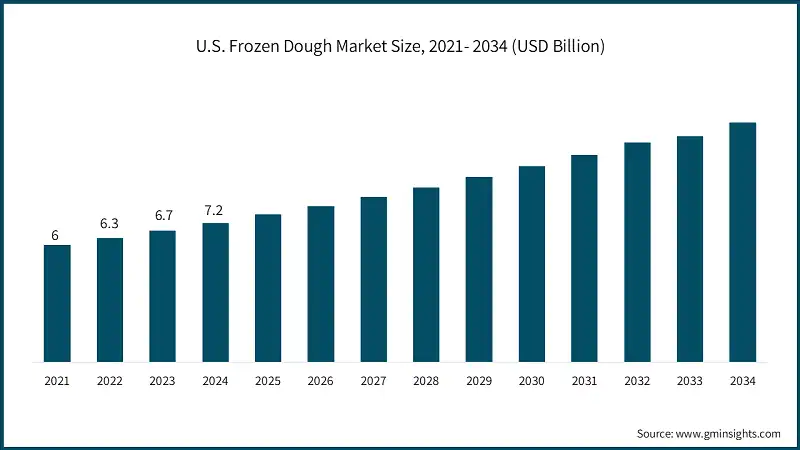
U.S. dominated the frozen dough market in North America with around 81% share and generated USD 7.2 billion in revenue in 2024.
- The North American market, especially in the U.S. and Canada, is witnessing uniform growth motivated by consumer increasing demand for ready-to-bake products that are convenient to use. Busy lifestyles and the preference for bakery-quality home-cooked meals have been stated to boost the sales of frozen dough items such as bread, pizza, and pastry dough in the U.S. frozen dough market demand for this segment is from millennials and Gen Z as these people favor the products due to their convenience and variety, thus calling for innovation in flavor formulations with health-conscious alternatives such as gluten-free and organic offerings.
- In Canada, the market is also growing, thanks to the increase in the urban population and growing trends toward baking at home. The target market of high-quality, locally sourced ingredients is pushing Canadian manufacturers towards developing more premium and artisanal frozen dough products.
The frozen dough market in the Germany is expected to experience significant and promising growth from 2025 to 2034.
- Europe's market, mainly in Germany, the UK, and France, is growing well because of the changing interest of customers toward convenience in bakery products. In Germany, this transforming nature of frozen dough by very strong bakery culture and two increasing trends of homemaking have made consumers opt for products that can be ready to bake and have authentic taste and freshness.
- The adaptation of frozen dough products is growing in the UK; busy professionals and family needs of hasty meals can result in increasing acceptance. Apart from this, it will enhance freshly prepared frozen dough products innovation such as gluten-free and organic products.
- France is famous for its great baking tradition, it is marketed with pure and artisanal frozen dough products, emphasizing pure and natural raw materials according to traditional techniques. In addition, the growing retail expansion and development of better distribution channels as influenced by health-conscious trends such as organic and preservative-free options stand for increased acceptance of frozen dough in these countries.
The frozen dough market in China is expected to experience significant and promising growth from 2025 to 2034.
- One of the fast-growing frozen dough markets with CAGR of 7.9%, that embraced the rising urbanization, changing lifestyles, and disposable incomes. Demand for ready-to-bake bakery products for convenience purposes is increasing on fast rises in western countries like China, where people have traditional tastes and unusual styles for pizzas and sweet frozen dough like pastries. The increased growth of the food service industry and retail channels only helps the market to prosper.
- In India there is increasing interest in frozen bakery products because of rising urbanization and a growing number of working professionals and young families who find quick and easy meal solutions very appealing. The market in Japan comes with a prejudice for high- quality, premium frozen dough often integrated with artisanal and healthy-oriented ingredients, which plays along with the significance the Japanese consumer gives to quality and tradition.
The frozen dough market in the Brazil is expected to experience significant and promising growth from 2025 to 2034.
- The market in Latin America witnessing CAGR of 7.6%, where Brazil and Mexico are driving the growth is expected to be on the way to steady growth due to urbanization and changing lifestyles. Convenient bakery products are increasingly in demand, and frozen dough is embraced by Brazilian consumers in the forms of traditional bread, pastries, and pizza bases. A growing trend is seen in premium and health-oriented products like organic and gluten-free options.
- The market in Mexico is also rapidly expanding due to the popularity of quick-service foods and the baking culture. Consumers are looking for baked goods that are easy to prepare but still taste authentic.
The frozen dough market in South Africa is expected to experience significant and promising growth from 2025 to 2034.
- This region, which includes nations such as South Africa and Saudi Arabia, has increasing trends for frozen dough products because of urbanism and the increase in the number of working-class individuals, along with trends toward Westernized convenience foods. In South Africa, consumers tend to adopt frozen bakery products such as bread, pizza dough, and pastries, and their access towards liberalization is widened through the expansion of retail chains and food outlets.
- This trend is further established with the growing amount of disposal income in the region since products with very attractive prices capture the audience. All factors of the emerging fast-food chains and the new retail formats further promote accepted disposable-form-string-of-business income in the country's market and are responsible for the very strong demand in the Middle East for ready-to-bake and frozen bakery products.
Frozen Dough Market Share
Top 7 companies include General Mills Inc., Ajinomoto Co., Inc., Aryzta AG, Bridgford Foods Corporation, Campbell Soup Company, Dawn Food Products, Inc., Europastry. These are prominent companies within the frozen dough market operating in their respective regions and accounting the market share of 41.4%. These companies hold strong positions globally due to their extensive experience in market. Their diverse product portfolios, backed by robust production capabilities and distribution networks, enable them to meet the rising demand for Frozen dough across various regions.
- General Mills Inc. has a solid standing in the frozen dough segment due to its wide range global distribution channels and brand equity. It offers a wide portfolio comprising bread and pastry products, which would help meet the needs of several consumers, particularly in North America and Europe.
- Ajinomoto Co., Inc. is placing its emphasis on frozen and processed foods, where it is currently a strong player in Asia and is increasing globally. The strengths of Ajinomoto generally come from its items of good quality, innovations in technologies, and Asian style baked goods, which have a very high ceiling of appeal to niche markets and ethnic consumers worldwide.
- Aryzta AG considers itself as a premium player of artisan and specialty baked goods, among which are frozen dough products. Its focus on such high-end and gourmet products, combined with a well-developed footprint across Europe and North America in terms of these products, allows it then to manage upscale foodservice providers and retail chains, thus providing a competitive edge by way of distinction.
- Bridgford Foods Corporation offers frozen and refrigerated bakery products focused on convenience and affordability. With a solid base in North America, particularly surrounding retail and food service channels, the company is well-positioned as it also carries with it a well-earned reputation surrounding quality and innovation concerning ready-to-bake items, thus making it a strong competitor in the frozen dough segment.
- Campbell Soup Company has entered the market for frozen bakery and dough products among its multiplicity of other products and services, most predominantly due to its global distribution network and strong reputation. The company's strategic acquisitions and focus on health-conscious and convenient foods give it a competitive edge, both in the North American retail and foodservice markets.
- Dawn Food Products, Inc. is one of the active players in bakery ingredients and finished bakery products associated with frozen dough. The real strength of it lies in its extensive range of products, capabilities for customization, and very close relationships with bakery and foodservice customers globally, which help it respond quickly to changing consumer tastes.
- Europastry is the best-known company among the European bakery manufacturers. It has been appreciated for its innovative frozen baked products and dough products with strong market views. Indeed, it places much attention on its product quality, innovation projects, and sustainability maintains competitive advantage among the European and emerging markets, serving both retail and foodservice segments with a large portfolio of products.
Frozen Dough Market Companies
Major players operating in the frozen dough industry are:
- Ajinomoto Co., Inc.
- Aryzta AG
- Bridgford Foods Corporation
- Campbell Soup Company
- Dawn Food Products, Inc.
- Europastry
- General Mills Inc.
- Gonnella Baking Company
- Guttenplan's
- Nestlé S.A.
- Tyson Foods Inc.
Frozen Dough Market Report Attributes
| Key Takeaway | Details |
|---|---|
| Market Size & Growth | |
| Base Year | 2024 |
| Market Size in 2024 | USD 26.1 Billion |
| Forecast Period 2025 – 2034 CAGR | 7% |
| Market Size in 2034 | USD 50.9 Billion |
| Key Market Trends | |
| Drivers | Impact |
| Rising urbanization and busy lifestyles | Increased demand for convenient, ready-to-use frozen dough solutions, boosting sales. |
| Increasing demand for convenience foods | Consumers prefer quick meal options, expanding market potential for frozen dough products. |
| Expanding retail and online distribution channels | Wider accessibility and availability, driving growth and consumer reach in various regions. |
| Pitfalls & Challenges | Impact |
| Quality and freshness concerns | Perceived decline in product freshness may reduce consumer trust and purchase frequency. |
| High competition and market saturation | Intense rivalry limits market share growth and compresses profit margins. |
| Opportunities: | Impact |
| Growing demand for international and specialty frozen dough products | Catering to diverse tastes, capturing new customer segments, and increasing market share. |
| Innovation in healthier and organic options | Meeting health-conscious consumer needs, enhancing brand loyalty and premium pricing. |
| Market Leaders (2024) | |
| Market Leaders |
8.6% market share |
| Top Players |
Collective Market Share of 33.40% in 2024 |
| Competitive Edge |
|
| Regional Insights | |
| Largest Market | North America |
| Fastest Growing Market | Asia Pacific |
| Emerging Countries | China, Japan, Canada, Italy |
| Future outlook |
|
What are the growth opportunities in this market?
Frozen Dough Industry News:
- In July 2025, Doughlicious, the British favorite cookie dough brand known for its artisan frozen gelato bites and its knack for pushing boundaries in innovative snacking, released its latest offering, "Cookies & Cream".
- In January 2023, Well Crusters, a third-generation family business, specializes in Kosher frozen pastries, inaugurated a new plant in Paterson, NJ. The opening is the first such event in New Jersey for the family-after 47 years based in Montreal.
- In 2023, General Mills announced that it will be expanding its facilities for frozen dough in Joplin, MO, which will create increased manufacturing capacity along with an additional capability for packaging.
- In November 2023, OK Frozen Dough, a family-run company, expanded its operations in Calgary. The new facility to be constructed shall qualify as an SQF-certified facility, thereby enhancing the strict food safety program in the company.
- In September 2023, CJ Foodville, a South Korean food services group, planned to construct its first production facility within the United States as a support mechanism for the bakery-cafe chain TOUS les JOURS.
The frozen dough market research report includes an in-depth coverage of the industry with estimates and forecast in terms of revenue (USD Billion) and (Kilo Tons) in volume from 2021 - 2034 for the following segments:
Market, By Type
- Bread
- Pizza
- Pastry
- Biscuits & cookies
- Bagels
- Others
Market, By End Use
- Food service industry
- Retail
- Commercial bakeries
- Household
Market, By Distribution Channel
- Supermarkets & hypermarkets
- Convenience stores
- Online retail
- Specialty stores
- Others
The above information is provided for the following regions and countries:
- Key trends
- North America
- U.S.
- Canada
- Europe
- Germany
- UK
- France
- Italy
- Spain
- Rest of Europe
- Asia Pacific
- China
- India
- Japan
- Australia
- South Korea
- Rest of Asia Pacific
- Latin America
- Brazil
- Mexico
- Argentina
- Rest of Latin America
- Middle East & Africa
- Saudi Arabia
- South Africa
- UAE
- Rest of Middle East & Africa
Frequently Asked Question(FAQ) :
What is the market size of the frozen dough in 2024?
The market size was USD 26.1 billion in 2024, with a CAGR of 7% expected through 2034. The growth is driven by the demand for convenience, extended shelf life, and innovations in frozen dough production and marketing.
What is the projected value of the frozen dough market by 2034?
The market is poised to reach USD 50.9 billion by 2034, fueled by increasing retail and foodservice sales, technological advancements, and consumer preference for premium and health-conscious products.
How much revenue did the bread segment generate in 2024?
The bread segment generated approximately USD 7.7 billion in 2024, with an expected CAGR of 6.4% through 2034.
What was the valuation of the supermarket and hypermarket segment in 2024?
The supermarket and hypermarket segment accounted for USD 11.8 billion in 2024 and is anticipated to expand at a CAGR of 7.2% till 2034.
What is the growth outlook for the food service industry from 2025 to 2034?
The food service industry, which held a 53.2% market share in 2024, is set to witness over 7.1% CAGR up to 2034.
Which region leads the frozen dough sector?
North America leads the market, with the U.S. dominating an 81% share and generating USD 7.2 billion in revenue in 2024.
What are the upcoming trends in the frozen dough market?
Rising demand for gluten-free, vegan, and premium dough, along with advances in packaging, enzyme formulations, and AI quality control.
Who are the key players in the frozen dough industry?
Key players include Ajinomoto Co., Inc., Aryzta AG, Bridgford Foods Corporation, Campbell Soup Company, Dawn Food Products, Inc., Europastry, Guttenplan's, Nestlé S.A., and Tyson Foods Inc.
Frozen Dough Market Scope
Related Reports