Summary
Table of Content

Freight Trucking Market
Get a free sample of this report
Form submitted successfully!
Error submitting form. Please try again.
Thank you!
Your inquiry has been received. Our team will reach out to you with the required details via email. To ensure that you don't miss their response, kindly remember to check your spam folder as well!
Request Sectional Data
Thank you!
Your inquiry has been received. Our team will reach out to you with the required details via email. To ensure that you don't miss their response, kindly remember to check your spam folder as well!
Form submitted successfully!
Error submitting form. Please try again.
Freight Trucking Market Size
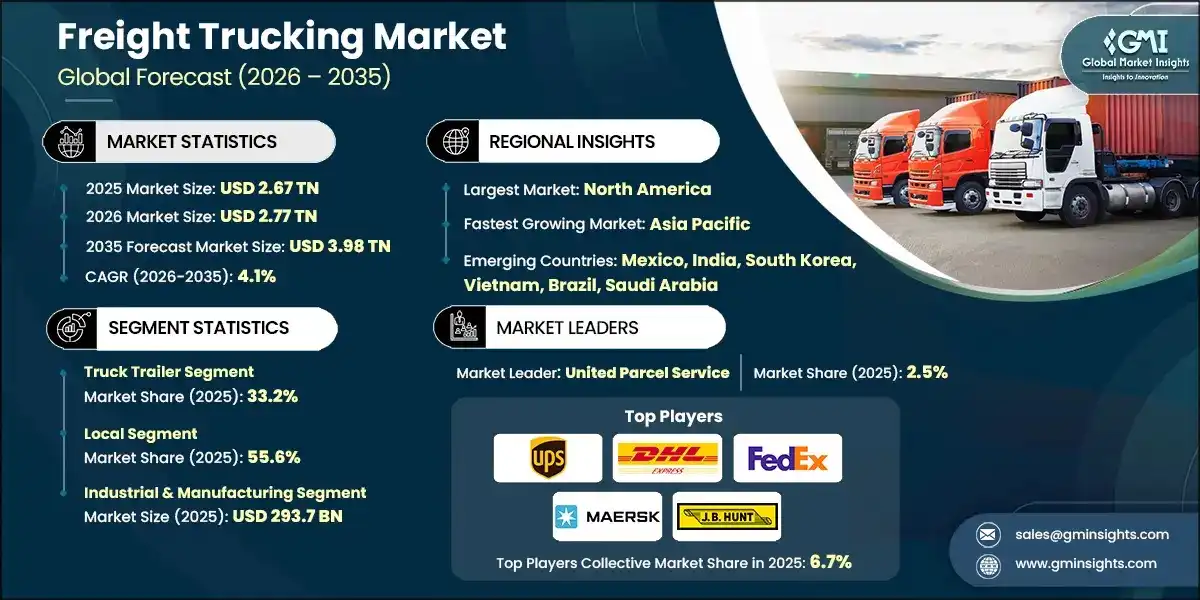
The global freight trucking market was valued at USD 2.67 trillion in 2025. The market is expected to grow from USD 2.77 trillion in 2026 to USD 3.98 trillion in 2035 at a CAGR of 4.1%, according to latest report published by Global Market Insights Inc.
Freight Trucking Market Key Takeaways
Market Size & Growth
- 2025 Market Size: USD 2.67 Trillion
- 2026 Market Size: USD 2.77 Trillion
- 2035 Forecast Market Size: USD 3.98 Trillion
- CAGR (2026–2035): 4.1%
Regional Dominance
- Largest Market: North America
- Fastest Growing Region: Asia Pacific
Key Market Drivers
- Global e-commerce and omnichannel retail growth.
- Global trade deals and partnership expansion.
- Infrastructure investment.
- Fleet renewal and stricter emissions standards.
Challenges
- Regulatory fragmentation across countries/regions.
- Road congestion and deteriorating urban access.
Opportunity
- Electrification & zero-emission truck adoption.
- Automated Driving Systems in Freight Trucks.
- Rapid expansion of digital freight platforms.
- Value-added logistics.
Key Players
- Market Leader: United Parcel Service led with over 2.5% market share in 2025.
- Leading Players: Top 5 players in this market include United Parcel Service, DHL Express, FedEx, A.P. Moller - Maersk, J.B. Hunt Transport, which collectively held a market share of 6.7% in 2025.
Get Market Insights & Growth Opportunities
Worldwide logistics is predominantly run by roadways. In this, trucks are the major aspects of businesses and trades, whether for domestic or international. As per the current trend, over 60% of worldwide logistics are done through trucks.
Industries such as pharmaceuticals, food & beverages and chemicals always look for logistic solutions that help to keep the originality and freshness of the products. Expanding freight trucking domestically or internationally helps them to go with the roadways as the first option for logistics.
Each year thousands of logistics startups are founded, most of which are related to trucks. Such a strong preview of the future of logistics indicates how the worldwide investors are planning to capture the logistics market at the earliest possible time by launching services for domestic and international freight.
Notable initiatives are Japan and China’s program to construct a dedicated lane to boost their logistics sector and support the faster delivery of goods. For instance, Japan is on the way to developing a 320-mile "autoflow road" between two major cities, Tokyo and Osaka, to tackle its trucking and delivery capacity crisis.
Similarly, China's initiative on LNG vehicles created dedicated lanes for LNG vehicles in nearly 300 cities. In industries such as steel and coking, new rules require most road freight to be carried by electric or LNG vehicles.
To get key market trends
Freight Trucking Market Trends
Current market for freight trucking sees significant growth with the expansion of newer technologies such as AI & ML, digital twin and advanced analytics. These technologies help in expansion of the efficiency and effectiveness of freight trucking. As per the statistics, over 50% of logistics companies have started experimenting with artificial intelligence in their process.
AI is now not just a demand, but it is a need of organizations to be in forefront, aligning themselves with industry 4.0 revolution. In logistics, AI is used in route planning and capacity utilization as well as the areas of procurement & purchasing, production and sales & distribution along the entire supply chain have already revolutionized.
For instance, in June 2025, Plus Automation, a physical AI company, commercializing AI-based virtual driver software for autonomous trucks. The company has already secured partnerships with top transportation leaders. These partners include global truck manufacturers, including TRATON GROUP, Hyundai, and IVECO, as well as global fleets, including Amazon and DSV.
Freight Trucking Market Analysis
Learn more about the key segments shaping this market
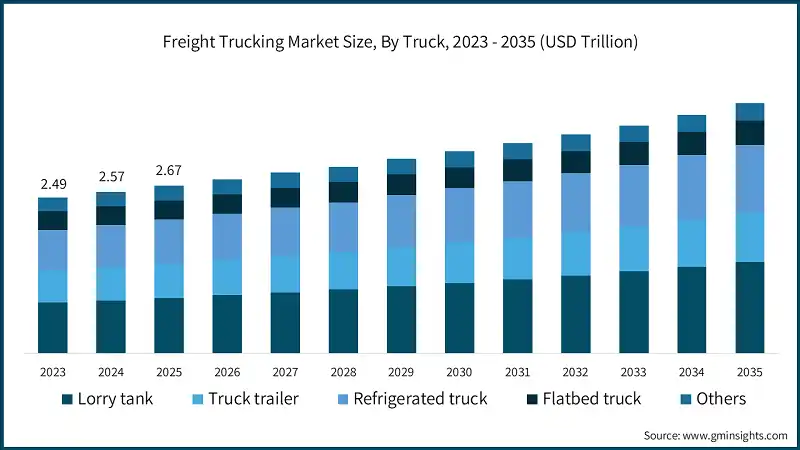
Based on truck, the freight trucking market is divided into lorry tank, truck trailer, refrigerated truck, flatbed truck and others. The truck trailer segment dominated the market with 33.2% share in 2025.
- Truck trailers are mostly needed in the transport of non-perishable goods. Thus, they are majorly used in the retail, consumer goods, and e-commerce sectors as the most suitable means of transport. Over ten million truck trailers are registered across the world that shows the demand for them from various industries.
- The online shopping trend continues to increase and the requirement for quicker delivery is the main contributor to the robust demand for truck trailers that are used to transfer products from warehouses to stores and customers. Their ability to carry large loads, protect goods from weather conditions, and move easily make trailers indispensable in these industries.
- On the other hand, lorry tanks, refrigerated trucks and flatbed trucks are used in different applications. For instance, chemical industries use lorry tanks for transporting oil and gases to other locations. Refrigerated trucks are used mostly for perishable goods like pharmaceuticals, fresh vegetables and fruits, and frozen products.
Learn more about the key segments shaping this market
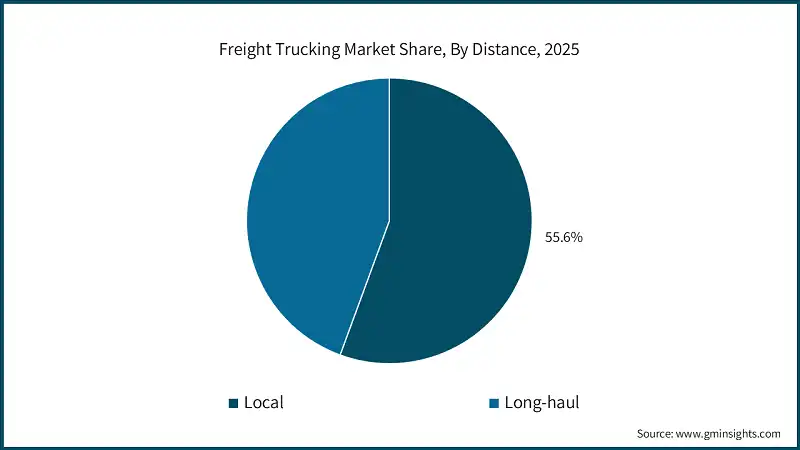
Based on distance, the freight trucking market is divided into local and long haul. The local segment dominated the market with 55.6% share in 2025.
- The domestic need of transporting goods from one place to another resulting in higher adoption of local distance freight logistics in 2025, which was valued at USD 1.48 trillion. This is dominance of the segment is the result of local manufacturing of goods nearby location or between 100 to 250 miles.
- For instance, in November 2025, Ritco Logistics has secured multiple contracts worth ?130 crore (around USD 14.5 million) from different sectors including petrochemicals, FMCG, and energy. The company is adding 50 custom-designed trucks to its fleet for its infrastructure customers.
- On the other hand, many logistics companies that have both national and international permits are also picking up pace of growth. These logistics companies deliver services over a distance of 400 km. For manufacturers who don’t produce products in a region or area where the product is going to be used, these logistics companies secure long-term partnerships.
Based on industry, the freight trucking market is divided into food and beverages, retail & e-commerce, industrial and manufacturing, energy and mining, oil and gas, pharmaceutical and healthcare, chemical and others. In 2025, the Industrial & Manufacturing segment led the market, reaching a market value of USD 293.7 billion.
- This segment dominated because factories and heavy machinery units rely on steady, large-volume freight to keep production schedules on track.
- Moreover, the retail & e-commerce segment is predicted to have the quickest growth from 2026 to 2035 with a CAGR of 5.9%. This will be mainly due to the online shopping trend, last-mile delivery networks that will be constantly developed, and growing demand for same-day and next-day deliveries as well.
- The combined effects of the omnichannel retail trend, consumer expectations for faster delivery, and small-parcel, frequent shipments are pulling the trucking industry to the forefront, hence being the segment that drives market growth in the future.
- Segments such as food & beverages, energy & mining, oil & gas, chemical, etc. are still popular, but their shipping volumes are not as large as that of retail & e-commerce and industrial. The shipping might be critical, but they are also constrained by factors such as compliance with regulations, seasonal trends, and unique handling requirements.
Looking for region specific data?
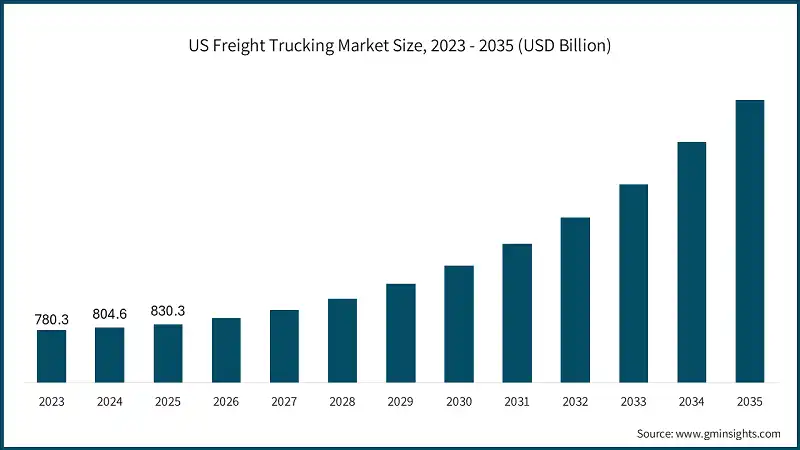
The US freight trucking market reached USD 830.3 billion in 2025, growing from USD 804.6 billion in 2024.
- The U.S. market is growing due to economic factors and changing logistics patterns. The U.S. being the home of many manufacturing companies, which indicates a strong domestic manufacturing, high consumer-driven freight volumes and a large interstate network, are among the key drivers of this market.
- Truck transportation has become the main method for carrying freight as per reports from the American Trucking Associations (ATA) and government organizations.
- Besides, the growth in on-line shopping and the demand for prompt deliveries have been altering the distribution channels and has made trucking the primary solution for transportation.
- At the same time, more warehouses and distribution centers near ports and highways have increased freight movement, helping carriers of all sizes. With these advantages, the U.S. freight trucking market is expected to grow at a CAGR of 3.6% from 2026 to 2035, driven by strong demand, changing logistics networks, and ongoing infrastructure upgrades.
The North America region is valued at USD 908.4 billion in 2025 and expected to grow at the CAGR of 3.5% between 2026 and 2035.
- North America is the largest region in the freight trucking market. This is due to government and trade associations focusing on the region’s strong manufacturing, energy production, and agricultural output.
- The U.S. has a large number of trucks compared to other countries. For example, by June 2025, the USDT reported nearly 580,000 active U.S. motor carriers registered with FMCSA. Each of these carriers owns or leases at least one tractor.
- This fragmented network of carriers provides enough capacity, flexible services, and competitive freight rates across the country. Trade with Mexico and Canada also helps this growth, as the U.S. Department of Transportation has reported increasing truck-based trade across North America.
The Europe freight trucking market accounted for USD 724.4 billion in 2025 and is anticipated to grow at the CAGR of 4.3% between 2026 and 2035.
- The Europe market remains strong and currently is the second largest region in the market. Unlike rail or water-based transportation, trucking can provide delivery directly to the customer making it an important part of most supply chains in the last mile. This capability is what keeps trucking at the top of the market, with approximately 75% of all land freight transported in the EU via truck.
- Road freight, involving around 6 million trucks, is thus a major contributor to the trade and commerce movement across the whole of Europe.
- Regulations and infrastructure put into place by the EU has made the freight trucking industry successful. The EU has several programs such as the Single European Transport Area and the Trans-European Transport Network (TEN-T) to continue reducing trade barriers and creating efficiency in the trade between EU member states by allowing for the easy delivery of freight and supplies to one another.
- In addition to this support by the EU, it continues to invest heavily in the development of road infrastructure, which will lower costs and increase efficiency for trucking companies.
Germany's freight trucking market is growing quickly in Europe, with a strong CAGR of 4.7% between 2026 and 2035.
- Road freight transport is a major contributor to Germany's economy, and it plays a significant role in the country's geography as well. The economy heavily relies on the movement of raw materials, semi-finished goods and finished products due to the strong industrial base of the automotive, chemicals and machinery industries.
- Germany's geographical position as a Central European Transit Hub makes its road infrastructure more significant for both local and international transport. This dual function of supporting a large domestic market and being a key logistics link for Europe keeps the road transportation sector strong.
- Germany's Logistics Performance Index (LPI) ranking, which is among the top in the world, and government spending on road infrastructure contribute to the trucking sector's success. The growth of e-commerce has also led to a higher demand for road freight, as trucks are the best option for dealing with decentralized logistics and fast last-mile deliveries.
The Asia Pacific freight trucking market is estimated to reach USD 1.13 trillion by 2035, by growing at a CAGR of 5.6% during the analysis timeframe.
- The primary drivers of the Asia Pacific freight trucking market are the region’s stable economic foundations and its designation as a global manufacturing hub. The industrialization of China, India and the ASEAN countries has consequently created a great need for truck freight services.
- The region relies totally on transporting raw materials, intermediate goods and finished products over and across countries unlike other regions where industries are located far apart.
- Road transportation, being economical and convenient, takes the lead in the movement of these goods. Besides, the governments are making huge investments in infrastructure projects, for instance, the Belt and Road Initiative and national highway upgrades.
- Such investments help to eliminate congestion and cut down the time taken for transportation, thereby reducing logistics costs and strengthening the road freight sector as an important trade partner.
China is estimated to grow with a CAGR of 4.7% in the projected period between 2026 and 2035, in the Asia Pacific freight trucking market.
- The freight trucking industry in China is experiencing a steady growth, which is mainly due to the on-going e-commerce boom and strong infrastructure. The fact that China has the largest online retail market in the world means that there will always be a need for last-mile and regional deliveries.
- Road transport is very important for the linking of production areas to consumers. This need is complemented by the network of highways in China, which is very extensive and has been built over the years with government investment. Consequently, the country has the largest share of the Asia Pacific market with about 55.5%.
- Also, the infrastructure support allows trucking services to provide flexible, door-to-door deliveries, meeting the complex needs of modern supply chains and keeping the market ahead of other freight options.
- Sustainability regulations and competition are two major factors also influencing the market. The governments that support the introduction of New Energy Vehicles (NEVs) in the trucking industry are forcing the manufacturers to clean up their technologies, though this will require considerable investments.
Latin America freight trucking market is estimated to reach USD 290.5 billion in 2025 and is anticipated to show lucrative growth over the forecast period.
- The regional market is being propelled by the increase in manufacturing and global trade. The need for long-distance and cross-border Full Truckload (FTL) services has risen due to nearshoring, particularly in Mexico. The Free Trade Agreements (FTAs) and the regional alliances like Mercosur have facilitated the logistics and thus the movement of freight and the creating of stable supply chains have become very steady.
- Along with the above developments, the market is also impacted by the growth of e-commerce and the unique needs of particular industries. The growing number of online shoppers has brought about the increased need for last-mile delivery and Couriers, Express, and Parcel (CEP) services.
- Furthermore, the Latin America's heavy agricultural industry has demanded cold chain logistics which requires very strict compliance with quality standards. This has also resulted in the adoption of digital tools and technology to enhance efficiency and transparency in the sector.
Brazil is estimated to grow with a CAGR of 3.6% between 2026 and 2035, in the Latin America freight trucking market.
- Brazil's large domestic production and its use of highways for distribution are key to its market. Agriculture and manufacturing drive steady demand for Full-Truck-Load (FTL) transport to move raw materials and finished goods across the country.
- At the same time, the rapid growth of e-commerce and urbanization is changing demand patterns. This has increased the need for Less-than-Truck-Load (LTL) services and last-mile delivery systems, especially in busy cities like São Paulo. The demand for faster and more reliable final-mile logistics is pushing carriers to use new strategies and technology.
- To keep the market strong, the government is investing in infrastructure through programs like Novo PAC. These projects aim to improve highways and concession models, which help lower costs and reduce transit times for carriers.
The Middle East and Africa accounted for USD 154.7 billion in 2025 and is anticipated to show lucrative growth over the forecast period.
- In the region, freight trucking sector relies on strong infrastructure development and its key geographical location. In the GCC, governments are heavily investing in better road networks, expanding port capacity, and improving intermodal connections.
- These efforts make logistics more efficient and use the region's position as a trade hub between Asia, Europe, and Africa. This supports high-volume cross-border road freight and strengthens regional supply chains.
- Urbanization, a growing middle class, and the rapid growth of e-commerce are increasing the need for fast and reliable road transport, especially for last-mile and cold-chain logistics. Additionally, government policies promoting non-oil industries like manufacturing, mining, and construction are boosting the need for specialized and heavy-haul trucking services.
UAE to experience substantial growth in the Middle East and Africa freight trucking market in 2025.
- The country's industrial goals and supportive trade environment are driving higher demand. The "Operation 300Bn" strategy is increasing domestic manufacturing, which is boosting the need to transport raw materials, intermediate goods, and finished products by road.
- Free Zones like JAFZA, with easy customs processes and tax benefits, are also increasing re-export and transshipment activities that depend on reliable road freight services.
- The UAE Logistics Integration Council is improving processes and promoting smart transport systems to make operations more efficient and safe. Additionally, Comprehensive Economic Partnership Agreements (CEPAs) are strengthening the UAE's position as a key regional trade hub, ensuring steady growth in cross-border and domestic freight for the trucking industry.
Freight Trucking Market Share
- The top 7 companies in the freight trucking industry are United Parcel Service, DHL Express, FedEx, Maersk, J.B. Hunt Transport, Nippon Express and Schneider National, contributing 7.2% of the market in 2025.
- United Parcel Service provides ground freight, LTL, full truckload transport, cross-border trucking, and temperature-controlled shipping. It also offers tracking, customs support, supply chain solutions, and reliable delivery across the country for commercial and industrial customers.
- DHL Express offers international road freight, cross-border trucking, palletized cargo movement, and temperature-controlled transport. It also provides fast delivery, customs handling, multimodal options, and flexible freight services for global trade and supply chain needs.
- FedEx offers LTL freight trucking, priority road shipments, cross-border transport, and heavy-weight cargo solutions. It also provides tracking, customs clearance, and reliable delivery for industries like retail, manufacturing, healthcare, and e-commerce.
- Maersk provides inland trucking, full truckload services, cross-border road transport, and logistics management. It connects ports to factories and offers temperature-controlled, time-critical, and project cargo services worldwide.
- J.B. Hunt offers full truckload, LTL, intermodal trucking, dedicated contract services, and final-mile delivery. It provides flexible freight capacity, modern fleet management, shipment tracking, and logistics solutions for retailers and manufacturers.
- Nippon Express provides domestic and international trucking, full truckload, LTL services, and temperature-controlled transport. It also offers integrated logistics, cross-border solutions, and freight support for industries like automotive, healthcare, electronics, and retail.
- Schneider National offers truckload, LTL, intermodal, cross-border trucking, and bulk transport. It provides modern fleet support, reliable capacity, temperature-controlled options, and logistics solutions for retail, industrial, chemical, and manufacturing supply chains.
Freight Trucking Market Companies
Major players operating in the freight trucking industry are:
- United Parcel Service
- DHL Express
- FedEx
- A.P. Moller – Maersk
- J.B. Hunt Transport
- Nippon Express
- Schneider National
- XPO Logistics
- Kuehne + Nagel
- C.H. Robinson
- UPS uses its large global network, trusted brand, and advanced routing technology to its advantage. The company focuses on making ground freight more efficient, improving digital logistics tools, growing its healthcare and e-commerce logistics, and reducing emissions through sustainability programs in transportation.
- DHL Express has strong international coverage and expertise in fast deliveries. The company plans to expand cross-border freight services, invest in digital tracking systems, use electric vehicles for greener logistics, and grow operations in high-growth areas like Europe, Asia, and new trade routes.
- FedEx has a reliable global transportation network. The company aims to increase its LTL and ground freight capacity, automate sorting facilities, improve digital tools for customers, lower operating costs, and strengthen cross-border services for e-commerce and industrial shipments.
- Maersk is strong in integrated logistics, combining ocean shipping, inland trucking, and supply chain management. The company wants to become a full-service logistics provider by expanding inland services, investing in digital platforms, improving warehousing, and creating low-carbon transportation solutions.
- J.B. Hunt has a large trucking fleet and leads to intermodal services. The company focuses on improving its dedicated contract services, improving digital freight matching with the J.B. Hunt 360° platform, making supply chains more efficient, and building rail partnerships for reliable capacity.
- Nippon Express has strong logistics networks in Asia and globally, with expertise in specialized cargo. The company plans to expand cross-border trucking, improve logistics for the automotive and healthcare industries, invest in digital supply chain platforms, and support low-emission freight operations through sustainability programs.
- Schneider National has strong truckload, intermodal, and dedicated services supported by a modern fleet. The company focuses on growing intermodal partnerships, improving freight tracking with digital tools, strengthening dedicated contract logistics, and using data analytics to make transportation more efficient.
Freight Trucking Market Report Attributes
| Key Takeaway | Details |
|---|---|
| Market Size & Growth | |
| Base Year | 2025 |
| Market Size in 2025 | USD 2.67 Trillion |
| Market Size in 2026 | USD 2.77 Trillion |
| Forecast Period 2026-2035 CAGR | 4.1% |
| Market Size in 2035 | USD 3.98 Trillion |
| Key Market Trends | |
| Drivers | Impact |
| Global e-commerce and omnichannel retail growth | Drives higher shipment volumes and accelerates demand for faster and last-mile trucking. |
| Global trade deals and partnership expansion | Boosts cross-border freight flows and strengthens long-haul trucking demand through simplified, predictable trade corridors. |
| Infrastructure investment | Enhances transport capacity and reduces transit delays, improving fleet productivity and lowering overall logistics costs. |
| Fleet renewal and stricter emissions standards | Pushes carriers toward cleaner, efficient trucks, reducing operating costs while improving fleet sustainability and compliance. |
| Pitfalls & Challenges | Impact |
| Regulatory fragmentation across countries/regions | Increases compliance complexity and operational inefficiencies, restricting seamless cross-border trucking movement. |
| Road congestion and deteriorating urban access | Creates delays, reduces fleet productivity, and increases fuel consumption and delivery costs across major freight corridors. |
| Opportunities: | Impact |
| Electrification & zero-emission truck adoption | Opens new fleet modernization avenues and reduces lifecycle costs while meeting tightening global sustainability expectations. |
| Automated Driving Systems in Freight Trucks | Enhances route efficiency and safety while reducing dependence on driver availability for long-haul operations. |
| Rapid expansion of digital freight platforms | Improves load matching, pricing transparency, and capacity utilization, lowering costs and boosting operational efficiency. |
| Value-added logistics | Expands revenue potential by offering specialized, high-margin services for temperature-sensitive, time-critical, and premium shipments. |
| Market Leaders (2025) | |
| Market Leaders |
2.5% market share |
| Top Players |
|
| Competitive Edge |
|
| Regional Insights | |
| Largest Market | North America |
| Fastest growing market | Asia Pacific |
| Emerging countries | Mexico, India, South Korea, Vietnam, Brazil, Saudi Arabia |
| Future outlook |
|
What are the growth opportunities in this market?
Freight Trucking Industry News
- In November 2025, Ritco Logistics has won contracts worth ?130 crore (about USD 14.5 million) from sectors like petrochemicals, FMCG, and energy. The company is adding 50 custom-designed trucks to its fleet to serve its infrastructure customers.
- In September 2025, METRANS and Volvo Trucks launched six electric trucks in the Czech Republic. These trucks will be used for last-mile and first-mile deliveries in cities and nearby areas, focusing on reducing noise and emissions.
- In May 2025, Volvo introduced a new long-distance electric truck with a range of 600 kilometers. The truck’s batteries can be charged from 20% to 80% in 40 minutes.
- In May 2025, W&P added 20 Mercedes-Benz eActros 600 trucks to its fleet and opened a charging park with 56 charging points. The eActros 600 can travel 500 kilometers without needing to recharge.
- In February 2025, Tevex Logistics added 150 new Mercedes-Benz Actros L trucks to its fleet. These trucks have Active Brake systems that can automatically stop for pedestrians and cyclists to improve safety.
The freight trucking market research report includes in-depth coverage of the industry with estimates & forecasts in terms of revenue ($ Mn/Bn) and fleet size from 2022 to 2035, for the following segments:
Market, By Truck
- Lorry tank
- Truck trailer
- Refrigerated truck
- Flatbed truck
- Others
Market, By Distance
- Local
- Long haul
Market, By Service Model
- Full Truckload (FTL)
- Less Than Truckload (LTL)
Market, By Truck Size
- Light-Duty Trucks (LDTs)
- Medium-Duty Trucks (MDTs)
- Heavy-Duty Trucks (HDTs)
Market, By Cargo
- Dry Goods
- Perishables
- Hazardous Materials
Others
Market, By Enterprise Size
- SMEs
- Large Enterprises
Market, By Industry
- Food & beverages
- Retail & e-commerce
- Industrial & manufacturing
- Energy & mining
- Oil & gas
- Pharmaceutical & healthcare
- Chemical
- Others
The above information is provided for the following regions and countries:
- North America
- US
- Canada
- Europe
- Germany
- UK
- France
- Italy
- Spain
- Russia
- Nordics
- Benelux
- Asia Pacific
- China
- India
- Japan
- South Korea
- ANZ
- Singapore
- Malaysia
- Indonesia
- Vietnam
- Thailand
- Latin America
- Brazil
- Mexico
- Argentina
- Colombia
- MEA
- South Africa
- Saudi Arabia
- UAE
Frequently Asked Question(FAQ) :
What was the market size of the freight trucking in 2025?
The market size was USD 2.67 trillion in 2025, with a CAGR of 4.1% expected through 2035. The growth is driven by the dominance of roadways in logistics and the increasing reliance on trucks for domestic and international trade.
What is the projected value of the freight trucking market by 2035?
The market is poised to reach USD 3.98 trillion by 2035, fueled by advancements in technology, growing industrial activities, and the expansion of e-commerce.
What is the expected size of the freight trucking industry in 2026?
The market size is projected to reach USD 2.77 trillion in 2026.
What was the market share of the truck trailer segment in 2025?
The truck trailer segment held a 33.2% market share in 2025, led by its extensive use in transporting non-perishable goods across retail, consumer goods, and e-commerce sectors.
What was the valuation of the Industrial & Manufacturing segment in 2025?
The Industrial & Manufacturing segment was valued at USD 293.7 billion in 2025, dominating the market due to its reliance on steady, large-volume freight for production schedules.
What was the market share of the local segment in 2025?
The local segment accounted for 55.6% of the market in 2025, valued at USD 1.48 trillion, propelled by the need for short-distance freight logistics within 100 to 250 miles.
What was the size of the U.S. freight trucking sector?
The U.S. market reached USD 830.3 billion in 2025, supported by strong domestic manufacturing, high consumer-driven freight volumes, and an extensive interstate network.
What are the upcoming trends in the freight trucking market?
Key trends include growing use of AI, ML, digital twins, and analytics for efficiency, AI-driven route and capacity optimization, and the rise of autonomous trucking supported by global fleet partnerships.
Who are the key players in the freight trucking industry?
Key players include United Parcel Service, DHL Express, FedEx, A.P. Moller – Maersk, J.B. Hunt Transport, Nippon Express, Schneider National, XPO Logistics, Kuehne + Nagel, and C.H. Robinson.
Freight Trucking Market Scope
Related Reports