Summary
Table of Content

Flat Glass Market
Get a free sample of this report
Form submitted successfully!
Error submitting form. Please try again.
Thank you!
Your inquiry has been received. Our team will reach out to you with the required details via email. To ensure that you don't miss their response, kindly remember to check your spam folder as well!
Request Sectional Data
Thank you!
Your inquiry has been received. Our team will reach out to you with the required details via email. To ensure that you don't miss their response, kindly remember to check your spam folder as well!
Form submitted successfully!
Error submitting form. Please try again.
Flat Glass Market Size
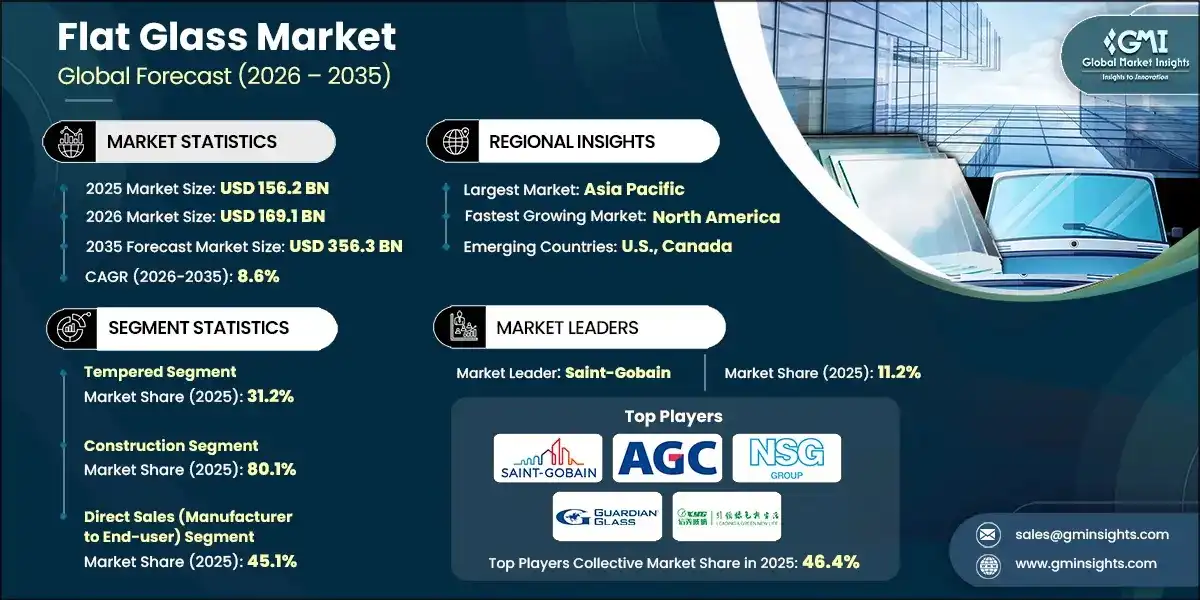
The global flat glass market was valued at USD 156.2 billion in 2025. The market is expected to grow from USD 169.1 billion in 2026 to USD 356.3 billion in 2035, at a CAGR of 8.6% according to latest report published by Global Market Insights Inc.
Flat Glass Market Key Takeaways
Market Size & Growth
- 2025 Market Size: USD 156.2 Billion
- 2026 Market Size: USD 169.1 Billion
- 2035 Forecast Market Size: USD 356.3 Billion
- CAGR (2026–2035): 8.6%
Regional Dominance
- Largest Market: Asia Pacific
- Fastest Growing Region: North America
Key Market Drivers
- Rising construction activities in emerging economies.
- Increasing demand for solar glass.
- Technological advancements in glass production.
Challenges
- High cost of advanced glass technologies.
- Environmental and regulatory challenges.
Opportunity
- Increasing adoption in construction and infrastructure.
- Growing use of energy-efficient and smart glass.
Key Players
- Market Leader: Saint-Gobain led with over 11.2% market share in 2025.
- Leading Players: Top 5 players in this market include Saint-Gobain, AGC Inc., NSG Group, Guardian Glass, Xinyi Glass Holdings, with a collective market share of 46.4% in 2025.
Get Market Insights & Growth Opportunities
- The flat glass market has been growing significantly due to many emerging demands from different industries. Energy efficiency and sustainability have become the most important trends in these aspects as they lead towards the preference of high-performance glass solutions for energy consumption savings in buildings and structures.
- Flat glass plays a significant role in this market as the primary material for construction, automotive, furniture, and solar energy sectors. Flat glass lends structural support, beautifies, and adds functional benefits of ultraviolet protection and sound insulation. Adaptability to customize it for different uses makes it popular in many sectors.
- Energy-efficient glass lowers heating and cooling costs in buildings, hence promoting environmental sustainability. Safety is enhanced using tempered and laminated glass products, which resist breakage and accidental injury. Moreover, the adaptability of flat glass in color, coating, and size enables architects and designers to create structures that are attractive but also functional.
- Flat glass has been deployed in numerous fields. It has been employed in buildings for windows, facades, skylights, and curtain walls, which allow daylight penetration while enabling the architecture to surprise with modern aesthetics. Flat glass has been used in vehicles for windscreen and side windows to give security as well as visibility. In the furniture industry, flat glass is employed in tabletops, cabinets, and decorative panels. Flat glass is also utilized by solar energy to harness rays of the sun in specialized photovoltaic panels, which operate at powering levels extremely maximized.
To get key market trends
Flat Glass Market Trends
- In market, modernization is showing vigorous growth underpinned by technological advancement and regulatory parameters as well as advancing product innovations. Among them, the growing acceptance of energy-efficient and smart glass solutions to cater to the rising demand for sustainable building materials is a principal trend. Innovations such as low emissivity (Low-E) coating, self-cleaning glass and reflective coating have tremendously improved the thermal insulation properties of flat glass, thereby greatly boosting its attractiveness for construction and transport.
- Technological advancement is also being geared toward manufacturing process improvements, where automatic settings, robotics, and digital technology concepts are enhancing productivity and quality. The gradual introduction of thicker, stronger, and lighter glass types, including tempered and laminated glass, is set to open application scopes in high-rise buildings, transport, and solar energy. Besides, coating technology progress has also enabled multifunctional glass, with other properties like UV protection, glare reduction, and enhanced durability.
- Regulatory systems are becoming stricter with an emphasis on safety, energy efficiency and environmental suitability. Governments from around the world are implementing inefficient building codes and standards that compel using high-performance glass products with certain minimum standards of safety and energy conservation. This regulatory push thus aids manufacturers to innovate and bring product portfolios that are meeting the regulations, on the other hand, this has also enhanced the likelihood of such products receiving green building certification such as LEED and others.
- Product innovation remains the buzzword, and companies are putting huge investments into developing advanced glass solutions that present better aesthetics, technological design, durability, and functionality. The integration of photovoltaic cells into glass panels for solar power generation and the production of decorative and colored glass for architectural purposes are some of the ways innovation is to shape the future of the market.
Flat Glass Market Analysis
Learn more about the key segments shaping this market
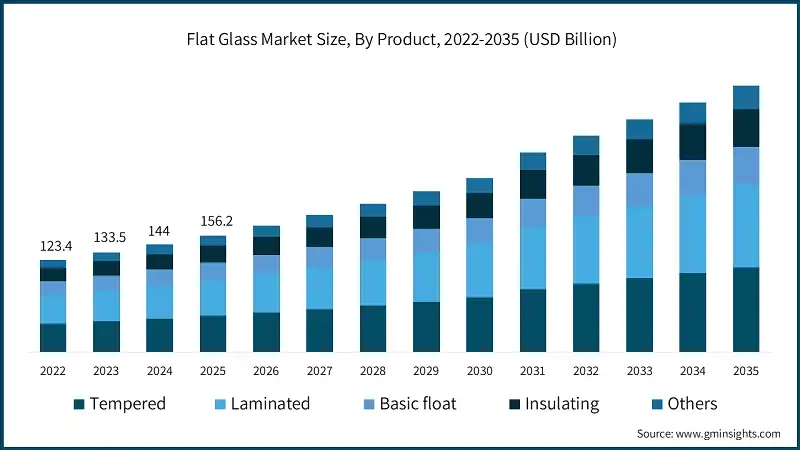
Based on product, the market is segmented into tempered, laminated, basic float, insulating, others. Tempered glass dominated the market with an approximate market share of 31.2% in 2025 and is expected to grow with a CAGR of 8.8% by 2035.
- The durability and increased safety features of tempered glass have made it appealing for use in the flat glass category. This type of glass finds application in the construction industry, décor, and automotive industries. Tempered glass, having a high strength-to-weight ratio together with resistance to impact and thermal stressors, is gaining popularity with growing urban industries providing optimum strength at every application. Technological innovations in the tempering processes have enhanced the quality and cost-efficiency of tempered glass, making it far more widespread.
- The laminated glass market is gaining popularity because of the safety and security aspects of soundproofing materials. Buildings and houses where there are fears of break-ins typically employ this glass. Laminated glass has become popular now because of innovations in such interlayers as polyvinyl butyral (PVB) and increasing durability, durability, and desirable soundproofing. Increasing awareness on safety legislations and codes of practice is increasing the demand for laminated glass in applications such as skylights, glass facades, and automotive windshields.
- Basic float glasses are clear and cheap. It revolves around the mere evolvement of common glassware in keeping with basic packaging requisites, simple furniture requirements, and constructed designs at the most basic primitive levels. Its viability is an evidenced correlation with construction growth overall, especially in less developed regions with expanding urban infrastructures.
- Insulating glass (IG) is highly accelerative in response to the worldwide shift toward favoring energy efficiency and green building practices. The drive toward energy savings and reduction of carbon emissions serves as the principal plotting of insulating glass in the new age of sustainable architecture. In addition, growth in retrofit projects to upgrade aged buildings further bolsters the hope of steady demand.
Learn more about the key segments shaping this market
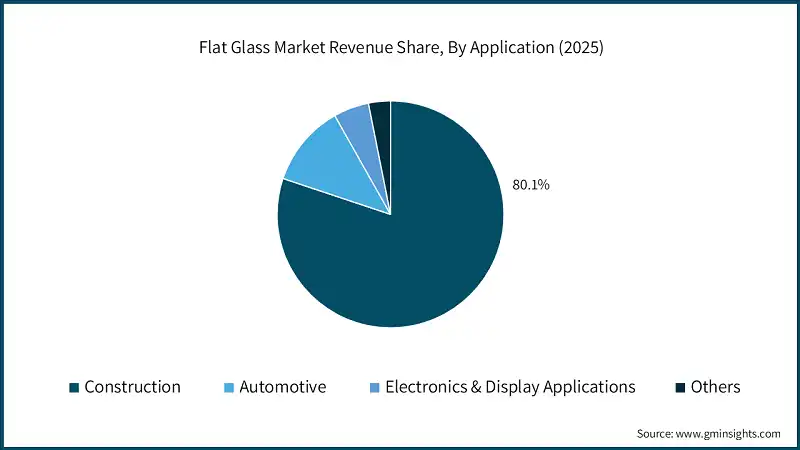
Based on application, the flat glass market is segmented into construction, automotive, electronics & display applications, and others. Construction held the largest market share of 80.1% in 2025 and is expected to grow at a CAGR of 8.7% during 2026-2035.
- The construction segment is a primary driver for designing flat glass constructors for the growing demand for energy-efficient, sustainable and aesthetic glazing solutions. Urbanization and infrastructure development in emerging economies are fueling growth, particularly in the regions of residential, commercial and high-rise construction activities. The application of advanced glass types such as insulated, laminated and Low-E coatings is growing in response to stringent energy codes and safety measures. Green building certifications such as LEED are impeding on developers to use high-performance glass for energy reduction and enhancing building sustainability.
- The automotive industry forms a major demand base for flat glass with evolving safety, comfort, and technological desires considerably influencing market trends. Increasing production volumes for vehicles, especially in emerging markets, is creating demand for windshield, side, and rear windows. Innovations such as heated, UV protective, and acoustic glass provide enhanced safety and comfort levels to vehicles. The trend toward electric and autonomous vehicles is driving manufacturers toward integrating advanced glazing solutions with in-glass sensor and display functionalities furthering the development of smart multifunctional automotive glazing.
- The electronics and display sector for flat glass is flourishing quickly owing to the advancements achieved in consumer electronics, wearable devices, and display technologies. Specialized glass is increasingly used in large-area, high-resolution displays, such as cover glass for smartphones, tablets, and large TV screens, which requires scratch resistance, anti-reflective coatings, and high durability. Similarly, the rise of foldable and flexible displays is also pushing the innovation of ultra-thin, bendable glass substrates, opening opportunities in portable electronics and wearable tech.
Based on distribution channel, the flat glass market is segmented into direct sales (manufacturer to end-user), distributors/wholesalers, retail/building material dealers. Direct sales (manufacturer to end-user) segment dominated the market with an approximate market share of 45.1% in 2025 and is expected to grow with a CAGR of 8.7% by 2035.
- Direct sales by manufacturers to end-users dominate the markets. Short demand for customized and high-quality products, coupled by the need to have smooth processes regarding procurement, has led to this trend. The direct sales channel includes market evolving innovations influencing the product offering. Direct sales are expected to have more growth, especially in specialized or high-value glass products, providing strategic advantages with close customer engagement and increased margins for manufacturers.
- Distributors and wholesalers play a significant role in the flat glass market, especially in those areas with broad demands in construction and manufacturing. They form a bridge with a diverse stock of different types, sizes, and grades of glass for many clients, from small contractors to fabricators and retail installations. The market portion for distributors is likely to grow as the demand for accessible flat glass products continues to rise, especially in developing areas where local networks are essential for market entry. Being able to provide quick delivery and localized support makes them irreplaceable during further developments in digitalization within the sector.
- Retail and building material dealers are growing steadily, sustained by improved activity in the construction sector as well as refurbishment projects. This is the channel that serves small contractors, homeowners, and DIY enthusiasts. The flat glass products offered include float glass, patterned glass, and specialty coatings. The trend toward selling through online avenues and e-commerce stores has made a wide variety of glass products available for the public, making such products more accessible and competitive. Value-added services such as glass cutting, installation advice, and after-sales support have become important differentiators for retailers.
Looking for region specific data?
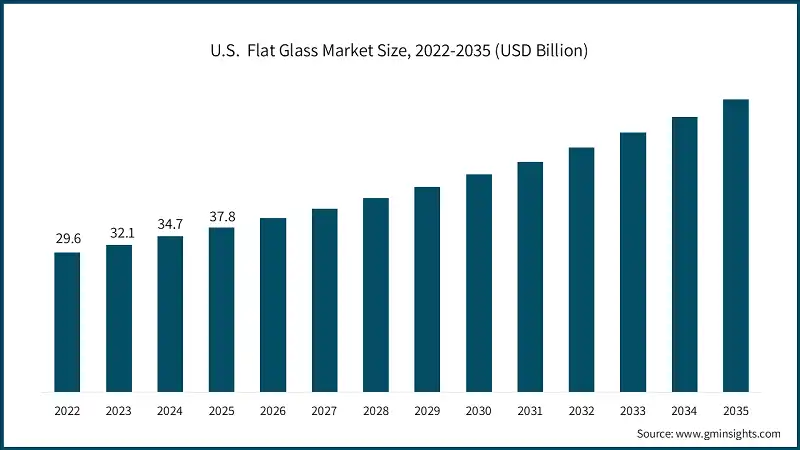
The North America flat glass market is growing rapidly on the global level with a market share of 30.2% in 2025.
- The North American market is increasing steadily with an increase in construction, renovation projects and the changing of technologies. Demand for Low-E coated, insulated and smart glass solutions is being propelled by energy-efficient and sustainable building materials trendy in the region. Tight energy codes and environmental standards in turn promote high-performance glazing systems across commercial, residential and industrial buildings in these countries. In terms of regulatory requirements, technology innovations, and attention to sustainability, the market is expected to continue to grow in North America.
Europe flat glass market leads the industry with revenue of USD 30.9 billion in 2025 and is anticipated to show lucrative growth over the forecast period.
- The European market has a strong emphasis on sustainability energy efficiency, and innovative designs for buildings. Stringent environmental regulations and numerous green building certification schemes in the region are driving the glass manufacturers and builders to use such eco-friendly alternatives as low-emissivity glass, laminated glass, and recycled glass. The renovation of aging infrastructure and the increasing installation of glass facades in commercial and residential buildings are significant growth drivers.
The Asia Pacific flat glass market is anticipated to grow at a CAGR of 8.6% during the analysis timeframe.
- The Asia Pacific region is the leading market for flat glass fueled by rapid urbanization, industrialization & infrastructure development. Countries including China, India, and Southeast Asia are witnessing a boom in large-scale construction projects such as commercial complexes, residential towers & infrastructure. The rising middle class and increasing disposable income are fueling demand for luxury glass products inclined toward aesthetics decorative glass such as tinted and reflective glass. In addition, the automobile industry in the region is growing rapidly, accelerating demand for automotive glass providing safety and comfort.
Latin America flat glass market accounted for 10.1% market share in 2025 and is anticipated to show steady growth over the forecast period.
- Latin America’s market is gradually expanding, mainly driven by infrastructure development, urbanization and renovation projects. Countries like Brazil, Mexico & Argentina are witnessing increased demand for residential and commercial construction, which drives the need for all types of glass, including insulated and decorative glass. The automotive sector in the region is also rising, driving the automotive glass with more emphasis on safety and comfort.
Middle East & Africa flat glass market accounted for 4.8% market share in 2025 and is anticipated to show lucrative growth over the forecast period.
- Growth is being realized in the MEA region market, driven mainly by infrastructure development, tourism projects, and expansion in the construction sector. The construction of luxury real estate, commercial complexes, and iconic architectural projects across the Middle East & Africa in countries such as UAE, Saudi Arabia have posed a huge demand for high-quality, large format, and energy-efficient glass solutions. The sustainability perspective on the region encourages the adoption of new glass products with insulation and solar control properties.
Flat Glass Market Share
The top 5 companies in flat glass industry include Saint-Gobain, AGC Inc., NSG Group, Guardian Glass, Xinyi Glass Holdings. These are prominent companies operating in their respective regions covering approximately 46.4% of the market share in 2025. These companies hold strong positions due to their extensive experience in market. Their diverse product portfolios, backed by robust production capabilities and distribution networks, enable them to meet the rising demand across various regions.
- Saint-Gobain is one of the most diverse building materials enterprises. The company is carrying famous products with a high degree of innovation, including energy efficient and intelligent glass solutions, and its strong distribution network internationally, as well as its portfolio related to sustainable building materials, provides it with a good competitive advantage. The very same advancement through research and development keeps its global position ahead of the ever-increasing technological trends in coated and laminated glass, as well as consumer preferences and market trends driving the whole industry's agenda for development.
- AGC has successfully entered being a core player in flat glass market. The company's biggest strength is in its technological innovation and in a very large range of automotive and architectural glass. AGC's strong distribution network, in partnership with some of the world's giants, results in effective provision of diverse markets. Its constant innovations, alongside a strong presence in key regions, makes AGC that rival-contender in flat glass.
- NSG is one of the strong player of flat glass-it is considerably visible in Europe, North America, and Asia. The company manufactures and sells high-quality products, which are categorized under architectural and automotive glass. It has focused on innovation to provide products that fully meet the regional need and promoted wide distribution network.
- Guardian Glass is an eminent name in the market of flat glass and deals mainly in innovative as well as green glass solutions. The firm is highly interested in energy-efficient, reflective, and other types of specialty glass products falling under residential, commercial, and automotive segments. Guardian's mission towards sustainability, which includes developing low-emissivity and smart glass, is also in keeping with increased worldwide demand for green building solutions. The location of strategic manufacturing units across the globe, particularly in North America, Europe, and Asia, provides the firm with a competitive edge in supply chain management.
- Xinyi Glass is one of China's leading manufacturers of flat glass and has a concentration on the architectural and automotive glass segments. The strategic location of the firm in China provides high cost advantages as well as a vast opportunity of access to the growing Asian markets. Its aggressive expansion and diversification strategies are gaining significant share in the value market, particularly in Asia. While there is global competition against other players, its cost competitiveness and strong regional presence make it a key challenger in the flat glass industry.
Flat Glass Market Companies
Major players operating in the flat glass industry include:
- AGC Inc.
- AJJ Glass Products Co., Ltd.
- Cardinal Glass Industries
- Central Glass Co., Ltd.
- China Glass Holdings Ltd.
- Corning Inc.
- CSG Holding Co., Ltd.
- Duratuf Glass Industries Ltd.
- Euroglas GmbH
- GSC Glass Ltd.
- Guardian Glass
- Interglass AG
- NSG Group
- Saint-Gobain
- Schott AG
- Sisecam
- Trulite Glass & Aluminum Solutions
- Vitro Architectural Glass
- Xinyi Glass Holdings
Flat Glass Market Report Attributes
| Key Takeaway | Details |
|---|---|
| Market Size & Growth | |
| Base Year | 2025 |
| Market Size in 2025 | USD 156.2 Billion |
| Market Size in 2026 | USD 169.1 Billion |
| Forecast Period 2026-2035 CAGR | 8.6% |
| Market Size in 2035 | USD 356.3 Billion |
| Key Market Trends | |
| Drivers | Impact |
| Rising construction activities in emerging economies | Rapid urbanization and infrastructure expansion in countries like China, India, and Southeast Asian nations are boosting demand for flat glass. |
| Increasing demand for solar glass | The growth of solar energy installations is driving demand for solar control glass and photovoltaic glass, which are key segments of the flat glass market. |
| Technological advancements in glass production | Innovations such as lightweight glass, energy-efficient coatings, and advanced manufacturing processes enhance product quality and open new application avenues. |
| Pitfalls & Challenges | Impact |
| High cost of advanced glass technologies | The premium pricing of smart and energy-efficient glass products can hinder adoption, especially in cost-sensitive markets. |
| Environmental and regulatory challenges | Strict environmental regulations related to manufacturing emissions and resource consumption can lead to increased compliance costs and operational hurdles. |
| Opportunities: | Impact |
| Increasing adoption in construction and infrastructure | Rising urbanization and infrastructure development projects globally are driving demand for flat glass in residential, commercial, and industrial buildings. |
| Growing use of energy-efficient and smart glass | The integration of energy-efficient coatings and smart glass technologies (like electrochromic and self-tinting glass) is gaining popularity to improve building sustainability and occupant comfort. |
| Market Leaders (2025) | |
| Market Leaders |
11.2% Market Share |
| Top Players |
|
| Competitive Edge |
|
| Regional Insights | |
| Largest Market | Asia Pacific |
| Fastest growing market | North America |
| Emerging countries | U.S., Canada |
| Future outlook |
|
What are the growth opportunities in this market?
Flat Glass Industry News
- In February 2025, AGC and Saint-Gobain officially inaugurated Volta production line, with the presence of local authorities, stakeholders, and representatives from both companies. Volta, which will be established at AGC Barevka plant in Teplice, is a groundbreaking pilot project that aims at reducing CO2 emissions significantly and supporting the transmutation of a sustainable flat glass production. This is an extraordinarily large investment in R&D for both companies, which were financially supported by the European Union's Innovation Fund.
- In March 2024, Saint-Gobain launched a EURO 160 million flat glass factory in Sokhna, SCZONE, and Saint-Gobain Egypt, wherein this project fits an area of 200,000 square meters with great exports and local employment with French partners.
- In December 2023, C-Capture started Europe's first trial for carbon capture at flat glass in a major manufacturing plant at St. Helens, UK.
This flat glass market research report includes in-depth coverage of the industry, with estimates & forecasts in terms of revenue (USD Billion) and volume (Kilo Tons) from 2026 to 2035, for the following segments:
Market, By Product
- Tempered glass
- Laminated glass
- Basic float glass
- Insulating glass
- Others (patterned, wired, mirror, coated glass)
Market, By Application
- Construction
- New construction
- Refurbishment/renovation
- Interior construction
- Curtain walls & facades
- Skylights & roof glazing
- Automotive
- OEM
- Aftermarket/replacement
- Laminated windshields
- Tempered side/rear windows
- Electronics & display applications
- Others
Market, By Distribution Channel
- Direct sales (manufacturer to end-user)
- Distributors/wholesalers
- Retail/building material dealers
The above information is provided for the following regions and countries:
- North America
- U.S.
- Canada
- Europe
- Germany
- UK
- France
- Spain
- Italy
- Rest of Europe
- Asia Pacific
- China
- India
- Japan
- Australia
- South Korea
- Rest of Asia Pacific
- Latin America
- Brazil
- Mexico
- Argentina
- Rest of Latin America
- Middle East and Africa
- Saudi Arabia
- South Africa
- UAE
- Rest of Middle East and Africa
Frequently Asked Question(FAQ) :
What is the market size of the flat glass industry in 2025?
The market size for flat glass was valued at USD 156.2 billion in 2025, driven by strong demand from the construction, automotive, and solar energy industries focused on sustainability and energy efficiency.
What is the flat glass market value in 2026?
The market size for is projected to reach USD 169.1 billion in 2026, supported by rising infrastructure development, urbanization, and increased adoption of high-performance glass products across end-use industries.
What is the projected value of the flat glass market by 2035?
The market size for flat glass is expected to reach USD 356.3 billion by 2035, expanding at a CAGR of 8.6% driven by green building initiatives, solar installations, and advancements in glass manufacturing technologies.
Which product segment dominated the flat glass market in 2025?
The tempered glass segment led the market with a 31.2% share in 2025, owing to its superior strength, safety characteristics, and extensive use in construction and automotive applications.
What was the largest application segment in the flat glass industry in 2025?
The construction segment accounted for 80.1% of the market in 2025, fueled by growing demand for energy-efficient glazing, large-scale urban projects, and sustainable building certifications.
Which distribution channel led the flat glass market in 2025?
Direct sales (manufacturer to end-user) dominated the market with a 45.1% share in 2025, supported by rising demand for customized solutions and closer collaboration between manufacturers and end users.
Which region leads the flat glass market?
North America held a 30.2% share of the market in 2025, reflecting its strong market position. Growth is driven by renovation activity, strict energy-efficiency regulations, and increasing adoption of Low-E, insulated, and smart glass solutions.
What are the key trends shaping the flat glass industry?
Key industry trends include rising adoption of energy-efficient and smart glass, technological advancements in coatings, and expanding use of glass in solar energy and sustainable construction projects.
Who are the key players in the flat glass industry?
Major market players include Saint-Gobain, AGC Inc., NSG Group, Guardian Glass, and Xinyi Glass Holdings, supported by diversified product portfolios and strong global manufacturing footprints.
Flat Glass Market Scope
Related Reports