Summary
Table of Content

Flanges Market
Get a free sample of this report
Form submitted successfully!
Error submitting form. Please try again.
Thank you!
Your inquiry has been received. Our team will reach out to you with the required details via email. To ensure that you don't miss their response, kindly remember to check your spam folder as well!
Request Sectional Data
Thank you!
Your inquiry has been received. Our team will reach out to you with the required details via email. To ensure that you don't miss their response, kindly remember to check your spam folder as well!
Form submitted successfully!
Error submitting form. Please try again.
Flanges Market Size
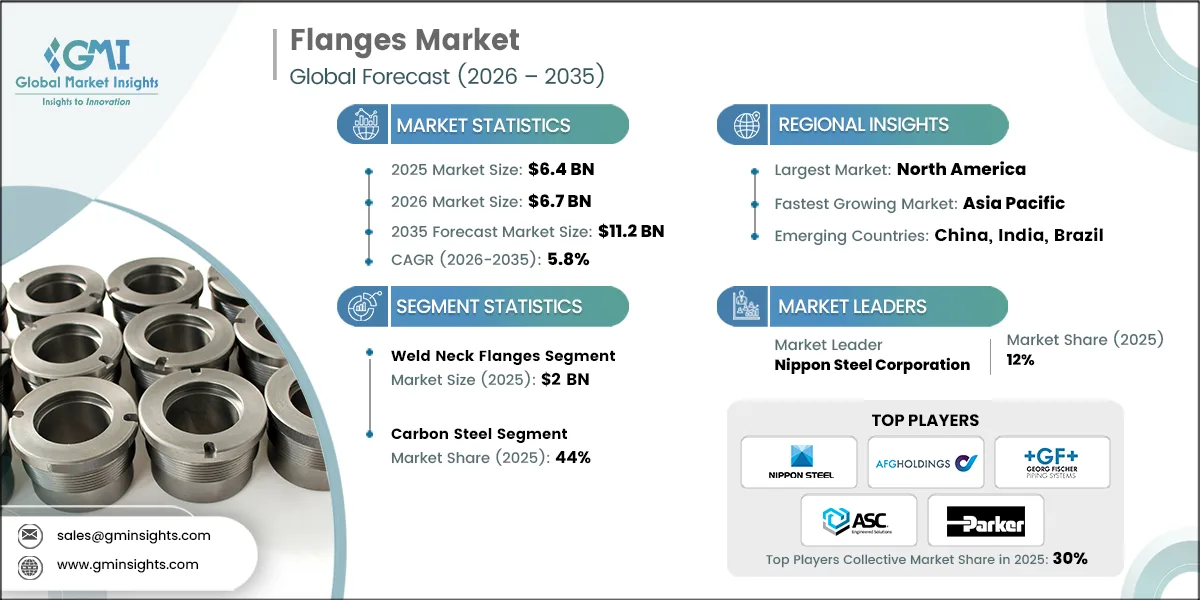
The flanges market was estimated at USD 6.4 billion in 2025. The market is expected to grow from USD 6.7 billion in 2026 to USD 11.2 billion in 2035, at a CAGR 5.8% according to latest report published by Global Market Insights Inc.
Flanges Market Key Takeaways
Market Size & Growth
- 2025 Market Size: USD 6.4 Billion
- 2026 Market Size: USD 6.7 Billion
- 2035 Forecast Market Size: USD 11.2 Billion
- CAGR (2026–2035): 5.8%
Regional Dominance
- Largest Market: North America
- Fastest Growing Region: Asia Pacific
Key Market Drivers
- Expansion of Energy and Process Industries.
- Growth in Infrastructure and Industrial Construction.
- Replacement and Maintenance of Aging Assets.
Challenges
- Volatility in Raw Material Prices.
- Stringent Regulatory and Quality Compliance.
Opportunity
- Growth of Energy Transition and Hydrogen Infrastructure.
- Increasing Demand for High‑Specification and Custom Flanges.
Key Players
- Market Leader: Nippon Steel Corporation led with over 12% market share in 2025.
- Leading Players: Top 5 players in this market include Nippon Steel Corporation, Georg Fischer (GF Piping Systems), Parker Hannifin, AFG Holdings (Ameriforge), ASC Engineered Solutions, which collectively held a market share of 30% in 2025.
Get Market Insights & Growth Opportunities
The worldwide flanges market is an important part of the contemporary industrial world; flanges are used to connect pipes and control the flow of fluids and gases throughout entire systems. Flanges are simple; however, they serve a very important function in connecting valves, pumps, and other equipment together at various points along the pipelines. Therefore, they provide the necessary strength, alignment, and accessibility for maintenance.
The demand for flanges is directly correlated with the level of industrial activity in the world. For example, many of the leading sectors driving flange sales are comprised of oil and gas, electrical energy, water management systems, chemical manufacturing, construction, and heavy equipment manufacturing. All these sectors have been major contributors to new infrastructure construction throughout many parts of the world in addition to improving energy security and upgrading existing industrial manufacturing facilities. This ongoing activity creates additional demand for flanges, which are required for almost every type of piping application, rather than offering buyers choice. Traditionally, manufacturers have developed long-term relationships with their distributors and end-users. Reliability, equipment quality, and compliance with industry standards are more important than brand new and innovative flange designs.
Buyers typically prefer to work with suppliers that have a proven track record of supplying quality, consistent-performing flanges across a variety of operating conditions, such as high-pressure, moderate to high-temperature, and/or exposed to corrosive environments. In response, many manufacturers are progressively adjusting their products to satisfy evolving customer requirements; some of these modifications include improving flange durability through superior manufacturing processes, developing more supply-chain materials to offer more material choices, and implementing sustainability practices to achieve better manufacturing practices. In addition, changes in international conditions will impact flange sales with industrial expansion in the developing world creating new demand opportunities globally.
To get key market trends
Flanges Market Trends
The global flanges market is experiencing dynamic shifts, influenced by evolving industrial demands, technological advancements, and regulatory pressures through weld neck flages.
- Weld neck flanges are the largest share of the worldwide market for flanges, which exhibit high structural integrity, pressure containment, and fatigue resistance. The long-tapered hub provides good stress transfer from the flange to the pipe, with a smooth transition to reduce stress concentrations at the welded connection between the two elements. Therefore, weld neck flanges are suitable for use in high-pressure, high-temperature, and cyclic-load applications.
- Weld neck flanges are commonly found in oil and gas, petrochemical, power generation, refinery; LNG, and chemical processing industries within critical pipeline applications, where the escape or failure of product through the pipeline system cannot be tolerated. Weld neck flanges produce stronger and more dependable connections than slip-on or threaded flanges, especially with large diameter and thick wall pipes. With compatibility with ASME/ANSI standards, as well as an extended lifetime, weld neck flanges constitute a primary component of the core industrial infrastructure.
- The weld neck flange market is also increasing at a rapid pace due to the size of new energy, process industries, and high specification investments. The increase of offshore and deepwater oil and gas development, development of LNG terminals, development of hydrogen infrastructure, development of nuclear power, and growth of high-pressure steam applications require flanges that can endure harsh operating conditions.
- Due to the greater focus on safety, maintenance reliability, and reducing the total cost of ownership by most industrial segment operators, weld neck flanges are preferred despite their higher cost versus alternative types of flanges.
Flanges Market Analysis
Learn more about the key segments shaping this market
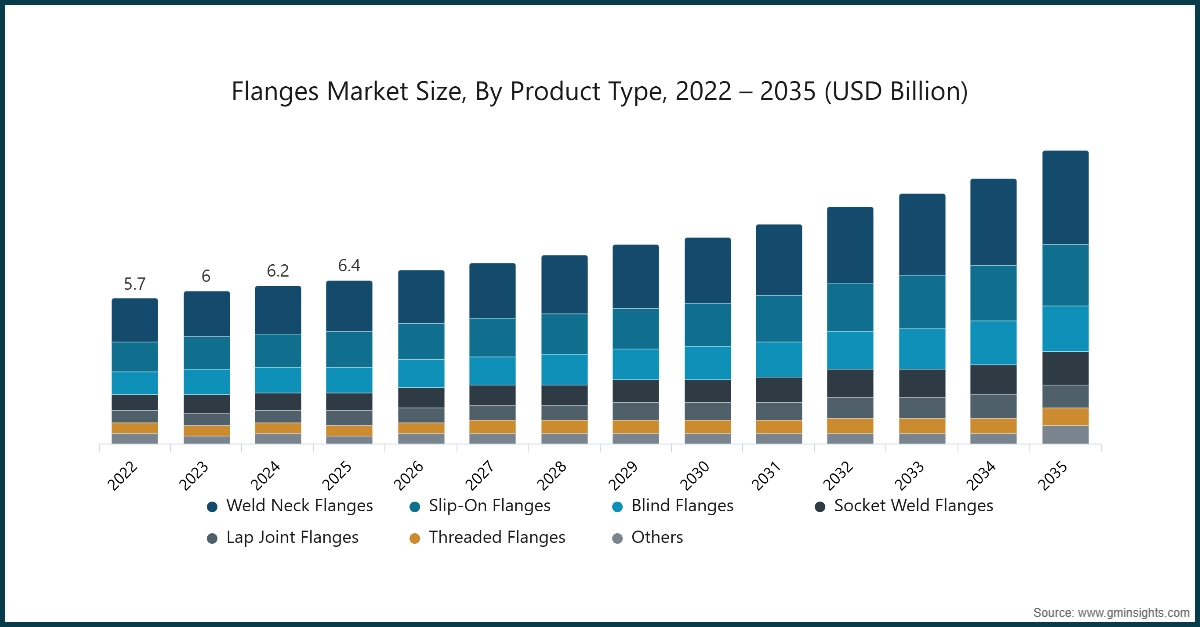
Based on product type, the flanges market is divided into weld neck flanges, slip-on flanges, blind flanges, socket weld flanges, lap joint flanges, threaded flanges, others. In 2025, weld neck flanges held the major market share, generating a revenue of USD 2 billion.
- Weld neck flanges hold the largest market share because they offer excellent structural integrity, pressure handling, and fatigue resistance. Their long-tapered hub allows smooth stress distribution from the flange to the pipe, reducing stress concentration at the weld joint. This makes them ideal for high‑pressure, high‑temperature, and cyclic‑load applications.
- Industries such as oil & gas, petrochemicals, power generation, refineries, LNG, and chemical processing widely use weld neck flanges in critical pipeline systems where leakage or failure is unacceptable. Compared to slip‑on or threaded flanges, weld neck flanges provide stronger, more reliable joints, especially for large‑diameter and thick‑wall pipes. Their compatibility with ASME/ANSI standards and long service life further drive adoption, making them the preferred choice for core industrial infrastructure.
- The weld neck flange segment is also growing rapidly due to increasing investments in energy, process industries, and high‑specification projects. Growth in offshore and deep‑water oil & gas, LNG terminals, hydrogen infrastructure, nuclear power, and high‑pressure steam systems demands flanges that can withstand extreme operating conditions.
- As industries focus more on safety, reliability, and lifecycle cost reduction, weld neck flanges are favored despite their higher initial cost, since they reduce the risk of joint failure, maintenance, and unplanned shutdowns. Additionally, the trend toward larger pipeline diameters and higher operating pressures further accelerates demand.
Learn more about the key segments shaping this market
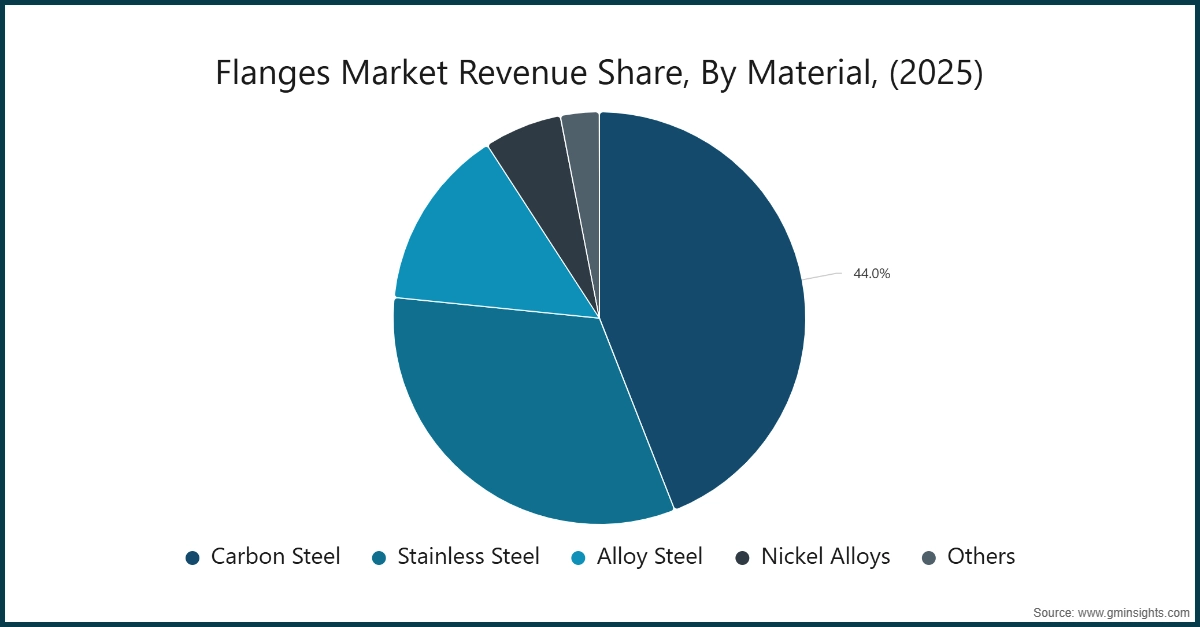
Based on material, the market is segmented into carbon steel, stainless steel, alloy steel, nickel alloys, and others. Carbon steel segment held around 44% of the global flanges market share in 2025.
- The carbon steel flange has the greatest share of sales within the flange market because it is the most cost-efficient and strongest material with the most adaptable properties. Compared to the stainless-steel and nickel-alloy types, carbon-steel flanges are not only much less expensive than either of those materials, making them ideal for projects that require high volume at low cost. Within this group of industries, carbon steel continues to be the standard for any type of oil and gas, power generation, water/wastewater, construction, or general industry piping applications where the conditions (i.e. pressure and/or temperature) of the installation can only be classified as low to moderate.
- In addition to low cost, carbon-steel flanges have exceptional tensile strength, good machinability, excellent load-bearing capability, and high durability, making them the most versatile choice for both pipelines and pressure systems. Standardization of these materials (ASME, ANSI, ASTM) as well as the global marketplace gives engineers easy access to materials that meet their needs and that are compatible with one another, particularly in the developing world where there is a great deal of investment in new infrastructure and energy systems. Because most carbon-steel flanges do not have any significant exposure to highly corrosive fluid systems, carbon-steel flanges are still capable of providing solid performance while at the same time providing the lowest total lifecycle cost of any other flange material.
- Nickel alloy flanges are among the fastest growing types of flanges on the market because of the demand created by highly corrosive and extreme operating environments. Nickel alloy materials provide superior resistance to corrosion, high temperature, high pressure and aggressive chemicals compared to both carbon-steel and stainless-steel flanges.
Based on distribution channel, the flanges market is segmented into direct and indirect sales. In 2025, direct sales dominate the market with highest market share.
- Flange manufacturers sell their products to large end-use customers directly rather than through third-party distributors. The first reason for this is that most of these industries have a desire for reliability, technical assurance, and long-term supplier relationships. For example, when an oil and gas company sells to large refiners or EPC contractors, they will need flanges accurately designed and manufactured to meet specified requirements, as these large facilities have complex piping systems where safety and performance depend on the accurate application of these products. Most of these countries also require the flanges they order to either be customized, have very high specifications, or have project certification.
- To properly document this information and provide suitable quality control in the flanges, an oil and gas flange manufacturer must work closely with the manufacturers of flanges directly. Additionally, there are numerous ways that using direct sales reduces the risk of receiving flanges from other distributors that could result in mismatches to the OEM's specifications, receive counterfeit flanges, and/or face delays in supplying the flanges; thus, putting at risk one or more of an operator's operations.
- Large-scale construction projects that require producing flanges for high-pressure, high-temperature, or corrosive service often require Mill Test Certifications (MTC), pressure ratings, heat numbers, and traceability. Directly purchasing flanges allows a manufacturer to provide all of this information to their oil and gas company customers more effectively than if they purchase these flanges through other distributors. For these reasons, the largest end-use customers for flange manufacturers generally negotiate long-term supply contracts with the flange manufacturers to establish an assured constant level of quality; a fixed price for the flanges over the specified period; and an assured delivery schedule. Consequently, direct sales have a clear competitive advantage when compared to selling through distributors when it comes to selling flanges.
Looking for region specific data?
North America Flanges Market
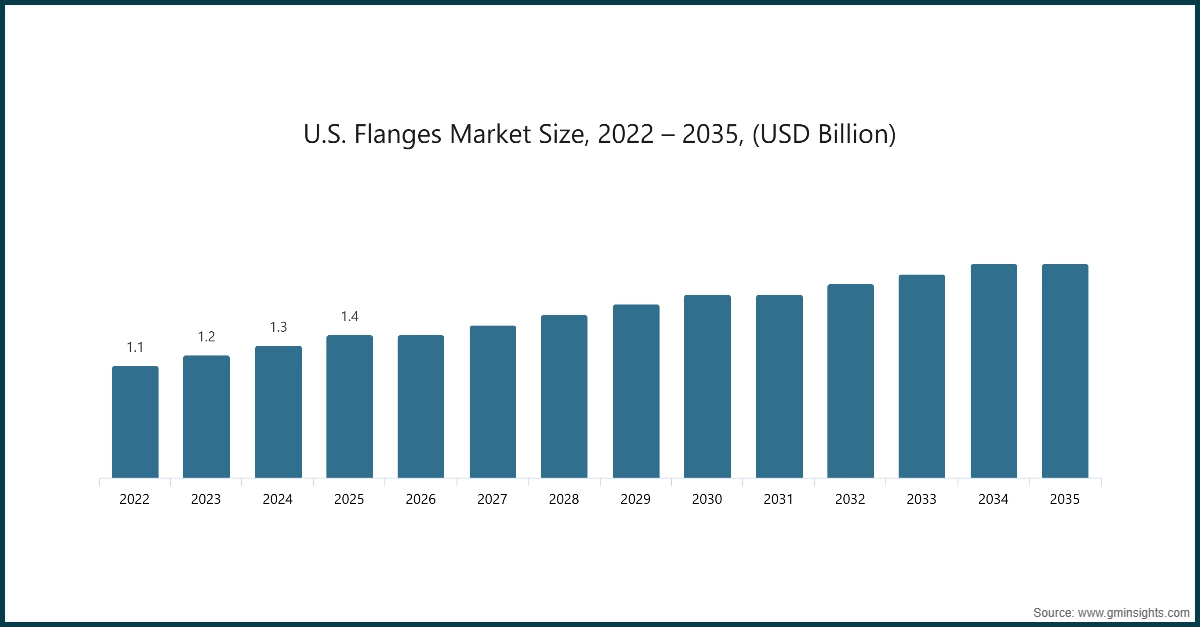
In 2025, the U.S. dominated the North America flanges industry, accounting for around 83% and generating around USD 1.4 billion revenue in the same year.
- The North American flanges market is shaped by a mature industrial base, strong regulatory standards, and consistent investment across energy and process industries. The United States leads regional demand, supported by continuous activity in oil & gas exploration, shale gas production, refinery upgrades, and midstream pipeline expansions.
- The region’s extensive network of aging infrastructure spanning pipelines, chemical plants, power facilities, and municipal water systems drives steady maintenance, repair, and replacement (MRO) demand for flanges. Compliance with strict standards such as ASME, API, MSS, and ASTM pushes end users toward high‑quality forged and alloy‑based flanges, especially for high‑pressure and high‑temperature operations.
- Growth is also supported by expanding LNG export terminals, hydrogen hubs, and carbon capture projects, which require high‑performance flanges capable of withstanding cryogenic conditions and aggressive media.
- The presence of large EPC contractors and established flange manufacturers strengthens the direct sales channel, ensuring strong supply chain reliability. While overall growth is moderate due to market maturity, investment in energy transition, industrial modernization, and advanced materials continue to create stable, long‑term demand. As a result, North America remains a technologically advanced and high‑value market for premium and specification‑driven flanges.
Europe Flanges Market
In Europe, Germany leads the market 29% share in 2025 and is expected to grow at 5.5% during the forecast period.
- The European market for flanges is characterized by steady demand driven by industrial modernization, sustainability goals, and stringent regulatory standards. Key markets such as Germany, the UK, France, Italy, and the Nordics rely on high‑quality, certified flanges for chemical processing, power generation, pharmaceuticals, food and beverage, and district heating systems. Europe follows rigorous standards including CEN (EN 1092), CEIR, PED, which drive preference for premium forged, stainless steel, and specialty alloy flanges designed for high‑pressure, corrosive, and safety‑critical environments.
- While traditional oil & gas investment is comparatively lower, ongoing upgrades in refineries, chemical plants, and offshore energy platforms sustain stable demand. The region is also a global leader in hydrogen infrastructure, offshore wind, nuclear energy, and carbon‑neutral industrial development, all of which require advanced flange materials and precision manufacturing.
- Europe’s emphasis on decarbonization is increasing the use of corrosion‑resistant alloys and zero‑leakage flange designs, especially in green hydrogen and carbon capture systems. Although growth is moderate due to market maturity and economic constraints, Europe remains a high‑value market where quality, certification, and technical reliability are prioritized over low‑cost alternatives.
Asia Pacific Flanges Market
The Asia Pacific holds significant share in the flanges market. China holds a market share of around 42% in 2025 and is anticipated to grow with a CAGR of around 6% from 2026 to 2035.
- Asia‑Pacific is the fastest‑growing region in the global market, driven by rapid industrialization, infrastructure development, and expanding energy capacity. China and India are the core demand centers, supported by large investments in refineries, petrochemical complexes, thermal and renewable power plants, water infrastructure, and manufacturing expansion. The region consumes high volumes of carbon steel flanges due to largescale mechanical and civil construction projects, while demand for stainless steel and alloy flanges is rising in LNG, offshore oil & gas, and chemical processing sectors.
- Government‑backed initiatives such as China’s refining expansion, India’s pipeline development under GAIL and IOCL, and Southeast Asia’s growing industrial base further accelerate adoption. APAC also benefits from a strong manufacturing ecosystem, with China, Japan, South Korea, and India emerging as major producers of forged and cast flanges, offering competitive pricing and large‑volume capabilities. Increasing investments in LNG import terminals, hydrogen pilots, and industrial automation are pushing the need for higher‑specification, corrosion‑resistant flanges. Overall, the combination of economic growth, industrial upgrades, and expanded energy infrastructure positions APAC as the global leader in both volume consumption and future growth potential.
Flanges Market Share
Nippon Steel Corporation is leading with 12% market share. Nippon Steel Corporation, Georg Fischer (GF Piping Systems), Parker Hannifin, AFG Holdings (Ameriforge), and ASC Engineered Solutions collectively hold around 30% indicating moderately fragmented market concentration. These prominent players are proactively involved in strategic endeavors, such as mergers & acquisitions, facility expansions & collaborations, to expand their product portfolios, extend their reach to a broad customer base, and strengthen their market position.
- Nippon Steel is one of the world's largest steel producers, offering a vast array of high-quality steel products. While not a direct manufacturer of finished flanges, they hold a significant position as a crucial upstream supplier of raw materials. Their specialized steel plates, bars, and forging stock are essential for numerous flange manufacturers globally, directly influencing the quality and performance of final flange products across industries.
- GF Piping Systems is a leading global provider of high-quality piping solutions, including a wide range of fittings and connection technologies. They hold a significant position in the flanges market, particularly for plastic and specialized metal flanges used in demanding industrial, water, and gas distribution applications. Their expertise in integrated piping systems and material innovation ensures reliable, leak-proof connections for critical infrastructure.
- Parker Hannifin is a global leader in motion and control technologies, manufacturing diverse fluid power and control components. They hold a significant position in the specialized flanges market by providing high-performance hydraulic and instrumentation flanges. These precision-engineered flanges are vital for connecting tubes and pipes in high-pressure and high-integrity fluid power systems, catering to aerospace, mobile, and industrial machinery applications.
Flanges Market Companies
Major players operating in the flanges industry are:
- Nippon Steel Corporation
- Georg Fischer (GF Piping Systems)
- Parker Hannifin
- AFG Holdings (Ameriforge)
- ASC Engineered Solutions
- Alleima
- Viraj Profiles Pvt. Ltd.
- Texas Flange
- Bonney Forge
- Metalfar S.p.A.
- Flanschenwerk Bebitz GmbH
- Victaulic
- General Flange & Forge LLC
- Coastal Flange
- JFE STEEL CORPORATION
AFG Holdings is a diversified manufacturing company providing highly engineered products primarily for the energy and infrastructure sectors. Through its Ameriforge division and other entities, AFG Holdings is a prominent manufacturer of forged flanges. Their robust capabilities in custom forging and extensive product range for critical applications in oil and gas, petrochemicals, and power generation secure their key position in the North American and global heavy industrial flange market.
ASC Engineered Solutions provides a comprehensive portfolio of pipe connection, support, and protection systems for various applications. They hold a significant position in the flanges market by offering a broad range of cast iron, ductile iron, and grooved flanges. Their focus on delivering complete engineered solutions, along with an extensive distribution network, makes them a crucial supplier for commercial, industrial, and fire protection piping systems requiring reliable connections.
Flanges Market Report Attributes
| Key Takeaway | Details |
|---|---|
| Market Size & Growth | |
| Base Year | 2025 |
| Market Size in 2025 | USD 6.4 Billion |
| Market Size in 2026 | USD 6.7 Billion |
| Forecast Period 2026-2035 CAGR | 5.8% |
| Market Size in 2035 | USD 11.2 Billion |
| Key Market Trends | |
| Drivers | Impact |
| Expansion of Energy and Process Industries | Rising investments in oil & gas, LNG, petrochemicals, power generation, and chemical processing are a primary driver for flange demand. |
| Growth in Infrastructure and Industrial Construction | Large‑scale infrastructure development, including water & wastewater systems, district heating, industrial plants, and manufacturing facilities, continues to support high demand for flanges. |
| Replacement and Maintenance of Aging Assets | Aging pipeline networks and industrial facilities in North America and Europe are driving maintenance, repair, and replacement (MRO) demand. |
| Pitfalls & Challenges | Impact |
| Volatility in Raw Material Prices | Flange manufacturing is highly dependent on carbon steel, stainless steel, and nickel‑based alloys, whose prices fluctuate due to supply disruptions, geopolitical factors, and energy costs. |
| Stringent Regulatory and Quality Compliance | Compliance with ASME, ASTM, EN, and ISO standards, along with region‑specific safety and environmental regulations, increases manufacturing complexity and costs, particularly for small and mid‑sized suppliers. |
| Opportunities: | Impact |
| Growth of Energy Transition and Hydrogen Infrastructure | Rising investments in hydrogen production, carbon capture, LNG, nuclear, and renewable energy projects are creating demand for high‑performance and specialty alloy flanges, opening premium growth opportunities. |
| Increasing Demand for High‑Specification and Custom Flanges | End users are increasingly prioritizing longer service life, higher safety margins, and reduced downtime, driving demand for weld neck, large‑diameter, and alloy‑based flanges, especially in critical and high‑risk applications. |
| Market Leaders (2025) | |
| Market Leader |
12% market share |
| Top Players |
Consolidate share of 30% |
| Competitive Edge |
|
| Regional Insights | |
| Largest market | North America |
| Fastest growing market | Asia Pacific |
| Emerging countries | China, India, Brazil |
| Future Outlook |
|
What are the growth opportunities in this market?
Flanges Industry News
- In November 2025, Vallourec announced a $39-48 million expansion at its Youngstown, Ohio facility to add a new threading line for VAM premium connections. This is going to help the company strengthen regional supply assurance, shorten lead times for energy markets, and create approximately 40 full-time positions by early 2027.
- In March 2025, INTLEF Group launched the world's first hydraulic quick-connect flange for API 6A standard wellhead and BOP applications, reducing installation time by 75-90%. This is going to help the company revolutionize BOP connection methods, reduce labor intensity by 95%, and improve operational safety in oil and gas operations.
- In August 2024, Flowserve Corporation acquired MOGAS Industries for $290 million to expand its severe-service isolation valve and flow control product portfolio. This is going to help the company double its mining sector exposure, enhance aftermarket opportunities, and achieve $15 million in cost synergies within two years.
- In July 2024, Victaulic invested $100 million to expand its Lawrenceville, Pennsylvania foundry with 150,000 sq ft addition and advanced CNC equipment. This is going to help the company increase production capacity by 70%, create 214 jobs, and strengthen its North American manufacturing infrastructure.
- In March 2024, Genesys Industries acquired 100% of Latrobe Foundry Machine & Supply Company, a manufacturer of threaded and flanged aluminum pipe fittings. This is going to help the company expand its mechanical hardware manufacturing footprint and broaden its parts catalog to approximately 124,000 SKUs.
The flanges market research report includes in-depth coverage of the industry with estimates & forecasts in terms of revenue (USD Billion) and volume (Thousand Units) from 2022 to 2035, for the following segments:
Market, By Product Type
- Weld neck flanges
- Slip-on flanges
- Blind flanges
- Socket weld flanges
- Lap joint flanges
- Threaded flanges
- Others
Market, By Pressure Temperature
- Low
- Medium
- High
- Extreme
Market, By Material
- Stainless steel
- Alloy steel
- Nickel alloy
- Carbon steel
- Others
Market, By Manufacturing Process
- Forged
- Cast
- Fabricated
Market, By End User
- Oil & gas
- Chemical & petrochemical processing
- Power generation
- Water & wastewater treatment
- Pulp & paper
- Pharmaceuticals
- Food & beverage processing
- Mining & metals
- General manufacturing
- Others
Market, By Distribution Channel
- Direct sales
- Indirect sales
The above information is provided for the following regions and countries:
- North America
- U.S.
- Canada
- Europe
- Germany
- UK
- France
- Italy
- Spain
- Asia Pacific
- China
- Japan
- India
- South Korea
- Australia
- Latin America
- Brazil
- Argentina
- Mexico
- Middle East and Africa
- South Africa
- Saudi Arabia
- UAE
Frequently Asked Question(FAQ) :
What is the market size of the flanges in 2025?
The market size was USD 6.4 billion in 2025, growing at a CAGR of 5.8% through 2035, driven by rising industrial activity in oil & gas, power generation, and chemical manufacturing, along with growing infrastructure investment worldwide.
What is the projected value of the flanges market by 2035?
The flanges market is expected to reach USD 11.2 billion by 2035, propelled by expanding LNG terminals, hydrogen infrastructure development, and increasing demand for high-performance flanges in offshore and deepwater energy applications.
What is the flanges industry size in 2026?
The market size is projected to reach USD 6.7 billion in 2026, supported by ongoing global infrastructure development and sustained demand from oil & gas, water management, and power generation industries.
How much revenue did the weld neck flanges segment generate in 2025?
The weld neck flanges segment generated USD 2 billion in 2025, dominating the market due to its superior structural integrity, pressure containment, and fatigue resistance, making it the preferred choice for critical high-pressure and high-temperature applications.
What was the market share of the carbon steel segment in 2025?
The carbon steel segment held the largest share at 44% in 2025, driven by its cost efficiency, high tensile strength, and versatility across oil & gas, power generation, and water infrastructure projects, particularly in developing regions with large-scale construction activity.
What is the growth outlook for the Asia Pacific flanges market from 2026 to 2035?
Asia Pacific is the fastest-growing region, with China holding 42% share and growing at 6% CAGR through 2035, driven by rapid industrialization, refinery expansions, LNG terminal development, and government-backed pipeline infrastructure programs in China and India.
Which region leads the flanges market?
North America leads the market, with the U.S. accounting for 83% of regional revenue at USD 1.4 billion in 2025, supported by shale gas production, refinery upgrades, midstream pipeline expansions, and growing LNG export terminal and hydrogen hub investments.
What are the upcoming trends in the flanges market?
Key trends include rising demand for high-performance and corrosion-resistant materials, along with growing investments in energy infrastructure such as LNG, hydrogen, and renewable projects.
Who are the key players in the flanges market?
Key players include Nippon Steel Corporation, Georg Fischer, Parker Hannifin, AFG Holdings, and ASC Engineered Solutions, collectively holding ~30% market share, driven by strategic expansions, precision forging capabilities, and strong supply chain relationships with energy and industrial end-users.
Flanges Market Scope
Related Reports