Summary
Table of Content

Fish Protein Hydrolysate Market
Get a free sample of this report
Form submitted successfully!
Error submitting form. Please try again.
Thank you!
Your inquiry has been received. Our team will reach out to you with the required details via email. To ensure that you don't miss their response, kindly remember to check your spam folder as well!
Request Sectional Data
Thank you!
Your inquiry has been received. Our team will reach out to you with the required details via email. To ensure that you don't miss their response, kindly remember to check your spam folder as well!
Form submitted successfully!
Error submitting form. Please try again.
Fish Protein Hydrolysate Market Size
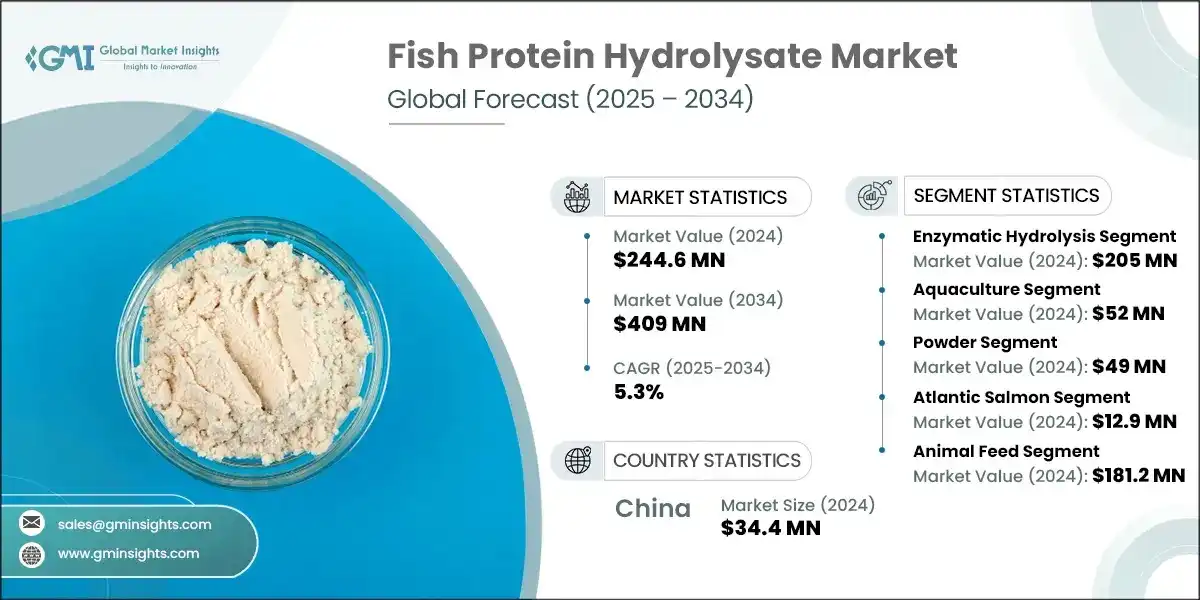
The global fish protein hydrolysate market size was estimated at USD 244.6 million in 2024 and is projected to grow from USD 256.4 million in 2025 to USD 409 million by 2034, at a CAGR of 5.3% from 2025 to 2034, according to Global Market Insights Inc.
Fish Protein Hydrolysate Market Key Takeaways
Market Size & Growth
- 2024 Market Size: USD 244.6 Million
- 2034 Forecast Market Size: USD 409 Million
- CAGR (2025–2034): 5.3%
Key Market Drivers
- Rising demand for natural and sustainable feed ingredients.
- Increasing awareness of the nutritional benefits of fish protein hydrolysates.
- Shift towards premium and specialty pet food and animal feed.
Challenges
- High production costs and complex processing methods.
- Limited availability of sustainable fish raw materials.
Opportunity
- Drives higher adoption and revenue growth in regions with growing aquaculture industries..
- Enables entry into premium and value-added product segments..
Key Players
- Market Leader: Omega Protein led with over 17% market share in 2024.
- Leading Players: Top 5 players in this market include Omega Protein, Diana Aqua, Hofseth Biocare, Bio-Marine Ingredients Ireland, Copalis Sea, which collectively held a market share of 57% in 2024.
Get Market Insights & Growth Opportunities
- Fish Protein Hydrolysate market is growing robustly because of the increasing trend of natural and sustainable used feed ingredients. Aquaculture and livestock producers are becoming more interested in finding an alternative source to normal sources of protein that are environmentally friendly as well as nutrient rich. Transforming fish by-products into hydrolysates allows businesses to minimize waste without sacrificing quality protein, making hydrolysates ever more popular in food sectors covering most of the major animal feed markets worldwide.
- There have also been rises in the awareness about the nutrition value of FPH feeding the market growth. FPH promotes animal growth, immunity and health due to its source of good quality bioactive constituents, and essential amino acids and peptides. The region characterized with high water fish and animal husbandry, including North America, Europe, and Asia Pacific are rich in terms of awareness, especially regarding the viability of functional feed additives to maximize productivity.
- The global fish protein hydrolysate market is highly diversified in terms of the available players with most of the market share being secured in areas where there is a high occurrence of aquaculture and livestock. North America U.S.-led has a significant share owing to the presence of more advanced processing technologies and animal feed high usage, while Europe has a close share owing to the sustainability efforts and high demand premium feed. The Asia Pacific, especially in China, leads in terms of volume production, taking advantage of fish by-products that are easily available and an increasing influence of aquaculture production.
- Enzymatic Hydrolysis, Powder form, Atlantic Salmon as the species of choice, and Animal Feed are the more popular segments of the FPH in the market. Enzymatic hydrolysis is of choice given that it results in high-quality protein with retained amino groups and bioactive peptides. Powdered FPH is long and easy to add in the mix of the feed and Atlantic Salmon is the most widely used source because of its high protein content and the availability of the product.
To get key market trends
Fish Protein Hydrolysate Market Trends
- Fish processing by-products and waste streams are becoming more and more desirable ways of producing FPH for companies given that the fisheries products are readily available and accessible in a sustainable way without producing negative environmental costs with the same time yielding value-added goods. This is a trend that is related to sustainability practices as it aids producers to reduce costs of raw materials and adhere to the regulations. As an example, Yantai oriental ocean Sci-Tech (China) has maximized the utilization of the fish waste to enhance the protein production and cut on the environmental bottom line.
- There are manufacturers who produce hydrolysate with particular peptide patterns that address gut health, immunity and growth in aquaculture and livestock. The trend is also coupled with the increased demand of premium and specialty feed products. Omega Protein (U.S.) provides special FPH mixes in swine feed and aquaculture, which enhances animal productivity.
- The use of new and improved enzymatic hydrolysis, the ultrafiltration and drying process is raising the quality and bioactive content of the products. The associated relationship with R&D and innovation enables the companies to differentiate the products and diversify into the functional food and nutraceutical domain. The major territories that experience these upgrades in technologies are Europe and North America.
- FPH has been moving towards and is becoming increasingly used as a vital functional ingredient in aquafeed and in high-end pet food markets. This tendency is cross connected with the market growth in premium animal feed markets where manufacturers could obtain increased margins. As an example, U.S. firms are adding FPH-based formulations to the pet food lines to enhance digestibility and immune boosting capabilities.
- Companies are trying to focus on traceability and environment-friendly production to attract socially aware consumers and government. This tendency is associated with ecological policies and responsible business. The use of the certified sustainable sourcing of raw fish material is becoming an active move by the brands like the BioMarine Ingredients (Norway) in the effort to achieve better market positioning.
Fish Protein Hydrolysate Market Analysis
Learn more about the key segments shaping this market
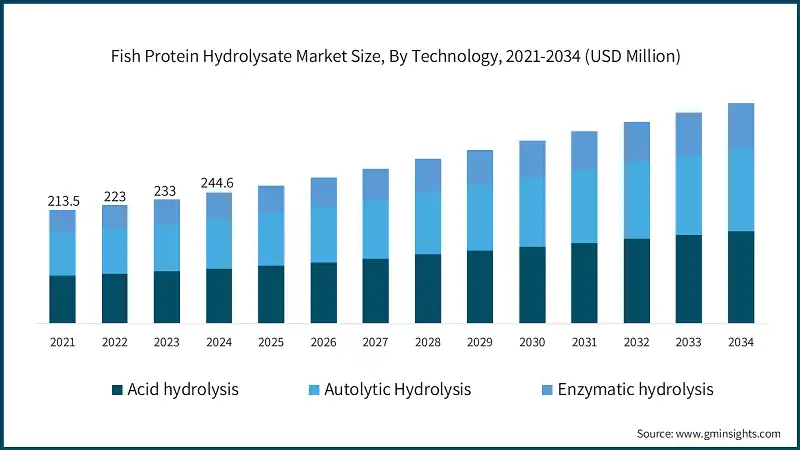
Based on technology the market is segmented into acid hydrolysis, autolytic hydrolysis, and enzymatic hydrolysis. Enzymatic hydrolysis segment holds a significant share at a value of USD 205 million in 2024.
- Fish Protein Hydrolysate (FPH) market is classified on the basis of production technology as Acid Hydrolysis, Autolytic Hydrolysis, and Enzymatic Hydrolysis, of which Enzymatic Hydrolysis enjoys the largest share in the fish protein hydrolysate market. In choosing this approach, it is because it resulted in high-quality protein hydrolysates that have desirable molecular weight distribution, high digestibility, and low nutritional loss. However, as opposed to acid hydrolysis, enzymatic hydrolysis does not destroy essential amino acids and bioactive peptides, which is why it is quite appropriate to use it in animal feeding, aquafeed and functional food.
- Enzymatic hydrolysis is gaining in popularity among major manufacturers in China, the U.S. and Europe, to enhance efficiency and product consistency. As an example, Omega Protein (U.S.) and Yantai Oriental Ocean Sci-Tech Co., Ltd (China) conduct enzymatic conversion of fish by-products into protein-rich hydrolysates that are used to supply aquaculture and pet foods. One could also customize the peptide profiles using this technology with specific purposes in mind such as improving growth and immune responses in animals.
Learn more about the key segments shaping this market
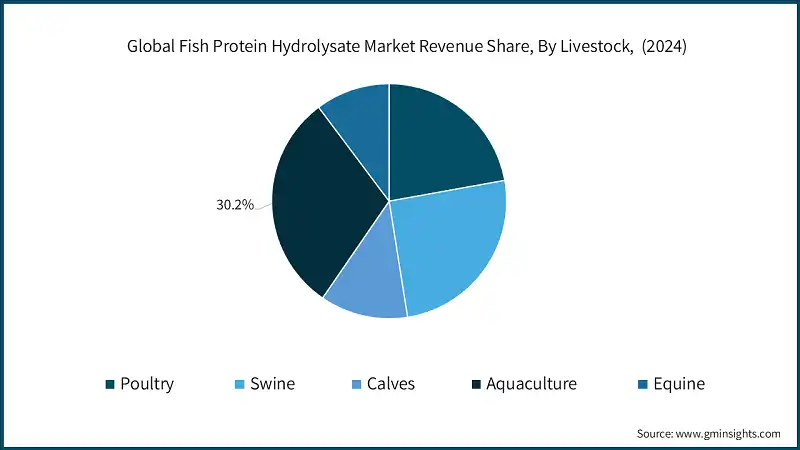
Based on livestock, the fish protein hydrolysate market is segmented into poultry, swine, calves, aquaculture, and equine. Aquaculture was valued at USD 52 million in 2024.
- The segmentation in FPH market is divided into Livestock, Poultry, Swine, Calves, Aquaculture, and Equine where aquaculture makes the largest percentage. The ability to increase growth performance, gut health and immunity in pigs together with its high digestibility, high-quality amino acids and bioactive peptides render FPH as a widely used component in swine feed. It is widely used to increase feed conversion ratio and therefore its use in pig farming is highly desired in the commercial sector.
- Producers in some regions are increasingly paying attention to swine feed formulations, based on FPH. Incidences of large-scale production of hydrolysates that are specifically dedicated to the nutritional needs of the pigs occur through companies such as Omega Protein (U.S.) and Yantai Oriental Ocean Sci-Tech Co., Ltd (China). The uniformity of protein quality and functional advantage has strengthened the rule of swine in end-use category.
- Though aquaculture and poultry, as well as other types of livestock species, use FPH, the segment that creates the most demand and revenue is the swine segment owing to widespread agriculture based on commercial pig farming. With the current food industry worldwide, the proliferation of swine feed in FPH is most likely to increase in the coming years, thus further propelling the market.
- The high quality of horticulture round also contributes towards the increased dollar investment in fertilizers per acre as observed in compared to the broadacre farming or gardening. As the demand of fresh produce, floriculture exports and the continuous provision of year-long greenhouse products is growing at a global level, since this section is falling under the horticulture segment of the market, it is expected that this segment would maintain leadership market position particularly at the area with developed irrigation and crop management facilities.
Based on form, the fish protein hydrolysate market is segmented into powder, liquid, and paste. Powder segment was valued at USD 49 million in 2024.
- Powder occupies the biggest share as it has a longer shelf-life, is easier to store, and easier to handle than liquid or paste forms, powdered FPH is favored. It incorporates well into animal, aquafeed, or functional food formulation, does not stabilize or harm the quality of the product.
- Some regions are becoming more interested in supplying powdered hydrolysates to meet the soaring demand in areas such as aquaculture enterprises and pet food industries. As an example, the Omega Protein (U.S.) and Yantai Oriental Ocean Sci-Tech Co., Ltd (China) companies provide powders of FPH that may be readily added in the dietary mixtures and create a delicate dosage and a comprehensive balance of nutrients.
- Although there is fixed use of liquid and paste forms which are applied to special purposes mainly in aquaculture tanks or the direct use of the product, the most popular kind of the product is the powdered FPH as it is more convenient, scalable, and applicable to industrial feed manufacturing. In the future, this trend is likely to surpass because worldwide, there will be an increase in demand in sustainable and high-quality protein components.
Based on source, the fish protein hydrolysate market is segmented into anchovy, tilapia, tuna, sardine, atlantic salmon, crustacean, molluscs, codfish, and others. Atlantic salmon segment was valued at USD 12.9 million in 2024.
- Atlantic Salmon being the greatest share. Atlantic Salmon has been favored over other salmon species because it contains high protein richness, attached amino acid content plus the ease of availability as caused by the large-scale aquaculture practices especially in North America and Europe. Salmon can produce high-quality and consistent hydrolysates to fit usage in animal nutrition, aquafeed uses, and functional food.
- The supply of raw material towards FPH production is being triggered by the rise of Atlantic Salmon aquaculture in countries like Norway, Chile, Canada and the U.S. Fishman industries such as Ocean Harvest Technology (Ireland) and BioMarin Ingredients (Norway) are companies dealing with the Atlantic Salmon by-products using them to produce high quality hydrolysates specially formulated as pet food, and aquaculture feed.
- Value of these hydrolysates is that they accelerate the growth of animals, boost immunity and offer bioactive peptides that enhance the general health of autoimmune diseases.
Based on applications, the fish protein hydrolysate market is segmented into animal feed and petfood. Animal feed segment was valued at USD 181.2 million in 2024.
- Animal Feed is used mostly for aquaculture, poultry, and livestock, and it is very effective in all those uses. It poses significantly high digestibility apart from having a well-balanced amino acid profile, thus making it a cheap yet sustainable protein source, mainly for large-scale farming. With an increasing inclination toward eco-friendly feed solutions along with improved growth performance of animals due to such feed, this segment stands to gain.
- Pet food occupies a small but fast-growing segment that results from the rise of premium pet nutrition. Fish protein hydrolysate is its natural origin, palatable, and provides health benefits associated with joint and skin support; the increasing tendency to keep pets in urban centers is likely to set this section as a promising area for clean labels and innovation in functional ingredients.
Looking for region specific data?
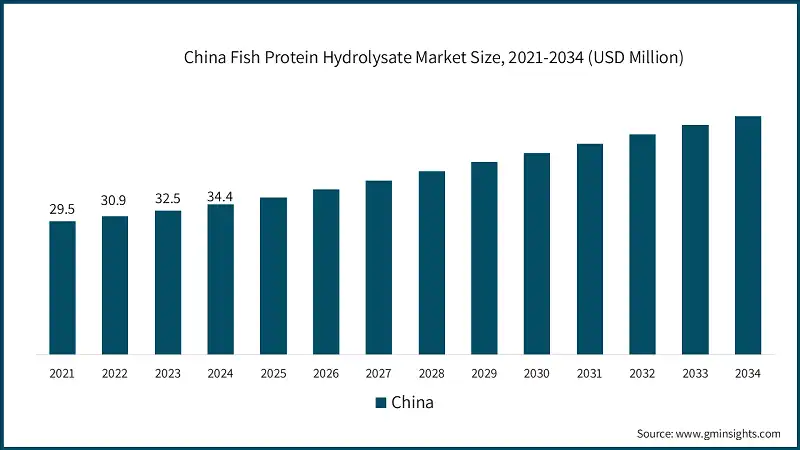
China fish protein hydrolysate market accounted for USD 34.4 million in 2024.
- Asia Pacific is the biggest and fastest growing market of the fish protein hydrolysate (FPH), principally because of the mature aquaculture and livestock sectors in this domain. China is on the forefront as it is accompanied by a powerful seafood processing industry and attention to sustainable feeding solutions. The growth is also being enhanced due to the adoption of high-quality protein supplements in animal feeding in other countries such as Japan, India, South Korea, and Australia.
- The factors leading to the increased demand in FPH are fast growth of aquaculture and livestock culture because it supplies high digestible proteins and essential amino acids to enhance the health and growth of farm animals. Manufacturers are gradually taking advantage of FPH to boost feed performance and limit the use of traditional protein sources. This has made FPH a choice ingredient in livestock feed as well as in aquafeed.
- The government policies and sustainability initiatives are contributing to the market development process. The development of food and fish processing waste to obtain added value products such as FPH is being promoted in China through national plans. These have been assisting the manufacturers to adopt eco-friendly production methods and be aligned to regional sustainability objectives.
- New technology in enzyme hydrolysis and production processes are increasing the quality, consistency and scale of production of products. The customization of protein profiles of various animals through the current processing techniques is also fueling the diffusion of FPH in Asia Pacific.
The fish protein hydrolysate market in the Germany is expected to experience significant and promising growth from 2025 to 2034.
- Europe makes up about 29 % of the global market so, it is quite an influential region. The major players include Germany, the Netherlands and Norway where Germany is likely to have the biggest market share because of whilst its advanced aquaculture industry and concentrated on sustainable feed solutions. FPH is also slowly becoming widespread in the countries where it is utilized in animal nutrition, in functional foods and in nutraceuticals.
- One of the significant growths in Europe is sustainability and circular economy. There is an active use of fish by-products by countries to make FPH which decreases waste and forms high-quality protein ingredients that are used in animal food and functionality. The Netherlands specifically has established very powerful policies of engaging in circular bioeconomy which has enhanced local production and innovations.
- Market is further supported by the government and the regulatory bodies. Farm to Fork Strategy of the EU and national bioeconomy initiatives offer financing and incentives, in addition to directives, to revise the production in an environmentally friendly way. As an example, Germany has invested tremendously in marine bioeconomy initiatives, and this has assisted local producers in the growth of FPH production efficiently.
- The market growth is also due to the increase in demand by the animal nutrition and pet food industries. FPH is appreciated because of its high digestibility and amino acid content contributing to animal health and high productivity. The market is characterized by steady inclusions of FPH in the production of pet food and aquaculture feed, which demonstrates the steady introduction in the market and long-term prospects.
The fish protein hydrolysate market in the U.S. is expected to experience significant and promising growth from 2025 to 2034.
- The North America region has a considerable portion of the market across the globe with 24.8% and the U.S. leading the share. The U.S. market is dominated by high aquaculture and livestock industry which greatly benefits by use of FPH to supplement high quality proteins. As a processed form of the commercial fishing by-products, fish hydrolysates are already generated in an environmentally friendly and sustainable manner, benefiting the concept of sustainability and the overall demand of animal feed that is high in nutraceutical properties.
- The main drivers that condition the market are sustainability and circular economy initiatives. The U.S. has also adopted polices and programs that promote utilization of fish processing byproducts to produce value-added products such as FPH. It mitigates the environmental impact, and also offers stability of supply into animal nutrition, functional foods, and pet foods.
- The growth is further enhanced by the increase in demand in the areas of animal nutrition and pet food. FPH is being appreciated due to the high digestible energy and amino acids content, which enhance health and productivity gains in animals. Together with the government support and the improvements in the enzymatic hydrolysis technology, they are pushing the North America market towards the stable and sustainable growth.
The fish protein hydrolysate market in the Brazil is expected to experience significant and promising growth from 2025 to 2034.
- The Latin American region is constituting a relatively smaller but growing FPH market share around the world where Brazil is the major player because it has a big aquaculture and fishing industry. There is increased use of FPH in the shrimp and tilapia, as well as other fish farming industries in this country to enhance feed efficiency and animal health. Local production is an advantage that takes advantage of fish processing, as well as cost-efficiency and environmental sustainability.
- Other sustainable trends, such as circular economy models, are slowly but steadily picking up in the region. Producers in Brazil are looking at using enzymatic hydrolysis and value-added processing methods to create high-quality protein with the advantages of small-environmental footprints of fish waste to hydrolysates. Infrastructural problems notwithstanding, the increasing demand to employ sustainable animal nutrition and pet food ingredients assures consistent market uptake.
The fish protein hydrolysate market in the UAE is expected to experience significant and promising growth from 2025 to 2034.
- The MEA FPH sector is still in its early stages and expansion is gradual rising, steadily due to emergent markets in the aquaculture industry and growing knowledge of sustainable sources of protein. Utilization of fish by-products in FPH production by countries engaging in active fisheries, like Egypt and Morocco, is just emerging to feed the FPH market in animal feed and aquafeed markets.
- Market adoption is being affected by regulatory support and sustainability issues but there is a lack of technological infrastructure, and the awareness levels are on the lower side. Demand in the local industry in the MEA region should see its share in the market increase gradually over the years, mainly due to the functional feed ingredients and green protein solutions
Fish Protein Hydrolysate Market Share
- The top 5 companies in the market are Omega Protein, Diana Aqua, Hofseth BioCare, Bio-Marine Ingredients, and Copalis Sea, contributing around 57% of the market in 2024.
- Omega Protein is one of the primary companies producing fish protein hydrolysates using their vertically integrated strategies that allow sustaining the quality of the product and its consistency. Fishmeal and oils, which are the products they supply, cater to the markets of aquaculture, pet foods, and human nutrition. With capabilities in real-time quality monitoring and traceability across its processing plants, and its innovative capacity in protein extraction and enrichment to serve functional food applications, the company is serving two of the sectors most significant demands.
- Diana Aqua is a sustainable aquafeed ingredients and high performance protein hydrolysates specialist. It has a product line that promotes feed consumption, growth, and wellness of aquatic organisms. Diana Aqua utilizes the potential of global R&D and tailors formulations to regional peculiarities of aquaculture and offers technical assistance to feed producers in order to guarantee the best results in nutrition and sustainability.
- Hofseth BioCare offer top-quality salmon protein hydrolysate such as ProGo with emphasis on bioactive peptides and high digestibility. The company uses new processes of enzymatic hydrolysis and focuses on the sustainable and traceable sourcing. Hofseth proposes to address the markets of human nutrition, pet food and animal feed, providing technical support and tailor-made formulas to cope with regulatory and functionality needs.
- Bio-Marine Ingredients concentrates on the best quality of fish protein hydrolysates in securing fish food and nutraceuticals. The company has focused on the principles of sustainability, safety and assured perfect bioactive content which facilitates improved feed performance and functional health.
- Copalis Sea develops fish protein hydrolysates of higher quality based on the innovative forms of enzymatic treatment. Its products are marketed in the high quality, standardised hydrolysates to animal and human nutrition industries and the company has solid relationships with its customers to supply the customised solutions to regional markets.
Fish Protein Hydrolysate Market Companies
Major players operating in the fish protein hydrolysate industry are
- Bunge Limited
- Alaska Protein Recovery
- Bio-Marine Ingredients Ireland
- Copalis Sea
- Diana Aqua
- Hofseth Biocare
- Janatha Fish Meal & Oil Products
- Nutrifish
- Omega Protein
- Rossyew
- SAMPI
- Scanbio Marine
- Sociedad Pesquera Landes
- SOPROPECHE
- TC Union
- Triplenine
- Omega Protein has taken a dominant market share in the fish protein hydrolysate market due to its vertically integrated operations and their keen interest in sustainability. Its products, such as high quality fish protein powders and oils, are aimed at increasing nutrition in human food, animal food, and nutraceuticals. The capabilities of Omega Protein in sourcing and processing globally and having research and development investments help them to maintain consistent product quality and help them innovate in protein extraction and enrichment methods.
- Diana Aqua is a division of Symrise AG that has established a foothold in the aquafeed and markets because of its high-performance and sustainable ingredient solutions. It bases its line of products to elevate feed efficiency, growth, and health of aquatic species. Using a network of R&D facilities and technical specialists around the world, Diana Aqua tailors formulations to meet local aquaculture needs, with reliably comparable efficacies.
- Hofseth BioCare ASA, a major competitor in the fish protein hydrolysate market, has established a pinnacle brand image due to its knowledge on novel enzymatic hydrolysis techniques and premium quality protein products in the market. Its ProGo branded salmon protein hydrolysates are human food-oriented, pet food and animal feed products that are immune support bio economically efficient sources of these important amenities of proteins. Sustainability, traceability of sourcing, and high quality control Hofseth takes great interest in help establishing stable and environment friendly products.
Fish Protein Hydrolysate Market Report Attributes
| Key Takeaway | Details |
|---|---|
| Market Size & Growth | |
| Base Year | 2024 |
| Market Size in 2024 | USD 244.6 Million |
| Forecast Period 2025 - 2034 CAGR | 5.3% |
| Market Size in 2034 | USD 409 Million |
| Key Market Trends | |
| Drivers | Impact |
| Rising demand for natural and sustainable feed ingredients | Drives increased adoption of FPH in animal feed and aquafeed, supporting eco-friendly and cost-efficient protein sourcing. |
| Increasing awareness of the nutritional benefits of fish protein hydrolysates | Boosts market penetration across livestock, swine, and aquaculture sectors due to enhanced growth, immunity, and overall health benefits. |
| Shift towards premium and specialty pet food and animal feed | Encourages manufacturers to develop high-value FPH products, expanding revenue opportunities in premium feed and functional nutrition segments. |
| Pitfalls & Challenges | Impact |
| High production costs and complex processing methods | Leads to inefficient application, reduced crop productivity, and environmental degradation |
| Limited availability of sustainable fish raw materials | Pressures manufacturers to reformulate products and comply with stricter sustainability regulations, potentially increasing production costs |
| Opportunities: | Impact |
| Drives higher adoption and revenue growth in regions with growing aquaculture industries. | Drives higher adoption and revenue growth in regions with growing aquaculture industries. |
| Enables entry into premium and value-added product segments. | Enables entry into premium and value-added product segments. |
| Market Leaders (2024) | |
| Market Leaders |
17% Market Share |
| Top Players |
Collective Market Share in 2024 is 57% |
| Competitive Edge |
|
| Regional Insights | |
| Largest Market | Asia Pacific |
| Fastest Growing Market | Asia Pacific |
| Emerging Country | China, India, Germany, Brazil and UAE |
| Future Outlook |
|
What are the growth opportunities in this market?
Fish Protein Hydrolysate Industry News
- In March 2023 Symrise announced a new line of diana food bioactives specially formulated as Beauty from Within actives. The expansion boasts functional and novel nutricosmetic ingredients that can target skin conditioning, anti-aging, skin brightening and hair and nail care.
- In June 2023 their fishing partner, Ocean Harvesters, tested successfully a new boat tailored with fish spill response capabilities. The F/V Hopeful Harvest is titled to quickly arrive at the scene of a net tear and have the proper equipment to quickly gather the source of net tears on the surface and retrieve the spillage of fish.
The fish protein hydrolysate market research report includes in-depth coverage of the industry with estimates & forecasts in terms of revenue (USD Million) & volume (KiloTons) from 2021 to 2034, for the following segments:
Market, By Technology
- Acid hydrolysis
- Autolytic hydrolysis
- Enzymatic hydrolysis
Market, By Form
- Powder
- Liquid
- Paste
Market, By Source
- Anchovy
- Tilapia
- Tuna
- Sardine
- Atlantic salmon
- Crustacean
- Molluscs
- Codfish
- Others (herring, mackerel)
Market, By Application
- Animal feed
- Petfood
- Cat
- Dog
Market, By Livestock
- Poultry
- Broilers
- Layers
- Swine
- Calves
- Aquaculture
- Salmon
- Trouts
- Shrimps
- Others (oysters, crabs, lobsters)
- Equine
The above information is provided for the following regions and countries:
- North America
- U.S.
- Canada
- Europe
- UK
- Germany
- France
- Italy
- Spain
- Rest of Europe
- Asia Pacific
- China
- India
- Japan
- South Korea
- Australia
- Rest of Asia Pacific
- Latin America
- Brazil
- Mexico
- Argentina
- Rest of Latin America
- MEA
- UAE
- Saudi Arabia
- South Africa
- Rest of Middle East and Africa
Frequently Asked Question(FAQ) :
What is the market size of the fish protein hydrolysate in 2024?
The market size was USD 244.6 million in 2024, with a CAGR of 5.3% expected from 2025 to 2034. The growth is driven by sustainability practices, increased demand for premium feed products, and advancements in hydrolysis technologies.
What is the projected value of the fish protein hydrolysate market by 2034?
The market is projected to reach USD 409 million by 2034, fueled by the adoption of enzymatic hydrolysis, rising aquaculture activities, and the utilization of fish processing by-products.
What is the valuation of the enzymatic hydrolysis segment in 2024?
The enzymatic hydrolysis segment held a significant market share, valued at USD 205 million in 2024, due to its efficiency and ability to produce high-quality hydrolysates.
What was the valuation of the aquaculture segment in 2024?
The aquaculture segment was valued at USD 52 million in 2024, driven by the increasing use of fish protein hydrolysates in aquafeed to enhance growth and immunity in aquatic species.
What was the size of the fish protein hydrolysate market in China in 2024?
China's market was valued at USD 34.4 million in 2024, supported by the country's large aquaculture industry and focus on sustainable practices.
What are the key trends in the fish protein hydrolysate market?
Key trends include the use of fish processing by-products for sustainable production, development of hydrolysates targeting gut health and immunity, and rising demand for premium and specialty feed products.
Who are the major players in the fish protein hydrolysate industry?
Major players include Bunge Limited, Alaska Protein Recovery, Bio-Marine Ingredients Ireland, Copalis Sea, Diana Aqua, Hofseth Biocare, Janatha Fish Meal & Oil Products, Nutrifish, Omega Protein, and Rossyew.
Fish Protein Hydrolysate Market Scope
Related Reports