Summary
Table of Content

Fish Protein Hydrolysate Market
Get a free sample of this report
Form submitted successfully!
Error submitting form. Please try again.
Thank you!
Your inquiry has been received. Our team will reach out to you with the required details via email. To ensure that you don't miss their response, kindly remember to check your spam folder as well!
Request Sectional Data
Thank you!
Your inquiry has been received. Our team will reach out to you with the required details via email. To ensure that you don't miss their response, kindly remember to check your spam folder as well!
Form submitted successfully!
Error submitting form. Please try again.
Fish Protein Hydrolysate Market for Animal Feed & Pet Food Application Size
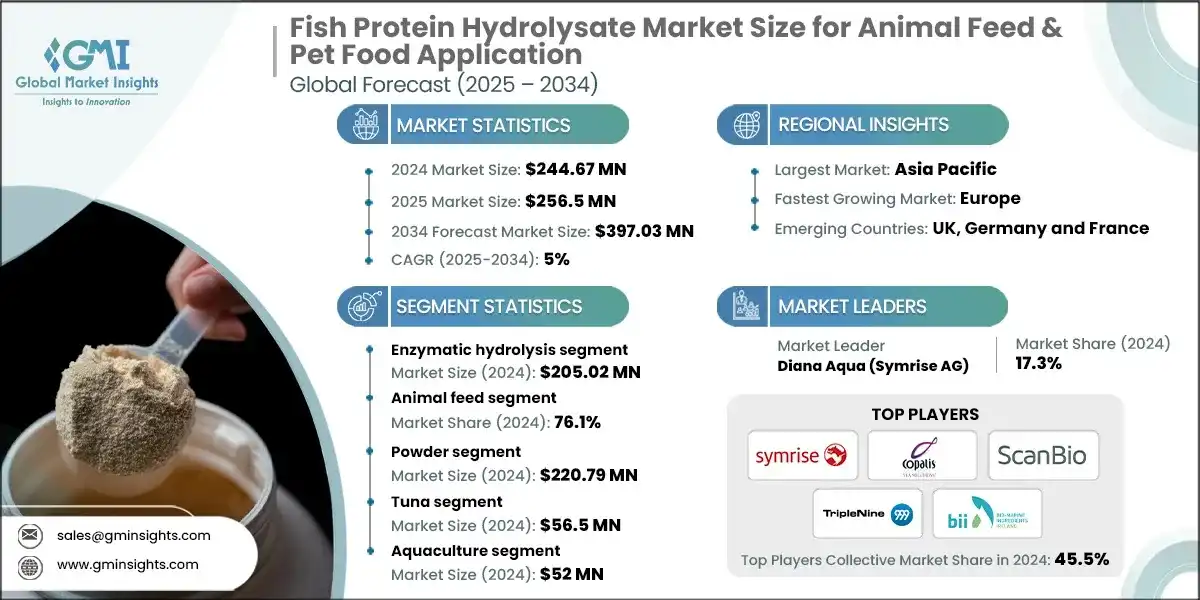
The global fish protein hydrolysate market size for animal feed & pet food application was estimated at USD 244.67 million in 2024. The market is expected to grow from USD 256.5 million in 2025 to USD 397.03 million by 2034, at a CAGR of 5%, according to latest report published by Global Market Insights Inc.
Fish Protein Hydrolysate Market Key Takeaways
Market Size & Growth
- 2024 Market Size: USD 244.67 Million
- 2025 Market Size: USD 256.5 Million
- 2034 Forecast Market Size: USD 397.03 Million
- CAGR (2025–2034): 5%
Key Market Drivers
- Rising demand for natural and sustainable feed ingredients.
- Increasing awareness of the nutritional benefits of fish protein hydrolysates.
- Shift towards premium and specialty pet food and animal feed.
Challenges
- High production costs and complex processing methods.
- Limited availability of sustainable fish raw materials.
Opportunity
- Expansion in aquaculture starter feeds.
- Use in antibiotic-free livestock diets.
- Premiumization of pet nutrition.
- Circular economy via fish waste valorization.
Key Players
- Market Leader: Diana Aqua (Symrise AG) led with over 17.3% market share in 2024.
- Leading Players: Top 5 players in this market include Diana Aqua (Symrise AG), Copalis Sea Solutions, Scanbio Marine Group, TripleNine Group A/S, Bio-Marine Ingredients Ireland Ltd, which collectively held a market share of 45.5% in 2024.
Get Market Insights & Growth Opportunities
To get key market trends
- Animal feed and pet food applications of fish protein hydrolysate have been recording gradual growth, in large part due to the increased popularity of natural and sustainable feed ingredients. As there is rising concern about the environmental consequences of synthetic additives and conventional sources of protein such as soybean meal. Fish protein hydrolysates are by-products of fish that provide a sustainable solution, in addition to the problem of resource efficiency. This is likely to increase as the producers and consumers focus on sustainability in feed production.
- The next significant driver to the growth of the market is the growing awareness of the nutritional benefits of fish protein hydrolysates. These products improve animal growth, gut health, and immunity and are packed with easily digestible peptides, amino acids, and bioactive compounds.
- Farmers are learning to understand that livestock farmers are taking part in ensuring that the proportion of their feeds to productivity is enhanced, and pet owners are learning to recognize the contribution made by livestock feeds to the digestive and functional requirements of their pets. Consequently, the adoption in the poultry sector, aquaculture sector and companion animal nutritional segments is increasing.
- For instance, IFIF reported world compound feed production to be over 1 billion tons annually. Global commercial feed manufacturing generates an estimated annual turnover of over USD 400 billion. This signifies that the recent years, there has been increase in the demand for animal protein worldwide, including for livestock, dairy and fish.
- The market is also picking up because of the transition to premium and specialty feed, especially in pet food. The trend of humanization of pets is compelling pet owners to spend more on quality, functional foods that offer holistic health-related benefits. Hydrolysates containing fish protein are suitable in this category of foods because they are hypoallergenic and highly palatable with functional bioactivity. These ingredients are being added to premium pet food brands to provide a differentiation to their products, and this increase in demand is growing.
- Asia Pacific is the dominating region due to the rising demand for healthy protein sources, the booming aquaculture sectors, and increasing pet ownership in countries like China, India, Japan, and South Korea. This region has a large population and is modernizing animal nutritional practices, which places it in this leading position.
- Europe is the fastest growing region because of increasing consumer awareness about health and nutrition for pets, stringent regulations to promote sustainable, high-quality ingredients, and the expanding pet food sector. The increased adoption of fish protein-based products in applications such as animal feed and pet food further drives the market growth in this region.
Fish Protein Hydrolysate Market for Animal Feed & Pet Food Application Trends
- There is a significant trend in the fish protein hydrolysate industry towards greater use of fish by-products in the circular economy. Rather than throwing away the fish processing waste, manufacturers are turning to superior enzyme hydrolysis technologies to transform such by-products into high-value protein hydrolysates.
- The other important trend influencing the market is the increased use of functional ingredients in the formulation of animal food and pet food. Fish Hydrolysates have been utilized beyond offering a source of protein and their bioactive properties are being utilized in providing immune system support, gut health and stress resistance in livestock and pets.
- Digitalization and traceability in the animal nutrition market are also driving demand in the fish protein hydrolysate market. Consumers and regulators are seeking more openness in sourcing and processing and are compelling companies to invest in traceable supply chains and electronic tracking mechanisms.
- Moreover, the high cost of pets is opening up markets of specialized fish protein hydrolysate. There is a growing preference among pet owners to buy products that are labeled as hypoallergenic, highly digestible, and naturally sourced, and manufacturers have been promoting hydrolysates as high-quality protein sources. This trend of premiumization transforming product portfolios, but it is also broadening the sphere of application to niche segments such as functional treats and veterinary diets.
- According to a survey done by Instituto Pet Brasil, the Brazilian pet market earned BRL 40.8 billion in 2020. However, according to a SEBRAE survey, the crisis arising from the pandemic impacted part of the segment’s businesses with around 70% of pet shops showing a reduction in revenue in the same year. One of the main reasons for the growth of this market is related to the role of animal nutrition and its influence on the health, longevity and quality of life of pets.
Fish Protein Hydrolysate Market for Animal Feed & Pet Food Application Analysis
Learn more about the key segments shaping this market
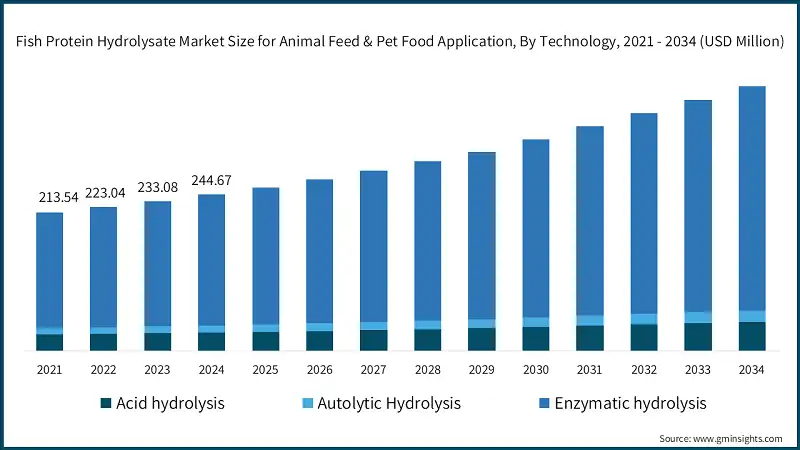
Based on technology, fish protein hydrolysate market for animal feed & pet food application is segmented into acid hydrolysis, autolytic hydrolysis, and enzymatic hydrolysis. The enzymatic hydrolysis segment was valued at USD 205.02 million in 2024, and it is anticipated to expand to 5.1 % of CAGR during 2025 to 2034.
- Enzymatic hydrolysis is growing in popularity as a protein breakdown method in fish protein hydrolysates, due to providing a cleaner and more controlled breakdown process than conventional alternatives. Enzymatic hydrolysis maintains the nutritional integrity of protein, resulting in bioactive peptides that are highly digestible and may be of functional use in animal health. It is the most rapidly growing technology segment because of its capability to produce consistent and high-value products, which are now being embraced in upscale pet feed and specialty animal feed.
- Autolytic hydrolysis is growing steadily as it is natural and uses natural fish tissue enzymes. This method is not costly and most importantly it is eco-friendly, given the concept of sustainable feed solutions. Acid hydrolysis is still applicable especially in the huge industrial process where cost and convenience of operation are the determining factors. It does grow fairly well, though, and its growth results in relatively low-quality protein fractions and can influence functional properties.
Learn more about the key segments shaping this market
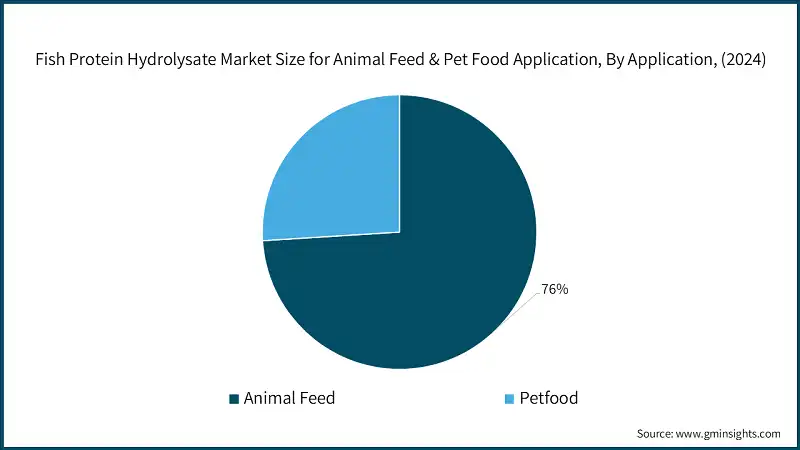
Based on application, fish protein hydrolysate market size for animal feed & pet food application is segmented into animal feed and pet food. The animal feed segment commands the major market share precisely around 76.1% and is expected to grow at a CAGR of over 4.7% CAGR from 2025 to 2034.
- Animal feed is one of the largest areas of application of fish protein hydrolysates and is increasingly used in poultry, swine, and aquaculture. They are highly digestible, balanced in amino acids, and their bioactive components promote high feed-to-mass ratio, growth rate, and the overall health of livestock and farmed fish. Increased interest in sustainable and functional protein sources in feeds is further driving the utilization of hydrolysates in large scale animal nutrition.
- Another important use is pet food, which has been gaining momentum as people pay more attention to the quality and functionality of food fed to pets. In this market, fish protein hydrolysates are considered to be very useful due to their hypo allergenicity, palatability and digestive health and immunological advantages. Humanization of pets and use of natural and high-quality ingredients is leading manufacturers to include hydrolysates in high-quality pet nutrition, such as in dry food, wet food, and functional treats.
Based on form, the fish protein hydrolysate market size for animal feed & pet food application is segmented into powder, liquid, and paste. The powder segment was valued at USD 220.79 million in 2024, and it is anticipated to expand to 5.1% of CAGR during 2025 to 2034.
- Fish protein hydrolysate in powder form is becoming the most dominant group largely because it is stable, has a longer shelf life and is more transportable. Powder is commonly used in animal feed and pet food because it can be easily mixed with other additives, and it still contains good nutritional value.
- Liquid hydrolysates are also typical growth enhancers and feed attractants, and they are widely common in intensive fish farming practices. They have limited use outside aquaculture, though, because of their lower storage life and high storage costs relative to powder. Paste form is nonetheless starting to see niche use in special feeds. It is semi-solid in nature making it highly suitable for being used in pet treats and in the diet of some livestock.
Based on source, fish protein hydrolysate market size for animal feed & pet food application is segmented into anchovy, tilapia, tuna, sardine, atlantic salmon, crustacean, molluscs, codfish, and others. The tuna segment was valued at USD 56.50 million in 2024, and it is anticipated to expand to 4.9% of CAGR during 2025-2034.
- Tuna is the most commonly used source due to its great availability through the tuna processing industry globally, and its good protein content. Products that are produced by tuna processing can easily be converted into hydrolysates therefore, tuna processing is cost effective and sustainable.
- Atlantic salmon is also capturing a large portion of the market due to the growing aquaculture industry and its rich by-products. The salmon-derived hydrolysates are characterized by high quality, functional bioactive compounds, and health-promoting effects (enhanced digestion and immunity).
- The base of raw material is diversified by other sources such as anchovy, tilapia, sardine, codfish, molluscs and crustaceans in a meaningful way. They are common in markets of other regions to balance the demand in aquaculture, livestock and pet food. Anchovy and sardine hydrolysates are prized in aquafeed because they are palatable, and molluscs and crustaceans offer functional and nutritional variety to support innovation in targeted feeds.
Based on livestock the fish protein hydrolysate market size for animal feed & pet food application is segmented into poultry, swine, calves, aquaculture, and equine. The aquaculture segment was valued at USD 52 million in 2024, and it is anticipated to expand to 5% of CAGR during 2025-2034.
- The most common livestock area to fish protein hydrolysates is aquaculture, where they are used as high-digestibility, palatability, and highly-nutritious feed materials. Hydrolysate enhances the feed consumption, growth, and immunity of farmed fish and shrimp and thus form a critical ingredient of the present day aquafeed. The growth of global aquaculture production to satisfy the increasing seafood demand has been reinforcing the position of this segment.
- The other area of concern is poultry where hydrolysates are currently being used to enhance growth performance and gut health. As an addition to high density poultry rearing systems, they are expected to improve the feed efficiency and disease-resistance of poultry through their bioactive peptides and amino acid profile. Other growth opportunities which can be applied to improve the health and productivity of young, or performance oriented animals include swine, calves and equine. In equine feed, hydrolysates are being used in niche applications in performance, recovery and digestive maintenance diets.
Looking for region specific data?
North America has a significant market in the fish protein hydrolysate market size for animal feed & pet food application with a market share of 26% in 2024.
- The fish protein hydrolysate markets for animal feed and pet food have been on the constant growth momentum that has propelled demand among consumers for sustainable, high-quality protein sources, along with the increasing functional ingredients adoption in promoting animal health and wellness.
- Regulation aims at promoting sustainable fish practice and using fish by-products is proving to be a promising gain to the market. Hence, the trend continues towards eco-friendly and nutrient-rich feed, and it is expected that North America will be a considerable market for fish protein hydrolysates in the animal nutrition industry.
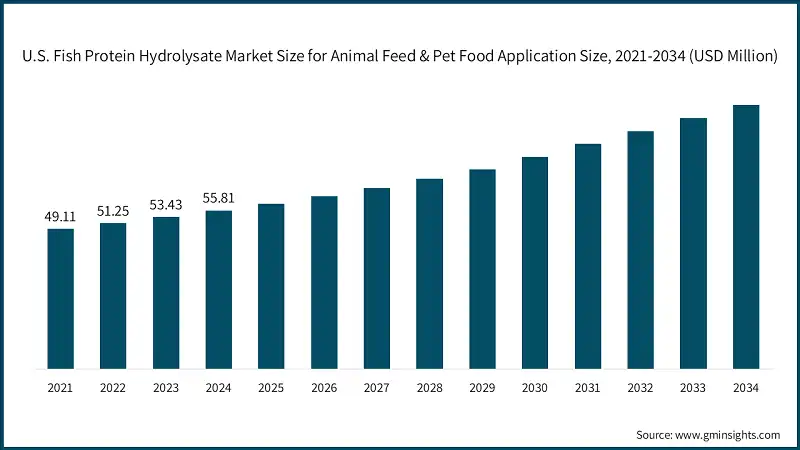
The U.S. fish protein hydrolysate market size for animal feed & pet food application was valued at USD 49.11 million and USD 51.25 million in 2021 and 2022, respectively. The market size reached USD 55.81 million in 2024.
- U.S. has seen exponential development in the fish protein hydrolysate market in animal and pet feed because of behavioral trends among consumers that are shifting toward natural, functional ingredients. Moreover, because of the growing focus on health-based products within the pet industry, there is a greater demand for protein hydrolysates as they are easily digestible and offer a rich source of amino acids.
- Improvements in processing techniques will continue to enhance the quality and bioavailability of protein hydrolysates, causing further adoption. Increased emphasis on sustainability and waste valorization will motivate use of fish by-products in further converting them into high-value-added materials with benefit to eco-sensitive consumers.
Europe fish protein hydrolysate market size for animal feed & pet food application accounted for USD 72.9 million in 2024 and is anticipated to show lucrative growth over the forecast period.
- There is growing demand in Europe for fish protein hydrolysate specifically in the branch of animal feed and pet food ultimately results from the selling power generated from sustainable natural ingredients and green-hungry citizens. It can influence companies in Europe to find effective ways to use fish by-products to develop environmentally friendly products.
- The current and future favoring regulatory framework adheres to the sustainable sourcing and waste reduction elements of market expansion inhalation. The nature of innovation in processing and formulation is changing bioavailability and bio efficacy for consumers. In general, Europe tries to be a landing hub for high-quality fish protein hydrolysates into the animal feed sector, sustainable and eco-friendly.
The Germany dominates the European fish protein hydrolysate market size for animal feed & pet food application showcasing strong growth potential.
- Rapid growth is witnessed in the markets of fish protein hydrolysate in Germany for animal feed and pet food products due to consumers demanding natural, sustainable, and health-promoting ingredients. The growing emphasis in the country regarding recycling and the sustainability of wastes adds to the reason for fish by-product usage in the country.
- Also, advancements in processing technology have made improvements to the quality and bioavailability of products in line with stringent regulatory requirements. Germany is increasingly being positioned to be one of the main market hubs for innovative and sustainable fish protein hydrolysate solutions across Europe.
Asia Pacific fish protein hydrolysate market size for animal feed & pet food application is anticipated to grow at the highest CAGR of 5.4% during the analysis timeframe.
- The Asia-Pacific fish protein hydrolysate market for animal feed and pet food is undergoing speedy growth propelled by the entry of new consumers owning pets and increasing demands for healthy, functional ingredients as a result of-holds such countries as India, Japan, and Australia focusing on sustainable sourcing as well as on innovative sourcing processing methods.
- The developing aquaculture sector will also enhance high-quality protein sources needed by high- or higher-protein foods. Preference is shifting toward natural and health-promoting pet foods by consumers and thus encouraging brands to adopt fish hydrolysates. Governments also initiated boosting the sustainable fishing and waste utilization in the whole market. With the highest growing markets for pet and aquaculture, Asia-Pacific will emerge as a site for fish protein hydrolysates.
The China fish protein hydrolysate market size for animal feed & pet food application is estimated to grow with a significant CAGR, in the Asia Pacific market.
- China's fish protein hydrolysate is in its booming pet food segment and adding up aquaculture activities. The per capita increased revenue and urbanization in the country have resulted in higher demands for pet nutrition products that are marketed at a price.
- Advances in processing technology will improve product quality and digestibility and enhance adoption. With a domestic growing market and exports opportunities, China would become a strong force in the fish protein hydrolysate industry. This is bound to continue growing since consumer awareness and demand for functional pet foods keep increasing.
Latin America fish protein hydrolysate market size for animal feed & pet food application is expected to experience significant growth from 2025 to 2034.
- The Latin America fish protein hydrolysate market is thriving on the backdrop of developing aquaculture and pet food sectors. Sustainable practices and natural ingredients are being embraced by the likes of Mexico, Argentina, and Chile to respond to consumers' demand for healthy and eco-friendly products.
- The growing pet population and rising disposable incomes support the increased demand for functional, high-quality pet foods containing fish hydrolysates. Regional initiatives for waste valorization and sustainable fishing further increase the growth of this market.
The Brazil dominates the Latin America fish protein hydrolysate market size for animal feed & pet food application exhibiting remarkable growth during the analysis period.
- Brazilian market has grown considerably owing to active demand in the pet food industry and a burgeoning local aquaculture sector. Demand relates to the degree of consumer acceptance for natural health-enhancing ingredients for fish-based functional products.
- Improvements in processing techniques lead to better product quality and digestibility, thereby meeting the regulatory framework. Brazil is set to take the position of being an important player in the market, supplying up for domestic and export markets.
Middle East and Africa fish protein hydrolysate market size for animal feed & pet food application is expected to experience significant growth from 2025 to 2034.
- There is an increasing interest in fish protein hydrolysates in the Middle East and Africa due to the increased activity in aquaculture and the increasing demand for quality animal feed materials. Countries such as South Africa, Egypt, and the United Arab Emirates are tapping into sustainable fishing and waste utilization so that they can provide innovative and natural feed additives
- The increase in pet ownership along with urbanization has also contributed to the rising demand for high-end pet food. Technological advancement in processing and quality enhancement facilitates market growth. Development in industry is further supported by government initiatives for promoting sustainable fisheries and bioresource utilization.
The Saudi Arabia fish protein hydrolysate market size for animal feed & pet food application to experience substantial growth in the Middle East and Africa market in 2024.
- Fast-rising pet ownership along with increasing emphasis on premium pet nutrition are stated as the key growth drivers for the country's fish protein hydrolysate market in Saudi Arabia. In addition, the country has taken initiatives to improve its aquaculture sector and has designs that support sustainable fishing methods by the government for developing fish-based products.
- Enhanced consumer awareness on health benefits related to natural and functional ingredients stretches supply. The strategic approach of diversifying the economy and promoting bioresources provides a stage for the expansion of the market. Saudi Arabia is playing the role of emerging player in the regional fish protein hydrolysate industry for domestic and export markets.
Fish Protein Hydrolysate Market for Animal Feed & Pet Food Application Share
The top 7 companies in the fish protein hydrolysate industry size for animal feed & pet food application are Diana Aqua (Symrise AG), Copalis Sea Solutions, Scanbio Marine Group, TripleNine Group A/S, and Bio-Marine Ingredients Ireland Ltd, Janatha Fish Meal & Oil Products and SAMPI contributing around 49.6% of the market in 2024, whose dominance is facilitated by technological edge, streamlined production, and dominance of supply chain within the regions.
- Diana Aqua (Symrise AG) remains competitive in the market through its high quality fish protein hydrolysates which is directed to aquaculture and pet food. To meet the big feed requirements, the company uses effective R&D to present functional ingredients to improve animal health, palatability and performance.
- Copalis Sea Solutions does not abandon its product because it has the ability to use fish by-products in an effective manner and through the best technology of hydrolysis. Through its emphasis on sustainability and nutritional innovation, the company provides the market with hydrolysates of high digestibility and functional characteristics, strengthening the company position in the market of specialized feed and pet food.
- Scanbio Marine Group is able to gain its market position through its highly integrated supply chain to transform the fish by-products into protein rich hydrolysates. Large-scale production and sustainable practice enable it to address the increasing demand in aquaculture and animal nutrition at a cost competitive level.
- TripleNine Group A/S has its advantage when it focuses on the creation of value based on the by-products of fisheries, and this creates hydrolysates that enhance animal welfare and feed efficiency. It is well connected with aquafeed manufacturers and focuses on the idea of a circular economy, which guarantees its further relevance in the competitive market.
- Bio-Marine Ingredients Ireland Ltd remains competitive because it sells hydrolysates of high quality due to the use of locally sourced raw materials. The emphasis of the company to traceability, uniform quality and sustainability grants its high position in pet food and aquaculture feed applications.
- Janatha Fish Meal & Oil Products is an eminent fish meal and oil company that mainly extracts and processes high-quality fish meal and fish oil for animal feed and industrial applications. To stay ahead of the competition, the company invests in modern processing technologies that ensure product quality and operational efficiency.
- SAMPI is one of the main producers of fish-based ingredients: fish meal, fish oil, and other aquaculture feed components. SAMPI sustains its competitive advantages by investing in advanced processing facilities and research-oriented product development to deliver high-grade, environmentally-friendly ingredients to satisfy a growing demand for sustainable aquaculture practices.
Fish Protein Hydrolysate Market for Animal Feed & Pet Food Application Companies
Prominent players operating in the fish protein hydrolysate industry size for animal feed & pet food application are:
- SOPROPECHE
- Diana Aqua (Symrise AG)
- Copalis Sea Solutions
- Scanbio Marine Group
- Bio-Marine Ingredients Ireland Ltd
- Hofseth Biocare ASA
- Janatha Fish Meal & Oil Products
- SAMPI
- Nutrifish
- TC Union Agrotech
- Alaska Protein Recovery
- Rossyew
- Sociedad Pesquera
- Triplenine Group A/S
- Omega Protein
Fish Protein Hydrolysate Market Report Attributes
| Key Takeaway | Details |
|---|---|
| Market Size & Growth | |
| Base Year | 2024 |
| Market Size in 2024 | USD 244.67 Million |
| Market Size in 2025 | USD 256.5 Million |
| Forecast Period 2025 - 2034 CAGR | 5% |
| Market Size in 2034 | USD 397.03 Million |
| Key Market Trends | |
| Drivers | Impact |
| Rising demand for natural and sustainable feed ingredients | Boosts adoption of fish protein hydrolysates as eco-friendly alternatives in animal nutrition |
| Increasing awareness of the nutritional benefits of fish protein hydrolysates | Encourages their inclusion in feed formulations for enhanced health and growth |
| Shift towards premium and specialty pet food and animal feed | Elevates market value through demand for high-quality, functional ingredients |
| Pitfalls & Challenges | Impact |
| High production costs and complex processing methods | Restrict scalability and price competitiveness in broader feed markets |
| Limited availability of sustainable fish raw materials | Constrains supply chain reliability and long-term sourcing strategies |
| Opportunities: | Impact |
| Expansion in aquaculture starter feeds | Opening new growth avenues by supporting early-stage fish development |
| Use in antibiotic-free livestock diets | Aligns with clean-label trends and regulatory shifts in animal farming |
| Premiumization of pet nutrition | Drives demand in bioactive-rich ingredients like fish protein hydrolysates |
| Circular economy via fish waste valorization | Enhances sustainability credentials and supports waste-to-value initiatives |
| Market Leaders (2024) | |
| Market Leaders |
17.3% |
| Top Players |
Collective Market Share of 45.5% in 2024 |
| Competitive Edge |
|
| Regional Insights | |
| Largest Market | Asia Pacific |
| Fastest Growing Market | Europe |
| Emerging Country | UK, Germany and France |
| Future Outlook |
|
What are the growth opportunities in this market?
Fish Protein Hydrolysate Industry Size for Animal Feed & Pet Food Application News
- In February 2022, Bio-Marine Ingredients Ireland Ltd borrowed Euro 6.5 million through a loan to construct new production facilities in Castleblayney in Ireland. This growth boosted its manufacturing competence of high-quality fish protein hydrolysates, which promotes increasing demand in animal feed and pet food.
The fish protein hydrolysate market size for animal feed & pet food application research report includes in-depth coverage of the industry with estimates & forecasts in terms of revenue (USD Million) and volume (Kilo Tons) from 2021 to 2034, for the following segments:
Market, By Technology
- Acid hydrolysis
- Autolytic hydrolysis
- Enzymatic hydrolysis
Market, By Form
- Powder
- Liquid
- Paste
Market, By Source
- Anchovy
- Tilapia
- Tuna
- Sardine
- Atlantic Salmon
- Crustacean
- Molluscs
- Codfish
- Others
Market, By Application
- Animal Feed
- Petfood
- Cat
- Dog
Market, By Livestock
- Poultry
- Broilers
- Layers
- Swine
- Calves
- Aquaculture
- Salmon
- Trouts
- Shrimps
- Others
- Equine
The above information is provided for the following regions and countries:
- North America
- U.S.
- Canada
- Europe
- UK
- Germany
- France
- Italy
- Spain
- Rest of Europe
- Asia Pacific
- China
- India
- Japan
- South Korea
- Australia
- Rest of Asia Pacific
- Latin America
- Brazil
- Mexico
- Argentina
- Rest of Latin America
- MEA
- UAE
- Saudi Arabia
- South Africa
- Rest of Middle East and Africa
Frequently Asked Question(FAQ) :
What is the market size of the fish protein hydrolysate for animal feed and pet food applications in 2024?
The market size was USD 244.67 million in 2024, with a CAGR of 5% expected through 2034. The growth is driven by the rising demand for sustainable and natural feed ingredients.
What is the projected value of the fish protein hydrolysate market for animal feed and pet food applications by 2034?
The market is projected to reach USD 397.03 million by 2034, fueled by the focus on sustainability in feed production and the adoption of functional ingredients to enhance animal health and wellness.
What is the expected size of the fish protein hydrolysate market for animal feed and pet food applications in 2025?
The market size is projected to reach USD 256.5 million in 2025.
How much revenue did the enzymatic hydrolysis segment generate in 2024?
The enzymatic hydrolysis segment was valued at USD 205.02 million in 2024 and is expected to witness over 5.1% CAGR till 2034.
What was the valuation of the powder segment in 2024?
The powder segment was valued at USD 220.79 million in 2024 and is anticipated to expand at a CAGR of 5.1% through 2034.
What is the growth outlook for the animal feed segment from 2025 to 2034?
The animal feed segment, which held a 76.1% market share in 2024, is set to showcase around 4.7% CAGR up to 2034.
Which region leads the fish protein hydrolysate for animal feed and pet food applications?
North America leads the market with a 26% share in 2024, driven by the demand for sustainable, high-quality protein sources and the increasing adoption of functional ingredients to promote animal health and wellness.
What are the upcoming trends in the fish protein hydrolysate market for animal feed and pet food applications?
Key trends include sustainability, use of fish by-products, and rising awareness of fish protein hydrolysates nutritional benefits for growth, gut health, and immunity.
Who are the key players in the fish protein hydrolysate industry for animal feed and pet food applications?
Key players include SOPROPECHE, Diana Aqua (Symrise AG), Copalis Sea Solutions, Scanbio Marine Group, Bio-Marine Ingredients Ireland Ltd, Hofseth Biocare ASA, Janatha Fish Meal & Oil Products, SAMPI, Nutrifish, TC Union Agrotech, Alaska Protein Recovery, Rossyew, Sociedad Pesque, Triplenine Group A/S, and Omega Protein.
Fish Protein Hydrolysate Market Scope
Related Reports