Summary
Table of Content

Financial Wellness Software Market
Get a free sample of this report
Form submitted successfully!
Error submitting form. Please try again.
Thank you!
Your inquiry has been received. Our team will reach out to you with the required details via email. To ensure that you don't miss their response, kindly remember to check your spam folder as well!
Request Sectional Data
Thank you!
Your inquiry has been received. Our team will reach out to you with the required details via email. To ensure that you don't miss their response, kindly remember to check your spam folder as well!
Form submitted successfully!
Error submitting form. Please try again.
Financial Wellness Software Market Size
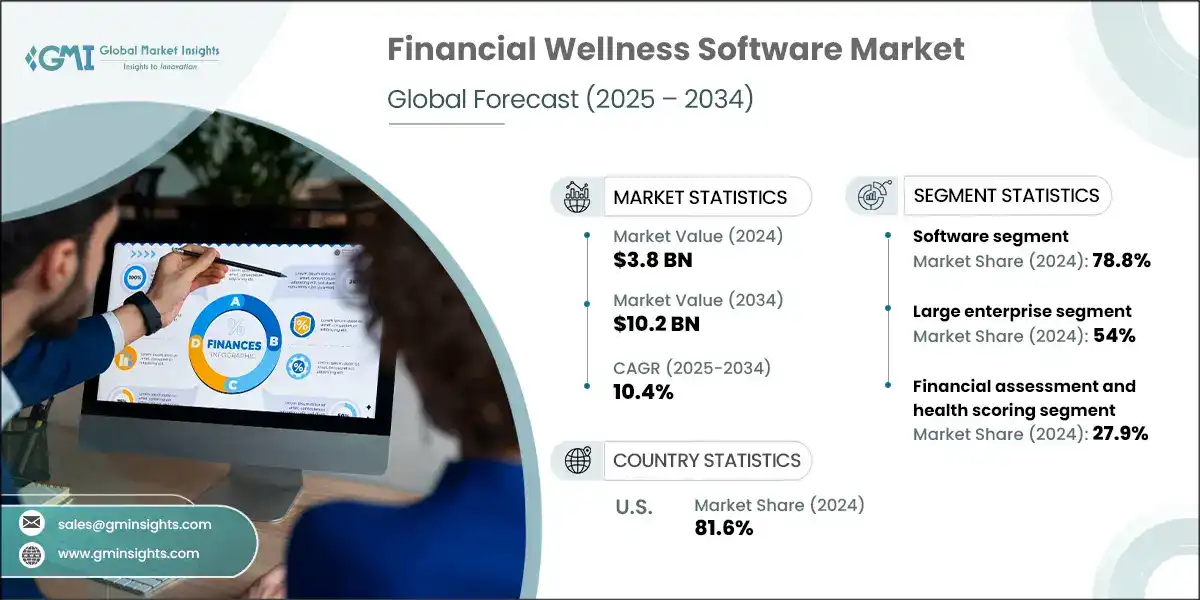
The global financial wellness software market was valued at USD 3.8 billion in 2024. The market is expected to grow from USD 4.2 billion in 2025 to USD 10.2 billion in 2034, at a CAGR of 10.4%, according to latest report published by Global Market Insights Inc.
To get key market trends
- The financial wellness software market is gaining strong momentum driven by the increased adoption of cloud computing, AI personalization, mobile-first solutions, and advanced analytics. It is widely recognized that employee financial stress is increasing, a demand for real-time financial advice and guidance is rising, and more employers are attending to the whole person (often referred to as holistic intervention). These factors are accelerating organizations who are taking a more ESG minded focus by offering software platforms that have budgeting capabilities, retirement, debt management and financial literacy/education.
- The pace of modernization and regulatory impacts across geographies in the financial wellness space is changing the industry landscape. For example, in February 2025 the EU announced employee benefits and data privacy laws under the Digital Employee Well-being Act and required financial wellness software provider to have stronger encryption, anonymization of data, and audits of compliance implementation. Vendors are working to comply with regulations but ensure they still integrate with users' HRIS and Payroll systems with little interruption.
- In North America, corporate-led, and government-funded initiatives are driving the adoption of cloud-based employee financial wellness platforms offering AI-based budgeting, personalized savings programs, and automated reporting tools. Tax incentives and workforce well-being grants aimed at demonstrating that spending on employee retention and productivity is the smart business move are pushing organizations from disparate well-being programs to nimble, modular platforms that use data to drive their decision-making and engage employees.
- The COVID-19 pandemic had a transformational impact on the financial wellness software market. For instance, during 2020, there were some initial disruptions in budgets and corporate wellness programs, which slowed adoption. However, the demand for financial wellness companies quickly picked up again beginning in 2021, because employers were increasingly interested in providing remote-access capabilities, digital coaching, and self-service financial education to their employees who may have been experiencing financial distress related to the pandemic.
- As the market matures, many credit unions and banks will start to think of the financial wellness planning platform as a feature or an extension of their broad platform that delivers several products and services, including financial wellness. Value-add features with financial coaching, dashboards integrated with retirement planning, real-time debt assessment, or customized investment mentorship will be market differentiators. For example, BrightPlan introduced its AI-enabled financial wellness assistant in May 2025 which combines automated budgeting tools, savings brilliance, and retirement planning into a single dashboard.
- The current market in financial wellness software deployment and investment belongs to North America as many corporate wellness budgets support financial wellness software as mature technology in the workplace system. The North American market is supported by many software packages deployed for several applications and employed by numerous organizations. The market for financial wellness software will see the largest growth from the Asia-Pacific region as business recovery continues with digitalization of financial literacy programs coupled with increased employment across many jurisdictions.
Financial Wellness Software Market Report Attributes
| Key Takeaway | Details |
|---|---|
| Market Size & Growth | |
| Base Year | 2024 |
| Market Size in 2024 | USD 3.8 Billion |
| Forecast Period 2025 – 2034 CAGR | 10.4% |
| Market Size in 2034 | USD 10.2 Billion |
| Key Market Trends | |
| Drivers | Impact |
| Rising Employee Financial Stress | Increased debt, student loans, and cost-of-living pressures are motivating employers to adopt wellness solutions. |
| Growing Adoption of Cloud & AI Technologies | Cloud platforms and AI-powered personalization enable scalable, remote, and data-driven financial wellness programs. |
| Employer Focus on Holistic Employee Well-being | Companies recognize that financial wellness improves productivity, retention, and overall workforce satisfaction. |
| Regulatory and Government Incentives | Grants, tax incentives, and compliance mandates encourage adoption of structured financial wellness programs. |
| Pitfalls & Challenges | Impact |
| Data Privacy and Security Concerns | Handling sensitive employee financial data requires strict compliance with GDPR, CCPA, and other regulations. |
| Integration with Legacy HR Systems | Many organizations struggle to integrate modern financial wellness software with existing payroll and HR platforms. |
| Opportunities: | Impact |
| Integration with FinTech and Personalized Services | Offering AI-driven savings recommendations, debt management, retirement planning, and investment guidance to improve employee engagement. |
| Adoption of Cloud-Based and Mobile-First Platforms | Scalable, remote-access solutions enable wider adoption among SMEs and distributed workforces. |
| Integration with Corporate Benefits Platforms | Opportunities to embed financial wellness solutions alongside health, insurance, and retirement benefits for a unified employee experience. |
| Emergence of AI and Predictive Analytics | Advanced analytics and machine learning can deliver personalized insights, predictive financial guidance, and proactive interventions. |
| Market Leaders (2024) | |
| Market Leaders |
Holds 14% market share |
| Top Players |
Collective market share in 2024 is 19% |
| Competitive Edge |
|
| Regional Insights | |
| Largest Market | US |
| Fastest Growing Market | China |
| Emerging Countries | Brazil, Mexico, Argentina |
| Future outlook |
|
What are the growth opportunities in this market?
Financial Wellness Software Market Trends
- The financial well-being software market is in fundamental shift at the market level, driven by artificial intelligence-based financial analytics, cloud-based solutions, and customizable employee well-being programs. Many organizations in North America, Europe, and Asia-Pacific are increasingly leveraging cloud-native solutions and the advancements in AI-based financial guidance systems to provide employees with personalized recommendations to improve employee engagement, budgeting accuracy, and long-term planning.
- For example, Prudential Financial introduced a financial well-being suite that leverages AI capabilities in Germany in February 2025. The program comes with personalized investment recommendations, cloud access that permits secure integration, and ongoing employee financial wellness scoring - in real-time.
- The integration of mobile, IoT, and edge computing solutions has accelerated, primarily in response to increasing remote workforce support and developing digital workforce initiatives. Vendors are using modular and scalable software platforms that provide employees real-time financial monitoring, personalized coaching, and automated alerts. For example, LearnLux deployed its mobile first financial well-being platform to Singapore in April 2025, allowing employees to access budgeting tools, debt management planning, and a course of interactive financial education wherever they are.
- Sustainable and energy-efficient, digital infrastructure has become a point of interest for financial wellness software vendors, many of whom are trying to embody green computing standards while also leveraging servers and low-power processing opportunities from AI to align more closely with their ESG commitments. In March 2025, Mercer introduced an environmentally friendly financial wellness offering in the Netherlands, which featured energy-efficient storage and secure data handling done in compliance with EU data privacy standards.
- The enterprise ecosystem is expanding to include interoperable capabilities, artificial intelligence-assisted financial coaching models, built-in advanced security options, collaborative partnerships with finance providers, talent acquisition, and processes that allow data and security workflows to flow seamlessly together.
- Recent collaborations between software vendors, corporate HR departments, and financing technology partners have created an eco-system that is seamless (e.g., data-sharing, predictive financial planning models, operating completely in the cloud). In May 2025, SmartDollar partnered with a few multinational companies in the U.S. to deliver an integrated platform for budgeting, retirement planning, and real-time financial literacy analysis.
Financial Wellness Software Market Analysis
Learn more about the key segments shaping this market
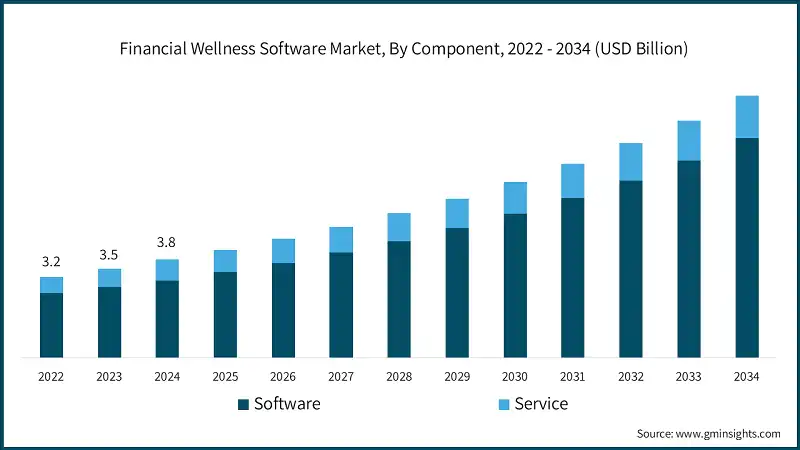
Based on components, the financial wellness software market is divided into software and services. The software segment dominated the market, accounting for around 78.8% in 2024 and is expected to grow at a CAGR of over 11% through 2034.
- The software segment, fueled by organizations’ desire for automated, scalable, and data-driven financial wellness technology, is the largest segment of the financial wellness software market. Financial wellness platforms offer features such as budgeting and expense management tools, debt management solutions, investment and savings guidance apps, and personalized financial health dashboards that prepare their employees to make informed choices while also improving their overall financial literacy.
- Four of the top providers, Financial Finesse, Prudential Financial, and Mercer LLC have upgraded their software offerings to offer secure, configurable platforms with safety features, actionable analytics, and personalized recommendations, using their connections to other solutions in the enterprise HR and payroll space. The features of the platforms, like real time financial health scoring, dashboards, and modular technology, has increased the visibility of the software segment more than other solutions. Financial Finesse upgraded their platform in January 2025, with AI-powered financial coaches and superior reporting capabilities for overall organizational reporting.
- Although the services category is a relatively small segment of the total category, it is growing rapidly in popularity as organizations understand the benefit of supplemental personalized financial coaching, advisory services, training workshops, and ongoing program support as part of their software solution. Services increase the adoption rates, employee engagement, and the impact of financial wellness programs.
- Newer providers such as LearnLux, SmartDollar, and Enrich have added various service components to their existing software solution to deliver a stronger brand of integrated programs that combine digital tools with individualized coaching, consulting, and educational resources. For example, LearnLux launched a cloud-based financial coaching service that allows employees in March 2025 to access budget advice, debt management assistance, and personal investment coaching in a unique, on-demand environment.
- Industry players are increasingly developing software-service integration that facilitates more employee participation or engagement, improves actionable insight, and creates efficiencies in program management. In February 2025, Mercer LLC introduced a new hybrid financial wellness program utilizing an AI-enhanced software tool and service model.
Learn more about the key segments shaping this market
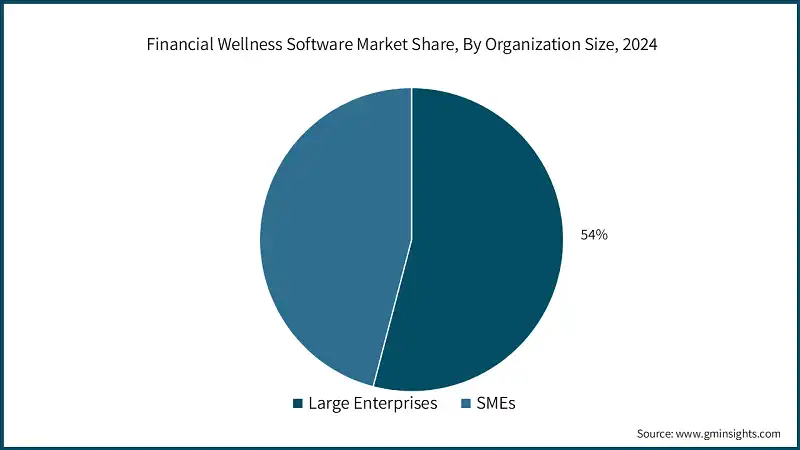
Based on organization size, the financial wellness software market is segmented into large enterprises and SMEs. The large enterprise segment dominates the market with 54% share in 2024 and is expected to grow at a CAGR of over 9% from 2025 to 2034.
- Large enterprises need large robust, scalable financial wellness software solutions that provide integrated financial planning capabilities, real-time analytics, AI-supported individual recommendations, and comprehensive employee engagement metrics.
- For example, in March 2025, Prudential Financial rolled out an AI-supported financial wellness solution for a valuable Fortune 500 client that gives employees personalized guidance on where to invest, provided automated budgeting insights, and gave the company insights into the overall financial wellness of their employees.
- Small and medium-sized enterprises (SMEs) are taking advantage of modern cloud-based upstarts or hybrid, cloud-based, solutions with a view to fostering greater engagement, financial literacy and efficiencies in benefits administration.
- LearnLux implemented a hybrid cloud financial wellness platform in January 2025, on a medium-sized IT organization with employees who had access to a budgeting application, support on debt management, and interactive financial literacy modules - all while safeguarding their data and compliance.
Based on deployment mode, the financial wellness software market is segmented into cloud-based, on-premises and hybrid. The cloud-based segment is expected to dominate the market.
- Cloud-based segment will dominate the financial wellness software market, as organizations increasingly need scalable, accessible and cost-effective platforms that create employee engagement, provide personalized financial information, and track engagement with organizational policy.
- Cloud-based platforms are critical options for employers that want to develop their financial wellness program because they aggregate employee financial information, budgeting resources, and investment advice. For example, in April 2025, LearnLux began developing a cloud-native financial wellness platform for a multinational company in the technology space that provided AI-enabled personal recommendations and integration with payroll and HR
- While on-premises solutions maintain a role for organizations that need total control over sensitive employee data and internal information technology (IT) governance, the uptake is limited because of high infrastructure costs and limited flexibility as an option. Organizations will increasingly look for hybrid solutions that provide on-premises security with the scalability of cloud.
Based on solutions, the financial wellness software market is segmented into financial assessment and health scoring, budgeting and expense management, savings and investment guidance, debt management and credit improvement and financial education and coaching. The financial assessment and health scoring segment dominates the market with 27.9% share in 2024.
- The Financial assessment and health scoring area clearly dominates the financial wellness software market as organizations are increasingly seeking customized financial health insights, predictive analytics, and data-driven insights. In addition to allowing organizations to assess an overall measure of employee financial well-being, and risk areas, these platforms also offer the ability to create tailored interventions to improve employee's financial literacy and financial well-being.
- Financial assessment and health scoring tools are the foundation of current financial wellness programs, bringing together all of your employees' financial data, building customized reports, and recommending actions you can take. For instance, in March 2025, Financial Finesse announced the implementation of an AI-enabled financial health scoring system for a Fortune 500 company that gave employees personalized recommendations on budgeting, saving, and planning for retirement.
- Other solution areas include specific components of personal finance that span budgeting and expense tracking, savings and investment recommendations, debt management and credit improvement, and financial education and coaching, which align with financial assessment tools, and there are bespoke tools that offer solutions for certain issues.
- Providers like Prudential Financial, LearnLux, and SmartDollar are in the process of providing additional services to these complementary solutions that are aimed at raising engagement and outcomes.For example, in April 2025, LearnLux now has tools for debt management and savings guidance within their platform, allowing employees to develop actionable recommendations based on their financial health scores.
Based on end use, the financial wellness software market is segmented into BFSI, IT & telecom, healthcare, manufacturing, retail & e-commerce and others. The BFSI segment dominates the market.
- The BFSI sector is leading the financial wellness software market, as a highly regulated segment with many employees and focuses on financial literacy/retirement planning. Organizations in the BFSI sector have made serious investments in financial wellness as part of their engagement strategy to reduce financial stress and increase productivity.
- The BFSI-focused platforms are the foundation of any organization financial wellness strategy by serving as a centralized place for employees to access their financial data, receive personalized budgeting and investment advice, and predictive financial health scoring. For example, in February 2025 Prudential Financial launched a financial wellness service and platform for a large European bank that introduced AI-based personal recommendations, retirement planning, and debt management.
- Other end-use sectors such as IT & Telecom, Healthcare, Manufacturing, Retail & E-commerce and Other are beginning to adopt financial wellness as part of their overall plan to maximize employee engagement, productivity and financial literacy.
Looking for region specific data?
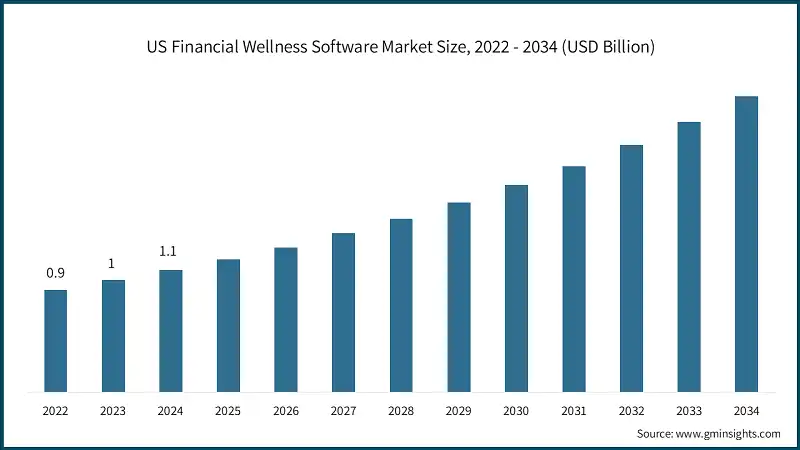
US dominated the financial wellness software market in North America with 81.6% share in 2024 and generated USD 1.1 billion in revenue.
- The financial wellness software market is enhancing in the U.S. thanks to its existing digital infrastructure, extensive corporate workforce, and acceptance of cloud-based financial wellness and AI-enabled solutions that have quickly caught hold. The U.S. remains the largest consumer of most wellness solutions and is the center of innovation and development for financial wellness, with a broad spectrum of deployment in large enterprises, SMEs, and multinational firms which, potentially employ millions of workers.
- The most established solution providers, such as Prudential Financial, Mercer LLC, and Financial Finesse, have each expanded its operations recently in the U.S. by providing integrated financial wellness platforms, AI-based financial health scoring, and responsive employee-level personal financial wellness solutions.
- For example, in March 2025, Prudential Financial, launched a new national financial wellness platform for multiple Fortune 500 employer clients, with elements including extended predictive analytics, interactive dashboards, personalized retirement planning modules with upgraded personalization features for ease of employee usage engagement and financial literacy.
- U.S. market dominance is further supported by favorable corporate wellness programs, strong data privacy regulations, and a mature technology ecosystem. Vendors are heavily investing in automation, cloud-native platforms, and mobile-first solutions to meet growing demand for real-time, data-driven employee financial wellness capabilities.
The financial wellness software market in the Germany is expected to experience significant and promising growth from 2025 to 2034.
- Such growth is driven by Germany’s strong emphasis on corporate digital transformation, adherence to EU business standards for data privacy, and the enhanced acceptance and implementation of financial wellness and employee engagement tools via AI.
- Many German enterprises and associations are directing financial resources to platforms which assess financial health, budgeting and expense management technologies, in which the objective is to expand employee engagement, financial literacy, and overall productivity at work.
- For example, in January 2025 Mercer LLC teamed with Europe’s largest financial institution to deploy an AI driven financial wellness platform, which provided employees with personalized retirement planning and debt reduction, and real time financial health assessments.
- Germany’s strong digital infrastructure, its leadership position among EU based corporate wellness programs, and its focus on employee wellness will all further support that growth. Finally, the emergence of cloud-based platforms, predictive analytics, and mobile accessible financial tools, is expected to further cement Germany’s contributions as an upcoming growth engine in the European market over the next decade.
The financial wellness software market in China is expected to experience strong growth from 2025 to 2034.
- The growth of financial wellness software in China is also being driven by ongoing digital transformation, a growing middle-class workforce, and extensive government investment focused on employee wellness and financial literacy initiatives in the workplace. China's vast working population, growing corporate wellness programs, and adoption of AI-based financial wellness tools, China is scaling up the use of cutting-edge financial wellness software across large companies, small to medium-sized enterprises (SMEs), and public sector organizations.
- Chinese organizations are adopting integrated financial evaluation systems, mobile budgeting solutions, and AI-enabled solutions that offer savings and investment recommendations to assist employees in understanding, planning, and improving their financial management. For example, Alipay collaborates with trusted HR service provider in July 2024 to provide a cloud based financial wellness platform with their own brand for employees at corporations that provided access to personalized debt management, digital savings tools, and real-time financial well-being score.
- China's growth is bolstered by a robust and active domestic technology ecosystem, government-subsidized R&D projects, and rapid uptake of mobile fintech applications. With growth in demand for customized financial education, AI-facilitated retirement planning, and integrated workplace financial wellness ecosystems, we take the view that China remains one of the most vibrant and growth-oriented markets for financial wellness software across Asia-Pacific.
The financial wellness software market in Brazil is expected to experience high growth from 2025 to 2034.
- Brazil is expected to see strong growth in the financial wellness software industry, fueled by a rapid digital transformation journey among businesses, mobile penetration, and government-led educational support for financial literacy and employee wellness programs. With a growing workforce and appetite for digital financial service options, the country is seeing rapid growth of financial wellness tools and platforms across all types of businesses from large enterprises to SMEs.
- Global and regional financial wellness software leaders are growing their footprint in Brazil through corporate partnerships with fintech providers and HR platforms to deliver scalable, secure, and AI-enabled financial wellness to Brazil's workers. A prime example is Nubank's partnership with a major HR tech player to build an employee financial wellness solution, powered by AI, that offers budgeting tools, savings recommendations, and credit improvement tools specific to Brazil, which launched in April 2025.
- Corporate well-being programs are increasing across Brazil, high internet penetration is based on a growing percentage of mobile devices, the rapid shift to mobile-first financial applications has expanded demand for cloud-based, financial coaching, and personal financial health scores. These shifts position Brazil to become one of the fastest-growing markets for financial wellness software across Latin America.
The financial wellness software market in UAE is expected to experience strong growth from 2025 to 2034.
- The UAE financial wellness software market is anticipated to continue its rapid growth following the UAE's digital transformation initiatives, the country's high mobile phone penetration rate, and government financial literacy and financial and employee wellness initiatives. The growing demand for AI-driven financial tools and cloud adoption, and a mobile-first approach is nurturing a sector of financial wellness solutions that are being adopted by enterprises and public entities alike.
- These enterprises are making extensive investments on financial assessments platforms, savings and investment guidance tools, and AI-enabled budgeting solutions to enhance productivity and engagement of the workforce. Financial wellness platforms or tools are most likely to be successful in the banking, telecom, and healthcare sectors. In February 2025, Emirates NBD partnered with a fintech startup to launch a cloud-based employee financial wellness platform that provides personalized savings recommendations, debt management support, and digital financial coaching.
- Growth in the UAE is further supported by favorable government policies, rising fintech innovation hubs in Dubai and Abu Dhabi, and strong investments in cloud-native financial technologies. With the rise of hybrid work models, data-driven HR practices, and increased emphasis on employee well-being, the UAE is set to remain a key growth driver for the market in the Middle East region.
Financial Wellness Software Market Share
The top 7 companies in the financial wellness software industry are Financial Finesse, Mercer LLC, Prudential Financial, LearnLux, BrightDime, SmartDollar (Dave Ramsey Solutions) and Enrich (iGrad Inc.), contributing around 20% of the market in 2024.
- Financial Finesse is the leader in the financial wellness software space and provides a host of employee financial education and coaching platforms, in that vein, Financial Finesse announced its next-generation platform for financial coaching, with AI capabilities, in January 2025 that is capable of personalized financial assessments, budgeting help, and realtime saving suggestions for Fortune 500 companies.
- Mercer LLC is one of the world's largest holistic financial wellness solutions providers of financial wellness, integrating employee benefits, retirement planning solutions, and digital advisory tools. In March 2025, Mercer added a cloud-based retirement readiness platform to their financial wellness suite in an effort to offer to multinational organizations workforce financial security and increased employee engagement.
- Prudential Financial utilizes its deep experience in insurance and retirement services to provide large employers with enterprise-level financial wellness platforms. A great example of this is Prudential's launch of AI-enabled workplace financial wellness program in February 2025 that offered investment guidance, debt management, and digital financial literacy modules across the U.S. market.
- LearnLux is one of the key innovators providing interactive, mobile-first financial wellness software to improve financial literacy and provide actionable information to employees. For instance, in April 2025, LearnLux worked with a premier healthcare provider to deploy its hybrid digital & human coaching solution that includes personalized budgeting tools, investment education, and live financial advice.
- BrightDime is providing AI-powered financial wellness and coaching solutions that bundle together debt management, redeemable savings, and behavioral nudges. For example, in May 2025, BrightDime introduced its upgraded platform with real-time debt repayment optimization features to help employees decrease financial stress and improve long-term savings outcomes.
- SmartDollar offers monthly accessible wellness platforms that begin with behavioral finance and use principles in reduction of debt, budgeting, and savings discipline. For example, in February 2025 SmartDollar rolled out a workplace program that included gamified challenges and a way to track financial milestones for their financial wellness program that allowed enterprises to boost their employee’s participation rates in financial wellness programs.
- Enrich (iGrad Inc.) is a leading supplier of personalized financial education tools and health assessment platforms for colleges, corporations, and government agencies. For example, in March 2025, Enrich launched its upgraded AI-powered financial health assessment tool, which provides users with personalized learning paths, budgeting modules, and large-scale investment simulations to improve financial literacy.
Financial Wellness Software Market Companies
Major players operating in the financial wellness software industry are:
- BrightDime
- Enrich (iGrad Inc.)
- Financial Finesse
- LearnLux
- Mercer LLC
- Origin Financial
- PayActiv
- Prudential Financial
- SmartDollar
- Thrive Global
- Financial Finesse has rapidly gained market share in the financial wellness software space through continued investment in AI-driven financial coaching, personalized support, and SaaS delivery models that are scalable overall. Financial Finesse continues to monopolize North America, utilizing their human and digital hybrid model to achieve measurable financial health outcomes for employees and return on investment for their enterprise clients. Financial Finesse continues to grow into Europe and across the Asia-Pacific, and its efforts are primarily driven by their approach to digital transformation, workplace ecosystems, and robust financial wellness ecosystems that can scale over time.
- Mercer LLC is expanding its financial wellness software offerings by employing its global consulting network and its enterprise-scale platforms. Mercer is also investing in an AI-enabled financial assessment, retirement readiness tools, and bringing them to life, and of course, integration among employee benefits ecosystems.
- Prudential Financial has enhanced its position on the market by providing retirement planning, insurance and investment advisory service that feeds into financial wellness. Prudential is focused on delivering secure, enterprise-grade cloud platforms that are catered to large corporate and government clients. Prudential efforts are expanding in Latin America and Southeast Asia with a focus on proven financial wellness ecosystems including education, planning and behavioral finance-based engagement tools.
Financial Wellness Software Industry News
- In April 2025, Financial Finesse has launched its next-generation, AI-enhanced financial coaching platform, providing real-time personalized advice and predictive savings recommendations. It connects with enterprise HR systems so organizations in the U.S. and Europe can deliver measurable improvements to employee financial wellbeing.
- In March 2025, Mercer LLC quadrupled its financial wellness software capabilities with the launch of its new global retirement readiness suite. Launching in the Asia-Pacific and Middle East regions first, this platform provides AI-enhanced forecasting and integration with benefits and compliance-ready reporting tools for multinational companies.
- In February 2025, Prudential Financial launched a holistic financial wellness ecosystem that combines insurance planning, investment advisory, and digital tools for retirement across North America and Latin America. The new solution utilizes cloud-enabled technology infrastructure and behavioral finance insights to increase long-term engagement for employees.
- In January 2025, LearnLux launched its mobile-first financial wellness app that includes gamified learning, a budgeting feature, and a multilingual feature. The early deployments in Canada and the UK have improved reach to more diverse employee populations, especially those in healthcare and technology sectors where there are significant multilingual populations.
- In December 2024, BrightDime launched an AI-driven platform dedicated to simplifying debt management and automating savings for small and medium-sized enterprises. Its initial deployments have occurred in India and Brazil and preliminary use indicates that user adoption improved following the team's introduction of monitoring real-time financial health and personal coaching capabilities of the platform.
- In November 2024, SmartDollar (Dave Ramsey Solutions) released its enhanced behavioral finance platform that improved milestone tracking, employee incentives, and links to employer-sponsored wellness programs. Pilot deployments in U.S. education and the manufacturing sectors have indicated increased employee engagement for those organizations willing to support financial literacy initiatives.
- In October 2024, Enrich (iGrad Inc.) launched its AI-enabled financial literacy assessment tool for universities, government agencies, and corporate clients. The tool is now rolled out in North America and Southeast Asia, allowing organizations to deliver personalized financial education pathways for their users and improve long-term financial outcomes.
The financial wellness software market research report includes in-depth coverage of the industry with estimates & forecast in terms of revenue (USD Billion) from 2021 to 2034, for the following segments:
Market, By Component
- Software
- Service
Market, By Deployment Model
- Cloud-based
- On-premises
- Hybrid
Market, By Organization Size
- Large Enterprises
- SME
Market, By Solution
- Financial assessment and health scoring
- Budgeting and expense management
- Savings and investment guidance
- Debt management and credit improvement
- Financial education and coaching
Market, By End Use
- BFSI
- IT & Telecom
- Healthcare
- Manufacturing
- Retail & E-commerce
- Others
The above information is provided for the following regions and countries:
- North America
- US
- Canada
- Europe
- UK
- Germany
- France
- Italy
- Spain
- Russia
- Nordics
- Asia Pacific
- China
- India
- Japan
- Australia
- South Korea
- Southeast Asia
- South America
- Brazil
- Mexico
- Argentina
- MEA
- South Africa
- Saudi Arabia
- UAE
Frequently Asked Question(FAQ) :
Who are the key players in the financial wellness software industry?
Key players include BrightDime, Enrich (iGrad Inc.), Financial Finesse, LearnLux, Mercer LLC, Origin Financial, PayActiv, Prudential Financial, SmartDollar, and Thrive Global.
What are the upcoming trends in the financial wellness software market?
Trends include AI-powered financial analytics, mobile-first platforms, sustainable infrastructure, scalable modular software, and HR–vendor collaborations for integrated ecosystems.
Which region leads the financial wellness software sector?
The U.S. leads the market in North America, accounting for 81.6% of the regional revenue in 2024, generating USD 1.1 billion.
What is the growth outlook for the financial assessment and health scoring segment?
The financial assessment and health scoring segment dominated the market with a 27.9% share in 2024.
What was the market share of the large enterprise segment in 2024?
The large enterprise segment held a 54% market share in 2024 and is set to expand at a CAGR of over 9% till 2034.
What is the market size of the financial wellness software in 2024?
The market size was USD 3.8 billion in 2024, with a CAGR of 10.4% expected through 2034. The market is driven by the adoption of cloud computing, AI personalization, mobile-first solutions, and advanced analytics.
How much revenue did the software segment generate in 2024?
The software segment generated approximately 78.8% of the market share in 2024 and is expected to witness over 11% CAGR through 2034.
What is the expected size of the financial wellness software industry in 2025?
The market size is projected to reach USD 4.2 billion in 2025.
What is the projected value of the financial wellness software market by 2034?
The market is poised to reach USD 10.2 billion by 2034, fueled by advancements in AI, cloud-native platforms, and the rising demand for holistic financial wellness solutions.
Financial Wellness Software Market Scope
Related Reports