Summary
Table of Content

Fermented Plant Milk Market
Get a free sample of this report
Form submitted successfully!
Error submitting form. Please try again.
Thank you!
Your inquiry has been received. Our team will reach out to you with the required details via email. To ensure that you don't miss their response, kindly remember to check your spam folder as well!
Request Sectional Data
Thank you!
Your inquiry has been received. Our team will reach out to you with the required details via email. To ensure that you don't miss their response, kindly remember to check your spam folder as well!
Form submitted successfully!
Error submitting form. Please try again.
Fermented Plant Milk Market Size
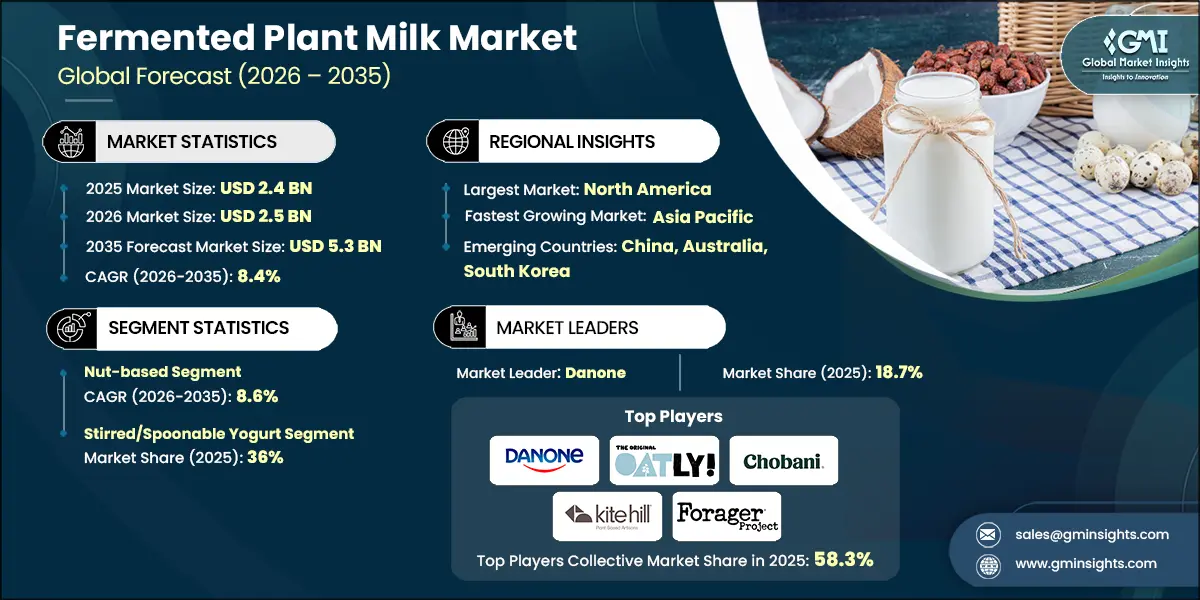
The global fermented plant milk market was valued at USD 2.4 billion in 2025. The market is expected to grow from USD 2.5 billion in 2026 to USD 5.3 billion in 2035, at a CAGR of 8.4% according to latest report published by Global Market Insights Inc.
Fermented Plant Milk Market Key Takeaways
Market Size & Growth
- 2025 Market Size: USD 2.4 Billion
- 2026 Market Size: USD 2.5 Billion
- 2035 Forecast Market Size: USD 5.3 Billion
- CAGR (2026–2035): 8.4%
Regional Dominance
- Largest Market: North America
- Fastest Growing Region: Asia Pacific
Key Market Drivers
- Rising lactose intolerance & dairy allergy prevalence.
- Growing vegan & vegetarian population.
- Increasing demand for probiotic & functional foods.
Challenges
- Higher price point vs. Dairy yogurt.
- Taste & texture challenges.
Opportunity
- Blended plant base formulations.
- Protein-enhanced & fortified products.
Key Players
- Market Leader: Danone led with over market share: 18.7% in 2025.
- Leading Players: Top 5 players in this market include Danone, Oatly, Chobani, Kite Hill, Forager Project, which collectively held a market share of 58.3% in 2025.
Get Market Insights & Growth Opportunities
Fermented plant milk includes various plant-based drinks which have undergone fermentation to produce soy milk, almond milk, oat milk, coconut milk and rice milk with enhanced probiotic content and improved taste and added nutritional value. The products provide health advantages through their improved digestibility which makes them an appealing choice for people who want to avoid conventional dairy products. Lactose intolerance and dairy allergies now affect a greater number of people which leads to significant changes in global consumer preferences. The National Institute of Health reports that around 68% of people worldwide experience some degree of lactose intolerance which results in them choosing plant-based products instead of regular dairy items. Fermented plant milks function as a dairy-free solution which contains probiotics that promote gut health while minimizing allergic reactions.
The increasing number of people who follow vegan and vegetarian diets around the world drives higher market demand. People choose this path because they want to achieve better health results while practicing their ethical values and preserving the environment. Consumers now prefer plant-based dietary options because fermented plant milks deliver these benefits through their nutrient content which includes additional vitamins and minerals and probiotics.
The rising demand for probiotic and functional foods has opened up a major market opportunity for fermented plant milks. Through public health programs multiple countries establish a healthy dietary framework which promotes functional food consumption to create a demand for probiotic products. North America currently leads due to its advanced manufacturing infrastructure and consumer awareness, while Asia Pacific is recognized as the fastest-growing market, driven by increasing health consciousness and urbanization trends.
To get key market trends
Fermented Plant Milk Market Trends
Fermentation technology innovations lead to better quality and taste of fermented plant milks while maintaining their probiotic content. Controlled fermentation environments together with microbial strain optimization enable producers to create products which maintain essential nutrients while delivering constant quality. The advancements in technology create opportunities for developing advanced fermented plant milks which provide better health advantages through increased probiotic diversity and improved nutrient absorption capacity to meet consumer requirements for functional foods.
The market now offers more product choices which include flavored and fortified and functional types of fermented plant milks. Companies introduce products which contain vitamins and minerals and plant extracts to attract health-conscious consumers. The introduction of shelf-stable fermented products together with single-serve packaging solutions meets the demand for convenient products.
Worldwide governments together with regulatory bodies are implementing stricter regulations for organic certification and ingredient traceability and health claim verification. The new regulations require manufacturers to switch to cleaner product labeling methods and organic fermentation methods and non-GMO ingredient usage. The new regulations create consumer trust while supporting the growing demand for natural foods which require minimal processing, which leads to market growth.
Consumers now understand how food ingredients are sourced and processed, which leads them to seek transparent ingredient labeling on clean label fermented plant milks. Government health campaigns together with food safety initiatives power this shift. Brands now focus on minimal processing and natural fermentation methods together with allergen-free products to satisfy changing consumer preferences.
Fermented Plant Milk Market Analysis
Learn more about the key segments shaping this market
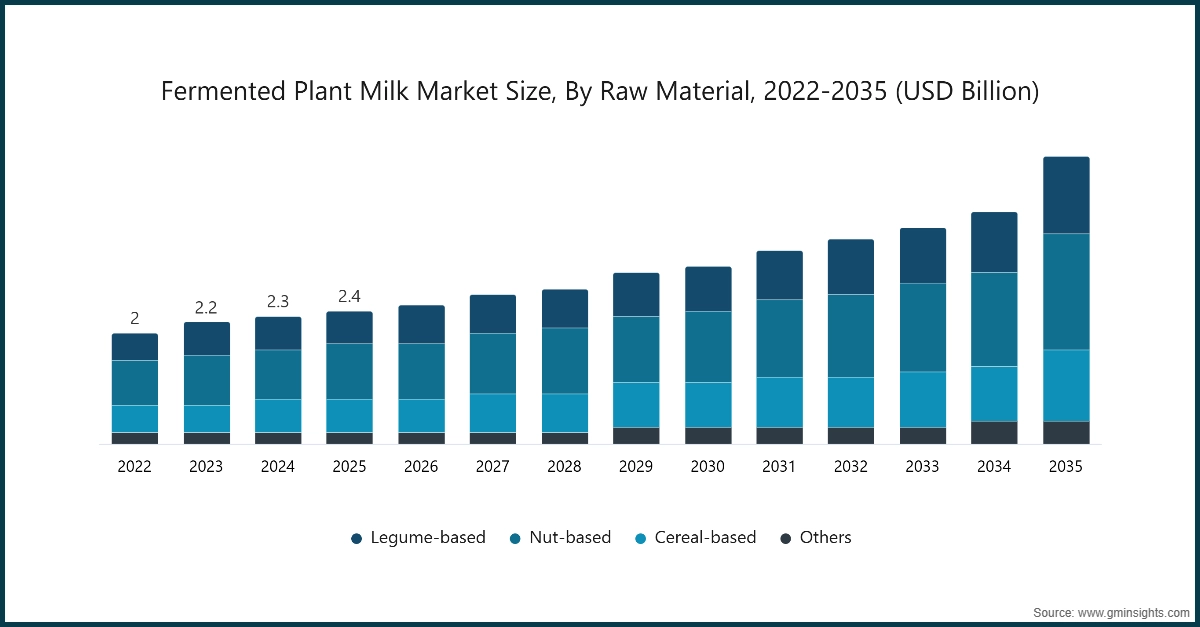
Based on raw material, the market is segmented into legume-based, nut-based, cereal-based and others. Nut-based dominated the market with an approximate market share of 40.2% in 2025 and is expected to grow with a CAGR of 8.6% by 2035.
- Nut-based fermented plant milks currently dominate the segment because they offer exceptional taste and complete nutritional value and people already know about them. The smooth texture of almond and cashew milks combined with their ability to be used in different recipes leads to increased consumption of these milks. Nut-based products receive recognition as high-quality items which results in their manufacturers setting higher prices while they fund research to develop new products that secure their market dominance. The increasing number of people who follow plant-based diets and gluten-free dairy-free diets has made nut-based milks highly popular among health-conscious consumers who prefer this beverage option.
- Cereal-based fermented plant milks, which include oat and rice milk, are becoming more popular because these products offer low prices and their users can drink them safely without experiencing allergic reactions and because these products are easy to find.
- Legume-based fermented plant milks which include soy milk continue to have importance in the market. They provide high protein content at affordable prices which makes them accessible to multiple consumer groups.
Learn more about the key segments shaping this market
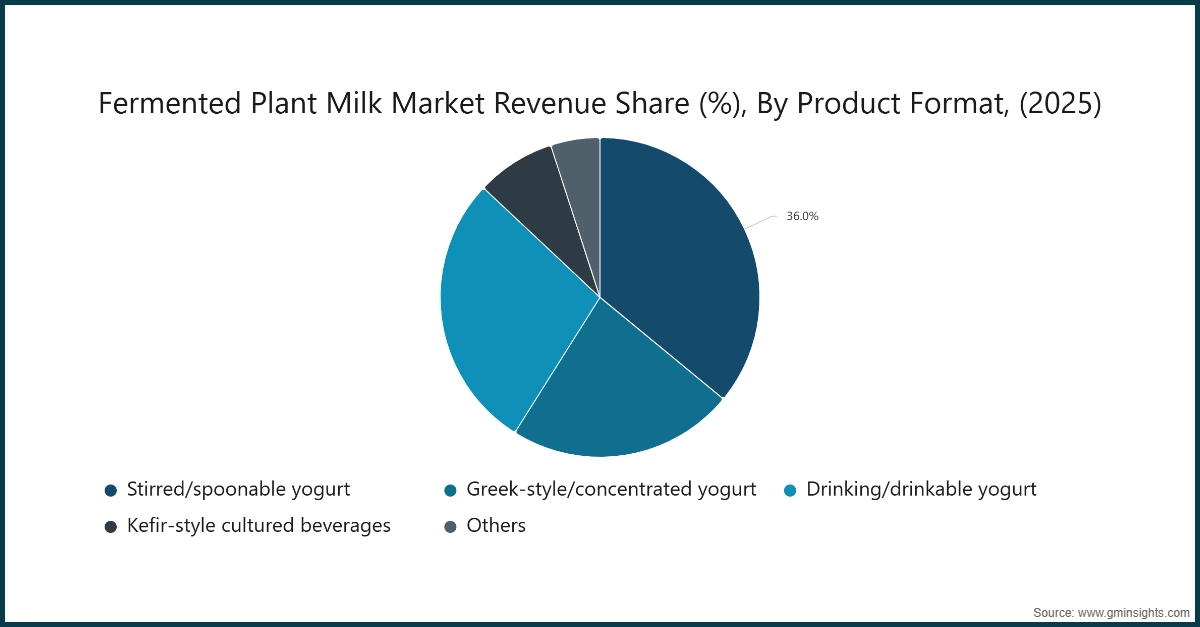
Based on product format, the fermented plant milk market is segmented into stirred/spoonable yogurt, greek-style/concentrated yogurt, drinking/drinkable yogurt, kefir-style cultured beverages and others. Stirred/spoonable yogurt held the largest market share of 36% in 2025.
- The product segment of stirred/spoonable yogurt exists as the leading format because customers choose its creamy texture which they can use for both breakfast and snack purposes. Health-focused buyers prefer its probiotic advantages while its easy use for outdoor activities drives its increasing demand. Functional dairy alternatives with extra nutrients show growing demand because this format allows easy addition of vitamins and probiotics and flavorings which attract wide consumer markets.
- Greek-style/concentrated yogurt is becoming more popular because its thick texture provides higher protein content and people consider it a high-end product. People who want better nutrient-rich food choices who want to lose weight find this product more appealing.
- The market dominance of drinking/drinkable yogurt depends on its practical use which benefits people who lead active lifestyles and need portable food options. The liquid product attracts all age groups through its ability to provide water and immediate nutritional benefits to children and working adults.
- Kefir-style cultured beverages emerged as health trend favorites because they offer probiotic benefits and people enjoy their distinct sour taste. The product attracts health-conscious consumers who want to maintain gut health benefits through its specialty design.
Based on end use, the fermented plant milk market is segmented into direct consumption, culinary/cooking applications, food service/ HoReCa, industrial/ingredient use and others.
- Direct consumption sector dominates because customers prefer ready-to-drink products which provide convenient daily usage options while health trends and flavor requirements and the rising popularity of plant-based diets push customers to select those products.
- The culinary sector experiences growth because people use fermented plant milk to create recipes for smoothies and baked goods while culinary innovation and the demand for nutritious cooking ingredients both drive their increasing usage.
- The food service sector, which includes cafes and restaurants and catering services is experiencing growth because these businesses now use fermented plant milks to create beverages and food items which serve the market need for dairy-free products and special drinks.
- The industrial sector experiences rising demand because manufacturers use fermented plant milks as ingredients for their processed food and snack and functional product lines to meet consumer demand for clean-label products which provide extra nutritional advantages.
Looking for region specific data?
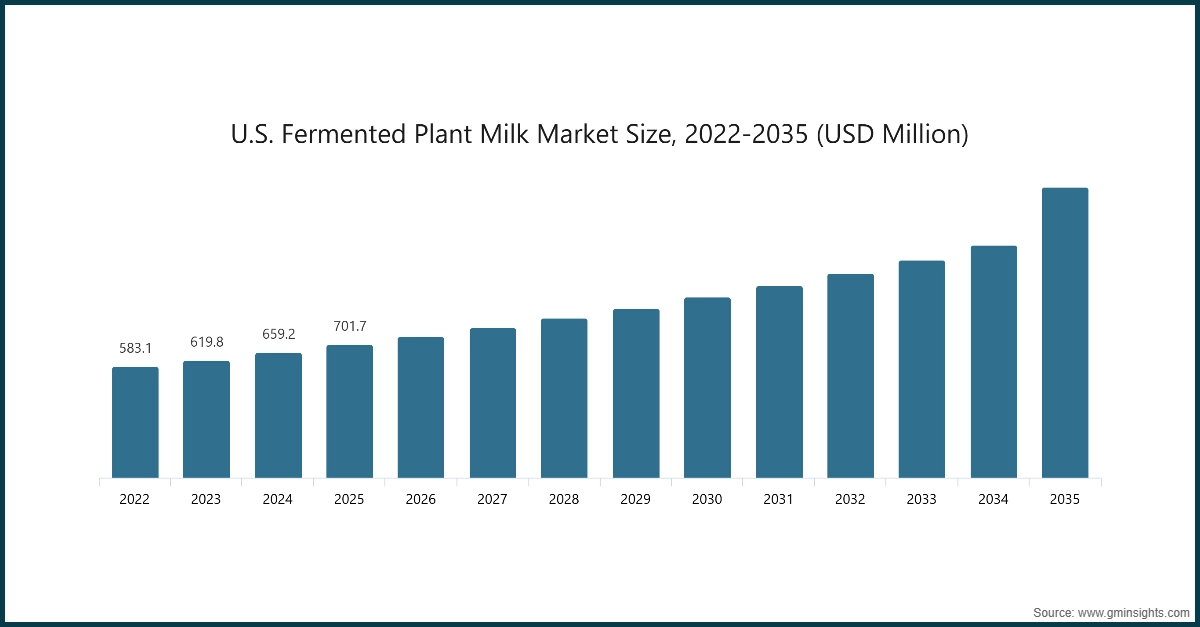
The fermented plant milk market in North America will grow at a CAGR from approximately 8.4% between 2026 and 2035.
- The market expansion is driven by increasing consumer awareness of health benefits and the rising popularity of dairy alternatives which depend on advancements in fermentation technology and flavouring methods.
The fermented plant milk markets in Europe, especially in a few countries like Germany, are expected to grow with a rapid pace in the coming years.
- The rising consumer preference for products that display their ingredients and do not contain allergens and use sustainable materials which meet both health standards and environmental regulations is driving industries to implement green fermentation and processing techniques.
The fermented plant milk market in China and India is expected to have lucrative growth between 2026 and 2035, with CAGR 8.6% in the Asia Pacific region.
- The increasing urban population together with higher disposable incomes is creating a market need for new fermentation technologies and plant-based ingredients which include soy and oat and nut-based fermented milks that can be used in food products and healthcare items and packaging materials.
- The pharmaceutical and nutraceutical sectors require sustainable bio-based processing solutions to develop new manufacturing methods which produce innovative functional products.
Between 2026 and 2035, the market for fermented plant milk in the Middle East is projected to grow significantly during this period.
- The implementation of energy-efficient sustainable fermentation systems results in decreased operating expenses while their utilization extends to the food health and personal care industries which benefit from technological developments in thermal and UV-based extraction processes.
Between 2025 and 2035, a promising expansion of the fermented plant milk sector is foreseen in the Latin America.
- Waste recycling policies and growing environmental awareness lead to the adoption of fermented plant milks in plant-based beverages and functional foods and cosmetics which contributes to sustainable development objectives.
- The food and pharmaceutical and personal care sectors experience growth because of two factors which are the increased demand for eco-friendly fermentation technologies and natural bio-based extracts and the rising disposable incomes together with scientific research.
Fermented Plant Milk Market Share
Fermented plant milk industry is moderately consolidated with players like Danone, Oatly, Chobani, Kite Hill and Forager Project which accounts for 58.3% market share in 2025.
The fermented plant milk market consists of such leading companies operating mostly in their regional areas. Their long years of experience with fermented plant milk have allowed these companies to maintain a strong market position worldwide. Their product offerings are diverse and majorly supported by production capacities and distribution networks, which can serve the increasing demand for fermented plant milk in various regions.
Fermented Plant Milk Market Companies
Major players operating in the fermented plant milk industry includes:
• Califia Farms
• Chobani
• Cocojune
• Daiya Foods
• Danone
• Forager Project
• Harmless Harvest
• Kite Hill
• Lavva
• Oatly
• Siggi's
• So Delicious Dairy Free
Danone provides plant-based fermented products which include plant milks and yogurts while promoting probiotic advantages and clean-label components to health-conscious shoppers.
Oatly develops several fermented oat milk products which include beverages that achieve sustainability targets and excellent flavor and health advantages through their special fermentation methods.
Chobani produces an oat milk range which contains fermented plant-based drinks made from pure ingredients to showcase their probiotic benefits and provide non-dairy health solutions.
Kite Hill produces artisanal products which contain fermented plant-based materials that include almond milk and yogurt while showcasing conventional fermentation methods and plant-based nutritional value.
Forager Project produces organic dairy-free yogurts and drinks which use fermented methods to create products that contain plant-based ingredients which support wellness and sustainable practices.
Fermented Plant Milk Market Report Attributes
| Key Takeaway | Details |
|---|---|
| Market Size & Growth | |
| Base Year | 2025 |
| Market Size in 2025 | USD 2.4 Billion |
| Market Size in 2026 | USD 2.5 Billion |
| Forecast Period 2026-2035 CAGR | 8.4% |
| Market Size in 2035 | USD 5.3 Billion |
| Key Market Trends | |
| Drivers | Impact |
| Rising lactose intolerance & dairy allergy prevalence | Increased consumer shift toward plant-based fermented milk options to avoid dairy-related health issues, expanding market demand globally |
| Growing vegan & vegetarian population | Surge in demand for plant-based fermented milk products as key protein sources, boosting market growth and product innovation |
| Increasing demand for probiotic & functional foods | Heightened consumer interest in probiotic-rich fermented plant milks enhances market expansion and product diversity |
| Pitfalls & Challenges | Impact |
| Higher price point vs. Dairy yogurt | Premium pricing may limit mass-market adoption, constraining volume growth in price-sensitive segments |
| Taste & texture challenges | Consumer preference for appealing taste and texture necessitates technological advancements, impacting product acceptance and market penetration |
| Opportunities: | Impact |
| Blended plant base formulations | Development of innovative blends enhances flavor profiles and nutritional value, attracting broader consumer segments |
| Protein-enhanced & fortified products | Incorporation of extra proteins and nutrients positions fermented plant milks as complete dietary solutions, driving premium product sales |
| Market Leaders (2025) | |
| Market Leader |
Market share: 18.7% |
| Top Players |
Collective market share of top 5 players in 2025: 58.3% |
| Competitive Edge |
|
| Regional Insights | |
| Largest Market | North America |
| Fastest growing market | Asia Pacific |
| Emerging countries | China, Australia, South Korea |
| Future outlook |
|
| Companies covered: | 12 |
| Tables, Charts & Figures: | 220 |
| Countries covered: | 22 |
| No of Pages: | 180 |
What are the growth opportunities in this market?
Fermented Plant Milk Industry News
In July 2023, The PLANTICIOUS project which began at Wageningen University & Research seeks to create new hybrid fermented milk products through the establishment of industrial fermentation methods and custom fermentation strains which will enhance the taste and texture and safety and environmental performance of plant-based dairy products.
In March 2023, Daiya announced its multi-million-dollar commitment to fermentation technology development to create advanced plant-based cheese products which will have improved taste and melting and stretching capabilities through traditional fermentation methods at the Burnaby facility.
This fermented plant milk market research report includes in-depth coverage of the industry, with estimates & forecasts in terms of revenue (USD Billion) and volume (Kilo Tons) from 2022 to 2035, for the following segments:
Market, By Raw Material
- Legume-based
- Soy
- Pea
- Lupin
- Others
- Nut-based
- Almond
- Cashew
- Others
- Cereal-based
- Oat
- Rice
- Others
- Others
Market, By Product Format
- Stirred/spoonable yogurt
- Greek-style/concentrated yogurt
- Drinking/drinkable yogurt
- Kefir-style cultured beverages
- Others
Market, By End Use
- Direct consumption
- Breakfast & snacking
- On-the-go beverages
- Others
- Culinary/cooking applications
- Baking & cooking substitute
- Smoothie base & beverage ingredient
- Others
- Food service/HoReCa
- Hotels, restaurants & cafés
- Bulk packaging
- Industrial/ingredient use
- Bakery & confectionery
- Food manufacturing applications
- Others
The above information is provided for the following regions and countries:
- North America
- U..S.
- Canada
- Europe
- Germany
- UK
- France
- Spain
- Italy
- Rest of Europe
- Asia Pacific
- China
- India
- Japan
- Australia
- South Korea
- Rest of Asia Pacific
- Latin America
- Brazil
- Mexico
- Argentina
- Rest of Latin America
- Middle East and Africa
- Saudi Arabia
- South Africa
- UAE
- Rest of Middle East and Africa
Frequently Asked Question(FAQ) :
What is the fermented plant milk market size in 2025?
The market size for fermented plant milk is valued at USD 2.4 billion in 2025. Increasing consumer preference for plant-based alternatives and rising lactose intolerance are driving market growth.
What is the market size of the fermented plant milk industry in 2026?
The market size for fermented plant milk is projected to reach USD 2.5 billion in 2026, reflecting steady growth driven by demand for functional and probiotic-rich foods.
What is the projected value of the fermented plant milk market by 2035?
The market size for fermented plant milk is expected to reach USD 5.3 billion by 2035, growing at a CAGR of 8.4%. This growth is fueled by innovation in plant-based formulations and increasing adoption of fortified products.
What was the market share of nut-based fermented plant milk in 2025?
Nut-based fermented plant milk dominated the market with an approximate share of 40.2% in 2025. Its popularity is attributed to its nutritional benefits and consumer preference for almond and cashew-based products.
Which product format held the largest market share in 2025?
Stirred/spoonable yogurt held the largest market share of 36% in 2025. Its dominance is driven by its versatility and widespread consumer acceptance.
What is the growth outlook for the North American fermented plant milk market from 2026 to 2035?
The North American market is projected to grow at a CAGR of approximately 8.4% between 2026 and 2035. Increasing demand for plant-based diets and probiotic-rich products is driving this growth.
What are the key trends in the fermented plant milk industry?
Key trends include the development of blended plant-based formulations, protein-enhanced and fortified products, and advancements in taste and texture technologies. Rising consumer interest in functional foods and probiotics is also shaping the market.
Who are the key players in the fermented plant milk market?
Key players include Danone, Oatly, Chobani, Kite Hill, Forager Project, Califia Farms, Cocojune, Daiya Foods, Harmless Harvest, Lavva, and Siggi's. These companies are focusing on product innovation, expanding their portfolios, and meeting the growing demand for plant-based alternatives.
Fermented Plant Milk Market Scope
Related Reports