Summary
Table of Content

Fermentation-Derived Proteins Market
Get a free sample of this report
Form submitted successfully!
Error submitting form. Please try again.
Thank you!
Your inquiry has been received. Our team will reach out to you with the required details via email. To ensure that you don't miss their response, kindly remember to check your spam folder as well!
Request Sectional Data
Thank you!
Your inquiry has been received. Our team will reach out to you with the required details via email. To ensure that you don't miss their response, kindly remember to check your spam folder as well!
Form submitted successfully!
Error submitting form. Please try again.
Fermentation-Derived Proteins Market Size
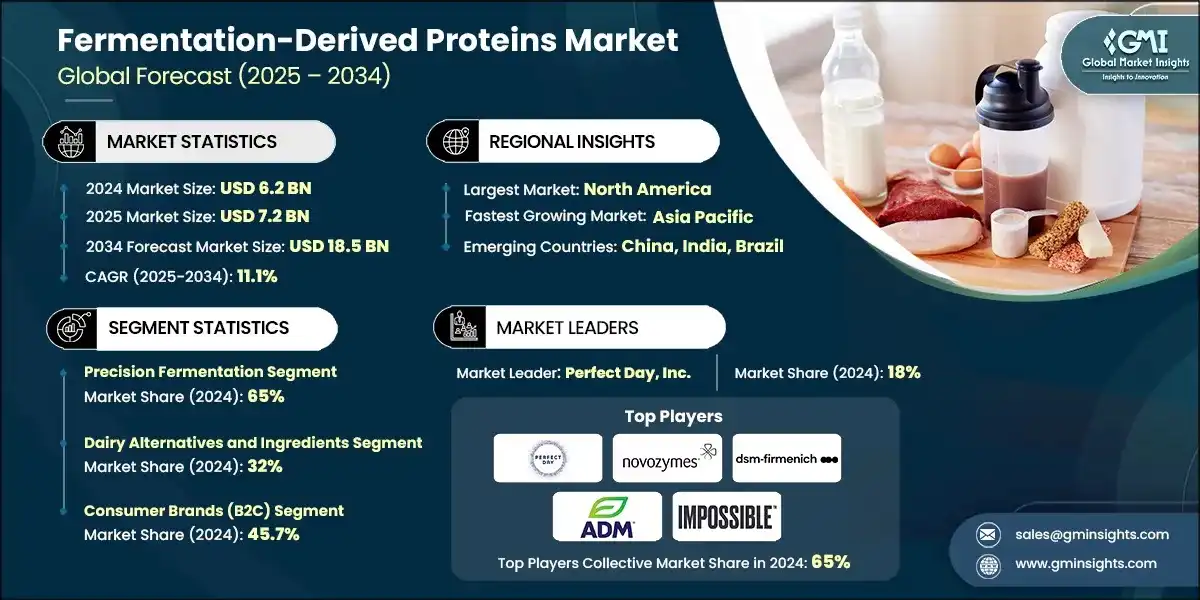
The global fermentation-derived proteins market size was valued at USD 6.2 billion in 2024. The market is expected to grow from USD 7.2 billion in 2025 to USD 18.5 billion in 2034, at a CAGR of 11.1% according to latest report published by Global Market Insights Inc.
Fermentation-Derived Proteins Market Key Takeaways
Market Size & Growth
- 2024 Market Size: USD 6.2 Billion
- 2025 Market Size: USD 7.2 Billion
- 2034 Forecast Market Size: USD 18.5 Billion
- CAGR (2025–2034): 11.1%
Regional Dominance
- Largest Market: North America
- Fastest Growing Region: Asia Pacific
Key Market Drivers
- Growing demand for sustainable, animal-free protein solutions.
- Advances in precision fermentation and strain engineering.
- Strategic partnerships with global food and beverage players.
Challenges
- High production and capital expenditure requirements.
- Regulatory uncertainty and slow approval pathways.
Opportunity
- Rising corporate climate and ESG commitments.
- Untapped potential in emerging markets and applications.
Key Players
- Market Leader: Perfect Day, Inc. led with over 18% market share in 2024.
- Leading Players: Top 5 players in this market include Perfect Day, Inc., Novozymes A/S, DSM-Firmenich, ADM (Archer Daniels Midland), Impossible Foods Inc., which collectively held a market share of 65% in 2024.
Get Market Insights & Growth Opportunities
- Since 2021, the protein economy has become increasingly reliant on cell-fermentation. The increasing pressure on the food industry to decarbonize, and the increasing demand for animal agriculture to be replaced, has accelerated the movement of these food technologies into commercial use for substitutes derived from dairy, meat, and eggs.
- From 2021 to 2024, the momentum surrounding alternative proteins increased rapidly. The Good Food Institute reported that by 2023 there was approximately 14 billion in global investments in alternative proteins, and rapid growth in the fermentation sector. Significant investments have also been made in the scaling of precise fermentation which has increased the facility, strain-engineering, and regulatory processes in North America, Europe, and Asia.
- Investments made in the industry led to the expansion of major players in the market such as Perfect Day, Quorn, and Impossible Foods. Significant collaborations also took place in the form of Nestle, and larger food companies like ADM and DSM-Firmenich. This increased the commercial supply and the industrial integration of food technologies.
- Policies and sustainability discourses also supported the growth. Reports published after 2021 showed that for dairy and meat protein, the fermentation-based alternative has a less negative impact on the environment, including overall greenhouse gas emissions and land use as compared to traditional livestock. These concerns, paired with the recent public discourse on the risks of zoonoses and the antibiotic use, supported the use of fermentation-derived proteins as an asset for policymakers in climate and food-security scenarios.
To get key market trends
Fermentation-Derived Proteins Market Trends
- Developing precision fermentation for dairy and egg alternatives: Businesses are no longer focusing only on basic plant-based formulations. EVERY Company and Perfect Day are examples of brands that are surpassing competitors in the flexibility of their products due to their precision fermentation protein dairy and egg alternatives in ice cream and creamers and whey protein beverages and baking.
- Integration into mainstream CPG and food service channels: Distillate Proteins from Fermentation are Embedded Within Established Brands. Partnerships Show How Major CPGs and QSRs Incorporate These Ingredients to Reformulate and Extend Product Offerings While Keeping Their Market Activities Secret. Perfect Day and Nestle, Heme from Impossible Foods in Burger King, and Quorn with its Injera in established retail outlets, are examples of joint value creation to achieve commercial success.
- Cost increase expenditure on process related innovations in biomanufacturing: One notable trend is the relentless upward scaling of the bioreactor. A number of key players are investing in large (continuous) fermenters, rapid downstream purification, and engineered strains of microorganisms. New facilities are being constructed by Solar Foods, Perfect Day, and Calysta with their contract manufacturing partners, signaling the transition from pilot to commercial.
- Diversification into non-human food fermentation: proteins are entering aquaculture, pet nutrition, and specific nutrition. This illustrated by Calysta with single cell proteins in fish feed and lactoferrin for medical infant nutrition, and Turtle Tree’s microbial proteins in sustainable pet foods. This demonstrates a diversification away from consumers facing solely dairy and meat alternatives.
Fermentation-Derived Proteins Market Analysis
Learn more about the key segments shaping this market
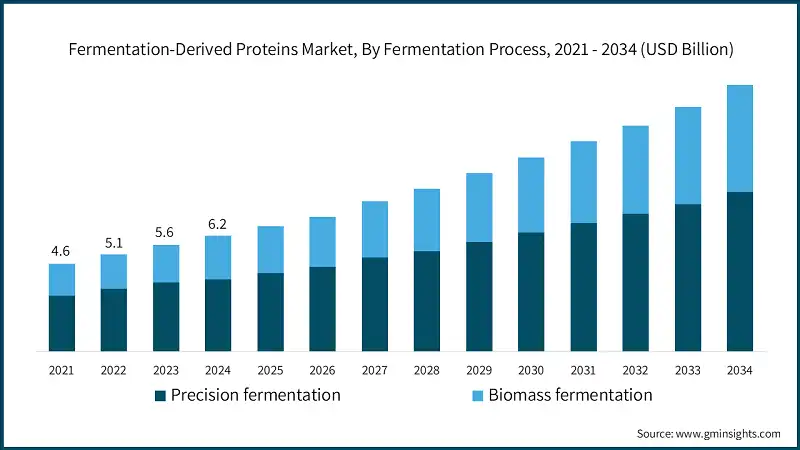
Based on fermentation process, the fermentation-derived proteins market is segments in precision fermentation, biomass fermentation. Precision fermentation dominated the market with an approximate market share of 65% in 2024 and is expected to grow with a CAGR of 10.9% till 2034.
- Businesses focus on integrating highly versatile ingredients into formulations with precision, biomass, and traditional fermentation. Companies aim for dairy and egg analogs with similar foaming, gelling, and melting functionality, as well as versatile, flavor-modulating proteins essential to CPG brands’ reformulations for clean-label differentiation in texture, nutrition, and sensory attributes.
- To achieve necessary cost and scale, companies expand production of mycoprotein, yeast, and gas-fed single-cell proteins in combination with hybrid and fermented plant matrices. Strategic partnerships for capacity, regulatory support, and market reach with contract manufacturers, ingredient behemoths, and leading foodservice companies transform pilot dairy, meat, and egg analogue projects into multi-regional supply contracts.
Based on applications, the fermentation-derived proteins market is segmented into dairy alternatives and ingredients, egg alternatives and functional egg ingredients, meat and seafood alternatives, bakery, confectionery, desserts, beverages and nutrition products, food service and industrial ingredients. Dairy alternatives and ingredients segment dominated the market with an approximate market share of 32% in 2024 and is expected to grow with the CAGR of 8.6% up to 2034.
- In dairy, egg and meat, baked goods, beverages, and industrial uses, business focuses on matching or exceeding the emulsification, foaming, gelling, and melting functionality of animal proteins. To improve texture and nutrition, ease allergen and ingredient lists, and support regulatory compliance, brands covertly add fermentation-derived proteins to ice creams, creamers, sauces, and ready-to-drink beverages.
- Companies are More Focused on Targeting the Food Industry, Industrial Ingredients, and Co-Manufacturing Deals Than They are Targeting Co-Manufacturing Deals Focused on Retail Items. The Industries of Fermentation-Derived Proteins are Now Present on the Menus of Quick Service Restaurants, Private Label Products, and Business-to-Business Systems for Cooking and Baking Desserts. This Expands Volume and Risk and Speeds Up Collaborative Advanced Product Development With Larger Consumer Packaged Goods Companies. They Develop Sustainably and Reliably Functional Proteins.
Learn more about the key segments shaping this market
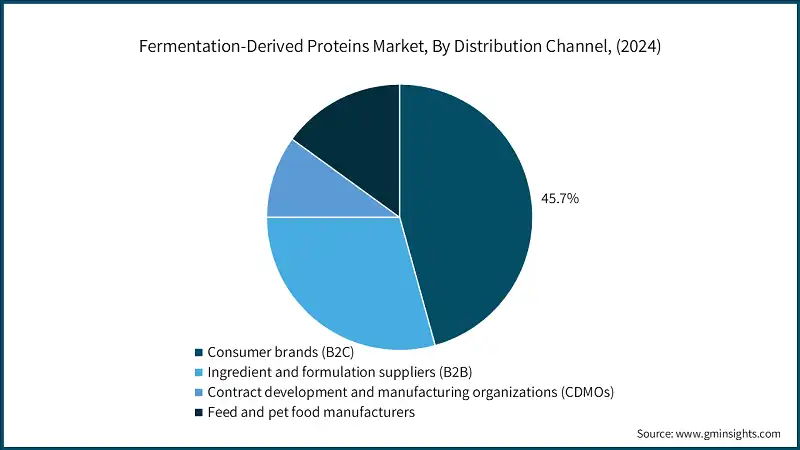
Based on distribution channel, the fermentation-derived proteins market is segmented into consumer brands (b2c), ingredient and formulation suppliers (b2b), contract development and manufacturing organizations, feed and pet food manufacturers. Consumer brands (B2C) segment dominated the market with an approximate market share of 45.7% in 2024 and is expected to grow with the CAGR of 11.6% through 2034.
- Multiple Business Models Combine the Business of Consumer Facing Brands and Their Business of Business Ingredients. They Start with the Business of Consumer Facing Brand Launching Products Such as Ice Creams, Drinks, or Meat Analogs to Illustrate the Brand's Potential Before Moving to the Business of Supplying Proteins and Functional Ingredients to Other Larger Consumer Packaged Goods Companies. This Approach to Business is a Simulation.
- Contract Development and Manufacturing Organizations and Dedicated Biomanufacturing are Becoming More Important for Providing Fermentation Capacity and Optimized Processes. Manufacturers of feed and pet food are increasingly making new microbial proteins for their sustainability and price resilience.
Looking for region specific data?
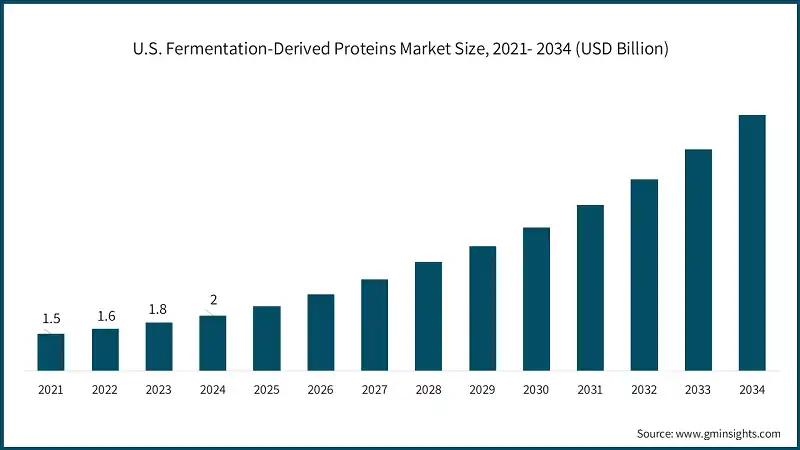
North America dominates the fermentation-derived proteins market in value by USD 2.3 billion in 2024 to USD 6.9 billion in 2034, mainly driven by strong innovation ecosystems and early commercialization. The region benefits from leading precision fermentation players, deep venture funding, and receptive retailers and foodservice channels accelerating adoption across dairy, egg, and meat alternatives.
- The U.S. is the core hub for advanced fermentation-derived protein innovation. With major startups, biomanufacturing infrastructure, and strong CPG partnerships, it leads to regulatory progress, large-scale pilots, and launches of high-value ingredients for beverages, dairy alternatives, and performance nutrition.
Europe is second largest market in value by USD 1.9 billion in 2024 to USD 5.4 billion in 2034, mainly driven by strict sustainability regulations and strong food science capabilities. EU climate targets, clean-label preferences, and established ingredient manufacturers support broad uptake in dairy, bakery, confectionery, and functional nutrition applications.
- Germany is a central engine for Europe’s fermentation-derived proteins landscape. Its strong chemical, biotech, and food-processing base underpins pilot-to-commercial projects, especially for dairy analogues, functional proteins, and specialty nutrition, benefitting from EU-funded research collaborations and sophisticated industrial infrastructure.
Asia Pacific fermentation-derived proteins market is emerging region with value reaching from USD 1.4 billion in 2024 to USD 4.8 billion in 2034, mainly driven by rapid urbanization and rising protein demand. Governments and corporates see fermentation as a strategic tool for food security, prompting investments in regional biomanufacturing hubs and alternative protein platforms.
- China is emerging as a strategic growth engine in Asia Pacific. Expanding middle-class consumption, domestic biotech capacities, and state interest in food resilience promote local production, joint ventures, and technology transfer for dairy alternatives, functional beverages, and feed-related microbial proteins.
Latin America is anticipated to increase from USD 304 million in 2024 to USD 851 million in 2034, mainly driven by sustainable protein diversification. Its strong agricultural base and export orientation foster opportunities to blend fermentation-derived proteins with commodity supply chains in processed foods and ingredients.
- Brazil is the leading Latin American fermentation-derived proteins market. A large food industry, modern retail expansion, and export-focused meat and dairy sectors support early trials of microbial proteins in processed foods, ingredients, and potential feed applications aligned with deforestation and emissions-reduction goals.
MEA is substantially propagating in value from USD 180 million in 2024 to USD 482 million in 2034, mainly driven by food security priorities and high import dependence. Regional initiatives explore advanced protein technologies to reduce vulnerability to supply shocks and strengthen long-term nutritional resilience.
- Saudi Arabia is a key emerging MEA fermentation-derived proteins market. Economic diversification plans, investment in food-tech hubs, and interest in domestic protein production enable pilot projects, collaborations with global players, and gradual integration into niche food, beverage, and specialized nutrition categories.
Fermentation-Derived Proteins Market Share
Perfect Day, Inc., Novozymes A/S, DSM-Firmenich, ADM, and Impossible Foods are major companies of protein from fermentation for not just mix of proprietary, but also, their market application and partnerships within the CPG industries. They have 65% of the market share in 2024 due to their fermentation infrastructure, regulatory expertise, and value-chain partnerships across the continents of North America, Europe, and Asia-Pacific.
- Perfect Day, Inc.: The company is the leader of the market specializing in dairy protein from precision fermentation and is the only company that makes dairy whey and other components for ice cream, creamers, and other B2B products. The estimated market share is 18% and it is the only company that has expanded the market to brand the end products and other ingredients.
- Novozymes A/S: Novonesis is the only company with expertise in enzymes and functionality on fermentation to control the market for ingredients across: bakery, dairy, beverages and for food processing. The estimated market share is 15%, and the only company with fermentation proteins and enzymes bio ingredients for other uses.
- DSM-Firmenich: DSM-Firmenich is a company that integrates nutrition, flavor, and fermentation with the distribution of proteins, enzymes, and specialty ingredients in food, feed, and nutrition markets. It has a chunk of market share equal to 14% of the market. It possesses regulatory and R&D strength, along with broad application support that allows it to embed sustainable, tasteful, and high-performance fermentation-derived proteins in reformulation projects.
- ADM (Archer Daniels Midland): Marketing fermentation and specialty ingredients, and commodity crop marketing, work simultaneously under the company’s large infrastructure to market microbial proteins and other functional components. With an estimated market share of 10%, the company exploits integrated sourcing, a worldwide customer base, and the capacity to create low-cost fermentation-derived proteins with plant systems for scalable responses.
- Impossible Foods Inc.: With an 8% share in fermentation-derived proteins, the company is well known for its meat analogues that use its unique heme ingredient that the company creates using fermentation, a standout product that influences flavor the most. Strong active demand and brand reputation are augmented by the company’s specialized heme in newfound recipes and its growth in fast food and retail markets.
Fermentation-Derived Proteins Market Companies
Major players operating in the fermentation-derived proteins industry include:
- Perfect Day, Inc.
- EVERY Company
- Impossible Foods Inc.
- Nature’s Fynd
- The Better Meat Co.
- Solar Foods Oy
- TurtleTree Labs
- Formo
- Onego Bio
- Standing Ovation
- Quorn Foods
- Givaudan (including Naturals & Ingredients)
- Novozymes A/S
- ADM (Archer Daniels Midland)
- DSM-Firmenich
- Kerry Group
- Cargill
- Corbion
- DuPont (IFF)
- Calysta
Fermentation-Derived Proteins Market Report Attributes
| Key Takeaway | Details |
|---|---|
| Market Size & Growth | |
| Base Year | 2024 |
| Market Size in 2024 | USD 6.2 Billion |
| Market Size in 2025 | USD 7.2 Billion |
| Forecast Period 2025 – 2034 CAGR | 11.1% |
| Market Size in 2034 | USD 18.5 Billion |
| Key Market Trends | |
| Drivers | Impact |
| Growing demand for sustainable, animal-free protein solutions | Accelerates adoption of fermentation-derived proteins across applications |
| Advances in precision fermentation and strain engineering | Improve yields, reduce costs, enable novel protein functionalities |
| Strategic partnerships with global food and beverage players | Expand distribution, validate technology, speed market entry |
| Pitfalls & Challenges | Impact |
| High production and capital expenditure requirements | Limit scale-up, raise entry barriers for smaller innovators |
| Regulatory uncertainty and slow approval pathways | Delay commercialization and cross-border product launches |
| Opportunities: | Impact |
| Rising corporate climate and ESG commitments | Spur procurement of lower-impact proteins for reformulation |
| Untapped potential in emerging markets and applications | Open new revenue streams beyond dairy and meat |
| Market Leaders (2024) | |
| Market Leaders |
18% |
| Top Players |
Collective Market Share of 65% in 2024 |
| Competitive Edge |
|
| Regional Insights | |
| Largest Market | North America |
| Fastest growing market | Asia Pacific |
| Emerging countries | China, India, Brazil |
| Future outlook |
|
What are the growth opportunities in this market?
Fermentation-Derived Proteins Industry News
- In June 2024, Perfect Day announced B2B partnerships with major global dairy and beverage manufacturers, shifting further from consumer brands to ingredients supply. The move strengthens its role as a core precision-fermented whey provider within large-scale reformulation projects.
- In October 2023, DSM-Firmenich launched new fermentation-based dairy and taste-modulating solutions, integrating its protein, enzyme, and flavor portfolios. These offerings target cleaner-label dairy alternatives and improved sensory performance, reinforcing its position as a full-stack partner for CPG reformulation.
- In March 2023, Novonesis advanced its protein and enzyme fermentation platforms through new collaborations with leading food manufacturers. The focus on tailored functional proteins for bakery, dairy, and beverages enhanced its ability to embed fermentation-derived ingredients into mainstream product lines.
- In September 2022, Impossible Foods scaled production of its fermentation-derived heme ingredient to support broader distribution of Impossible Burger and related products. Increased fermentation capacity underpinned additional QSR launches and retail penetration, cementing heme as a cornerstone of its meat-analogue strategy.
This fermentation-derived proteins market research report includes in-depth coverage of the industry, with estimates & forecasts in terms of revenue (USD Billion) and volume (Kilo Tons) from 2025 to 2034, for the following segments:
Market, By Fermentation Process
- Precision fermentation
- Dairy proteins
- Egg proteins
- Functional and specialty proteins
- Flavor and aroma proteins/compounds
- Biomass fermentation
- Mycoprotein
- Yeast- or bacterial-based biomass
- Single-cell protein from gases or unconventional feedstocks
- Traditional / mixed fermentation
- Fermented plant-based protein matrices
- Hybrid fermentation with animal or plant inputs
Market, By Application
- Dairy alternatives and ingredients
- Egg alternatives and functional egg ingredients
- Meat and seafood alternatives
- Bakery, confectionery, and desserts
- Beverages and nutrition products
- Food service and industrial ingredients
Market, By Distribution Channel
- Consumer brands (B2C)
- Ingredient and formulation suppliers (B2B)
- Contract development and manufacturing organizations (CDMOs)
- Feed and pet food manufacturers
The above information is provided for the following regions and countries:
- North America
- U.S.
- Canada
- Europe
- Germany
- UK
- France
- Spain
- Italy
- Rest of Europe
- Asia Pacific
- China
- India
- Japan
- Australia
- South Korea
- Rest of Asia Pacific
- Latin America
- Brazil
- Mexico
- Argentina
- Rest of Latin America
- Middle East and Africa
- Saudi Arabia
- South Africa
- UAE
- Rest of Middle East and Africa
Frequently Asked Question(FAQ) :
What is the market size of the fermentation-derived proteins in 2024?
The market size was USD 6.2 billion in 2024, with a CAGR of 11.1% expected through 2034. The market is driven by the increasing reliance on cell fermentation and the demand for sustainable alternatives to animal agriculture.
What is the projected value of the fermentation-derived proteins market by 2034?
The market is poised to reach USD 18.5 billion by 2034, fueled by advancements in precision fermentation, biomanufacturing innovations, and diversification into non-human food applications.
What is the expected size of the fermentation-derived proteins industry in 2025?
The market size is projected to reach USD 7.2 billion in 2025.
How much revenue did the precision fermentation segment generate in 2024?
The precision fermentation segment generated approximately 65% of the market share in 2024 and is expected to grow at a CAGR of 10.9% through 2034.
What was the valuation of the dairy alternatives and ingredients segment in 2024?
The dairy alternatives and ingredients segment accounted for 32% of the market share in 2024, with a projected CAGR of 8.6% till 2034.
What is the growth outlook for the consumer brands (B2C) segment from 2025 to 2034?
The consumer brands (B2C) segment is set to expand at a CAGR of 11.6% up to 2034, led by increasing adoption of fermentation-derived proteins in mainstream consumer products.
Which region leads the fermentation-derived proteins sector?
North America leads the market, with a valuation of USD 2.3 billion in 2024, will reach USD 6.9 billion by 2034. The region benefits from strong innovation ecosystems, venture funding, and early commercialization of precision fermentation technologies.
What are the upcoming trends in the fermentation-derived proteins market?
Trends include advanced precision fermentation for dairy and egg alternatives, broader CPG and foodservice integration, scaled biomanufacturing, diversification into aquaculture and pet nutrition, and market leadership of precision fermentation.
Who are the key players in the fermentation-derived proteins industry?
Key players include Perfect Day, Inc., EVERY Company, Impossible Foods Inc., Nature’s Fynd, The Better Meat Co., Solar Foods Oy, TurtleTree Labs, Formo, Onego Bio, Standing Ovation, and Quorn Foods.
Fermentation-Derived Proteins Market Scope
Related Reports