Summary
Table of Content

Fermentation-Derived Protein Ingredients Market
Get a free sample of this report
Form submitted successfully!
Error submitting form. Please try again.
Thank you!
Your inquiry has been received. Our team will reach out to you with the required details via email. To ensure that you don't miss their response, kindly remember to check your spam folder as well!
Request Sectional Data
Thank you!
Your inquiry has been received. Our team will reach out to you with the required details via email. To ensure that you don't miss their response, kindly remember to check your spam folder as well!
Form submitted successfully!
Error submitting form. Please try again.
Fermentation-Derived Protein Ingredients Market Size
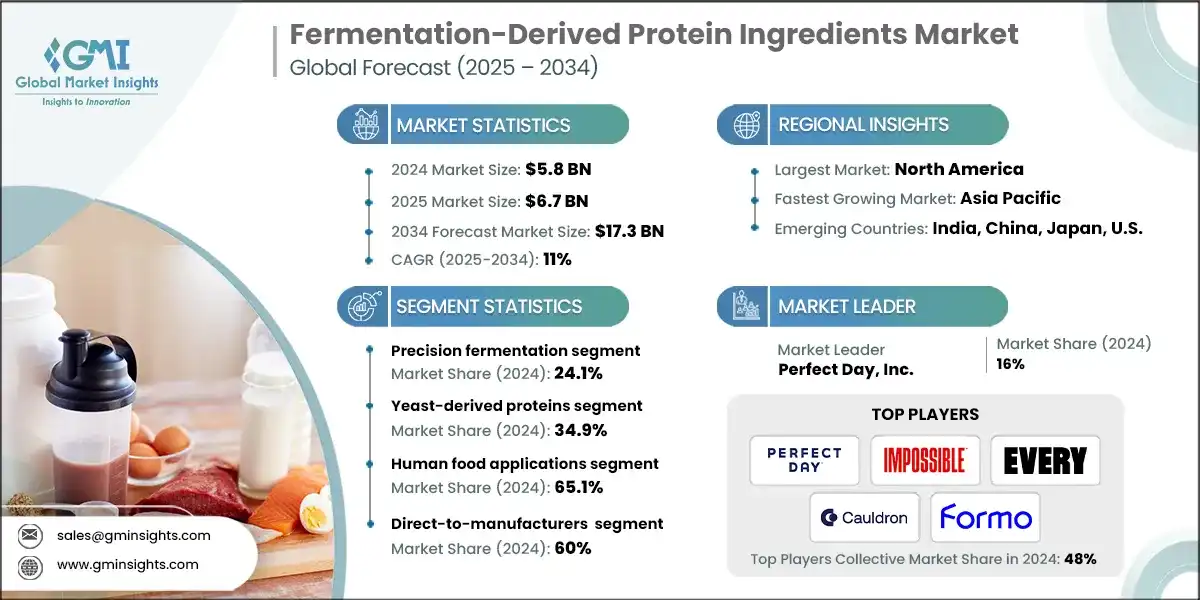
The global fermentation-derived protein ingredients market size was estimated at USD 5.8 billion in 2024. The market is expected to grow from USD 6.7 billion in 2025 to USD 17.3 billion in 2034, at a CAGR of 11% according to latest report published by Global Market Insights Inc.
Fermentation-Derived Protein Ingredients Market Key Takeaways
Market Size & Growth
- 2024 Market Size: USD 5.8 Billion
- 2025 Market Size: USD 6.7 Billion
- 2034 Forecast Market Size: USD 17.3 Billion
- CAGR (2025–2034): 11%
Regional Dominance
- Largest Market: North America
- Fastest Growing Region: Asia Pacific
Key Market Drivers
- Rising vegan and vegetarian population.
- Health and wellness trends.
- Food industry innovation and R&D.
Challenges
- High production costs.
- Regulatory challenges.
Opportunity
- Shift toward sustainable protein sources.
- Innovation in fermentation technologies.
- Integration with plant-based products.
Key Players
- Market Leader: Perfect Day, Inc. led with over 16% market share in 2024.
- Leading Players: Top 5 players in this market include Perfect Day, Inc., Impossible Foods Inc., The EVERY Company, Cauldron, Formo, which collectively held a market share of 48% in 2024.
Get Market Insights & Growth Opportunities
- The fermentation-derived protein ingredients market is increasing due to consumer demand for sustainable, plant-based, and clean-label products. The market is also significant among the alternative protein sources which provide their innovative, scalable, and environmental-friendly protein sources through precision fermentation techniques. These include proteins from microbes, fungi, or engineered microorganisms that are considered highly nutritional and functional equal to conventional animal proteins.
- Some of the specific sustainable aspects of fermentation-derived protein include the significantly fewer land, water, and energy resources requirements for their feedstock inputs as compared with livestock, which thereby reduces the environmental footprint. Fermentation processes under which these proteins are produced ensure consistency, safety, and scalability to meet worldwide food demands. These allow access to the vegan consumers inclined toward plant-based and ethically produced choices. Their functional properties and versatility make them highly valuable in fortification of products with high protein quality, increased shelf life, and enhanced flavor profiles.
- North America is the largest market for fermentation-derived protein ingredients due to advancement in technology and research facilities in U.S. & Canada.
- Asia Pacific is the fastest growing region for fermentation-derived protein ingredients market, due to increasing industrialization, the region can enhance its performance in this market in the coming years.
To get key market trends
Fermentation-Derived Protein Ingredients Market Trends
- The market for protein-based ingredients derived from fermentation is on a fast-transforming track due to international sustainability efforts, health-conscious consumers, and change through technological innovation. Through precision fermentation, it has become possible to manufacture high-purity counterparts of casein, whey, egg white, and heme without resorting to animal scale agriculture. This method imparts far better control over nutritional profiles, taste, and texture to be able to create next-generation food products.
- Advancements in manufacturing include synthetics, biological improvements, and bioprocess optimizations. In addition, organizations are using AI or automation to streamline the fermentation parameters that enhance their productivity and reduce waste.
- The regulatory framework has been changing to recognize these proteins. Countries and their agencies are at the processing level of their approvals while making investments in public research to catalyze innovation. The areas that remain obstacles as regards harmonization of standards are usually those of labeling, consumer acceptance, and set-out conditions in regions.
- Brands are also launching hybrid formulations; fermented proteins combined with plant-based sources to gain improved functional properties. Consumers have been showing preference toward clean-label and minimally processed products, especially in the case of meat and dairy alternatives, snacks, and functional beverages. Fermentation that comes from soy, pea, and rice are becoming more popular due to their digestibility and sustainability.
Fermentation-Derived Protein Ingredients Market Analysis
Learn more about the key segments shaping this market
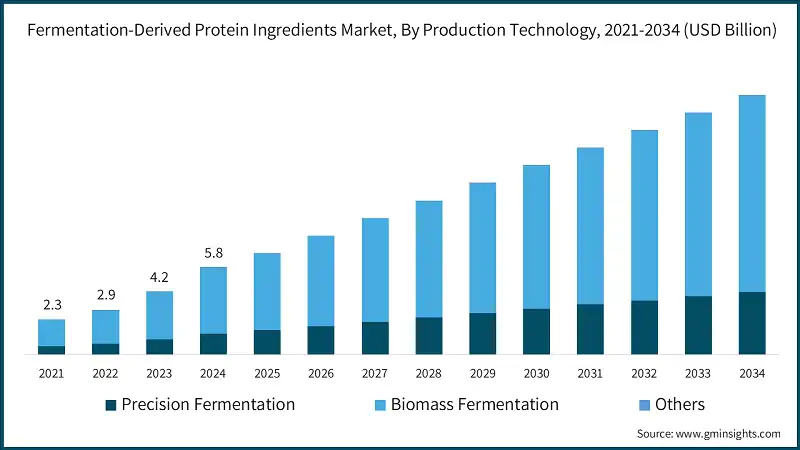
Based on production technology, the fermentation-derived protein ingredients market is segmented into precision fermentation, biomass fermentation, and others.
- Precision fermentation has the most advanced technology and accounts for 24.1% of the market in 2024, with a projected 11.1% CAGR through 2034. The term implies producing specific proteins through manipulation of genetically engineered microorganisms, thus bringing identical proteins from conventional sources. Successful commercialization in such an area includes dairy protein from Perfect Day and egg proteins from The EVERY Company, both of which produced products without animal involvement. Precision fermentation allows customers to achieve control above and beyond the ability to customize functional properties of and nutritional profiles for, and sensory attributes for strictly defined proteins.
- With 75.1%, biomass fermentation makes the most significant share in this respect because of its established commercial viability and capability for scaling up production. It consists of all traditional fermentation approaches where entire microbial biomass acts as a source.
- On the other hand, other technologies project CAGR of about 4.9%. New approaches such as hybrid fermentation systems, different fermentation continuous processes, and novel designs of bioreactors have been termed to fall under this segment. This segment, although small at present, encompasses several potentially important technologies that might develop into larger categories as time advances and commercial viability is approached.
Learn more about the key segments shaping this market
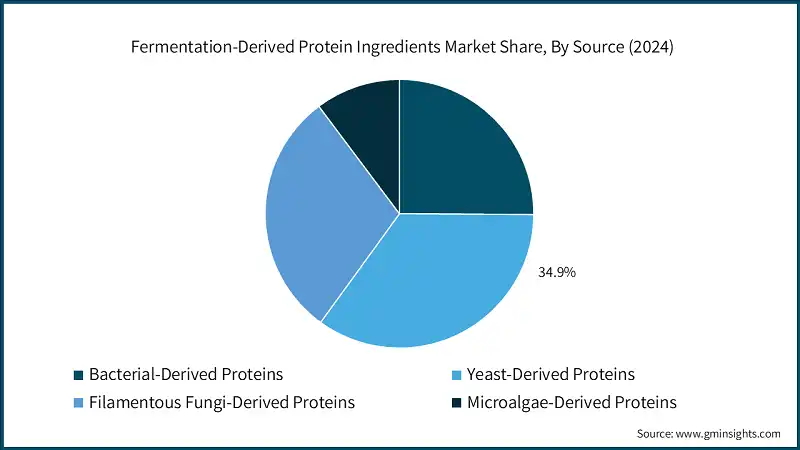
Based on sources, the fermentation-derived protein ingredients market is segmented into bacterial-derived proteins, yeast-derived proteins, filamentous fungi-derived proteins, microalgae-derived proteins.
- Yeast-derived proteins dominate the sources segment with 34.9% market share in 2024. The safety profile, nutritional completeness, and fermentation efficiencies of yeast have made the biggest benefactor for such a huge section of market share. Saccharomyces cerevisiae and other food-level yeasts can produce high-quality proteins having excellent amino acid profiles and functional properties. The segment is growing at a 10.9% CAGR, which means a steadily growing market with applications in food products, nutritional supplements, and animal feed formulations.
- Filamentous fungi-derived proteins have a 29.8% share of the market with 10.7% CAGR, owing to the novel textural development potential of fungi and unique value in nutrition. Fungal proteins, including those derived from Fusarium and Aspergillus species, exhibit fibrous textures that mimic meat products closely and thus are of huge value for plant-based meat alternatives.
- Bacterial-derived proteins account for 25.1% market share with 11.2% CAGR, which considers proteins produced from several bacterial species including Methylococcus capsulatus and altered bacterial strains. This segment includes both time-proven single-cell proteins as well as specifically derived precision fermentation proteins. Among various cell types, that of a bacterium is known to have the best growth rates together with the most significant yields of protein using diverse carbon sources for fermentation.
- Microalgae-derived proteins is the smallest market with a share of 10.2%, implying a significant span of interest in the nutritional values associated with algae and their sustainable production characteristics.
Based on application, the fermentation-derived protein ingredients market is segmented into human food applications, animal feed applications, pharmaceutical applications, cosmetic & personal care applications, others.
- Human food applications dominate with a 65.1% market share in 2024 and an 11.1% CAGR till 2034 and include an array of food categories such as plant-based meats, dairy alternatives, baked goods, beverages, and nutritional products. The growing demand from consumers for sustainable sources of protein, health consciousness, and product innovations from food manufacturers provide major incentives for the growth within this segment.
- Animal feed applications hold 19.5% market share with 10.1% CAGR, serving aquaculture, poultry, swine, and pet food markets. The advantages of fermentation-derived proteins such as consistent quality, lower risk of pathogen infection, and sustainable production chain vs classic feed proteins like fishmeal and soy protein create attractive prospects for the growth of this segment. Growth drivers include increased aquaculture production, a trend toward premium pet food, and the regulatory restrictions placed on conventional feed ingredients.
- Pharmaceutical applications represent 10.2% market share at 11.8% CAGR & include therapeutic proteins; vaccine components & pharmaceutical excipients produced via fermentation. This segment is priced at a premium due to the stringent quality and regulatory requirements.
- Cosmetic & personal care applications have a market share of 3% with an 11.6% CAGR, utilizing fermentation-derived proteins in anti-aging products, hair care formulations, and skin care applications.
Based on distribution channel, the fermentation-derived protein ingredients market is segmented into direct-to-manufacturers, specialty ingredient distributors, contract manufacturing organizations, online platforms, others.
- Direct-to-manufacturers are the clear dominator in the distribution landscape, commanding a staggering 60% market share and an 11% CAGR, defining the chief channel through which fermentation protein ingredient companies sell to major food, feed, and pharmaceutical manufacturers. Perfect Day and The EVERY Company, among others, use direct manufacturer relationships to help integrate their proteins into established production processes while ensuring quality control along the supply chain.
- Specialty ingredient distributors, with 30.1% market share and 11.2% CAGR, come into play as intermediaries between the fermentation protein producers and smaller manufacturers who in many cases may not have direct arrangements with suppliers of ingredients. These distributors provide a variety of services, including inventory management, technical support, and entry into the market for emerging fermentation companies that are eager to seek business beyond the big manufacturers.
- Contract manufacturing organizations (CMOs) account for 5.8% market share with 10% CAGR, allowing companies to outsource production rather than invest in their own fermentation facilities. CMOs are crucial for smaller fermentation companies and especially those concentrating on research and development rather than production activities.
- Online platforms have a 3% market share and 11% CAGR and serve mainly small manufacturers, research institutions, and cases where emerging applications do not find the traditional channel cost-effective. This channel is represented by both B2B e-commerce platforms and specialized ingredient marketplaces facilitating the trade of fermentation-derived proteins.
Looking for region specific data?
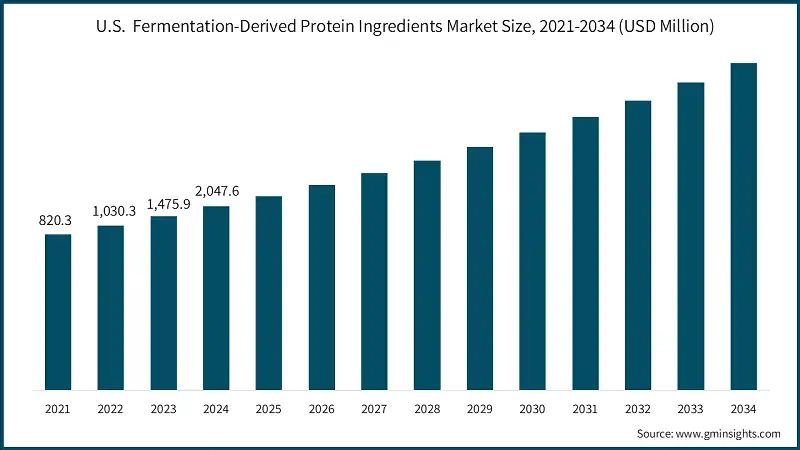
North America accounts for a decent share of the fermentation-derived protein ingredients market with 43.5% of the market share and 11.1% CAGR with US occupying USD 2 billion market size in 2024.
- The North American market for fermentation-derived protein ingredients is growing fast because of the rapidly increasing demand for plant-based protein and sustainable ones among consumers. It is health-related as well as being driven by technological improvements in fermentation processes. This further intensifies the demand caused by the increasing number of vegan and flexitarian diets across the US and Canada. The favorable projection is aided by regulation as well as innovations in clean-label ingredients.
Europe fermentation-derived protein ingredients market accounted for USD 1.7 billion in 2024 and is anticipated to show lucrative growth over the forecast period.
- Europe is underlined by strong characteristics related to sustainability and clean-label products. Therefore, such factors in the countries of Europe are driving demand for plant proteins from fermentation since consumers know the environment and animal welfare are constellations of effects. Germany, the UK, and France are among the innovators and adopters of products wherein stringent rules and direction toward natural ingredients influence the trends in the marketplace, and organic and non-GMO products are increasingly preferred.
The Asia Pacific fermentation-derived protein ingredients market is anticipated to grow at the CAGR of 11.4% during the analysis timeframe.
- The Asia Pacific region has shown enormous growth rates due to health concerns and the increase in numbers of vegetarians. Key markets turning to such rapid growth include China, Japan, and India, which are predominantly traditional practices of consuming food yet still increasingly seen in urbanization. Local fermentation technologies combined with collaboration from developed global players enhance the market expansion. The affordability rates of the region, along with diverse culinary applications, further boost demand.
Latin America fermentation-derived protein ingredients market accounted for 5.1% market share in 2024 and is anticipated to show lucrative growth over the forecast period.
- Emerging opportunities for Latin America are showcased through fermentation-based proteins that continue to be promoted with increasing health awareness coupled with changing consumer demands towards plant-based diets. The emerging potential of Latin America is that supported by the growing food processing industries in the region and favorable government initiatives to develop the market, the evolving infrastructure and regulatory frameworks are still contributing to market development.
Middle East & Africa fermentation-derived protein ingredients market accounted for 1.5% market share in 2024 and is anticipated to show lucrative growth over the forecast period.
- The MEA region is emerging in market growth, although currently there is rising interest in health and wellness trends. However, limited infrastructure as well as awareness presents challenges but nevertheless, increasing urbanization and disposable income are gradually opening more opportunities for the market. South Africa and GCC countries are looking into fermentation-based proteins with the goal of ensuring food security and sustainability while also catering to the growing health-conscious population.
Fermentation-Derived Protein Ingredients Market Share
The top 5 companies in the fermentation-derived protein ingredients industry include Perfect Day, Inc., Impossible Foods Inc., The EVERY Company, Cauldron, Formo. These are prominent companies operating in their respective regions covering 48% of the market share. These companies hold strong positions globally due to their experience in fermentation-derived protein ingredients market. Their diverse product portfolios, backed by robust production capabilities and distribution networks, enable them to meet the rising demand across various regions.
- Perfect Day has positioned themselves as pioneers in the production of fermentation-made proteins and artificial dairy proteins using its proprietary fermentation technologies. Collaborations with critical food and beverage organizations further fortify their place in the market, but still they are put through the trial to face high production costs.
- Impossible Foods has made a name for themselves with their plant-based meat products. However, they have recently been dabbling with protein ingredients derived from fermentation to support quality and sustainability. These are good as brand recognition, substantial R&D efforts, and grand conceptual use of hem proteins ensure their high shelf placement in the market.
- EVERY is in the business of producing sustainably derived healthy protein for food applications. It involves transparency, health status, and application in a wide range of food and beverage products.
- Cauldron is company with unique technology that fermented biomass. It has come to wider knowledge within the plant-based/alternative protein realm by staying on the sustainable side, focusing on nutrition and versatility.
- Formo is a growing player within the market for fermentation-derived proteins, where the major focus lies in producing dairy proteins via microbial systems, which are both animal-free and highly sustainable.
Fermentation-Derived Protein Ingredients Market Companies
Major players operating in the fermentation-derived protein ingredients industry include:
- Cauldron
- Formo
- Impossible Foods Inc.
- Nature's Fynd
- Onego Bio
- Perfect Day, Inc.
- ScaleUp Bio
- Solar Foods Oy
- Standing Ovation
- The Better Meat Co.
- The EVERY Company
- TurtleTree Labs
Fermentation-Derived Protein Ingredients Market Report Attributes
| Key Takeaway | Details |
|---|---|
| Market Size & Growth | |
| Base Year | 2024 |
| Market Size in 2024 | USD 5.8 Billion |
| Market Size in 2025 | USD 6.7 Billion |
| Forecast Period 2025 - 2034 CAGR | 11% |
| Market Size in 2034 | USD 17.3 Billion |
| Key Market Trends | |
| Drivers | Impact |
| Rising vegan and vegetarian population | Increasing adoption of plant-based diets boosts demand for alternative protein sources like fermentation-derived proteins. |
| Health and wellness trends | Consumers seeking clean-label, non-GMO, and allergen-free protein ingredients prefer fermentation-based options for their nutritional benefits. |
| Food industry innovation and R&D | Continuous research and development efforts are expanding the applications of fermentation-derived proteins in various food and beverage products. |
| Pitfalls & Challenges | Impact |
| High production costs | The fermentation process can be expensive, making the final products costlier compared to traditional protein sources. |
| Regulatory challenges | Evolving and sometimes uncertain regulatory frameworks for novel food ingredients can hinder market entry and expansion. |
| Opportunities: | Impact |
| Shift toward sustainable protein sources | Increasing consumer demand for environmentally friendly and sustainable protein options, driven by concerns over traditional livestock farming's environmental impact. |
| Innovation in fermentation technologies | Advancements in microbial fermentation processes, including precision fermentation, to produce high-quality, scalable protein ingredients. |
| Integration with plant-based products | Growing use of fermentation-derived proteins as functional ingredients in plant-based foods to improve texture, taste, and nutritional profile. |
| Market Leaders (2024) | |
| Market Leaders |
16% Market share |
| Top Players |
Collective Market Share 48% in 2024 |
| Competitive Edge |
|
| Regional Insights | |
| Largest Market | North America |
| Fastest growing market | Asia Pacific |
| Emerging countries | India, China, Japan, U.S. |
| Future outlook |
|
What are the growth opportunities in this market?
Fermentation-Derived Protein Ingredients Industry News
- In December 2024, The EVERY Company has been awarded an EU patent for its recombinant ovalbumin product by The EVERY Company (EVERY), a biotech company focused on fermentation-based protein ingredients. This extends EVERY's intellectual property (IP) portfolio to a new significant market along with its previous patents in the U.S.A., Finland, Germany, Denmark, and the U.K.
- In February 2024, Nestlé and Fonterra launched new animal-free and lactose-free precision fermentation-derived protein products. This is really indicative of the trends among the big players in the market moving toward declining-sustained alternative proteins, as it shows that fermentation technology is being adopted more and more into the mainstream food manufacturing processes as direct responses to consumer needs for more ethical and plant-based alternatives.
This fermentation-derived protein ingredients market research report includes in-depth coverage of the industry, with estimates & forecasts in terms of revenue (USD Billion) and volume (Kilo Tons) from 2025 to 2034, for the following segments:
Market, By Production Technology
- Precision fermentation
- Biomass fermentation
- Others
Market By Sources
- Bacterial-derived proteins
- Yeast-derived proteins
- Filamentous fungi-derived proteins
- Microalgae-derived proteins
Market By Application
- Human food applications
- Dairy alternative proteins
- Meat alternative & enhancement
- Egg alternative protein
- Functional food & beverage
- Nutritional supplement
- Animal feed applications
- Livestock feed supplement
- Aquaculture protein
- Pet food ingredient
- Specialty animal nutrition
- Pharmaceutical applications
- Therapeutic protein production
- Nutraceutical & medical nutrition
- Cosmetic & personal care applications
- Functional protein
- Anti-aging & skin care
- Hair care product
- Others
Market By Distribution Channel
- Direct-to-manufacturer
- Specialty ingredient distributors
- Contract manufacturing organizations (CMOS)
- Online platforms
- Others
The above information is provided for the following regions and countries:
- North America
- U.S.
- Canada
- Europe
- Germany
- UK
- France
- Spain
- Italy
- Rest of Europe
- Asia Pacific
- China
- India
- Japan
- Australia
- South Korea
- Rest of Asia Pacific
- Latin America
- Brazil
- Mexico
- Argentina
- Rest of Latin America
- Middle East and Africa
- Saudi Arabia
- South Africa
- UAE
- Rest of Middle East and Africa
Frequently Asked Question(FAQ) :
What is the market size of the fermentation-derived protein ingredients in 2024?
The market size was USD 5.8 billion in 2024, with a CAGR of 11% expected through 2034. The growth is driven by increasing demand for sustainable, plant-based, and clean-label products.
What is the projected value of the fermentation-derived protein ingredients market by 2034?
The market is poised to reach USD 17.3 billion by 2034, fueled by advancements in precision fermentation and rising consumer preference for alternative protein sources.
What is the expected size of the fermentation-derived protein ingredients industry in 2025?
The market size is projected to reach USD 6.7 billion in 2025.
What was the market share of precision fermentation in 2024?
Precision fermentation accounted for 24.1% of the market in 2024, with a projected CAGR of 11.1% through 2034. This technology enables the production of specific proteins using genetically engineered microorganisms.
What was the market share of yeast-derived proteins in 2024?
Yeast-derived proteins dominated the sources segment with a 34.9% market share in 2024, attributed to their safety profile, nutritional completeness, and fermentation efficiency.
What is the growth outlook for human food applications from 2025 to 2034?
Human food applications, which held a 65.1% market share in 2024, are set to expand at a CAGR of 11.1% til 2034. This segment includes plant-based meats, dairy alternatives, baked goods, beverages, and nutritional products.
Which region leads the fermentation-derived protein ingredients sector?
North America leads the market with a 43.5% share in 2024. The U.S. alone accounted for a market size of USD 2 billion in 2024, led by consumer demand for sustainable protein sources and technological advancements.
What are the upcoming trends in the fermentation-derived protein ingredients market?
Key trends include precision fermentation growth, hybrid protein blends, AI-optimized bioprocessing, and rising demand for clean-label, minimally processed products.
Who are the key players in the fermentation-derived protein ingredients industry?
Key players include Cauldron, Formo, Impossible Foods Inc., Nature's Fynd, Onego Bio, Perfect Day, Inc., ScaleUp Bio, Solar Foods Oy, Standing Ovation, The Better Meat Co., The EVERY Company, and TurtleTree Labs.
Fermentation-Derived Protein Ingredients Market Scope
Related Reports