Summary
Table of Content

Eyelash Serum Market
Get a free sample of this report
Form submitted successfully!
Error submitting form. Please try again.
Thank you!
Your inquiry has been received. Our team will reach out to you with the required details via email. To ensure that you don't miss their response, kindly remember to check your spam folder as well!
Request Sectional Data
Thank you!
Your inquiry has been received. Our team will reach out to you with the required details via email. To ensure that you don't miss their response, kindly remember to check your spam folder as well!
Form submitted successfully!
Error submitting form. Please try again.
Eyelash Serum Market Size
The market is also experiencing a major shift due to the increasing interest of consumers in natural beauty care, the efficiency of product development, and the growing focus of the industry on sustainability. Major brands are also diversifying their product lines, using clean formulas, and working on sustainable packaging. As a result, eyelash serums have become a popular alternative to lash extensions and falsies, as they provide consumers with a low-maintenance solution that fits well into their self-care routine and need for natural-looking beauty. Compared to salon extensions, which are expensive, time-consuming, and produce waste, eyelash serums are a more economical and sustainable alternative. This trend also helps the industry make a transition to ethical beauty and sustainable product development.
Eyelash Serum Market Key Takeaways
Market Size & Growth
- 2025 Market Size: USD 767 Million
- 2026 Market Size: USD 820 Million
- 2035 Forecast Market Size: USD 1.67 Billion
- CAGR (2026–2035): 8.3%
Regional Dominance
- Largest Market: North America
- Fastest Growing Region: Asia- Pacific
Key Market Drivers
- Rising consumer preference for non-invasive beauty solutions.
- Clean beauty and sustainability movement.
- Digital influence and social commerce.
Challenges
- Safety concerns and regulatory compliance.
- Counterfeit products and brand integrity risks.
Opportunity
- Expansion into emerging markets.
- Product innovation through multi-functional formulations.
Key Players
- Market Leader: L’Oréal led with over 6% market share in 2025.
- Leading Players: Top 5 players in this market include L’Oréal, LVMH, Shiseido, E.l.f. Cosmetics, RevitaLash, which collectively held a market share of 38% in 2025.
Get Market Insights & Growth Opportunities
The North American market is also one of the most prominent markets in the industry, the high level of beauty awareness, advanced e-commerce infrastructure, and fast adoption of new technologies by consumers. On the other hand, the European and Asia-Pacific markets are also gaining strength due to the mature beauty industry, growing spending on cosmetic products, and increasing e-commerce infrastructure. In the global market, the digitalization of the beauty industry has become a major driver. These trends have solidified serums as a staple in both premium and mass‑market beauty assortments.
As consumers and retailers increasingly focus on convenience and disruption-free experiences, eyelash serums have proven to be a great fit for the modern beauty routine. With simple at-home application, subscription and replenishment services, and strong digital content performance, serums continue to gain popularity with consumers. Clean beauty positioning, ingredient disclosure, and dermatologically safe positioning further boost consumer confidence. These factors, combined with strong digital demand and geographic distribution expansion, ensure steady financial performance across the category.
Innovation is playing a pivotal role in determining the market’s future course. Formulators are now moving towards peptide complexes, botanicals, and hydrating ingredients such as hyaluronic acid to ensure effective performance while maintaining a gentle, non-irritating profile. Peptide-centric solutions are particularly appealing to consumers who are avoiding prostaglandin-based serums due to possible sensitivity issues. At the same time, beauty brands are leveraging AI-powered recommendation engines, skin analyzers, and personalized product matching solutions, further boosting digital engagement and helping to drive higher customer lifetime value.
The trend of digital-first beauty consumption is further fueling the demand for eyelash serums. Online channels provide high product visibility, strong social reviews, and quick trend sharing, making serums highly sensitive to influencer marketing. Regulatory factors are a key determinant in defining product positioning as well as consumer expectations. In the United States, there is only one approved eyelash growth product, which is bimatoprost, and it is approved as a drug for lash enhancement. All other serums, which are positioned as cosmetics, have to follow very strict guidelines for safety, transparency, and claims substantiation. This has led to a situation where manufacturers are promoting clean formulations, transparent disclosure of ingredients, and conservative marketing claims to maintain consumer trust.
The clean label movement is driving the industry towards peptide serums, botanical formulas, and formulas for sensitive eyes. With growing awareness about the potential irritation caused by certain active ingredients, consumers are increasingly turning towards serums that claim to nourish, prevent lash breakage, and promote healthy growth cycles without irritation. At the same time, manufacturers are working on optimizing delivery systems, applicator technology, and preservative systems to ensure safety and efficacy. Overall, the market is poised to gain from a favorable set of trends, including growing consumer interest in natural enhancement, improved digital commerce infrastructure, clean label innovation, and sustainable manufacturing practices.
The global eyelash serum market was estimated at USD 767 million in 2025. The market is expected to grow from USD 820 million in 2026 to USD 1.67 billion in 2035 at a CAGR of 8.3% according to latest report published by Global Market Insights Inc.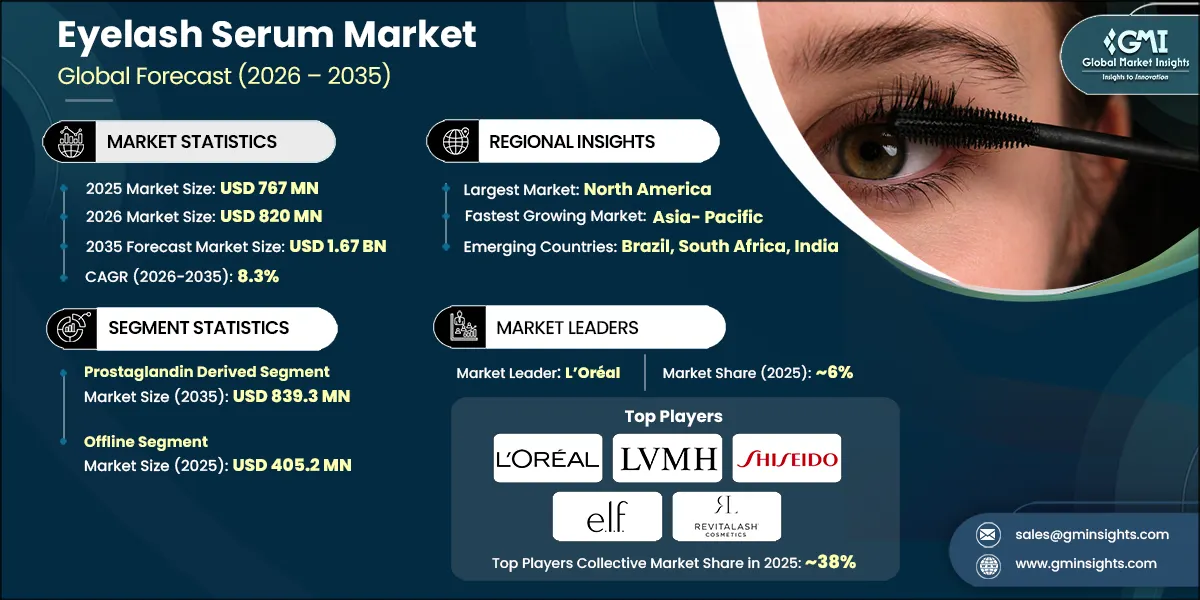
To get key market trends
Eyelash Serum Market Trends
The eyelash serum industry is growing as consumers' awareness of beauty increases and they begin to follow beauty trends through social media. Many consumers want an easier option when it comes to applying mascara and other cosmetics, so they use eyelash serums because they are non-invasive. Products created with a natural, clean, and cruelty-free formula are aligning with consumers' desire to lead a more sustainable and healthier lifestyle.
Digitalization has also been a significant contributor to the market's growth through its e-commerce platform where influencers promote products. The use of AI for personalized products and peptide technology innovations have improved the effectiveness of the product, as well as enhancing the consumer's confidence in purchasing and using the product. The research findings show that the market represents a combination of all three elements that are driving beauty trends: self-care, convenience, and technology, allowing the eyelash serum to become part of global beauty routines.
- The rise of the clean beauty movement is changing the way people view the eyelash serum industry. There is a growing emphasis on safety, transparency, and sustainability among shoppers purchasing eyelash serums. Many buyers now take into consideration what goes into creating products that will be applied near sensitive areas such as their eyes. This has resulted in an increase in demand for eyelash serums that do not contain parabens, sulfates, or synthetic fragrances. As a response to this demand, there are now many brands offering formulations with added benefits such as plant-based extracts, organic oils, and naturally derived peptides to support lash health while still being effective.
- Additionally, many consumers are now looking for cosmetics that are certified cruelty-free and vegan, and this is especially true for younger consumers, who want to support ethical practices. The combination of regulatory pressure and consumer advocacy for eco-friendly packaging continues to reinforce the clean beauty field, as this is not only a common preference among consumers but is also becoming a normal expectation in both premium and mass-market varieties of beauty products.
- The development of new technologies has evolved the industry for eyelash serum; it has grown exponentially. As a result of the use of technology, especially when it comes to the customization of eyelash serums, there has been an increase in growth. Beauty brands are now able to create customized product recommendations for everyone based on their unique lash characteristics, their individual goals, and their lifestyles because of the use of artificial intelligence (AI) tools, and augmented reality (AR) software systems. Through virtual try-ons and diagnostic Apps, many are able to see what potential results from a purchase will look like, thus increasing the likelihood that they will purchase an expensive serum.
- In addition to providing greater confidence and less hesitation about a high-priced serum, the tech-driven innovations have created new opportunities for subscription models whereby companies analyze user-generated data to create recommendations on when to reorder and what additional products to use. By innovating with the combination of scientific developments and technology-based marketing, beauty companies are able to enhance their customer satisfaction while creating a greater long-term loyalty base in a highly dynamic and constantly evolving marketplace.
- Social media is at the heart of beauty marketing, and eyelash serums are among the most popular types of beauty products marketed through social media. Influencers and beauty bloggers use social media to share dramatic before and after images to create an emotional response in consumers, which encourages impulse buying.
Eyelash Serum Market Analysis
Learn more about the key segments shaping this market
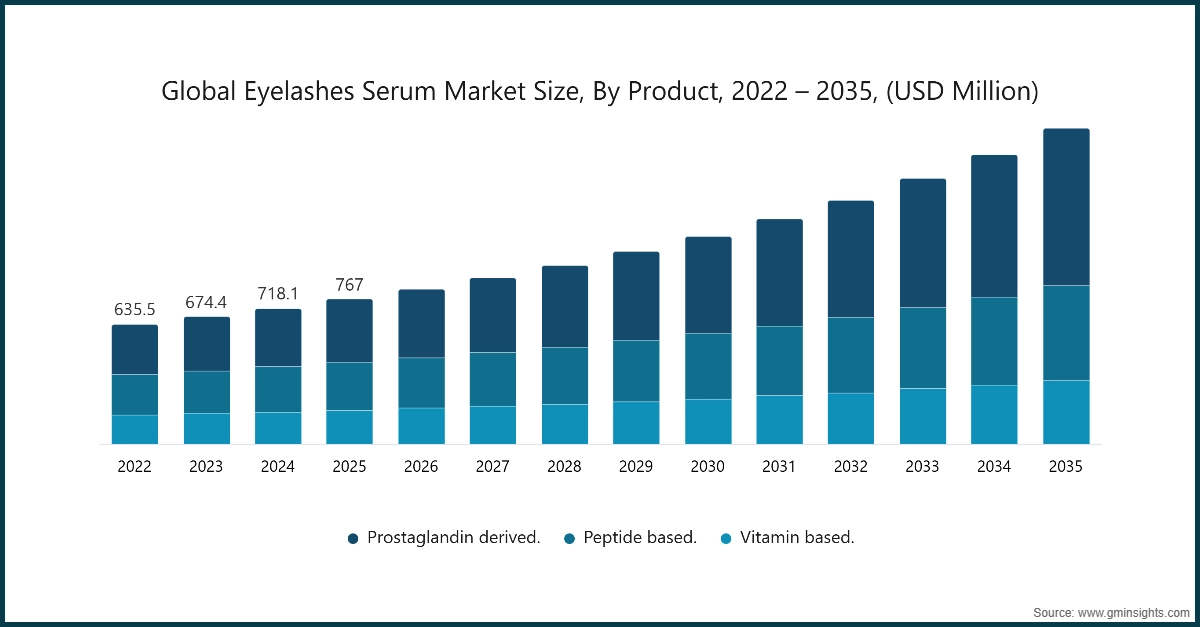
Based on the product type, the eyelash serum market is segmented into prostaglandin derived, peptide based, and vitamin based. The prostaglandin derived segment leads the market and was valued at USD 364.2 million in 2025 and is projected to reach USD 839.3 million by 2035.
- The eyelash serum category has been dominated by prostaglandin derivatives due to their overall superior performance compared to other types of eyelash serums that use alternative ingredients (such as peptides and vitamins) that work to condition and strengthen eyelashes but do not provide the dramatic or rapid results associated with prostaglandins.
- Prostaglandins are the most effective ingredient and have clinical proof that they extend and maintain the length of the growth (anagen) phase within the hair growth cycle; hence, they produce longer, thicker and darker eyelashes than any other product. When consumers want to enhance the length, volume, and pigmentation (like seen with wearing mascara), they will prefer products with prostaglandin over those containing peptides or vitamins; therefore, there is a high demand for prostaglandin-derived serums among beauty lovers and those experiencing eyelash loss.
- The prostaglandin‑derived segment dominates the global eyelash serum market due to its clinically visible, potent lash‑growth effects. These formulations often deliver faster and more dramatic improvements in lash length, density, and darkness compared with other segments, positioning them as the premium‑performance tier of the category. Consumers seeking results comparable to professional treatments (such as extensions) tend to gravitate toward prostaglandin‑based serums, strengthening demand within this segment.
- The peptide‑based serum segment is gaining strong momentum as consumer preferences shift toward cleaner, safer, and non‑hormonal alternatives. Peptides serve as conditioning and strengthening agents that support keratin production, helping lashes appear fuller and more resilient over time.
- Brands increasingly position peptide‑based serums as gentle, ophthalmologist‑tested, and suitable for long‑term use, attracting users who prefer subtle enhancement without potential irritation
Learn more about the key segments shaping this market
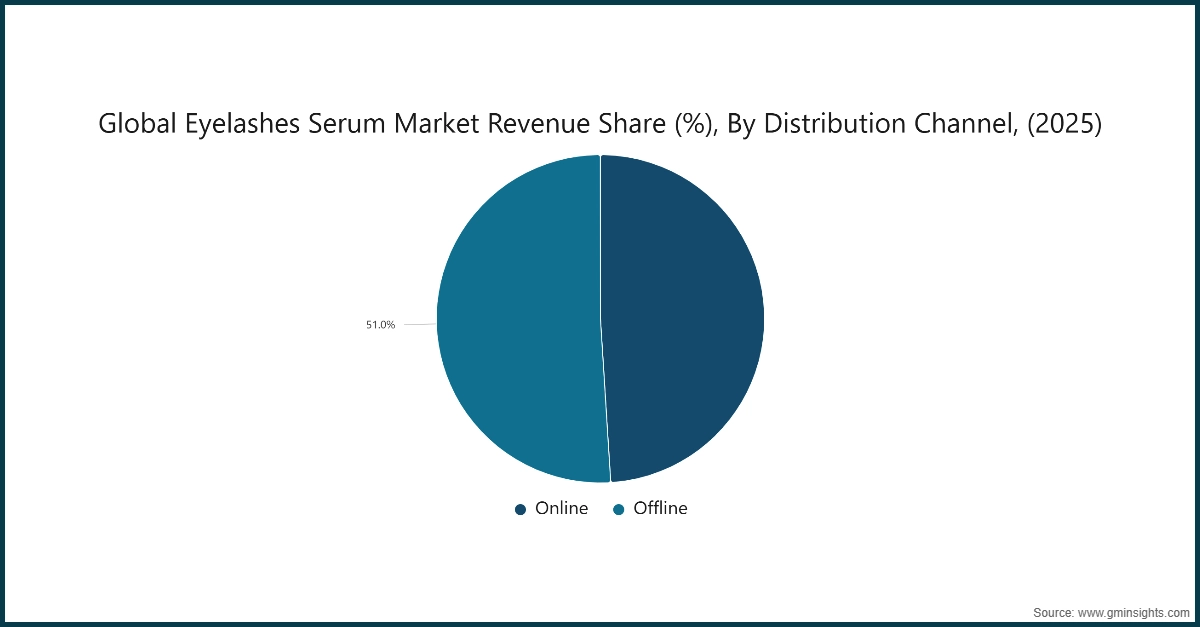
The eyelash serum market by distribution channel is segmented into online and offline. The offline segment was the leading segment in this market in 2025 with a revenue of USD 405.2 million and has a market share of around 50%.
- The offline segment held the leading market position in 2025, generating USD 405.2 million and accounting for around 50% of the total market share. Its dominance is reinforced by the strong presence of hypermarkets, supermarkets, specialty beauty stores, and pharmacies, which remain essential points of purchase for beauty shoppers.
- Offline channels benefit from high consumer trust, particularly for products applied near the eyes, as many consumers prefer in‑person evaluation, ingredient inspection, and expert consultation before purchase.
- In general, consumer trust and experience play a major role in the continued prosperity of offline sales channels, specifically regarding the purchase of eyeliner/eyelash serums. Eyelash serums contain ingredients that are used very close to the eye area, so consumers seek product assurance regarding safety and legitimacy.
- Thus, consumers prefer to verify product quality and availability, perform a check on the product expiration date, as well as consult with beauty advisors, prior to purchasing products from online retailers.
North America Eyelash Serum Market
Looking for region specific data?
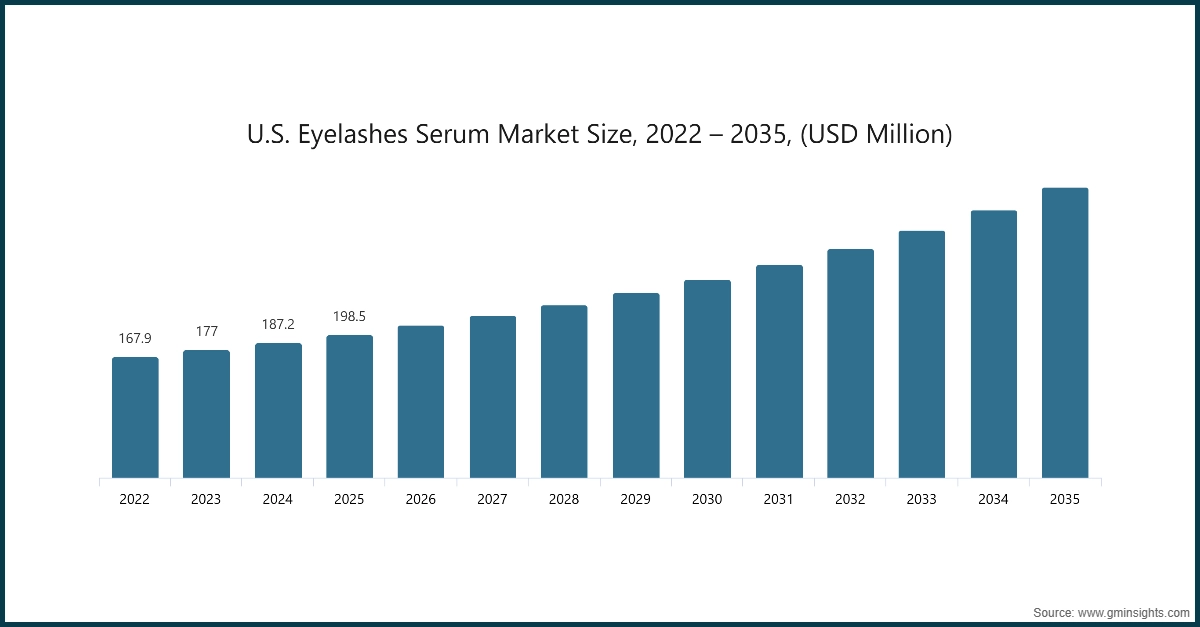
The U.S. eyelash serum market was valued at around USD 198.5 million in 2025 and is anticipated to register a CAGR of 7.5% between 2026 and 2035.
- With its large economy and the customers' willingness to spend on luxury items, the U.S. leads the North American eyelash serum industry. Personal consumption in the U.S. for beauty products, with a broad range depending on the economic class, continues to increase, with consumers eager to look their best by using items like eyelash serum.
- The Bureau of Labor Statistics reports nearly 10% increase from last year to this year for each household's personal care expenditures, which indicates a tremendous demand for specialized beauty categories, including lash care, based on the current cultural emphasis on beauty and pop culture's influence of non-surgical enhancements.
- Creators and influencers drive growth in eyelash serum sales in the U.S. because of the rapid adoption of digital media by consumers. According to the Quarterly Retail E-Commerce sales report published by the Census Bureau, the ecommerce market penetration exceeds 16% of all retail sales. Beauty products are among the fastest-growing segments within ecommerce. Eyelash serum serves as one of these items that consumer purchase via the internet, taking advantage of social media tutorials and endorsements.
- Strengthening U.S. dominance in the eyelash serum category are the new regulatory modernization and advanced infrastructure within its industry. The FDA Modernization of Cosmetics Regulation Act (MoCRA) requires higher safety and labeling requirements for eyelash serums greatly increasing consumer trust due to the close proximity of these types of products to sensitive areas of the body, such as the eye. In addition, U.S. manufacturing hubs and exports provide U.S. companies with reliable sources of supply and offer a competitive advantage internationally.
- U.S. companies have also established sophisticated production clusters in key states that provide substantial economic benefits. As a result of these added benefits and other factors, such as an increasingly high level of disposable income, advances in digital technology, and the regulatory support provided by MoCRA, the United States is not only the largest, but also the fastest growing eyelash serum market throughout North America.
Asia Pacific Eyelash Serum Market
The Asia Pacific eyelash serum industry was valued at around USD 164.9 million in 2025 and is anticipated to register a CAGR of 9.7% between 2026 and 2035.
- Asian-Pacific has been able to expand at a fast rate compared with other parts of the world. The IMF has predicted that Asia-Pacific will have the highest rate of GDP growth and by 2020 will contribute to more than 60 percent of total GDP growth. Increased incomes and the level of urbanization are among the many factors driving the growth within Asia-Pacific.
- Countries such as India and China have implemented policies and launched programs that will stimulate consumer demand. For example, the 14th Five-Year Plan in China is focused on increasing the variety and quality of consumer goods available to consumers. In India, the Production Linked Incentive (PLI) Scheme and the Start Up India initiatives are designed to develop and increase local manufacturing and innovation in the beauty and personal care products sectors. These structural changes and the rapid growth of the Middle Class and Digital Inclusion efforts provide an ideal environment for the growth of Beauty and Cosmetics demand.
- Cultural trends and digital transformation are driving the continued rise in eCommerce and cross-border digital trade across Southeast Asia by increasing the rate at which consumers are adopting online channels for beauty products through online platforms like Amazon and eBay, which are now becoming the preferred method of purchasing beauty products in Southeast Asia.
- Regulatory frameworks that promote halal certification and clean beauty standards align with the growing demand for safe and ethical products from consumers in Southeast Asia. Japan's official survey of household expenditures has shown an ongoing increase in the amount spent on personal care and beauty products, demonstrating that premium products have gained popularity in mature markets. Meanwhile, the National Medical Products Administration (NMPA) in China created a fast-tracked approval mechanism for innovative cosmetic materials, enabling quicker introduction of new products into the marketplace.
Europe Eyelash Serum Market
Europe was valued at around USD 191.7 million in 2025 and is anticipated to register a CAGR of 9.7% between 2026 and 2035.
- Germany leads the European market for beauty and personal care products as the largest beauty and personal care market in the EU, consisting of 83.6 million people and generating one-fourth (1/4) of the GDP for the EU. Its economic power provides high purchasing power and a desire for new and premium-priced products in Germany's economy. The German Federal Statistical Office reports that private household expenditures averaged $3,000 per month ($36,000 per year) in 2024, with consumer spending in discretionary categories such as personal care showing resilience in the face of current economic challenges. Germany's social market economy, characterised by economic stability and confidence, allows for continued product demand even during times of weak growth.
- In Germany, cultural and structural factors increase the demand for cosmetic and eyelash serum products. The German government reports show that the retail market is well-organized but fragmented, with drug stores and e-commerce being the main sales channels. Furthermore, Increasingly German Consumers prefer quality and sustainability regarding their Cosmetic products; these trends are consistent with legislation requiring high levels of safety for cosmetic products.
Eyelash Serum Market Share
- The top 5 companies in the eyelash serum industry, such as L’Oréal, LVMH, Shiseido, E.l.f. Cosmetics, and RevitaLash hold a market share of 35%.L’Oréal's business strategy is heavily focused on diversifying its product range and innovating new products. The primary source of funding for this is the significant amount that L’Oréal invests in research and development each year. This has enabled L’Oréal to develop a wide range of technologically advanced products, including products that are defined by your skin (personalized skincare) and AI-based technology to provide a more direct connection between consumers and L’Oréal brands.
- Along with the continually improving e-commerce capabilities, L’Oréal has further strengthened the way that it interacts with customers through the creation and implementation of social media and influencer marketing strategies. The additional revenue generated through the purchase of niche brands in clean beauty and dermocosmetics will continue to support L’OREAL in keeping up with the latest trends, despite increasing competition in the marketplace.
- LVMH's main focus is to maintain exclusivity and a luxury position within the beauty market. As such, LVMH is not typically able to compete directly on a price basis with other brands. To further strengthen its position in the luxury beauty market, LVMH regularly releases limited edition products to increase the desirability and scarcity of its products, in addition to its flagship and experiential retail locations. The company's ability to successfully combine its heritage and innovation (for example, through the introduction of sustainable packaging and premium skincare lines) has kept it at the forefront of the luxury beauty industry.
- Shiseido has focused primarily on growing in Asia by using science to create skincare products. Consumers who are health conscious appreciate that Shiseido offers high quality products developed through dermatological testing, (i.e.: “skin test”), which supports Shiseido's continued ability to dominate the Asia Pacific region. Currently, Shiseido has added new channels to reach customers in Asia, especially through worldwide e-commerce expansion. The use of eco-friendly packaging and ‘clean’ formulations supports Shiseido's continued success by creating unique products that set Shiseido apart from many other brands in the highly competitive global market by maintaining the perception of a premium brand.
Eyelash Serum Market Companies
Major players operating in the eyelash serum industry are:
- Allergan (AbbVie)
- Benefit Cosmetics
- DHC
- Dior
- E.l.f. Cosmetics
- Grande Cosmetics
- JB Cosmetics
- L'Oréal
- Mavala
- Neora
- RapidLash
- RevitaLash
- Shiseido
- Skin Research Laboratories
- Uklash
e.l.f. has built a business around value; they take a digital first approach to their marketing strategy. Their products are priced affordably, but they maintain high quality, appealing to both Gen Z and Millennial consumers alike. The company takes advantage of social media virality and influences collaborations by launching trend-driven products quickly in order to capitalize on market buzz. Additionally, e.l.f.'s strong TikTok presence and commitment to cruelty-free and vegan product formulations align with the values of younger audiences and allow them to successfully compete against both legacy as well as indie brands.
RevitaLash has established themselves by focusing on a niche market and having specialized expertise in lash and brow care, a growing category within the beauty industry. Their strategy is focused on clinically proven formulas and a premium brand image which is being endorsed by dermatologists. RevitaLash has further developed their distribution channel through expanding their partnerships with professional salons and their direct-to-consumer channels offering access to RevitaLash products while keeping a level of exclusivity. With this focus on a smaller, high-margin segment, coupled with their educational efforts on their brands, RevitaLash is poised to compete against larger, more well-known beauty companies.
Eyelash Serum Market Report Attributes
| Key Takeaway | Details |
|---|---|
| Market Size & Growth | |
| Base Year | 2025 |
| Market Size in 2025 | USD 767 Million |
| Market Size in 2026 | USD 820 Million |
| Forecast Period 2026-2035 CAGR | 8.3% |
| Market Size in 2035 | USD 1.67 Billion |
| Key Market Trends | |
| Drivers | Impact |
| Rising consumer preference for non-invasive beauty solutions | This trend is accelerating global demand for eyelash serums as consumers shift from salon-based treatments to convenient, at-home lash enhancement products. |
| Clean beauty and sustainability movement | Brands embracing eco-friendly formulations and ethical practices are gaining premium positioning worldwide, driving higher adoption among health-conscious and environmentally aware consumers. |
| Digital influence and social commerce | Social media-driven marketing and influencer endorsements are fueling rapid global penetration of eyelash serums, making online platforms the dominant growth channel across regions. |
| Pitfalls & Challenges | Impact |
| Safety concerns and regulatory compliance | Stringent regulations and consumer apprehension over potential side effects are slowing product approvals and limiting market expansion globally. |
| Counterfeit products and brand integrity risks | The rise of fake eyelash serums in online channels undermines consumer trust and damages brand reputation, reducing overall market growth potential. |
| Opportunities: | Impact |
| Expansion into emerging markets | Rapid urbanization, rising disposable incomes, and growing beauty consciousness in regions like Asia-Pacific, Latin America, and the Middle East present untapped potential for eyelash serum brands. |
| Product innovation through multi-functional formulations | Developing eyelash serums that combine lash growth benefits with additional features such as conditioning, anti-breakage, and nutrient infusion aligns with consumer demand for multifunctional beauty products. |
| Market Leaders (2025) | |
| Market Leader |
Market share of ~6% |
| Top Players |
Collective market share ~38% |
| Competitive Edge |
|
| Regional Insights | |
| Largest Market | North America |
| Fastest growing market | Asia- Pacific |
| Emerging countries | Brazil, South Africa, India |
| Future outlook |
|
What are the growth opportunities in this market?
Eyelash Serum Industry News
- In April 2025, Estée Lauder launched turbo lash night revitalizing serum for lashes and brows, featuring a thickening complex with 16 amino acids, rice protein, panthenol, and hyaluronic acid. This product helps Estée Lauder expand its prestige eye care portfolio, complement its mascara offerings, and compete in the premium lash conditioning segment with clinically tested formulations.
- In January 2025, L'Oréal Paris launched its first-ever lash-boosting serum called "clinically proven lash serum," enriched with castor oil, vitamin B5, filoxane, and hyaluronic acid to strengthen and reinforce lashes. This launch helps L'Oréal Paris penetrate the growing eyelash serum category, diversifying its eye makeup portfolio and capturing market share in the lash enhancement segment with accessible pricing.
- In August 2024, Galderma signed a memorandum of understanding with L'Oréal to pursue an R&D scientific partnership focused on developing advanced dermatology technologies, with L'Oréal also acquiring a 10% stake in Galderma. This partnership helps Galderma accelerate innovation in skin aging solutions and jointly develop new products using complementary technologies, potentially expanding both companies' dermatology and beauty portfolios including premium lash care products.
- In April 2024, RevitaLash advanced eyelash serums became available for purchase in California after resolving a private lawsuit, ending a decade-long absence. This expansion helps Revitalash recapture the lucrative California market, strengthen its U.S. distribution network, and increase revenue from one of the largest beauty markets globally.
The eyelash serum market research report includes in-depth coverage of the industry, with estimates & forecasts in terms of revenue (USD Million) and volume (Thousand Units) from 2022 to 2035, for the following segments:
Market, By Product Type
- Prostaglandin derived
- Peptide based
- Vitamin based
Market, By End-user
- Women
- Men
Market, By Price
- Low
- Medium
- High
Market, By Distribution Channel
- Online
- E-Commerce website
- Company owned website
- Offline
- Department stores
- Pharmaceutical stores
- Beauty salons
The above information is provided for the following regions and countries:
- North America
- U.S.
- Canada
- Europe
- Germany
- U.K.
- France
- Italy
- Spain
- Asia Pacific
- China
- Japan
- India
- South Korea
- Australia
- Latin America
- Brazil
- Mexico
- Argentina
- MEA
- UAE
- Saudi Arabia
- South Africa
Frequently Asked Question(FAQ) :
What was the market size of the eyelash serum in 2025?
The market was valued at USD 767 million in 2025, with a CAGR of 8.3% expected through 2035. The market growth is driven by increasing consumer interest in natural beauty care, advancements in product development, and a focus on sustainability.
What is the projected value of the eyelash serum market by 2035?
The market is poised to reach USD 1,678.7 million by 2035, fueled by clean beauty trends, technological innovations, and the rising demand for sustainable and cruelty-free products.
What is the expected size of the eyelash serum industry in 2026?
The market size is projected to reach USD 820 million in 2026.
How much revenue did the prostaglandin-derived segment generate in 2025?
The prostaglandin-derived segment generated USD 364.2 million in 2025 and is expected to grow significantly, reaching USD 839.3 million by 2035.
What was the valuation of the offline segment in 2025?
The offline segment led the market with a revenue of USD 405.2 million in 2025, capturing approximately 50% of the market share.
What is the growth outlook for the U.S. eyelash serum sector from 2026 to 2035?
The U.S. market, valued at USD 198.5 million in 2025, is anticipated to expand at a CAGR of 7.5% up to 2035.
What are the upcoming trends in the eyelash serum market?
Key trends include clean beauty growth, AI-based personalization, peptide innovations, sustainable packaging, social media influence, virtual try-ons, and subscription models.
Who are the key players in the eyelash serum industry?
Major players include Allergan (AbbVie), Benefit Cosmetics, DHC, Dior, E.l.f. Cosmetics, Grande Cosmetics, JB Cosmetics, L'Oréal, Mavala, Neora, RapidLash, and RevitaLash.
Eyelash Serum Market Scope
Related Reports