Summary
Table of Content

eVTOL Cabin Interior Market
Get a free sample of this report
Form submitted successfully!
Error submitting form. Please try again.
Thank you!
Your inquiry has been received. Our team will reach out to you with the required details via email. To ensure that you don't miss their response, kindly remember to check your spam folder as well!
Request Sectional Data
Thank you!
Your inquiry has been received. Our team will reach out to you with the required details via email. To ensure that you don't miss their response, kindly remember to check your spam folder as well!
Form submitted successfully!
Error submitting form. Please try again.
eVTOL Cabin Interior Market Size
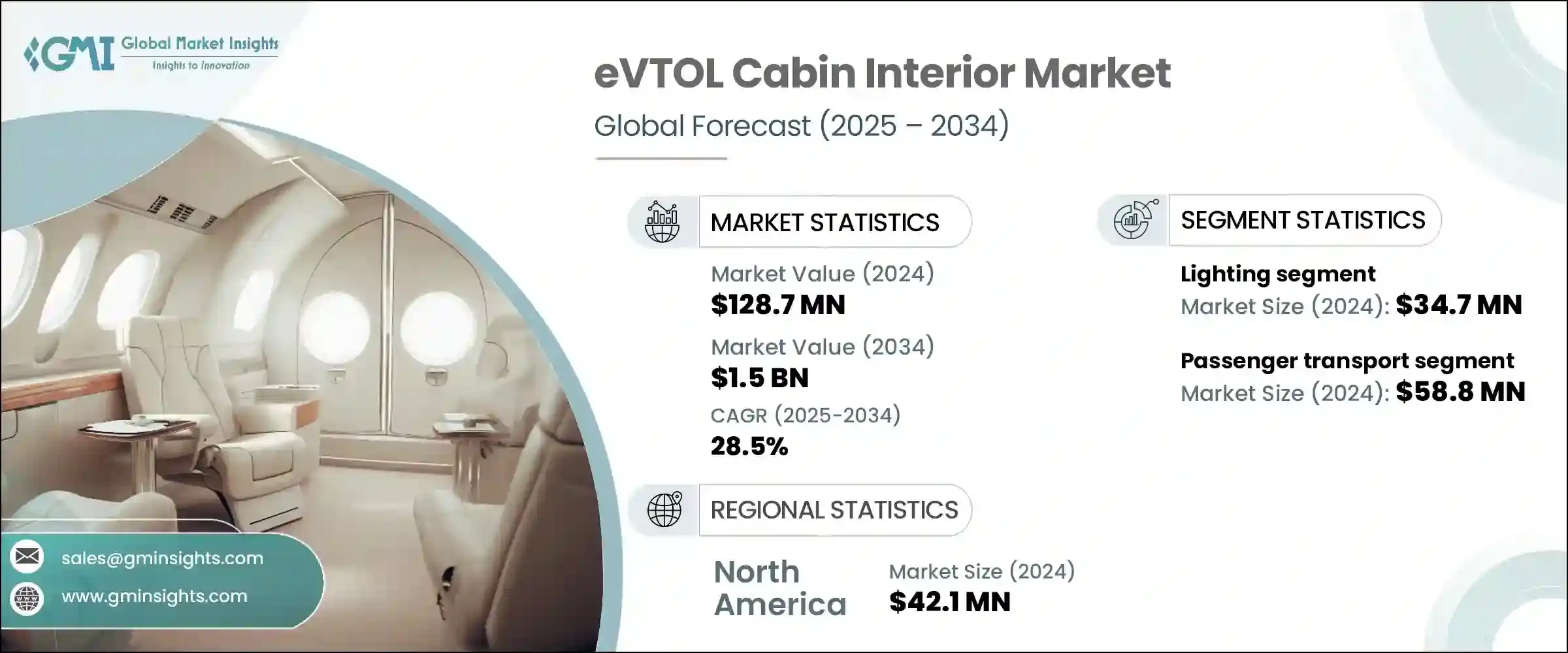
The global eVTOL cabin interior market was estimated at USD 128.7 million in 2024. The market is expected to grow from USD 161 million in 2025 to USD 534.8 million in 2030 and USD 1.5 billion by 2034, at a CAGR of 28.5% during the forecast period of 2025–2034.
To get key market trends
- The growth of eVTOL cabin interior market is attributed to factors such as urban congestion and need for efficient mobility, increasing focus on passenger comfort and safety, advancements in lightweight materials, rising investments and strategic partnerships, and growing luxury & customization demand.
- Rising urban congestion in the major cities is encouraging government and tech companies to explore urban air mobility as a viable solution for short distance, on demand transportation. eVTOLs are gaining rapid traction, which offers vertical take off and landing capabilities that can further bypass ground level traffic entirely.
- With eVTOLs moving closer to the commercial deployment, especially in urban air mobility services, passengers are increasingly prioritizing safety & comfort. This trend is fuelling the demand for ergonomic seating, low vibration interiors, effective noise insulation, advanced climate control, and clearly visibility safety features such as emergency lighting and restraint systems.
- Weight reduction is one of the critical factors in eVTOL design to maximize battery efficiency, extend flight range, and increase payload capacity, which further positions the usage of lightweight material in cabin interior as top engineering priority. Innovations such as carbon fibre composites, thermoplastics, and magnesium alloys are further gaining rapid popularity among manufacturers and enables the production of durable & ultra lightweight seats, panels, and enclosures.
- The eVTOL cabin interior market on the basis of type is categorized into seating, lighting, in-flight entertainment, and cabin systems. Under the type, the lighting segment accounted for 27% of the total market share in 2024. With the eVTOLs increasing target urban air mobility and short haul transport, lighting systems are increasingly being optimized to ensure enhanced comfort, safety, and spatial perception in compact cabin environments.
- In 2024, North America dominated the eVTOL cabin interior market with a market share of 32.7% and accounted for USD 42.1 million in 2024. The regional growth stems from the active growth in e-commerce and medical logistics, rising demand for urban air mobility, and increased government funding directed toward defense and public-sector infrastructure.
eVTOL Cabin Interior Market Report Attributes
| Key Takeaway | Details |
|---|---|
| Market Size & Growth | |
| Base Year | 2024 |
| Market Size in 2024 | USD 128.7 Million |
| Forecast Period 2025 - 2034 CAGR | 28.5% |
| Market Size in 2034 | USD 1.5 Billion |
| Key Market Trends | |
| Drivers | Impact |
| Urban congestion & need for mobility | Accelerates adoption by 25%, expands urban air mobility demand, drives cabin interior upgrades. |
| Focus on passenger comfort & safety | Boosts the growth by 20% driven by OEM interior upgrades and design innovation. |
| Advancements in lightweight materials | Improves range and efficiency enables modular, sustainable interior designs. |
| Rising investments & strategic partnerships | Drives the demand by 25% fueling faster product development and certification. |
| Luxury & customization demand | Supports high-margin premium interiors attracts new affluent customer segments. |
| Pitfalls & Challenges | Impact |
| High development costs | Limits smaller players entry affects ROI and pricing competitiveness. |
| Regulatory approval delays | Slows commercialization and fleet scale-up |
| Opportunities: | Impact |
| Integration of digital and personalized cabin experiences | Moderate uplift from enhanced passenger experience and perceived value. |
| Sustainable interiors using recycled and bio‑based materials | Niche differentiator aligned with ESG trends, growing among urban fleets. |
| Market Leaders (2024) | |
| Market Leader |
|
| Top Players |
Collective market share in 2024 is 59.9% |
| Competitive Edge |
|
| Regional Insights | |
| Largest Market | North America |
| Fastest growing market | Asia Pacific |
| Emerging countries | India, China, Saudi Arabia |
| Future outlook |
|
What are the growth opportunities in this market?
eVTOL Cabin Interior Market Trends
- The integration of advanced cabin lighting systems in the eVTOLs is a significant trend in the market, which are emphasizing towards enhancing passenger comfort, safety, and overall travelling experience. These systems use dynamic and customizable LED lighting such as mood and ambient lighting, safety enhancement, and personalization, that can adapt to different phases of flight and passenger’s needs. This trend started gaining pace during 2022 – 2023, with the early integration of LED lighting in eVTOL cabin components. As of 2025, full-scale prototype and test flight with advanced lighting systems are underway and are likely to hit commercial market by 2026.
- The increasing usage of sustainable and eco-friendly materials to reduce the environmental impact while significantly improving the aircraft efficiency is another trend observed in the market. Several materials such as carbon fibre reinforced plastics, polycarbonate glazing, and naturally recycled materials, which significantly reduces weight, enhancing range, and energy efficiency benefits. Focus in this technology accelerated between 2022 and 2023, coinciding with the first prototypes that incorporated LED elements into cabin hardware. By early 2025 full-scale tests featuring these systems are planned, and manufacturers expect the lights to be part of commercial eVTOLs beginning in 2026.
- The growing deployment of the touchless and voice guided lavatory systems is another major trend observed in the market, focusing on maximizing hygiene and access to compact EVTOL cabins. These systems include hands free operation, voice and light guidance for voice activated control and light feature by guide, and sensors and actors to enable modular design for easy maintenance and installation.
- The trend began to receive traction with manufacturers in early 2021, which applies the first touchless lavatory concepts on commercial aircraft. The trend later acquired mainstream deployment in commercial aircraft and was included in the eVTOLS prototype in 2024, which led to the access and maintenance with updated touchless controls and modular lavatories. This trend will continue to gain rapid traction until 2030, as hygiene and accessibility become standard elements in lavatory designs.
eVTOL Cabin Interior Market Analysis
Learn more about the key segments shaping this market
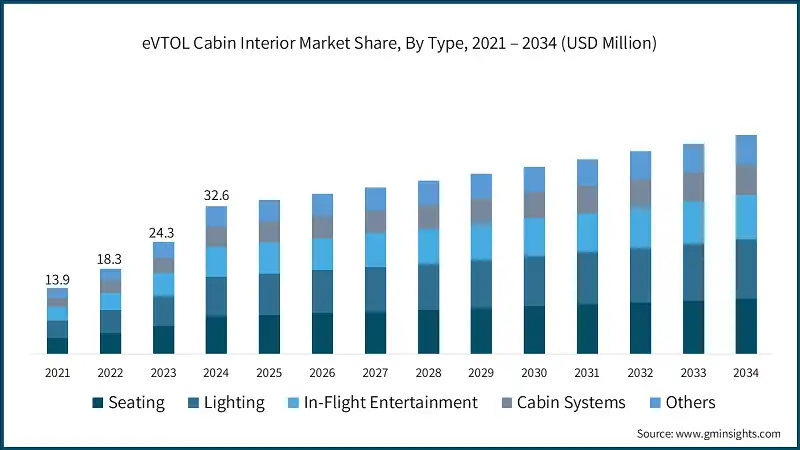
Based on the type, the market is categorized into seating, lighting, in-flight entertainment, cabin systems, and others.
- The lighting segment was the largest market and accounted for USD 34.7 million in 2024. The growing emphasis towards offering more relaxing and customizable cabin atmosphere in short urban eVTOL flights has led to deployment of mood lightings that adjust colour tones to match flight phases, to ensure passengers comfort and reduce anxiety, which contributes to the growth of this segment.
- Moreover, LED lighting systems are favoured in eVTOLs due to their lower power consumption, which further aligns with energy constraints for battery power aircrafts. These systems reduce operational cost and ensure compliance with sustainability goals, that further positions them as a viable option for eVTOL manufacturers.
- Manufacturers must focus on the development of adaptive spectral lighting that aligns with circadian rhythms for morning and evening flights, which can be a key differentiator for urban commuter routes. Also, manufacturers can enter into a strategic partnership with material science firms such as PPG aerospace for the development of ultra-thin and conformal lighting firms that further reduces weight while complying with flammability standards.
- The seating segment is the fastest growing market and is anticipated to grow with a CAGR of 30.2% during the forecast period. This growth is fuelled by the increasing demand for compact, lightweight, and ergonomic seating solutions, which ensures maximized space utilization in confined cabin of aircraft. For instance, Recaro aircraft seating has introduced their first seating solutions with high grade aluminium, titanium, and composites in 2025, which are specifically designed for eVTOL aircraft while ensuring enhanced passenger comfort.
- In addition, the implementation of stringent safety and performance standards set by aviation authorities such as FAA and EASA has forced manufacturers to incorporate seatings with secure harness systems and crash safety features while maintaining low weight and slim designs.
- Manufacturers should prioritize on developing modular seating systems with quick release mechanism, that enables cargo and passenger reconfiguration, which are critical for hybrid use eVTOLs.
Learn more about the key segments shaping this market
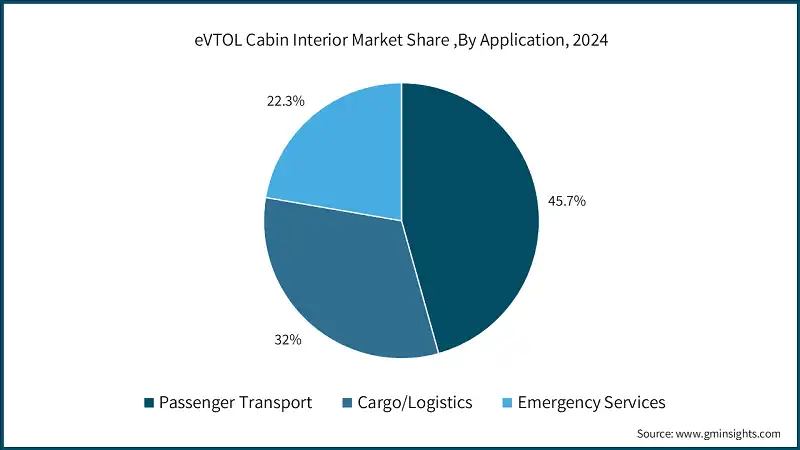
Based on the application, the eVTOL cabin interior market is bifurcated into passenger transport, cargo/logistics, and emergency services.
- The passenger transport segment was the largest market and accounted for USD 58.8 million in 2024. The rapid expansion of Urban Air Mobility has led to increasing demand for quicker and more efficient travel alternatives, where eVTOLs are gaining rapid adoption due to their ability to offer point to point transport above traffic and faster mobility solutions.
- For instance, over 850 eVTOL aircraft concepts are currently under development globally, with more than 70% targeting passenger transport applications, stated by Vertical Flight Society (VFS). Several OEMs such as Joby Aviation, Archer Aviation, and Volocopter are heavily investing towards the luxury ride hailing style interiors, that are integrated with features such as noise cancelling panels, modular seating, touchless controls, and ambient lighting to ensure enhanced short distance passenger experience.
- Manufacturers can enter into strategic partnership with ride hailing platforms such as Uber Copter and Blade to access high value customer, which will assist in reducing customer acquisition costs by 35 to 50%. Also, Manufacturers can develop modular cabin architecture that can further switch between 4 seat economy and 2 seat premium layouts in less than 15 minutes, which can be a key differentiating factor for optimizing fleet utilization in day times.
- The cargo/logistics segment is the fastest growing market and is anticipated to grow with a CAGR of 29.5% during the forecast period. The growing demand for last mile delivery solutions is fuelling the usage of eVTOLs in for various application such as e-commerce delivery and medical supply transport. There is also growing demand for modular cabin interiors, that can further accommodate secure cargo storage systems such as racks and containers, which further fuels innovation.
- Moreover, several logistics firms require real time data and precision tracking, which has led to development of cabins fitted with sensors, RFID systems, and connected monitoring tools, that can be integrated with warehouse and fleet systems. This smart interior capability further ensures improved logistics visibility and reduced errors, while enabling predictive maintenance.
- To gain the competitive edge, Manufacturers should focus on developing hybrid cargo passenger cabins with foldable crash safe bulk heads, that can serve dual use market. Also, manufacturers can form partnership with cold chain specialists such as Envirotainer to certify eVTOL compatible active cooling units for pharma logistics.
Looking for region specific data?
North America dominated the eVTOL cabin interior market and was valued at USD 42.1 million in 2024 and is projected to grow with a CAGR of 29.3% during the forecast period. The dominance of the regions is driven by the rapid expansion of e-commerce & medical logistics, increasing urban air mobility demand, and increasing governmental investment towards defense and public sector infrastructure.
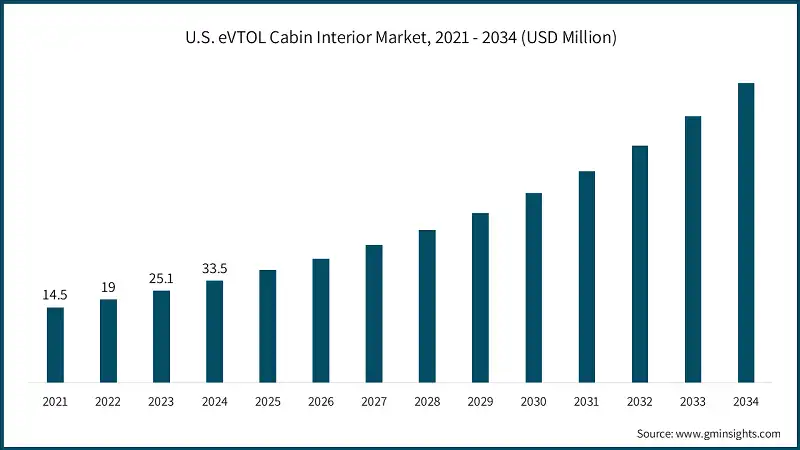
- The eVTOL cabin interior market in the U.S. was valued at USD 33.5 million in 2024 and is anticipated to grow with a CAGR of 29.5% during the forecast period. The U.S. is at the forefront of urban air mobility momentum and FAA leadership, that targets site deployment by 2028, which generates significant demand for certified interiors fitting while ensuring compliance with regulatory requirements and aesthetics. For instance, according to the Vertical Flight Society (VFS), over 45% of the 900+ global eVTOL concepts originate from U.S.-based companies. Additionally, there is a growing demand for customizable interiors with modularity, noise cancellation, and sustainability, particularly for air taxi modes, that drives continued investment.
- Interior suppliers must focus on aligning with OEMs participating with FAA and NASA trials for co-development of compliant, lightweight, and modular cabin components. Manufacturers can also prioritize ergonomic design, fire resistant sustainable materials, and digital comfort solutions such as mood lighting and smart displays, which will help them to gain competitive edge.
- The Canada eVTOL cabin interior market is anticipated to grow with a CAGR of 28.4% during the forecast period. The growth in the region is fuelled by the advanced air mobility (AAM) ecosystem, especially for regionally connectivity in remote and underserved areas. For instance, over 20 municipalities are collaborating on AAM integration plans, as stated by Canadian Advanced Air Mobility Consortium (CAAM). This program emphasizes towards safety and cold weather adaptability, that further influences material selection and thermal insulation in cabin interiors.
- Manufacturers should focus on development of modular and dual purpose interior solutions, that can be used for commercial and emergency use cases. Manufacturers must emphasize towards lightweight insulation, anti-microbial surfaces, and rapid reconfiguration layout can further offer competitive edge in the Canada’s eVTOL environment.
Europe market is anticipated to grow with a CAGR of 27.2% during the forecast period. The growth in the region is fuelled by the strong regulatory backing and sustainability mandates.
- The eVTOL cabin interior market in the Germany is anticipated to surpass USD 79.9 million by 2034. Germany is emerging as a core hub for eVTOL innovation, backed by OEMs such as Lilium and Volocopter, which are both progressing through the European Union Aviation Safety (EASA) certification. For instance, according to the German Aerospace Industries Association (BDLI), Germany accounts for over 25% of Europe’s AAM R&D investment, which generates significant demand for recyclable interior materials, smart lighting systems, and ergonomic seatings in commercial eVTOL models.
- Interior system manufacturers must focus on early partnership with German OEMs while aligning with the EASA’s high certification standards. Emphasis towards modularity, lightweight, acoustic materials, and sustainability certifications will assists manufacturers in gaining competitive edge and securing long term contract for large scale deployment across cities such as Munich and Stuttgart.
- The UK eVTOL cabin interior market was valued at USD 6.6 million in 2024 and is anticipated to grow with a CAGR of 27.6% during the forecast period. UK is positioned as a niche leader through the presence of government and industry collaborations. For instance, the UK Civil Aviation Authority (CAA) and the Future Flight Challenge (UKRI), has been invested over USD 146.1 million in advanced air mobility R&D, with multiple pilot programs in cities like London, Coventry, and Oxford. Moreover, the zero emissions aviation regulation in generating significant demand for lightweight and sustainable cabin components, which aligns with the national decarbonisation policies.
- To capture the growing demand, Manufacturers must tailor their offerings for the UK market, with a focus towards inclusive design principles, sustainable materials, and smart cabin features such as digital control panel & ambient lightings. Additionally, Manufacturers can engage with the CAA certified trials under the Future Flight Program, which can be a key advantage to showcase compliance and commercial viability, as the UK continues to gear up for commercial eVTOL launch by 2030.
Asia Pacific is the fastest growing market for eVTOL cabin interior market and is anticipated to grow with a CAGR of 31% during the forecast period. The growth in the region is driven by the increasing urban congestion, rapid infrastructure development, and government backed smart city initiatives.
- The eVTOL cabin interior industry in the China is anticipated to surpass USD 218.7 million by 2034. China is leading the commercialization of eVTOLs with the presence of strong policy support and accelerated certification pathways. For instance, according to the Civil Aviation Administration of China (CAAC), EHang became the first company globally to receive type certification for an autonomous passenger eVTOL (EH216-S) in 2023. Additionally, the China’s focus on reducing urban air pollution that aligns with eVTOL’s zero emissions capabilities has led to surge in adoption of eco-friendly materials such as lightweight composites and sustainable fabrics to support green mobility initiatives.
- The Japan eVTOL cabin interior market is anticipated to grow significantly with a CAGR of 30.3% during the forecast period. The densely populated cities of Japan such as Tokyo & Osaka, faces logistical challenges due to traffic congestion has led to growing demand for eVTOL due to faster delivery solutions, which require cabin interiors with specialized storage for cargo. Moreover, the rapid expansion of e-commerce in Japan along with the consumer demand for rapid delivery, that further fuels demand for eVTOL cabin interior to meet with this growing demand.
- Manufacturers must focus on developing eVTOL cargo modules, which are tailored for dense urban corridors in Japan, while emphasizing towards modular, secure, and climate controlled storage units.
- The eVTOL cabin interior market in India is projected to surpass USD 95.3 million with a CAGR of 33% during the forecast period. The rapidly growing population of India faces severe traffic congestion, which fuels the demand for eVTOL air taxis, along with compact cabin interiors, comfortable seating, and advanced lighting to further enhance the travel experience. Moreover, the increasing economic growth of middle-class population coupled with the constantly increasing demand is pushing enormous investment towards passenger-centric cabin interiors that are made of sustainable materials and energy-efficient systems.
- Manufacturers must develop climate adaptive, space optimized, and cost effective interior solutions, which should be specifically tailored for Indian urban air taxi plans. Cabin interior manufacturers can also prioritize affordable, thermally comfortable, and durable sustainable material, which will assist in them to gain competitive edge.
The eVTOL cabin interior market in Latin America was valued at USD 11.7 million in 2024 and is expected to surpass USD 97.1 million by 2034. This growth is fuelled by the sustainability and green mobility initiatives along with the tourism and regional connectivity.
The MEA market is projected to surpass USD 125.1 million by 2034, supported by the growing demand for e-commerce and rapid delivery, increasing emphasis towards logistics in remote and underserved areas, and growing infrastructure investment from government.
- The South Africa eVTOL cabin interior market is projected to grow with a CAGR of 23.4% during the forecast period. The market growth in South Africa is supported by the rapid growth of e-commerce and remote logistics in rural areas, which fuels the demand for eVTOLs with modular cabin interiors meeting SACAA safety standards.
- The Saudi Arabia eVTOL cabin interior market is projected to surpass USD 47.5 million by 2034. Saudi Arabia's Vision 2030 plan, backed by projects such as NEOM and Red Sea Project are driving rapid adoption of eVTOLs for urban and regional air mobility, which require cabin interior with luxurious and modular in design to cater to different applications. Furthermore, the events such as Hajj and Saudi season festival create peak demand for eVTOLs with premium cabin features for tour trips.
- To capitalize on the growing demand, Manufacturers must develop luxury grade cabin design with customization capabilities for tourism, VIP, and regional services. Manufacturers can also collaborate with NEOM based AAM developers while aligning with GACA’s standard, especially in high profile zone with year round tourism activities.
- The eVTOL cabin interior market in UAE accounted for USD 4.3 million in 2024. The tourism sector of UAE, boosted by the events such as Expo 2020 fuels significant demand for eVTOLs with high end cabin interiors for frequent travellers. Additionally, the growing investment towards vertiport network and GCAA regulations fuels significant demand for cabin interiors that further comply with safety and operational standards.
eVTOL Cabin Interior Market Share
- The top 5 companies in the market are Collins Aerospace, Diehl Aviator, Recaro Aircraft Seating, Safran, and FACC AG together held 59.9% of the market share. This shows the high level of consolidation of the market.
- Collins Aerospace remains a dominant leader in the eVTOL cabin interior industry with a market share of 15.9% in 2024 and continues to excel in eVTOL cabin interiors with lightweight modular cabin systems. As the leading player in the market, Collins Aerospace provides innovative cabin systems which integrate comfort, safety, and advanced connectivity due to strong R&D and collaborations with major eVTOL OEMs.
- Diehl Aviation holds a major position in the market, accounting market share of 13.6%. Diehl Aviation is specialized in developing integrated cabin interiors for eVTOL aircraft. With a reputation for system integration and novel materials, Diehl works with leading eVTOL developers to provide tailored solutions that optimize passenger interfaces and structurally contribute to urban air mobility vehicles.
- Recaro Aircraft Seating has maintained a competitive position in the eVTOL cabin interior market with a market share of 12.3%. Recaro continues as a leading designer and producer of lightweight and ergonomic seats tailored for the eVTOL industry. As a hallmark of comfort and safety, Recaro seats are built to strict aerospace standards and are ultra-weight and space efficient. Their partnership with leading eVTOL OEMs strengthens Recaro’s position as an important supplier for eVTOL cabin interiors.
- Safran maintained a 10.1% share of the eVTOL cabin interior market. Utilizing its extensive aerospace cabin specialization, Safran provides interiors for eVTOL platforms. The company's offerings include advanced lighting and cabin management systems as well as lightweight structural elements, enhancing ease of use and passenger comfort while improving operational efficiency. Safran also demonstrates strong market presence due to his continuous innovations and global reach.
eVTOL Cabin Interior Market Companies
List of prominent players operating in the market include:
- Collins Aerospace
- Diehl Aviation
- Recaro Aircraft Seating
- Safran
- FACC AG
- JAMCO Corporation
- Joby Aviation
- Lilium GmbH
- Collins Aerospace, Diehl Aviation, Safran, Recaro Aircraft Seating, Thales Group are market leader. All these companies have eVTOL cabin interior materials because of integrated sophisticated cabin systems, lightweight materials, seating systems, advanced avionics, and smart cabin technologies. Their strong R&D spending, collaboration with top eVTOL OEMs, and capacity to deliver certified aerospace-grade interiors sustain urban air mobility projects. Their global footprint and specialization in aerospace interiors position them as the primary innovators driving market standards and customer adoption.
- Astronics Corporation, FACC AG, Panasonic Avionics and JAMCO are considered as challengers in the market. These aerospace suppliers have long-standing strengths in cabin systems, cabin electronics, composite materials, and integrated cabin solutions. Despite the prominence of their technologies and products, these companies hold a smaller market share because their customer base extends beyond eVTOLs. These challengers are bringing focused eVTOL innovations and collaborations with OEMs, but they remain overshadowed by pure-play leaders.
- Aviointeriors, AUTOFLUG, Archer Aviation, and Wisk Aero are classified as followers. These companies have a strong regional presence and pronounced niche specialization in cabin interiors and eVTOL development, although their global reach is limited. These companies focus on serving specific eVTOL models and regions. While innovation drives these companies, the absence of competitiveness in large-scale, integrated urban air mobility systems constrains the scope of such innovations.
- Eve Air Mobility, Joby Aviation, and Lilium GmbH are niche players in the industry. Although they are focusing on the eVTOL OEM segments and not full-fledged cabin interior suppliers, quite a few are working on modular cabin interior systems and proprietary materials to enhance the market position of their aircraft. Their developments in modular systems and materials propel them towards integrative proprietary designs yet, as new market entrants, their influence on the cabin interior materials supply chain is still minor. The focus on bespoke solutions underscores increasing prospects as vertically integrated eVTOL manufacturers however, they are still concentrated on pilot program stages.
eVTOL Cabin Interior Industry News
- In April 2025, RECARO Aircraft Seating unveiled its first-ever eVTOL (electric vertical take-off and landing) seat at the 2025 Aircraft Interiors Expo (AIX) in Hamburg, developed in collaboration with Eve Air Mobility, an Embraer spin-off focused on urban air mobility
- In July 2024, Eve Air Mobility has selected Diehl Aviation to the full scope of designing and fabrication of Eve's eVTOL aircraft interior from the floor to the ceiling, encompassing side and ceiling panels, partition walls, floor panels, and the inner surfaces of the cabin, cockpit, and cargo hold.
- In July 2022, Lilium has partnered with Diehl Aviation, a leading Tier 1 aerospace supplier, to collaborate on the design, development, integration, and manufacturing of the Lilium Jet’s cabin interior. The agreement is a significant step towards the industrialization and type certification of the Lilium Jet.
The eVTOL cabin interior market research report includes an in-depth coverage of the industry with estimates and forecast in terms of revenue (USD Million) from 2021 – 2034 for the following segments:
Market, By Type
- Seating
- Lighting
- In-flight entertainment
- Cabin systems
- Others
Market, By Application
- Passenger transport
- Cargo/logistics
- Emergency services
The above information is provided for the following regions and countries:
- North America
- U.S.
- Canada
- Europe
- Germany
- UK
- France
- Spain
- Italy
- Netherlands
- Asia Pacific
- China
- India
- Japan
- Australia
- South Korea
- Latin America
- Brazil
- Mexico
- Argentina
- Middle East and Africa
- Saudi Arabia
- South Africa
- UAE
Frequently Asked Question(FAQ) :
Who are the key players in the eVTOL cabin interior market?
Key players include Collins Aerospace, Diehl Aviation, Recaro Aircraft Seating, Safran, FACC AG, JAMCO Corporation, Joby Aviation, Lilium GmbH, Panasonic Avionics, and Thales Group.
What are the upcoming trends in the eVTOL cabin interior industry?
Key trends include adaptive LED lighting, use of sustainable materials, modular seating, and integration of touchless controls and voice-guided systems.
Which region leads the eVTOL cabin interior market?
North America held 32.7% share with USD 42.1 million in 2024. Growth was driven by urban air mobility, government support, and prototype testing.
What is the growth outlook for the seating segment from 2025 to 2034?
Seating segment is projected to grow at a 30.2% CAGR through 2034.
What was the valuation of the passenger transport application segment in 2024?
Passenger transport accounted for USD 58.8 million in 2024.
How much revenue did the lighting segment generate in 2024?
The lighting segment generated USD 34.7 million in 2024, accounting for 27% of the total market share.
What is the projected value of the eVTOL cabin interior market by 2034?
The eVTOL cabin interior industry is expected to reach USD 1.5 billion by 2034, fueled by advanced materials, ergonomic design trends, and increased OEM investments.
What is the market size of the eVTOL cabin interior in 2024?
The market size was USD 128.7 million in 2024, with a CAGR of 28.5% projected through 2034 driven by urban air mobility growth and rising demand for luxury and customized interiors.
eVTOL Cabin Interior Market Scope
Related Reports