Summary
Table of Content

EV Charging Management Software Platform Market
Get a free sample of this report
Form submitted successfully!
Error submitting form. Please try again.
Thank you!
Your inquiry has been received. Our team will reach out to you with the required details via email. To ensure that you don't miss their response, kindly remember to check your spam folder as well!
Request Sectional Data
Thank you!
Your inquiry has been received. Our team will reach out to you with the required details via email. To ensure that you don't miss their response, kindly remember to check your spam folder as well!
Form submitted successfully!
Error submitting form. Please try again.
EV Charging Management Software Platform Market Size
Global demand for electric vehicle (EV) charging systems is rapidly growing, creating strong need for centralized software solutions which can provide monitoring, billing, load management and user authentication capabilities across diverse types of public, private and fleet networks to enable effective operation of a thriving and fully functioning charging ecosystem. In January 2025, Tesla announced an extension of its global Supercharger network with upgraded site management software tools to support the projected substantial increase in number of EVs using devices within that infrastructure.
EV Charging Management Software Platform Market Key Takeaways
Market Size & Growth
- 2025 Market Size: USD 3.4 Billion
- 2026 Market Size: USD 4.3 Billion
- 2035 Forecast Market Size: USD 31.5 Billion
- CAGR (2026–2035): 24.8%
Regional Dominance
- Largest Market: Europe
- Fastest Growing Region: Asia Pacific
Key Market Drivers
- Growing adoption of electric vehicles (EVs).
- Government policies & incentives.
- Focus on sustainability & energy optimization.
- Integration with smart grid & digital technologies.
Challenges
- High initial costs & complex implementation.
- Interoperability & standardization barriers.
Opportunity
- Expansion into emerging regions.
- Renewable energy & grid services integration.
- AI and predictive analytics integration.
- Ecosystem partnerships & interoperable services.
Key Players
- Market Leader: ChargePoint led with over 5.7% market share in 2025.
- Leading Players: Top 5 players in this market include Ampeco, ChargePoint, Enel X / Utility Platforms, EV Connect, EVBox, which collectively held a market share of 16.4% in 2025.
Get Market Insights & Growth Opportunities
Government initiatives, such as regulations, subsidies and infrastructure funding programs aimed at promoting clean transportation (decarbonization), are accelerating the deployment of charging stations, thus supporting increasing adoption of compliant interoperable, scalable EV Charging management software platforms that are integrated into the nationwide energy and mobility frameworks. In March 2025, European Commission published implementation measures for AFIR (Alternative Fuel Infrastructure Regulation), to encourage the integration of smart charging systems among EU member countries.
The increasing focus placed on the importance of reducing carbon emissions and improving energy efficiency by both corporations and state and federal government entities, intelligent software solutions that provide load balancing, renewable energy integration, emissions tracking and reporting, and demand response capabilities are expanding for use in the operation of EV charging infrastructure. On April 2025, Siemens announced enhancements to its entire suite of EV Charging software tools by adding energy optimization solutions for commercial properties.
As the result of technological advances in IoT connectivity, cloud computing and real-time analytics, EV Charging platforms will be able to successfully connect with and be integrated into a Smart Grid and provide remote diagnostics, predictive maintenance, and dynamic load management capabilities on a distributed basis using the grid to provide charging for connected EVs.
The global EV charging management software platform market was valued at USD 3.4 billion in 2025. The market is expected to grow from USD 4.3 billion in 2026 to USD 31.5 billion in 2035 at a CAGR of 24.8%, according to latest report published by Global Market Insights Inc.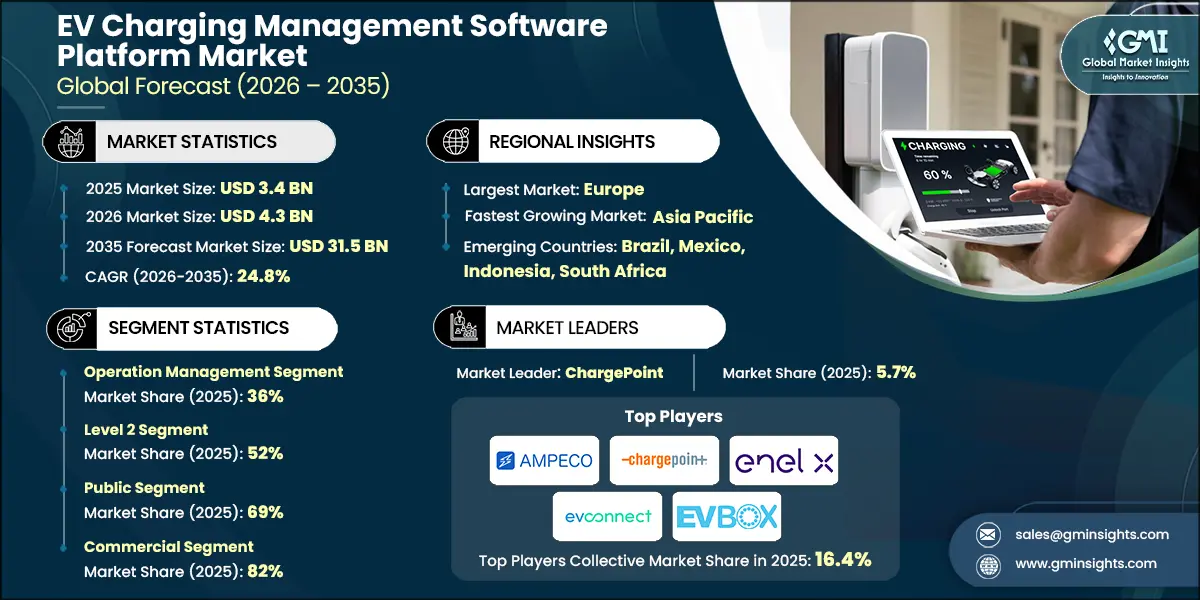
To get key market trends
EV Charging Management Software Platform Market Trends
The use of smart charging methods such as dynamic load balancing, time of use pricing models, automated scheduling and grid responsive energy management are rapidly becoming standard procedures thereby improving operational efficiencies and reducing excessive peak load demands placed on electricity distribution systems. In May 2025 ChargePoint launched its new generation of smart charging algorithms for commercial fleet customers.
The integration of artificial intelligence (AI) and machine learning (ML) into charging management platforms is enhancing demand forecasting, predictive maintenance, uptime optimization, fraud detection, and user behaviour analysis which overall results in greater reliability and cost-effective operations. In June 2025 ABB Ltd added further AI based analytics to its EV charging network management software offerings.
Using blockchain technology to create secure transaction frameworks is also being investigated as means of improving payment security, enabling transparent peer-to-peer energy transactions, creating more robust roaming between operators and increasing billing accuracy across multi-operator charging ecosystems.
As a result, current platform designs have become more flexible; they support many forms of charging including standards for both AC/DC fast charge, fleet depots, residential installations and roaming across multiple provider brands thus presenting improved efficiency through scalability and interoperability between networks.
EV Charging Management Software Platform Market Analysis
Learn more about the key segments shaping this market
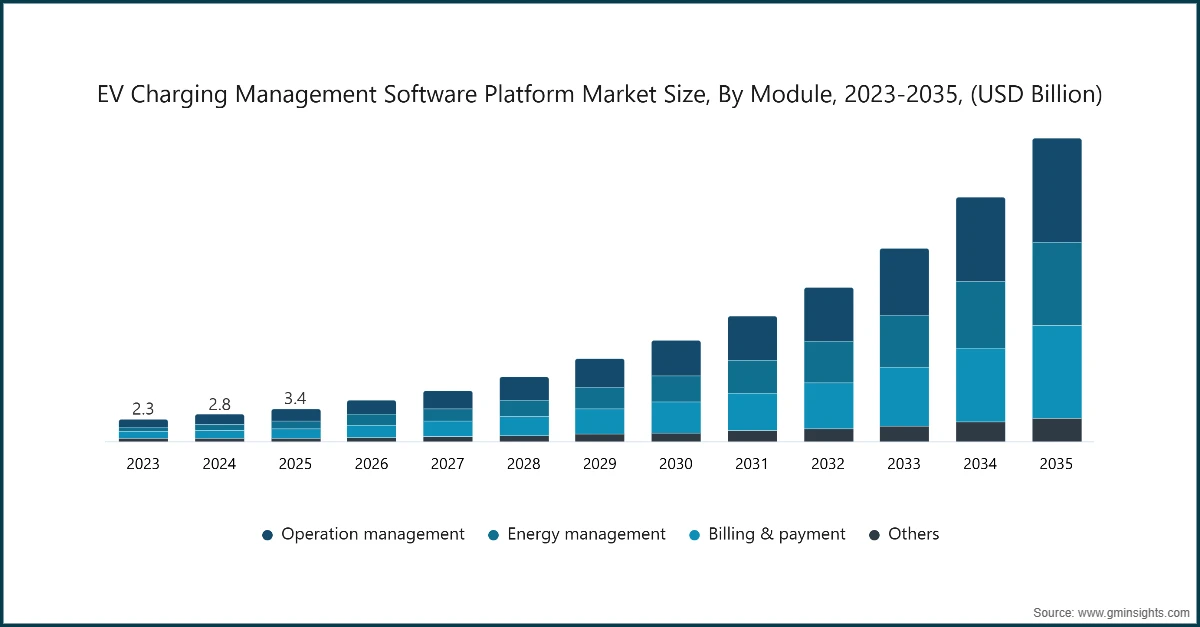
Based on module, the EV charging management software platform market is divided into operation management, energy management, billing & payment and others. Operation management dominated the market, accounting for 36% in 2025 and are expected to grow at a CAGR of 24.1% through 2026 to 2035.
- The operation management software allows for real time monitoring, scheduling, and control of charging stations, and provides the capability to detect faults in the system, provide alerts for maintenance, and analyze the performance at the site level to ensure maximum up time, efficient utilization of the station, and seamless operation between public, commercial and fleet charging networks.
- Energy management platforms optimize the electricity consumed by the charging stations through the controlling of charging loads, the incorporation and integration of renewable sources and the enablement of demand response programs. These platforms reduce the stress placed upon the electrical grid during peak load periods, reduce costs through the optimization of energy consumed at peak rates and enhance grid stability while ensuring sustainability and productive energy utilisation across multiple charging stations.
- Billing & Payment Modules are designed to automate the billing (invoicing), receiving (payment), and managing subscriptions for users of the charging stations. They can accommodate many different types of payments and support a variety of different pricing models and methods, as well as providing user authentication methods.
- For instance, ChargePoint system provides additional functionality, such as analytics dashboards, user engagement tools roaming interoperability, cybersecurity, and reporting tools/analysis. These features provide for improved operational intelligence, improved customer experience, and deliver actionable insights for better management of the charging network.
Learn more about the key segments shaping this market
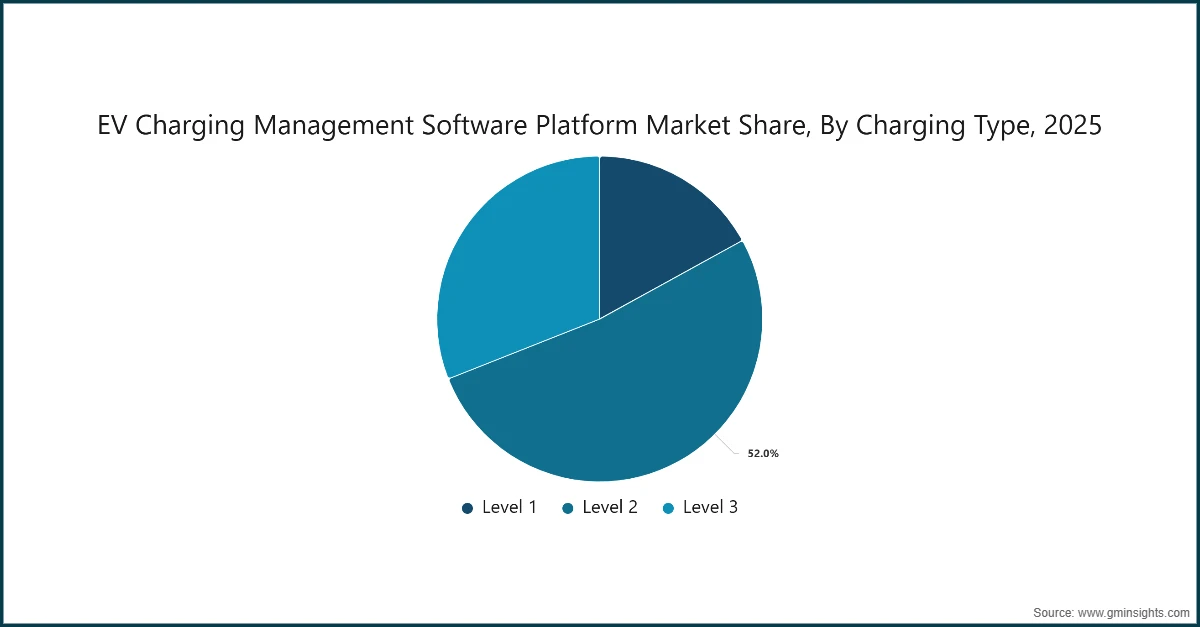
Based on charging type, the EV charging management software platform market is segmented into level 1, level 2 and level 3. Level 2 segment dominates the market with 52% share in 2025, and the segment is expected to grow at a CAGR of 24.8% from 2026 to 2035.
- Level 2 focuses on charging station deployment and network operations, including station installation, connectivity, and interoperability. It involves physical chargers, network monitoring, and basic software functionalities to enable user access, data collection, and operational reliability.
- Level 1 represents the broadest market, encompassing all hardware, software, and services related to EV charging. It includes stations, networks, management systems, and grid integration across residential, commercial, public, and fleet applications g Level 3 is the software-focused submarket within charging infrastructure, offering platforms for operation management, energy optimization, billing, user engagement, predictive maintenance, and multi-site network coordination, enhancing efficiency, scalability, and user experience across charging networks.
Based on charging site, the EV charging management software platform market is segmented into public and private. The public segment dominates the market with 69% share in 2025, and the segment is expected to grow at a CAGR of 25.3% from 2026 to 2035.
- Public charging locations are open to ALL EV users, typically found in urban areas, on highways, in retail locations or commercial areas. They need network management software to control user access/authentication, billing/transactions, load balancing, real-time monitoring of charging activity and to provide interoperability between different operators' networks.
- There is a growing trend toward using mobile applications in public charging locations to allow for dynamic pricing and/or allowing users to schedule their charging session in advance. By allowing this feature to be used the operator can limit the amount of congestion at the location, maximize the number of vehicles charged and increase their overall revenue.
- Private charging locations only allow very specific users, such as corporate fleets, residents in multi-family communities and companies with industrial facilities. Software can be used to monitor access control, optimize energy usage and cost; notify when maintenance is required and account for actual operational costs.
- More and more private charging locations are utilizing V2G (vehicle-to-grid) technology to allow the EV's used on the private property to provide power back to either the private property or to the grid when demand is highest. This helps provide energy cost savings, provides better stability on the power grid and supports the corporation's sustainability and energy management goals.
Based on application, the EV charging management software platform market is segmented into commercial and residential. The commercial segment is expected to dominate the market with a share of 82% in 2025.
- Commercial companies increased to help with fleet scheduling, predictive maintenance for their vehicles, and energy management, by using big data and analytics. Using software applications, businesses are able to reduce loss from vehicle downtime, lower electricity costs, and ensure their vehicle schedules align with the delivery schedule and the charging stations.
- Software platforms are being used to provide dynamic load management for multiple chargers located at commercial properties. This type of software solution improves a facility’s energy efficiency, reduces the risk of violating grid reliability due to excessive load from all the chargers operating simultaneously, and allows for the integration of renewable energy and/or on-site energy storage to help the organizations save on operational costs and enhance their sustainability metrics.
- Residential charging platforms relate to smart home energy management systems to allow homeowners charge their EVs by utilizing solar energy, battery energy storage, and time-of-use (TOU) electricity pricing to save on their electricity bills and to be more compatible with the local power grid.
- Home charging station software is now incorporating mobile apps to help the homeowners remotely monitor their home charging stations, receive notifications regarding charging time, schedule charging periods, and view charging data associated with their home charging stations, thus providing a more convenient and energy efficient experience while using their home charging stations.
Looking for region specific data?
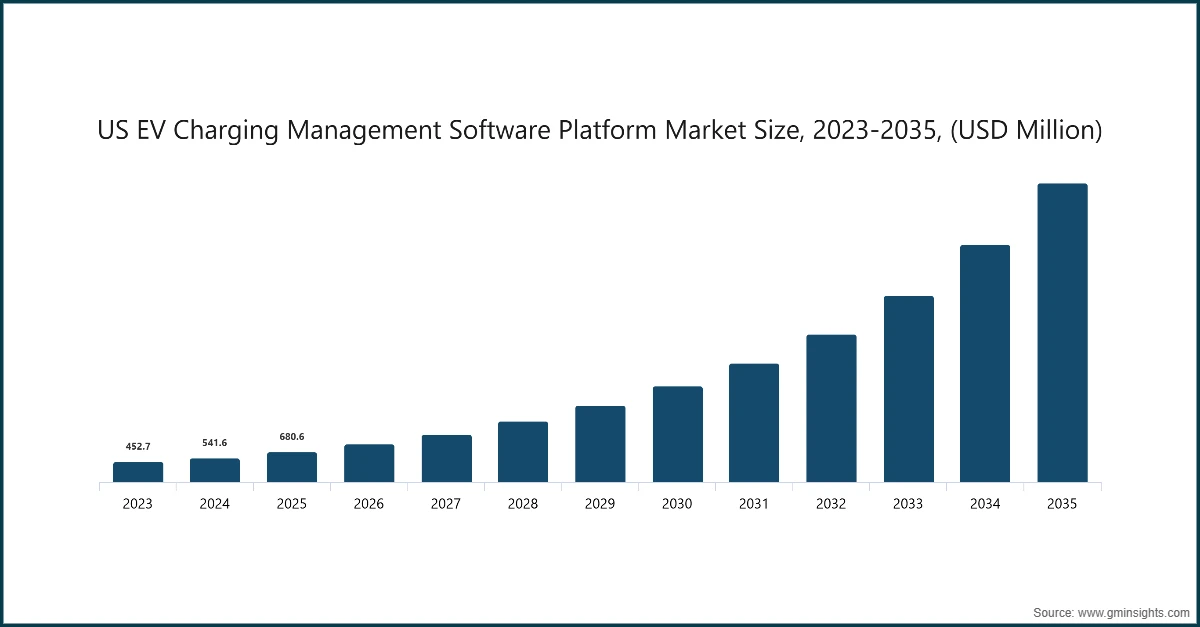
US EV charging management software platform market reached USD 680.6 million in 2025, growing from USD 659.9 million in 2024.
- In US, the adoption of time-of-use rates continues to expand, software is enabling charging schedules to be modified in response to tariff signals, resulting in lower total cost of ownership for both commercial and residential users, and ultimately relieving the stress placed on the electric grid from the charging of EVs through both federal incentives and state-utility partnerships.
- With the increasing number of users and the associated databases of payment and session data, US-based charging networks are focusing on developing strong encryption methodologies and secure authentication capabilities to protect user privacy and secure data from cyber threats.
- Commercial and government fleet operators will continue to adopt EV fleet management systems that provide dedicated tools for planning routes, optimizing charging times at depot locations, and leveraging usage reports and analytics.
North America EV charging management software platform market has a market size of USD 824.6 million in 2025.
- In North America, with the adoption of smart charging increases, utility companies and fleet operators are using software to improve load optimization, renewables integration, and peak demand management. Advanced platforms provide greater interaction with the grid and optimize the energy efficiency of the expanding EV infrastructure in the US and Canada.
- Software facilitates interoperability and roaming by providing seamless access to charging networks, unified billing systems, and standardized protocols; this will create many cross-state and cross-province charging stations as EVs become more prevalent throughout North America.
- The use of AI-driven predictive maintenance is also growing, as operators throughout North America are leveraging machine learning technology to predict when a fault will occur, plan for the necessary service, and enhance the overall user experience across the various charging networks.
Europe EV charging management software platform market accounted for a share of 33.3% and generated revenue of USD 1.1 billion in 2025.
- Unified roaming frameworks develop across member states, enabling EV drivers seamless cross-border charging with single software accounts and billing.
- Regulatory compliance modules expand within platforms as EU directives require reporting on emissions, energy use, accessibility, and consumer protection.
- Integration with renewable energy forecasts becomes widespread, as software adjusts charging based on wind and solar output for more sustainable grid use across Europe.
Germany EV charging management software platform market is showcasing strong growth potential, with a CAGR of 24.8% from 2026 to 2035.
- Grid-interactive charging gains dominance, with software enabling local utilities and operators to balance renewable generation and demand, reflecting Germany’s energy transition (Energiewende) goals.
- Standardization across OEMs and networks accelerates, as German regulators and industry consortia push for interoperable protocols to foster cross-network EV charging experiences.
- Energy efficiency analytics are embedded into platforms, helping industrial and residential users optimize charging in conjunction with building energy systems to reduce costs and emissions.
The Asia Pacific EV charging management software platform market is anticipated to grow at the highest CAGR of 26% from 2026 to 2035 and generated revenue of USD 1 billion in 2025.
- Rapidly evolving charging networks are creating demand for scalable and cloud-based solutions across cities and suburban areas in many Asian Pacific countries.
- Due to the large variety of languages, payment types and regulations throughout Asia, localized multi-language user experiences will be critical and each piece of software must be designed specifically for each of those languages, payment types and regulatory types.
- Mobile apps continue to grow with real time updates on the status of charging stations, making reservations for charging and the ability to pay through digital wallets which are used extensively throughout the Americas.
China EV charging management software platform market is estimated to grow with a CAGR of 26.9% from 2026 to 2035.
- In China, due to the proliferation of public charging stations, large-scale load balancing will need to be established by operators, enabling them to control the grid impact of the tens of thousands of public charging stations used across major metropolitan areas.
- Integrated mobile payments continue to dominate mobile payment solutions and will continue their integration into super apps and digital wallets that are widely used in China to allow for seamless charging sessions.
- Data driven planning tools will continue to grow in availability and will assist governments and enterprises with accurate demand projections, resource allocations and infrastructure growth priorities at a provincial level.
Latin America EV charging management software platform market shows lucrative growth over the forecast period.
- In Latin America, low-cost management software is created for offering remote operations, mobile payment integration, and low‑bandwidth support to bridge connectivity gaps.
- Regional partnerships between original equipment manufacturers (OEMs) are developing charging solutions for commercial fleets that include route planning, depot scheduling, and remote diagnostic services to maximize a commercial operator's total cost of ownership.
- As-billing frameworks are starting to develop within the Mercosur region of South America that will allow for an EV driver to seamlessly charge their vehicle throughout the countries of Argentina, Brazil, Chile, and Paraguay and have unified billing capabilities.
Brazil EV charging management software platform market is estimated to grow with a CAGR of 23.5% from 2026 to 2035 and reach USD 767.1 million in 2035.
- Software platforms that originate in Brazil are developing mobile-first user interface solutions and provide localized payment options to enhance usability and availability in both urban and rural areas of charging infrastructure.
- In Brazil, both corporate and public charging networks, are starting to adopt energy optimization modules to establish charging time coordinates based on time of use tariffs, which will assist in minimizing peak load costs.
- Increasing collaborative initiatives between electric utilities and charging network operators have begun embedding grid service capabilities into the operators' software platforms to support load forecasting and reactive power management throughout local distribution networks.
The Middle East and Africa EV charging management software platform market accounted for USD 171.7 million in 2025 and is anticipated to show lucrative growth over the forecast period.
- Smart charging software in the UAE works in conjunction with sources of renewable energy such as solar PV to help balance the energy used for charging with on-site generation, which leads to a better overall sustainability score for EVs in the UAE.
- Roaming agreements and unified payment systems are being implemented as part of the national mobility initiative to allow for easy access to EV charging across all UAE emirates.
- City platforms leverage real-time analytical data for monitoring how much traffic and where charging stations are utilized and allow dynamic reservation of charging stations, predictive maintenance scheduling, and optimal routing for users.
UAE is expected to experience substantial growth in the Middle East and Africa EV charging management software platform market, with a CAGR of 22.8% from 2026 to 2035.
- Charging management trends across the MEA region emphasize strong synchronization between offline/online data to alleviate issues caused by weak connectivity and ensure accurate remote monitoring and billing of charging stations throughout the urban and rural areas.
- In MEA, integration with national grid control systems allows for demand response and load forecasting to assist in the development of energy infrastructure in areas that are undergoing change.
- Telecom companies partnering with charging platforms have provided a way of creating data-driven solutions for their customers, such as user alerts, predictive outage notifications, and extended customer support through SMS and mobile app channels.
EV Charging Management Software Platform Market Share
- The top 7 companies in the EV charging management software platform industry are ChargePoint, ABB, Enel X (Enel Group), EVBox, Bosch, EV Connect and Ampeco which contributed 20% of the market in 2025.
- ChargePoint provides a leading cloud-based EV charging network platform in North America and Europe. Its software enables real-time monitoring, mobile payments, network analytics, fleet management, and multi-site station control, supporting both commercial and residential EV charging deployments.
- ABB provides innovative and advanced technologies in the form of hardware and software products on a worldwide basis. They provide users with complete smart functionality to manage their charging stations through "smart charging" technology, as well as remote monitoring, predictive maintenance, and grid-based integration technologies, giving their customers scalable, secure, and interoperable E/V charging infrastructure.
- Enel X, offer smart charging networks for your home, business, or a public facility. The software promotes increased charging efficiency through real-time visibility on charges, dynamic load balancing, predictive analytics, and using renewable energy.
- EVBox, provides a software-as-a-service solution to help businesses (and utilities) manage multiple locations' electric vehicle (EV) charging stations in one network. The scalable EV charging services give businesses and utilities access to real-time data about electric vehicle (EV) charging, manage EV charging from any location, and help you manage your utility load on the EV charger.
- Bosch provide a smart EV charging software solution that combines the expertise of our automotive and industrial divisions. The software supports entire EV charging operation by monitoring your EV charging infrastructure; uses predictive maintenance; manages energy; and integrates with multiple hardware platforms, giving a comprehensive solution for efficient, scalable, and reliable EV charging from one global source.
- EV Connect delivers an open, cloud-based platform for multi-site network management, fleet optimization, and real-time analytics. It enables flexible charging operations, easy integration with third-party software, and robust support for public, commercial, and residential charging networks.
- Ampeco offers a white-label EV charging management platform, allowing operators to provide branded services. Its software supports real-time monitoring, load management, billing, and predictive maintenance, targeting commercial, fleet, and public networks with scalable, customizable solutions.
EV Charging Management Software Platform Market Companies
Major players operating in the EV charging management software platform industry are:
- ABB
- Ampeco
- Blink Charging
- ChargePoint
- Driivz
- Enel X
- EVBox
- Schneider Electric
- Shell Recharge Solutions
- Siemens
- Tesla
- All companies involved in this field provide technology solutions for public and private ChargePoint networks, work closely with fleets and their owners/occupiers, create and develop integrated charging solutions, and provide technical support for ongoing operation and maintenance of their systems. ChargePoint will remain the leader in this segment as it continues to innovate and develop the latest technology, which includes intelligent charge management systems and large-scale deployment capabilities.
- All players within the EVCMS will be competing for these opportunities based on three primary value propositions: scalable, reliable, and user-friendly. In this regard, the EVCMS platform manufacturers will differentiate from their competition through interoperability across diverse types of EVSE; integration of software and hardware to provide a single platform (along with optimal user experience); adoption of innovative applications, such as predictive analytics; implementation of various strategies, such as real-time monitoring; and support of fleet operators, public charging networks, commercial facilities, and residential customers, through the development of unique platforms that combine multiple capabilities.
EV Charging Management Software Platform Market Report Attributes
| Key Takeaway | Details |
|---|---|
| Market Size & Growth | |
| Base Year | 2025 |
| Market Size in 2025 | USD 3.4 Billion |
| Market Size in 2026 | USD 4.3 Billion |
| Forecast Period 2026-2035 CAGR | 24.8% |
| Market Size in 2035 | USD 31.5 Billion |
| Key Market Trends | |
| Drivers | Impact |
| Growing adoption of electric vehicles (EVs) | Directly expands the addressable market by increasing the number of charging points and networks requiring centralized software management. |
| Government policies & incentives | Accelerate charging infrastructure rollout, indirectly boosting demand for compliant, scalable charging management software platforms. |
| Focus on sustainability & energy optimization | Drives adoption of advanced software features such as energy monitoring, load balancing, and emissions reporting, increasing platform value. |
| Integration with smart grid & digital technologies | Enhance platform sophistication and long-term adoption by enabling real-time control, analytics, and grid-interactive charging capabilities. |
| Pitfalls & Challenges | Impact |
| High initial costs & complex implementation | Slows adoption among small operators and emerging markets, limiting near-term penetration despite long-term demand potential. |
| Interoperability & standardization barriers | Increases integration complexity and operational inefficiencies, constraining seamless network expansion and roaming services. |
| Opportunities: | Impact |
| Expansion into emerging regions | Creates strong greenfield opportunities as new charging infrastructure deployments increasingly embed software platforms from inception. |
| Renewable energy & grid services integration | Opens new revenue streams by positioning platforms as energy management and grid-support tools beyond basic charging operations |
| AI and predictive analytics integration | Enables differentiation through improved uptime, cost optimization, and data-driven decision-making, supporting premium pricing models. |
| Ecosystem partnerships & interoperable services | Strengthens platform stickiness and scalability by embedding software within broader EV, utility, and smart city ecosystems. |
| Market Leaders (2025) | |
| Market Leader |
5.7% market share |
| Top Players |
Collective market share in 2025 is 16.4% |
| Competitive Edge |
|
| Regional Insights | |
| Largest Market | Europe |
| Fastest growing market | Asia Pacific |
| Emerging countries | Brazil, Mexico, Indonesia, South Africa |
| Future outlook |
|
What are the growth opportunities in this market?
EV Charging Management Software Platform Industry News
- In February 2026, ChargePoint expanded European operations by acquiring a leading Nordic charging platform, adding ~15,000 managed points in Sweden, Norway, Denmark, and Finland, enhancing cold-weather charging optimization and strengthening its presence in the European EV charging software market.
- In January 2026, Shell Recharge Solutions launched a fleet charging management platform for commercial vehicles, featuring advanced scheduling, total cost of ownership analytics, and integration with Geotab and Verizon Connect, addressing fleet-specific needs beyond public charging.
- In December 2025, The European Union adopted final Alternative Fuels Infrastructure Regulation standards, mandating OCPP 2.0.1 compliance, OCPI v2.2 roaming, and ISO 15118 Plug & Charge for all new public charging infrastructure from January 2027, driving software platform upgrades.
- In November 2025, November 2025: Tesla opened its Supercharger network in the U.S. to non-Tesla EVs after European pilot programs, requiring Tesla app authentication and payment, marking a shift from its closed ecosystem and creating new market opportunities for Tesla charging platforms.
The EV charging management software platform market research report includes in-depth coverage of the industry with estimates & forecasts in terms of revenue ($ Mn/Bn) from 2022 to 2035, for the following segments:
Market, By Offering
Operation management
- Energy management
- Billing & payment
- Others
Market, By Charging Type
Level 1
- Level 2
- Level 3
Market, By Charging Site
- Public
- Private
Market, By Application
- Commercial
- Residential
Market, By End use
- Charge point operators (CPOs)
- Fleet operators
- Property owners & managers
- Utilities & energy companies
- Automotive OEMs & dealerships
- eMobility service providers (eMSPs)
The above information is provided for the following regions and countries:
- North America
- US
- Canada
- Europe
- Germany
- UK
- France
- Italy
- Spain
- Russia
- Nordics
- Poland
- Romania
- Asia Pacific
- China
- India
- Japan
- South Korea
- ANZ
- Vietnam
- Indonesia
- Latin America
- Brazil
- Mexico
- Argentina
- MEA
- South Africa
- Saudi Arabia
- UAE
Frequently Asked Question(FAQ) :
What was the market size of the EV charging management software platform in 2025?
The market size was USD 3.4 billion in 2025, with a CAGR of 24.8% expected through 2035. The rising demand for centralized software solutions for monitoring, billing, load management, and user authentication is driving market growth.
What is the projected value of the EV charging management software platform market by 2035?
The market is poised to reach USD 31.5 billion by 2035, driven by advancements in AI, machine learning, blockchain technology, and the growing adoption of EVs globally.
What is the expected size of the EV charging management software platform industry in 2026?
The market size is projected to reach USD 4.3 billion in 2026.
How much revenue did the operation management segment generate in 2025?
The operation management segment accounted for 36% of the market in 2025 and is expected to grow at a CAGR of 24.1% till 2035.
What was the market share of the Level 2 segment in 2025?
The Level 2 segment dominated the market with a 52% share in 2025 and is set to expand at a CAGR of 24.8% up to 2035.
What was the market share of the public segment in 2025?
The public segment held a 69% market share in 2025 and is anticipated to observe around 25.3% CAGR through 2035.
What was the valuation of the US EV charging management software platform sector in 2025?
The US market reached USD 680.6 million in 2025, led by the adoption of time-of-use rates, federal incentives, and state-utility partnerships.
What are the upcoming trends in the EV charging management software platform market?
Trends include smart charging adoption, AI-driven predictive maintenance and forecasting, blockchain-based secure transactions, and scalable interoperable platforms supporting fast charging and roaming.
Who are the key players in the EV charging management software platform industry?
Key players include ABB, Ampeco, Blink Charging, ChargePoint, Driivz, Enel X, EVBox, Schneider Electric, Shell Recharge Solutions, Siemens, and Tesla.
EV Charging Management Software Platform Market Scope
Related Reports