Summary
Table of Content

EV Battery Health Monitoring Market
Get a free sample of this report
Form submitted successfully!
Error submitting form. Please try again.
Thank you!
Your inquiry has been received. Our team will reach out to you with the required details via email. To ensure that you don't miss their response, kindly remember to check your spam folder as well!
Request Sectional Data
Thank you!
Your inquiry has been received. Our team will reach out to you with the required details via email. To ensure that you don't miss their response, kindly remember to check your spam folder as well!
Form submitted successfully!
Error submitting form. Please try again.
EV Battery Health Monitoring Market Size
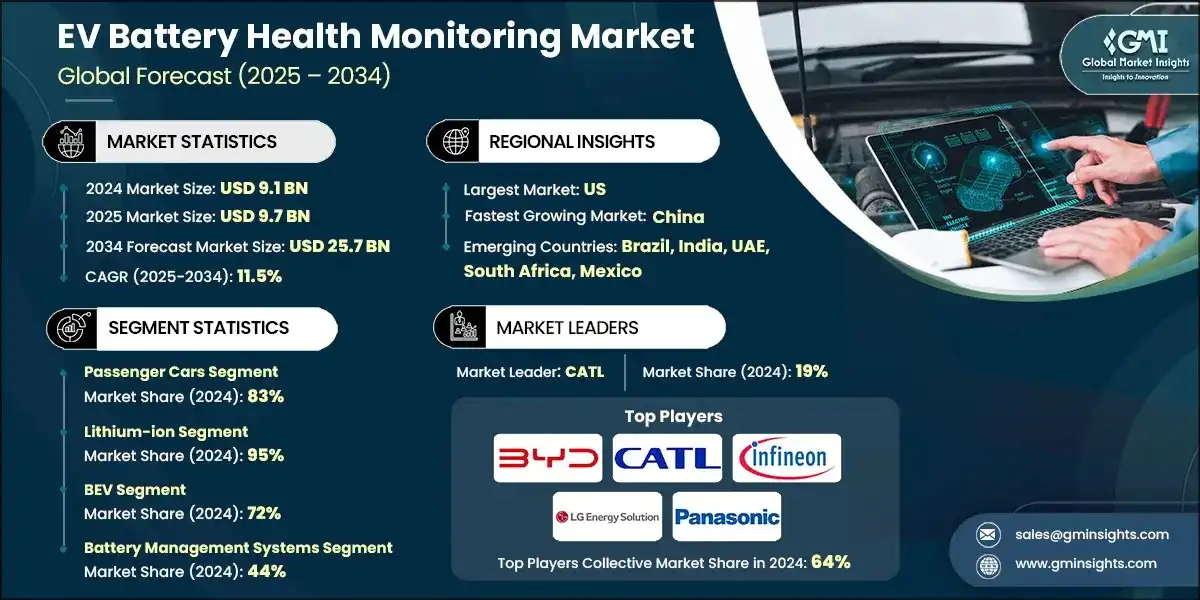
The global EV battery health monitoring market size was estimated at USD 9.1 billion in 2024. The market is expected to grow from USD 9.7 billion in 2025 to USD 25.7 billion in 2034, at a CAGR of 11.5% according to latest report published by Global Market Insights Inc.
EV Battery Health Monitoring Market Key Takeaways
Market Size & Growth
- 2024 Market Size: USD 9.1 Billion
- 2025 Market Size: USD 9.7 Billion
- 2034 Forecast Market Size: USD 25.7 Billion
- CAGR (2025–2034): 11.5%
Regional Dominance
- Largest Market: US
- Fastest Growing Region: China
Key Market Drivers
- Growing adoption of connected EV platforms.
- Shift toward AI-driven battery diagnostics.
- Battery safety regulations and transparency mandates.
- Growth of electrified commercial fleets.
Challenges
- High cost of advanced monitoring hardware.
- Variability in battery chemistries and designs.
- Thermal safety concerns.
- Data security and privacy issues.
Opportunity
- Expansion of second life and recycling markets.
- Growth in APAC EV manufacturing.
- Charging infrastructure integration.
- Predictive maintenance services for fleets.
Key Players
- Market Leader: CATL led with over 19% market share in 2024.
- Leading Players: Top 5 players in this market include BYD, CATL, Infineon, LG Energy Solution, Panasonic, which collectively held a market share of 64% in 2024.
Get Market Insights & Growth Opportunities
The world is rapidly shifting towards EV, and there is a growing demand to have clear and real-time information about battery health. Because batteries make up as much as one-half of the vehicle cost, OEMs and fleets need the ability to monitor SOC/SOH to mitigate warranty claims, enhance safety, and customer confidence. This pressure to have data-driven battery visibility is driving the implementation of advanced health monitoring systems.
Predictive maintenance supporting AI and ML are changing the way EV batteries are operated, with digital twins and degradation models predicting breakdowns and optimizing charges and preventing thermal incidents. All of these capabilities lower operational downtime, increase battery life, and increase fleet reliability. With the shift to software-defined batteries, predictive analytics platforms are now essential, and this is generating significant market growth across the world.
Companies operating in the market are launching new battery management chipset to support battery monitoring, providing significant market opportunities over forecast timeframe. In October 2025, NXP introduces the first battery management system (BMS) chipset that has built-in Electrochemical Impedance Spectroscopy (EIS). It uses precise hardware synchronization for all battery cell measurements within one high-voltage battery pack. This new system aims to improve safety, lifespan, and performance in electric vehicles and energy storage systems. It integrates EIS measurement directly into three BMS chipset units, allowing carmakers to gain better insights into battery health and behavior.
The governments of the world are increasing the battery safety and transparency of the lifecycle and recycling regulations of EV, which compel OEMs and mobility operators to implement advanced monitoring tools. The recycling and second-life markets have a need in the accurate counts of the remaining useful life, which introduces the need of battery diagnostics. Continuous health monitoring is being embraced rapidly by the battery value chain due to regulatory pressure, both on the production phase and end-of-life phases.
The commercial fleets like logistics, ride-hailing, rental and shared-mobility services are becoming more heavily depending on continuous battery intelligence with electrification. High-utilization fleets have the priority of real-time monitoring, to lower their operating cost, control their charging behavior, and avoid unplanned vehicle breakdowns. Telematics, cloud environments, and sophisticated technology in BMS is also increasingly becoming a necessity and accelerates implementation of monitoring solutions.
The fastest-growing market is the APAC because of its leading EV and battery production base, fast uptake of smart BMS, and powerful government-imposed electrification goals. China, South Korea, and Japan are the leaders in cell manufacturing and EV export that stimulates the need in innovative diagnostics. The growth of the fleet of public mobility and the limitations of the safety policy is also contributing to an increased rate of battery health monitoring systems adoption.
North America has a large market share due to strong OEM investments, a well-developed connected vehicle ecosystem, and the quick rollout of software-defined battery platforms. The region excels in AI-driven analytics, telematics integration, and the adoption of premium EVs. Federal incentives, growing gigafactories, and strict safety regulations highlight the need for reliable battery monitoring, which strengthens its leadership in the region.
To get key market trends
EV Battery Health Monitoring Market Trends
The use of EV all over the world is increasing at a high rate and this can lead to the use of real-time battery monitoring to ensure safety, reliability and optimal performance. Having batteries as a considerable part of EV prices, OEMs and fleet operators need to have precise SOH/SOC diagnostics, which will curb warranty claims, avoid degradation, and enhance the lifecycle management to accelerate the uptake of sophisticated monitoring solutions in all vehicle categories.
Battery management is changing with AI- and ML-based predictive maintenance that predicts battery degradation, eliminates thermal events, and charges batteries optimally. Digital twin technologies enable OEMs and fleet operators to model battery behavior in different scenarios, minimizing downtime and increasing battery life. The growing use of software-based intelligence is generating a high demand in cloud-enabled platforms with AI-based features of battery health monitoring.
Strict battery safety and lifecycle laws are being enforced worldwide and are forcing the automakers to implement sophisticated monitoring systems. Governments need meticulous reporting, thermal controls and fault detection whereas second life and recycling markets expect precise determination of remaining useful life (RUL). OEMs, energy storage providers and fleet operators are being pushed by compliance and traceability requirements to use integrated battery health monitoring systems.
The growing electrification of commercial fleets (ride-hailing, delivery, and rental) is driving up the need to have centralized battery intelligence. The real-time diagnostics is used to optimize the charging schedule, avoid unforeseen breakdowns, and minimize the costs of operation. Battery health monitoring is a crucial part of sustainable EV fleet management because fleet operators use monitoring solutions that are installed with telematics to enhance vehicle availability and ensure high service conditions.
The increasing need for connected software-defined batteries is driving the uptake of sophisticated BMS and monitoring platforms. OTA updates, remote diagnostics, and intelligent analytics allow optimizing performance and providing warranty-level transparency. With OEMs standardizing connectivity and data-driven management, battery health monitoring systems are turning into the backbone of EV operation, the ability to predictive maintenance, fleet analytics, and integration with the charging infrastructure.
EV Battery Health Monitoring Market Analysis
Learn more about the key segments shaping this market
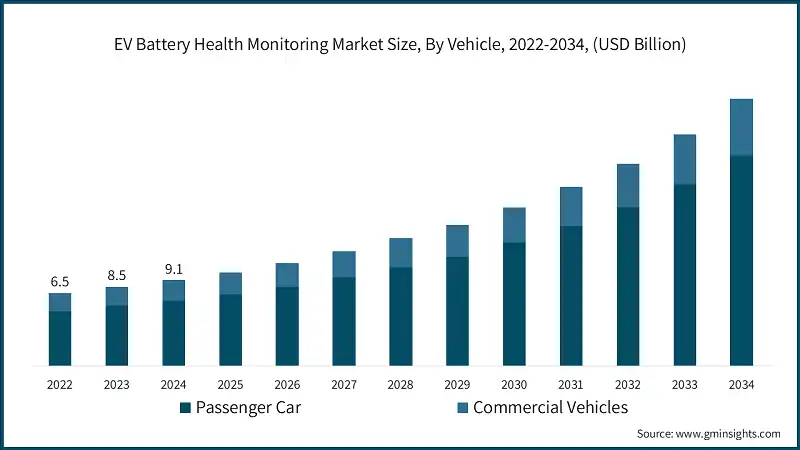
Based on vehicle, the EV battery health monitoring market is divided into passenger cars and commercial vehicles. The passenger cars segment dominated the market accounting for around 83% in 2024 and is expected to grow at a CAGR of over 11% from 2025 to 2034.
- The increasing adoption of EVs in the passenger car market by the mass-market is driving the requirement of precise and real-time health battery data. Having longer warranty terms, more safety guarantees, and predictable performance are a requirement of first-time EV buyers, thus advanced SOH/SOC algorithms are more frequently featured to minimize the risks of degradation and improve the trust of customers, and monitoring systems are becoming a significant distinguishing characteristic of consumer EV models.
- Premium passenger EVs are moving to software-based architecture, making more use of predictive analytics, digital twins, and cloud-based battery intelligence. These technologies maximize the range, charge behavior and thermal safety, which are significant buying variables of individual automobile purchasers. The quest to get advanced driving experience and less fuel consumption causes faster integration of high-level battery health management in mainstream and luxury passenger models.
- The incentives offered by the government to charge them at home, as well as tougher safety standards of personal EV, are increasing the demand to have constant battery checkups. The OEMs are motivated by the following factors to develop a more accurate monitoring system into passenger cars mandated safety reporting, early fault detection, and thermal event prevention, which, in turn, guarantee compliance and minimized warranty payouts, as well as greater brand reliability in the long-term perspective.
- The increasing consumer anxieties about range anxiety, battery life, and charging quickness are compelling car manufacturers to incorporate smarter BMS and real-time monitoring to passenger EVs. State-of-health is estimated accurately, which contributes to the consistency of ranges and eliminates drops in performance with time. Increased transparency provided by smartphone applications and dashboards in vehicles also increase the use of monitoring technologies.
- Growth of EV subscription, leasing offerings, as well as shared personal mobility vehicles necessitate complex battery life management to regulate depreciation and residual worth danger. The leasing business and OEMs can evaluate the usage patterns, charging behavior and degradation more precisely due to monitoring systems, enhancing the asset valuation and making the models of passenger EV ownership financially more alluring.
Learn more about the key segments shaping this market
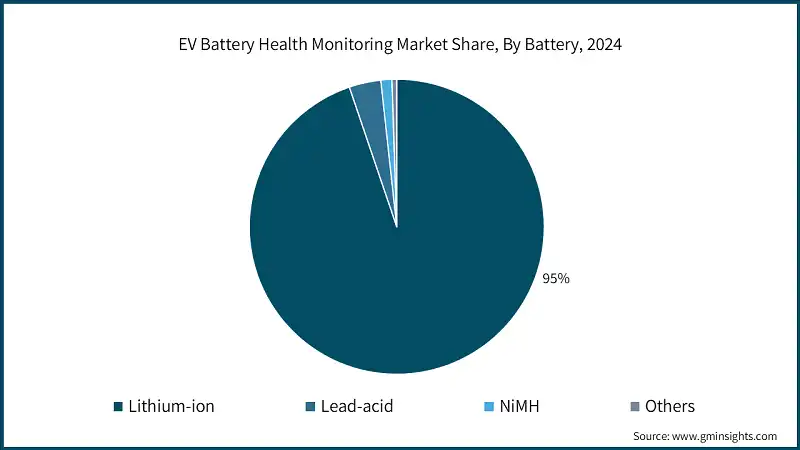
Based on battery, the EV battery health monitoring market is segmented into lithium-ion, lead-acid, NiMH, and others. The lithium-ion dominates the market with 95% share in 2024, and the segment is expected to grow at a CAGR of 11.5% from 2025 to 2034.
- The prevalence of lithium-ion batteries in EVs heightens the need to be able to monitor important aspects of health because the performance of this technology directly influences the range, safety, and warranty costs. OEMs are characterized by high energy density, sensitivity to temperature, and voltage imbalance, and charge cycles, which need sophisticated diagnostics to safeguard the cells, enhance lifetime, and maintain a high level of uniform performance under various driving and climatic conditions.
- Increased usage of high-charge infrastructure is exerting more thermal and chemical stress on lithium-ion cells and increasing the real-time monitoring urgency. More sophisticated systems that measure the distribution of heat, charge rates, and degradation pathways allow safer fast charging to reduce the risks of lithium-plating and capacity loss. This increases the convenience of charging a consumer besides ensuring reliability and long-term durability of the battery.
- Due to the increasing consumption of high-nickel chemistries, including NMC and NCA, thermal and structural management in lithium-ion batteries becomes sophisticated. Health monitoring systems that have the ability to detect micro-level degradation, cathode degradation, and heat runaway risks are necessary. The transition to energy-dense chemistries motivates robust uptake of advanced measurement ICs and analytics and monitoring intervention platforms, which are BMS-integrated.
- Growth of second-life use cases of lithium-ion batteries - e.g. stationary storage and microgrid systems - generates the need to precisely estimate SOH and RUL. Monitoring systems are useful to assess the residual capacity, cycle history, and safety parameters in anticipation of repurposing. With the scale of reuse markets, strong diagnostics will be core to the extraction of values, the lifecycle traceability and the regulatory compliance.
- The shift to OEM concentration on battery warranties and performance guarantees is a factor that will boost the demand of lithium-ion battery health monitoring. Warranty claims are commonly the result of degradation and therefore closer monitoring of charge cycles, temperature exposure and stress of the usage can assist a manufacturer in anticipating failures and minimal liability. This boosts the confidence of the customers and allows more profitable and data-driven battery warranty approaches.
Based on propulsion, the EV battery health monitoring market is segmented into BEV, PHEV, and HEV. The BEV segment dominated the market, accounting for share of 72% in 2024.
- BEVs do not have a propulsion system, so real-time monitoring is necessary to predict the range of the vehicle, maintain stability in performance, and increase safety. With the need of consumers to operate longer distances and with more reliability, OEMs are advancing the use of advanced SOH, SOC, thermal and cell-level diagnostics to guarantee optimal battery usage and increase long-term durability in a wide array of driving environments.
- The drive to 500-800 km long-range BEVs places more strain on battery packs particularly during high load acceleration and frequent fast charging. High-tech health monitoring systems need to monitor early degradation, keep the range accurate, and permit foretelling maintenance. This guarantees high consumer confidence, adds value to the BEV models and lessens financial exposure to warranty among automakers.
- Extensive use of 150-350 kW fast chargers exposes the BEV batteries to a lot of thermal strain. OEMs also combine advanced monitoring and real-time thermal modeling, current detection, and predictive safety algorithms to avoid the lithium plating, overheating, and rapid aging. This enables BEVs to charge quicker besides not compromising on performance, safety, and long-term cycle life.
- The growing global network of BEVs, such as personal vehicles, fleets, and mobility services, is a pressing need today to have monitoring tools that predict future battery failure and even optimize the maintenance routines. Predictive analytics systems assist operators in determining the degradation patterns, enhancing the uptimes, and optimizing the vehicle performance. With large scale BEVs, analytics-driven battery health data is required to achieve operational reliability.
- Contemporary BEVs are progressively based on over-the-air updates, connected to the cloud, and controlled by AI. This change drives the need to have smart battery health management that allows remote diagnostics, charging optimization, and data-driven lifecycle management. The shift towards software-defined EVs converts battery information into a performance tool, which prompts a high demand of sophisticated monitoring solutions.
Based on technology, the EV battery health monitoring market from battery management systems, monitoring & diagnostic, AI/ML & cloud-based analytics, fleet telematics & remote monitoring, aftermarket diagnostic solutions, and others. Battery management systems segment is leading the market with 44% share in 2024.
- The EVs of the next generation are based on high-energy-density batteries, which need high-resolution cell-level monitoring to identify imbalances, eliminate thermal incidents, and ensure consistent performance. The more advanced architectures of BMS offer high-resolution voltage, temperature, and impedance measurements to predict the SOH better. With automakers driving towards longer range and faster charging, the need to have more accurate and intelligent BMS solutions gains rapid momentum.
- The movement of OEMs towards centralized domain-based EV architectures, rather than distributed electronics, is generating a high demand in more sophisticated BMS platforms. The following next-generation architecture necessitates high-speed data interchange, cybersecurity abilities, and centralized diagnostics. This development transforms BMS into an essential organizer of holistic battery intelligence, which causes uptake in high-end and mass-market EVs.
- Since EVs are transitioning to ultra-fast charging (150-350 kW), heat builds up on batteries. Continuous thermal modeling, heat map coordination and advanced thermal modeling of the BMS are necessary to avoid lithium plating and accelerated degradation. The development of worldwide fast-charging networks enhances the business argument of the solutions of high precision of the BMS that ensure safety, quickness in charging and durability of the battery health.
- The advanced battery monitoring and fault-isolation are obligatory because of the new safety frameworks, including UNECE R100, ISO 26262, and the Chinese GB standards. BMS needs to identify situation of thermal runaway at the initial stages, overcurrent and unusual degradation trends. These compliance forces are propelling OEMs to invest in more comprehensive, analytics-based BMS that increase adoption in passenger cars, fleets, and commercial EV platforms.
- AI-based BMS systems provide better SOC/SOH prediction, fault detection, and degradation models and information. Learning based on real-world patterns of usage increases range accuracy as well as increases battery life. With the growing use of software-defined EV strategies by automakers, AI-based BMS systems are required to support constant monitoring, OTA software updates, and smart battery optimizations.
Looking for region specific data?
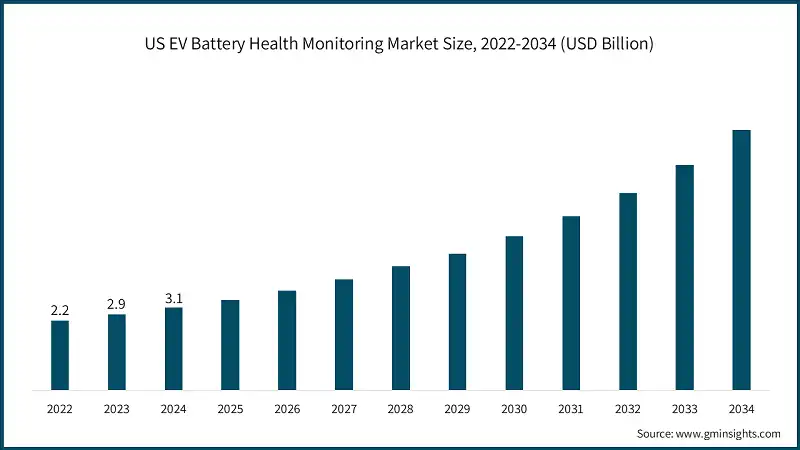
US dominated the EV battery health monitoring market in North America with around 86% share and generated USD 3.1 billion in revenue in 2024.
- The EV adoption rate is high in the US market due to tax cuts provided by the Inflation Reduction Act, state-level incentives, and clean mobility requirements across the country. With the influx of EVs in the market, OEMs and fleet operators are seeking more sophisticated battery health management systems to achieve safety, warranty management optimization, and reliability in the long-term curve of operation in various driving conditions.
- Ride-hailing, rental, last-mile delivery, and government fleet electrification programs are growing fast in the US Fleet operator can focus on predictive battery analytics to minimize unexpected downtimes, increase battery life, and minimize operating expenditures. This creates a high demand on real time SOH/SOC monitoring, thermal control information, and cloud-connected diagnostics that are specific to high-utilization EV fleets.
- NHTSA, UL standards and emerging federal safety systems demand strong battery monitoring features to identify early failure trends, avoid thermal incidents and increase reaction to accidents. These laws drive car manufacturers to more advanced, AI-based surveillance. Strict compliance levels reinforce the use of advanced BMS, onboard sensors, and real-time diagnostic board in all the key EV models.
- High-power fast chargers currently being rolled out in rapid amounts using federal NEVI funds result in greater battery thermal and chemical loads, and more sophisticated monitoring is necessary to safeguard battery packs. The current State of OEMs and charging operators in the US is dependent on real-time thermal modeling, impedance mapping, and charging behavior analytics to control the degradation, and this aspect requires intelligent battery health monitoring technologies.
- Software-defined vehicle architecture is fast becoming the new technology that US car manufacturers embrace, demanding ongoing analytics, cloud connectivity, and battery diagnostics (OTA). This change makes real-time battery health data be part of vehicle performance, warranty optimization, and customer experience. With embedded and cloud-based monitoring now the norm, the use of scalable battery intelligence platforms picks up speed in the American EV market.
The EV battery health monitoring market in Italy is projected to grow at a strong CAGR of 13.6% from 2025 to 2034, driven by accelerating EV adoption, strict battery safety compliance under EU regulations, rapid expansion of charging infrastructure, and rising demand for advanced diagnostics.
- The market of EV battery health monitoring in Italy is undergoing a very high growth rate because of the European battery safety standards such as the UNECE rules and new traceability requirements. These policies involve regular checking of SOH, thermal stability and charging behavior. Since OEMs and fleet operators in Italy are changing, the need to rely on advanced diagnostics, cloud analytics, and certified BMS platforms is also in high demand, which will speed up market penetrations.
- The initiative by Italy to electrify buses, municipal fleets and mobility services in the region is a plus to the acquisition of real-time battery monitoring. Predictive diagnostics are valued by the public transit authorities to increase the availability of fleets, fewer failures, and sustainability goals. The extensive electrification, driven by government subsidies, brings about an immense pressure in the need to have monitoring platforms that would maximize battery lifecycle execution in the increasing electric transportation systems in Italy.
- The increase in electric passenger cars in big cities in Italy, such as Milan, Rome, Bologna, promotes the necessity to obtain precise battery health data. With the increase in the number of public and private fast-charging stations, operators need monitoring devices to address the degradation caused by charging. The urban energy ecosystem will intensify the need to BMS intelligence, telematics-connected, diagnostics, and lifecycle modeling to provide safety and consistency in range.
- Italian car makers and mobility operators are incorporating AI-powered battery analytics to make cars more reliable and customer-oriented. Predictive health monitoring enhances warranty optimization, lower unplanned service events as well as enhances energy efficiency. When OEMs, technology suppliers and energy suppliers work closely, it will be possible to implement next-generation BMS solutions that suit the varied vehicle and climatic factors in Italy.
China’s EV battery health monitoring market reached over USD 884 million in 2024, driven by the country’s massive EV production scale, rapid integration of intelligent BMS platforms, strong government mandates for battery safety and traceability, and widespread adoption of connected-car ecosystems enabling real-time diagnostics, predictive analytics, and telematics-linked battery monitoring across major domestic OEMs and urban mobility networks.
- Strictness of GB standards and the current national systems of traceability of battery in China require real-time monitoring, thermal risk detection and diagnostics of early failures. These policies entail the usage of sophisticated BMS and cloud analytics by OEMs. There is also high regulatory regulation and high-scale EV adoption, which makes China one of the most ambitious users of battery health monitoring technologies in the world.
- As the most popular OEMs, including BYD, NIO, XPeng, and SAIC, switch to high-intelligence BMS design, the requests to have advanced monitoring tools are on the increase. These manufacturers are based on AI models, onboard sensors and cloud diagnostics to support fast-charging, battery safety and long warranties. Technological leadership in the country propels the use of advanced battery health management in the country.
- Cities like Shanghai, Shenzhen, and Guangzhou are electrifying cabs, ride-hailing fleets, logistics vans and government vehicles. Predictive monitoring is required to minimize downtime and enhance the battery lifecycle, as well as to maintain the thermal stability of the device in high utilization. The operationally intensive, large-scale ecosystem brings significant demand to SOH analytics in real-time and fleet wide battery performance dashboards.
- The aggressive implementation of the ultra-fast charging stations by China accelerates the demand of sophisticated thermal and chemical stress monitoring. Battery analytics enable operators to reduce degradation and facilitate the best charging practices. The operation of fast-charging along the routes of the public, private, and highway stimulates the dependence on monitoring platforms that can examine the trends of impedance, patterns of heat generation, and charge-cycle character.
The electric vehicle (EV) battery health monitoring market in Mexico reached over USD 170 million in 2024, powered by growing EV adoption in urban corridors, increased deployment of telematics-linked BMS platforms, rising demand for predictive battery diagnostics among fleet operators, and deeper integration of connected-vehicle technologies by domestic and global OEMs to enhance safety, reliability, and lifecycle visibility.
- The rapid adoption of EVs in Mexico, particularly in Mexico City, Guadalajara, and Monterrey, creates the need to develop proper battery monitoring solutions. With the growing popularity of charging networks and city-driven electrification projects, OEMs and fleet operators invest in SOH monitoring, thermal monitoring, and predictive analytics to enhance the performance, drive down operational risks, and increase battery reliability in the diverse climatic conditions of Mexico.
- Electrifying the delivery vans, corporate fleets, and ride-hailing services are putting greater strain on the batteries by overloading them. The Mexican fleet operators need sophisticated monitoring systems to control charge cycles, maintain optimized maintenance schedule and retain residual value. This transition increases the need to use cloud-to-diagnostic and BMS technologies oriented towards intensive urban use.
- The continued adoption of telematics in Mexico to manage fleet visibility and safety is expanding to battery health analytics. Integrated dashboards that consist of vehicle data, charging patterns and degradation modeling have become standard in OEMs and operators. Such an expanding digital ecosystem increases the adoption of monitoring solutions, which deliver real-time notifications, predictive failure data, and frequency optimization.
The EV battery health monitoring market in Saudi Arabia is projected to grow at a CAGR of 8.6% from 2025 to 2034, driven by the country’s accelerating EV transition, rising demand for advanced battery diagnostics to support harsh-climate performance, expanding insurance telematics frameworks, and national initiatives focused on safety, reliability, and optimized fleet efficiency across public and private sectors.
- The national targets of Saudi Arabia on sustainability and increasing investments of EVs promote the demands of more sophisticated battery monitoring technologies. With the electrification of government fleets, public transport, and individual mobility services, real-time diagnostics will be a necessary factor in working in severe desert conditions. Such a move fuels the move towards monitoring platforms to enhance safety, thermal efficiency, and extended battery life.
- The implementation of large-scale charging infrastructure in Riyadh, Jeddah, NEOM, and highway corridors raises concern of the intelligent monitoring to control the accumulation of heat and charging pressure as well as variation in performance. SOH/SOC analytics and predictive models are becoming more and more popular among operators as a way to make charging strategies and battery stability more efficient in the extreme temperatures.
- The increasing need of telematics in the logistics, rental, and corporate fleet in Saudi Arabia provides the possibility of integrating battery health monitoring. Real-time diagnostics allow the fleet operators to reduce the number of breakdowns, prolong the battery life, and meet the changing national standards. This ecosystem has been spurring the uptake of singular platforms that integrate driving behavior analytics, battery intelligence, and operational efficiency applications.
EV Battery Health Monitoring Market Share
- The top 7 companies in the EV battery health monitoring industry are CATL, BYD, LG Energy Solution, Panasonic, Analog Devices, Infineon, and LEM International, collectively contributing around 73% of the market in 2024.
- CATL remains highly competitive by integrating cell-level sensors, AI-driven battery analytics, and digital twins across its battery platforms. The company is expanding BMS intelligence to enable real-time SOH and SOC diagnostics for automakers and energy storage partners. CATL also invests heavily in predictive maintenance algorithms and cloud-linked monitoring. This focus ensures superior lifecycle performance, safety, and fleet-scale monitoring capabilities for EV OEMs.
- BYD uses vertical integration to strengthen EV battery health monitoring. It embeds proprietary BMS, advanced failure detection, and thermal risk analytics into its Blade Battery architecture. The company improves remote diagnostic capabilities for fleets, deploys AI-based degradation prediction, and works with OEM partners to standardize data interfaces. BYD’s focus on safety analytics and continuous over-the-air BMS updates keeps it competitive in the market.
- LG Energy Solution boosts its competitiveness through high-precision cell sensing technologies, cloud-connected diagnostic platforms, and partnerships with OEMs for data integration. The company develops next-generation BMS modules that can detect anomalies early and improve SOH forecasting. By investing in AI-powered monitoring software and cybersecurity-focused battery data systems, LG ES enhances reliability and analytical depth across global EV programs.
- Panasonic improves EV battery health monitoring by developing high-accuracy sensors, enhanced BMS firmware, and advanced thermal prediction models. The company works closely with automakers to create integrated monitoring stacks that support long-term degradation tracking. Panasonic also invests in smart cloud diagnostics, better data telemetry systems, and embedded analytics to ensure safer, longer-lasting EV battery performance worldwide.
- Analog Devices stays competitive by providing precision battery sensing ICs, high-voltage monitors, and signal-processing technologies that are central to modern BMS platforms. Its innovations in cell balancing, current measurement, and diagnostics support real-time SOH evaluation. ADI also integrates AI-enabled edge monitoring and cybersecurity features, which enable more accurate, long-lasting, and safer EV battery health management for major OEMs and Tier-1 suppliers.
- Infineon strengthens its position by offering strong semiconductor solutions for EV BMS, including battery sensor ICs, microcontrollers, and power electronics that improve thermal and electrical stability. The company develops advanced algorithms for battery state estimation, which allow for safer and more efficient monitoring. Infineon’s focus on functional safety, cybersecurity, and cloud-ready analytics gives it a strong stance within next-generation EV battery monitoring.
- LEM International remains competitive by providing high-accuracy current and voltage sensors that are essential for advanced EV BMS architectures. Its sensors enable precise SOH and SOC estimation, thermal risk detection, and real-time performance monitoring. LEM continues to innovate with compact, high-efficiency sensor platforms optimized for EVs. It collaborates with OEMs to integrate deeper analytics, enhancing reliability and battery lifecycle insights.
EV Battery Health Monitoring Market Companies
Major players operating in the EV battery health monitoring industry are:
- Analog Devices
- BYD
- CATL
- Continental
- Infineon
- LEM International
- LG Energy Solution
- Panasonic
- Samsung SDI
- Texas Instruments
- The electric vehicle battery health monitoring market is becoming more competitive as cell manufacturers, semiconductor companies, and analytics experts come together to create integrated monitoring systems. Leading firms are developing AI-driven BMS platforms that combine high-precision sensors, digital twins, and cloud-based analytics to improve State of Health and thermal safety assessments. Strategic partnerships with EV OEMs, fleet operators, and charging network providers are speeding up innovation. At the same time, strong investments in predictive maintenance and real-time diagnostics help companies stand out in global markets.
- Competition is increasing through vertical integration. Leading battery manufacturers are adding their own monitoring software, edge intelligence, and strong cybersecurity measures into their battery designs. Technology suppliers are creating next-generation ICs, embedded analytics, and data frameworks that work together, supporting over-the-air diagnostics and lifecycle optimization. Companies are prioritizing accuracy, safety, and scalability, allowing for better predictions for first-life, fleet, and second-life battery uses. Ongoing improvements in sensing, cloud telemetry, and AI modeling define the leaders in this market.
EV Battery Health Monitoring Market Report Attributes
| Key Takeaway | Details |
|---|---|
| Market Size & Growth | |
| Base Year | 2024 |
| Market Size in 2024 | USD 9.1 Billion |
| Market Size in 2025 | USD 9.7 Billion |
| Forecast Period 2025 – 2034 CAGR | 11.5% |
| Market Size in 2034 | USD 25.7 Billion |
| Key Market Trends | |
| Drivers | Impact |
| Growing adoption of connected EV platforms | Real-time cloud-linked battery data improves SOH/SOC accuracy, enhances preventive maintenance, boosts vehicle uptime, and drives adoption of integrated battery health monitoring tools across OEMs and fleets. |
| Shift toward AI-driven battery diagnostics | Digital twins, anomaly detection, and ML-based degradation modelling reduce warranty claims, predict failures, optimize charging cycles, and extend battery life. |
| Battery safety regulations and transparency mandates | Stricter global standards require early fault detection, lifecycle reporting, and traceability, pushing OEMs to implement advanced health monitoring across EV models. |
| Growth of electrified commercial fleets | Delivery, rental, and mobility fleets rely on real-time diagnostics to minimize downtime, optimize charging, and maintain high operational efficiency. |
| Pitfalls & Challenges | Impact |
| High cost of advanced monitoring hardware | Sensor-rich BMS modules and cloud platforms increase costs, limiting adoption in cost-sensitive EV segments. |
| Variability in battery chemistries and designs | Diverse cell formats require customized monitoring algorithms, complicating standardized deployment. |
| Thermal safety concerns | Rising EV fire risks require sophisticated thermal mapping, but lack of universal standards delays implementation. |
| Data security and privacy issues | Cloud-linked battery data increases cybersecurity requirements for safe OTA updates and telematics integration. |
| Opportunities: | Impact |
| Expansion of second life and recycling markets | Accurate RUL diagnostics enable battery repurposing, accelerating demand for advanced monitoring tools. |
| Growth in APAC EV manufacturing | China, Japan, and South Korea drive large-scale adoption of embedded diagnostics throughout production and fleet usage. |
| Charging infrastructure integration | Smart charging platforms rely on real-time battery health inputs to optimize load, boost charging speed, and support V2G services. |
| Predictive maintenance services for fleets | Subscription-based analytics and monitoring create recurring revenue opportunities for OEMs and telematics providers. |
| Market Leaders (2024) | |
| Market Leaders |
19% market share |
| Top Players |
Collective Market Share is 64% |
| Competitive Edge |
|
| Regional Insights | |
| Largest Market | US |
| Fastest growing market | China |
| Emerging countries | Brazil, India, UAE, South Africa, Mexico |
| Future outlook |
|
What are the growth opportunities in this market?
EV Battery Health Monitoring Industry News
- In October 2024, LG Energy Solution took an important step to change how electric vehicle (EV) batteries are measured. It launched B. once, a battery diagnostic platform. This service identifies key battery health factors, such as remaining capacity, voltage, and temperature, every 5 minutes. It uses the company’s top battery management system (BMS) design capabilities, backed by over 10,000 patents globally, to bring speed, precision, and scale to the used EV market.
- In January 2025, BatteryOK Technologies introduced its AI-enabled EV Doctor to over 1,500 EV service centers in India and other countries. This hand-held diagnostic device generates accurate battery health reports in just 15 minutes. It can also integrate analytics, warranty rights, and service revenues for dealers.
- In December 2024, IDTechEx reported that AI-assisted diagnostics are transforming EV battery management. By uploading battery management system (BMS) data to the cloud for machine learning analysis, problems caused by battery degradation can be detected early. This can improve battery life by 10 to 20 percent at times and help fleets using diagnostic-based services reduce their insurance costs.
- In May 2024, German supplier MAHLE launched its E-HEALTH Charge diagnostic system. This system is built into a DC charger and assesses the condition of EV batteries in 15 minutes. It is especially useful for workshops and fleet operators, as it can quickly provide accurate battery health data for any vehicle make or model in under 15 minutes.
The EV battery health monitoring market research report includes in-depth coverage of the industry with estimates & forecasts in terms of revenue ($ Mn/Bn) and shipment (Units) from 2021-2034, for the following segments:
Market, By Battery
- Lithiumion
- Lead acid
- NiMH
- Others
Market, By Propulsion
- BEV
- PHEV
- HEV
Market, By Vehicle
- Passenger car
- Hatchback
- Sedan
- SUV
- Commercial vehicle
- Light duty
- Medium duty
- Heavy duty
Market, By Technology
- Battery management systems
- Monitoring & diagnostic
- AI/ML & cloud-based analytics
- Fleet telematics & remote monitoring
- Aftermarket diagnostic solutions
- Others
Market, By Application
- First-life vehicle operation
- Fleet management
- Charging infrastructure integration
- Vehicle-to-grid services
- Others
Market, By End Use
- Automotive OEMs
- Fleet operators
- Battery manufacturers & suppliers
- Charging infrastructure providers
- Aftermarket service providers
- Others
The above information is provided for the following regions and countries:
- North America
- US
- Canada
- Europe
- UK
- Germany
- France
- Italy
- Spain
- Russia
- Nordics
- Asia Pacific
- China
- India
- Japan
- South Korea
- ANZ
- Southeast Asia
- Latin America
- Brazil
- Mexico
- Argentina
- MEA
- South Africa
- Saudi Arabia
- UAE
Frequently Asked Question(FAQ) :
What is the market size of the EV battery health monitoring in 2024?
The market size was USD 9.1 billion in 2024, with a CAGR of 11.5% expected through 2034. The increasing adoption of EVs and the need for real-time battery health insights are driving market growth.
What is the projected value of the EV battery health monitoring market by 2034?
The market is poised to reach USD 25.7 billion by 2034, driven by advancements in AI-based predictive maintenance, digital twin technologies, and stringent battery safety regulations.
What is the expected size of the EV battery health monitoring industry in 2025?
The market size is projected to reach USD 9.7 billion in 2025.
How much revenue did the passenger car segment generate in 2024?
The passenger car segment dominated the market, accounting for approximately 83% of the share in 2024.
What was the market share of lithium-ion batteries in 2024?
Lithium-ion batteries held a dominant 95% market share in 2024, driven by their high energy density and widespread adoption in EVs.
What is the growth outlook for the battery management systems segment from 2025 to 2034?
The battery management systems segment is set to grow at a CAGR of 11.5% till 2034, fueled by the demand for high-resolution monitoring and advanced architectures.
Which region leads the EV battery health monitoring sector?
The United States leads the North American market with an 86% share, generating USD 3.1 billion in revenue in 2024. This growth is supported by tax incentives, state-level benefits, and clean mobility initiatives.
What are the upcoming trends in the EV battery health monitoring market?
Key trends include AI/ML-driven predictive maintenance, digital twins, cloud-based platforms, OTA updates, remote diagnostics, and stricter global battery safety compliance.
Who are the key players in the EV battery health monitoring industry?
Key players include Analog Devices, BYD, CATL, Continental, Infineon, LEM International, LG Energy Solution, Panasonic, Samsung SDI, and Texas Instruments.
EV Battery Health Monitoring Market Scope
Related Reports