Summary
Table of Content

Europe Veterinary Assistive Reproduction Technology Market
Get a free sample of this report
Form submitted successfully!
Error submitting form. Please try again.
Thank you!
Your inquiry has been received. Our team will reach out to you with the required details via email. To ensure that you don't miss their response, kindly remember to check your spam folder as well!
Request Sectional Data
Thank you!
Your inquiry has been received. Our team will reach out to you with the required details via email. To ensure that you don't miss their response, kindly remember to check your spam folder as well!
Form submitted successfully!
Error submitting form. Please try again.
Europe Veterinary Assistive Reproduction Technology Market Size
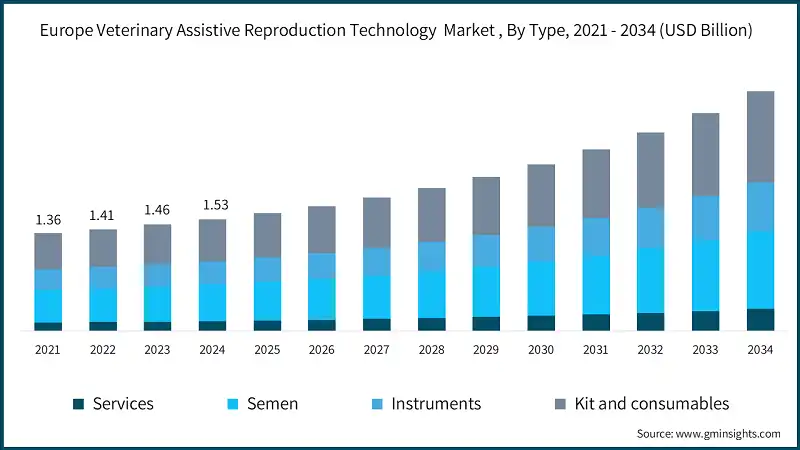
The Europe veterinary assistive reproduction technology market was estimated at USD 1.5 billion in 2024. The market is expected to grow from USD 1.6 billion in 2025 to USD 3.1 billion in 2034, at a CAGR of 7.7%, according to the latest report published by Global Market Insights Inc. To improve productivity and meet rising demands for meat and dairy, assistive reproduction technologies are being widely adopted to enhance reproductive efficiency and herd quality.

To get key market trends
As per the United Nations Food and Agriculture Organization (FAO) estimates, by 2050, the demand for food will grow by 60% and between 2010 and 2050, production of animal proteins is expected to grow by around 1.7% per year, with meat production projected to rise by nearly 70% and dairy by 55%. As per Statista, Germany consumes the most meat per capita across Europe, with about 50 kilograms of meat consumed annually. Such growing demand for animal products is fostering market growth.
Veterinary ART helps increase the productivity of livestock and the number of offspring to meet the growing demand for meat and milk. By employing superior genetic materials and facilitating accelerated breeding cycles, ARTs enhance the yield of milk and meat products to meet the increased consumption. In many countries, government and agricultural institutions provide subsidies and livestock-related programs that support the technologies, thus fueling market growth.
Veterinary assistive reproductive technology (ART) is an advanced breeding technology used to enhance the reproduction processes in animals by using techniques such as artificial insemination (AI), in vitro fertilization (IVF), embryo transfer (ET), and other technologies. The leading market players in the Europe veterinary ART market include Genus Plc, CRV Holding B.V., URUS Group LP, SEMEX, and IMV Technologies. These players fuel market expansion by creating creative ART solutions, increasing access to specialized equipment, providing veterinarians with training and services, and making R&D investments to enhance efficiency and success rates.
During 2021-2023, the Europe veterinary ART market grew steadily with support from technological and structural changes in breeding livestock, growing from USD 1.4 billion to USD 1.5 billion in 2023. Producers increasingly used sexed semen and genomic selection to improve herd genetics, shorten calving intervals, and increase productivity. Moreover, more extensive utilization of portable ART equipment and mobile veterinary services widened coverage in medium-sized farms, further boosting the adoption of ART across the region.
Europe Veterinary Assistive Reproduction Technology Market Report Attributes
| Key Takeaway | Details |
|---|---|
| Market Size & Growth | |
| Base Year | 2024 |
| Market Size in 2024 | USD 1.5 Billion |
| Market Size in 2025 | USD 1.6 Billion |
| Forecast Period 2025 - 2034 CAGR | 7.7% |
| Market Size in 2034 | USD 3.1 Billion |
| Key Market Trends | |
| Drivers | Impact |
| Rising demand for genetic improvement in livestock | European livestock producers are increasingly turning to ART techniques to accelerate genetic progress. Superior genetics translate into higher milk yields, better feed efficiency, and enhanced disease resistance, directly improving farm profitability and sustainability. |
| Advancements in genomics and reproductive technologies | Integration of next-generation sequencing, sexed semen, and embryo grading technologies has significantly increased ART success rates, thereby further boosting adoption. |
| Rising government and industry support programs | Many European countries offer subsidies, breeding schemes, and regulatory backing for ART adoption. Schemes offering financial incentives and structured frameworks for using ART boost adoption rates. |
| Improved veterinary infrastructure and spending | Strong veterinary networks across Europe, coupled with rising veterinary spending in the region, are positively driving market growth. |
| Pitfalls & Challenges | Impact |
| High costs of ART procedures | ART involves sophisticated equipment, laboratory facilities, and specialized veterinarians, making it costly. Small and medium-scale farmers often struggle to justify these expenses, slowing market penetration outside large-scale operations. |
| Regulatory complexity across Europe | EU-level regulations are layered with diverse national rules, particularly regarding embryo transfer, gene editing, and cross-border trade of germplasm. This fragmented regulatory environment creates compliance burdens for service providers and limits scalability. |
| Opportunities: | Impact |
| Expansion into equine and companion animal sectors | Beyond livestock, ART is gaining traction in equine breeding and niche companion animal markets. High-value horse breeding and rising demand for reproductive services in pedigree dogs and cats will create lucrative opportunities for veterinary ART providers. |
| Emerging markets within Europe | Countries in Eastern and Southern Europe are under-penetrated compared to Western Europe. Establishing mobile ART units, regional embryo banks, and cross-border collaborations will provide significant growth in these regions. |
| Market Leaders (2024) | |
| Market Leaders |
18.4% market share. |
| Top Players |
Collective market share in 2024 is 48.5% |
| Competitive Edge |
|
| Regional Insights | |
| Largest Market | Germany |
| Fastest growing market | France |
| Emerging countries | Italy, Spain, Netherlands, and Poland |
| Future outlook |
|
What are the growth opportunities in this market?
Europe Veterinary Assistive Reproduction Technology Market Trends
- Technological advances are strategically influencing the growth of the market. Recent advances in cryopreservation, ovum retrieval (OPU) processes, and precision breeding are enhancing accessibility of ART for small clinics and large-scale farms alike.
- Moreover, advancements in the cold chain supply industry and the cryopreservation of semen are allowing the application to be more widespread, even in remote regions. These improvements have provided solutions to the problems hampering the preservation of semen samples during storage and transport, thus increasing success rates.
- Further, the demand for meat and dairy products has increased dramatically in recent decades, owing to high population growth, increased lifespan, and improved economic prosperity in the developing world.
- For instance, EU is the world’s largest milk producer, followed by the U.S. and India. In 2022, EU production of raw milk reached 160 million tonnes, 96 % of which was cows’ milk, with the remaining 4 % from sheep, goats and buffalos.
- Similarly, according to a November 2024 U.S. Department of Agriculture (USDA) report, European Union (EU) chicken meat consumption is projected to grow by 1.6% in 2024 and 0.5% in 2025.
- Furthermore, the increasing head of livestock, coupled with rising consumption trends of protein-rich foods, is bolstering the need for more sophisticated breeding techniques such as artificial insemination, in vitro fertilization (IVF), and embryo transfer (ET).
- Thus, as the demand continues to grow, livestock producers are increasing herd productivity and accelerating breeding cycles through the use of ART techniques.
Europe Veterinary Assistive Reproduction Technology Market Analysis
Learn more about the key segments shaping this market
Based on the type, the market is segmented into services, semen, instruments, and kits and consumables. The kits and consumables segment dominated the market in 2024 with a revenue of USD 565.6 million and is anticipated to witness growth at a CAGR of 7.9% between 2025 – 2034.
- Consumables such as semen extenders, embryo culture media, cryopreservation solutions, pipettes, and diagnostic kits are widely used in various ART techniques such as artificial insemination, embryo transfer, and IVF programs.
- Their frequent usage and the need for replenishment create a recurring revenue stream, thus boosting rapid segmental growth.
- The semen segment, on the other hand, accounted for the second-highest market share and was valued at USD 502.9 million in 2024, owing to its high importance in the artificial insemination process.
- The capability to harvest, treat, and preserve semen from genetically superior animals has significantly enhanced the efficiency of selective breeding programs. This not only optimizes herd genetics but also curtails the transmission of infectious diseases that are prevalent with natural mating.
- As a result, semen-based reproduction strategies are preferred by farmers and breeders to enhance livestock productivity and profitability.
Based on the technology, the Europe veterinary assistive reproduction technology market is categorized into artificial insemination (AI), in vitro fertilization (IVF), embryo transfer (MOET), and other technologies. The artificial insemination (AI) segment dominated the market and is anticipated to reach 2.3 billion by 2034. The in vitro fertilization (IVF) segment, on the other hand, is anticipated to witness robust growth at a CAGR of 8.7%. IVF offers the ability to generate multiple embryos from high-value donor females, significantly enhancing reproductive efficiency compared to traditional artificial insemination. Thus, the demand for advanced breeding solutions that deliver faster genetic improvement is driving the adoption of this technique.
- Due to its widespread use in various animal species, particularly in the livestock and dairy industries, the artificial insemination (AI) segment has the largest share of the veterinary assistive reproduction technology market.
- AI allows for the efficient scheduling of breeding seasons, decreases the requirement for multiple male breeding animals, and enables the distribution of genetically superior males to distant locations.
- In addition, the cost-effectiveness, reliability, and the low risk of injury or disease transmission compared to natural breeding are significant contributors to the AI segment’s market share.
- Moreover, several governmental initiatives aimed at increasing livestock yields have further increased the adoption of AI in routine veterinary practices.
Learn more about the key segments shaping this market
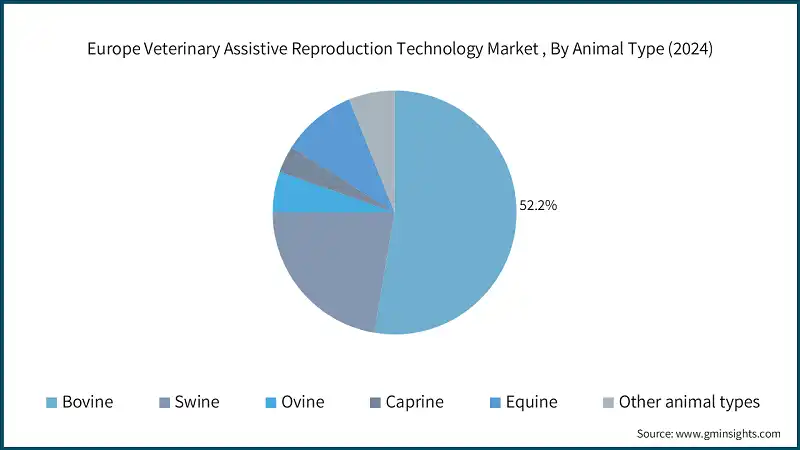
Based on the animal type, the Europe veterinary assistive reproduction technology market is categorized into bovine, swine, ovine, caprine, equine, and other animal types. The bovine segment dominated the market with 52.2% market share in 2024.
- There is considerable adoption of ART in bovine herds due to the demand for higher milk and beef production. These technologies allow breeders to improve genetic quality, productivity, and the hereditary disease rate of the herd, which increases the profitability and productivity of cattle farming.
- Moreover, growing demand for dairy and meat products is a major factor driving the adoption of veterinary assistive reproduction technologies in bovines.
- For example, as per the European Commission, the production of raw milk on the EU's farms was an estimated 160.8 million tonnes in 2023, representing a year-on-year increase of 0.8 million tonnes.
- Additionally, growing support from private and government entities within prominent cattle-raising countries has supported reproduction technology adoption, thereby further driving the segmental growth.
- The swine segment held the second largest market share of 22.6% in 2024 in the Europe veterinary assistive reproduction technology market owing to their large population and growing demand for pork in the region.
- For instance, in 2024, the European Union had 132 million pigs. Further, the EU is the world's second biggest producer of pork after China and the biggest exporter of pork and pork products.
Based on the end use, the Europe veterinary assistive reproduction technology market is classified into veterinary clinics and hospitals, animal breeding centers, research institutes and universities, and other end users. In 2024, the veterinary clinics and hospitals segment held the highest market share and is expected to showcase growth at a 7.4% CAGR over the analysis period.
- Veterinary clinics and hospitals play a crucial role in providing reproductive healthcare services for various animal species. These facilities offer specialized assistive reproductive technology (ART) procedures such as artificial insemination (AI), in vitro fertilization (IVF), embryo transfer, and semen cryopreservation, catering to livestock, companion animals, and exotic species.
- Moreover, increasing preference for veterinary clinics and hospitals can be attributed to the availability of advanced medical equipment in these facilities.
- Further, their established infrastructure and ability to offer comprehensive care position them as key contributors to the market's dominance in this segment.
Looking for region specific data?
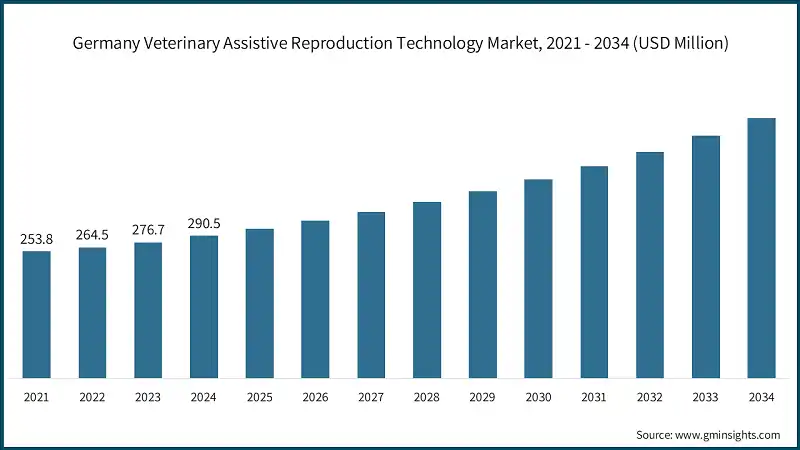
The Germany veterinary assistive reproduction technology market was valued at USD 253.8 million and USD 264.5 million in 2021 and 2022, respectively. The market size reached USD 290.5 million in 2024, growing from USD 276.7 million in 2023.
- Germany commands a dominant position in the market owing to the country's well-established veterinary infrastructure as well as extensive funding directed towards animal health services.
- The country boasts a large livestock population, having a substantial demand for more specialized reproductive services like artificial insemination, embryo transfer, and even in-vitro fertilization.
- As per Eurostat, in 2022, Germany accounted for 17% of the EU’s pigs and 15% of the EU’s bovines, 3% of the EU’s sheep and 1% of the EU’s goats.
- Further, German veterinary clinics and breeding centers are equipped with modern tools and facilities, which allow for the ready implementation of these technologies.
- Moreover, the presence of leading veterinary research institutions in the country further spurs market growth.
France is experiencing significant growth in the Europe veterinary ART market, primarily driven by its robust and advanced livestock industry.
- As per the European Commission, France accounted for 9% of the EU’s pigs, 23% of the EU’s bovines, 12% of the EU’s sheep and 12% of the EU’s goats.
- Artificial insemination, embryo transfer, and in vitro fertilization are being adopted increasingly by French farmers for improving herd quality, reproductive efficiency, and maximizing productivity.
- Growing focus on premium milk and meat production stimulates the application of these sophisticated reproductive technologies, leading to consistent market growth.
Netherlands has become a prime growth center in the Europe veterinary ART market.
- The widespread awareness concerning the veterinary healthcare industry, along with the well-established veterinary infrastructure within the country, is increasing the demand for veterinary ART services.
- Additionally, government and private initiatives aimed at improving animal health and breeding outcomes are creating a favorable environment for the adoption of these technologies across both commercial and small-scale farming operations.
Europe Veterinary Assistive Reproduction Technology Market Share
The market is highly competitive, with the presence of both established players, emerging companies, and several local and regional players focusing on innovation and technological advancements. The top 5 market players in the Europe veterinary ART market, including Genus Plc, CRV Holding B.V., URUS Group LP, SEMEX, and IMV Technologies, account for ~48.5% of the market. These industry players are noted to have undertaken certain strategic initiatives, such as product launches and approvals, assisting them in sustaining the market competition.
Additionally, there are several local and regional players operating in the market who are boosting competition by providing affordable options at lower costs. These players are also involved in several strategies, such as mergers, acquisitions, and novel product launches, to expand their product offerings.
Europe Veterinary Assistive Reproduction Technology Market Companies
Few of the prominent players operating in the Europe veterinary assistive reproduction technology industry include:
- Avantea
- AB Europe
- Besamungsstation Greifenberg
- Bovine Elite
- CRV Holdings
- Geno SA
- Genus Plc
- IMV Technologies
- Minitube Group
- SEMEX
- Select Sires
- STgenetics
- Stallion AI Services
- URUS Group
- VikingGenetics
- Genus Plc
Genus plc specializes in advanced breeding technologies for dairy, beef, and pork sectors. Operating through its subsidiaries Genus ABS (bovine genetics) and Genus PIC (porcine genetics), the company offers artificial insemination (AI), genomic testing, and reproductive services. The company serves over 85 countries and is recognized for its innovative approach to breeding and reproductive technologies.
CRV Holding is a Dutch cooperative specializing in cattle improvement, offering a comprehensive range of reproductive and genetic services. The company provides artificial insemination, embryo transfer, genomic testing, and herd management solutions. CRV's breeding programs focus on enhancing health, efficiency, and sustainability in dairy and beef herds. With a strong presence in Europe, CRV operates breeding centers in the Netherlands and collaborates with international distributors to serve global markets. The company emphasizes innovation and animal welfare in its breeding strategies.
URUS Group comprises of leading animal genetics and reproductive technology brands such as Alta Genetics, GENEX, and Trans Ova Genetics. The group offers a wide array of services, including artificial insemination, embryo transfer, in vitro fertilization, and genetic preservation. URUS focuses on providing sustainable and productive solutions for dairy and beef producers worldwide. Through its subsidiaries, URUS delivers advanced genetics, herd management tools, and reproductive services, playing a pivotal role in enhancing livestock productivity and genetic quality.
Europe Veterinary Assistive Reproduction Technology Industry News:
- In February 2025, Geno launched a campaign showcasing Norwegian Red cattle and the impact of AI and ET in improving fertility and sustainability. This highlighted advancements in the veterinary assistive reproduction technology market.
- In January 2024, Minitube in collaboration with UNEX, launched an Equine Embryo Transfer Course to enhance expertise in assisted reproduction. The program provides hands-on training in embryo collection, evaluation, and transfer techniques for improved equine breeding outcomes.
- In December 2023, ABS Global, a division of Genus Plc, partnered with Genes Diffusion in France to enhance bovine genetics and reproductive solutions. This collaboration aims to advance artificial insemination and genetic selection for improved herd productivity.
- In January 2023, CRV Holdings B.V. partnered with BullWise, making it the primary distributor of CRV genetics in Ireland & Northern Ireland. This collaboration grants farmers access to elite bulls from CRV’s breeding programs, enhancing herd productivity and genetic quality in the region.
- In June 2021, Genus Plc’s bovine division, ABS, partnered with World Wide Sires Deutschland GmbH to operate in Austria, Luxembourg, and Germany. This collaboration strengthens ABS’ distribution network, enhancing access to advanced bovine genetics in these regions.
The Europe veterinary assistive reproduction technology market research report includes in-depth coverage of the industry with estimates and forecast in terms of revenue in USD Million from 2021 – 2034 for the following segments:
Market, By Type
- Services
- Semen
- Normal semen
- Sexed semen
- Instruments
- Kit and consumables
Market, By Technology
- Artificial insemination (AI)
- In vitro fertilization (IVF)
- Embryo transfer (MOET)
- Other technologies
Market, By Animal Type
- Bovine
- Swine
- Ovine
- Caprine
- Equine
- Other animal types
Market, By End Use
- Veterinary clinics and hospitals
- Animal breeding centers
- Research institutes and universities
- Other end use
The above information is provided for the following countries:
- Germany
- UK
- France
- Spain
- Italy
- Poland
- Netherlands
Frequently Asked Question(FAQ) :
Who are the key players in the Europe veterinary assistive reproduction technology industry?
Key players include Avantea, AB Europe, Besamungsstation Greifenberg, Bovine Elite, CRV Holdings, Geno SA, Genus Plc, IMV Technologies, Minitube Group, SEMEX, Select Sires, and STgenetics.
What are the key trends in the Europe veterinary assistive reproduction technology market?
Key trends include advancements in cryopreservation, ovum retrieval (OPU) processes, and precision breeding, along with improvements in cold chain supply and semen cryopreservation, enabling wider application even in remote regions.
What was the valuation of the Germany veterinary assistive reproduction technology market in 2024?
The Germany market was valued at USD 290.5 million in 2024, growing from USD 276.7 million in 2023.
Which end-use segment led the Europe veterinary assistive reproduction technology market in 2024?
The veterinary clinics and hospitals segment led the market in 2024, holding the highest market share and is expected to grow at a CAGR of 7.4% during the analysis period.
What was the market share of the bovine segment in 2024?
The bovine segment held a 52.2% market share in 2024, dominating the market.
What is the market size of the Europe veterinary assistive reproduction technology in 2024?
The market size was USD 1.5 billion in 2024, driven by the increasing adoption of assistive reproduction technologies to enhance reproductive efficiency and meet the rising demand for meat and dairy products.
What is the projected size of the Europe veterinary assistive reproduction technology industry in 2025?
The market is expected to reach USD 1.6 billion in 2025.
How much revenue did the kits and consumables segment generate in 2024?
The kits and consumables segment generated USD 565.6 million in 2024 and is anticipated to grow at a CAGR of 7.9% between 2025 and 2034.
What is the projected value of the Europe veterinary assistive reproduction technology market by 2034?
The market is expected to reach USD 3.1 billion by 2034, growing at a CAGR of 7.7% during the forecast period.
Europe Veterinary Assistive Reproduction Technology Market Scope
Related Reports