Summary
Table of Content

Europe Trading Card Games Market
Get a free sample of this report
Form submitted successfully!
Error submitting form. Please try again.
Thank you!
Your inquiry has been received. Our team will reach out to you with the required details via email. To ensure that you don't miss their response, kindly remember to check your spam folder as well!
Request Sectional Data
Thank you!
Your inquiry has been received. Our team will reach out to you with the required details via email. To ensure that you don't miss their response, kindly remember to check your spam folder as well!
Form submitted successfully!
Error submitting form. Please try again.
Europe Trading Card Games Market Size
- Europe's trading card games (TCG) market is experiencing significant growth, primarily driven by the sustained demand for physical cards. These tangible cards dominate the European market landscape, reflecting a strong preference among collectors and players for assets that are visually appealing, collectible, and hold long-term investment value. This demand is further supported by the enduring popularity of high-quality printed cards, exclusive limited-edition releases, and a well-established culture of physical collecting that remains integral to the European TCG ecosystem. According to the European Games and Amusement Federation (EGA), the physical card segment accounted for over 65% of the total TCG market revenue in 2023, highlighting its dominance and resilience. The tactile and rarity-driven nature of physical collections continues to attract a loyal consumer base, offering an experience that digital formats cannot replicate.
- Additionally, the market is witnessing a surge in collector activity, fueled by nostalgia and the return of adult enthusiasts. This trend aligns with a broader global phenomenon where nostalgia significantly influences purchasing behavior. Collectors are increasingly seeking rare, graded, or limited-edition cards that carry both emotional and financial value. Many adults who grew up with iconic trading card franchises are now re-engaging with the hobby, either as a personal passion or as an alternative investment strategy. The European TCG market benefits from this trend, as it strengthens secondary-market activity, enhances long-term card valuations, and fosters greater participation in community events and trading platforms. According to a 2023 report by the European Collectibles Association, the secondary market for trading cards in Europe grew by 18% year-over-year, driven largely by adult collectors.
- Moreover, the demographic profile of TCG participants in Europe is expanding, supported by cross-generational engagement and the enduring popularity of major global franchises. Iconic brands such as Pokémon, Yu-Gi-Oh!, and Magic: The Gathering maintain strong fan bases across Europe, bolstered by consistent product releases, cross-media entertainment, and extensive franchise ecosystems. New product launches, including expansion sets and special editions, attract younger players while retaining long-time enthusiasts, creating a vibrant and diverse consumer base. These franchises also leverage their presence in video games, animated series, and retail merchandising to engage younger audiences early and sustain loyalty among older fans. As a result, the European TCG market continues to grow, with a broadening audience that spans multiple generations and ensures sustained demand across diverse consumer groups.
The Europe trading card games market was estimated at USD 1.34 billion in 2025. The market is expected to grow from USD 1.45 billion in 2026 to USD 2.82 billion in 2035, at a CAGR of 7.6% according to latest report published by Global Market Insights Inc.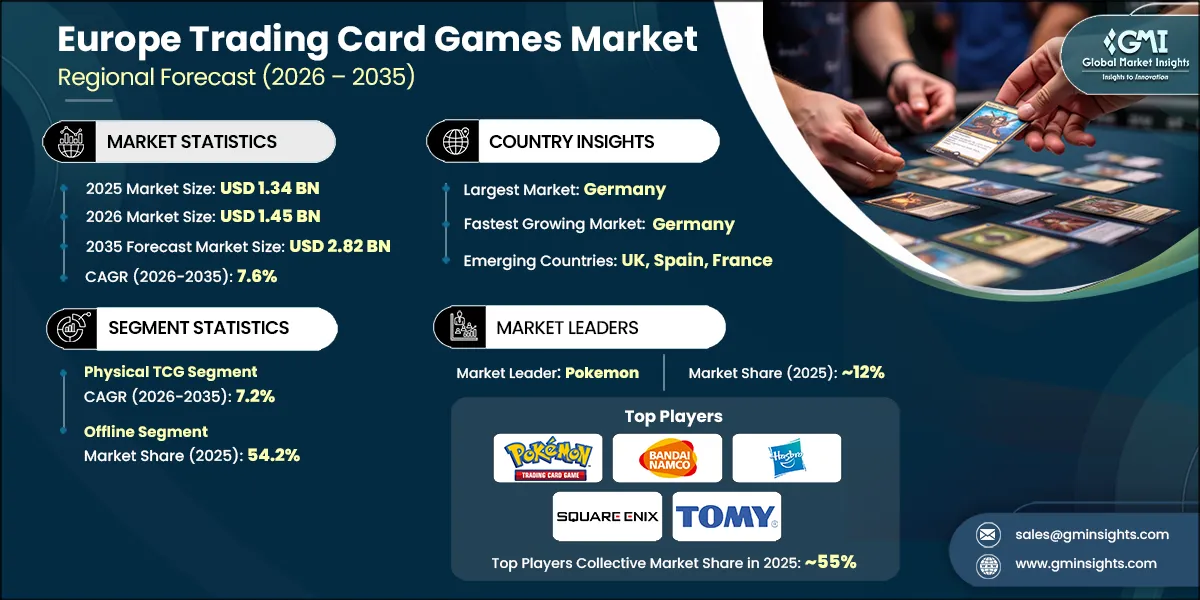
Europe Trading Card Games Market Key Takeaways
Market Size & Growth
- 2025 Market Size: USD 1.34 Billion
- 2026 Market Size: USD 1.45 Billion
- 2035 Forecast Market Size: USD 2.82 Billion
- CAGR (2026–2035): 7.6%
Regional Dominance
- Largest Market: Germany
- Fastest Growing Country: Germany
Key Market Drivers
- Strong expansion of physical card demand.
- Growing collector community & nostalgia effect.
- Expanding demographics and cross-generational engagement.
Challenges
- Counterfeit products and authenticity challenges.
- Environmental and sustainability concerns.
Opportunity
- Integration of augmented reality (AR) and virtual experiences.
- Strategic collaborations with entertainment and pop culture brands.
Key Players
- Market Leader: Pokemon led with over 12% market share in 2025.
- Leading Players: Top 5 players in this market include Pokemon, Bandai Namco, Hasbro, Square Enix, Tomy Co. Ltd., which collectively held a market share of 55% in 2025.
Get Market Insights & Growth Opportunities
To get key market trends
Europe Trading Card Games Market Trends
- Leading brands in the trading card games market are actively adopting blockchain technology to develop decentralized infrastructures. These infrastructures allow for the transfer of true ownership of digital assets, moving away from the traditional centralized platforms that have dominated the industry. By utilizing non-fungible tokens (NFTs), companies are creating distinct digital properties. Each digital card becomes a one-of-a-kind asset that can be traded seamlessly across various ecosystems while maintaining its ownership and verification records. This technological advancement provides collectors with the assurance that their digital assets are genuinely rare and cannot be replicated or reproduced by the issuing companies, thereby preserving their value over time.
- The younger generation, particularly those who are highly engaged in the digital world, has shown a strong inclination toward investing in digital collectibles. This trend mirrors the enthusiasm of previous generations for collecting physical trading cards. By 2024, global spending on digital trading cards facilitated by blockchain technologies exceeded $800 million, representing an extraordinary 340% increase compared to the total sales reported in 2023. This remarkable growth highlights the increasing acceptance and adoption of digital ownership concepts within the broader trading card game collector community. The shift toward digital collectibles is not only reshaping consumer behavior but also redefining the value proposition of trading card games in the digital age.
- The integration of augmented reality (AR) with blockchain-validated digital trading cards is further enhancing the digital collectibles market. This combination is enabling the creation of immersive collector experiences that seamlessly connect the physical and digital worlds. Collectors can now showcase their digital collections in virtual galleries, participate in competitive online tournaments using verified digital trading cards, and trade their digital assets across multiple gaming platforms. These features are particularly appealing to Generation Z, who place significant value on their online interactions and actively seek opportunities to share their digital experiences with friends and peers. The ability to merge AR with blockchain technology is not only elevating the user experience but also driving innovation within the trading card games market.
- The growth of the trading card games industry has been significantly influenced by strategic partnerships between publishers and prominent pop culture franchises. These collaborations have allowed trading card game publishers to extend their reach far beyond the traditional audience of TCG enthusiasts. By leveraging the widespread popularity of iconic media franchises, publishers have successfully attracted new demographics and expanded their market presence. These partnerships have also enabled the creation of exclusive, themed trading card collections that resonate with fans of specific franchises, further driving engagement and sales. The synergy between trading card game publishers and pop culture properties continues to play a pivotal role in shaping the industry's trajectory and fostering sustained growth.
Europe Trading Card Games Market Analysis
Learn more about the key segments shaping this market
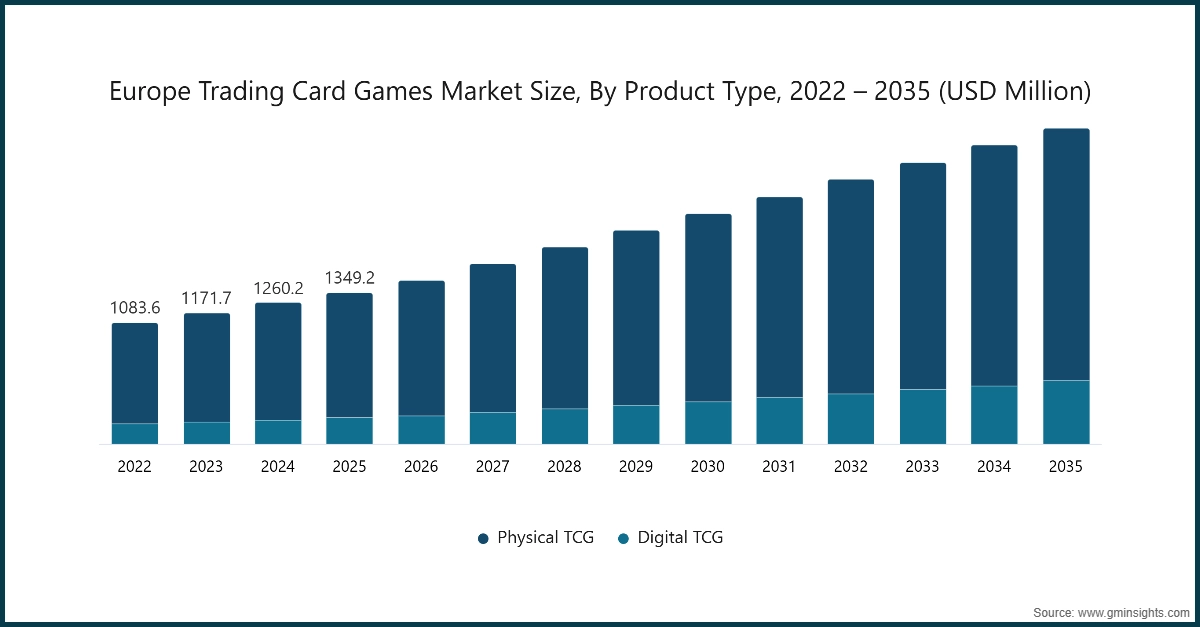
Based on product type, the Europe trading card games market is categorized into digital TCG and physical TCG. The physical TCG segment accounted for revenue of around USD 1,120.7 million in 2025 and is anticipated to grow at a CAGR of 7.2% from 2026 to 2035.
- The European trading card games (TCG) market continues to demonstrate remarkable resilience, driven by collectors' strong preference for physical collectible items. This preference stems from the unique tactile experience, visual display value, and long-term investment potential that physical cards offer qualities that digital versions fail to fully replicate. For European collectors, physical cards are more than just collectibles; they are tangible assets that can be held, displayed, traded in person, and preserved over time. These cards often gain value due to factors such as limited availability, pristine condition, and the enduring legacy of established brands. The sense of ownership and the ability to physically interact with these items further enhance their appeal, making them a preferred choice for collectors across the region.
- Additionally, the market benefits significantly from the presence of globally recognized TCG brands, including Pokémon, Magic: The Gathering, and Yu-Gi-Oh!, all of which maintain strong and expanding player and collector communities in Europe. These brands actively contribute to market growth by consistently introducing innovative products that cater to diverse consumer preferences. New releases frequently feature elements designed to heighten desirability, such as limited print runs, exclusive special editions, holographic designs, and premium card treatments. Furthermore, these brands often expand their franchises with new themes, characters, and storylines, appealing to both competitive players and dedicated collectors. By incorporating these elements, they ensure that their offerings remain fresh and engaging.
Learn more about the key segments shaping this market
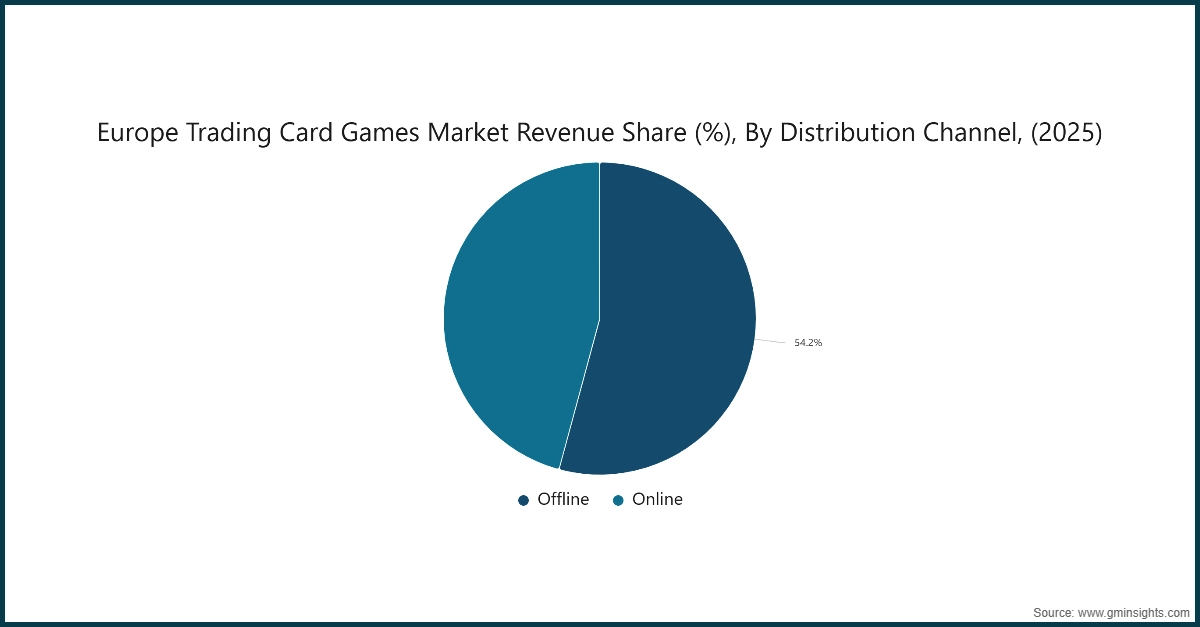
Based on distribution channel of Europe trading card games market consists of online and offline. The offline distribution channel emerged as leader and held 54.2% of the total market share in 2025 and is anticipated to grow at a CAGR of 6.9% from 2026 to 2035.
- The European trading card games (TCG) market operates through a wide range of distribution channels, including specialty game stores, hobby shops, comic book outlets, mass-market retailers, convenience stores, and direct sales channels associated with tournaments and organized play venues. Among these, specialty game stores play a pivotal role in sustaining the TCG ecosystem across Europe. These stores provide collectors and players with a dedicated physical space to engage in various activities, such as playing games, participating in organized events, and interacting with knowledgeable staff. Additionally, they offer the advantage of immediate product availability, which online platforms cannot fully replicate. Mass-market retailers, such as Carrefour, Tesco, Smyths Toys, and El Corte Inglés, also contribute to the market by ensuring widespread product accessibility, although their focus is more on general retail rather than community engagement.
- Specialty game stores are integral to the TCG community, as they frequently serve as officially sanctioned tournament venues for major TCG publishers. This designation not only drives significant foot traffic but also creates additional revenue streams through the sale of complementary products, including card packs, protective sleeves, binders, playmats, and exclusive promotional items. These stores often host events that provide players with a unique in-store experience, combining competitive gameplay, social interaction, and opportunities for community building. Such experiences foster a sense of belonging and loyalty among players, encouraging them to support their local stores. Furthermore, these venues often act as hubs for the latest product releases, exclusive previews, and promotional events, enhancing their appeal to both casual players and dedicated collectors.
Looking for region specific data?
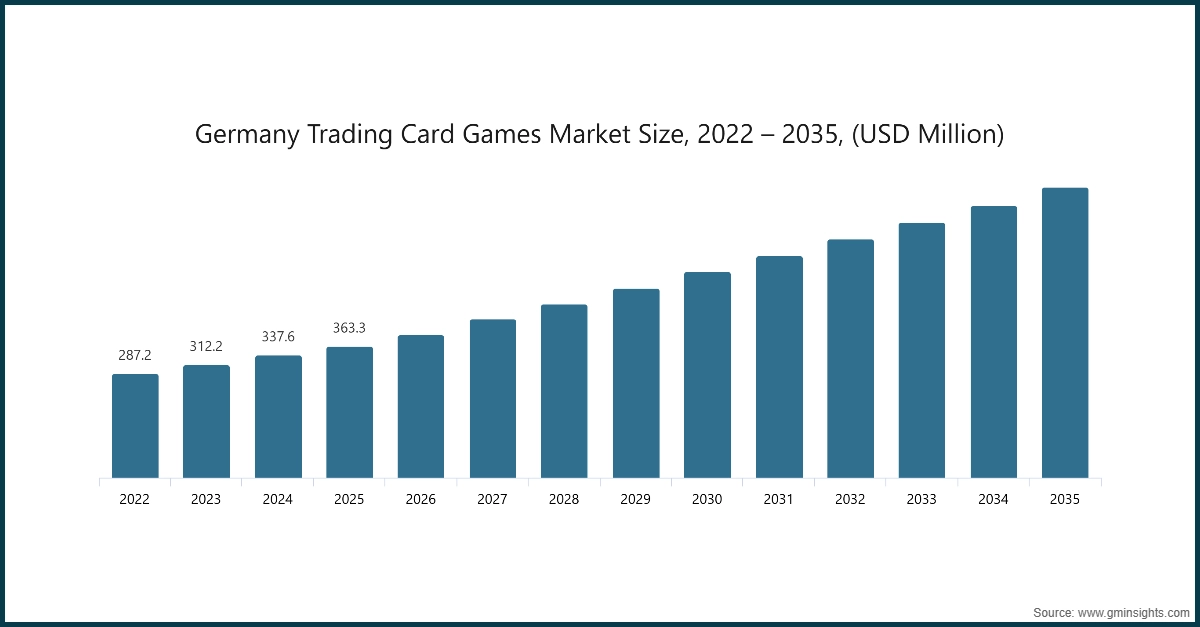
In the European trading card games market, Germany is expected to experience significant and promising growth from 2026 to 2035.
- Germany is a key player in the European trading card game market, contributing approximately 26.9% in 2025 of the region's total revenues. The country benefits from a well-established hobby game community, which includes a diverse range of enthusiasts actively participating in the trading card game ecosystem. Retail availability is extensive, with numerous specialty stores and online platforms catering to the demand for trading card games.
- Additionally, Germany is home to a significant number of domestic publishers, producing a wide variety of trading card game products tailored to consumer preferences. German consumers exhibit a strong inclination toward strategic-based gameplay and high-quality components, which has led to a growing demand for premium products. Furthermore, the market is enriched by a vibrant calendar of gaming conventions and organized play events, such as tournaments and community meetups, which foster engagement and strengthen the trading card game community. These factors collectively position Germany as a cornerstone of the European trading card game market.
- The United Kingdom holds a substantial share of the European trading card game market, accounting for approximately 25% of the region's total revenues. The market is supported by a strong presence of English-language franchises, which enjoy widespread popularity among consumers.
- France is currently the fastest-growing trading card game market in Europe, driven by the increasing popularity of manga and anime among its population. This cultural trend has created significant opportunities for the adoption of trading card games related to Japanese franchises and French-licensed properties. Younger generations, in particular, are showing a heightened interest in these games, contributing to the market's rapid expansion. The French trading card game market is further supported by a growing number of local publishers and distributors, who are capitalizing on this trend by introducing innovative products that cater to consumer preferences.
Europe Trading Card Games Market Share
- In 2025, the prominent manufacturers in market are Pokemon, Bandai Namco, Hasbro, Square Enix, and Tomy Co. Ltd. collectively held the market share of ~55%.
- The Pokémon Company holds a significant 12% share of the global trading card game (TCG) market, underpinned by its extensive worldwide brand recognition and multigenerational appeal. The company has successfully established itself as a leader in the TCG market by leveraging its strong portfolio of core video games, a highly popular animated television series, and numerous blockbuster film releases. These efforts ensure that Pokémon remains a household name and continues to attract players and collectors across all age groups.
- Bandai Namco accounts for approximately 9% of the global TCG market, driven by its diverse portfolio of franchises, including the Dragon Ball Super Card Game, the One Piece Card Game, and the Digimon Card Game. The company employs a strategic approach by utilizing popular anime and game intellectual properties (IPs) with established fan bases, effectively minimizing the risks associated with entering new markets. This model allows Bandai Namco to tap into pre-existing demand and ensures a strong reception for its products. The company has a particularly strong presence in Asian markets, where it benefits from a growing consumer base and increasing entertainment expenditures.
Europe Trading Card Games Market Companies
Major players operating in the Europe trading card games industry include:
- Bandai Namco
- Bushiroad Inc.
- Fanatics/Topps
- Fantasy Flight
- Hasbro
- Kayou
- Konami
- Legend Story Studios
- Nintendo Co., Ltd.
- Panini S.p.A.
- Pokemon
- Ravensburger AG
- Square Enix
- Tomy Co. Ltd.
- Upper Deck Company
Square Enix Holdings Co., Ltd. is a prominent Japanese video game publisher renowned for producing the Final Fantasy Trading Card Game, along with a variety of other collectible card products derived from its extensive portfolio of gaming intellectual properties (IPs). The company strategically capitalizes on its well-established video game franchises, such as Final Fantasy and Dragon Quest, to attract a dedicated fan base. By offering these fans an opportunity to engage further with beloved characters, intricate storylines, and immersive worlds, Square Enix strengthens its brand loyalty and expands its reach within the collectible card game market.
Tomy Company, Ltd., a leading Japanese toy manufacturer, is actively involved in the production and distribution of the globally popular Pokemon Trading Card Game (TCG). The company’s extensive expertise in toy design and manufacturing, coupled with its robust distribution network across the Asian market, positions it as a key player in the TCG industry. Tomy collaborates closely with major trading card game brands to ensure high-quality production standards and efficient market penetration. Furthermore, the company’s ability to adapt to evolving consumer preferences and its focus on innovative product development contribute to its success in maintaining strong partnerships and delivering engaging products to a diverse audience.
Europe Trading Card Games Market Report Attributes
| Key Takeaway | Details |
|---|---|
| Market Size & Growth | |
| Base Year | 2025 |
| Market Size in 2025 | USD 1.34 Billion |
| Market Size in 2026 | USD 1.45 Billion |
| Forecast Period 2026-2035 CAGR | 7.6% |
| Market Size in 2035 | USD 2.82 Billion |
| Key Market Trends | |
| Drivers | Impact |
| Strong expansion of physical card demand | This boosts steady retail sales and strengthens the role of hobby stores as core distribution hubs. It also enhances long‑term market stability as collectors continue to value tangible, investment‑grade cards. |
| Growing collector community & nostalgia effect | Nostalgia-driven engagement increases repeat purchases and elevates demand for rare or premium editions. It also strengthens the secondary market, raising card values and expanding overall market liquidity. |
| Expanding demographics and cross-generational engagement | Broad age group participation widens the consumer base and supports sustainable, long-term market growth. |
| Pitfalls & Challenges | Impact |
| Counterfeit products and authenticity challenges | Rising counterfeits undermine consumer confidence and can reduce willingness to invest in high-value cards. |
| Environmental and sustainability concerns | Growing scrutiny around packaging waste and printing materials pressures companies to adopt eco friendly practices. |
| Opportunities: | Impact |
| Integration of augmented reality (AR) and virtual experiences | AR features can deepen player engagement and create hybrid digital physical experiences that attract new users. |
| Strategic collaborations with entertainment and pop culture brands | Partnerships broaden audience reach by tapping into established fan communities across media franchises. They also boost product visibility and drive spikes in demand through themed releases and cross-promotions. |
| Market Leaders (2025) | |
| Market Leader |
Market share of ~12% |
| Top Players |
Collective market share of ~55% |
| Competitive Edge |
|
| Regional Insights | |
| Largest Market | Germany |
| Fastest growing market | Germany |
| Emerging countries | UK, Spain, France |
What are the growth opportunities in this market?
Europe Trading Card Games Industry News
- In February 2025, The Pokemon Company International announced record-breaking sales for the Scarlet & Violet series, surpassing 3 Million Cards sold within 18 months of launch, driven by strong franchise performance across video games, animated content, and trading cards. The company also revealed expansion plans for organized play programs with over 15,000 sanctioned tournaments planned globally for 2025.
- In January 2025, Konami Holdings Corporation launched Yu-Gi-Oh! Cross Duel mobile game with integrated physical card scanning functionality, allowing players to import physical card collections into digital play environments. The hybrid approach addresses consumer demand for seamless physical-digital experiences and is projected to drive incremental physical card sales.
- In December 2024, Hasbro Inc. reported Magic: The Gathering achieved its strongest year on record with over USD 1.3 billion in revenue across physical cards and digital platforms. The company announced plans to expand crossover collaborations with popular franchises, building on successful partnerships with Marvel, Warhammer 40,000, and The Lord of the Rings.
- In November 2024, Legend Story Studios completed Series B funding round raising USD 60 million to expand Flesh and Blood TCG into new markets and develop digital companion applications. The investment reflects growing investor interest in alternative TCG franchises that challenge established market leaders.
The Europe trading card games market research report includes in-depth coverage of the industry, with estimates & forecast in terms of revenue (USD Million) and volume (Million Units) from 2022 to 2035, for the following segments:
Market, by Product Type
- Physical TCG
- Booster packs
- Booster boxes
- Starter decks
- Collector/premium products
- Tins & blister packs
- Digital TCG
Market, by Franchise
- Pokémon
- Magic: the gathering
- Yu-gi-oh!
- Anime/manga tcgs
- Star wars
- Others (vanguard, etc.)
Market, by Release Type
- Standard sets
- Special/limited editions
- Promotional products
- Reprints/reissues
Market, by Price
- Economy (USD 3- USD 15)
- Mid-Tier (USD 15 - USD 50)
- Premium (USD 50 - USD 150)
- Ultra-Premium (Above USD 150)
Market, by Consumer Group
- Players/gamers
- Investors/collector
- Children/families
Market, by Distribution Channel
- Online
- E-commerce website
- Company owned website
- Offline
- Mass retail stores
- Specialty stores
- Others
The above information is provided for the following regions and countries:
- Europe
- Germany
- UK
- France
- Italy
- Spain
- Russia
Frequently Asked Question(FAQ) :
What was the market size of the Europe trading card games market in 2025?
The market size was USD 1.34 billion in 2025, with a CAGR of 7.6% expected through 2035, driven by technological advancements such as blockchain adoption and increasing interest in digital collectibles.
What is the projected value of the Europe trading card games market by 2035?
The market is expected to reach USD 2.82 billion by 2035, fueled by the growing popularity of digital trading cards and the expansion of offline and online distribution channels.
What is the projected size of the Europe trading card games market in 2026?
The market is expected to reach USD 1.45 billion in 2026.
How much revenue did the physical trading card games (TCG) segment generate?
The physical TCG segment generated approximately USD 1,120.7 million in 2025 and is anticipated to grow at a CAGR of 7.2% from 2026 to 2035.
What was the market share of the offline distribution channel in 2025?
The offline distribution channel held 54.2% of the total market share in 2025 and is projected to grow at a CAGR of 6.9% from 2026 to 2035.
Which country is expected to experience significant growth in the Europe trading card games market?
Germany is expected to witness significant and promising growth in the trading card games market from 2026 to 2035.
What are the upcoming trends in the Europe trading card games market?
Key trends include the adoption of blockchain technology for decentralized infrastructures, the use of NFTs to create unique digital assets, and the increasing interest of younger generations in digital collectibles.
Who are the key players in the Europe trading card games market?
Key players include Bandai Namco, Bushiroad Inc., Fanatics/Topps, Fantasy Flight, Hasbro, Kayou, Konami, Legend Story Studios, Nintendo Co., Ltd., Panini S.p.A., and Pokemon.
Europe Trading Card Games Market Scope
Related Reports