Summary
Table of Content

Europe Smart Water Meter Market
Get a free sample of this report
Form submitted successfully!
Error submitting form. Please try again.
Thank you!
Your inquiry has been received. Our team will reach out to you with the required details via email. To ensure that you don't miss their response, kindly remember to check your spam folder as well!
Request Sectional Data
Thank you!
Your inquiry has been received. Our team will reach out to you with the required details via email. To ensure that you don't miss their response, kindly remember to check your spam folder as well!
Form submitted successfully!
Error submitting form. Please try again.
Europe Smart Water Meter Market Size
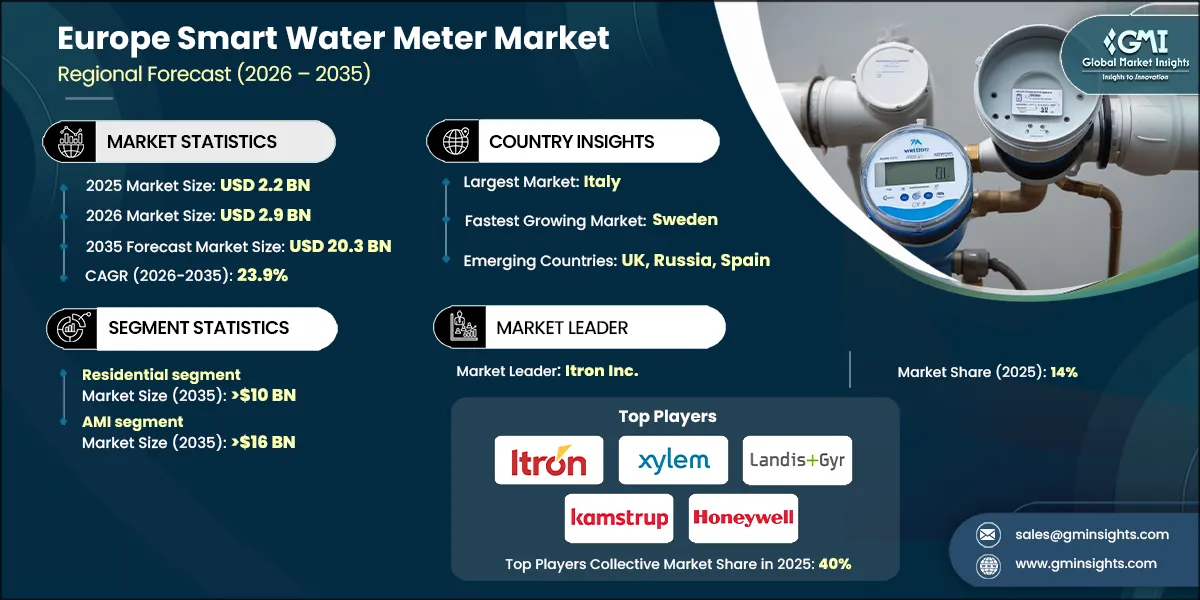
The Europe smart water meter market was estimated at USD 2.2 billion in 2025. The market is expected to grow from USD 2.9 billion in 2026 to USD 20.3 billion in 2035, at a CAGR of 23.9%.
Europe Smart Water Meter Market Key Takeaways
Market Size & Growth
- 2025 Market Size: USD 2.2 Billion
- 2026 Market Size: USD 2.9 Billion
- 2035 Forecast Market Size: USD 20.3 Billion
- CAGR (2026–2035): 23.9%
Regional Dominance
- Largest Market: Italy
- Fastest Growing Country: Sweden
Key Market Drivers
- Non-Revenue Water (NRW) Monitoring and Control.
- Ongoing Inclination Toward Intelligent Systems in Water Sources.
Challenges
- Privacy and cyber security concerns.
Opportunity
- Advancement in Technology.
Key Players
- Market Leader: Itron Inc. led with over 14% market share in 2025.
- Leading Players: Top 5 players in this market include Itron Inc., Xylem, Landis + GYR, Kamstrup, Honeywell International, which collectively held a market share of 40% in 2025.
Get Market Insights & Growth Opportunities
- Several key drivers underpin this rapid expansion. European Union directives such as EU 2006/32/EC and the Clean Energy for All Europeans package (Directive 2019/944) have mandated efficient resource usage and incentivized smart meter rollouts, including water meters.
- Reducing "non-revenue water" (NRW) the water lost due to leaks, theft, or inefficiencies is critical. Estimates indicate that over 20% of treated water is lost across Europe annually, costing utilities billions. Smart meters, often featuring real-time data and leak-detection capabilities, are vital tools for curbing these losses.
- Government investments and regulatory incentives are fueling deployment. The European Investment Bank has earmarked over USD 1.1 billion by 2025 for smart water infrastructure. National-level rollouts are already underway, Italy, France, the UK, Spain, and the Netherlands have deployed millions of smart water meters or launched extensive plans. German federal programs report efficiency improvements up to 25% after smart meter adoption.
- Strategic EU-funded projects offer concrete implementation examples. The Horizon 2020 backed SMART-MET consortium deployed 3,000 innovative smart water meter prototypes across five European test sites spanning Spain, France, Italy, Belgium, and Hungary.
- This initiative emphasized data collection, interoperability, and leak detection in real-world settings. In Gdansk, Poland, CEE water utilities under the EU’s “Blue Deal” framework reduced NRW from 25% to 15% through AMI-driven smart water meter installations.
- Private and public utilities are also realizing financial benefits. It was reported that average ROI for smart water meter investments in Europe ranges from 1.5 to 3 years, driven by savings in manual reading costs and faster leak response. In France, the Syndicat des Eaux et de l'Assainissement Alsace-Moselle installed prototypes in Sélestat and Strasbourg, enabling early leak detection and improved billing accuracy.
- Technology and IoT integration are also advancing since European standards like DLMS/COSEM ensure hardware interoperability, while back-end platforms leverage analytics to optimize resource scheduling, forecast demand, and flag anomalies. Major technology providers such as Kamstrup and Landis+Gyr are scaling up production to support mass-market demand.
To get key market trends
Europe Smart Water Meter Market Trends
- Legislative frameworks like the EU Water Framework Directive and the European Green Deal have intensified pressure on utilities to deploy smart sensing and remote metering systems to reduce non-revenue water (NRW) and improve resource efficiency.
- A dominant trend is the transition from Automated Meter Reading (AMR) to Advanced Metering Infrastructure (AMI), fueled by IoT and two-way communication networks. AMI enables real-time data exchange, remote control, and frequent consumption reports essential for precise billing, operational visibility, and leak detection. Europe already hosts over 80 million AMR/AMI endpoints, a figure expected to double by 2030, with AMI penetration rising significantly.
- AI-powered analytics are transforming water metering operations. Utilities leverage machine-learning models to monitor real-time consumption, predict equipment faults, and detect leaks early, thereby reducing NRW by up to 40% in pilot cases. Platforms now analyze granular flow and pressure records for anomaly detection and demand forecasting, delivering both service reliability and operational savings.
- Interoperability is another top priority since The DLMS/COSEM standard, widely adopted in Europe, provides a unified data-exchange framework, progress continues via the Water Smart Meter Generic Companion Profile (GCP), which ensures cross-vendor compatibility and certification. This standardization is critical for secure remote reading, tariff flexibility, and advanced metering system integration.
- Between 2025 and 2027, the EIB committed USD 17 billion potentially scaling to USD 46 billion with private sector participation for water infrastructure initiatives across the EU. A significant portion of this will support smart water projects, including water efficiency upgrades, metering infrastructure, and climate resilience measures such as enhanced monitoring and leak control.
- Pilot projects highlight innovation across regions. In Dublin, AI-enabled acoustic sensors on 40 km of mains are paired with in-pipe monitoring to detect leaks ahead of rupture. In Iberia, the EU’s PERTE program funded LoRaWAN rollouts in Terrassa, deploying 4,500 smart water meters to combat water scarcity by reducing NRW and enhancing consumer awareness.
- These trends reflect strong synergy between EU policy, investment, and cutting-edge technologies. As connectivity improves, AI adoption deepens, and standards mature, Europe is moving firmly toward a digital, resilient, and sustainable water infrastructure anticipating smarter utilities, engaged consumers, and significantly reduced non-revenue water.
Europe Smart Water Meter Market Analysis
Learn more about the key segments shaping this market
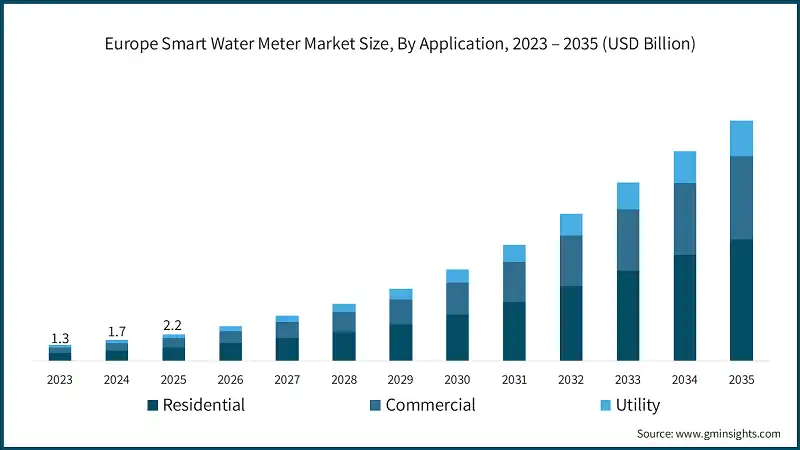
- Based on applications, the residential segment is anticipated to exceed USD 10 billion by 2035 since smart water meters in homes empower consumers to monitor usage in near-real time, promoting conservation and reducing demand. In 2024, over 40 % of European households had a smart water meter, and pilot studies showed up to a 30 % drop in water losses post-installation.
- For instance, France and the Netherlands have fully implemented smart water meters in over 80 % of households by 2024, following EU mandates such as the Water Framework Directive. This rollout enhances billing accuracy and empowers consumers through user dashboards and alerts.
- Spain, Italy, and the UK are set to receive a combined investment of over USD 2.26 billion by 2030 specifically for residential smart water metering as part of broader smart city initiatives. These meters, often built on LPWAN technologies like NB-IoT and LoRaWAN, allow households real-time mobile app access to usage stats, helping reduce non-revenue water and prompting more sustainable behavior.
- The residential segment drives household-level water conservation and empowers consumers with insight into their usage profiles. In drought-prone Mediterranean countries, government recovery plans have allocated dedicated funding for residential smart water meters. This trend reflects a growing commitment to sustainability, as households increasingly adopt smart technologies to align with national water efficiency goals and EU directives.
- Moreover, the commercial segment holds the overall market share of 34.7% in 2025 since it plays a crucial role in this market. Commercial properties such as offices, hotels, retail centers, and schools benefit substantially from smart metering through operational savings and proactive leak prevention.
- In Europe, a large proportion of AMI-enabled meters are deployed in non-residential environments, reflecting a growing trend toward smart infrastructure in commercial facilities. The government identifies major deployments of smart meters in commercial buildings across Germany and the Netherlands, supported by EU smart city frameworks. These installations cut manual billing tasks critically for facilities aiming to meet green certification standards.
Learn more about the key segments shaping this market
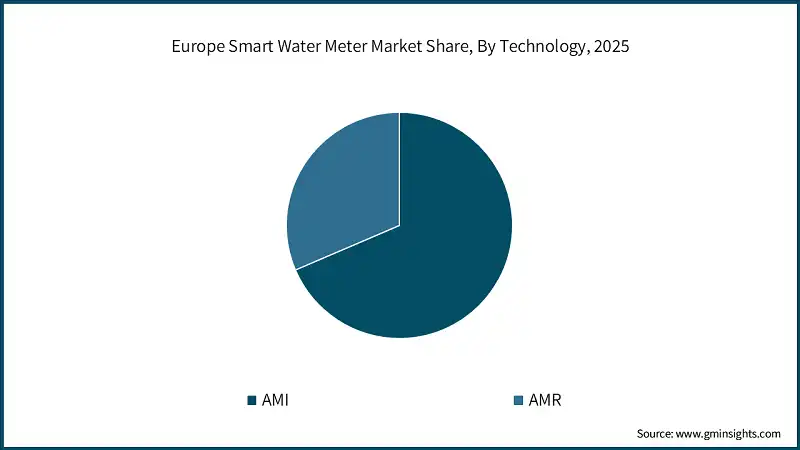
- Based on technology, the AMI segment is anticipated to cross USD 16 billion by 2035 and is expected to grow at a CAGR of 25% by 2035. AMI meter has its ability to offer continuous, high-frequency data exchange between meters and utilities enabling functionalities like leak detection, remote control, and dynamic billing.
- In a European study, AMI deployments represented markedly richer functionality compared to earlier AMR systems. This has led utilities to favor AMI for its potential to reduce non-revenue water (NRW) and improve overall operational efficiency. A concrete example of Europe’s AMI expansion is Spain, the leading adopter of 3GPP-based LPWAN (notably NB-IoT).
- Several major Spanish utilities, like Aqualia and Canal de Isabel II, are undertaking large-scale AMI rollouts supported by EU recovery funds to deploy thousands of smart water endpoints using NB-IoT. These efforts are driven by investments in smart networks capable of remote monitoring and management, resulting in improved leak identification and billing precision.
- Central and Eastern Europe (CEE) is another hotspot for AMI deployment under the EU’s “Blue Deal”. Countries such as Poland, Hungary, and Czechia are receiving significant funding under the Just Transition Mechanism and InvestEU projects, enabling extensive rollout of smart meters and connected systems. These initiatives aim to achieve at least 80% smart metering penetration by 2024–2027, with water networks benefiting from the same digital infrastructure upgrades applied to electricity and gas.
- Industrial clusters linked to green hydrogen projects also drive demand. Germany’s Hydrogen Valley program, backed by USD 500 million, involves large-scale electrolyzers that consume significant water volumes. Smart water meters are installed to monitor and optimize water usage in these plants, ensuring compliance with EU water directives. This industrial trend directly increases demand for AMI-enabled meters capable of handling high-frequency data.
- Large-scale renewable energy projects also indirectly boost smart water meter adoption. For instance, the North Sea Wind Power Hu a Euro 30 billion offshore wind initiative requires extensive water management for cooling systems and operational facilities.
- These hubs often integrate smart water meters to monitor water usage in substations and maintenance platforms, ensuring efficiency and compliance with environmental standards. As renewable projects expand, associated infrastructure like smart metering becomes critical for resource optimization.
Looking for region specific data?
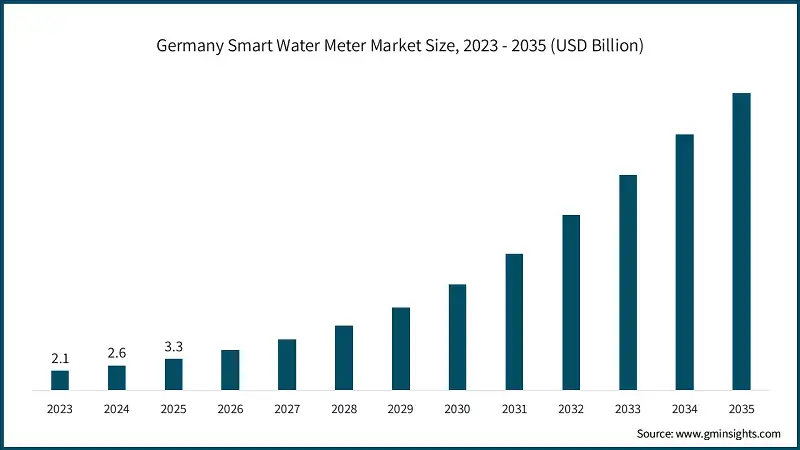
- The Germany smart water meter market is anticipated to exceed USD 3.5 billion by 2035. Germany’s Hydrogen Valley program, backed by Euro 500 million, focuses on green hydrogen production using large-scale electrolyzers that consume significant water volumes.
- Smart water meters are being deployed in these industrial clusters to monitor water usage and prevent wastage. As hydrogen projects expand, utilities require AMI-enabled meters for real-time monitoring and compliance with EU water directives. This industrial trend directly accelerates demand for smart water meters in Germany’s energy transition ecosystem.
- Italy’s Milan Smart City initiative, funded under the EU Recovery and Resilience Facility (USD 4.5 billion for green infrastructure), includes installing more than 80,000 smart water meters across residential and commercial zones by 2027. These meters aim to reduce water losses by 25% and integrate with IoT platforms for leak detection. Milan’s rollout sets a precedent for other Italian cities, creating a ripple effect that boosts AMI adoption nationwide.
- Sweden’s Northvolt Gigafactory, a USD 4.5 billion battery manufacturing project, requires extensive water for cooling and production processes. Smart water meters are integrated into the facility’s water management system to optimize consumption and meet sustainability targets. As Sweden scales renewable energy and battery storage projects, industrial water monitoring becomes critical, driving demand for advanced metering infrastructure in both industrial and municipal networks.
- The UK’s Thames Water AMP8 program involves a Euro 300 million investment to deploy more than 1 million AMI smart water meters by 2030. This initiative aims to cut non-revenue water by 15%, saving millions of liters annually. The program also supports real-time data analytics and customer engagement tools, making AMI systems essential for achieving regulatory compliance and sustainability goals in the UK water sector.
Europe Smart Water Meter Market Share
- The top 5 companies in the Europe smart water meter industry are Itron Inc., Landis + GYR, Kamstrup, Xylem, Honeywell International. They are contributing around 40% of the market in 2025.
- These leading companies play a pivotal role in the Europe smart water meter market due to their technological expertise, extensive product portfolios, and innovative solutions. These corporations also contribute significantly through their presence and extensive service networks, enabling them to undertake large-scale projects across diverse countries.
Europe Smart Water Meter Market Companies
- Apator S.A.: Apator S.A. provides a range of smart metering technologies for water, electricity, and gas. Its water meters are known for their reliability and compatibility with remote reading systems. The company emphasizes modular design and interoperability, catering to both residential and industrial applications across various regions.
- Siemens: Siemens provides intelligent water metering and infrastructure solutions as part of its broader smart grid and IoT portfolio. Its systems enable remote monitoring, leak detection, and consumption analytics. Siemens emphasizes innovation, interoperability, and scalable platforms for smart city and utility applications.
- Sontex SA: Sontex SA specializes in electronic water and heat meters with remote reading capabilities. Its products are designed for accuracy, reliability, and integration with various communication protocols. The company focuses on user-friendly solutions that support efficient resource management and utility modernization.
Major players operating in the Europe smart water meter market are:
- ABB
- Apator S.A.
- Arad Group
- Badger Meter, Inc.
- Baylan Water Meters
- BMETERS S.r.l
- Diehl Stiftung & Co. KG
- EMH Metering
- Honeywell International Inc.
- Itron Inc.
- Kamstrup
- Landis+Gyr
- Maddalena S.p.A
- Schneider Electric
- Siemens
- Sontex SA
- STMicroelectronics
- WaterTech S.p.A
- Xylem (Sensus)
- ZENNER International GmbH & Co. KG
Europe Smart Water Meter Market Report Attributes
| Key Takeaway | Details |
|---|---|
| Market Size & Growth | |
| Base Year | 2025 |
| Market Size in 2025 | USD 2.2 Billion |
| Market Size in 2026 | USD 2.9 Billion |
| Forecast Period 2026 - 2035 CAGR | 23.9% |
| Market Size in 2035 | USD 20.3 Billion |
| Key Market Trends | |
| Drivers | Impact |
| Non-Revenue Water (NRW) Monitoring and Control | NRW refers to water lost through leaks, theft, or inaccurate metering, which costs European utilities billions annually. Smart water meters equipped with AMI technology enable real-time leak detection and consumption tracking, reducing NRW by up to 30%. |
| Ongoing Inclination Toward Intelligent Systems in Water Sources | European utilities are increasingly adopting IoT-enabled smart water systems to optimize resource management. Intelligent meters provide predictive analytics, remote monitoring, and integration with smart city platforms. |
| Pitfalls & Challenges | Impact |
| Privacy and cyber security concerns | Smart water meters rely on real-time data transmission, often through wireless networks, which makes them vulnerable to cyberattacks and unauthorized access. |
| Opportunities: | Impact |
| Advancement in Technology | Rapid technological progress in IoT, AI, and communication networks is creating significant opportunities for Europes smart water meter market. Innovations like NB‑IoT and LoRaWAN enable cost-effective, long-range connectivity, while AI-driven analytics improve leak detection and predictive maintenance. |
| Market Leaders (2025) | |
| Market Leaders |
14% Market Share |
| Top Players |
|
| Competitive Edge |
|
| Regional Insights | |
| Largest Market | Italy |
| Fastest Growing Market | Sweden |
| Emerging Region | UK, Russia, Spain |
| Future outlook |
|
What are the growth opportunities in this market?
Europe Smart Water Meter Industry News
- In March 2024, British water utility United Utilities has partnered with telecommunications provider Arqiva to deploy over one million smart meters by 2030. The agreement, worth approximately USD 309 million with an option to extend for five additional years, covers the sourcing and installation of smart meters and related devices.
- In January 2024, Siemens announced the launch of its next-generation smart meters equipped with enhanced cybersecurity features and integrated AI analytics. These advanced meters aim to improve grid management by providing real-time data and predictive insights. Siemens plans to expand their smart meter portfolio by 2025, focusing on modular designs that facilitate renewable energy integration and support grid resilience.
The Europe smart water meter market research report includes in-depth coverage of the industry with estimates & forecast in terms of revenue (USD Million) and Volume (‘000 Units) from 2022 to 2035, for the following segments:
Market, By Application
- Residential
- Commercial
- Utility
Market, By Technology
- AMI
- AMR
Market, By Product
- Hot water meter
- Cold water meter
The above information has been provided for the following countries:
- UK
- Germany
- Russia
- Italy
- Spain
- Sweden
Frequently Asked Question(FAQ) :
What is the market size of the Europe smart water meter in 2025?
The market size was USD 2.2 billion in 2025, with 23.9% CAGR expected through 2025 driven by EU sustainability mandates, non-revenue water reduction initiatives, and increasing adoption of intelligent water management systems.
What is the projected value of the Europe smart water meter market by 2035?
The market is projected to reach USD 20.3 billion by 2035, supported by AMI deployments, IoT integration, and smart city investments.
What is the expected size of the Europe smart water meter industry in 2026?
The market size is expected to reach USD 2.9 billion in 2026, reflecting accelerated rollouts across residential, commercial, and utility sectors.
Which application segment dominates the Europe smart water meter market in 2025?
The commercial segment dominated the market with a 34.7% share in 2025, due to high adoption in offices, hotels, retail centers, and public infrastructure seeking operational efficiency and leak prevention.
What is the growth outlook for the AMI technology segment?
The AMI segment is expected to grow at a CAGR of around 25% through 2035, surpassing USD 16 billion, driven by real-time data exchange, remote monitoring, and advanced leak detection capabilities.
Which country leads the Europe smart water meter market?
The Germany smart water meter market revenue to cross USD 3.5 billion by 2035.
What are the key trends in the Europe smart water meter market?
Major trends include the transition from AMR to AMI systems, AI-powered analytics for leak detection, NB-IoT and LoRaWAN connectivity, interoperability standards such as DLMS/COSEM, and integration with smart city platforms.
Who are the key players in the Europe smart water meter industry?
Key players include Itron Inc., Landis+Gyr, Kamstrup, Xylem, Honeywell International, Siemens, Schneider Electric, Diehl Stiftung & Co. KG, and ABB, collectively accounting for around 40% of the market share in 2025.
Europe Smart Water Meter Market Scope
Related Reports