Summary
Table of Content

Europe Smart Home Market
Get a free sample of this report
Form submitted successfully!
Error submitting form. Please try again.
Thank you!
Your inquiry has been received. Our team will reach out to you with the required details via email. To ensure that you don't miss their response, kindly remember to check your spam folder as well!
Request Sectional Data
Thank you!
Your inquiry has been received. Our team will reach out to you with the required details via email. To ensure that you don't miss their response, kindly remember to check your spam folder as well!
Form submitted successfully!
Error submitting form. Please try again.
Europe Smart Home Market Size
According to research, many homeowners across Europe have opted for smart home products due to their added security and stylish appearance. Smart home devices such as smart locks, indoor cameras, and motion-activated lighting have been commonly left in the home as any other piece of furniture or accessory and not necessarily changed the overall design of the room where they will be used. Homeowners also want security products to fit into their home's existing décor sleek video doorbell cameras, for example, are now commonly used as décor. Consumers now want to find security products that fit into their home's décor without compromising on style, all at the same time as creating a safe environment.
Europe Smart Home Market Key Takeaways
Market Size & Growth
- 2025 Market Size: USD 33.9 Billion
- 2026 Market Size: USD 39.2 Billion
- 2035 Forecast Market Size: USD 150.1 Billion
- CAGR (2026–2035): 16.1%
Regional Dominance
- Largest Market: Germany
- Fastest Growing Country: UK
Key Market Drivers
- Growing focus on home security & convenience.
- Strong push for energy efficiency.
- Higher disposable incomes in western europe.
Challenges
- High upfront costs.
- Data privacy & cybersecurity concerns.
Opportunity
- Voice assistants, AI & predictive automation.
- Renewable energy & home electrification.
Key Players
- Market Leader: Signify N.V. led with over 10% market share in 2025.
- Leading Players: Top 5 players in this market include Signify N.V., Robert Bosch, Schneider Electric, Legrand, Somfy S.A., which collectively held a market share of 30% in 2025.
Get Market Insights & Growth Opportunities
In addition to the fact that consumers are wanting their home to be safe, they are also demanding that convenience is just as important as safety. As an example, consumers will soon be looking for decorative elements in their home that automatically respond to their daily routines and make their lives easier. End users want their homes to incorporate effortless living and provide them with convenience, making their daily routines run smoother and/or more intuitively. Smart décor that responds to voice commands or is controllable via mobile applications is helping end users create personalized and comfortable environments. The desire for convenience by consumers continues to drive the growth of the market for both good-looking décor and décor that provides a substantial improvement in the quality of their daily life.
European consumers are paying more attention than ever to how they use energy in their daily lives, which ultimately influences their decorative choices. People are drawn to smart, energy-efficient fixtures and lighting sources, such as LED light strips or climate-responsive heating elements, as alternatives to aesthetically pleasing but inefficient options. Similarly, consumers are selecting smart thermostats, temperature-detecting devices, and other heating accessories because of their usefulness, as well as their ability to blend into an overall design theme.
In addition, many Europeans want to ensure that their home decor contributes to an eco-friendly lifestyle. As a result, many consumers are now using solar energy-powered home decor, smart shading systems which optimize natural light, and energy-monitor display systems to produce energy-efficient homes while looking as stylish as possible. As a result, consumers are using these products to create a home that is both stylish and environmentally friendly.
The Europe smart home market was estimated at USD 33.9 billion in 2025. The market is expected to grow from USD 39.2 billion in 2026 to USD 150.1 billion in 2035, at a CAGR of 16.1% according to latest report published by Global Market Insights Inc.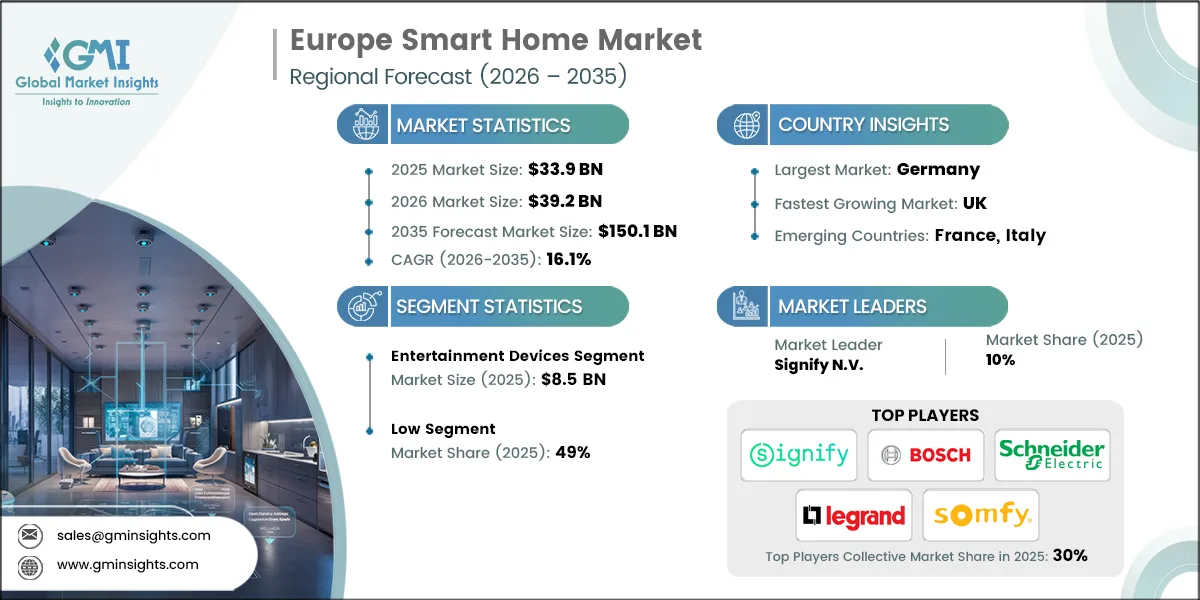
To get key market trends
Europe Smart Home Market Trends
The smart home industry in Europe is developing very quickly because of consumers seeking better-connected, environmentally sustainable, user-friendly living environments. There has been an increase in the number of smart devices being adopted by households across many categories including lighting, security, entertainment, climate control, and energy. The demand for smart devices has been driven by the rising expectations of consumers for seamless automation, improved user experience, and the integration of their smart device into their overall lifestyle needs, which include home comfort, safety, and environmentally friendly living. Over time, the technology used to implement smart home ecosystems in Europe will begin to be more interoperable, design-led, and responsive to their user’s preferences creating ideal conditions for a highly connected future for homes.
- An increasing number of smart home devices are being designed to work together as a coordinated solution, rather than as many individual or stand-alone devices. Households in Europe generally prefer to have a single ecosystem that works and communicates automatically, such as lighting, security, climate, and entertainment systems, and can be controlled through a single interface, which has reduced the amount of friction when setting up systems and has made it easier for consumers to create automation routines, as a result, providing a more seamless and better smart home experience for the user.
- The consumer priority of energy efficiency remains as consumers continue trying to reduce utility bills, live a more environmentally friendly lifestyle, and therefore, when purchasing smart home devices such as smart thermostats, adaptive lighting, energy monitoring panels, and automated shading systems these devices are becoming standard features in many households. The trend of consumers looking to limit their consumption and environmental impact through energy-efficient products from manufacturers who focus on developing products that save energy, at the same time, they do not compromise on their design aesthetics.
- Consumer demand for discreet home security has increased and therefore, security products are becoming more closely integrated into the home décor. This can include products such as slim doorbell cameras, low profile sensors, and ambient motion sensor lights which can provide a level of safety while allowing for an aesthetically pleasing space. In addition to aesthetics, these products also facilitate ease of use; consumers are looking for ease of control over their homes, instant notifications when something happens within their homes, and automated processes that help with their daily routines while not adding any additional steps or complications.
- Artificial intelligence and voice-controlled technology are also impacting the way that European Consumers use technology within their homes. Predictive automation technologies, such as heating systems that adjust automatically based on previous usages or lighting scenes that adjust based on the activities of the occupants, will help provide consumers with homes that feel much more personalized. The continuing evolution of smart home products will allow for the anticipation of user’s needs without requiring physical interaction with a device, making smart homes feel more natural and tailored to a specific occupant’s lifestyle.
Europe Smart Home Market Analysis
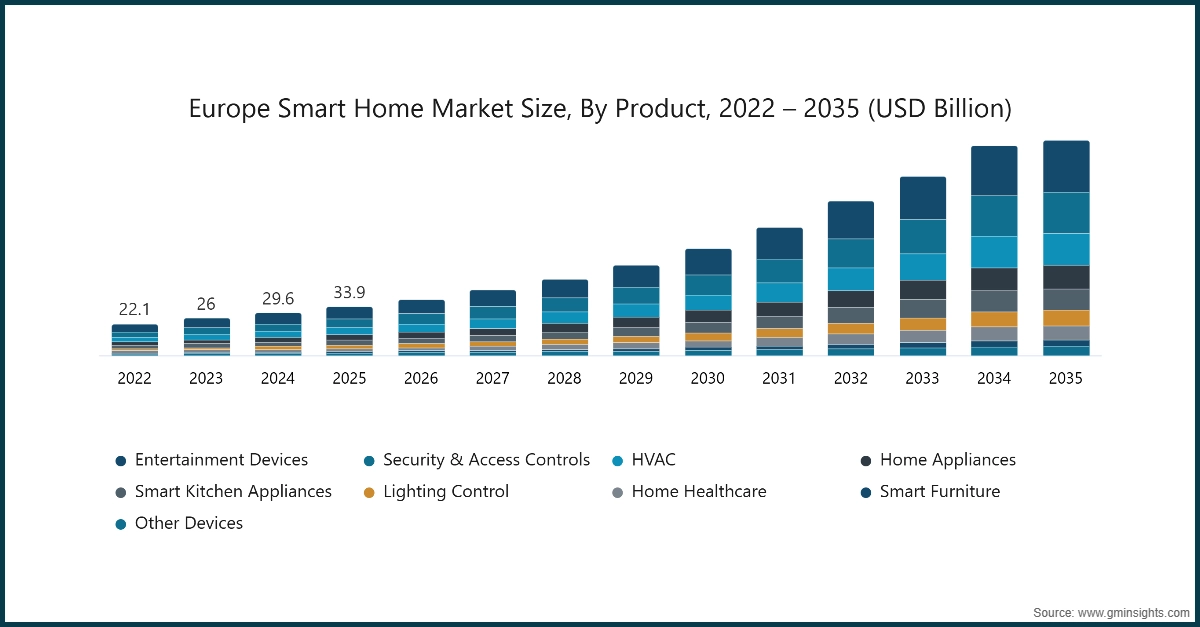
Learn more about the key segments shaping this market
Based on product type, the Europe smart home market is divided into entertainment devices, security & access controls, HVAC, home appliances, smart kitchen appliances, lighting control, home healthcare, smart furniture, other devices. In 2025, entertainment devices held the major market share, generating a revenue of USD 8.5 billion.
- The rise of smart home entertainment technology has transformed the way consumers listen to music, watch movies, and play games at their homes. Consumers want the ability to connect their speakers directly to a voice assistant such as an Amazon Alexa device, ad smart TVs that connect directly to streaming services, as well as devices that allow them to control multiple devices at the same time. Consumers want a simple command to control their entertainment experience and want to adjust their audio or lighting for the ideal environment. Consumers don't want to deal with multiple remote controls or cables and want to experience the same content across all their media options.
- As entertainment continues to grow in immersion, there are a variety of devices that allow consumers to customize their entertainment experience based on what they want. Products such as smart sound bars, adaptive audio systems and synchronized lighting enhance the feeling when watching movies and playing games so that an end-user can create a mini theatre experience right in their own home. In many cases, these devices learn about the end-user's habits things such as how loud or quiet they like the volume or the types of streaming services they often use so that every time they watch something it’s an experience that is seamless, customized, and feels like it was made just for them.
- Entertainment device popularity stems from their usefulness in day-to-day life. Users can listen to music while cooking or watch TV in multiple rooms of their home by using multiple sources. Most consumers find that these devices add style to their interior design, as well as function, therefore they are generally aesthetically appealing to consumers; this is important because they can deliver high-quality entertainment. As the smart home environment develops, entertainment devices will remain significant in creating enjoyable, connected living environments.
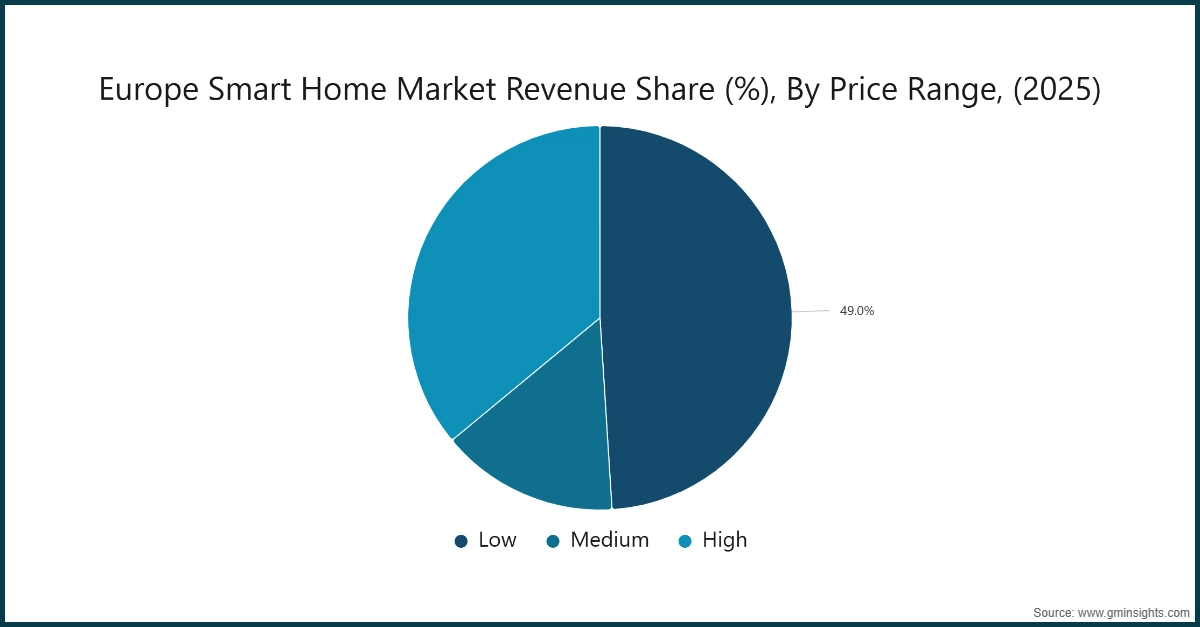
Learn more about the key segments shaping this market
Based on price, the Europe smart home market is segmented in low, medium, and high. The low segment held the largest share, accounting for 49% of the market in 2025.
- An expanding number of people are interested in entering the world of smart homes via low-price point options in today’s marketplace. Many budget-friendly items such as basic smart bulbs, plug-and-play sensors, and basic voice-accessory equipment allow consumers to utilize automation to enhance their quality of life without requiring the investment required for more expensive systems. Because of the amount of accessibility that exists through these low-price-point items, many first-time purchasers can experiment with and experience smart home functionality without feeling rushed. As a result, many continue using these products so that they can eventually expand their smart home ecosystems.
- For consumers within this segment of low-cost smart home products, practicality and installation ease are the key drivers when selecting a product over advanced features. Many low-cost smart home products focus on simple setup and ease of use, so they work easily with well-known voice assistant platforms. Most of these products will also have basic Features needed remote access, scheduling, and/or basic automation features to allow new users to experience all the benefits of using smart homes. Most of these products are designed for new users to experiment with smart home upgrades in renter ship, younger family units, or people who are trying out smart home upgrades for the first time. Therefore, because of the simplicity and value offered, this price range has become a significant way for consumers to enter the smart home market.
- The influence that commercial end users have on what consumers will purchase can also extend to the non-commercial space. For example, a consumer has had very successful treatment and then requests to purchase the same products for home use, this can lead to the broader adoption of the brand in the marketplace. This influence has a direct effect on the way consumers develop their trust in a company and their purchasing behavior, thus the commercial segment has an immensely powerful impact on the overall trends of the industry. As a result of this influence, commercial customers do encourage brands to be innovative and to consistently raise the bar on both product performance and user experience.
Based on distribution channel, the Europe smart home market is segmented into online and offline. In 2025, offline segment held the largest market share, generating a revenue of USD 22.8 billion.
- Offline sales channels remain a vital aspect of the smart home industry since so many customers still want to see and experience the items they are buying. In-Store sales give customers the opportunity to handle the product, to make side by side comparisons of quality and how it will be used in their own homes. Providing this kind of hands-on experience creates a sense of trust for customers, especially those with uncertainty about compatibility, installation, and real-life smart home technology performance.
- Additionally, in-store purchases also give customers personalized assistance that most customers find reassuring. Any customers who have had a bad experience before will appreciate in-store employees who can assist them with features of the products they are looking to purchase, with the set up and how to use the products and aid in choosing among various brands and putting together a package that fits within their budget and needs. Due to the complexity of many smart systems, providing personalized in-store assistance to customers provides customers with clarity when deciding to purchase and making the experience a more reliable and less confusing process will influence customers to continue to purchase from offline retailers who provide customers with expert advice and offer a like feeling of confidence when making their purchase.
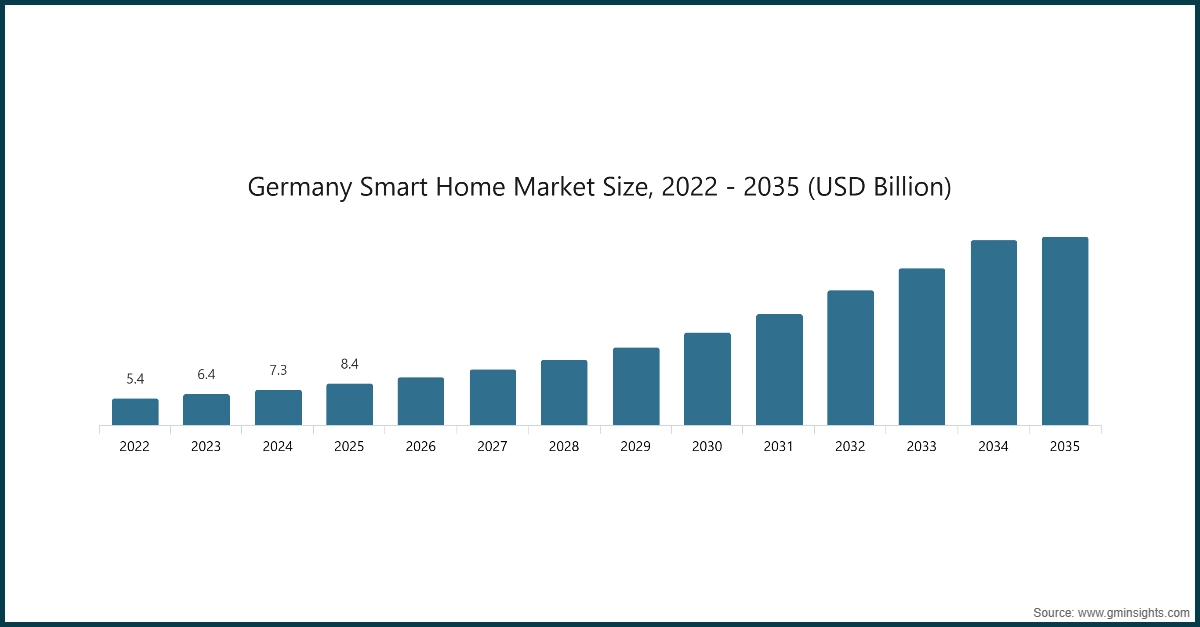
Looking for region specific data?
Germany Smart Home Market
In 2025, the Germany dominated the Europe smart home industry, accounting for around 25% and generating around USD 8.4 billion revenue in the same year.
- Connected living is an ongoing process of evolution in the German market, the growing acceptance of connected living leads to greater comfort, security, and efficiencies for consumers. There is an increased willingness by German households to invest in the automation of their physical environments for example, lighting controls, temperature controls, smart appliances, and voice-enabled automation systems. Consumers' increasing familiarity with using technology to control their home environment is aided by the widespread knowledge of technologies designed to improve convenience, and the tendency to look for well-engineered, high-quality solutions.
- Germany’s focus on energy efficiency and sustainability influence consumer decision-making. Consumers want to buy products that conserve energy and make it easier to heat, cool or operate their home with greater efficiency while also living in a manner that respects the environment. An additional major lifestyle promotion for consumers is the rise of smart security systems that provide reliable but discreet ways to increase home safety and peace of mind. Also related, the German market is moving from early-stage interest to readily available in the marketplace due to continued technological advancements in AI, automation, and home electrification.
Europe Smart Home Market Share
Signify N.V. is leading with 10% market share. Signify N.V., Robert Bosch, Schneider Electric, Legrand, Somfy S.A., collectively hold around 30%, indicating moderately fragmented market concentration. These prominent players are proactively involved in strategic endeavors, such as mergers & acquisitions, facility expansions & collaborations, to expand their product portfolios, extend their reach to a broad customer base, and strengthen their market position.
Signify N.V. is widely recognized for its strong presence in lighting and connected home solutions, offering a broad portfolio that integrates smart lighting with intuitive controls for enhanced home ambiance and energy efficiency. The company focuses on user‑friendly, design‑driven innovations that allow consumers to personalize lighting environments, automate routines, and improve overall comfort within the home.
Bosch plays a major role in the smart home space through its focus on reliable, easy‑to‑use connected devices designed to enhance home safety, comfort, and energy management. Its solutions typically emphasize robust engineering, seamless integration, and long‑term usability, making Bosch a trusted name for consumers who want dependable smart home automation that simplifies daily living.
Europe Smart Home Market Companies
Major players operating in the Europe smart home industry are:
- Ajax Systems
- Albrecht Jung GmbH & Co. KG
- Busch-Jaeger Elektro GmbH
- Fibaro
- Hager Group
- LEDVANCE GmbH
- Legrand
- Loxone Electronics GmbH
- Nuki Home Solutions GmbH
- Robert Bosch
- Schneider Electric
- Shelly Group
- Signify N.V.
- Somfy S.A.
- Tado GmbH
Busch‑Jaeger is known for offering a comprehensive range of smart switches, controls, and home automation products that blend functionality with modern design. The company’s solutions often appeal to homeowners looking for high‑quality, aesthetically aligned installations that enable convenient control over lighting, climate, and other in‑home systems while maintaining a premium, polished décor.
Shelly Group is recognized for its affordable and flexible smart home devices that cater to both beginners and advanced users who want customizable automation. Their products, often designed for easy retrofitting, help consumers control lighting, appliances, and energy usage with minimal effort, making smart home adoption more accessible and adaptable across different types of households.
Europe Smart Home Market Report Attributes
| Key Takeaway | Details |
|---|---|
| Market Size & Growth | |
| Base Year | 2025 |
| Market Size in 2025 | USD 33.9 Billion |
| Market Size in 2026 | USD 39.2 Billion |
| Forecast Period 2026-2035 CAGR | 16.1% |
| Market Size in 2035 | USD 150.1 Billion |
| Key Market Trends | |
| Drivers | Impact |
| Growing focus on home security & convenience | Users experience improved safety and ease of use in their homes where common tasks and maintaining their homes take little work. |
| Strong push for energy efficiency | Energy costs and environmental impact are greatly reduced for everyday people by using smarter systems that automate and use little energy. |
| Higher disposable incomes in western europe | Consumers are more likely to buy decorative items that use technology in a smart manner, add smart technology to their homes through larger purchases, and upgrade entire homes with advanced technology. |
| Pitfalls & Challenges | Impact |
| High upfront costs | They are delaying or limiting their consumers' purchases of smart home devices resulting in slow overall acceptance. |
| Data privacy & cybersecurity concerns | Consumers may be more hesitant to purchase new smart devices because they feel their private information could be compromised. |
| Opportunities: | Impact |
| Voice assistants, AI & predictive automation | Users enjoy a more personalized and responsive living space through an automatically updated environment that meets their needs with little/no manual input. |
| Renewable energy & home electrification | Users can better manage energy consumption because their smart home will seamlessly integrate with solar panels, battery storage units, and electric vehicle charging stations. |
| Market Leaders (2025) | |
| Market Leader |
10% market share |
| Top Players |
The collective market share in 2025 is 30% |
| Competitive Edge |
|
| Regional Insights | |
| Largest market | Germany |
| Fastest growing market | UK |
| Emerging countries | France, Italy |
| Future Outlook |
|
What are the growth opportunities in this market?
Europe Smart Home Industry Industry News
- In March 2026, Hager Group used the Light + Building trade fair to introduce a refreshed brand positioning and unveil a new switch and socket system under the Hager label, presented alongside advancements in intelligent energy management and bidirectional EV‑charging solutions, reinforcing the company’s commitment to smart, future‑ready residential electrification.
- In March 2026, Nuki Home Solutions introduced its fully integrated Smart Module, a permanently powered door‑embedded mechatronic system designed specifically for new‑build homes, offering seamless Matter support, remote access, and optional expansion through keypad, fingerprint, and NFC-based accessories bringing its next‑generation smart access technology directly into the structural design of modern entrances.
- In November 2025, Ajax Systems announced a major expansion of its smart home and security lineup with the launch of 55 new devices, featuring the industry’s first wireless Grade 3 intrusion system, next‑generation AI‑driven NVRs, advanced motorized varifocal cameras, and an extended range of outdoor protection solutions, marking a significant step forward in high‑security wireless technology for both residential and commercial markets.
- In 2025, Busch‑Jaeger expanded its smart home lineup by introducing a Matter Controller add‑on and a Thread‑based USB stick, complemented by new retrofit under‑plaster actuators and a battery‑free wireless switch, all designed to simplify multi‑ecosystem integration and make lighting and shading upgrades more seamless and accessible for existing homes.
The Europe smart home market research report includes in-depth coverage of the industry with estimates & forecasts in terms of revenue (USD Billion) & volume (Thousand Units) from 2022 to 2035, for the following segments:
Market, by Product
- Entertainment devices
- Security & access controls
- HVAC
- Home appliances
- Smart kitchen appliances
- Lighting control
- Home healthcare
- Smart furniture
- Other devices
Market, by Connectivity
- Wireless protocols
- Wired protocols
- Hybrid
Market, by Price Range
- Low
- Medium
- High
Market, by Application
- New construction
- Retrofit
Market, by Distribution Channel
- Online
- E-commerce
- Company owned website
- Offline
- Supermarkets & hypermarkets
- Specialty stores
- Others (department stores etc.)
The above information is provided for the following countries:
- UK
- Germany
- France
- Italy
- Spain
Frequently Asked Question(FAQ) :
What is the market size of the Europe smart home in 2025?
The market size was USD 33.9 billion in 2025, growing at a CAGR of 16.1% through 2035, driven by rising adoption of smart devices for security, energy efficiency, and convenience.
What is the projected value of the Europe smart home market by 2035?
The market is poised to reach USD 150.1 billion by 2035, supported by advancements in AI, voice-controlled technologies, and integrated smart ecosystems.
What is the expected size of the Europe smart home industry in 2026?
The market size is projected to reach USD 39.2 billion in 2026.
How much revenue did the entertainment devices segment generate in 2025?
The entertainment devices segment generated approximately USD 8.5 billion in 2025, driven by demand for smart TVs, voice-enabled speakers, and integrated systems.
What was the valuation of the low-price segment in 2025?
The low-price segment held 49% of the market share in 2025, supported by affordability of devices like smart bulbs and plug-and-play sensors.
Which country leads the Europe smart home sector?
Germany led the market with 25% share, generating approximately USD 8.4 billion in 2025, driven by high adoption and technological advancements.
What are the upcoming trends in the Europe smart home market?
Key trends include AI-powered predictive automation, seamless ecosystem integration, energy-efficient solutions, discreet security devices, and voice-controlled technologies.
Who are the key players in the Europe smart home industry?
Key players include Ajax Systems, Albrecht Jung GmbH & Co. KG, Busch-Jaeger Elektro GmbH, Fibaro, Hager Group, LEDVANCE GmbH, Legrand, Loxone Electronics GmbH, Nuki Home Solutions GmbH, Robert Bosch, Schneider Electric, and Shelly Group.
Europe Smart Home Market Scope
Related Reports