Summary
Table of Content

Europe Smart Clothing Market
Get a free sample of this report
Form submitted successfully!
Error submitting form. Please try again.
Thank you!
Your inquiry has been received. Our team will reach out to you with the required details via email. To ensure that you don't miss their response, kindly remember to check your spam folder as well!
Request Sectional Data
Thank you!
Your inquiry has been received. Our team will reach out to you with the required details via email. To ensure that you don't miss their response, kindly remember to check your spam folder as well!
Form submitted successfully!
Error submitting form. Please try again.
Europe Smart Clothing Market Size
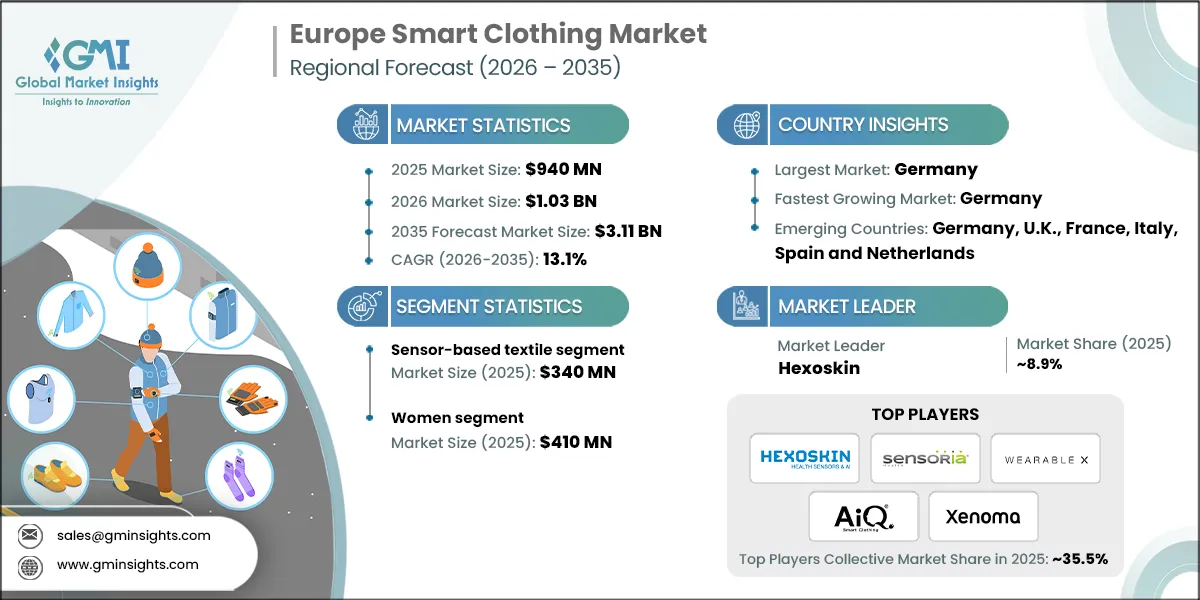
The Europe smart clothing market size was estimated at USD 940 million in 2025. The market is expected to grow from USD 1.03 billion in 2026 to USD 3.11 billion in 2035 at a CAGR of 13.1% according to latest report published by Europe Market Insights Inc.
Europe Smart Clothing Market Key Takeaways
Market Size & Growth
- 2025 Market Size: USD 940 Million
- 2026 Market Size: USD 1.03 Billion
- 2035 Forecast Market Size: USD 3.11 Billion
- CAGR (2026–2035): 13.1%
Regional Dominance
- Largest Market: Germany
- Fastest Growing Country: Germany
Key Market Drivers
- National push for neo-industrialization and technological innovation.
- Sustainability mandates and circular economy initiatives.
- Rising adoption of IoT and digital health technologies.
Challenges
- Inadequate e-waste management infrastructure.
- Skills gap and technological fragmentation.
Opportunity
- Expansion of eco-friendly and sustainable product lines.
- Penetration into rural and tier-2/tier-3 cities.
Key Players
- Market Leader: Hexoskin led with over 8.9% market share in 2025.
- Leading Players: Top 5 players in this market include Hexoskin, Sensoria, Wearable X, AiQ Smart Clothing Inc., Xenoma, which collectively held a market share of 35.5% in 2025.
Get Market Insights & Growth Opportunities
The European smart clothing market is experiencing rapid growth making the continent a centre for innovation in textile microelectronic and data analysis. This market goes beyond simple fitness trackers and include a wide variety of products from active smart govt with built in centre to Ultra Smart textile that can process data and respond automatically. These innovations play important role in healthcare high performance, sport and workplace safety.
The market growth is driven by an aging population, a strong focus on wellness and significant support from government and industries for digitalization. Major European economy like Germany France and the UK are leading this trend. They are using their advanced technology and strong consumer spending to blend this next generation E textile into everyday life. The appeal comes from their ability to provide noninvasive comfortable and continuous data collection going beyond the limitation of traditional wearable devices however the future success of this market depends on addressing issue related to data privacy possibility, power management and the need to standardize the complex supply chain across different sector.
Europe is facing a demographic shift with a growing number of elderly population putting pressure on public health care and health care system. This situation create a strong need for technology that can provide affordable ongoing and preventive health monitoring outside of hospital smart clothing is well suited for this task as it offer transparent monitoring solution for managing chronic disease and recovery after surgery and improving the overall well-being.
The history of EU funded Project shows this focus, which has been in place for over a decade. A notable early example is the health via project funded through an EU framework program. This project aim to create comfortable possible smart garments, like vest that contain sensor to monitor ECG, respiration, and body temperature continuously. A key success of this initiative was proofing that the garments could significantly sort an hospital stay for patients and the chronic obstructive pulmonary disease (COPD). Data so a reduced average discharge time and a fewer remission.
The European Commission Directorate-General for Communications Networks, Content and Technology DG CONNECT provide essential clinic and technological proof. It influenced purchasing decision in national health service across Europe such as NHS in the UK or similar system in Germany, by demonstrating that smart clothing evolved from being a novelty to a medically validated tool that cuts cost and enhance patient care. This institutional support along with the push for digital change in health care is spitting up move from isolated clinic-based monitoring to widespread clothing-based health data collection.
The European Union sees smart and e-textiles as a key enabling technology for keeping its manufacturing competitive. This technology helps advance both green and digital transitions while lowering reliance on non-European supply chains. Specific funding programs and policy platforms aim to connect textile manufacturing with microelectronics integration.
The European technology platform for the future of textile and clothing textile ETP a major industrial association, play a key role in guiding market direction the partnership with the European Commission has led to important strategic effort especially the launch of European partnership for textile of the future.
This partnership functioning under the Horizon Europe research and innovation programme shows a strong institutional commitment. Both the Commission and private industry partner are set to invest significant sum (up to Euro 60 million starting in 2025) in joint research and innovation projects that focus on sustainability, circularity, and digital integration in the textile field. Textile ETP, through its SmartX Innovation Hub, supports more than 40 high-potential projects in key areas like protective clothing, industrial uses, and healthcare.
To get key market trends
Europe Smart Clothing Market Trends
- The market is increasingly moving away from simple passive sensing (like temperature) to Ultra track heart rate but also offer haptic feedback to correct posture or prevent injury in athletes. The integration of machine learning algorithms with IoT connectivity enables predictive healthcare monitoring, anticipating chronic disease flare-ups or fatigue before they become critical events.
- The smart clothing industry is transforming through the integration of artificial intelligence into textile fibers, moving from external device attachments to embedded intelligence. MIT developed fiber computer technology that incorporates sensors, microcontrollers, digital memory, Bluetooth connectivity, and lithium-ion batteries into elastic, machine-washable textiles. These fibers maintain electrical continuity while achieving over 60% stretchability. Cornell University's SeamFit system demonstrates 93.4% exercise classification accuracy using conductive threads sewn into standard T-shirt seams.
- The system can perform machine learning inference directly within textiles, with collective networks achieving 95% accuracy compared to 70% for individual fibers. This integration of AI processing capabilities with textile manufacturing enables garments to analyze user behavior and provide real-time feedback without external computing devices. The U.S. military plans to conduct field trials of these technologies in Arctic conditions over 1,000 kilometers.
- The European Union is establishing new regulatory standards for the smart clothing market through the Ecodesign for Sustainable Products Regulation (ESPR), effective July 18, 2024. The regulation introduces digital product passports and prohibits the destruction of unsold textiles for large enterprises by July 19, 2026. Digital Product Passports (DPPs) serve as essential tools for managing smart clothing lifecycles by maintaining records of embedded electronics, firmware versions, and end-of-life handling protocols. Major brands like LVMH and H&M are implementing blockchain technology to create secure supply chain documentation.
- According to the European Environment Agency, textile waste generation reaches approximately 16 kg per person annually, with only 15% collected separately in 2022. Starting in 2025, mandatory separate collection requirements will increase the need for infrastructure to recover electronic components from smart garments while meeting recycled content targets by 2030. The evolving regulatory landscape has stimulated investment in circular technologies, particularly in automated sorting systems that use AI and advanced sensors for separating mixed-material textiles and electronic components.
Europe Smart Clothing Market Analysis
Learn more about the key segments shaping this market
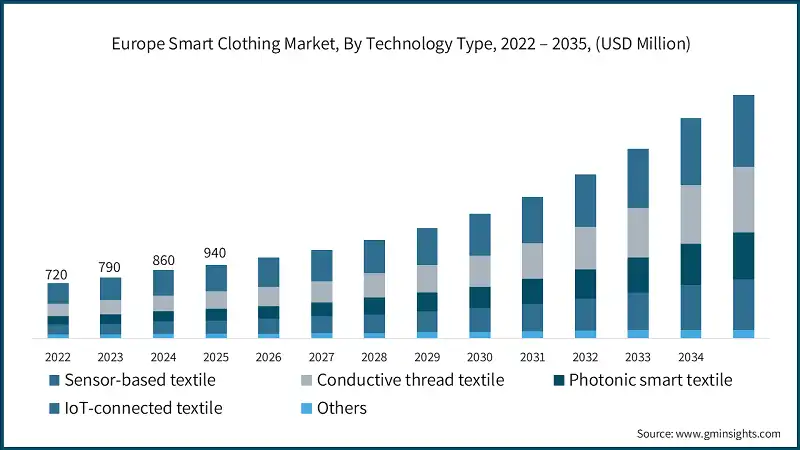
Based on technology type, the Europe smart clothing market is segmented into sensor-based textile, conductive thread textile, photonic smart textile, IoT-connected textile, and others. In 2025, the sensor-based textile segment dominated the market and generated a revenue of USD 340 million and is expected to grow at CAGR of around 10.8% during the forecast period 2026 to 2035.
- Sensor-based clothing dominates the smart clothing market primarily due to its early technological maturity and broad applicability across sectors such as healthcare, sports, and occupational safety.
- These garments are embedded with biometric sensors capable of monitoring vital signs like heart rate, respiration, and body temperature, features that align well with the growing demand for preventive healthcare and remote patient monitoring.
- The public health system across various countries have increasingly emphasized digital health solutions, and sensor-based textiles offer a non-invasive, continuous monitoring alternative that supports this shift. Additionally, huge population base in economies having primary age group of elderly citizens and chronic disease patients creates a natural demand for wearable health technologies, where sensor-based garments are often the first point of adoption due to their reliability and ease of use.
Learn more about the key segments shaping this market
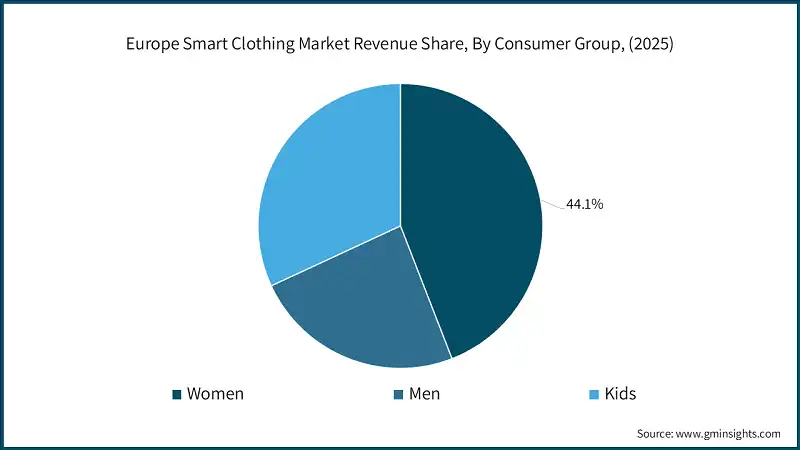
The Europe smart clothing market by consumer group is segmented into women, men, and kids. The women segment was the leading segment in this market in 2025 with a revenue of USD 410 million and has a market share of around 11.8%.
- Women dominate the smart clothing market primarily due to their strong engagement with both the fashion and wellness sectors, two pillars that smart clothing naturally integrates. This dominance is not just a reflection of purchasing power but also of behavioral trends. According to Europe adoption patterns, over 70% of wearable device users are women, particularly those tracking health and fitness metrics.
- Moreover, the rise of femtech and women-centric health solutions has accelerated the demand for sensor-based and IoT-connected garments tailored to female physiology. Wearables that track menstrual cycles, stress levels, and sleep patterns are gaining popularity among women consumers, who are seeking personalized, data-driven health insights.
- The fashion-forward nature of female consumers also plays a role, smart clothing that combines aesthetic appeal with functionality resonates strongly in a market where women drive trends in both casual and performance wear. As a result, brands that offer stylish, tech-integrated garments designed specifically for women are seeing higher adoption rates, reinforcing the segment’s leadership in the market.
Looking for region specific data?
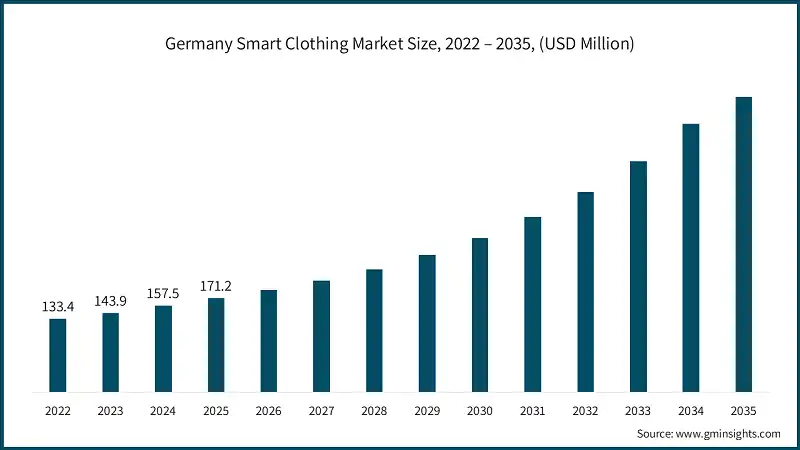
Germany witnessed promising demand in the smart clothing market with a share of around 18.2% in 2025 and is expected to grow at a robust CAGR of 12.5% during the forecast period.
- Europe is demonstrating strong demand in the smart clothing market due to its strategic alignment with sustainability, digitalization, and industrial modernization goals. The European Commission’s EU Strategy for Sustainable and Circular Textiles emphasize the transformation of the textile sector into a greener, more competitive, and resilient industry. This includes mandates for durability, recyclability, and digital product passports, which directly support the integration of smart technologies into garments. The strategy also promotes extended producer responsibility and innovation in textile design, creating fertile ground for smart clothing adoption across sectors like healthcare, sports, and defense.
- Additionally, rising digital engagement and e-commerce penetration are accelerating smart clothing uptake. According to Eurostat, 77% of EU individuals aged 16–74 made online purchases in 2024, with 46% buying clothing, shoes, and accessories, highlighting a robust digital consumer base ready for tech-integrated apparel.
- The Digital Economy and Society Index (DESI) further shows that EU member states are investing heavily in digital transformation, with countries like Germany and Ireland allocating over 30% of their Recovery and Resilience Facility funds to digital initiatives. This policy-driven digital momentum, combined with consumer readiness and sustainability, positions Europe as a high-growth region for smart clothing innovation and adoption.
Europe Smart Clothing Market Share
- The top 5 companies in the smart clothing industry, such as Hexoskin, Sensoria, Wearable X, AiQ Smart Clothing Inc., and Xenoma, hold a market share of 35.5%.
- Wearable X has built a niche by blending fashion-forward design with functional wellness technology, particularly through its flagship product, Nadi X smart yoga pants. These garments use embedded sensors and gentle vibrations to guide users through yoga poses, offering a unique value proposition in the fitness and lifestyle segment. The company’s strategy hinges on direct-to-consumer sales via e-commerce, influencer partnerships, and wellness-focused branding, allowing it to maintain high engagement with tech-savvy and health-conscious consumers. By prioritizing user experience and aesthetic appeal, Wearable X effectively differentiates itself from more clinical or utilitarian competitors, sustaining relevance in a crowded market.
- AiQ Smart Clothing Inc. leverages its deep expertise in textile-electronics integration to serve diverse sectors including healthcare, industrial safety, and sports. Its “Smart Inside Out” philosophy emphasizes reliability, scalability, and comfort, enabling the company to deliver wearable systems that meet stringent performance standards. AiQ’s strategy includes co-development partnerships, participation in innovation challenges, and modular product platforms that allow for rapid customization and deployment. By focusing on bio-signal acquisition and motion analysis, AiQ positions itself as a B2B enabler of next-gen smart garments, helping OEMs and solution providers bring products to market faster and more efficiently.
- Xenoma stands out through its proprietary e-skin technology, which integrates washable, stretchable sensors into everyday apparel for motion capture, health monitoring, and rehabilitation. The company targets both consumer and institutional markets, with applications ranging from fitness and EMS training to elder care and clinical diagnostics. Xenoma’s competitive edge lies in its ability to deliver high-performance smart garments that are comfortable, durable, and easy to maintain. Its strategy includes showcasing innovations at Europe tech expos, expanding its product portfolio (e.g., e-skin MEVA), and building strategic alliances in healthcare and sports tech. This multi-channel approach helps Xenoma stay agile and responsive to evolving market demands.
Europe Smart Clothing Market Companies
Major players operating in the smart clothing industry are:
- AiQ Smart Clothing Inc.
- Athos
- CuteCircuit
- Hexoskin
- Intelligent Textiles Limited
- Levi’s
- Mitsufuji Corporation
- Myant Health, Inc.
- Myontec
- Sensoria
- Siren
- TORAY INDUSTRIES, INC.
- Vulpes Electronics GmbH
- Wearable X
- Xenoma
Hexoskin has built its competitive edge through a deep specialization in clinical-grade biometric monitoring and long-term data infrastructure. Its flagship products, including the Astroskin platform, are used not only in healthcare and sports but also in space medicine, with collaborations involving NASA, CSA, and SpaceX. This diversification into high-stakes environments has allowed Hexoskin to develop robust, validated technologies that appeal to both institutional and consumer markets.
The company’s strategy includes B2B partnerships with research hospitals, pharma companies, and defense agencies, enabling it to withstand price-based competition from consumer-focused brands. Additionally, Hexoskin’s proprietary AI-driven diagnostics platform and its massive cardiorespiratory data repository curated over a decade, position it as a leader in digital biomarker development, a niche that is difficult for new entrants to replicate.
Sensoria has differentiated itself by focusing on modular, sensor-rich garments that integrate seamlessly with mobile apps and cloud platforms. Its strategy revolves around ecosystem development, offering not just smart clothing but also software development kits (SDKs) and APIs that allow third-party developers to build on its platform. This open innovation model has helped Sensoria expand into fitness, rehabilitation, and remote patient monitoring.
The company also emphasizes durability and washability, addressing one of the key pain points in smart clothing adoption. By maintaining a strong presence in both consumer retail and clinical pilot programs, Sensoria has created a dual-channel strategy that buffers it against market volatility. Its ability to license its technology to apparel brands further extends its reach without the overhead of direct manufacturing.
Europe Smart Clothing Market Report Attributes
| Key Takeaway | Details |
|---|---|
| Market Size & Growth | |
| Base Year | 2025 |
| Market Size in 2025 | USD 940 Million |
| Market Size in 2026 | USD 1.03 Billion |
| Forecast Period 2026 - 2035 CAGR | 13.1% |
| Market Size in 2035 | USD 3.11 Billion |
| Key Market Trends | |
| Drivers | Impact |
| National push for neo-industrialization and technological innovation | Accelerating R&D investments and cross-sector partnerships, enabling countries to localize smart textile production and reduce reliance on imports. |
| Sustainability mandates and circular economy initiatives | These policies are compelling manufacturers to adopt eco-friendly materials and modular designs, reshaping product lifecycles and boosting demand for recyclable smart garments. |
| Rising adoption of IoT and digital health technologies | This trend is expanding the smart clothing market into healthcare, fitness, and elder care, driving Europe demand for garments with embedded biometric and motion sensors. |
| Pitfalls & Challenges | Impact |
| Inadequate e-waste management infrastructure | This limits the scalability of smart garments by complicating end-of-life disposal and recycling, raising environmental concerns and regulatory hurdles. |
| Skills gap and technological fragmentation | This slows innovation and product commercialization due to misaligned expertise across fashion, electronics, and textile sectors, leading to inefficient development cycles. |
| Opportunities: | Impact |
| Expansion of eco-friendly and sustainable product lines | Companies that lead in eco-friendly innovation can build strong brand loyalty and premium positioning. |
| Penetration into rural and tier-2/tier-3 cities | Even small increases in per capita usage across large populations can significantly boost overall sales. |
| Market Leaders (2025) | |
| Market Leaders |
Market share of ~8.9% |
| Top Players |
|
| Competitive Edge |
|
| Regional Insights | |
| Largest Market | Germany |
| Fastest growing market | Germany |
| Emerging countries | Germany, U.K., France, Italy, Spain and Netherlands |
| Future outlook |
|
What are the growth opportunities in this market?
Europe Smart Clothing Industry News
- In September 2025, German electronics specialist Vulpes continued its focus on providing highly reliable, modular IoT-enabled heating and sensor systems for custom integration into third-party textiles. Their recent platform developments support manufacturers needing ready-to-integrate smart modules for high-value applications. This reinforces the German market's strength in industrial and occupational safety textiles. By acting as a B2B technology supplier, Vulpes fuels the development of smart workwear, military gear, and specialized outdoor apparel across Europe, where regulatory compliance and extreme durability are primary concerns.
- In 2025, the European Union began implementing the Ecodesign for Sustainable Products Regulation (ESPR), which mandates requirements like the Digital Product Passport (DPP) for textiles. This regulation forces manufacturers to design for durability and recyclability.
- In November 2024, Myant Corp a Canadian-based Textile Computing firm, Myant, strategically acquired two leading Swiss smart textile companies, Nanoleq (biosensing, stretchable electronics) and Osmotex (electronic moisture management). The company established a new European base in Zurich to accelerate its expansion across the EU and EMEA. This development directly leverages Swiss deep-tech expertise and is explicitly aimed at meeting the high standards of the European medical device market, consolidating key IP in biosensors and physiological comfort (crucial for first responders and patients) within the continent.
- In August 2024, Hexoskin, a leader in clinically validated biometric shirts, announced an additional capital raise that specifically included European investors such as ballas invest (Europe) and Deep Divers Ltd (UK). The investment was earmarked for growth, digital biomarkers research, and new AI-based solutions. This investment, explicitly sourced from European capital, validates the company’s focus on clinical-grade data and AI-driven diagnostics—the core requirement for securing reimbursement and wide adoption within European Nat diagnostics, Services for conditions like COPD and cardiovascular disorders.
The Europe smart clothing market research report includes in-depth coverage of the industry, with estimates & forecasts in terms of revenue (USD Billion) and volume (Million Units) from 2022 to 2035, for the following segments:
Market, By Technology Type
- Sensor-based textile
- Conductive thread textile
- Photonic smart textile
- IoT-connected textile
- Others
Market, By Price Range
- Low (Below USD 50)
- Medium (USD 50 - USD 200)
- High (Above USD 200)
Market, By Consumer Group
- Men
- Women
- Kids
Market, By Application
- Healthcare & medical monitoring
- Sports & fitness performance
- Industrial safety & workplace
- Consumer lifestyle & fashion
Market, By End Use
- Healthcare professionals & patients
- Military & defense personnel
- Professional athlete and fitness enthusiasts
- Industrial workers
- Others (General consumer, etc.)
Market, By Distribution Channel
- Online
- E-commerce website
- Brand website
- Offline
- Specialty stores
- Fitness retail centers
- Pop-up stores
- Others
The above information is provided for the following countries:
- Germany
- U.K.
- France
- Italy
- Spain
- Netherlands
- Rest of Europe
Frequently Asked Question(FAQ) :
What was the market size of the European smart clothing in 2025?
The market size was estimated at USD 940 million in 2025, with a CAGR of 13.1% expected through 2035. The market's growth is driven by advancements in textile microelectronics, data analytics, and increasing adoption across healthcare, sports, and workplace safety sectors.
What is the projected value of the European smart clothing market by 2035?
The market is poised to reach USD 3.11 billion by 2035, fueled by innovations in AI-integrated textiles, IoT connectivity, and regulatory support for sustainable and circular textiles.
What is the expected size of the European smart clothing industry in 2026?
The market size is expected to reach USD 1.03 billion in 2026.
How much revenue did the sensor-based textile segment generate in 2025?
The sensor-based textile segment generated approximately USD 340 million in 2025 and is projected to grow at a CAGR of 10.8% during the forecast period.
What was the valuation of the women segment in 2025?
The women segment generated USD 410 million in revenue in 2025, holding a market share of approximately 11.8%, led by strong engagement with the fashion and wellness sectors.
What is the growth outlook for Germany in the smart clothing sector?
Germany held an 18.2% market share in 2025 and is expected to grow at a robust CAGR of 12.5% till 2035, supported by sustainability and digitalization initiatives.
What are the upcoming trends in the European smart clothing market?
Trends include AI-integrated textiles, IoT-based predictive health monitoring, ML-enabled smart garments, evolving regulations such as the Ecodesign for Sustainable Products Regulation, and rising investments in circular textile recycling technologies.
Who are the key players in the European smart clothing industry?
Key players include AiQ Smart Clothing Inc., Athos, CuteCircuit, Hexoskin, Intelligent Textiles Limited, Levi’s, Mitsufuji Corporation, Myant Health, Inc., Myontec, Sensoria, and Siren.
Europe Smart Clothing Market Scope
Related Reports