Summary
Table of Content

Europe Secondhand Camera and Lens Market
Get a free sample of this report
Form submitted successfully!
Error submitting form. Please try again.
Thank you!
Your inquiry has been received. Our team will reach out to you with the required details via email. To ensure that you don't miss their response, kindly remember to check your spam folder as well!
Request Sectional Data
Thank you!
Your inquiry has been received. Our team will reach out to you with the required details via email. To ensure that you don't miss their response, kindly remember to check your spam folder as well!
Form submitted successfully!
Error submitting form. Please try again.
Europe Secondhand Camera and Lens Market Size
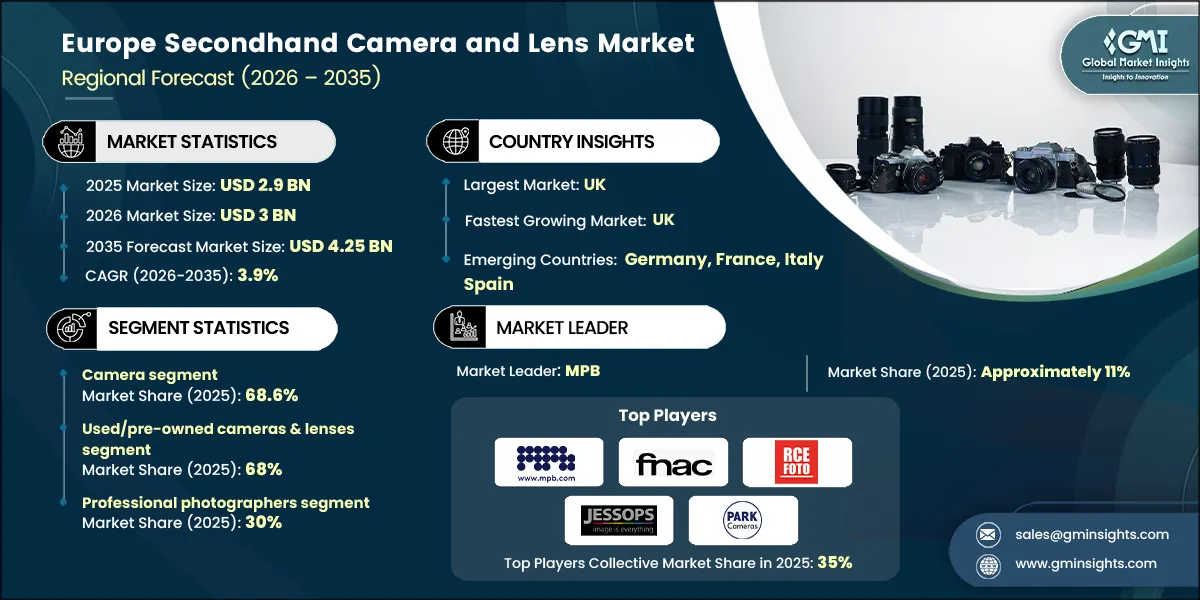
The Europe secondhand camera and lens market was estimated at USD 2.9 billion in 2025. The market is expected to grow from USD 3 billion in 2026 to USD 4.25 billion in 2035, at a CAGR of 3.9% according to latest report published by Global Market Insights Inc.
Europe Secondhand Camera and Lens Market Key Takeaways
Market Size & Growth
- 2025 Market Size: USD 2.9 Billion
- 2026 Market Size: USD 3 Billion
- 2035 Forecast Market Size: USD 4.25 Billion
- CAGR (2026–2035): 3.9%
Regional Dominance
- Largest Market: UK
- Fastest Growing Country: UK
Key Market Drivers
- Mirrorless shift & upgrade cycles.
- Increasing sustainability & circularity.
- Rise of online resale infrastructure.
Challenges
- Quality variance and warranty concerns.
- Counterfeit risk & limited certification.
Opportunity
- Certified pre owned & extended warranties.
- AI assisted pricing and diagnostics.
Key Players
- Market Leader: MPB led with over mpb is leading with approximately 11% market share in 2025.
- Leading Players: Top 5 players in this market include MPB, Fnac, RCE Foto, Jessoc, Park Cameras, which collectively held a market share of 35% in 2025.
Get Market Insights & Growth Opportunities
Second-hand cameras and lenses: These are pre-owned cameras and lenses for resale once they are initially used and come at a discounted cost because they are second-hand. This market includes second-hand digital cameras and lenses, second-hand film cameras and lenses, and second-hand professional cameras and lenses because they come with plenty of working life left in them. Clients would like second-hand cameras and lenses because they are cheap and come in lots. Clients can also buy second-hand cameras and lenses to move up to higher levels in their products.
The European market for second-hand cameras and lenses has come up as a vibrant and swiftly growing segment, driven by the need for affordability, sustainability, and changing consumer behaviors. The market has gained immense popularity with the increasing need for affordable solutions compared to the high costs associated with the purchase of new products. The need for affordable options has moved in tandem with the worldwide market for second-hand imaging equipment, in which the concern for sustainability has driven the interest in photography. Europe has been at the forefront of the global shift towards circular economy, advocating the reuse of photography equipment to achieve sustainability.
Another highly influential factor that has impacted the market is the transition from DSLRs to mirrorless camera systems. Mirrorless cameras have gained immense popularity, even surpassing DSLRs in terms of sales in new, as well as secondhand, markets. This has mainly been driven by young photographers, YouTubers, or video makers, who appreciate the versatility, portability, and advanced capabilities associated with mirrorless cameras. Based on consumer behavior and market search trends, it has been observed that people have been preferring to buy used mirrorless cameras, which has increased steadily, even surpassing DSLRs. Consequently, this has resulted in an increase in the availability of secondhand DSLRs, along with lenses, in the market, but simultaneously increasing the turn-over rate, or even the price, for mirrorless camera systems.
According to the Camera & Imaging Products Association (CIPA), it is discovered that the total number of lenses and camera bodies shipped in 2024 was 8% above year on year, and this is indicative of growing demand for high end photographic equipment. Moreover, the average retail price of lenses and cameras has increased by 3%, which shows the premium trend of the market. Sustainability and environmental consciousness are the factors propelling the Europe secondhand camera and lens market growth. Most photographers desire to have sustainable options in this age due to global warming. Since the need for second-hand cameras is increasing, users can limit electronic waste and contribute to a circular buying method. According to the most recent MPB impact report, MPB generated 35% of electricity from renewable sources, achieved 100% plastic-free packaging throughout the year and delivered zero waste to landfill.
MPB's approach to sustainability is founded on three themes across which the business invests and monitors its performance such as circular and renewable, inclusive and diverse, and trusted and ethical. Throughout its Circular and Renewable objectives, MPB announced that it is recycling 570,000 cameras, lenses and accessories annually. MPB remains a zero-waste-to-landfill company. Through its strong recycling and reuse initiatives throughout its four locations, MPB recycled an average of 69% of office and warehouse waste.
Lenses play a crucial role in the growth of the second-hand camera and lens market in Europe. Standard and prime lenses continue to dominate the market, holding the largest share due to their versatility and widespread use across various photography styles. However, telephoto and zoom lenses are emerging as the fastest-growing segments, driven by increasing interest in wildlife, sports, and long-range photography. The growing popularity of these lenses is supported by advancements in sensor technology and the availability of adapter systems, which enhance compatibility and usability across different camera models. These factors contribute to the long-term resale value of lenses, making them a vital component of the second-hand market. The accessibility of online marketplaces has further facilitated the growth of this segment, enabling consumers to explore a wide range of options and make informed purchasing decisions.
To get key market trends
Europe Secondhand Camera and Lens Market Trends
The Europe pre‑owned imaging market is mid‑transition from a fragmented, listing‑led space to a trust‑engineered, platform‑driven ecosystem that emphasizes grading rigor, warranties, and rapid cross‑border logistics. The best in the business is putting out into the marketplace solutions that are at the bleeding edge of innovation in the form of automatic condition and solutions that come with properties like intelligent MEMS sensors, AI-powered algorithms, and edge analytics.
- Technological advancement and product development: Platforms are using dynamic price indices and analytics to standardize pricing and minimize bid-ask spreads; sellers enjoy transparent benchmarking, while buyers feel assured of fair prices. With the adoption of mirrorless cameras surpassing DSLR sales in both new and used markets, the entry of new-generation bodies and RF/Z/E-mount lenses into the used market has enhanced the quality of supply.
- Smart resale & professional services:The scale of the European online resale market and the policy framework (circularity, right-to-repair) support trade-in at checkout, certified inspections, and guaranteed used programs provided by vertical specialists and high-end retailers. This cuts down the time-to-cash for the seller and improves consumer protection for the buyer.
- Sustainable asset use & circular logistics: Increasingly, European consumers deliberately opt for second-hand products to minimize e-waste and carbon emissions. Major imaging resellers claim that hundreds of thousands of products are recirculated every year, and efforts in renewable energy and zero-landfill initiatives indicate a sustainable competitive barrier for structured resale.
- Macro disruptions & supply realignment: Price spikes in the new market (and occasional supply tightness for popular models) funnel demand into the used space, while film/analog revivals keep niche legacy gear in circulation—broadening the addressable audience for second‑hand.
- Greater emphasis on creator led demand: Content creators and hybrid shooters continue to seek value‑dense kits (fast primes, stabilized zooms, compact full‑frame/mid‑format bodies) via used channels, driving high‑velocity rotations of popular SKUs and premium fixed‑lens compacts
Europe Secondhand Camera and Lens Market Analysis
 Learn more about the key segments shaping this market
Learn more about the key segments shaping this market
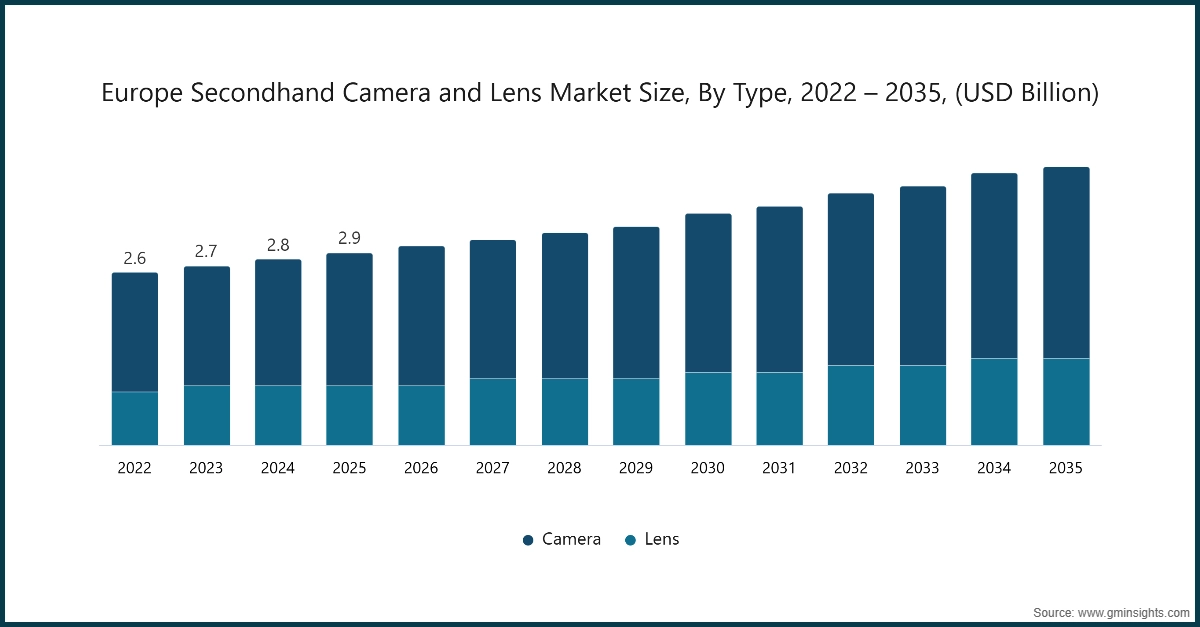
Based on the type, the market is segmented into camera and lens. In 2025, the camera segment holds the largest market share of 68.6% with generating a revenue of USD 2.92 billion.
- The European second-hand DSLR camera market has seen significant growth as photographers increasingly transition to mirrorless systems. This shift has resulted in a substantial supply of high-quality pre-owned DSLR units. Canon and Nikon models dominate this segment, with their flagship models maintaining strong resale values. Popular models from these brands continue to attract considerable interest from buyers.
- Point-and-shoot camera market has seen a surprising resurgence, largely driven by younger consumers seeking the nostalgic appeal of compact digital cameras from earlier decades. Social media platforms have played a significant role in popularizing this trend, particularly among younger demographics in major European markets. This nostalgia-driven demand has transformed previously overlooked cameras into sought-after items, leading to supply shortages for certain models. While this trend initially gained traction in Asian markets, it has firmly established itself in Europe, with countries such as the United Kingdom, France, and Spain showing strong interest.
- Film cameras segment has experienced remarkable growth in recent years, fueled by a renewed interest in analog photography among younger generations. Classic 35mm SLRs from brands like Canon, Nikon, Pentax, and Olympus have become highly desirable. Prices for popular models have increased significantly, reflecting the growing demand for these vintage cameras.
- The second-hand lens market in Europe is also expanding steadily, driven by factors such as affordability, a growing interest in creative photography, and the long usable lifespan of optical equipment. The market is supported by a diverse range of consumers, including students, amateur photographers, and content creators, who are seeking economical access to high-quality optics.
Learn more about the key segments shaping this market
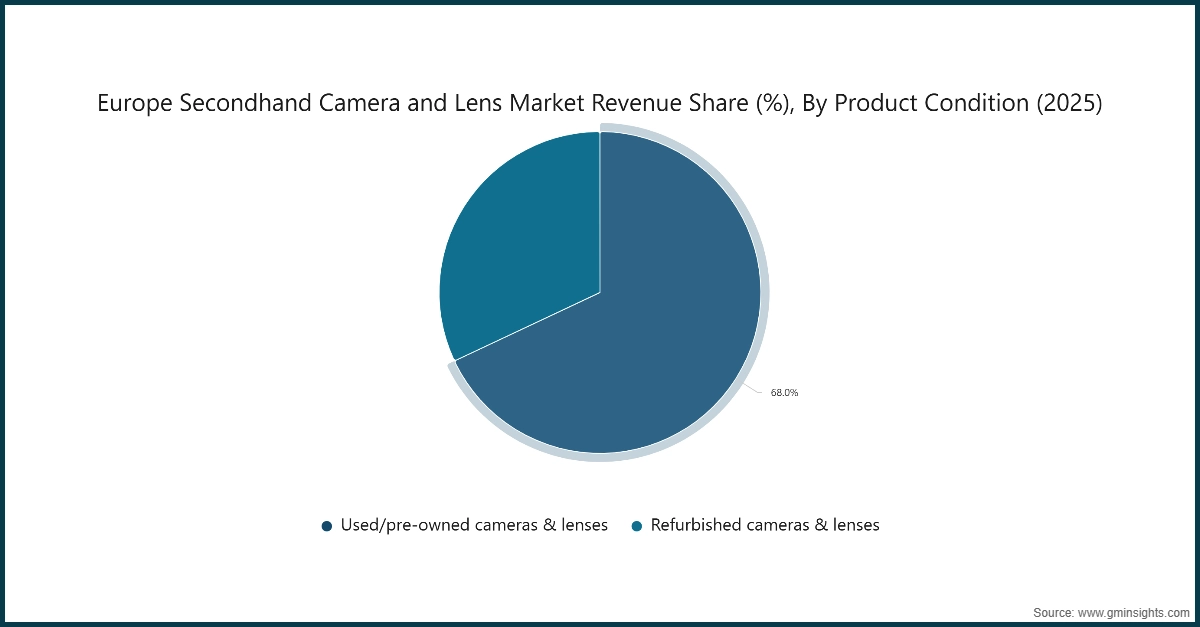
Based on the product condition, the Europe secondhand camera and lens market is segmented into used/pre-owned cameras & lenses and refurbished cameras & lenses. In 2025, used/pre-owned cameras & lenses held the major market share of 68%, reflecting the industry’s heavy reliance on high-value asset protection.
- The used and pre-owned camera segment forms the backbone of Europe's second-hand market, experiencing robust growth driven by economic factors, sustainability awareness, and the expansion of digital platforms.
- Online marketplaces have played a pivotal role in professionalizing the buying and selling experience, building consumer trust through grading systems, authentication processes, and buyer protection programs. While budget-conscious buyers remain a core segment, the market has expanded to include.
- The refurbished camera and lens segment is the fastest-growing category within Europe's second-hand market, offering a unique value proposition that bridges the gap between new and used equipment. Manufacturer-certified refurbishment programs from leading brands have gained significant traction, providing professionally restored equipment with warranty coverage.
- These programs address consumer concerns about the reliability of used equipment while offering substantial savings compared to new retail prices. Major European retailers have expanded their refurbished inventories, reflecting the growing demand for this category. The refurbishment ecosystem in Europe has matured considerably, with specialized companies developing advanced restoration processes. These include sensor cleaning, shutter mechanism replacement, firmware updates, and cosmetic reconditioning.
Based on the end user, the Europe secondhand camera and lens market is segmented into professional photographers, semi-professional, amateur/hobbyist and institutional/educational. In 2025, professional photographers held the major market share of 30%, reflecting the industry’s application for camera and lens.
- Professional photographers represent a vital and influential segment within Europe's second-hand camera and lens market. They play dual roles as both significant buyers and key suppliers of high-quality pre-owned equipment. These professionals, spanning various specializations such as wedding, commercial, fashion, sports, wildlife, and photojournalism, strategically utilize the second-hand market to optimize their investments while maintaining their competitive edge.
- The semi-professional segment represents a substantial and growing category within Europe's second-hand camera and lens market. This group bridges the gap between amateur enthusiasts and full-time professionals, encompassing part-time wedding and event photographers, freelance content creators, passionate hobbyists with professional aspirations, and individuals generating supplemental income through photography. Semi-professionals are drawn to the second-hand market for its ability to provide high-quality equipment at accessible price points, making it an attractive option for this cost-conscious yet quality-driven demographic.
- Amateur and hobbyist photographers constitute the largest end-user segment by volume within Europe's second-hand camera and lens market. This diverse group includes retirees pursuing photography as a leisure activity, beginners developing their skills, travel photographers documenting their adventures, parents capturing family moments, and dedicated hobbyists exploring specialized genres such as astrophotography, macro photography, or street photography.
- The institutional and educational segment is a specialized but significant category within Europe's second-hand camera and lens market. This segment includes universities, photography schools, art academies, vocational training programs, media organizations, and cultural institutions. Budget constraints faced by European educational institutions have driven the adoption of second-hand and refurbished equipment procurement strategies.
Looking for region specific data?
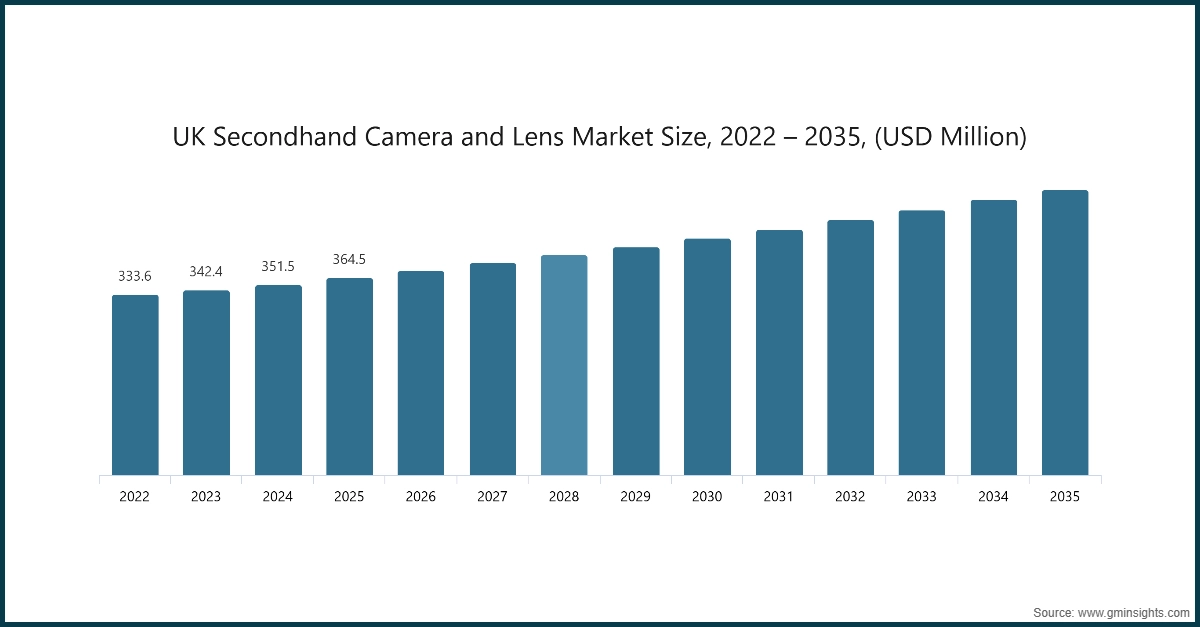
The Europe secondhand camera and lens market dominate with a revenue share of 68.6% in 2025. This growth is increasingly influenced by sustainability initiatives and reached USD 2.9 billion in 2025.
- The United Kingdom represents one of Europe's largest and most mature second-hand camera and lens markets, characterized by sophisticated consumer behavior, well-established distribution infrastructure, and a vibrant photography culture spanning professional, enthusiast, and casual segments. The UK market benefits from a strong heritage of photographic excellence, hosting renowned photography institutions, influential publications, and active communities that sustain demand for quality equipment across all price segments.
- Germany stands as continental Europe's largest and most significant second-hand camera and lens market, combining substantial population scale, high photography equipment ownership rates, strong consumer purchasing power, and deep cultural connections to photographic heritage. The country's historical role in optical engineering as home to legendary manufacturers including Leica, Zeiss, Rollei, and Voigtländer has cultivated enduring appreciation for quality photography equipment and sustained active collector communities.
- France represents one of Europe's most significant and culturally distinctive second-hand camera and lens markets, shaped by the country's profound photographic heritage and enduring artistic traditions. As the birthplace of photography through the pioneering work of Niépce and Daguerre, France maintains deep cultural connections to photographic arts that influence contemporary equipment markets. The French photography community spans world-renowned professionals, dedicated enthusiasts, and casual practitioners, creating diverse demand across all market segments.
- Italy represents one of Europe's most culturally significant second-hand camera and lens markets, shaped by the country's extraordinary artistic heritage, design excellence traditions, and passionate photography communities. Italian visual culture—spanning Renaissance art mastery to contemporary fashion and design leadership—has cultivated sophisticated aesthetic appreciation that influences photography equipment preferences and market dynamics.
Europe Secondhand Camera and Lens Market Share
- MPB is leading with approximately 11% market share. MPB, Fnac, RCE Foto, Jessoc and Park Cameras collectively hold around 35%, indicating a moderately fragmented market concentration with a strong tier of dominant global players. These prominent players are proactively involved in strategic endeavors, such as AI-driven software acquisitions, facility expansions, and IIoT collaborations, to expand their product portfolios, extend their reach to a broad customer base, and strengthen their market position
- Calumet Photographic became part of a major industry consolidation as AURELIUS completed the acquisition of Wex Photographic, enabling the merger of Wex Photographic and Calumet Photographic; this combined entity aimed to create a leading omni‑channel retailer across the UK and Europe, strengthening competitive presence and expanding market access within the professional and enthusiast photography sector.
- Canon Inc. expanded its PIXMA printer portfolio with the launch of three new all‑in‑one desktop printers—PIXMA TR7120, TS6520, and TS4320—designed to enhance home and small‑office printing efficiency; featuring improved print speeds, upgraded text‑clarity ink formulations, enhanced dual‑band wireless connectivity, and compatibility with Canon’s subscription‑based PIXMA Print Plan, the expansion strengthens Canon’s position in the global home‑printing market.
Europe Secondhand Camera and Lens Market Companies
Major players operating in the Europe secondhand camera and lens industry are:
- Calumet Photographic
- Canon Inc.
- Fnac
- Foto Erhardt
- Fujifilm Holdings
- Grays of Westminster
- Jessops
- Kamerastore
- Leica Camera AG
- London Camera Exchange (LCE)
- MediaMarkt
- Miss Numerique
- MPB
- Nikon Corporation
- Park Cameras
- RCE Foto
- Saturn
- Sigma Corporation
- Sony Corporation
- Zeiss
Fnac Darty strengthened its strategic position in Southern Europe through the acquisition of Unieuro, Italy’s leading consumer electronics and appliances retailer; this transaction expanded the Group’s regional footprint, enhanced purchasing synergies exceeding 22 million USD, and reinforced its omnichannel capabilities across key European markets.
Europe Secondhand Camera and Lens Market Report Attributes
| Key Takeaway | Details |
|---|---|
| Market Size & Growth | |
| Base Year | 2025 |
| Market Size in 2025 | USD 2.9 Billion |
| Market Size in 2026 | USD 3 Billion |
| Forecast Period 2035 CAGR | 3.9% |
| Market Size in undefined | USD 4.25 Billion |
| Key Market Trends | |
| Drivers | Impact |
| Mirrorless shift & upgrade cycles | Ongoing migration from DSLR to mirrorless liberates a steady stream of pre owned bodies and lenses; buyers secure “near flagship” performance at lower cost. |
| Increasing sustainability & circularity | Younger cohorts view buying used as an ethical, lower-carbon choice; resale platforms recirculate hundreds of thousands of items annually. |
| Rise of online resale infrastructure | Europe’s online second-hand economy is large and growing; authentication, grading and warranties reduce friction and increase high-ticket confidence. |
| Pitfalls & Challenges | Impact |
| Quality variance and warranty concerns | Buyer anxiety over shutter counts, history, or region-locked warranties requires robust grading and clear terms; EU legal guarantees help but vary in application for used goods |
| Counterfeit risk & limited certification | Niche counterfeits (batteries, accessories) and scarce manufacturer-level refurbishment programs necessitate platform-led verification and return policies |
| Opportunities | Impact |
| Certified pre owned & extended warranties | Retailer/platform warranties and no‑quibble returns increase conversion and ASPs, pushing the segment toward “assured used. |
| AI assisted pricing and diagnostics | Dynamic pricing indices and AI‑assisted grading/QA shorten turn times, improve yield, and increase inventory trust. |
| Market Leaders (2025) | |
| Market Leader |
|
| Top Players |
|
| Competitive Edge |
|
| Regional Insights | |
| Largest Market | UK |
| Fastest growing market | UK |
| Emerging countries | Germany, France, Italy, Spain |
| Future outlook | Shift from “listings” to “assured resale” (authentication, warranty, standardized grading), with policy‑aligned circularity (e.g., Digital Product Passports) and expanding trade‑in programs across retailers., Southern & Eastern Europe as marketplaces expand cross‑border logistics and localized warranty/returns. |
What are the growth opportunities in this market?
Europe Secondhand Camera and Lens Market News
- In 2025 Calumet Photographic advanced its European expansion strategy by integrating its 17 physical stores with Wex Photographic’s established online platform; this initiative enhanced reach, improved Europe secondhand camera and lens availability, and positioned the merged operation as a stronger player in Europe’s growing pre‑owned photography equipment market
- In February 2025 Canon Inc. introduced the RF 16–28mm F2.8 IS STM lens for its RF‑mount mirrorless ecosystem; engineered with a constant f/2.8 aperture, optical stabilization, and compact construction, this launch reinforces Canon’s strategic expansion of its mirrorless lens lineup, targeting creators seeking high‑performance hybrid stills‑and‑video capabilities.
- In October 2025 Fnac Darty launched the Darty brand in Portugal, marking a significant step in its European expansion strategy; through this rollout, the Group broadened its retail and service ecosystem in the region, accelerating its Beyond Everyday strategic plan and reinforcing its vision to deliver integrated customer experiences across Europe.
- In July 2025 Foto Erhardt advanced its brand expansion by fully rebranding former fotogena operations under the Foto Erhardt name; this transition included the continuation of fotogena’s Darmstadt and Worms stores, alignment of store interiors with the new brand identity, and consolidation of online services—strengthening the company’s unified market presence and operational footprint across Germany.
- In October 2024 MPB further extended its reach by announcing a standalone launch in Ireland, offering a localized platform and expanding its presence beyond the UK, US, Germany, France, and the Netherlands; driven by rising consumer adoption of recommerce, this move strengthens MPB’s position as a leading marketplace for pre‑owned photography equipment in Europe.
- In February 2025 Nikon expanded its professional video ecosystem with the launch of the NIKKOR Z 28–135mm f/4 PZ lens, the first full‑frame Z‑mount power‑zoom lens engineered specifically for video creators; designed for solo shooters and small crews, it delivers 8K‑ready optical performance and lightweight handling, strengthening Nikon’s position in the hybrid cinema market.
The Europe secondhand camera and lens market research report includes in-depth coverage of the industry with estimates & forecasts in terms of revenue (USD Billion) and volume (Thousand Units) from 2022 to 2035, for the following segments:
Market By Type
- Camera
- Lens
Market By Product Condition
- Used/pre-owned cameras & lenses
- Refurbished cameras & lenses
Market By Price Range
- Entry-level
- Mid-range
- Professional
- Premium
Market By End User
- Professional Photographers
- Semi-Professional
- Amateur/Hobbyist
- Institutional/Educational
Market By Distribution Channel
- Online
- Offline
Market By Country
- Germany
- UK
- France
- Italy
- Spain
- Netherlands
Frequently Asked Question(FAQ) :
Who are the key players in the Europe secondhand camera and lens market?
Key players include MPB, Fnac, RCE Foto, Jessops, Park Cameras, Calumet Photographic, Canon Inc., Foto Erhardt, Fujifilm Holdings, Grays of Westminster, Kamerastore, Leica Camera AG, London Camera Exchange (LCE), MediaMarkt, Miss Numerique, Nikon Corporation, Saturn, Sigma Corporation, Sony Corporation, and Zeiss.
What was the market share of the used/pre-owned segment in 2025?
The used/pre-owned cameras and lenses segment held 68% market share in 2025, reflecting the industry's heavy reliance on high-value asset protection.
What are the upcoming trends in the Europe secondhand camera and lens market?
Key trends include transition to platform-driven ecosystems with grading rigor and warranties, adoption of AI-powered pricing algorithms and dynamic price indices.
What is the market size of the Europe secondhand camera and lens in 2025?
The market size was USD 2.88 billion in 2025, with a CAGR of 3.9% expected through 2035 driven by the need for affordability, sustainability, and changing consumer behaviors toward circular economy practices.
What is the projected value of the Europe secondhand camera and lens market by 2035?
The secondhand camera and lens market is expected to reach USD 4.25 billion by 2035, propelled by the transition from DSLRs to mirrorless systems, expansion of online marketplaces, and growing environmental consciousness among photographers.
What is the current Europe secondhand camera and lens market size in 2026?
The market size is projected to reach USD 3 billion in 2026.
What was the market share of professional photographers segment in 2025?
The professional photographers segment held 30% market share in 2025, representing a vital and influential segment as both significant buyers and key suppliers of high-quality pre-owned equipment.
How much revenue did the camera segment generate in 2025?
The camera segment generated USD 2.92 billion in 2025, holding the largest market share of 68.6% in the type category.
Europe Secondhand Camera and Lens Market Scope
Related Reports