Summary
Table of Content

Europe Professional Cleaning Products Market
Get a free sample of this report
Form submitted successfully!
Error submitting form. Please try again.
Thank you!
Your inquiry has been received. Our team will reach out to you with the required details via email. To ensure that you don't miss their response, kindly remember to check your spam folder as well!
Request Sectional Data
Thank you!
Your inquiry has been received. Our team will reach out to you with the required details via email. To ensure that you don't miss their response, kindly remember to check your spam folder as well!
Form submitted successfully!
Error submitting form. Please try again.
Europe Professional Cleaning Products Market Size
Due to increased awareness about hygiene and regulatory intervention, the market in Europe continues to expand at an increasing rate. The ECDC reported that in 2023, the use of improved cleaning methods for public places resulted in a decrease in infections by 15%, illustrating the importance of professional cleaning products to the economy. For example, hospitals in the EU are required to follow Infection Prevention and Control (IPC) Guidelines that require them to have both routine disinfection and deep cleaning regimes. Schools in the EU have also increased their cleaning frequencies through funding assistance from the government, including a USD 50 million programme to support cleaning improvements for schools that began in 2023.
Europe Professional Cleaning Products Market Key Takeaways
Market Size & Growth
- 2025 Market Size: USD 13.5 Billion
- 2026 Market Size: USD 14.2 Billion
- 2035 Forecast Market Size: USD 24.6 Billion
- CAGR (2026–2035): 6.3%
Regional Dominance
- Largest Market: Germany
- Fastest Growing Country: UK
Key Market Drivers
- Rising demand for hygiene in commercial spaces.
- Shift toward eco‑friendly, sustainable products.
- Expansion of healthcare and hospitality sectors.
Challenges
- Price volatility of raw materials.
- Strict chemical and environmental regulations.
Opportunity
- Smart & integrated cleaning solutions.
- Green & certified product demand.
Key Players
- Market Leader: Ecolab led with over 10.5% market share in 2025.
- Leading Players: Top 5 players in this market include Ecolab, Reckitt Benckiser, Henkel, Unilever, Procter & Gamble, which collectively held a market share of 38.6% in 2025.
Get Market Insights & Growth Opportunities
Manufacturers are acting to meet the demand with innovative product solutions. Ecolab Inc. has a new cleaning product range called Apex, which provides the ability to clean while using less water and energy and will still provide effective sanitation for the end user. Diversey Holdings, Ltd. has also developed Oxivir Excel, which is a disinfectant that has been shown to kill organisms within 30 seconds and is geared towards high volume areas such as airports and train stations. Government-supported subsidies and grants are also helping the group USD 118 million to help fund the purchase of hygiene products in public facilities such as hospitals and schools in 2023.
Market expansion in Europe for professional cleaning products should continue during the period due to support from the government through regulations and providing funding for the purchase of cleaning supplies, as well as increased public awareness about hygiene standards, which should drive continued adoption of more advanced cleaning solutions.
The Europe professional cleaning products market was valued at USD 13.5 billion in 2025. The market is expected to grow from USD 14.2 billion in 2026 to USD 24.6 billion in 2035, at a CAGR of 6.3%, according to latest report published by Global Market Insights Inc.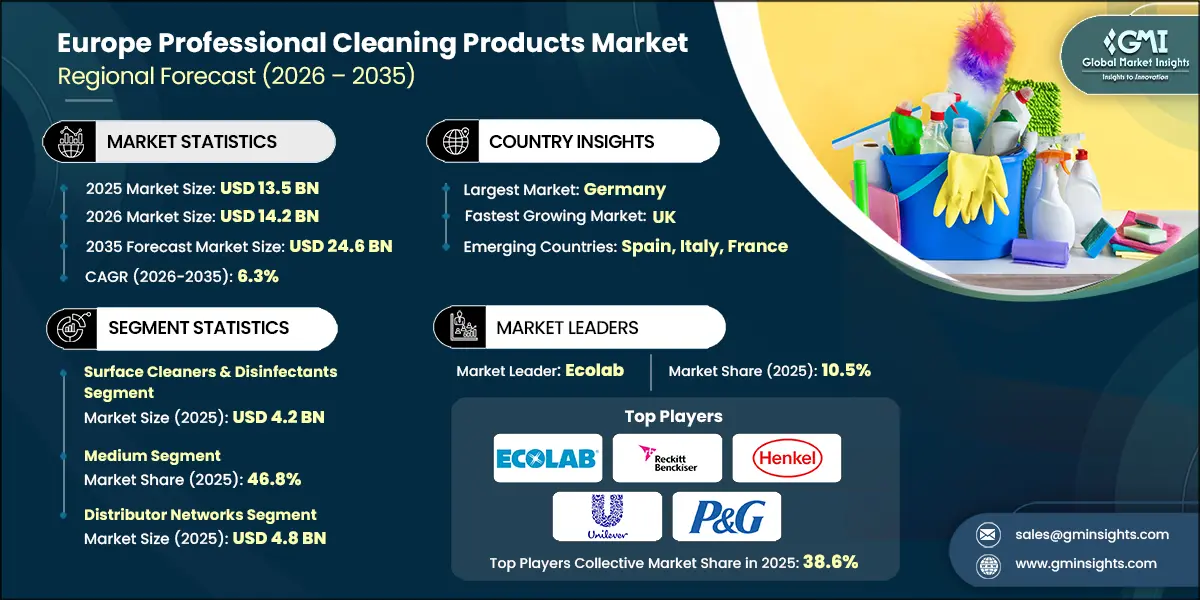
To get key market trends
Europe Professional Cleaning Products Market Trends
Changing innovation and technology transformation are important for the growth of the Europe professional cleaning products industry.
- Standardizing hygiene protocols is now becoming standard practice throughout Europe. Professional cleaning products are increasingly utilized by companies providing hygiene services to comply with demanding hygiene requirements. In 2023, the European cleaning and hygiene union (EFCI) reported a 15% increase in all cleaning products used that are specific for a particular type of surface, indicating that there is a demand for cleaning products specific to each surface.
- The trend toward eco-/sustainable cleaning products has also begun. Many companies like Ecolab and Diversey are producing biodegradable and non-toxic cleaning products that align with the European Union’s Green Deal goals, the European Commission estimates that, as of 2023, 40% of all manufacturers of cleaning products in Europe use sustainable production practices.
- The use of antimicrobial cleaning products mainly in health care and other public facilities has also gained popularity. According to a 2023 report produced by the European Centre for Disease Prevention and Control (ECDC), the use of disinfectants with antimicrobial efficacy has risen 20% due to the growing need to reduce nosocomial infections in hospitals and other healthcare facilities.
- Cleaning companies are using robotic cleaners from companies like Kärcher and Nilfisk in airports, shopping centers, and hospitals to improve their operations’ efficiency, while decreasing expenses associated with labor costs. According to the International Federation of Robotics, there was a 12% increase in the number of cleaning robots deployed in Europe during 2023.
- As well, the cleaning market is being changed by combining digital technologies into existing processes such as the internet of things enabled (IoT) cleaning applications and solutions. With these applications, managers can monitor both the resources consumed as well as the effectiveness of what employees are doing in real time. Tork’s EasyCube application has been used extensively by many European facilities, resulting in upwards of a 30% increase in operational efficiencies, according to Tork's internal reports.
Europe Professional Cleaning Products Market Analysis
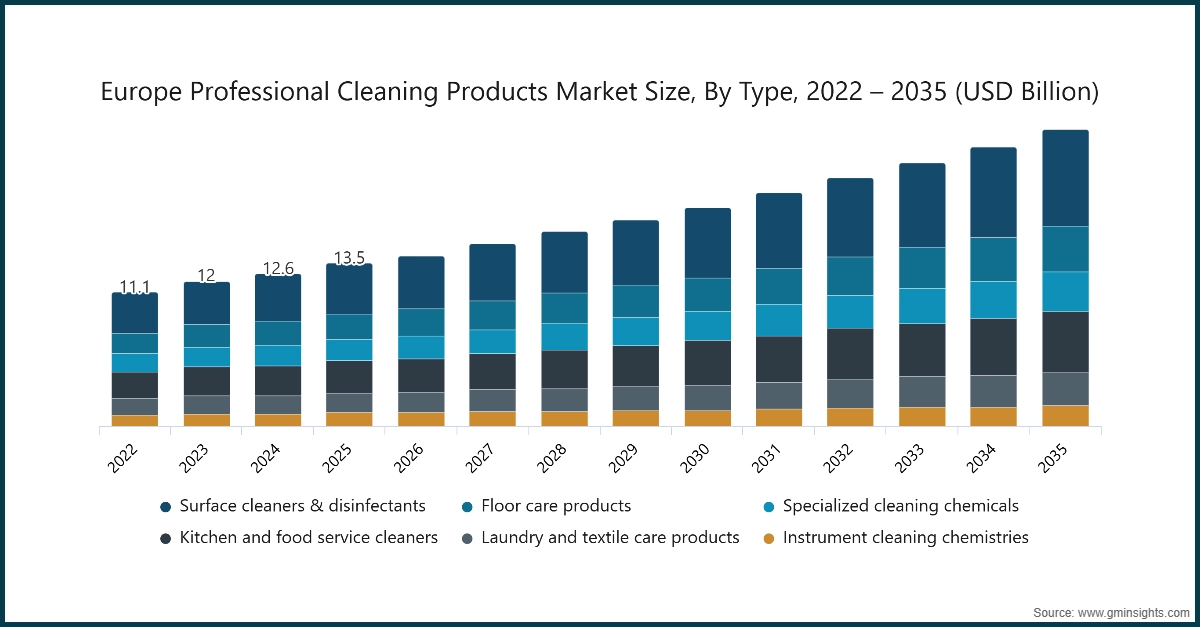
Learn more about the key segments shaping this market
Based on product type, the professional cleaning products market is divided into surface cleaners & disinfectants, floor care products, specialized cleaning chemicals, kitchen & food service cleaners, laundry & textile care products and instrument cleaning chemistries. In 2025, surface cleaners & disinfectants held the major market share, generating a revenue of USD 4.2 billion.
- Surface cleaners and disinfectants were the leading sector of both market share and volume for professional cleaning products across Europe in 14. These two products are essential for maintaining high levels of hygiene and safety within all sectors, including healthcare, hospitality, food service businesses, and all areas open to the public.
- According to ECHA, the demand for professional-grade surface cleaners and disinfectants grew 7.5% in 2023, the increase was attributed to the need for strict compliance with European Union hygiene standards as established by Regulation (EU) No 528/2012.
- Key players who drive product innovation in this category include Ecolab Inc. and Diversey Holdings Ltd. Ecolab’s Peroxide multi surface cleaner & disinfectant is extensively used in the food service industry because it meets food safety requirements. Likewise, Diversey’s Oxivir Excel hydrogen peroxide disinfectant is considered an industry leader due to its ability to rapidly kill pathogens in hospital settings, among other benefits.
- Unlike typical home cleaning agents, professional surface cleaners and disinfectants are meant to be used on a frequent basis with larger application sizes and follow strict industry requirements regarding hygiene. In addition, their effectiveness at controlling hazardous microorganisms makes them essential products for the European market.
- The increase in regulations, as well as innovation from leading manufacturers, will allow surface cleaners and disinfectants to continue to hold a position of strength in the European professional cleaning products market throughout the period.
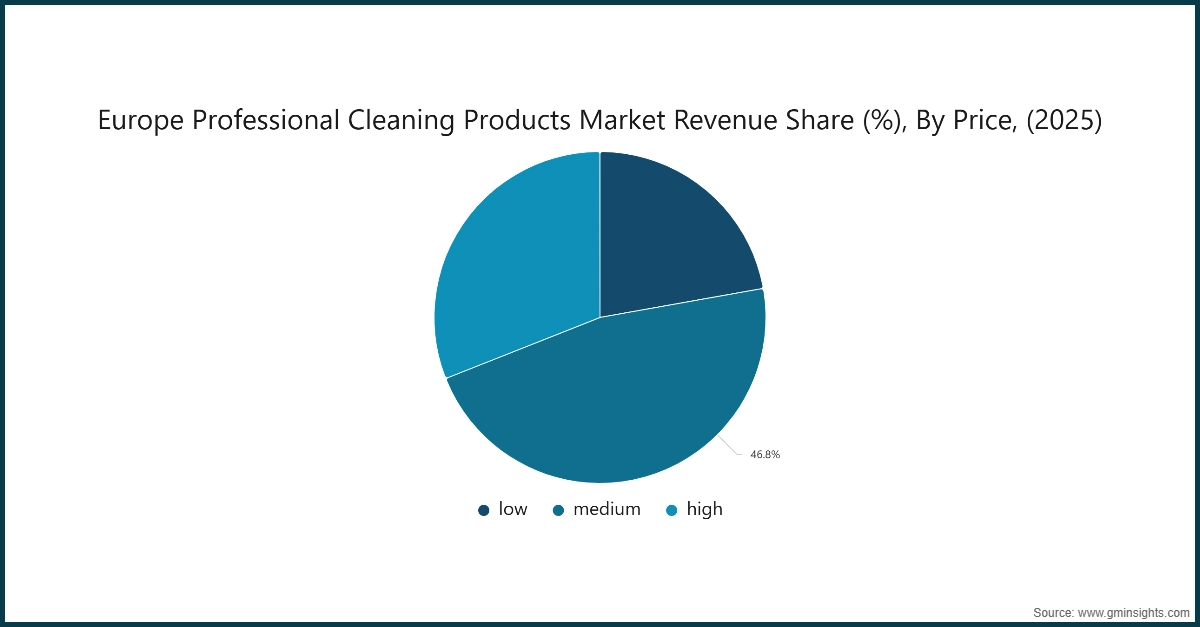
Learn more about the key segments shaping this market
Based on price, the professional cleaning products market is segmented in low, medium and high. The medium segment held the largest share, accounting for 46.8% of the global market in 2025.
- Medium-priced professional cleaning products comprise the largest proportion in Europe market, due to their ability to balance cost and performance. This segment serves to connect the two extremes of the product offering - low-cost products that are merely commodities versus premium products that perform at a very high level - making medium-priced products attractive to a wide range of users.
- According to the European cleaning and hygiene association (ECHA), medium-priced cleaning products made up an estimated 45% of total market share in 2023. Medium-priced products have been widely adopted by many small and medium sized businesses, schools, retailers, and third-party cleaning services because they are affordable and consistently perform well. For example, both Germany and France have displayed a very large need for medium-priced cleaning products in the commercial cleaning sector.
- Diversey and Ecolab offer products that satisfy the needs of businesses and institutions for effective cleaning, compliance to safety regulations, and durability. Examples of medium-priced products from Diversey and Ecolab are their TASKI range and Oasis Pro lineup respectively. Both products have become increasingly popular among cost-conscious buyers.
- The expansion of this market segment has been bolstered by governmental schemes that promote cleansers that offer environmentally friendly and economical solutions. For instance, the European Union (EU) promotes cleaning products that comply with GPP standards through its Green Public Procurement (GPP) program.
- The mid-range segment in Europe continues to be the strongest segment in this market as it satisfies conforming users' needs while remaining compliant with regulations and budgetary limits of the organizations that purchase these products.
Based on distribution channel, the professional cleaning products market is segmented into direct sales, distributor networks, online platforms, retail channels and others. In 2025, distributor networks segment held the largest market share, generating a revenue of USD 4.8 billion.
- The distributor networks segment held the largest market share in the Europe market, driven by its critical role in connecting manufacturers with end-users such as businesses, educational institutions, and healthcare facilities. According to the European cleaning and facility services industry (EFCI), the cleaning sector in Europe generated over USD 120 billion in revenue in 2022, highlighting the significant demand for professional cleaning products.
- There are many different types of distribution networks in Europe; for example, there are both national as regional companies like Bunzl and Lyreco, all of whom distribute various types of cleaning supplies including both all-purpose cleaners, disinfectant, and specialty cleaners through their established distribution sources. The wide availability of these distributors gives manufacturers an opportunity to successfully enter into fragmented markets throughout Europe.
- The demand for compliant and properly formulated cleaning products has grown due to governmental regulations including REACH (Registration, Evaluation, Authorization and Restriction of Chemicals), which is a requirement administered by the EU to regulate chemical substances. Distributors of professional cleaning products meet and assure their customers of compliance with the regulations and to get compliance-based quality products into the hands of customers in an efficient manner.
- B2B sales can be inefficient and costly without using a distribution network. An example of this is Bunzl's distribution model, in which manufacturers can concentrate on producing high quality products while complying with regional standards and delivering those products effectively and efficiently to customers in various end user categories.
- The strength of distributor networks in Europe’s professional cleaning product markets has been established through their ability to respond to the characteristics of each region, and also to ensure adherence to legal requirements and appropriate logistical arrangements when distributing products to end users.
Germany Professional Cleaning Products Market
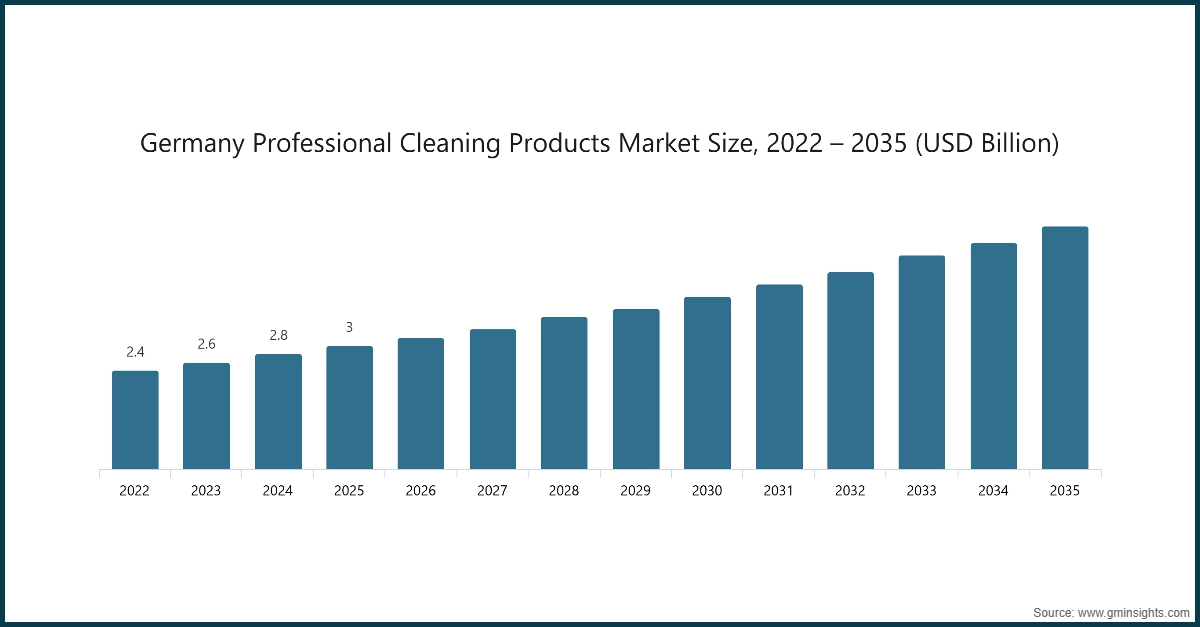
Looking for region specific data?
In 2025, Germany in the professional cleaning products market accounted for 22.3% of the share in the European region.
- Germany’s share is anchored in its extensive industrial and manufacturing ecosystem, which generates continuous demand for high‑performance cleaning, maintenance chemicals, and hygiene‑critical formulations. Large sectors such as automotive, pharmaceuticals, food processing, and heavy engineering require stringent and routine sanitation. Strong workplace‑safety regulations and compliance frameworks further elevate product consumption.
- Germany’s mature commercial infrastructure- airports, logistics hubs, corporate facilities, healthcare networks, and public institutions- ensures steady recurring demand for professional‑grade cleaning solutions. The rapid shift toward automation, smart‑cleaning systems, and sustainability‑driven procurement continues to elevate product replacement cycles.
U.K. Professional Cleaning Products Market
U.K. market is expected to grow at 6.8% during the forecast period.
- The U.K. growth is influenced by rising hygiene expectations across sectors such as hospitality, healthcare, education, and retail. Increased outsourcing of facility management services continues to expand demand for professional‑grade cleaning chemicals and sanitization products. The shift toward sustainability and biodegradable formulations further drives product innovation and adoption.
Europe Professional Cleaning Products Market Share
The top companies in the Europe professional cleaning products industry include Ecolab, Reckitt Benckiser, Henkel, Unilever and Procter & Gamble and collectively hold a share of 38.6% of the market in 2025. These prominent players are proactively involved in strategic endeavors, such as mergers & acquisitions, facility expansions & collaborations, to expand their product portfolios, extend their reach to a broad customer base, and strengthen their market position.
- Ecolab operates in the Europe professional cleaning products market by providing high‑performance sanitation, hygiene, and water‑treatment solutions across industries such as hospitality, healthcare, foodservice, and manufacturing. It drives growth through technology‑driven cleaning systems, on‑site service models, and digitally connected hygiene platforms that enhance operational efficiency and compliance.
- Reckitt Benckiser engages in Europe’s professional cleaning products market through globally recognized hygiene and disinfection brands, delivering science‑backed cleaning solutions used in commercial, institutional, and healthcare environments. It emphasizes rapid‑action disinfection, germ‑protection technologies, and high‑trust product lines that support professional hygiene standards.
- Henkel participates in the European professional cleaning products market with a broad portfolio of detergents, surface cleaners, and industrial hygiene solutions tailored to commercial facilities and institutional users. Its innovations focus on sustainable formulations, concentrated cleaning systems, and performance‑driven chemistry that reduces resource consumption and operational costs.
Europe Professional Cleaning Products Market Companies
Major players operating in the Europe professional cleaning products industry are:
- Bona
- Borer Chemie
- BUZIL
- Diversey
- Ecolab
- Henkel
- Hygeniq
- Kärcher
- NCH
- Nerta
- Pollet
- Procter & Gamble
- Reckitt Benckiser
- Solenis
- Unilever
Unilever operates in Europe’s professional cleaning products market by leveraging its global hygiene brands to supply commercial kitchens, hospitality chains, and institutional facilities with effective, sustainable cleaning solutions. The company integrates eco‑friendly chemistry, refill formats, and resource‑optimized cleaning systems to support large‑scale hygiene operations.
P&G engages in the European professional cleaning products market through its Professional division, offering high‑efficiency cleaners, sanitizers, and laundry solutions built on trusted consumer brands adapted for industrial use. It emphasizes performance, cost‑in‑use optimization, and safety‑driven formulations that meet professional hygiene and disinfection standards.
Europe Professional Cleaning Products Market Report Attributes
| Key Takeaway | Details |
|---|---|
| Market Size & Growth | |
| Base Year | 2025 |
| Market Size in 2025 | USD 13.5 Billion |
| Market Size in 2026 | USD 14.2 Billion |
| Forecast Period 2026-2035 CAGR | 6.3% |
| Market Size in 2035 | USD 24.6 Billion |
| Key Market Trends | |
| Drivers | Impact |
| Rising demand for hygiene in commercial spaces | Growing sanitation expectations in offices, retail, transport hubs, and public buildings continues to boost consumption of disinfectants, multi‑surface cleaners, and floor‑care chemicals. This trend accelerates product turnover and expands procurement volumes across facility‑management contracts. |
| Shift toward eco‑friendly, sustainable products | Sustainability commitments by businesses and regulators are driving rapid adoption of low‑toxicity, biodegradable, and certified green formulations. This shift is reshaping product portfolios and promoting higher‑value, environmentally compliant cleaning chemistries. |
| Expansion of healthcare and hospitality sectors | Growing healthcare infrastructure and rising tourism activity across Europe increase the need for high‑grade disinfectants, sanitizers, and specialized hygiene solutions. This expands demand for medical‑grade products and frequent cleaning cycles in sensitive environments. |
| Pitfalls & Challenges | Impact |
| Price volatility of raw materials | Fluctuations in the costs of surfactants, solvents, and specialty chemicals create margin pressure for manufacturers. This volatility complicates pricing strategies and may lead to supply instability for end users. |
| Strict chemical and environmental regulations | Tighter EU standards under REACH and environmental compliance frameworks require reformulation, additional testing, and certification. These demands increase development costs and slow time‑to‑market for new professional cleaning products. |
| Opportunities: | Impact |
| Smart & integrated cleaning solutions | Digitally enabled dosing, monitoring, and automated cleaning systems offer efficiency gains for large facilities and service providers. Adoption of robotics and IoT‑linked hygiene systems is opening new revenue streams for innovative manufacturers. |
| Green & certified product demand | Growing preference for EU‑Ecolabel, Cradle‑to‑Cradle, and Safer Choice‑type certifications is driving premiumization in the market. Companies offering verified sustainable formulations can capture higher margins and gain competitive differentiation. |
| Market Leaders (2025) | |
| Market Leader |
10.5% market share |
| Top Players |
Collective market share in 2025 is 38.6% |
| Competitive Edge |
|
| Regional Insights | |
| Largest Market | Germany |
| Fastest growing market | UK |
| Emerging countries | Spain, Italy, France |
| Future outlook |
|
What are the growth opportunities in this market?
Europe Professional Cleaning Products Industry News
- In February 2026, Diversey, a Solenis company, inaugurated its new European HQ and OpCo office in Breukelen, Netherlands, strengthening its regional operations and innovation capability. The modern facility integrates a state‑of‑the‑art R&D center dedicated to developing next‑generation cleaning, disinfection, and hygiene solutions. Located near major transport hubs, it enhances customer service, collaboration, and access to talent.
- In February 2026, Henkel received the ACI Sustainability Spotlight Award for transforming key liquid laundry lines through concentrated formulas and redesigned packaging. The initiative reduces CO₂ emissions, increases shipping efficiency, and saves an estimated nine million gallons of water annually. All redesigned bottles are fully recyclable, supporting circularity across the value chain. This recognition reinforces.
- In January 2026 ,Unilever expanded its Cif Infinite Clean range by launching new Anti‑Bac variants that combine probiotic cleaning technology with a powerful disinfection agent. These formulations kill 99.9% of bacteria and enveloped viruses while offering modern, non‑harsh fragrances. The line targets rising consumer demand for all‑in‑one hygiene cleaners with long‑lasting surface performance.
- In May 2025, Bona launched the Spray Mop Air, a compact, lightweight floor‑care tool designed for improved maneuverability and small‑space storage. It features a refillable cartridge using Bona’s hard‑surface cleaner and a reusable microfiber pad made from 90% recycled material. The design supports streak‑free, fast‑dry cleaning for homes and professional environments. This launch reinforces Bona’s sustainability‑focused innovation in floorcare equipment.
- In March 2025, Karcher previewed its upcoming sustainable dry vacuum range at The Cleaning Show 2025, featuring models made with 45–60% recycled plastics. The units include HEPA‑14 filtration, eco‑efficiency modes, and low‑noise operation suitable for hygiene‑sensitive facilities. Their modular design supports serviceability and reduced energy use.
The Europe professional cleaning products market research report includes in-depth coverage of the industry, with estimates & forecasts in terms of revenue (USD Billion) volume (Million Units) (from 2022 to 2035), for the following segments:
Market, By Material Type
- Surface cleaners & disinfectants
- Disinfectants
- Sanitizers
- Multi-surface cleaners
- Floor care products
- Floor cleaner
- Polishes
- Maintenance chemicals
- Specialized cleaning chemicals
- Degreasers
- Descalers
- Industrial-grade formulations
- Kitchen and food service cleaners
- Laundry and textile care products
- Instrument cleaning chemistries
Market, By Price
- Low
- Medium
- High
Market, By End User
- Healthcare & medical facilities
- Hospitality & food service
- Manufacturing & Industrial
- Educational institutions
- Government & public buildings
- Others
Market, By Distribution Channel
Direct sales
Distributor networks
Online platforms
Retail channels
Others
The above information is provided for the following countries:
- Germany
- France
- UK
- Italy
- Spain
- Russia
- Netherlands
- Poland
- Nordic Countries
Frequently Asked Question(FAQ) :
What was the market size of the Europe professional cleaning products in 2025?
The market size was USD 13.5 billion in 2025, with a CAGR of 6.3% projected through 2035. Increased hygiene awareness and regulatory interventions are driving market growth.
What is the projected value of the Europe professional cleaning products market by 2035?
The market is expected to reach USD 24.6 billion by 2035, driven by advancements in cleaning technologies, eco-friendly product adoption, and stringent hygiene standards.
What is the expected size of the Europe professional cleaning products industry in 2026?
The market size is projected to reach USD 14.2 billion in 2026.
How much revenue did the surface cleaners and disinfectants segment generate in 2025?
The surface cleaners and disinfectants segment generated USD 4.2 billion in 2025, dominating the market due to their critical role in maintaining hygiene across various sectors.
What was the valuation of the medium-priced professional cleaning products segment in 2025?
The medium-priced segment accounted for 46.8% of the market in 2025, balancing cost and performance to appeal to a broad user base.
What is the growth outlook for distributor networks in the market?
The distributor networks segment held the largest market share in 2025, generating USD 4.8 billion, and is expected to remain a critical channel connecting manufacturers with end-users.
Which country leads the Europe professional cleaning products sector?
Germany leads with a 22.3% market share in 2025, led by its robust industrial ecosystem and stringent workplace safety regulations.
What are the upcoming trends in the Europe professional cleaning products market?
Trends include the adoption of eco-friendly cleaning products, antimicrobial solutions, robotic cleaners, IoT-enabled cleaning applications, and surface-specific cleaning products.
Who are the key players in the Europe professional cleaning products industry?
Key players include Bona, Borer Chemie, BUZIL, Diversey, Ecolab, Henkel, Hygeniq, Kärcher, NCH, Nerta, Pollet, Procter & Gamble, Reckitt Benckiser, Solenis, and Unilever.
Europe Professional Cleaning Products Market Scope
Related Reports