Summary
Table of Content

Europe Nail Gun Market
Get a free sample of this report
Form submitted successfully!
Error submitting form. Please try again.
Thank you!
Your inquiry has been received. Our team will reach out to you with the required details via email. To ensure that you don't miss their response, kindly remember to check your spam folder as well!
Request Sectional Data
Thank you!
Your inquiry has been received. Our team will reach out to you with the required details via email. To ensure that you don't miss their response, kindly remember to check your spam folder as well!
Form submitted successfully!
Error submitting form. Please try again.
Europe Nail Gun Market Size
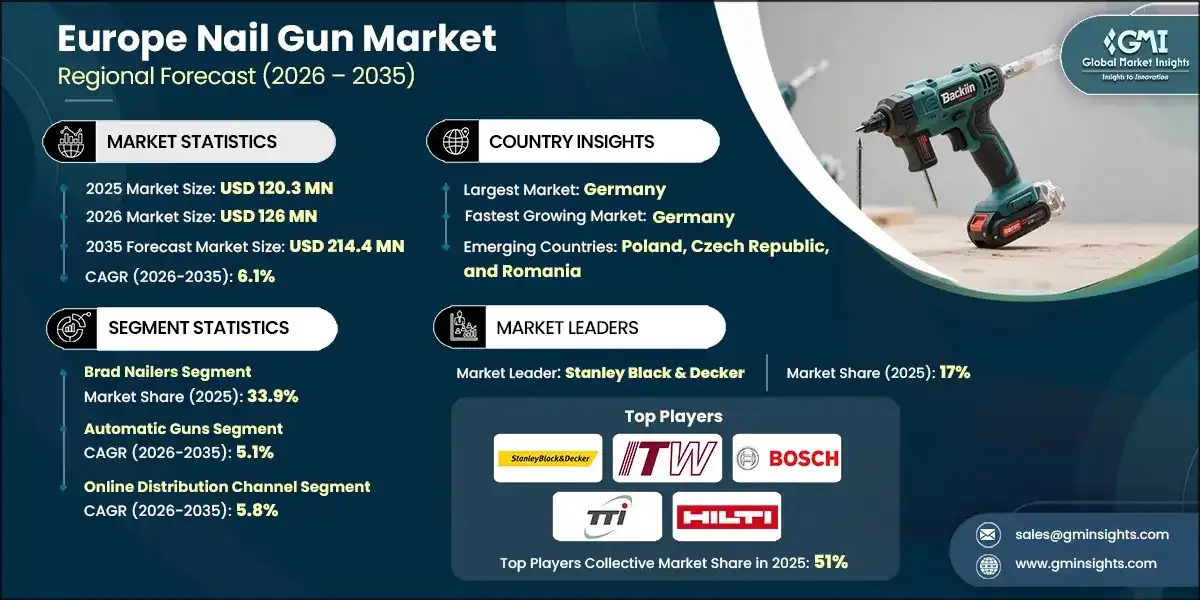
The Europe nail gun market was estimated at USD 120.3 million in 2025. The market is expected to grow from USD 126 million in 2026 to USD 214.4 million in 2035, at a CAGR of 6.1%, according to latest report published by Global Market Insights Inc.
To get key market trends
Thenail gun market is undergoing a significant expansion in sales mainly by the increased demand for fastening tools that have been used to the various end-user-industries, and mainly the residential and the commercial construction, the woodworking, and the rapidly growing prefabricated/modular construction sectors. The market is expected to keep its steady growth over the applied years with the compound annual growth rates that vary most of the time between 3.3% and 7% and even higher during the forecast period. The market growth goes hand in hand with the situations in Europe such as constructing modernization, increasing of labor costs, and the more substantial operational efficiency that results in faster and accurate fastening job-site solutions.
Technology breakthrough is an essential factor that leads to market expansion. Manufacturers are actively working on solutions that are more interactive, cordless, and battery-powered that use lithium-ion batteries and brushless motors for more excellent power and operative time. This new and more helpful technology, which can be among them, be the frame nailers, the brad nailers, the roofing nailers, and the concrete nail guns, can provide an increased rate of work, better efficiency, and accuracy. By doing this, employees can save more working time and at the same time, be able to increase the output of the working place. Currently, the market also boosts a noteworthy tilt towards the ergonomics and the safety aspect of the product features, which are correlating with the strict Europe rules for the workplace.
At the micro-level, Europe has become one of the major markets of consumption. The modernization of construction in Germany, France, and the UK has been the leading factor behind this market, where both residential and infrastructural projects have been witnessing significant investments.
Nevertheless, another significant and equally powerful trend that runs parallel to the first is the worldwide rally for sustainability and green building. As a result, tool and fastener makers need to innovate and come up with new product designs that are compatible with eco-friendly and low-VOC-coated nails. This would gradually take the industry toward such materials as recycled steel nails and more durable, corrosion-resistant coatings (e.g., hot-dip galvanized).
The European market this time is driven by key players such as Stanley Black & Decker, ITW, Robert Bosch GmbH, Makita Corporation, and Hilti Corp. They are creating cordless, high-performance, and ergonomic nail guns capable of meeting the very stringent demands of the rapidly changing market regulating efficiency-driven and highly regulated sectors.
The main cause of the shortage of labour and the need for operational efficiency has led to the necessity of a very high degree of automation and speed in construction fastening. This has resulted in the transfer of production from manual hammering to highly variable, powered tool processes. The market for nail guns is responding to the demand for fast and accurate fastening that makes it possible to shorten project timelines, decrease the risk of human error, and lessen labour costs.
According to associations such as PPMA (Processing and EU nail gun Association, which promotes engineering), direct construction associations oversee safety, and the main focus is on coming up with and standardizing protocols that will ensure that different power tools from various OEMs can work with the same level of performance and safety. This compatibility of fasteners and tools is very important for achieving fast completion rates that most of the modern construction projects require. That is how a single job site can use different nailing solutions without significant downtime.
Tight EU safety norms and regulations have an indirect role in influencing the design of machines, as they encourage producers to develop models with cutting-edge safety features, e.g., sequential triggers, anti-dry fire mechanisms, and sturdy guards thus ensuring meeting of stringent workplace compliance targets. The emphasis on ergonomics and security features is topped up by regional bodies that facilitate getting sophisticated, safe, and efficient tools designed particularly for the challenging requirements of the European industrial and construction supply chains.
Besides, the move towards prefab/modular construction requires collated high tolerance fastening systems, which has led the industry to petition for new compatibility standards for tools and fasteners.
The net effect is a rapid and sustained call for highly specialized, adaptable fastening systems, for example, cordless gas-powered, and high-capacity pneumatic tools for fast framing and roofing.
The second major factor is the widespread use of smart tool technologies that are turning professional tools from simple mechanical systems to integrated, data-driven ones. The main reason for this change is the necessity of coming very close to job site productivity, being able to meet the challenge of increasing labor costs, and satisfying strict global traceability and quality standards, especially in sensitive sectors.
This change in technology also needs the backing of industry bodies to standardise safety and develop the required technical workforce. One of the major players in that field is the European Agency for Safety, and Health at Work (EU-OSHA), which supports the adoption of safe and ergonomic tools as a way of ensuring compliance and lowering the incidence of accidents - the capacity of tools being safely and efficiently used across all European job sites.
All demonstrated in the market signs of growing further as technology develops and the respective demand continues.
Europe Nail Gun Market Report Attributes
| Key Takeaway | Details |
|---|---|
| Market Size & Growth | |
| Base Year | 2025 |
| Market Size in 2025 | USD 120.3 Million |
| Market Size in 2026 | USD 126 Million |
| Forecast Period 2026-2035 CAGR | 6.1% |
| Market Size in 2035 | USD 214.4 Million |
| Key Market Trends | |
| Drivers | Impact |
| Accelerated residential and infrastructure modernization | Drives the need for faster and more reliable fastening tools to keep pace with project deadlines. Manufacturers invest heavily in high-cycle, robust framing and roofing nailers and specialized concrete nail guns to ensure structural integrity and efficiency across new builds and renovations. |
| Rising on-site labor costs and skill shortages | Leads to a market shift toward cordless, high-efficiency tools that significantly reduce the time required for repetitive tasks like framing, deck-building, and trim work. This drastically improves worker productivity and reduces dependency on highly skilled (and expensive) manual labor. |
| Rising on-site labor costs and skill shortages | Leads to a market shift toward cordless, high-efficiency tools that significantly reduce the time required for repetitive tasks like framing, deck-building, and trim work. This drastically improves worker productivity and reduces dependency on highly skilled (and expensive) manual labor. |
| Global mandates for construction safety and ergonomics (EU-OSHA) | Forces power tool original equipment Manufacturers (OEMs) to redesign fundamental tool features (e.g., sequential triggers, anti-recoil systems, weight distribution) to comply with stringent European standards. This accelerates tool replacement cycles and drives R&D into safer, lighter, and more ergonomic nail gun models. |
| Pitfalls & Challenges | Impact |
| High initial acquisition cost of advanced cordless systems | Restricts market access for Small-to-Medium Contractors (SMCs) and independent tradespeople. Premium battery platforms and gas fuel cells represent a significant recurring expense, slowing the adoption rate compared to traditional pneumatic systems. |
| Critical skill gap in tool maintenance and advanced safety compliance | The complexity of programming and maintaining modern, integrated tools, especially gas-powered systems and advanced battery diagnostics, leads to increased unplanned downtime and higher injury risks due to insufficient user training. |
| Opportunities: | Impact |
| Expansion into tool fleet management and subscription models | Allows OEMs to transition from solely selling hardware to providing high-margin, recurring revenue services. IoT tracking and predictive maintenance for tool health maximize customer job site uptime and create a valuable, sustained revenue stream through leasing, servicing, and digital contracts. |
| Modular conversion and tool platform upgrades | Creates an addressable market beyond new tool purchases. OEMs can offer cost-effective upgrade paths (e.g., selling only body tools for compatibility with existing battery packs, or introducing new specialized nose pieces) that help customers comply with new job requirements without replacing their entire tool inventory. |
| Market Leaders (2025) | |
| Market Leaders |
17% market share |
| Top Players |
|
| Competitive Edge |
|
| Regional Insights | |
| Largest market | Germany |
| Fastest growing market | Germany |
| Emerging countries | Poland, Czech Republic, and Romania |
| Future outlook |
|
What are the growth opportunities in this market?
Europe Nail Gun Market Trends
Europe nail gun industry is using innovative methods such as Li-ion batteries and brushless motors to make it fast, cost-effective, and environmentally friendly. The market is driven by the demand for improved job site efficiency and cordless flexibility, which in turn, is a result of the rising construction activities in the residential and infrastructure sectors of Europe. This demand for speed, accuracy, and compliance with EU-OSHA safety standards has led to the creation of a close relationship between the power tool R&D and the construction industry, hence, a significant expansion of the capital goods sector for builders has taken place.
- In the first quarter of 2025, we could see a large-scale scenario like that of a typical industry player such as Hilti or Stanley Black & Decker (DeWalt) introducing an all-new cordless framing nailer featuring a completely redesigned high-capacity battery and a microprocessor-controlled firing mechanism (possibly retailing at more than 1,000 Euro for a kit). Growing demand for constant performance all day long in various weather conditions would be the reason for launching such an innovation. A digital device maintenance indicator and an anti-dry fire sensor are among the components in new tool architecture that would be designed to not only achieve a significant reduction in tool failure but also to enable exceedingly fast work completion rates thereby creating construction teams that are much more agile.
- Moreover, this state-of-the-art tool would come with certifications confirming its adherence to tightly specified European health, safety, and environmental (HSE) standards, thereby assuring maximum safety and less noise emission in urban construction activities. The cordless finishing nailers' demand is anticipated to have the highest increase in the range from 2026 to 2035 as these are indispensable in amenably solving the detailed trim work as well as the interior fittings which are the core of modern, high-value European properties.
- In the beginning of 2025, an influential industry player such as Hilti or Stanley Black & Decker (DeWalt) might come out with a new premium cordless framing nailer platform (probably sold for over €1,000 for a kit) that employs a completely reimagined nitrogen air spring mechanism and an IoT-enabled diagnostics platform. This creation will address the demand for pneumatically powered-like devices without the need for a hose, thus, providing a solution that is essential for high-volume framing. Some of the benefits that new tools' architecture could bring are incorporating AI-driven safety features (e.g. precise nail placement sensors) and quick-change magazines, which could help in substantially reducing the cases of safety issues as well as accomplishing ultra-fast sequential firing, thus, significantly increasing the level of user agility.
- The advanced device will be certified to meet the standards set by the European Agency for Safety and Health at Work (EU-OSHA) as well as those set by the Machinery Directive, thus, ensuring that it is the safest and most comfortable option for application in the construction and manufacturing sectors. The demand for electric cordless nail guns (mainly in the finish/trim segment) is forecasted to show the most significant increase from 2026 to 2035 (more than 6.8% CAGR) as they are the most efficient tools to carry out the high-quality, precise fastening that is a must to the modern European residential and commercial interiors.
The result is a new market dynamic that is not only intense but also very creative, battery specialists and power tool OEMs have to work together to come up with the most effective, safe, and fully integrated fastening solutions. Such collaborative products include intelligent tool management systems and diagnostic software that offer automated maintenance reminders and usage logging, thus, not only protecting the tool investment but also promoting continuous worker safety practice improvements and regulatory compliance.
Besides that, the current growth trend empowers manufacturers to access a variety of new demographics, creating goods that are attractive and appealing to the proficiency of the individuals, like lightweight, compact, M12/12V-platform tools targeting DIY users and high-precision finish carpenters in the rapidly growing renovation and remodelling sector of Europe.
Europe Nail Gun Market Analysis
Learn more about the key segments shaping this market
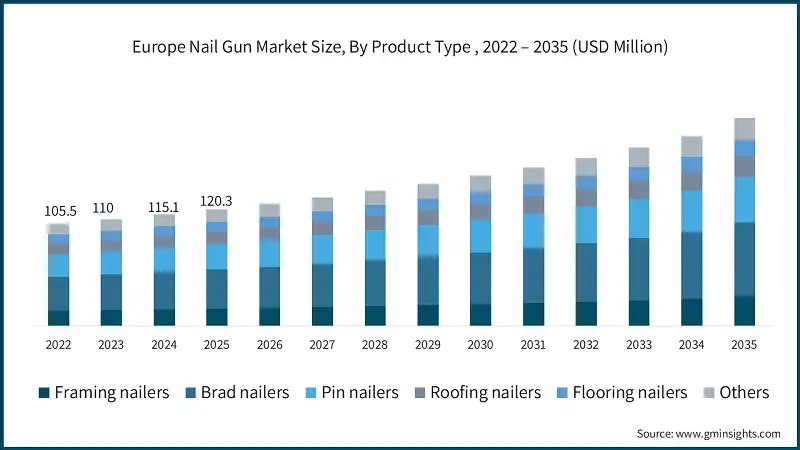
Based on the product type, the market is segmented into framing nailers, brad nailers, pin nailers, roofing nailers, flooring nailers, and others. The brad nailers segment held the largest share of 33.9% in 2025 and is forecasted to achieve the highest growth rate.
- Brad nailers segment accounted for 33.1% of the total market value in 2025 and are predicted to grow with a CAGR of 6.7% from 2026 to 2035.
- The demand for brad nailers is the primary growth driver, as it directly caters to the expanding furniture, carpentry, and home improvement sectors in Europe, requiring high-precision, low-marring fastening for interior trim and finishing work.
- The segment's strong growth trajectory reflects the shift towards cordless Li-ion tools (often 18-gauge brad nailers), which provide the convenience and portability essential for renovation and light construction work across diverse European job sites.
- By 2035, the brad nailers segment's share is projected to increase to 35.5% of the total market, consolidating its lead over the construction & infrastructure applications, which traditionally rely on lower-growth framing and roofing nailers.
Learn more about the key segments shaping this market
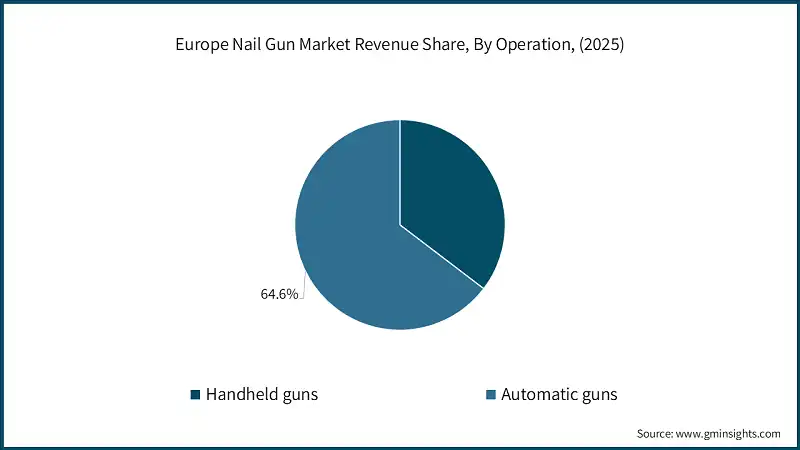
Based on the operation, the Europe nail gun market is segmented into handheld guns and automatic guns. The automatic guns segment held the largest share 64.6% in 2025 and is also predicted to grow the fastest rate of 5.1% from 2026-2035.
- Automatic machinery is the dominant growth engine, as it directly addresses the critical industry needs for maximum efficiency, speed, and reduced operational costs in construction and manufacturing environments.
- The adoption of modern cordless technology which enables high-speed, continuous, or sequential firing is almost exclusively integrated into automatic machinery. These tools enable superior productivity and compliance with strict European labour efficiency and safety standards.
- Furthermore, automatic equipment offers the highest degree of repeatability and precision in fastening, which is vital for both heavy-duty structural work and delicate interior finishing.
Based on the distribution channel, the market is segmented into offline and online channels. The online channel is the fastest-growing segment, though offline remains the majority.
- The online distribution channel is projected to achieve a CAGR of 5.8% from 2026 to 2035. offline segments hold the highest market share expected to grow with the revenue of USD 80.87 million.
- The accelerated growth of the online channel is driven by the increasing market penetration of DIY users and small/medium enterprises (SMEs), who prioritize convenience, price comparison, and direct delivery of lighter, cordless finishing nailers.
- Offline channels (specialty tool shops, wholesale distributors) remain the majority channel, accounting for 67.2% of the market in 2025. This channel is crucial for large professional contractors who require immediate access to consumables (nails, fuel cells), specialized tool demonstrations, and comprehensive after-sales service and maintenance contracts.
Looking for region specific data?
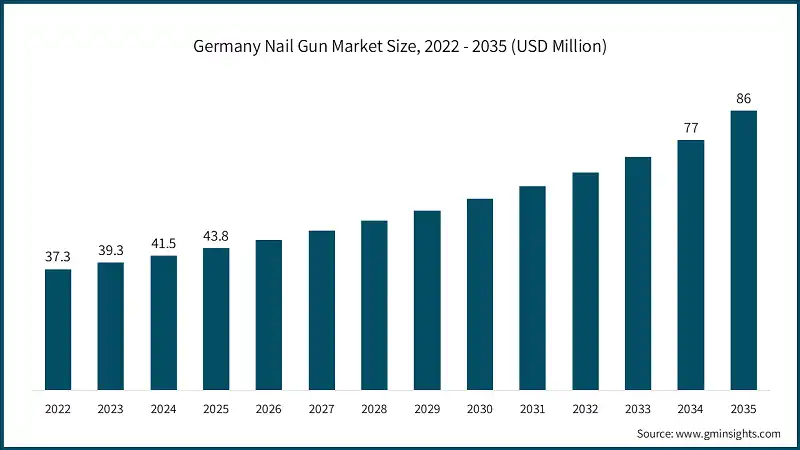
Germany dominated the 35.4% share of Europe nail gun market in 2025 and is forecasted to achieve the highest growth rate of 67.1% from 2026 to 2035.
- The region's dominance is underpinned by its massive and continuous capital investment in construction and its strong, technologically advanced manufacturing sector, where the demand for efficient, high-quality fastening tools is highest.
- France is the second-fastest growing major market with a 6.5% CAGR, driven by government-backed infrastructure and residential renovation projects. This strong regional growth confirms the EU's overall attractiveness for global power tool manufacturers.
Europe Nail Gun Market Share
Stanley Black & Decker is leading with 17% market share, Stanley Black & Decker, Illinois Tool Works Inc., Robert Bosch GmbH, Techtronic Industries Co. Ltd. And Hilti Corp. collectively hold around 51%, indicating moderately fragmented market concentration. These prominent players are proactively involved in strategic endeavors, such as mergers & acquisitions, facility expansions & collaborations, to expand their product portfolios, extend their reach to a broad customer base, and strengthen their market position.
- ITW (Illinois Tool Works Inc.) is a diversified global industrial manufacturer that dominates the professional fastening market through its highly specialized division, particularly the Paslode brand. ITW is recognized for pioneering the cordless gas-powered nailer technology, which remains a market standard for high-volume framing and first-fix applications in Europe, offering power comparable to pneumatic tools without the restriction of hoses. The company's strategy is to provide highly reliable, application-specific tools and the associated premium fuel cell/fastener consumables, securing a consistent, high-margin, recurring revenue stream. ITW's focus in Europe is on being a trusted partner for professional home builders and roofers, emphasizing job site productivity, reducing downtime, and maintaining a high level of performance that meets the rigorous demands of continental construction codes.
- Stanley Black & Decker, Inc. is a massive global tool and security group that commands a leading position in the Europe Nail Gun Market through its powerhouse brands, including DEWALT, Bostitch, and Stanley. SBD is recognized for its strategy of providing a complete spectrum of fastening solutions, leveraging its industry-leading cordless battery platforms (like DEWALT XR and FLEXVOLT) to offer nailers for virtually every application—from heavy framing to delicate finish work—all running on a common battery ecosystem. The company's competitive edge lies in its aggressive innovation in battery technology, its vast, established European distribution channels (serving both professional trades and retail/DIY), and a relentless commitment to integrating safety and ergonomic features that comply with strict EU labor standards while maximizing job site efficiency and user convenience.
- Hilti Corporation is a global leader in providing technological solutions for the construction industry, specializing in direct fastening and installation systems. Hilti is recognized for its strategy of providing premium, integrated solutions that include not just the tool, but the fasteners, software, and highly trained technical field service. The company dominates the niche but high-value segment of concrete, steel, and masonry fastening using specialized powder-actuated and battery-actuated nailers. Hilti's innovative strategies place a strong emphasis on digital integration (via its ON!Track asset management system) and job site safety, driving the development of semi-automatic direct fastening tools that offer superior repeatability and traceability, which enables its global customer base to meet stringent quality and regulatory targets across its operations in high-rise, commercial, and infrastructure projects.
These prominent players are proactively involved in strategic endeavors, such as mergers & acquisitions, digital ecosystem development, and specialized facility expansions, to expand their technological capabilities, secure a broader customer base, and strengthen their market position. Europe Nail Gun Market Companies Major players operating in the Europe nail gun industry are: Robert Bosch GmbH operates a strong and influential division in the professional tools market, offering a comprehensive line of cordless nailers under its Bosch Professional brand. Bosch is recognized for its strategy of providing high-quality, reliable, and durable tools powered by its widely adopted 18V battery platform. The company's focus is on being the preferred professional partner, emphasizing tool reliability, extended battery runtime, and providing a cohesive system of interoperable tools. Bosch's competitive edge in the Europe Nail Gun Market is its strong German heritage, robust engineering, and its focus on mid-to-high-tier cordless finishing and brad nailers, which are ideal for the large European interior fit-out and renovation markets. The brand relies on its established network of European dealers and distributors to emphasize tool service, rapid repair, and long-term product support.Europe Nail Gun Market News
The Europe nail gun market research report includes in-depth coverage of the industry with estimates & forecasts in terms of revenue (USD Million) and volume (Thousand Units) from 2022 to 2035, for the following segments:
Market, By Product Type
- Framing nailers
- Brad nailers
- Pin nailers
- Roofing nailers
- Flooring nailers
- Others
Market, By Operation
- Handheld guns
- Automatic guns
Market, By Price
- Low
- Medium
- High
Market, By End Use
- Construction & infrastructure
- Furniture & home improvement
- Automotive
- Packaging
- Others
Market, By Distribution Channel
- Online
- Offline
The above information is provided for the following countries:
- Germany
- UK
- France
- Italy
- Spain
Frequently Asked Question(FAQ) :
Who are the key players in the Europe nail gun market?
Key players include Stanley Black & Decker, Illinois Tool Works Inc., Robert Bosch GmbH, Techtronic Industries Co. Ltd., Hilti Corp., BeA GmbH, DEWALT, Draper Tools, Einhell Germany AG, Fischer Group, Makita Corporation, MAX Co., Ltd., and Metabo.
What are the upcoming trends in the Europe nail gun market?
Key trends include adoption of Li-ion battery platforms, brushless motor technology, IoT-enabled tool telemetry, AI-driven safety features, and expansion of cordless high-performance models meeting EU-OSHA standards.
Which region leads the Europe nail gun market?
Germany held 35.4% share in 2025 and is forecasted to achieve the highest growth rate of 67.1% from 2026 to 2035. The region's dominance stems from massive construction investments and advanced manufacturing sectors.
What is the current Europe nail gun market size in 2026?
The market size is projected to reach USD 126 million in 2026.
How much revenue did the brad nailers segment generate in 2025?
How much revenue did the brad nailers segment generate in 2025?
What is the growth outlook for online distribution channels from 2026 to 2035?
Online distribution channels are projected to grow at a 5.8% CAGR through 2035, driven by increasing DIY users, SME penetration, and demand for convenience and price comparison.
What was the valuation of automatic guns segment in 2025?
Automatic guns held 64.6% market share and generated USD 77.75 million in 2025.
What is the projected value of the Europe nail gun market by 2035?
The Europe nail gun market is expected to reach USD 214.4 million by 2035, propelled by cordless technology adoption, Li-ion battery innovations, and demand for operational efficiency and safety compliance.
What is the market size of the Europe nail gun in 2025?
The market size was USD 120.3 million in 2025, with a CAGR of 6.1% expected through 2035 driven by rising demand from residential and commercial construction, woodworking, and prefabricated/modular building sectors.
Europe Nail Gun Market Scope
Related Reports