Summary
Table of Content

Europe Microwave Oven Market
Get a free sample of this report
Form submitted successfully!
Error submitting form. Please try again.
Thank you!
Your inquiry has been received. Our team will reach out to you with the required details via email. To ensure that you don't miss their response, kindly remember to check your spam folder as well!
Request Sectional Data
Thank you!
Your inquiry has been received. Our team will reach out to you with the required details via email. To ensure that you don't miss their response, kindly remember to check your spam folder as well!
Form submitted successfully!
Error submitting form. Please try again.
Europe Microwave Oven Market Size
The Europe microwave oven market was estimated at USD 3.5 billion in 2025. The market is expected to grow from 3.6 billion in 2026 to USD 6.5 billion in 2035, at a CAGR of 6.6% according to latest report published by Global Market Insights Inc.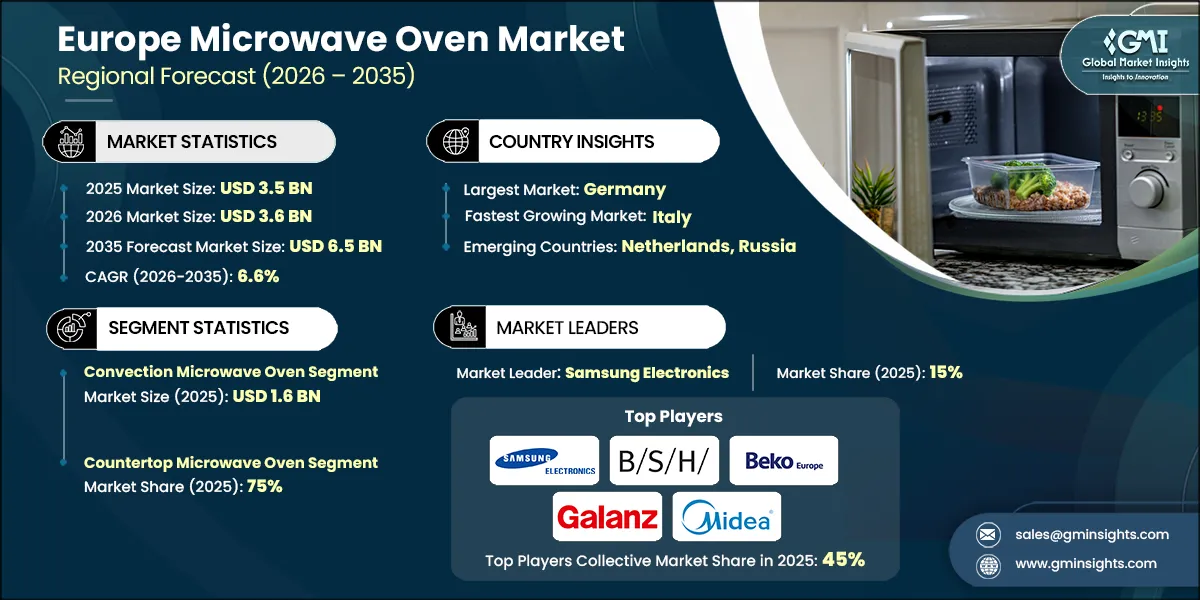
To get key market trends
The microwave oven market in Europe is changing rapidly due to changing lifestyles and the new consumer expectations associated with them. As more and more consumers have been able to make quick use of microwave ovens for reheating, they are looking for something that is far more than just something to warm food. In addition, microwave ovens are no longer just devices for heating food, they are becoming essential appliances in the kitchens of modern households.
The rise of new urban lifestyles and the growing trend toward home cooking are driving the movement away from single-function microwave ovens that simply heat already-prepared food, to machines that offer greater versatility through cooking modes and advanced functionality. As a result, manufacturers and consumers alike are now focusing on multifunctional machines. As with other kitchen appliances, design is a key factor influencing purchase decisions, with contemporary European consumers favoring appliances that match or complement the style of modern kitchens.
As more consumers are living in smaller apartments, compact microwave ovens are also being embraced, while those that want to create modular kitchen designs are gravitating toward higher-end built-in microwave ovens. Environmental consciousness is an important consideration for many consumers and therefore, manufacturers must keep in mind how much energy is consumed by their products and how they can provide customers with energy-efficient products at lower prices.
Competition in the microwave oven market is fierce, with global brands and domestically-based companies competing based on their ability to innovate and provide user-friendly interfaces. The development of smart ovens that come equipped with the ability to be controlled with smart phone apps or through voice commands represents an emerging but rapidly growing segment of the microwave oven market.
Europe Microwave Oven Market Report Attributes
| Key Takeaway | Details |
|---|---|
| Market Size & Growth | |
| Base Year | 2025 |
| Market Size in 2025 | USD 3.5 Billion |
| Market Size in 2026 | USD 3.6 Billion |
| Forecast Period 2026-2035 CAGR | 6.6% |
| Market Size in 2035 | USD 6.5 Billion |
| Key Market Trends | |
| Drivers | Impact |
| Rising Demand for Convenience and Time-Saving Appliances | Busy lifestyles and urbanization are pushing consumers toward appliances that simplify cooking and reduce preparation time, making microwave ovens a household essential. |
| Growing Popularity of Multifunctional and Smart Features | Consumers increasingly prefer ovens with grilling, convection, and smart connectivity options, reflecting a shift toward versatile and tech-enabled kitchen solutions. |
| Modern Kitchen Aesthetics and Space Optimization | The trend of modular kitchens and premium home upgrades is driving demand for sleek, integrated designs, boosting the adoption of built-in microwave ovens. |
| Pitfalls & Challenges | Impact |
| Strong Cultural Preference for Traditional Cooking Methods | In countries like Italy and Spain, traditional cooking habits limit the role of microwave ovens as a primary appliance, slowing adoption in certain segments. |
| Price Sensitivity in Emerging Regions | Eastern Europe’s cost-conscious consumers often opt for basic models, creating challenges for premium brands aiming to penetrate these markets. |
| Opportunities: | Impact |
| Expansion of Smart and Connected Appliances | Integration with IoT and voice assistants presents a significant growth opportunity, especially in tech-savvy regions like Northern Europe. |
| Sustainability and Energy-Efficient Innovations | Eco-friendly designs and energy-saving technologies can attract environmentally conscious consumers, aligning with Europe’s strong sustainability focus. |
| Market Leaders (2025) | |
| Market Leader |
15% market share |
| Top Players |
Consolidate share of 45% |
| Competitive Edge |
|
| Regional Insights | |
| Largest market | Germany |
| Fastest growing market | Italy |
| Emerging countries | Netherlands, Russia |
| Future Outlook |
|
What are the growth opportunities in this market?
Europe Microwave Oven Market Trends
The European microwave oven market is a dynamic landscape shaped by evolving consumer lifestyles, technological advancements, and a growing emphasis on kitchen aesthetics and efficiency.
- The Development of Smart and Connected Microwaves: Customers will continue to demand IPv6 connected microwaves with the ability to control by remote control from their smartphones and voice-assisted devices. In addition, they will demand automatic downloads of necessary recipes based on the cooking method. The growing trend of having an ultra-connected kitchen allows for much greater ease of use and more intuitive cooking methods.
- Growing Demand for Multifunctional Ovens: Consumers are increasingly choosing multifunctional microwave ovens that offer the ability to use microwave, grill, or convection cooking in one appliance. The advantages of combining these various types of cooking are to conserve space, have additional cooking options, and allow consumers to bake, roast, and grill in one appliance. This resonates well with small kitchen sizes in many areas of European countries.
- Higher Demand for a Premium Product in Aesthetics and Design: Microwaves are becoming a part of modern kitchens; therefore consumers want the microwave to fit within their kitchen design. The consumer demand for a microwave to match a consumer's own kitchen style is causing the manufacturers to create microwaves with premium finishes such as stainless steel and glass, and feature very clean, sleek lines.
- Higher Demand for Energy-efficient Products: Rising energy prices and a growing concern for the environment are prompting European consumers to buy microwaves that are more energy-efficient. Accordingly, manufacturers are constantly researching and developing inverter technology and eco-modes to reduce energy consumption of microwaves to help consumers save money and accomplish their sustainability goals.
Europe Microwave Oven Market Analysis
Learn more about the key segments shaping this market
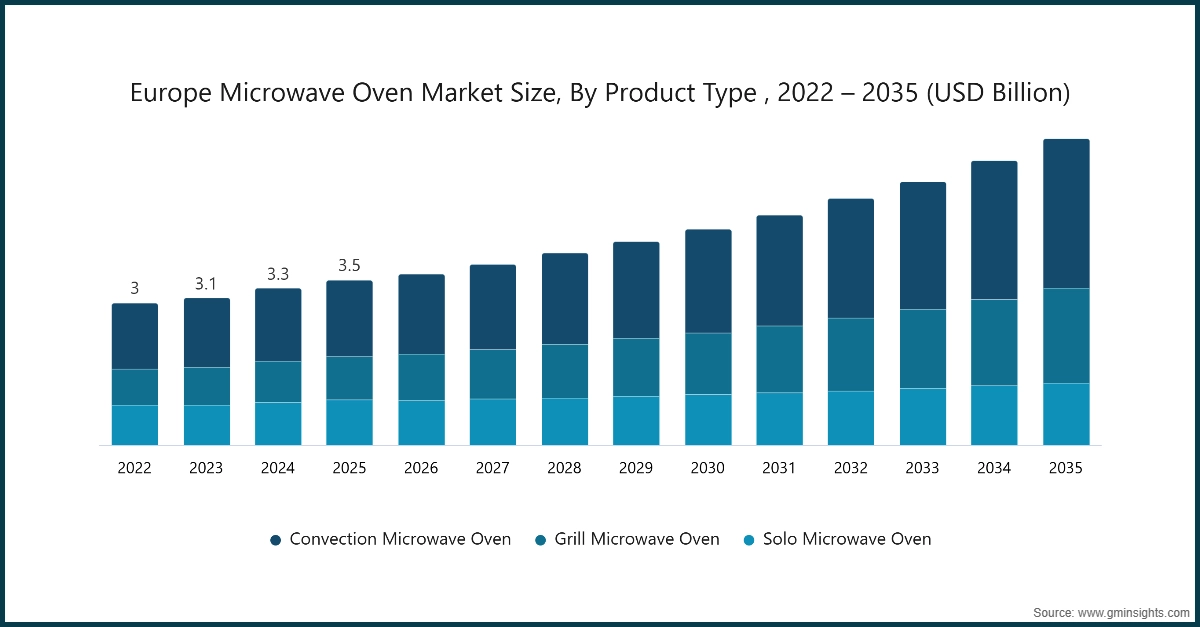
Based on product type, the Europe microwave oven market is divided into convection microwave oven, grill microwave oven, and solo microwave oven. In 2025, convection microwave oven held the major market share, generating a revenue of USD 1.6 billion.
- The European market for convection microwave ovens is seeing continued growth since they provide multiple functions to support the way people cook today. Consumers today want their appliances to support multiple cooking methods beyond just reheating and want to be able to bake, roast and grill from one appliance.
- Consumers want the best of both worlds in their convection microwave ovens by offering microwave technology combined with heating elements and a fan to provide even cooking and crispiness like conventional ovens. This makes it very appealing to those with busy families and those who want to cook healthy meals, especially in areas of Europe where there is an increased trend in Home Cooked Meals and Healthy meal preparation. The ability for convection microwave ovens to replace other appliances gives them a competitive advantage in European kitchens where space is limited.
- In terms of growth opportunities in Europe, the grill microwave oven is one of the fastest growing segments of the overall microwave oven market. Grill microwaves meet the needs of consumers looking for an appliance that will provide a charred appearance and enhance the taste of the foods they prepare. For many consumers in Europe, grilling is a big part of the dining experience; therefore, they are looking for ways to replicate that experience in their own homes and on the menu at home.
Learn more about the key segments shaping this market
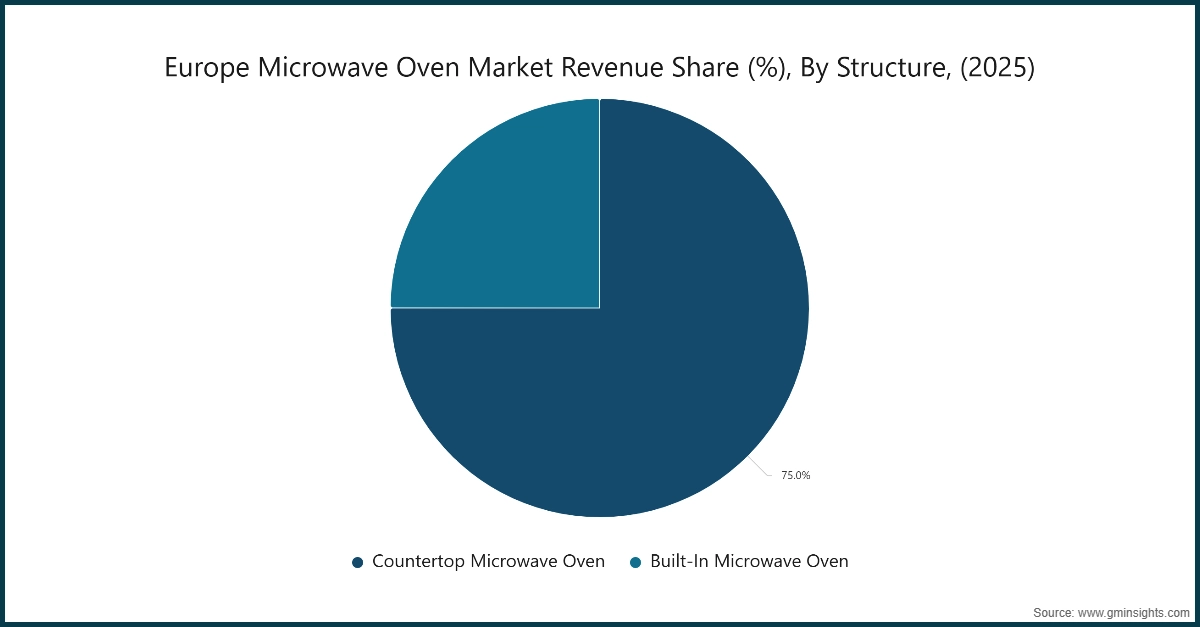
Based on structure the Europe microwave oven market is segmented into countertop microwave oven, and built-in microwave oven. The countertop microwave oven segment held the largest share, accounting around 75% of the market in 2025.
- Countertop microwave ovens are the most dominant type of microwave oven in Europe due to their affordability, simplicity of use, and ability to be easily installed by anyone. This appeals to consumers on a general level. Countertop microwave ovens are also very flexible in terms of where they can be used; they can be put in almost any area in the home, from large homes down to small, compact apartments.
- The price point of countertop microwave ovens is substantially lower than built-in microwave ovens, making it a popular choice for budget-conscious consumers seeking an option for everyday cooking/reheating.
- At the same time, the built-in microwave oven category is continuing to grow rapidly due to the growing demand in Europe for modern integrated kitchen designs. Consumers are beginning to purchase modular and premium upgrade products for their homes, and built-in appliances can provide an aesthetically pleasing, seamless look while providing more counter space.
- In many cases, built-in microwave ovens are constructed using high-end finishes that appeal to homeowners who desire a combination of functionality and looks. As smart home and luxury living continue to increase within the home, too will the demand for built-in models, which can work with other built-in appliances, as they typically require a qualified technician for professional installation.
Based on price, the Europe microwave oven market is segmented into low (under USD 50), medium (USD 50 - USD 100), high (above USD 100) dominate the market with highest market share.
- The medium price segment (50-100 USD) commands the European market for microwave ovens due to the very good value for money it provides for the home. Microwaves in this price range typically have all the essential features, including grill/convection/basic convection, increased wattage, auto-cooking programs, and higher energy efficiency, while also adhering to strict Ecodesign and Energy Labelling regulations from the European Union.
- On the opposite end of the spectrum, microwave ovens priced at less than 50 USD often only include a limited amount of reheating functions; have a shorter lifespan; and encounter pricing pressures resulting from the need to comply with several regulations, which decreases their competitiveness and availability in Western Europe. In general, consumers in Europe are likely to value the durability and functionality of a product more than the least expensive price available therefore, the medium price segment is considered the most rational choice when purchasing a microwave oven.
- The demographics and spending patterns of European consumers also support the medium price range. As the number of single individuals living alone, or in small households, increases within Europe and as the trend of living in urban areas increases, so does the need for microwaves that are compact, yet versatile enough to serve multiple functions; thus, the compact/multifunctional requirements of most European households are ideally met by countertop microwave ovens sold in the medium price range.
- High-priced microwave ovens (greater than 100 USD), often being either smart or built-in appliances, are typically sold to a limited number of consumers and compete primarily with in-ovens and other higher-end cooking appliances to an even lesser degree than a conventional microwave oven. As a result, unit sales of these higher-end appliances are limited by the same issues that restrict many consumers' moving to them consumers are cautious of their own spending given current economic conditions as well as, retailer's trend to concentrate primarily on mid-range SKU's.
Europe Microwave Oven Market Analysis
 Looking for region specific data?
Looking for region specific data?
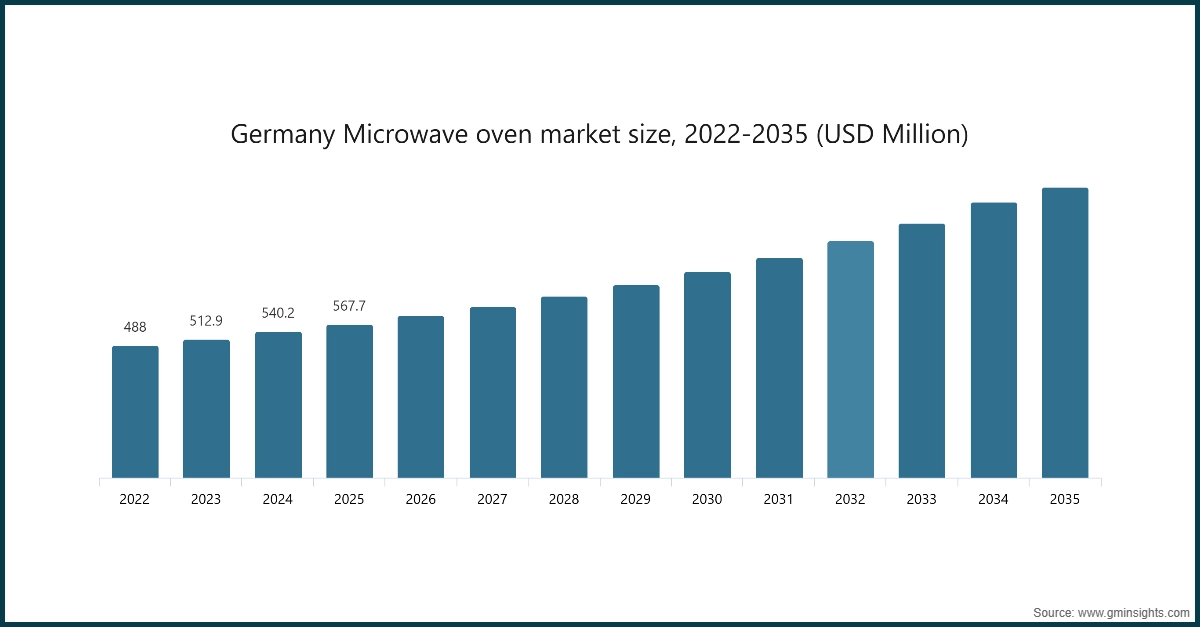
In 2025, the Germany dominated the Europe Microwave oven industry, accounting for around 16% and generating around USD 567.7 million revenue in the same year.
- Germany's high market demand for premium, energy-efficient oven models has positioned it at the forefront of premium oven sales. Consumers in Germany prefer durable, state-of-the-art, and environmentally friendly products, which is why convection ovens and built-in ovens are popular ovens in that market.
- Many German consumers are adopting smart ovens because of the growing number of smart homes integrating Smart Appliances via the Internet of Things (IoT). The UK market shows strong demand for convenience-oriented solutions, such as countertop ovens, which have become very popular because of their versatility and affordability. However, as the trend for modern kitchen design continues, the popularity of built-in ovens will continue to expand rapidly in major urban centers of the UK.
- In France, consumers want their product choices to reflect both form and function. There is an emphasis on style in French kitchens, so French consumers want ovens that reflect modern design elements and offer multiple cooking functions to fit in with the design of their kitchens. In France, built-in ovens have gained popularity in high-end homes, while consumers who enjoy preparing gourmet-style meals quickly have been drawn to grill ovens, which cook food quickly using radiant heat.
- Consumers in Italy and Spain are very influenced by their culinary traditions and typically view microwaves as complementary appliances, rather than primary cooking tools. The demand for compact and stylish microwave oven models is on the rise, and grill ovens have also become very popular in Italy and Spain due to their ability to produce traditional flavors in a short time.
Europe Microwave Oven Market Share
Samsung Electronics is leading with 15% market share. SAMSUNG ELECTRONICS, BSH GROUP (BOSCH BRAND), BEKO EUROPE, GALANZ, MIDEA GROUP collectively hold around 50%, indicating moderately fragmented market concentration. These prominent players are proactively involved in strategic endeavors, such as mergers & acquisitions, facility expansions & collaborations, to expand their product portfolios, extend their reach to a broad customer base, and strengthen their market position.
- Samsung is a global technology leader, manufacturing a vast array of consumer electronics and home appliances. In the European microwave oven market, Samsung holds a significant position by offering innovative models with sleek designs and smart features. Their strong brand recognition, extensive distribution network, and focus on technology appeal strongly to modern European consumers seeking advanced kitchen solutions.
- BSH Home Appliances Group is a global leader in the appliance industry, owning renowned European brands like Bosch and Siemens. Its Bosch brand is prominent in Europe for microwave ovens, recognized for German engineering, durability, and energy efficiency. BSH's focus on high-quality, reliable built-in and freestanding units integrates seamlessly into European kitchen designs, securing a dominant market presence.
- Beko is a major European home appliance manufacturer. In the microwave oven market, Beko holds a significant share by providing a wide range of affordable yet feature-rich models. Its strong retail presence, competitive pricing, and commitment to meeting diverse consumer needs across various European countries have solidified its market position.
Europe Microwave Oven Market Companies
Major players operating in the Europe microwave oven industry are:
- Bosch
- Gaggenau
- Miele
- Samsung Electronics
- LG Electronics
- Electrolux (incl. AEG)
- Panasonic
- Galanz
- Midea Group
- Beko Europe (Arçelik)
- Gorenje (Hisense)
- Smeg
- Sharp
- Candy Hoover (Haier)
- Whirlpool
Galanz is a Chinese multinational manufacturer, globally recognized as a leading producer of kitchen appliances, especially microwave ovens. They are a significant OEM/ODM supplier for many brands, while also selling under their own name. Galanz's immense production scale, cost-effectiveness, and wide product range make it a crucial player contributing substantially to the availability of microwave ovens in the European market.
Midea Group is a global diversified technology company, a major producer of home appliances, HVAC, and robotics. Midea's position in the European microwave oven market is substantial due to its vast manufacturing capabilities and diverse product portfolio. The company offers a wide array of microwave ovens, from basic to smart models, leveraging its global supply chain and growing brand presence to capture significant market share.
Europe Microwave Oven Industry News
- In January 2024, Arçelik completed its €1.7 billion acquisition of Whirlpool's European major domestic appliances business, including microwave oven production facilities and brands like Whirlpool, Hotpoint, and Indesit. This acquisition helps Arçelik become Europe's second-largest home appliances manufacturer, expanding its microwave oven portfolio and gaining access to five production sites and seven R&D centers across Europe.
- In October 2023, Electrolux announced major restructuring including European factory closures and production capacity adjustments affecting its appliance manufacturing operations including microwave ovens. This restructuring helps Electrolux reduce operational costs, improve profitability margins in the challenging European market, and optimize its manufacturing footprint amid declining demand and increased competition.
The Europe microwave oven market research report includes in-depth coverage of the industry with estimates & forecasts in terms of revenue (USD Billion) and volume (Thousand Units) from 2022 to 2035, for the following segments:
Market, By Product Type
- Convection microwave oven
- Grill microwave oven
- Solo microwave oven
Market, By Structure
- Countertop microwave oven
- Built-in microwave oven
Market, By Capacity
- Upto 20 liters
- 21 - 25 liters
- 26 - 30 liters
- Above 30 liters
Market, By Power
- Low power (under 700W)
- Medium power (700w-1000W)
- High power (above 1000W)
Market, By Price Range
- Low (under USD 50)
- Medium (USD 50 - USD 100)
- High (above USD 100)
Market, By End User Industry
- Residential
- Commercial
- Hotels and restaurants
- Catering services
- Corporate offices
- Others (healthcare facilities, etc.)
Market, By Distribution Channel
- Online
- E commerce
- company websites
- Offline
- Hypermarkets and supermarkets
- Specialty stores
- Others (department stores, individual stores, etc.)
The above information is provided for the following regions and countries:
- Europe
- UK
- Germany
- France
- Italy
- Spain
- Russia
- Netherlands
Frequently Asked Question(FAQ) :
What is the Europe microwave oven market size in 2025?
The Europe market size for microwave oven is valued at USD 3.5 billion in 2025. Increasing demand for convenience, multifunctional features, and modern kitchen aesthetics are driving market growth.
What is the market size of the Europe microwave oven industry in 2026?
The market size for the Europe microwave oven industry is projected to reach USD 3.6 billion in 2026, reflecting steady growth driven by urbanization and rising adoption of smart appliances.
What is the projected value of the Europe microwave oven market by 2035?
The market size for the Europe microwave oven industry is expected to reach USD 6.5 billion by 2035, growing at a CAGR of 6.6%. This growth is fueled by advancements in smart connectivity, energy-efficient designs, and increasing adoption of built-in models.
How much revenue did the convection microwave oven segment generate in 2025?
The convection microwave oven segment generated USD 1.6 billion in revenue in 2025, making it the leading product type. Its dominance is attributed to consumer preference for versatile cooking options and advanced features.
What was the market share of the countertop microwave oven segment in 2025?
The countertop microwave oven segment accounted for approximately 75% of the Europe microwave oven market in 2025. Its popularity is driven by affordability, ease of installation, and widespread availability.
Which country led the Europe microwave oven market in 2025?
Germany dominated the market in 2025, capturing around 16% market share and generating approximately USD 567.7 million in revenue. Its leadership is supported by high consumer spending on premium appliances and modern kitchen upgrades.
What are the upcoming trends in the Europe microwave oven industry?
Key trends include the integration of IoT and voice assistant technologies, rising demand for energy-efficient and eco-friendly designs, and the growing popularity of built-in microwave ovens to complement modular kitchen aesthetics.
Who are the key players in the Europe microwave oven market?
Key players include Samsung Electronics, Bosch, Gaggenau, Miele, LG Electronics, Electrolux (including AEG), Panasonic, Galanz, and Midea Group. These companies are focusing on innovation in smart connectivity, multifunctional features, and energy-efficient technologies to strengthen their market presence.
Europe Microwave Oven Market Scope
Related Reports